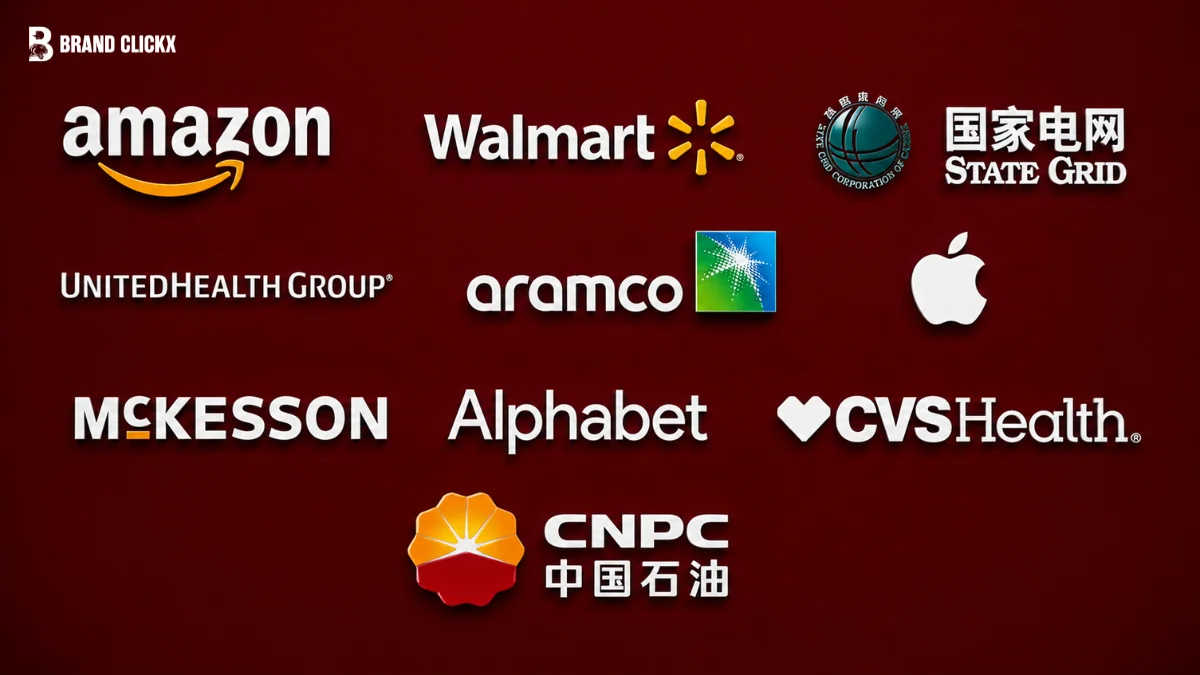
The world’s biggest companies in 2026 span retail, technology, energy, healthcare, utilities and finance. But “biggest” can mean different things, including revenue, market capitalization, profit or assets.
For this ranking, annual revenue is the primary measure, based on the 2026 Fortune Global 500, which uses fiscal-year 2025 results. The 500 companies generated $43.1 trillion in revenue, employed 70.2 million people, and earned $3.39 trillion in profit. Amazon ranked No. 1, ending Walmart’s 12-year reign at the top.
What Does “World’s Biggest Company” Actually Mean?
Before comparing companies, it is important to understand the different ways corporate size can be measured.
Biggest by Revenue
Revenue measures the amount of money a company generates from its operations.
This is the metric used by the Fortune Global 500.
It is particularly useful when comparing companies across industries because it provides a common measurement of business scale.
Biggest by Market Capitalization
Market capitalization measures the stock-market value of a publicly traded company.
It is calculated by multiplying the company’s share price by its outstanding shares.
Market value can change every trading day.
That means the company with the highest market capitalization can change without its annual revenue changing at all. It is also different again from brand value, which is why the world’s most valuable brands do not line up neatly with the revenue rankings below.
Biggest by Profit
Profit measures how much money remains after expenses.
A company with lower revenue can therefore be more profitable than a company ranked above it by sales.
Biggest by Assets
Assets measure the resources a company owns or controls.
This measurement is particularly important for banks and financial institutions.
Why Revenue Is Our Main Ranking Metric
This article uses revenue because the question is about the world’s biggest companies, and the Fortune Global 500 provides a standardized worldwide ranking specifically based on revenue.
Fortune describes the Global 500 as its annual ranking of the world’s 500 largest companies by revenue.
This prevents the article from mixing:
- Revenue
- Market capitalization
- Profit
- Assets
- Employee count
into one artificial ranking.
Quick Comparison: World’s Biggest Companies in 2026
| Rank | Company | Country | Revenue | Industry | Why It Stands Out |
|---|---|---|---|---|---|
| 1 | Amazon | U.S. | $716.9B | Technology & Retail | Massive e-commerce, cloud and advertising ecosystem |
| 2 | Walmart | U.S. | $713.2B | Retail | Extraordinary global retail scale |
| 3 | State Grid | China | $555.4B | Utilities | One of the world’s largest electricity networks |
| 4 | UnitedHealth Group | U.S. | $447.6B | Healthcare | Insurance and healthcare-services scale |
| 5 | Saudi Aramco | Saudi Arabia | $445.5B | Energy | Global oil and gas powerhouse |
| 6 | Apple | U.S. | $416.2B | Technology | Hardware, software and services ecosystem |
| 7 | McKesson | U.S. | $403.4B | Healthcare Distribution | Massive pharmaceutical distribution network |
| 8 | Alphabet | U.S. | $402.8B | Technology | Search, advertising, cloud and AI |
| 9 | CVS Health | U.S. | $402.1B | Healthcare | Pharmacy, insurance and healthcare services |
| 10 | China National Petroleum | China | $401.9B | Energy | Huge integrated energy business |
1. Amazon
Revenue: $716.9 Billion Industry: Technology, E-Commerce and Cloud Computing
Amazon is the world’s biggest company by revenue in the 2026 Fortune Global 500.
It generated approximately $716.9 billion in revenue, putting it narrowly ahead of Walmart’s $713.2 billion.
The achievement is especially significant because Amazon is no longer simply an online retailer.
It has developed into a diversified technology and commerce company with major businesses in retail, cloud computing, advertising, logistics, subscriptions and artificial intelligence. Its segment-level results are published on Amazon’s investor relations site.
What Amazon Does
Amazon operates across several major markets:
- Cloud computing
- Digital advertising
- Logistics
- Subscription services
- Streaming
- Consumer electronics
- Artificial intelligence
- Enterprise technology
Amazon’s Biggest Business Engines
E-Commerce
Amazon’s online marketplace remains one of the company’s most recognizable businesses.
Its enormous product selection and delivery network allow it to serve customers at global scale. It is also where the company is testing the next phase of online retail, from AI shopping assistants like Rufus to the broader shift toward agentic commerce.
Amazon Web Services
AWS is one of the world’s largest cloud-computing businesses.
It provides computing, storage, databases, artificial intelligence and other infrastructure services to companies and organizations, competing with both hyperscale rivals and a long tail of smaller cloud computing providers.
Advertising
Amazon has also built a significant advertising business.
Its access to shopping data gives advertisers an opportunity to reach consumers close to the point of purchase, which is exactly why rivals are racing to build competing retail media networks.
Logistics
Amazon has developed an extensive fulfillment and delivery infrastructure.
This allows the company to control more of the customer journey rather than relying entirely on outside logistics providers.
Strengths
- Enormous global scale
- Diversified revenue sources
- Powerful cloud business
- Massive logistics network
- Strong consumer ecosystem
- Major position in AI infrastructure and services
Challenges
- High capital requirements
- Heavy operating costs
- Regulatory scrutiny
- Intense competition
- Relatively lower margins in parts of retail
Why Choose Amazon as the No. 1 Company?
Amazon is the strongest example of a company that has expanded from a single core business into a broad corporate ecosystem.
Its combination of retail, cloud computing, advertising and logistics gives it multiple sources of growth.
2. Walmart
Revenue: $713.2 Billion Industry: Retail
Walmart ranks No. 2 in the 2026 Global 500 with approximately $713.2 billion in revenue, a figure confirmed by the retailer’s own fiscal 2026 financial results.
The company lost the top position to Amazon, but the difference is remarkably small.
What Walmart Does
Walmart operates through:
- Supercenters
- Grocery stores
- Discount stores
- E-commerce
- Delivery
- Membership services
- Digital advertising
- Wholesale operations
Why Walmart Generates So Much Revenue
Walmart’s business model is built around enormous sales volume.
Its stores sell groceries, household products, electronics, clothing, health products and many other everyday items. The company’s 2026 annual report sets out how that volume is spread across its store base and digital channels.
The Grocery Advantage
Grocery is particularly important because customers purchase food frequently.
That creates regular traffic and gives Walmart opportunities to sell other products during the same shopping trip.
Walmart’s Digital Strategy
Walmart has expanded beyond traditional physical retail.
Its stores can also support online fulfillment, pickup and delivery.
This creates a hybrid model:
Physical stores + e-commerce + logistics + grocery
Strengths
- Massive store network
- Strong grocery position
- Global purchasing power
- Large customer base
- Growing digital ecosystem
Challenges
- Extremely competitive retail industry
- Low-margin business model
- Significant labor requirements
- Competition from Amazon and other retailers
Why Choose Walmart?
Walmart remains one of the world’s most powerful companies because few businesses can match its combination of retail scale, grocery volume and supply-chain reach.
3. State Grid

Revenue: $555.4 Billion Industry: Electricity and Utilities
State Grid ranks No. 3 globally with approximately $555.4 billion in revenue.
It is one of the clearest examples of why the world’s largest companies are not necessarily consumer-facing brands.
What State Grid Does
State Grid operates electricity transmission and distribution infrastructure in China.
Its activities include:
- Electricity transmission
- Power distribution
- Grid infrastructure
- Energy technology
- Renewable-energy integration
Why State Grid Is So Large
Electricity is essential infrastructure.
China’s enormous population and industrial economy create a huge market for electricity services.
The Energy-Transition Challenge
Electricity networks are becoming increasingly important as economies add:
- Solar power
- Wind power
- Electric vehicles
- Battery storage
- Data centers
- Electrified industry
The International Energy Agency’s Electricity 2026 report forecasts global power demand rising at an average of 3.6% a year through 2030, with grids increasingly acting as the bottleneck. That pressure is already visible in markets where AI data-center growth is running into power limits.
Strengths
- Critical infrastructure
- Massive operating scale
- Essential service
- Strong position in China’s electricity system
Challenges
- Heavy infrastructure requirements
- Regulation
- Large capital expenditure
- Exposure to changing energy policies
Why Avoid Comparing It Directly With Amazon?
State Grid operates in a regulated infrastructure environment, while Amazon competes in consumer and technology markets.
Why We Recommend It
State Grid shows that infrastructure companies can reach extraordinary levels of revenue even without being consumer technology brands.
4. UnitedHealth Group

Revenue: $447.6 Billion Industry: Healthcare
UnitedHealth Group ranks fourth globally with approximately $447.6 billion in revenue, matching the total in its own full-year 2025 results.
Its position highlights the enormous economic scale of healthcare.
What UnitedHealth Does
The company operates across:
- Health insurance
- Healthcare services
- Pharmacy services
- Healthcare technology
- Data and analytics
UnitedHealthcare
UnitedHealthcare focuses primarily on health benefits and insurance.
Optum
Optum operates across healthcare services, pharmacy, technology and related areas.
Why UnitedHealth Is So Large
Healthcare spending involves insurance, medical services, pharmaceutical products, pharmacies and technology.
UnitedHealth participates in multiple parts of that ecosystem, a breadth that also shapes how healthcare brands market themselves.
Strengths
- Diversified healthcare operations
- Massive customer base
- Multiple revenue sources
- Strong healthcare infrastructure
Challenges
- Regulatory exposure
- Healthcare-cost pressures
- Complex operating environment
- Public scrutiny of healthcare businesses
Why Avoid Treating Revenue as Profit?
Healthcare companies can generate huge revenue while operating under complicated reimbursement and cost structures.
Why We Recommend It
UnitedHealth’s position demonstrates the enormous scale of the global healthcare economy.
5. Saudi Aramco

Revenue: $445.5 Billion Industry: Energy
Saudi Aramco ranks fifth with approximately $445.5 billion in revenue.
It is one of the most important companies in the global oil and gas industry, and publishes detailed results through its investor relations pages.
What Saudi Aramco Does
Its operations include:
- Crude oil production
- Natural gas
- Refining
- Petrochemicals
- Energy trading
- Industrial activities
Why Aramco Is So Large
Saudi Arabia has enormous hydrocarbon resources, while global economies continue to consume large amounts of oil and gas.
The Commodity-Price Factor
Energy companies are heavily influenced by commodity prices.
Higher oil prices can significantly affect revenue and profits.
Lower prices can have the opposite effect, as recent oil-shock and tariff pressures on the global economy have shown.
Strengths
- Huge production scale
- Major global energy position
- Integrated operations
- Significant resource base
Challenges
- Oil-price volatility
- Energy-transition pressures
- Geopolitical risks
- Long-term demand uncertainty
Why Avoid Comparing It Directly With Apple?
Apple’s revenue comes primarily from technology products and services, while Aramco’s business is deeply influenced by commodity markets.
Why We Recommend It
Saudi Aramco remains one of the clearest examples of how natural resources can support extraordinary corporate scale.
6. Apple
Revenue: $416.2 Billion Industry: Technology and Consumer Electronics
Apple ranks sixth globally with approximately $416.2 billion in revenue. The company confirmed a record fiscal year at roughly $416 billion in its fourth-quarter results announcement.
Unlike energy and retail giants, Apple’s scale comes primarily from a tightly integrated technology ecosystem.
Apple’s Major Businesses
- iPhone
- Mac
- iPad
- Apple Watch
- AirPods
- App Store
- iCloud
- Digital services
- Payments
- Other services
The iPhone Ecosystem
The iPhone remains central to Apple’s consumer ecosystem.
It also creates opportunities for Apple to sell accessories and services to existing customers, which is the core argument in the long-running Apple versus Samsung ecosystem comparison. Each hardware cycle, including the iPhone 18 launch timeline, feeds that installed base.
Apple’s Services Business
Services provide Apple with recurring revenue opportunities through its installed base of users, and the company continues to push further into AI-powered Siri and iCloud+ upgrades. Full financial detail is available through Apple’s investor relations site.
Strengths
- Extremely strong global brand
- Integrated hardware and software
- Large installed customer base
- Services ecosystem
- Premium positioning
Challenges
- Dependence on consumer spending
- Smartphone competition
- Supply-chain complexity
- Regulatory pressure
- High expectations for continued growth
Why Choose Apple?
Apple is particularly strong when the evaluation includes brand strength, ecosystem integration and customer loyalty.
Why Avoid Calling It the World’s Biggest Company Without a Metric?
Apple ranks sixth by revenue in the 2026 Global 500.
Calling it simply “the biggest company” would therefore be inaccurate without specifying the measurement.
Why We Recommend It
Apple demonstrates how a consumer technology ecosystem can grow into a business generating more than $400 billion in annual revenue.
7. McKesson
Revenue: $403.4 Billion Industry: Healthcare Distribution
McKesson ranks seventh globally with approximately $403.4 billion in revenue, consistent with its fiscal 2026 full-year results.
It is less familiar to ordinary consumers than Apple or Amazon, but its position demonstrates how enormous business-to-business healthcare companies can become.
What McKesson Does
Its operations include:
- Pharmaceutical distribution
- Medical products
- Specialty pharmaceuticals
- Healthcare services
- Healthcare technology
Why McKesson Is So Large
Healthcare products must move through complex distribution networks before reaching pharmacies, hospitals and other providers.
McKesson operates at an enormous scale within that supply chain.
Strengths
- Huge distribution network
- Essential healthcare role
- Large-scale operations
- Specialized industry expertise
Challenges
- Healthcare regulation
- Distribution costs
- Complex supply chains
- Relatively low public visibility
Why Avoid Judging It by Brand Recognition?
McKesson is primarily a business-to-business healthcare company.
Its enormous revenue does not require it to have the same consumer visibility as Apple.
Why We Recommend It
McKesson proves that behind-the-scenes infrastructure can create one of the world’s largest companies.
8. Alphabet

Revenue: $402.8 Billion Industry: Technology
Alphabet ranks eighth with approximately $402.8 billion in revenue, the first time annual revenue has passed $400 billion according to Alphabet’s investor relations disclosures.
The company is the parent of Google and operates one of the world’s largest digital ecosystems.
Major Alphabet Businesses
- Google Search
- YouTube
- Google Cloud
- Android
- Google Maps
- Google Play
- Advertising
- Artificial intelligence
- Consumer hardware
Search and Advertising
Google’s search engine connects users with information while creating enormous opportunities for digital advertising.
YouTube adds another major platform. Between them, they anchor a duopoly that is best understood alongside Meta’s competing ad business.
Google Cloud
Google Cloud provides computing and infrastructure services to businesses.
Artificial Intelligence
AI has become an increasingly important part of Alphabet’s strategy, affecting search, cloud computing, software and consumer products, from AI Mode in search to the Gemini agent rollout.
Strengths
- Global digital reach
- Search dominance
- YouTube
- Cloud computing
- AI capabilities
- Massive advertising ecosystem
Challenges
- Regulatory scrutiny
- AI competition
- Dependence on advertising
- Rapid technological change
Why Avoid Comparing Alphabet Only on Revenue?
Revenue does not capture the value of Alphabet’s ecosystem, intellectual property, cash generation or market position. It also does not explain shorter-term share moves, such as why Alphabet stock fell after Q2 2026.
Why We Recommend It
Alphabet combines search, advertising, cloud computing and AI into one of the world’s most influential technology platforms.
9. CVS Health

Revenue: $402.1 Billion Industry: Healthcare
CVS Health ranks ninth globally with approximately $402.1 billion in revenue, in line with its fourth-quarter and full-year 2025 results.
Its business spans pharmacies, healthcare services and insurance.
What CVS Health Does
- Retail pharmacies
- Pharmacy benefit management
- Health insurance
- Healthcare services
- Retail healthcare
Why CVS Is So Large
CVS operates across several interconnected parts of the healthcare system.
That allows it to generate revenue from more than one business line.
Strengths
- Large pharmacy network
- Diversified healthcare operations
- Insurance business
- Consumer accessibility
Challenges
- Healthcare regulation
- Competitive pressure
- Complex business structure
- Cost pressures
Why Avoid Comparing CVS With Consumer Technology Companies?
The company’s revenue model and operating environment are completely different from those of Apple or Alphabet.
Why We Recommend It
CVS Health demonstrates how pharmacy, insurance and healthcare services can combine into a company generating more than $400 billion in revenue.
10. China National Petroleum
Revenue: $401.9 Billion Industry: Energy
China National Petroleum ranks No. 10 with approximately $401.9 billion in revenue.
It is one of the world’s largest integrated energy companies, and its company profile describes operations spanning exploration through to marketing and finance.
What CNPC Does
Its operations span:
- Oil exploration
- Oil production
- Natural gas
- Refining
- Petrochemicals
- Energy distribution
Why CNPC Is So Large
China is one of the world’s largest energy-consuming economies.
CNPC operates across a market with enormous industrial and consumer energy requirements.
Strengths
- Huge energy-market exposure
- Integrated operations
- Large domestic market
- Broad energy portfolio
Challenges
- Commodity-price volatility
- Energy-transition risks
- Geopolitical factors
- Capital-intensive operations
Why Choose CNPC?
It provides another example of how energy demand can produce enormous corporate revenue.
Why Avoid Comparing CNPC Directly With Technology Companies?
Energy revenue can fluctuate significantly with commodity prices, as the market showed when oil prices fell after the Strait of Hormuz reopened, while technology revenue is driven by different factors such as product demand, subscriptions and advertising.
Why We Recommend It
CNPC completes the 2026 Global 500 top 10 and highlights China’s enormous role in global energy markets.
What the Top 10 Tells Us About the Global Economy
The most interesting feature of the 2026 ranking is that the world’s biggest companies come from very different industries.
The top 10 include:
- Technology
- Retail
- Utilities
- Healthcare
- Energy
This means corporate scale is not synonymous with technology.
| Industry | Companies in the Top 10 | Key Takeaway |
|---|---|---|
| Technology | Amazon, Apple, Alphabet | Technology companies continue to dominate the global corporate rankings. |
| Energy | Saudi Aramco, China National Petroleum | Energy remains one of the world’s largest industries by corporate scale. |
| Healthcare | UnitedHealth Group, McKesson, CVS Health | Healthcare companies demonstrate the enormous size of the global healthcare market. |
| Utilities | State Grid | State Grid highlights the massive scale of global electricity infrastructure. |
Which Industries Dominate the Global 500?
Looking beyond the top 10 provides an even more interesting picture.
- Financial companies are the largest sector by number of companies, with 123 companies.
- Energy follows with 77 companies.
- Technology has 38 companies, followed by motor vehicles and parts with 35 and healthcare with 31.
| Sector | Number of Global 500 Companies |
|---|---|
| Financials | 123 |
| Energy | 77 |
| Technology | 38 |
| Motor Vehicles & Parts | 35 |
| Health Care | 31 |
| Materials | 25 |
| Wholesalers | 23 |
| Transportation | 21 |
| Retailing | 19 |
| Food & Drug Stores | 17 |
| Industrials | 17 |
This shows that financial services and energy remain enormously important even in an economy increasingly shaped by artificial intelligence and digital technology.
Which Countries Have the Biggest Companies?
The Global 500 also provides a useful picture of where corporate power is concentrated.
United States
The United States has 141 companies on the 2026 Global 500.
Together, those companies generated approximately $15.5 trillion in revenue.
American companies dominate the top 10, with Amazon, Walmart, UnitedHealth Group, Apple, McKesson, Alphabet and CVS Health all headquartered in the U.S. They are also the businesses behind a large share of the world’s biggest personal fortunes.
Greater China
Greater China has 122 companies on the Global 500.
Fortune’s grouping includes mainland China, Hong Kong, Macau and Taiwan.
State Grid and China National Petroleum are two of the most prominent companies near the top of the global ranking.
Europe
Europe also maintains a significant presence across sectors such as:
- Automotive
- Banking
- Energy
- Pharmaceuticals
- Industrial manufacturing
- Consumer goods
The Global 500’s geographic data shows that the world’s largest corporations remain concentrated across North America, Europe and Asia-Pacific.
The Biggest Companies Are Becoming More Powerful
The 2026 Global 500 shows increasing concentration at the top.
Fortune reports that the top 50 companies account for about one-third of Global 500 revenue and 39% of profits.
That matters because scale itself can become a competitive advantage.
Large companies can often invest more heavily in:
- Artificial intelligence
- Data centers
- Research and development
- Global logistics
- Manufacturing
- Advertising
- Infrastructure
- Acquisitions
This creates a cycle in which successful companies can reinvest their resources to become even more competitive, though the scale of the current AI infrastructure buildout has also raised questions about how much of that spending will pay off.
Technology Companies Are Changing the Ranking
The Global 500 is also showing the growing influence of artificial intelligence and semiconductor demand.
Fortune reports that Nvidia climbed 38 positions to No. 28, while Taiwan Semiconductor Manufacturing Company climbed 44 positions to No. 82.
Technology’s influence is also visible in the sector’s financial performance.
The 38 technology companies on the Global 500 generated approximately $4 trillion in revenue and $835 billion in profit, with technology-sector profits rising 36%.
That suggests the AI boom is not only creating new products.
It is also increasing demand for:
- Semiconductors
- Cloud infrastructure
- Data centers
- Networking equipment
- Computing power
- AI software
The same demand is reshaping the AI chip market, driving the Nvidia versus AMD GPU race, and lifting a new cohort of fast-growing AI companies toward the ranking’s lower rungs.
Biggest by Revenue vs. Most Valuable by Market Cap
This is one of the most important distinctions in any company ranking.
Amazon is No. 1 by revenue.
That does not automatically mean it is No. 1 by market capitalization.
Market capitalization changes constantly because stock prices move every trading day, which is one reason the leadership of the major index-defining tech stocks keeps shifting.
Fortune’s separate 2026 U.S. Fortune 500 analysis reported that Nvidia reached approximately $4.2 trillion in market value, surpassing Apple and becoming the most valuable company on that list.
Therefore:
Revenue = business scale
Market capitalization = investor valuation
They should never be treated as interchangeable measurements.
Biggest Does Not Mean Most Profitable
Another common mistake is assuming that the company with the highest revenue must also have the highest profit.
That is not necessarily true.
A retailer may generate enormous sales but operate on relatively thin margins.
A software or semiconductor company may generate much less revenue but retain a significantly larger percentage as profit. The full Fortune 500 ranking makes that gap easy to see when revenue and profit columns are compared side by side.
For that reason, a complete company analysis should consider:
| Metric | What It Tells You |
|---|---|
| Revenue | Business scale |
| Profit | Earnings |
| Profit Margin | Efficiency |
| Market Cap | Investor valuation |
| Assets | Balance-sheet size |
| Employees | Workforce scale |
| Revenue Growth | Expansion |
| Free Cash Flow | Cash generation |
What Makes a Company Truly “Big”?
Revenue is only the starting point.
A truly powerful global company typically combines several characteristics.
Massive Revenue
Large sales provide financial resources for expansion.
Global Reach
International operations allow companies to serve multiple markets.
Strong Infrastructure
Large distribution networks, factories, data centers or physical assets can create barriers to entry.
Technology
Modern companies increasingly rely on software, AI, automation and data.
Capital
The ability to invest billions of dollars can create advantages that smaller competitors cannot easily replicate.
Brand or Market Position
Strong brands and dominant market positions can make it difficult for competitors to take customers, which is why brand marketing remains a core part of how the largest companies defend their share.
What Should You Look for When Comparing Giant Companies?
If you’re comparing companies for investment, research or business analysis, don’t stop at revenue.
Check Revenue Growth
Is the company getting larger?
Check Profit Margins
Is the company turning sales into profit efficiently?
Check Free Cash Flow
Does the business generate cash after capital expenditures?
Check Debt
High revenue does not automatically mean a strong balance sheet.
Check Market Position
Does the company have a defensible competitive advantage? A structured SWOT analysis is a simple way to frame that question.
Check Future Growth
A huge company can still be a poor investment if its growth prospects are weak.
Frequently Asked Questions
What is the biggest company in the world in 2026?
Amazon is the world’s biggest company by revenue in the 2026 Fortune Global 500, with approximately $716.9 billion in revenue.
Is Amazon bigger than Walmart?
By revenue, yes. Amazon generated approximately $716.9 billion, compared with Walmart’s $713.2 billion.
Which company is No. 3 in the Global 500?
State Grid ranks third with approximately $555.4 billion in revenue.
Which is the biggest technology company by revenue in the top 10?
Amazon ranks highest among the technology-related companies in the top 10, although its business is also heavily involved in retail.
Apple ranks sixth with $416.2 billion, while Alphabet ranks eighth with $402.8 billion.
Which industry has the most companies in the Global 500?
Financials, with 123 companies, is the largest sector by company count. Energy follows with 77 and technology with 38.
How many companies are in the Fortune Global 500?
There are 500 companies.
Together they generated $43.1 trillion in revenue in 2025.
How many U.S. companies are in the Global 500?
The United States has 141 companies on the 2026 Global 500.
How many Greater China companies are on the list?
Greater China has 122 companies in the 2026 Global 500.
Is the biggest company also the most valuable?
No.
The biggest by revenue and the most valuable by market capitalization are different measurements.
Final Verdict
Amazon Leads the 2026 Revenue Ranking
The world’s biggest companies in 2026 reflect the diversity of the global economy. Amazon ranks No. 1 by revenue at $716.9 billion, narrowly ahead of Walmart at $713.2 billion.
Infrastructure Remains Enormous
State Grid highlights the extraordinary scale of global electricity infrastructure and the importance of utilities to the world economy.
Healthcare Is a Global Powerhouse
UnitedHealth Group, McKesson and CVS Health demonstrate the enormous financial scale of the healthcare industry.
Energy Still Dominates Global Business
Saudi Aramco and China National Petroleum show that energy remains one of the world’s most economically important industries.
Technology Continues to Reshape the Rankings
Apple and Alphabet demonstrate the scale of modern technology platforms, while Nvidia and TSMC highlight the growing importance of artificial intelligence and semiconductor demand. Those same forces are also reshaping employment, as the wave of AI-driven layoffs and role changes in 2026 shows.
What Does “Biggest Company” Really Mean?
There is no single definition of the “biggest company.” The leader changes depending on the measurement.
- Revenue: Amazon is No. 1 in 2026.
- Market capitalization: A different company may lead.
- Profit: The ranking changes again.
- Assets or growth: Another group of companies can come out on top.
For this article, “world’s biggest companies” means the companies ranked by annual revenue in the 2026 Fortune Global 500. That makes Amazon the world’s largest company by revenue in 2026.