GOOGLE AI OVERVIEW
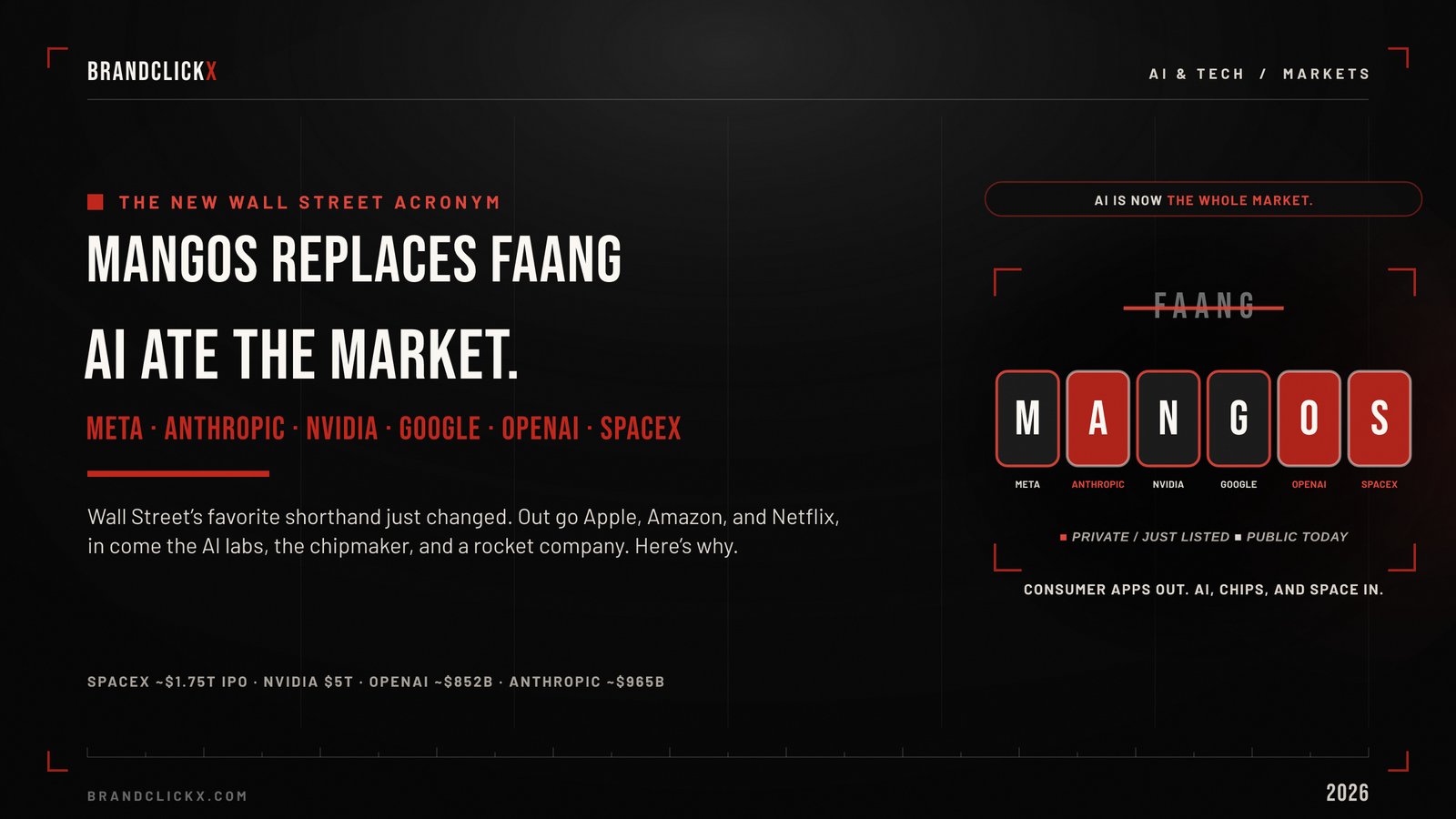
MANGOS stands for Meta, Anthropic, Nvidia, Google, OpenAI, and SpaceX, a new Wall Street acronym replacing FAANG. It reflects a shift from consumer-platform giants to AI and space leaders. Three members trade publicly, while Anthropic and OpenAI remain private and SpaceX listed in June 2026. The grouping signals that investors now treat artificial intelligence as the market’s defining theme.
On Friday, June 12, 2026, SpaceX walked onto the public market and rewrote the record books. It priced at a roughly $1.75 trillion valuation, then watched its shares surge past $2 trillion, making it the largest IPO in history and turning Elon Musk into the world’s first trillionaire.
That single event explains why MANGOS stocks are suddenly the only acronym Wall Street wants to talk about.
For a decade, FAANG was the shorthand for tech dominance. Facebook, Apple, Amazon, Netflix, and Google were the untouchables. They are not the story anymore.
Why it matters: acronyms are not trivia. A good one captures an entire economic era in a single word. FAANG said consumer internet is eating the world. MANGOS says something different and far more consequential. It says AI is now the market.
So here is the full breakdown of what MANGOS means, why FAANG fell out of favor, which names you can actually buy, and what this shift signals for brands, marketers, and anyone watching where power is moving.
What MANGOS Actually Stands For
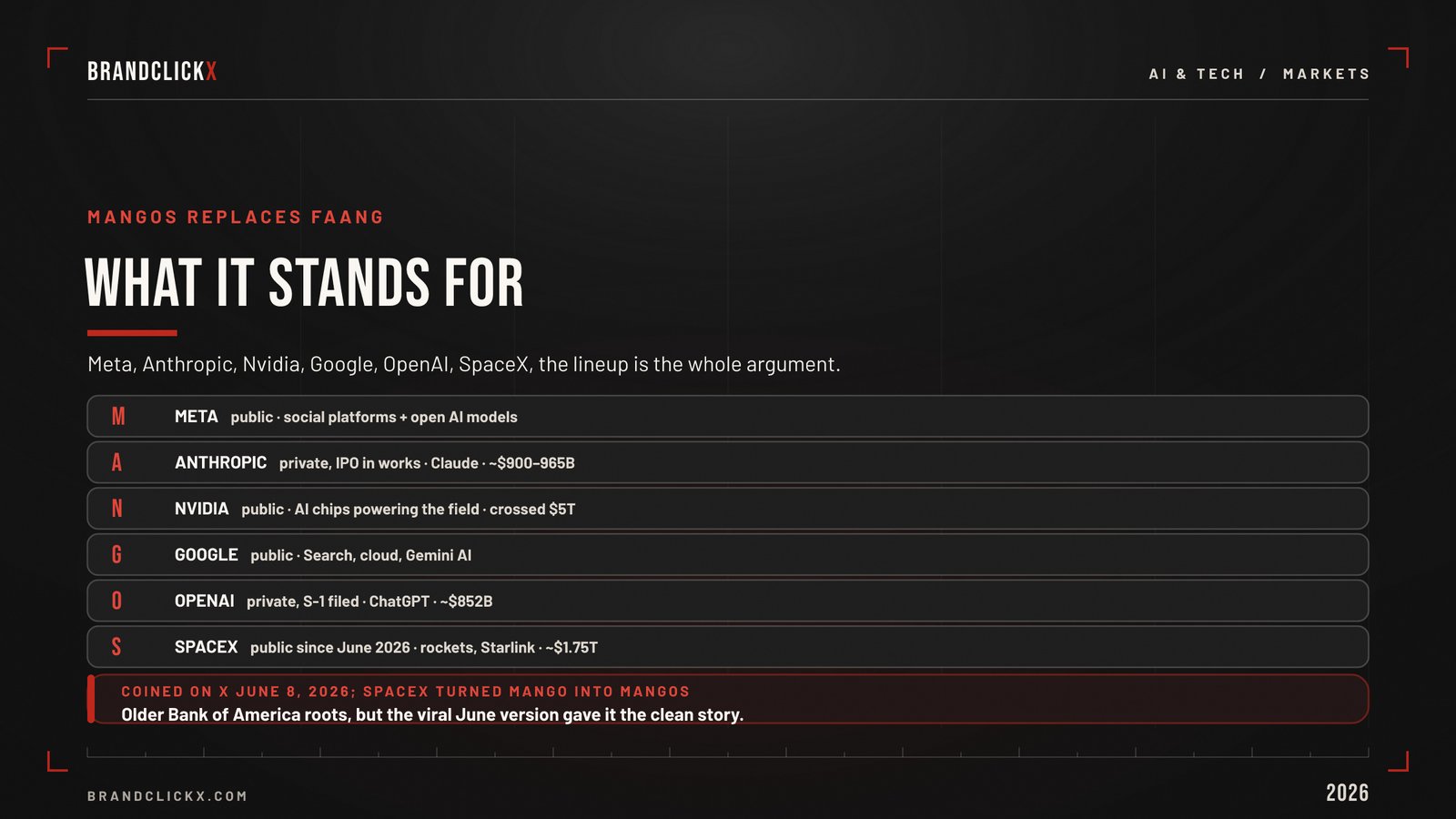
Let us start with the letters, because the lineup is the whole argument. MANGOS stands for Meta, Anthropic, Nvidia, Google, OpenAI, and SpaceX.
The term caught fire on June 8, 2026, when software engineer Krishna B. posted a graphic on X declaring it was not FAANG anymore, it was MANGO. The post drew millions of views within a day. SpaceX got added soon after, turning MANGO into MANGOS just as the rocket company headed for its listing.
The acronym is not entirely new, though. Bank of America analyst Vivek Arya first used MANGOS for a basket of semiconductor names, and analyst Stirling Larkin repurposed it in 2025 for an AI-era group. The June version simply gave it a clean, viral story.
Market Observation: there is even a competing label. Some investors push TANGOS, which swaps in Tesla. The debate itself is the signal. When the market argues this hard about a nickname, it is really arguing about which companies own the future.
Notice what the new acronym values. Three letters belong to AI model makers, one to the chipmaker powering them, one to the ad-and-AI giant, and one to a space and satellite empire. Consumer apps did not make the cut.
Why FAANG Died
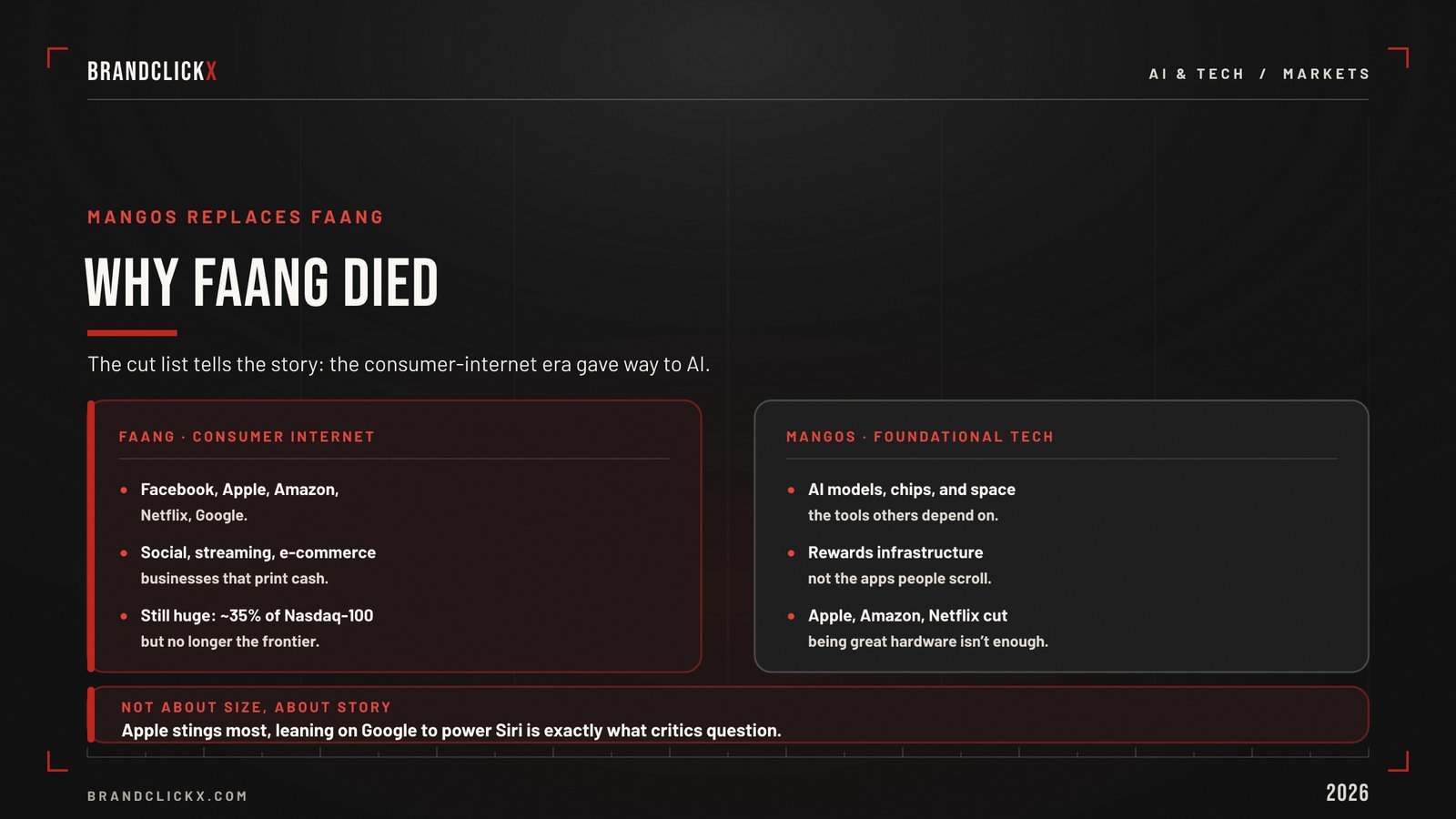
The cut list tells you everything. Apple, Amazon, and Netflix are gone. The names that defined the last decade of tech are out.
FAANG was coined by market technician Bob Lang and popularized by CNBC’s Jim Cramer back in 2013. Those five companies still carry enormous weight, accounting for roughly 35% of the Nasdaq 100 and about 19% of the S&P 500. So this is not about size. It is about story.
FAANG thrived on consumer platforms. Social feeds, streaming subscriptions, and e-commerce checkouts. Those businesses print cash, but they no longer feel like the frontier.
The Bigger Shift: MANGOS is built on foundational technology instead of consumer platforms. Artificial intelligence, advanced chips, and space infrastructure. The market is rewarding companies that build the tools others depend on, not the apps people scroll.
That is why Apple stings the most as an omission. The company is still one of the most valuable on earth. But after leaning on a Google partnership to power its rebuilt Siri, its standing as an AI leader is exactly what critics question. Being a brilliant hardware company is no longer enough to make the list.
The Half of MANGOS You Cannot Buy Yet
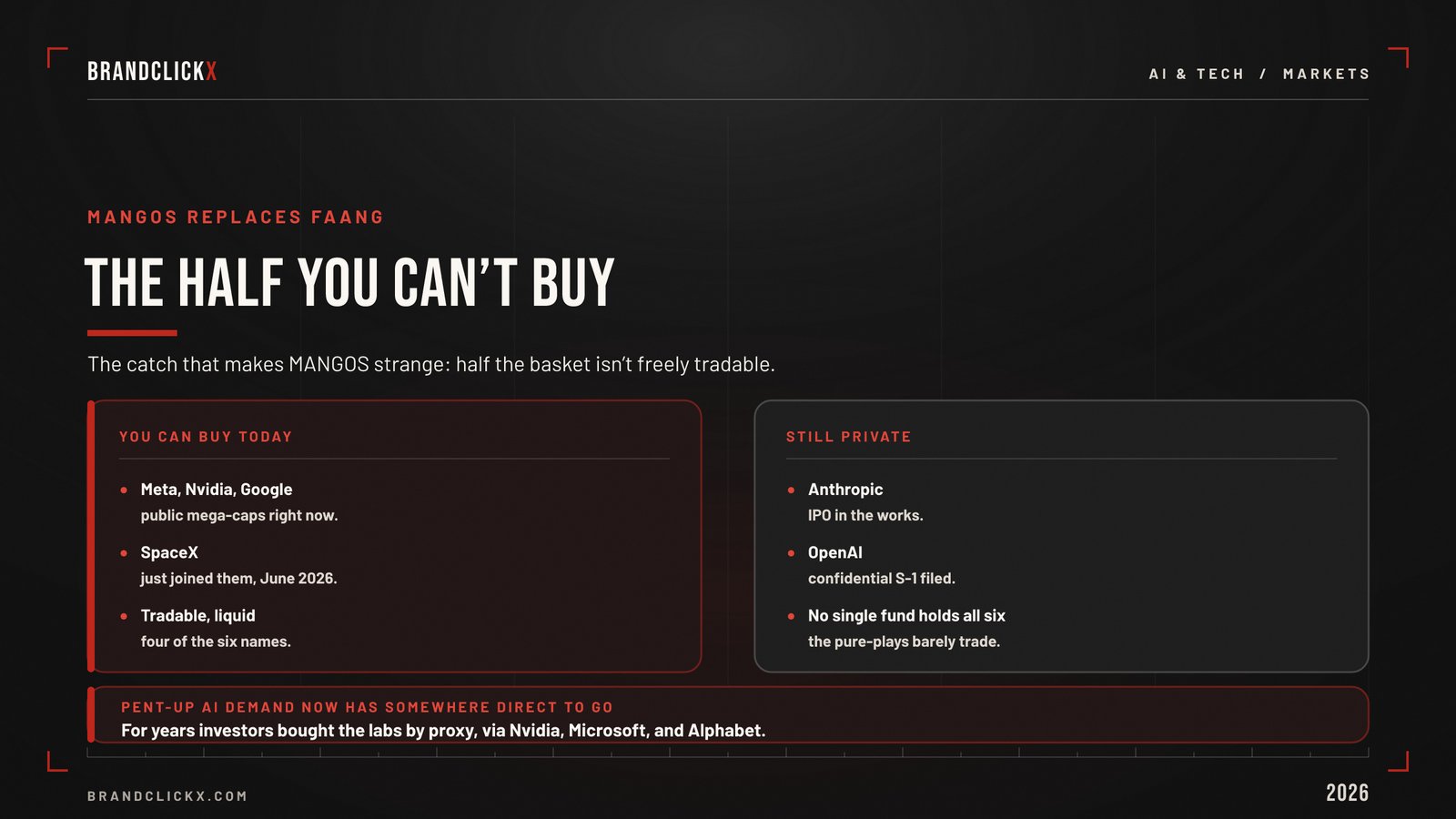
Here is the catch that makes MANGOS strange as an investment thesis. Half the basket is not freely tradable.
You can buy Meta, Nvidia, and Google today. SpaceX just joined them on the public market. But Anthropic and OpenAI remain private, with IPOs still in the works. No single fund holds all six names, because three of them barely trade or do not trade at all.
That gap has frustrated investors for years. The hottest pure-play AI companies were the ones ordinary buyers could not own. They had to invest by proxy instead.
Strategic Breakdown: institutional money has spent years getting AI exposure indirectly. Buying Nvidia for chips, Microsoft for its OpenAI stake, and Alphabet for its AI positions. The moment the pure-play labs go public, that pent-up demand has somewhere direct to go.
MANGOS Members at a Glance
| Company | Status | Reported valuation | Core role |
| Meta | Public | Mega-cap | Social platforms and open AI models |
| Anthropic | Private, IPO in works | Around $900B to $965B | Claude AI models |
| Nvidia | Public | Crossed $5 trillion | AI chips powering the entire field |
| Google (Alphabet) | Public | Mega-cap | Search, cloud, Gemini AI |
| OpenAI | Private, S-1 filed | About $852B | ChatGPT and frontier models |
| SpaceX | Public as of June 2026 | About $1.75T at listing | Rockets and Starlink |
The table makes the imbalance clear. The acronym mixes seasoned public giants with newly minted and still-private AI companies. That is unusual, and it is the source of both the excitement and the risk.
The $2.9 Trillion Stress Test
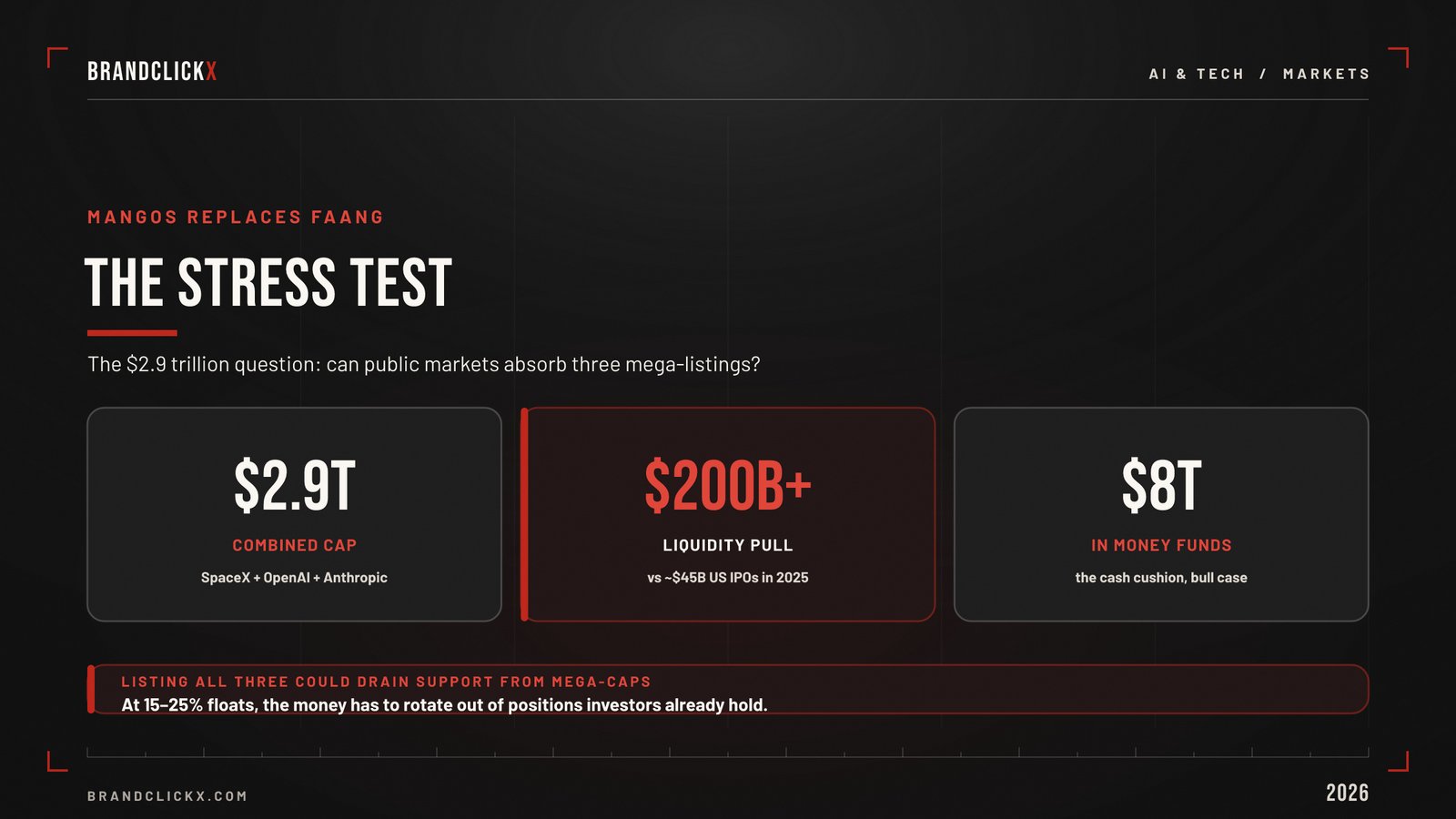
Now the part that should give every investor pause. The three IPO names alone represent staggering scale.
Analysts have pegged the combined market cap of SpaceX, OpenAI, and Anthropic near $2.9 trillion. At typical IPO float levels of 15 to 25 percent, listing all three would demand hundreds of billions from public markets in a short window.
For context, the entire US IPO market raised only about $45 billion across 2025. These three together could pull more than $200 billion of liquidity from public markets, even at modest floats.
Industry Impact: money rotating into these new listings has to come from somewhere. The likely source is existing positions, including the very mega-cap tech stocks investors already hold. So even people who never touch an IPO could feel the pull as portfolios rebalance.
There is a bull case for the liquidity, to be fair. Roughly $8 trillion sits in US money market funds, and SpaceX’s raise is a small fraction of that. The cash exists. The question is whether it flows in smoothly or yanks support from elsewhere.
The Contradiction at the Center
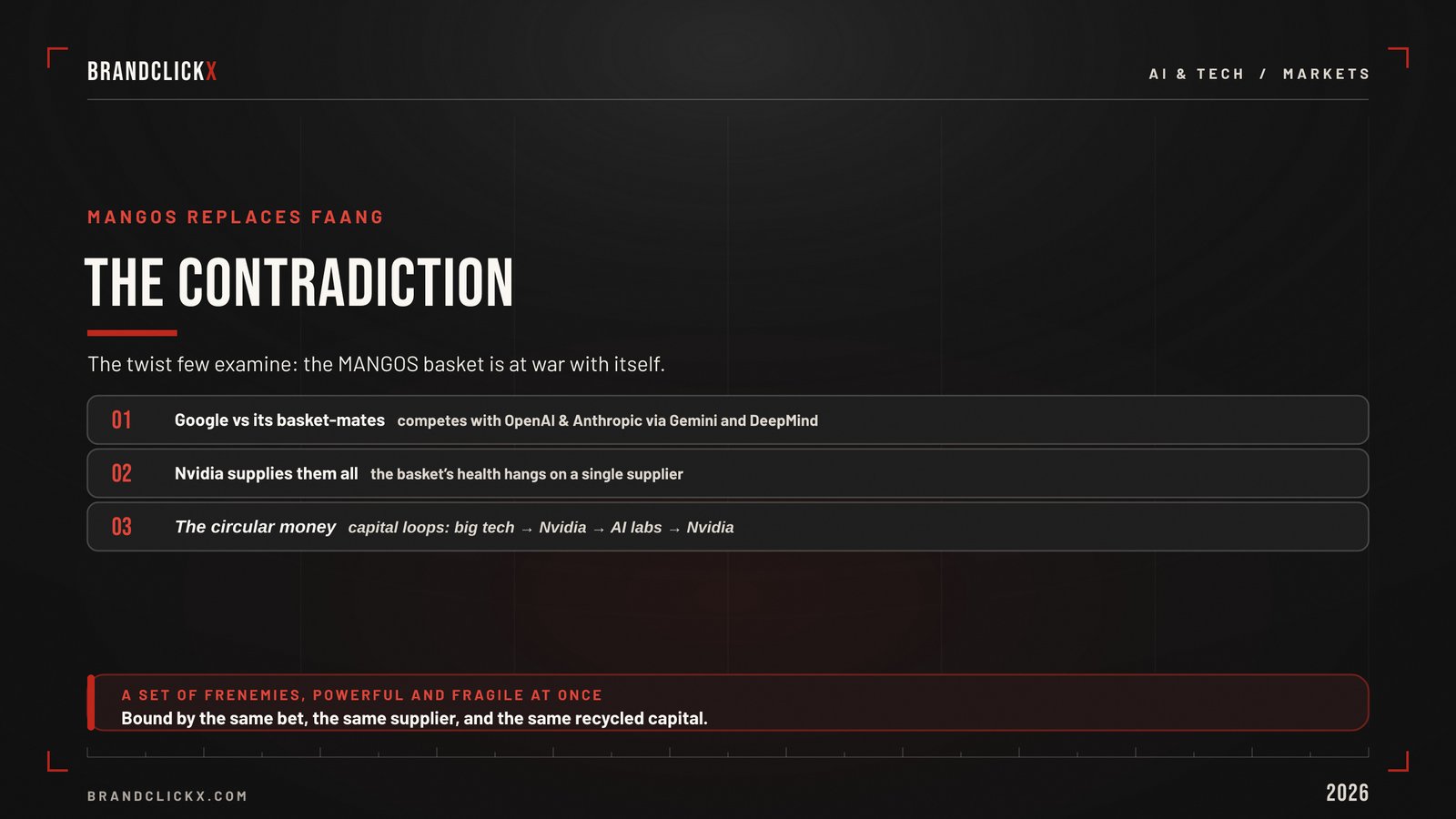
Here is the twist almost nobody is examining, and it is what separates real analysis from a viral graphic. The MANGOS basket is at war with itself.
Google sits in the group. Google also competes directly with OpenAI and Anthropic, two of its own basket-mates, through Gemini and DeepMind. The most strategically powerful name on the list is a structural threat to two others.
Nvidia adds another layer. It supplies the chips that every other MANGOS member depends on. Its fortunes rise when the others spend, which means the basket’s health is tangled up in a single supplier.
Enterprise Perspective: then there is the circular money problem. As one opinion piece put it, the AI giants increasingly invest in one another. Big tech pours money into Nvidia, Nvidia pumps cash into the AI labs, and those labs spend it back on Nvidia chips. Critics call it a fiscal loop, and it inflates headline growth across the whole group.
So MANGOS is not a tidy team. It is a set of frenemies bound together by the same bet, the same supplier, and the same flow of recycled capital. That makes it powerful and fragile at once.
The Valuation Question Nobody Can Dodge
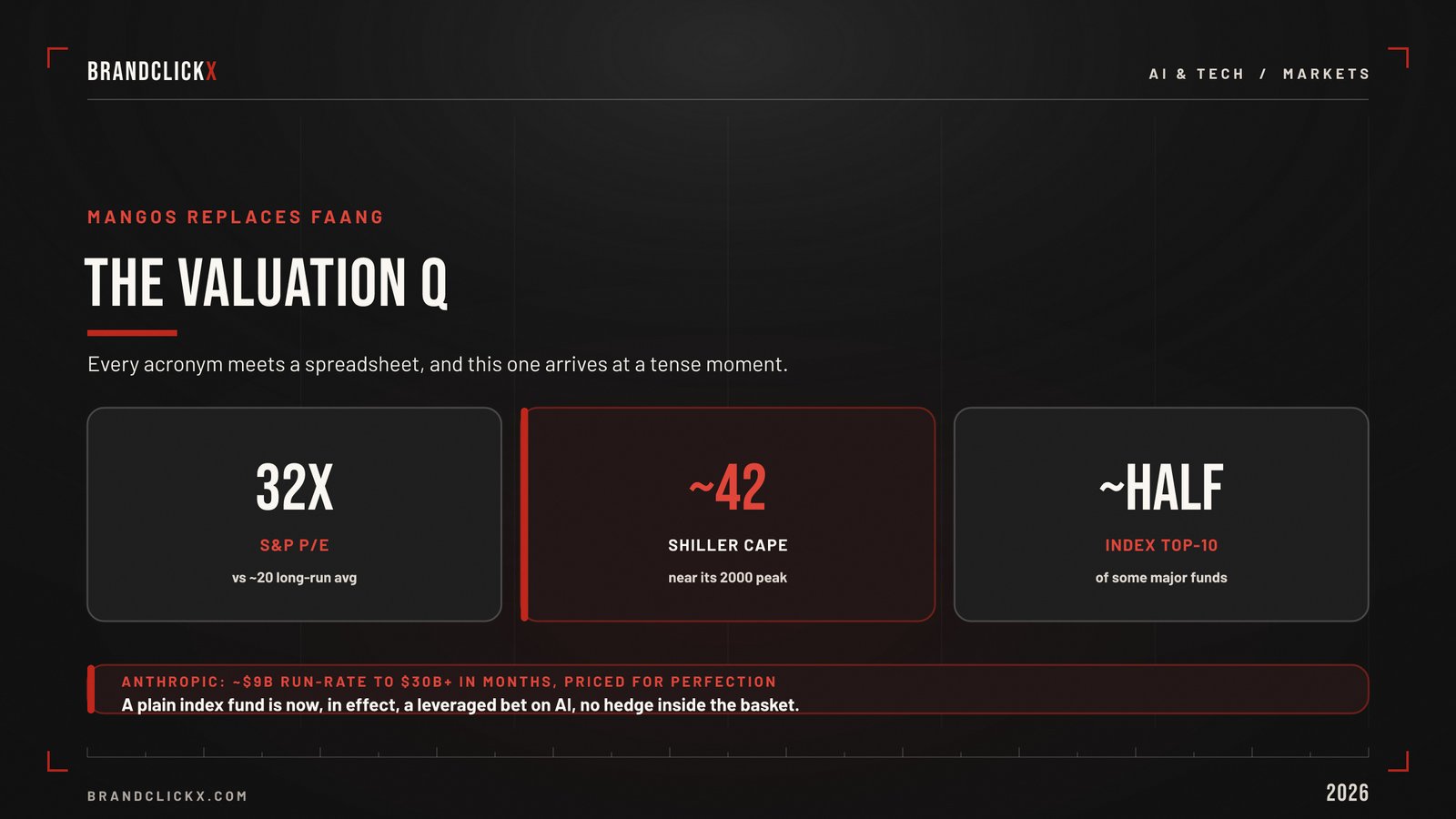
Every acronym eventually meets a spreadsheet. This one arrives at a tense moment for valuations.
The S&P 500 has traded near a price-to-earnings ratio of 32 times, well above its long-run average closer to 20. The Shiller CAPE ratio has sat near 42, just shy of its 2000 dot-com peak. Concentration is extreme, with the top 10 stocks making up close to half of some major index funds.
That means a plain index fund is now, in effect, a leveraged bet on AI. The MANGOS names are not a niche. They are the market’s center of gravity.
Expert Insight: the entire thesis rides on one assumption. If AI keeps paying off, these names lead and the bet looks brilliant. If AI adoption stalls or the revenue fails to justify the spend, the same concentration that powered the gains turns into the channel for the losses. There is no hedge inside the basket, because every member shares the same dependency.
Anthropic’s numbers show both the promise and the heat. Its annualized revenue run rate reportedly expanded from around $9 billion at the end of 2025 to north of $30 billion by April 2026. Growth like that is real. It is also priced for perfection.
Why It Matters for Marketers and Brands
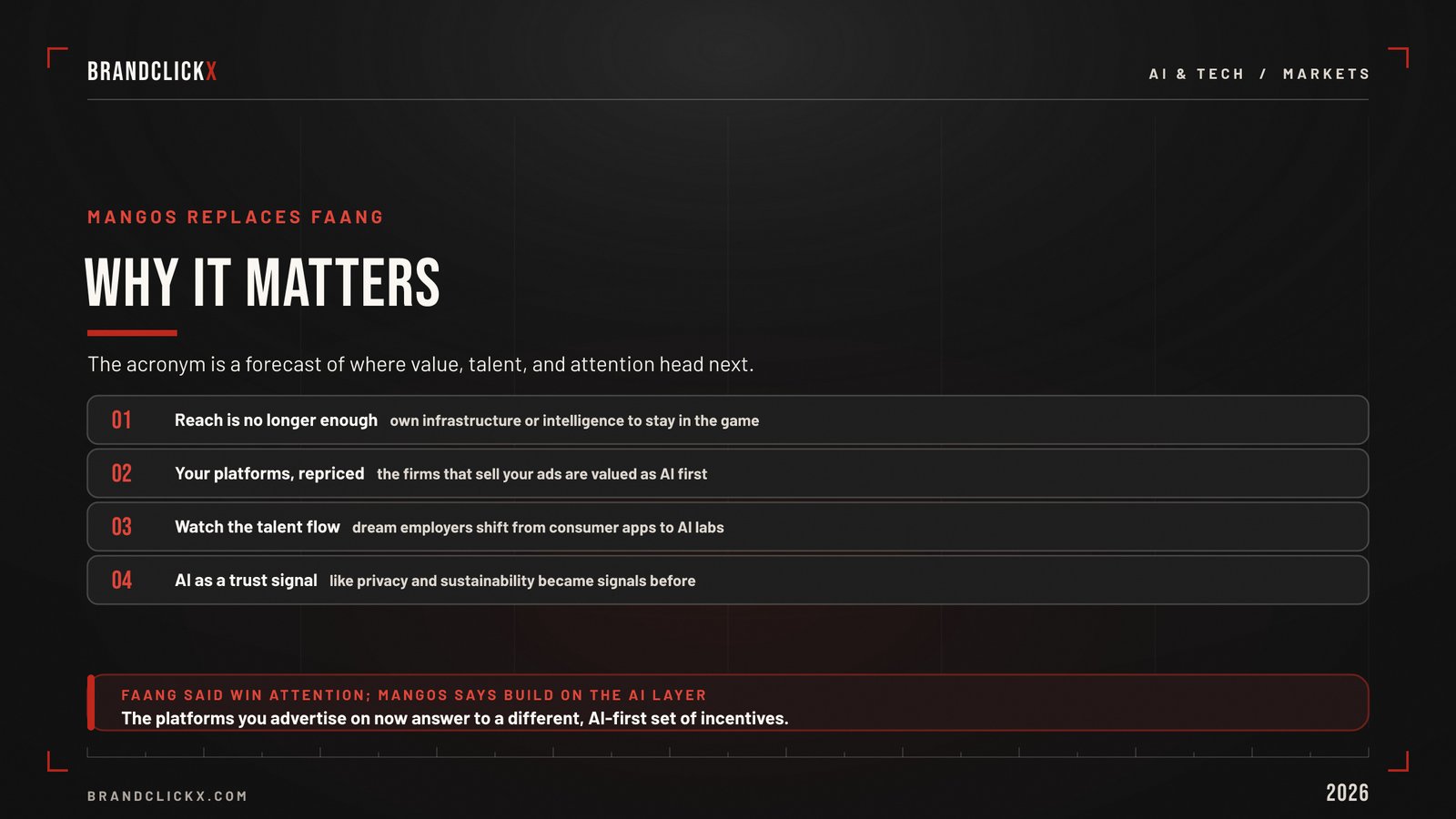
This is where MANGOS stops being a finance story and becomes a strategy map. The acronym is a forecast about where value, talent, and attention are heading.
Look at the survivors. Meta and Google made the cut not because of ads alone, but because they pivoted hard into AI. The lesson for every platform business is blunt. Consumer reach is no longer enough. You have to own infrastructure or intelligence to stay in the conversation.
For marketers, the platforms you advertise on and build on are being repriced around AI. The same companies that sell your ad inventory are now valued as AI firms first. That changes their incentives, their roadmaps, and eventually the tools they hand you.
Tactical Framework for reading the shift:
- Watch where engineering talent flows, since the dream-employer list is moving from consumer apps to AI labs and infrastructure.
- Expect martech and ad platforms to reframe themselves as AI companies, with pricing and features to match.
- Treat AI capability as a brand-trust signal, the way privacy and sustainability became signals before it.
- Assume the AI labs entering public markets will spend aggressively on talent, compute, and distribution, reshaping the competitive field.
The deeper point is about narrative power. FAANG told brands to win attention on consumer platforms. MANGOS tells them to build on, and compete with, an AI layer that a handful of giants now control.
The Bigger Shift: Does MANGOS Stick?
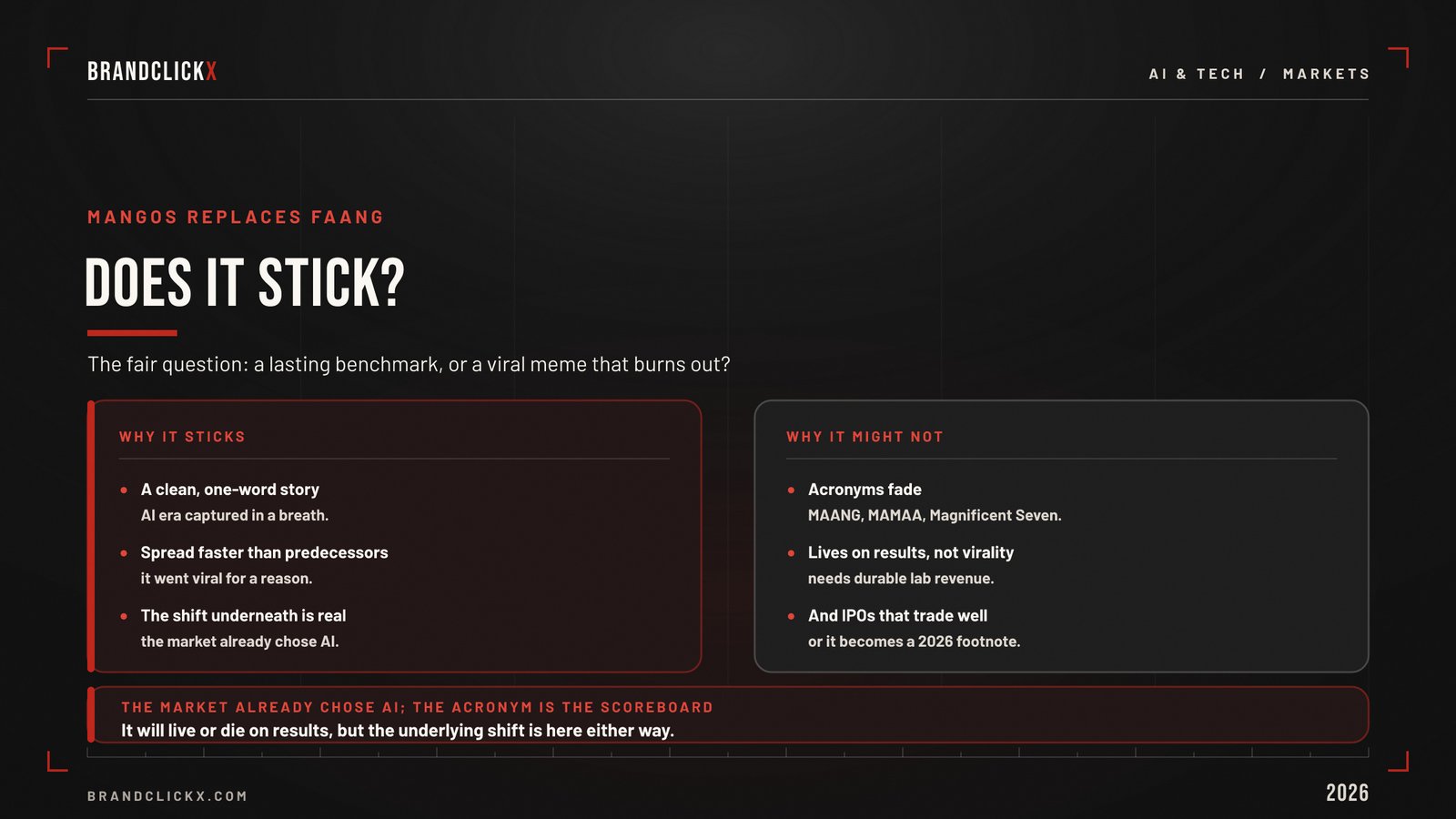
Acronyms come and go. MAANG, MAMAA, and the Magnificent Seven all tried and mostly faded. So the fair question is whether MANGOS lasts or burns out as a meme.
The case for staying power is the clean story. FAANG captured the consumer internet era in one word. MANGOS captures the AI era just as cleanly, which is exactly why it spread faster than its predecessors.
Future Outlook: the label will live or die on results, not virality. If the AI labs deliver durable revenue and the IPOs trade well, MANGOS becomes a benchmark institutions actually track and build products around. If the bet wobbles, it becomes a footnote, a reminder of how confident the market felt in 2026.
Either way, the underlying shift is real. The market has already chosen AI as the main event. The acronym is just the scoreboard catching up.
What Happens Next
The story is moving in real time, and the next few quarters will settle the big questions. Here is what to watch.
- How SpaceX trades after its record debut, since it sets the tone for the listings to come.
- Whether OpenAI and Anthropic complete their IPOs on schedule or let the timing slip.
- How much liquidity the new listings pull from existing mega-cap tech stocks.
- Whether regulators scrutinize the circular investment ties binding the group together.
- Whether MANGOS hardens into an index-tracked benchmark or fades like past acronyms.
Each of these will tell you more about the next decade of markets than the catchy name ever could.
COMPARISON TABLE: FAANG VS MANGOS
| Factor | FAANG | MANGOS |
| Members | Facebook, Apple, Amazon, Netflix, Google | Meta, Anthropic, Nvidia, Google, OpenAI, SpaceX |
| Era it captures | Consumer internet | Artificial intelligence and space |
| Core business | Social, streaming, e-commerce | AI models, chips, rockets, cloud |
| Coined by | Bob Lang, popularized by Jim Cramer in 2013 | Revived on X in June 2026, older BofA roots |
| Public access | All five publicly traded | Three public, two private, one freshly listed |
| Central risk | Mature growth, regulation | AI dependency, circular financing, valuation |
KEY TAKEAWAYS
- MANGOS stands for Meta, Anthropic, Nvidia, Google, OpenAI, and SpaceX, and it is fast replacing FAANG as Wall Street’s defining acronym.
- The swap reflects a shift from consumer-platform value to AI and infrastructure, with Apple, Amazon, and Netflix cut from the lineup.
- Half the basket is hard to own. Meta, Nvidia, and Google trade publicly, SpaceX just listed, while Anthropic and OpenAI remain private.
- SpaceX went public in June 2026 at roughly $1.75 trillion, the largest IPO ever, pushing past $2 trillion in early trading.
- The group carries a built-in contradiction. Google competes with OpenAI and Anthropic, while Nvidia supplies them all, tied together by circular money flows.
- For brands, MANGOS signals that the platforms they build on and advertise with are now valued as AI companies first, reshaping the entire field.
Frequently Asked Questions
What does MANGOS stand for?
MANGOS stands for Meta, Anthropic, Nvidia, Google, OpenAI, and SpaceX. It is the AI-era replacement for FAANG, grouping the companies investors believe will define the next decade.
What is the difference between MANGOS and FAANG?
FAANG was built on consumer platforms like social media, streaming, and e-commerce. MANGOS is built on AI, chips, and space, swapping Apple, Amazon, and Netflix for Anthropic, OpenAI, and SpaceX.
Can you buy MANGOS stocks?
Only partly. Meta, Nvidia, and Google trade publicly, and SpaceX listed in June 2026. Anthropic and OpenAI are still private, with IPOs in the works, so no single fund holds all six.
Why is Apple not in MANGOS?
Apple was cut because its core business is no longer seen as an AI leader. It even pays Google to power the new Siri, which critics say proves the point about its AI position.
Is SpaceX publicly traded?
Yes. SpaceX went public in June 2026 at a roughly $1.75 trillion valuation, the largest IPO ever, and its shares quickly pushed its value above $2 trillion.
Are OpenAI and Anthropic publicly traded?
Not yet. Both are private but moving toward IPOs. OpenAI filed a confidential S-1 in June 2026, and Anthropic is targeting a listing as soon as later in the year.
CONCLUSION
MANGOS is more than a clever piece of fruit-themed wordplay. It is the market admitting, out loud, that the era of consumer-platform dominance has given way to the era of AI.
FAANG sounded fierce. MANGOS sounds sweet, almost like a joke. But the bet underneath it is deadly serious, and the SpaceX listing just proved how much real money stands behind it.
Future Outlook: the acronym will be tested fast. If the AI labs grow into their valuations and the IPO wave trades well, MANGOS becomes the benchmark of the decade. If the bet stumbles, the same concentration that drove the gains will drive the pain, because the whole basket shares one dependency. Expect volatility, scrutiny, and a few humbling moments along the way.
For brands and marketers, the signal is the part that lasts. The companies that own your reach are now valued as AI firms first. The platforms you build on are competing in a race that reprices everything around intelligence. Reading that shift early is the difference between riding it and being surprised by it.
At BrandClickX, we track these moments the way operators do. Not as ticker symbols, but as a map of where attention, capital, and power are heading next. FAANG defined the last decade. MANGOS is making its case for the next one.
The names changed. The lesson did not. Follow where the value moves, and you can see the future taking shape before the acronym catches up.