
Introduction: The AI Lab That Decided It Wanted Your Marketing Budget
For the first four years of its existence, Anthropic was easy to categorize.
It was the safety-focused AI lab. The responsible alternative to OpenAI. The company that published research on alignment, hired philosophers alongside engineers, and made “building AI carefully” its defining brand proposition.
That framing wasn’t wrong. It was just incomplete.
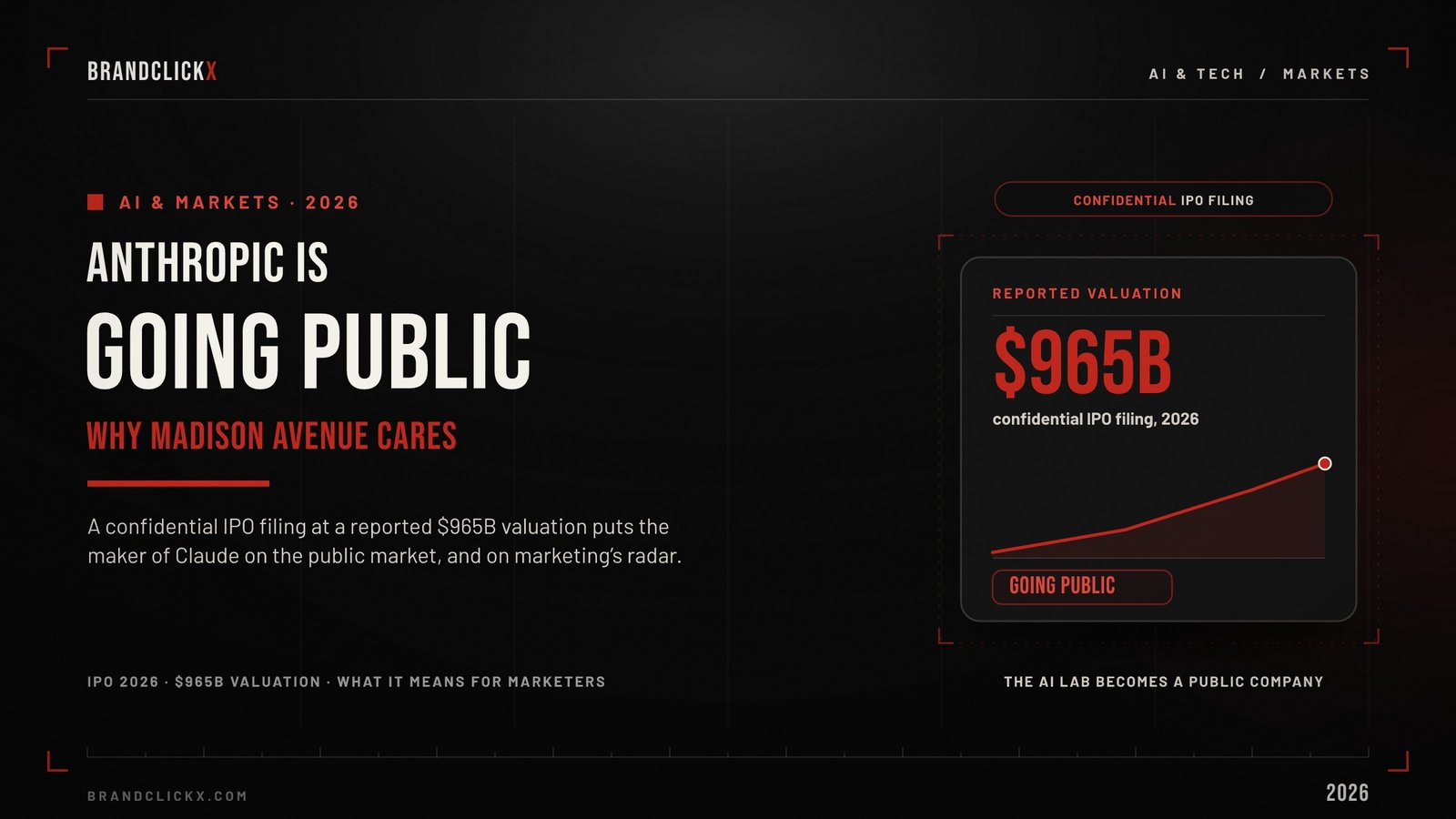
On June 1, 2026, Anthropic filed confidentially for a U.S. initial public offering days after closing a $65 billion Series H round at a $965 billion post-money valuation. The company now has a revenue run rate of $47 billion. It is weeks away from its first operating profit. It has launched a design tool that made Adobe and Figma stocks fall on the same afternoon.
And it is coming for Madison Avenue.
The IPO is the financial headline. But for CMOs, marketing executives, creative directors, and agency leaders, the real story isn’t the SEC filing. It’s what Anthropic has been quietly building behind it a full-stack move from AI model provider to marketing infrastructure company, one product launch at a time.
This is the article the finance press won’t write. Here’s what the IPO means for everyone who builds, buys, or bills for marketing.
Part I: The Filing, The Numbers, and Why They’re Bigger Than They Look
From $9 Billion to $47 Billion in Six Months
Let’s start with the numbers, because they reframe everything that follows.
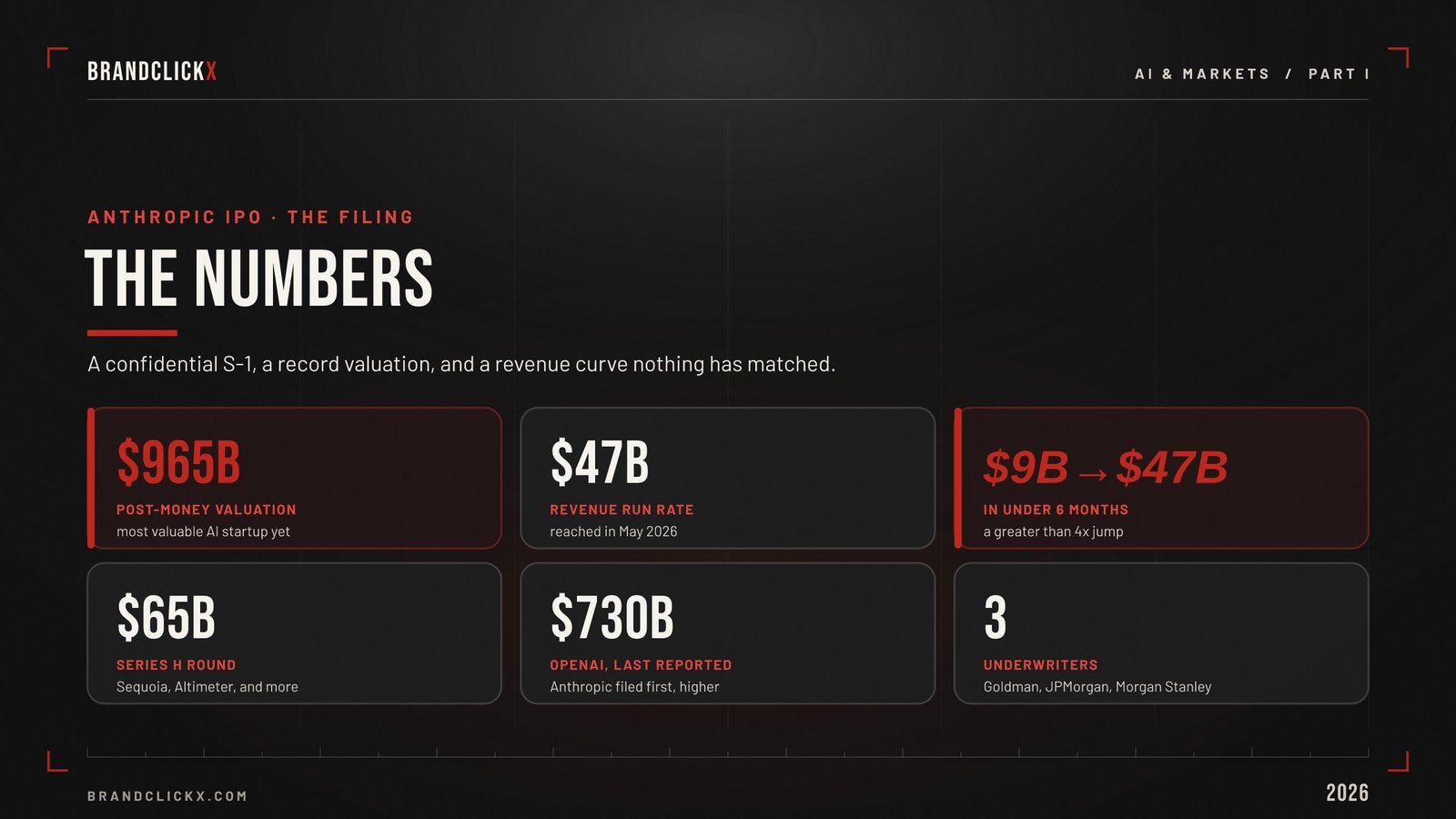
Anthropic’s revenue run rate hit $47 billion in May 2026 up from $30 billion in early April, and $9 billion at the end of 2025. That is a greater than 4x increase in annualized revenue in under six months.
No enterprise technology company has scaled at this rate. Ever.
The $65 billion Series H round was co-led by Altimeter Capital, Dragoneer, Greenoaks, and Sequoia Capital. Blackstone, GIC, General Catalyst, and Insight Partners also participated a mix of Silicon Valley and Wall Street that signals Anthropic is no longer a startup story. It is an asset class.
The confidential filing itself is straightforward mechanics. Anthropic submitted a draft S-1 to the SEC. It hasn’t set share count or price. It has conditioned the IPO on market conditions. The Wall Street Journal reported that underwriters Goldman Sachs, JPMorgan, and Morgan Stanley are in early conversations about the deal.
Why It Matters: A confidential filing at $965 billion valuation means Anthropic is giving public investors the clearest signal yet: the AI era is about to have a publicly traded flagship. And whoever prices first Anthropic or its rival OpenAI sets the template for how every AI company gets valued for the next decade.
Strategic Breakdown: OpenAI’s last reported valuation was $730 billion, per OpenAI’s own disclosure. Anthropic filing ahead of OpenAI and at a higher valuation is a deliberate sequencing move. The company that prices first on favorable terms shapes the narrative. Everything that follows is priced relative to the first deal.
Part II: Not Just an AI Lab. A Marketing Technology Company.
The Move Into Madison Avenue That Most Finance Coverage Is Missing
Here is what Adweek reported that most tech and finance outlets did not lead with: Anthropic has been “pushing further into enterprise marketing workflows, including tools like Claude Design an AI system aimed at generating slides, one-pagers and other sales and marketing materials.”
That sentence is the most strategically important thing written about this filing today.
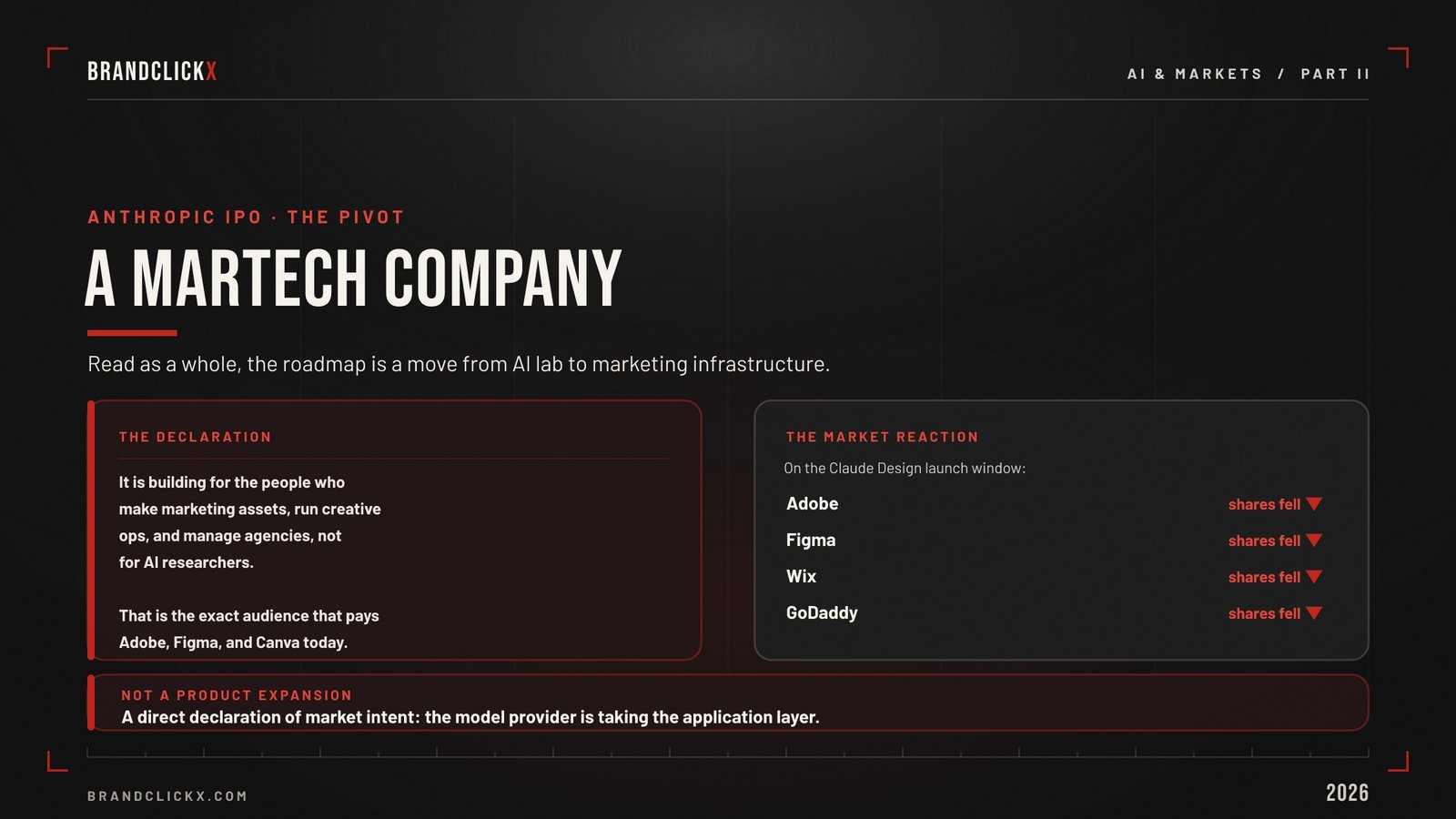
Anthropic is not building tools for AI researchers. It is building tools for the people who produce marketing assets, run creative operations, develop brand campaigns, and manage agency relationships.
It is building for the exact audience that has historically paid Adobe, Figma, and Canva for the software they use every day.
This is not a minor product expansion. It is a direct declaration of market intent.
The Bigger Shift: Anthropic launched Claude Design in April 2026 through Anthropic Labs the company’s new product division. The tool generates slides, one-pagers, prototypes, and marketing assets from plain-language prompts.
It ingests your codebase and design system during onboarding. It outputs live HTML clickable, testable, exportable to Canva, PDF, PPTX, or directly to Claude Code as a build bundle.
On the day Claude Design launched, Adobe shares fell. Figma’s stock dropped. Wix and GoDaddy also declined in the same two-day window.
That breadth matters. The market was not reading Claude Design as a Figma replacement alone. It was reading it as a threat to the entire chain from zero-to-one ideation through final publishing that multiple companies have built their businesses around.
Part III: Claude Design and the Collapse of the Traditional Design Workflow
What Happens When the Model Skips the Designer
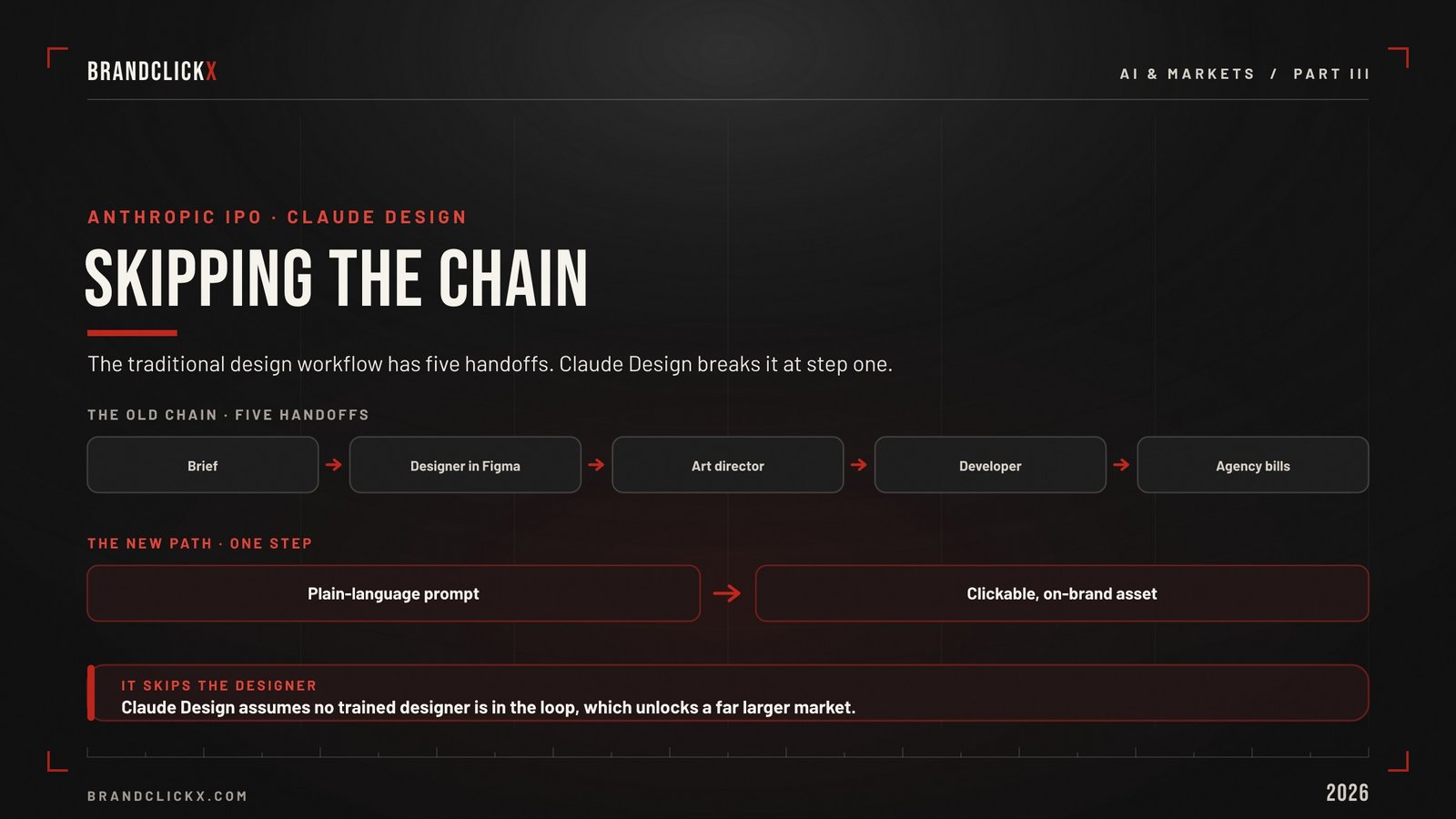
The traditional design workflow has a clear shape. A brief arrives. A designer opens Figma. An art director reviews. A developer builds. An agency bills.
Claude Design breaks that chain at the first step and it does so deliberately.
According to VentureBeat’s launch coverage, Claude Design “does not assume a trained designer is in the loop.” A product manager, account executive, or brand strategist can type a description of a dashboard, a signup flow, or a campaign one-pager and the system generates a functional, clickable layout, grounded in the brand’s actual design system.
That is a categorically different proposition from what Adobe and Figma offer. Adobe Firefly, embedded across Photoshop and Illustrator, assists designers already inside those tools. Figma AI operates inside the Figma interface. Both assume a trained user is in the loop.
Anthropic assumes they are not. And it turns out that assumption unlocks a much larger addressable market.
Expert Insight: The CPO departure signal was hard to miss. Anthropic’s chief product officer Mike Krieger resigned from Figma’s board in the days before Claude Design launched a legal requirement before he could participate in developing a competing product.
The resignation was a public, SEC-required filing. It was not a quiet exit. It was the competitive declaration filed with the regulator before the product shipped.
Industry Impact: Fast Company’s analysis of the Claude Design launch noted the uncomfortable position of Figma, Adobe, and Canva all of which had been operating under multiyear collaboration agreements with Anthropic to integrate Claude into their tools.
“Everyone wants a date to the AI dance,” Fast Company wrote. “And nobody wants to look like they were stood up while Anthropic went stag instead.”
For marketing teams: Claude Design is the clearest signal yet that the AI model providers are not content to remain infrastructure. They are building the application layer too.
Part IV: The Agency Disruption Nobody Wants to Say Out Loud
Vibe Coding, GEO Products, and the $47 Billion Pressure on Agency Retainers
The Claude Design launch is not the only place where Anthropic is quietly reshaping the agency business model.
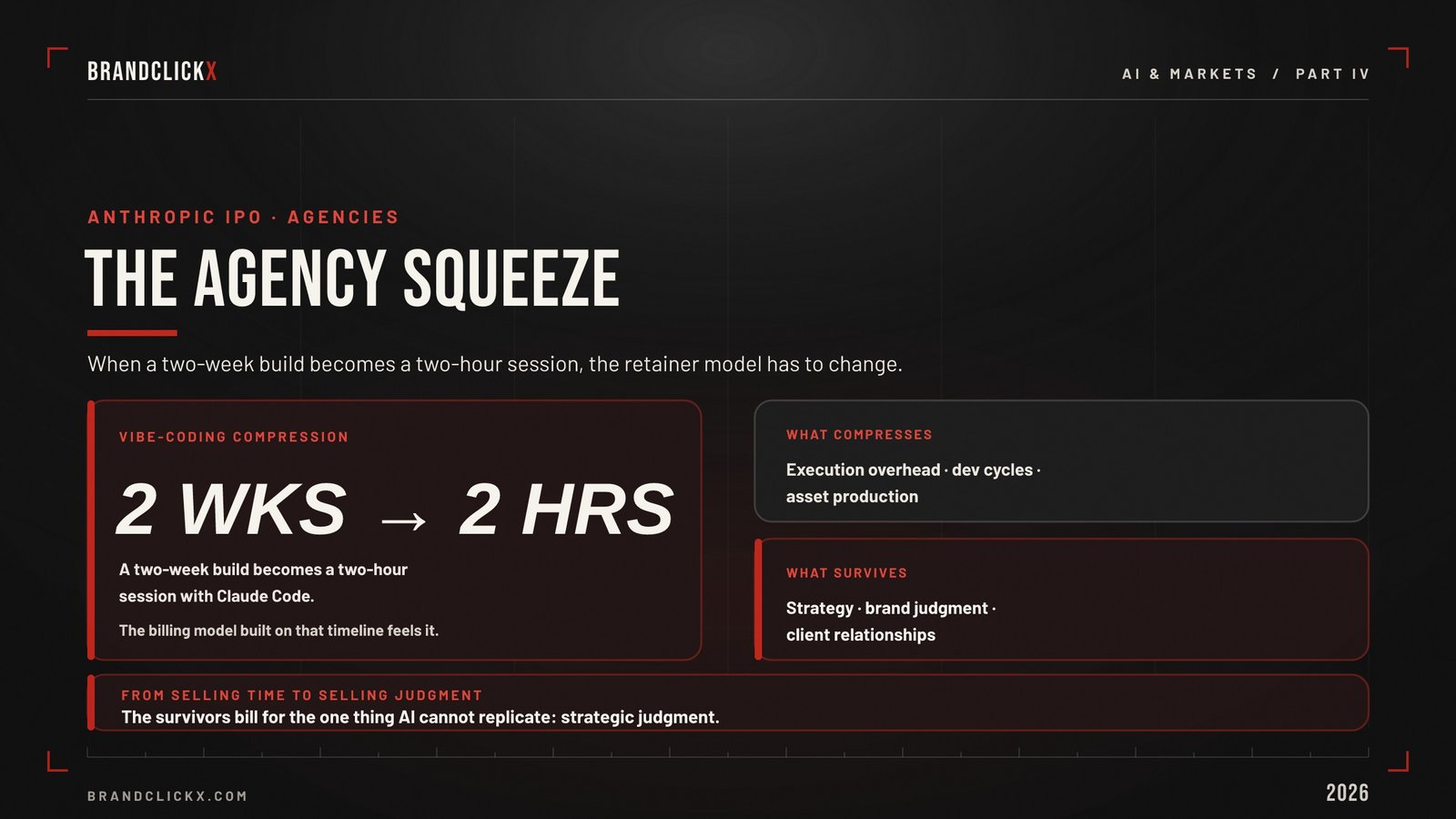
Adweek previously reported that ad agencies are embracing “vibe coding” using Claude Code to build GEO (generative engine optimization) products and campaign tools for clients, compressing development cycles from weeks to hours.
This is not hypothetical. Agencies are already using Claude to build functional products in two-hour sessions that would previously have required a full development sprint.
The implication is uncomfortable but direct: when AI can compress a two-week development build into two hours, the billing model built around that two-week timeline faces structural pressure. Not elimination but reconfiguration.
Market Observation: The agencies that survive this transition will be the ones that move fastest from selling time to selling strategic output. Claude Code and Claude Design do not replace creative strategy, brand judgment, or client relationship management.
They replace the execution overhead that sits between the idea and the deliverable.
That execution overhead is currently billed as a significant portion of most agency retainers.
Enterprise Perspective: For in-house marketing teams, the calculus is different. Claude Design and Claude Code do not require an agency relationship to produce a functional prototype, a campaign one-pager, or a data-driven marketing dashboard.
The question is not “do we use AI?” it is “which workflows do we bring in-house, and which do we still need agency expertise to execute at quality?”
The IPO accelerates this question. Fresh capital means faster product iteration, broader enterprise sales, and deeper integrations into the tools marketing teams already use daily.
Part V: The Product Stack Anthropic Is Building for Your Marketing Team
From Model Provider to Full-Stack Marketing Infrastructure
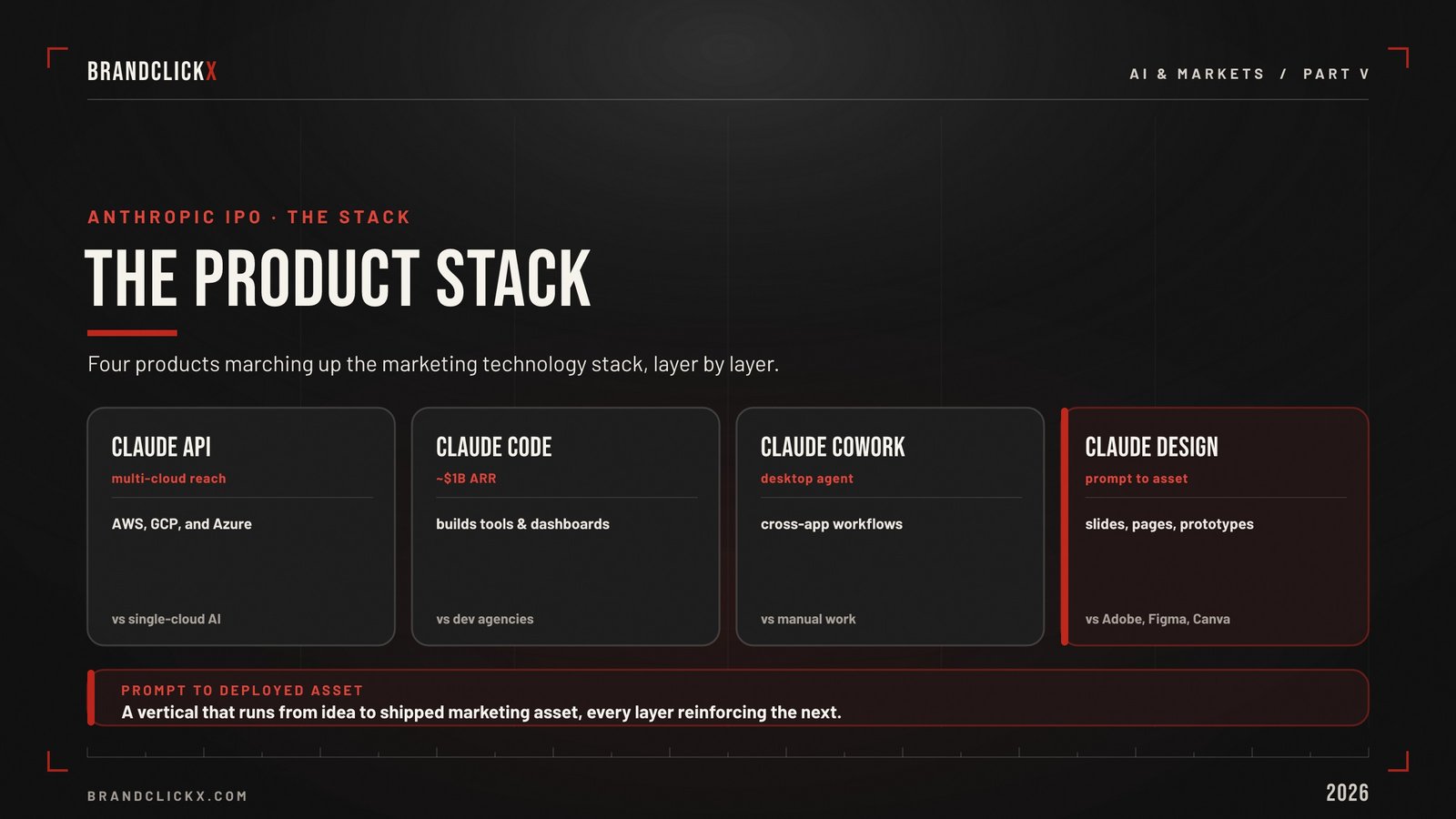
Anthropic’s product roadmap, read as a whole, is a deliberate march up the marketing technology stack.
It started at the infrastructure layer. Claude’s API, available across AWS Bedrock, Google Cloud Vertex AI, and Microsoft Azure Foundry simultaneously, made Claude the only frontier model with simultaneous access across all three dominant enterprise cloud platforms.
That multi-cloud availability was not an accident. It was a distribution strategy ensuring Claude was available wherever enterprise marketing and IT teams had already committed their infrastructure.
Then came the application layer.
Claude Code — the agentic coding assistant has reached nearly $1 billion in annualized revenue on its own. It builds functional web products, campaign tools, and internal dashboards from natural language. Agencies are using it.
Development teams at major brands are using it. And it integrates directly with Claude Design’s output, meaning a prototype generated by Design can be handed directly to Code for deployment.
Claude Cowork, launched in January 2026, operates directly on the desktop automating file management, cross-application workflows, and task orchestration without requiring a browser.
Claude Design — the April 2026 launch targets the creative and marketing asset layer directly. Slides, one-pagers, prototypes, brand-consistent visual assets, generated from a prompt and grounded in your actual design system.
Tactical Framework How These Products Map to the Marketing Workflow:
| Marketing Function | Claude Product | Incumbent Displaced |
| Campaign asset creation | Claude Design | Adobe, Canva, Figma |
| Development of marketing tools | Claude Code | Traditional dev agencies |
| Desktop workflow automation | Claude Cowork | Manual cross-app workflows |
| Enterprise AI via existing cloud | Claude API (AWS/GCP/Azure) | Single-cloud AI deployments |
| Code-to-deploy handoff | Design → Code pipeline | Figma-to-dev handoff tools |
The stack is not complete. But the direction is unmistakable.
Anthropic is building a vertical that runs from prompt to deployed marketing asset, with every layer reinforcing the next.
Part VI: The Safety Paradox Meets the Marketing Reality
What Happens When the AI Safety Company Has to Grow Revenue Quarterly
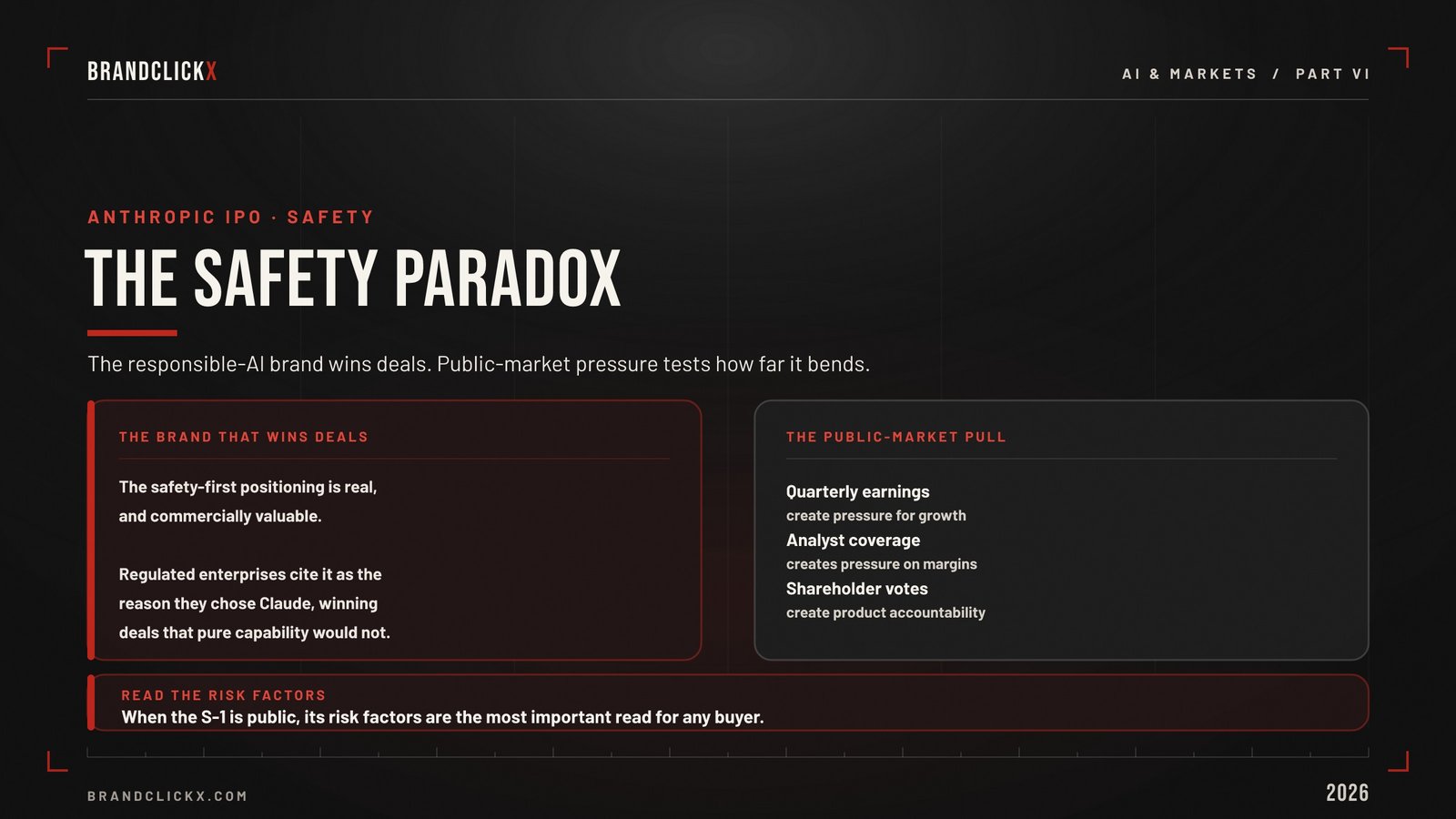
Anthropic’s founding narrative that it left OpenAI to build AI more carefully, more responsibly, with alignment research at the center has been commercially valuable.
Enterprise marketing and legal teams at regulated companies cite Anthropic’s safety positioning as a reason they chose Claude over alternatives. The “responsible AI” brand has won procurement decisions that pure capability comparisons would not have.
But public company status changes the dynamics.
Quarterly earnings calls create pressure for growth guidance. Analyst coverage creates pressure on margins. Shareholder votes create accountability on product decisions. The question is not whether Anthropic’s safety mission is genuine it clearly is.
The question is whether the institutional pressure of public market accountability changes the rate at which safety considerations can slow product decisions.
Expert Insight: According to MarketWise, famed Big Short investor Michael Burry recently stated that “Anthropic is eating Palantir’s lunch” in reference to its enterprise cybersecurity and software disruption capabilities.
That framing Anthropic as disruptor, not just model provider is how Wall Street is beginning to price this company. Public market investors will want to see that disruption continue, quarter over quarter.
For marketing technology buyers, the more immediate question is governance: does going public change how Anthropic makes product decisions that affect enterprise workflows? The S-1 risk factors, when they are publicly filed, will be the most important document any enterprise marketing buyer reads this year.
Part VII: The Race Nobody Is Admitting Is a Race
Anthropic vs. OpenAI vs. the Entire Marketing Technology Industry
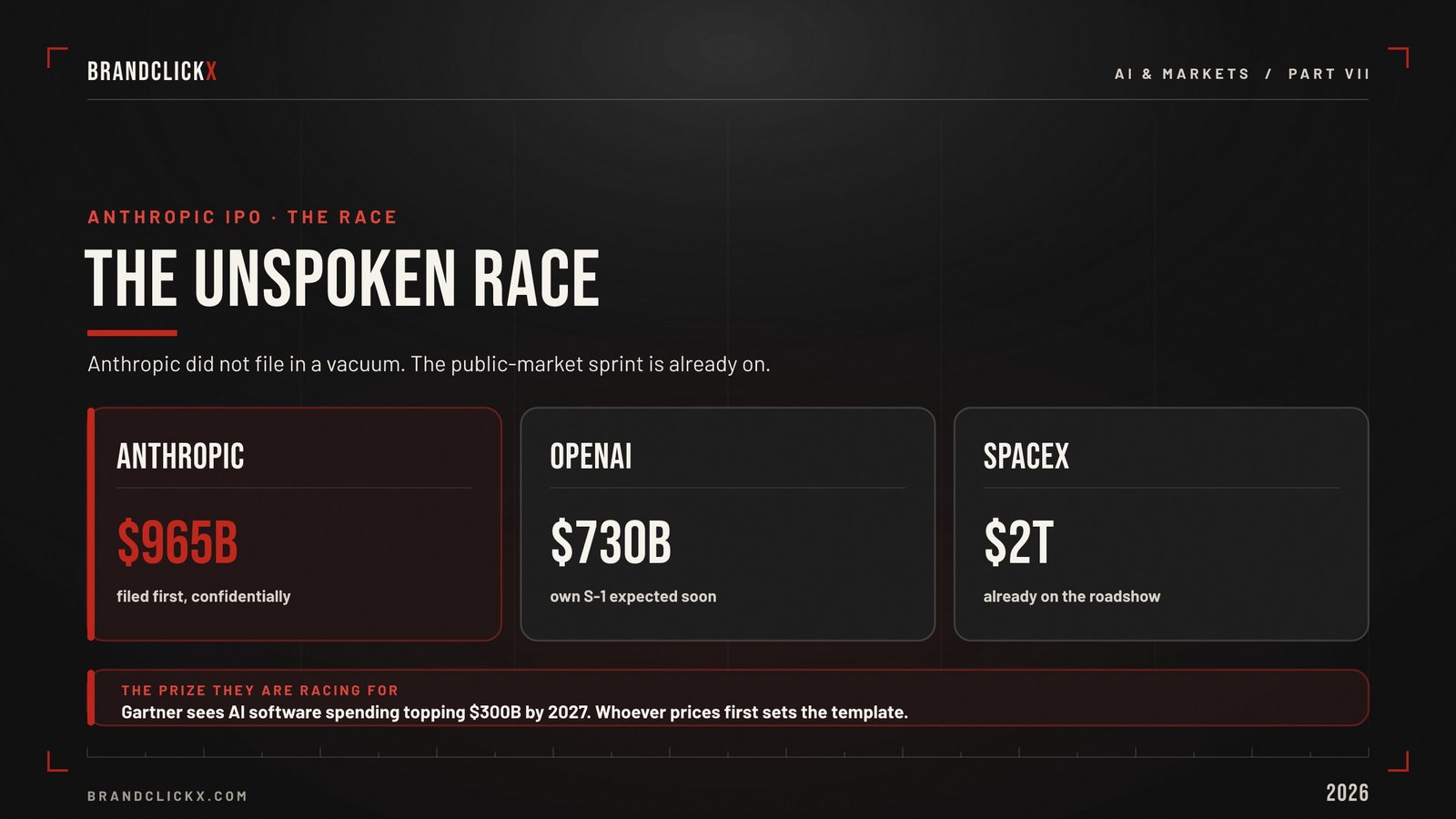
Anthropic’s IPO does not exist in isolation.
OpenAI is preparing its own confidential filing. As Reuters reported, OpenAI is expected to submit its own S-1 in the coming weeks, setting up a direct head-to-head IPO race between the two most prominent AI labs in the world.
SpaceX is already on a roadshow, targeting a $2 trillion valuation.
And the marketing technology industry Adobe, Salesforce, HubSpot, Figma, Canva, every SaaS tool in the martech stack is watching all of it with a mix of competitive anxiety and strategic calculation.
The companies that have built collaborative relationships with Anthropic integrating Claude into their products, selling it as a feature now face a more complex reality.
Anthropic is not just a vendor. It is a competitor that has taken its API fees, learned which use cases drive the most enterprise value, and is now building standalone products in exactly those categories.
What Happens Next: The IPO timeline most analysts expect is a fall 2026 roadshow October or November with the public S-1 landing at least 15 days before the roadshow begins.
Gartner’s 2026 AI market projections estimate that AI software spending will exceed $300 billion by 2027, with marketing and creative automation representing one of the fastest-growing categories within that number.
Anthropic’s IPO will price directly into that tailwind.
And for every CMO and marketing technology buyer reading the S-1 when it lands the real question is not what the company is worth to investors. It is what the company intends to own in the marketing stack. The product roadmap will be in the filing. Read it carefully.
Key Takeaways for Marketing Leaders
- Anthropic is not an AI model provider anymore. Claude Design, Claude Code, and Claude Cowork together constitute a full-stack marketing technology product suite. The IPO funds the next phase of that buildout. Plan accordingly.
- The Adobe and Figma threat is real but nuanced. Claude Design is not replacing production-grade design workflows today. It is replacing the upstream ideation and asset-generation layer for non-designers. That layer currently generates significant agency billing and SaaS subscription revenue. It will not disappear overnight. But it will compress.
- Agency billing models face structural reconfiguration. Claude Code compresses development cycles. Claude Design compresses creative production. The agencies that survive will be the ones that move from billing for execution time to billing for strategic judgment the one thing AI cannot replicate.
- Multi-cloud Claude availability is a procurement advantage, not just a technical detail. The fact that Claude runs natively on AWS, Google Cloud, and Azure means enterprise marketing teams can deploy it inside existing infrastructure without new vendor onboarding. Procurement teams should be evaluating this now, ahead of the IPO-driven pricing changes.
- Read the S-1 when it drops. The risk factors, product roadmap disclosures, revenue concentration details, and governance structure will tell enterprise marketing buyers more about Anthropic’s strategic intentions than any press release or product launch keynote.
FAQ: Anthropic IPO and Marketing
What is Anthropic’s valuation at its IPO filing?
Anthropic filed confidentially for an IPO on June 1, 2026, days after closing a $65 billion Series H round at a $965 billion post-money valuation making it the most valuable AI startup in history at the time of filing, ahead of OpenAI’s most recently reported $730 billion valuation.
What is Claude Design and why does it matter for marketing teams?
Claude Design, launched in April 2026, generates slides, one-pagers, prototypes, and marketing assets from plain-language prompts. It ingests a brand’s design system during onboarding and outputs live HTML exportable to Canva, PDF, PPTX, or directly to Claude Code. Unlike Adobe or Figma, it requires no design expertise. That distinction makes it a direct threat to agency creative workflows and incumbent design software subscriptions.
Why does Anthropic’s IPO matter for CMOs and marketing executives?
The IPO accelerates Anthropic’s product roadmap with fresh public capital, deepens enterprise integrations, and signals the company is transitioning from AI model provider to full-stack marketing infrastructure company. For CMOs, it means the vendor relationship with Anthropic is about to become significantly more consequential and more competitive with tools already in the stack.
How does Anthropic’s growth affect the marketing technology landscape?
Anthropic’s revenue run rate grew from $9 billion to $47 billion in six months, driven primarily by enterprise adoption. That growth funded product launches Claude Design, Claude Code, Claude Cowork that directly compete with major martech incumbents. The IPO will fund the next wave.
What is Anthropic’s strategy for the advertising and agency market?
As Adweek reported, Anthropic is pushing aggressively into enterprise marketing workflows generating slides, one-pagers, and marketing materials directly for enterprise teams. Ad agencies have simultaneously begun using Claude Code to build GEO products and campaign tools for clients at dramatically compressed timelines. Both trends represent a structural shift in who produces marketing assets and how.
Conclusion: The Safety-First AI Company Is Now in Your Marketing Stack
Here is the honest framing for every marketing leader reading this.
The company that filed for an IPO today is not the one you read about in 2022 AI safety papers. It is not the company quietly training alignment models in a San Francisco office. It is a $965 billion enterprise that has built tools that compete with Adobe, Figma, Canva, and your agency’s core service offering and just secured the public market capital to scale those tools globally.
The “safety-first” positioning is real. But it has been joined by something equally real: product aggression. Claude Design spooked the design software market in a single afternoon. Claude Code is already inside agency workflows. Claude’s API sits at the foundation of tools hundreds of thousands of enterprises use to run their marketing operations.
The IPO makes all of that permanent. It funds the roadmap. It creates accountability. And it puts Anthropic in direct competition with every incumbent in the marketing technology stack not as a scrappy startup, but as a near-trillion-dollar public company with a mandate to grow.
Gartner predicts AI software spending will exceed $300 billion by 2027. A meaningful portion of that spending will flow through tools that Anthropic either built, powers, or competes against.
The filing was the signal. The S-1 will be the roadmap. And the marketing industry’s response to both will define how the next phase of the AI era gets built.
Pay attention.