Introduction: The Leak Before the Launch
The most revealing moment at Google I/O 2026 didn’t happen on stage. It happened in the days before the keynote, when a researcher extracted unreleased animations from Google App version 17.23.33 on Android and found something Google hadn’t announced yet: two distinct AI agent identities, each with its own visual language, its own capabilities architecture, and critically its own risk profile.
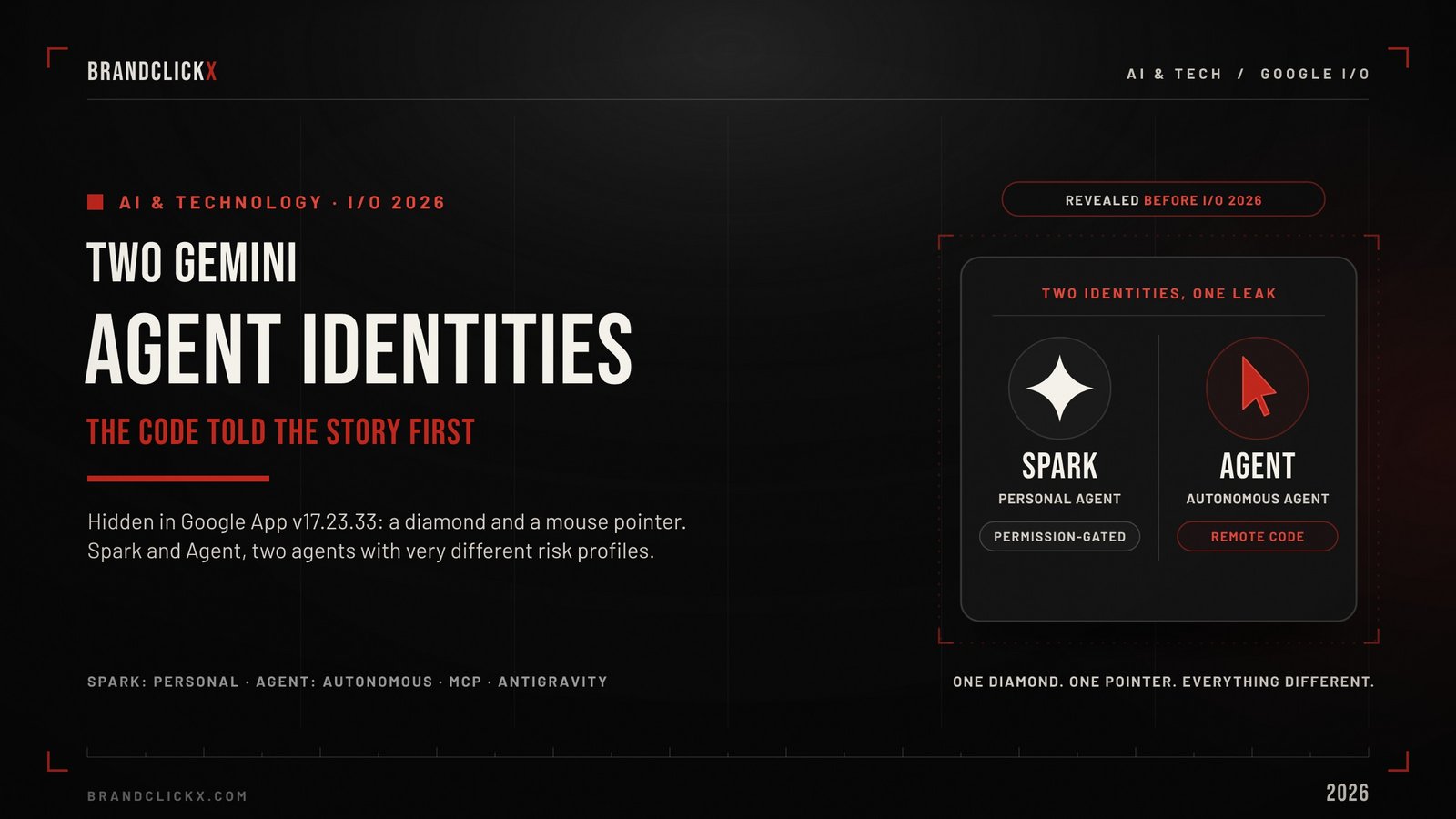
A diamond icon. A mouse pointer icon. Two product names: Gemini Spark and Gemini Agent. Hidden in production code, waiting.
The discovery, first reported by Forbes contributor Paul Monckton, set off a wave of pre-I/O analysis that reframed what Google was actually building.
Not a smarter chatbot. Not a feature update. A bifurcated agent platform two products positioned at different points on the autonomy spectrum, designed to serve fundamentally different use cases.
When Sundar Pichai finally walked onto the I/O stage and declared the beginning of “the agentic Gemini era,” the audience already had context. The code had told the story first.
For CMOs, marketing technology leaders, and enterprise teams evaluating their AI infrastructure, what Google revealed at I/O 2026 and what the leaked code had already telegraphed represents the most significant shift in how digital work gets done since the smartphone made the mobile browser obsolete.
Understanding the distinction between Gemini Spark and Gemini Agent isn’t an academic exercise. It is a strategic imperative.
Part I: What the Code Actually Said
The Extraction That Started Everything
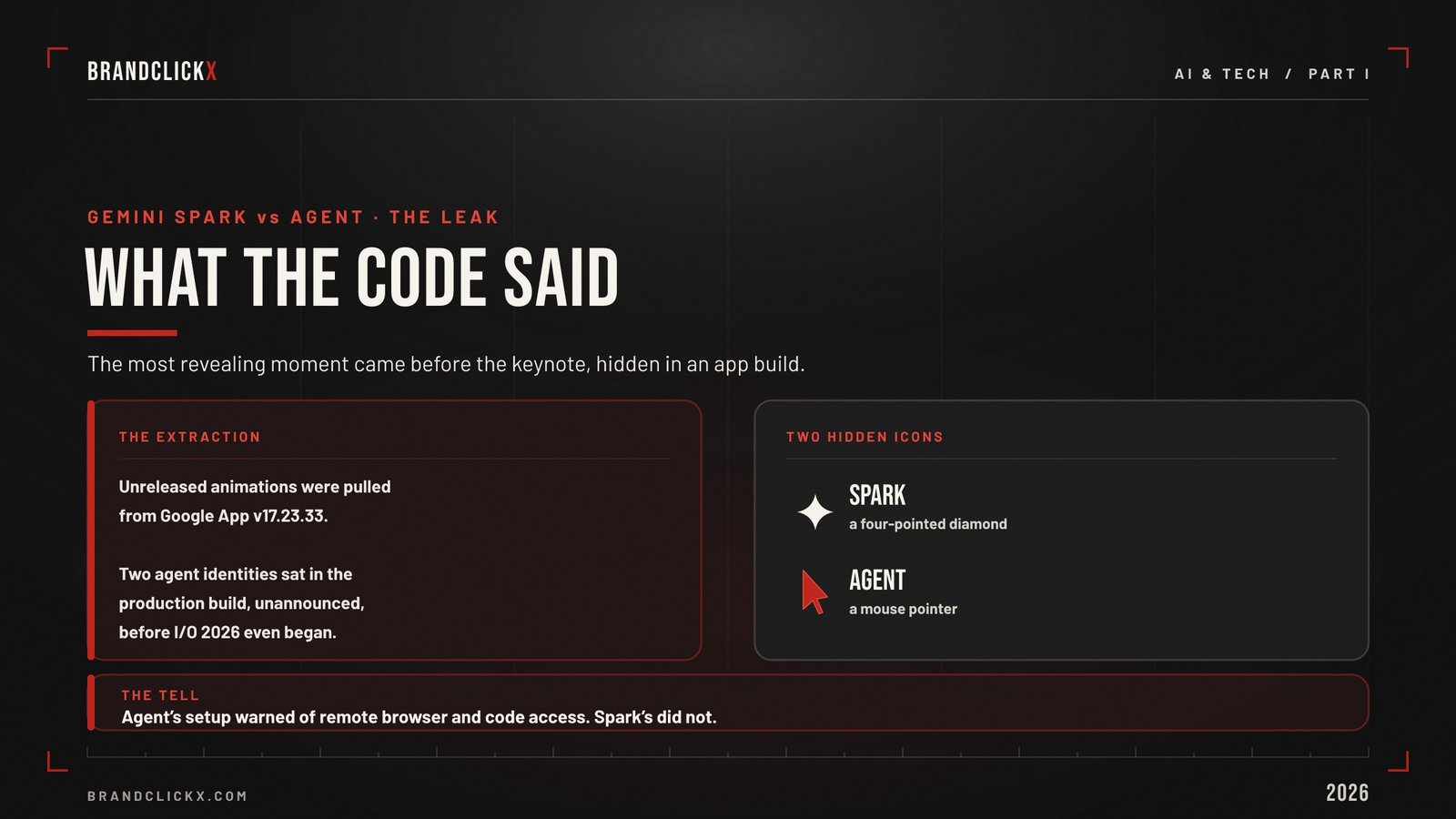
Unreleased animations extracted from Google App v17.23.33 revealed two animated characters with distinct visual identities both hidden within the production build, neither yet announced publicly.
The first: a four-pointed star, or diamond, icon associated with the product name “Gemini Spark.” The animation files referenced it as assistant_robin_agent_spark_working_blue.json a persistent, working state suggesting continuous background operation.
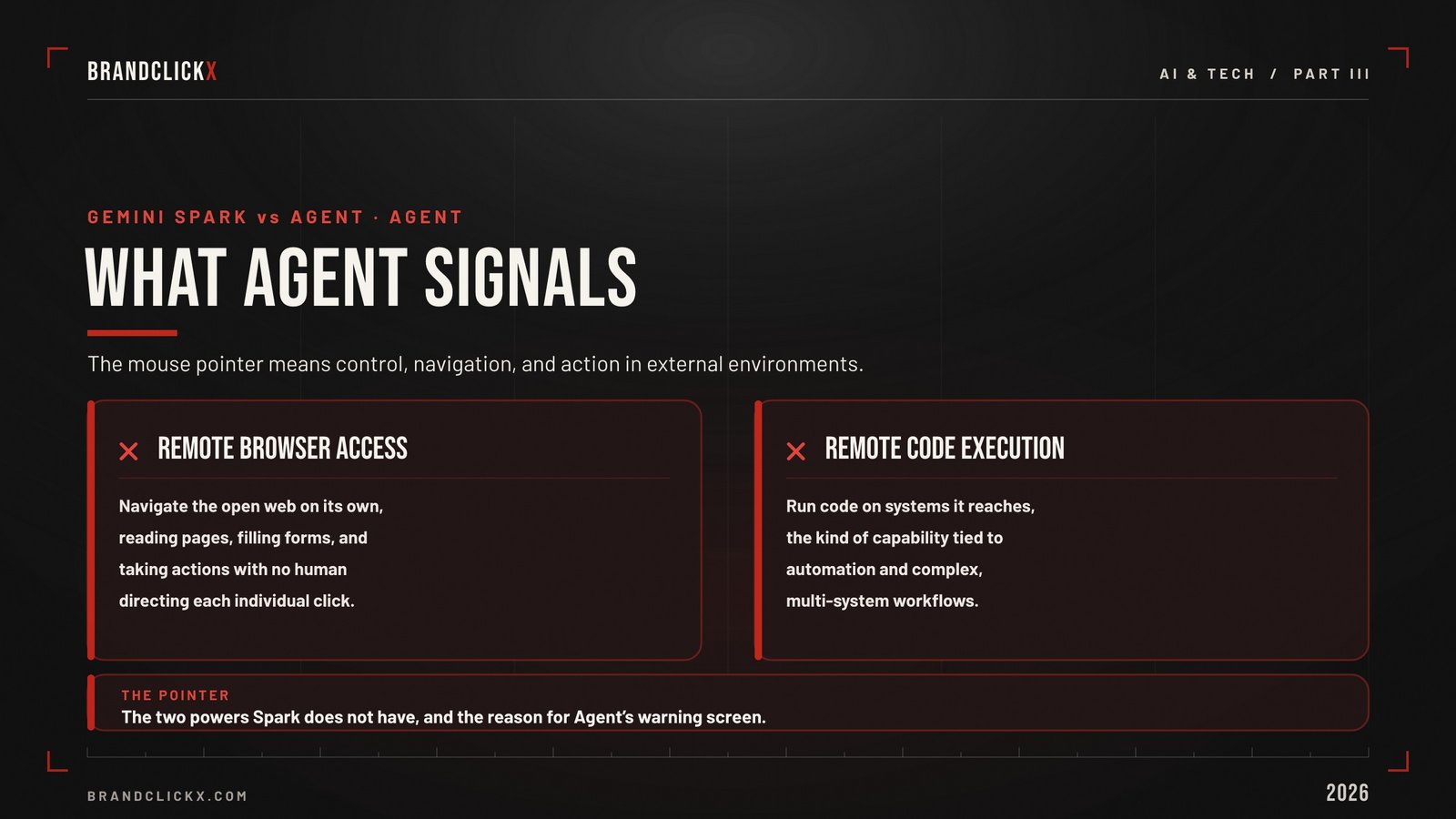
The second: a mouse pointer icon, associated with “Gemini Agent.” Unlike Spark, the Agent’s setup flow contained an onboarding screen that Spark’s flow did not a warning about remote browser data access and remote code execution.
That distinction is the most important detail in the entire leak.
Remote browser access means an AI agent can navigate the open web autonomously, reading pages, filling forms, extracting data, and taking actions in browser environments without a human in the loop for each step.
Remote code execution means the agent can run code on remote systems a capability associated with developer tools, automation infrastructure, and complex multi-system workflows.
Spark had neither. Agent had both.
Strategic Breakdown: The two icon choices are not arbitrary. The diamond signals something refined, personal, and contained a productivity enhancement. The mouse pointer signals control, navigation, and action-taking in external digital environments. Google embedded the product philosophy into the visual metaphor before anyone had written a press release.
Part II: What Gemini Spark Actually Is
The 24/7 Agent That Never Sleeps
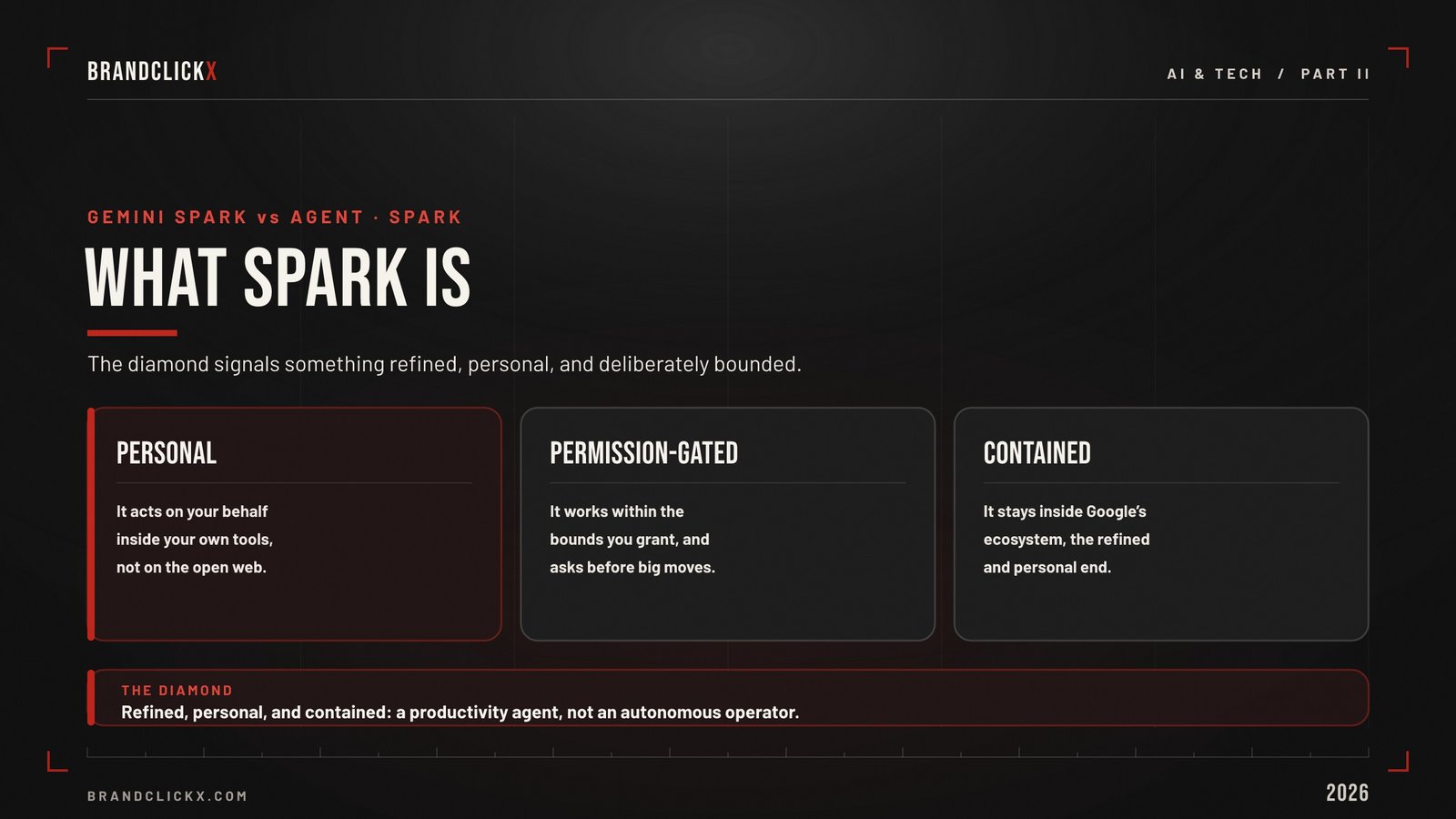
When Google officially announced Gemini Spark at I/O 2026, the product matched what the code had suggested: a persistent personal AI agent that runs continuously on dedicated Google Cloud virtual machines, executing tasks across a user’s digital environment even when their device is powered off.
Powered by Gemini 3.5 and built on the Antigravity orchestration harness, Spark breaks from every previous iteration of the Gemini assistant in one fundamental architectural way. The original Gemini assistant was stateless send a query, receive a response, session ends. Spark operates with persistent goal state. It maintains context across hours and days. The session never ends.
As Google’s own documentation puts it: “It can monitor your inbox on a schedule, cross-reference incoming emails against deadlines you described weeks ago, and draft responses before you’ve opened Gmail that morning.”
Tactical Framework Spark’s Three Operating Modes:
Tasks — Multi-step assignments delegated to Spark. Example: “Find and track interior design internships in New Orleans for this summer.” Spark connects to Gmail, Calendar, Drive, Docs, Sheets, and Slides, plus third-party apps via MCP, and works the task continuously until completion or update.
Skills — Reusable instruction sets built over time. A user can ask Spark to analyze their last 50 outgoing emails, derive a personal writing style guide, and invoke that guide automatically whenever Spark drafts a new message. Skills are learned behaviors, not one-time prompts.
Schedules — Time-based or conditional triggers. Example: “Every Monday at 9:00 AM, scan my inbox, recap the most important updates, provide a prioritized to-do list, and schedule calendar blocks for deep work.” This transforms Spark from a reactive assistant into a proactive operational system.
Why It Matters for Marketing Teams: The practical difference between Spark and a standard AI assistant is the difference between asking a colleague a question and delegating a project. Standard Gemini responds when prompted. Spark operates on a clock.
For marketing operations teams managing editorial calendars, campaign trackers, email sequences, and reporting workflows, this is not an incremental improvement it is a structural change in how those workflows can be staffed.
Expert Insight: At launch, Spark connects natively to Gmail, Calendar, Drive, Docs, Sheets, Slides, YouTube, and Google Maps. It also supports Canva, OpenTable, and Instacart through the Model Context Protocol (MCP) the open integration standard originally developed by Anthropic and now adopted across the AI agent ecosystem including Claude Code, Cursor 3, and Microsoft’s Agent 365. Adobe, Samsung, Spotify, and GitHub are among the brands confirmed for forthcoming MCP integrations.
Part III: What Gemini Agent Signals
The More Powerful, More Dangerous Twin
While Spark has dominated the post-I/O coverage, the deeper strategic signal sits in the Gemini Agent product that the code revealed and that Google has been considerably quieter about.
The onboarding warning embedded in Agent’s setup flow specifically the warning about remote browser data and remote code execution tells a more consequential story. This is not a productivity assistant operating within a permission-gated Workspace environment. This is an agent designed to operate on the open web, in browser environments, executing code on systems it accesses remotely.
The Bigger Shift: Remote browser execution is what separates a personal assistant from an autonomous operator. An agent that can navigate the web without a human directing each click can book travel, research competitors, fill procurement forms, execute A/B tests, manage advertising dashboards, and interact with any web-based system without requiring the user to be present at any step.
The mouse pointer icon makes perfect sense viewed through this lens. It isn’t decorating the product. It is defining it.
Market Observation: The competitive context here is direct. OpenAI’s ChatGPT agent operates primarily through a browser. Anthropic’s Claude Cowork operates directly on a user’s desktop. Microsoft’s Copilot is grounded in Office 365 data.
Google’s bifurcated strategy Spark for personal productivity within the Google ecosystem, Agent for broader autonomous web operations appears designed to compete on both fronts simultaneously rather than committing to one model.
Enterprise Perspective: For enterprise technology buyers, the Gemini Agent architecture raises the same governance questions that every autonomous AI product raises at enterprise scale: what data does the agent access, how are those access permissions audited, and who is accountable when an autonomous agent takes an action that a human wouldn’t have approved?
The onboarding warning exists because Google’s legal and product teams understand this. The warning is not a UX detail. It is a liability acknowledgment.
Part IV: The Antigravity Platform The Stack Nobody Is Talking About Enough
Google’s Agent Orchestration Infrastructure
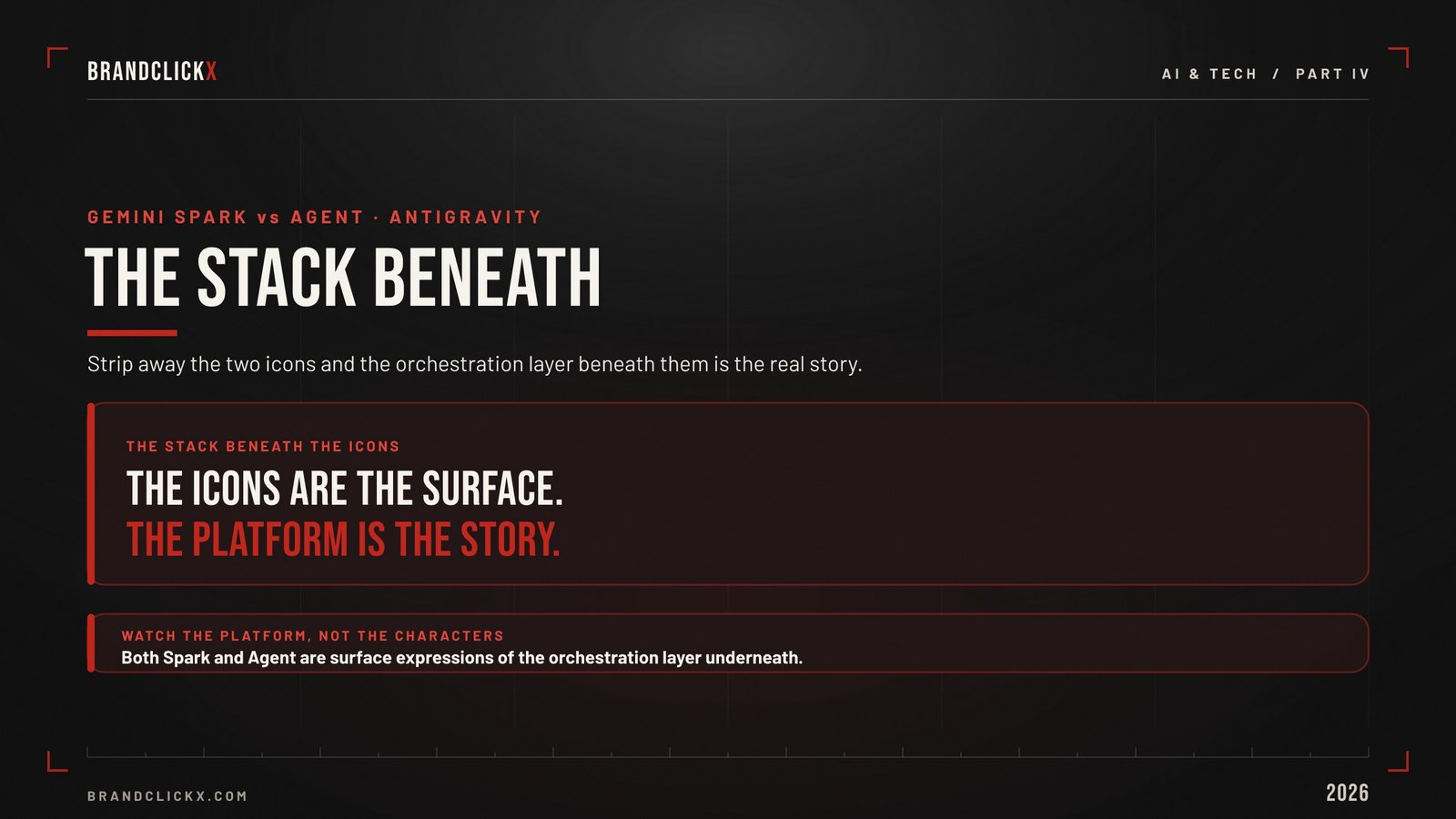
Both Spark and Agent are consumer-facing expressions of a deeper platform that Google announced at I/O 2026 and that most coverage has underweighted: Antigravity 2.0.
Antigravity is Google’s agent orchestration harness the infrastructure layer that allows Gemini agents to spin up isolated execution environments, maintain state across tasks, invoke tools and external services, and run multiple agents in parallel on different tasks simultaneously.
The Antigravity 2.0 release at I/O expanded its scope significantly: it is now a full platform for developing, deploying, and managing cohorts of autonomous AI agents, not just a coding environment.
According to Google Cloud’s official blog, Gemini 3.5 Flash the model powering Spark and Antigravity outperforms Gemini 3.1 Pro on challenging coding and agentic benchmarks: Terminal-Bench 2.1 (76.2%), GDPval-AA (1656 Elo), and MCP Atlas (83.6%).
It delivers this performance at a fraction of the latency of competing frontier models reportedly four times faster, and at significantly lower cost per token.
Strategic Breakdown: Antigravity is not a developer toy. It is Google’s attempt to become the agent runtime for the internet. The same orchestration infrastructure that powers Gemini Spark in the consumer Gemini app is exposed to enterprise developers through Google Cloud’s Agent Platform, and to individual developers through Google Antigravity’s standalone desktop application.
An MCP server built for Gemini Spark integration gives developers simultaneous distribution across Spark, Anthropic’s Claude Code, Cursor 3, and Microsoft’s Agent 365 all for the same development cost as a single-platform integration.
This cross-platform compatibility, engineered via the MCP open standard, is the infrastructure signal that most product and platform teams have missed in the I/O coverage.
Industry Impact: For SaaS companies and enterprise software vendors: every product that wants to be part of an agent’s workflow needs an MCP integration. The brands that build MCP servers now making their tools legible to Spark, Agent, and the broader autonomous agent ecosystem will have distribution advantages in an agent-mediated internet that will be very difficult to close later.
Part V: The Competitive Landscape Just Got Restructured
What Google’s Agent Bifurcation Means for OpenAI, Anthropic, and Microsoft
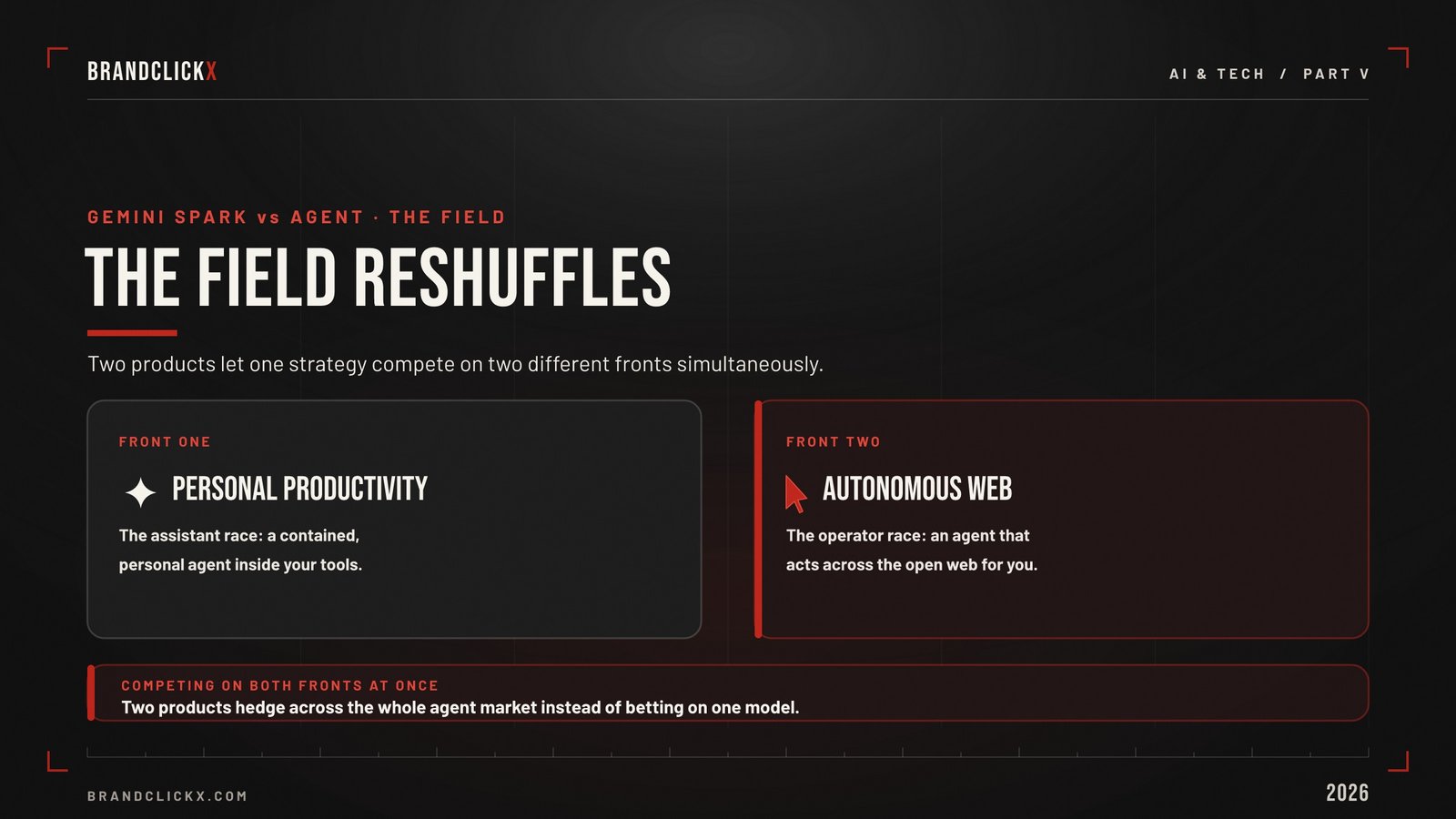
The Gemini Spark and Agent reveal doesn’t exist in a vacuum. It landed inside a competitive environment where every major AI platform is making its most consequential architectural bet simultaneously.
OpenAI’s ChatGPT agent is browser-first, operating within a sandboxed environment that balances capability with containment. Its strength is cross-site web navigation; its limitation is the absence of deep first-party data integration at the consumer level.
Anthropic’s Claude Cowork works directly on a user’s desktop closer to the operating system layer, with direct file and application access. Its strength is local context and workflow integration; its limitation is the requirement for desktop installation and the absence of Google-scale data infrastructure.
Microsoft’s Copilot is grounded in the Office 365 ecosystem deeply integrated with the productivity tools that most enterprise workers use daily. Its limitation is that Office 365 is also its ceiling. Tasks that require open web access or non-Microsoft system interaction require workarounds.
Apple, notably, is preparing a revamped Siri for WWDC 2026 that will be partly powered by Google’s own Gemini models through a multi-year deal which means Google’s agent architecture has already secured a distribution channel inside the world’s most valuable hardware ecosystem.
The Bigger Shift: Google’s I/O 2026 announcements represent a calculated response to a genuine platform risk the slow erosion of the browser and the search box as the primary interface between consumers and digital services.
By embedding Gemini agents into the device layer (Android), the productivity layer (Workspace), the browser layer (Chrome), the XR layer (Android XR glasses), and the search layer (AI Mode), Google is attempting to make Gemini the ambient computing interface across every surface it already controls.
This is not a product strategy. It is a platform defense. And the leaked code the diamond and the pointer, hidden in an Android app build before anyone had drafted the keynote script told the story days before Sundar Pichai walked on stage to confirm it.
Part VI: What This Means for Marketers and Marketing Teams Right Now
The Operational Implications of the Agentic Gemini Era
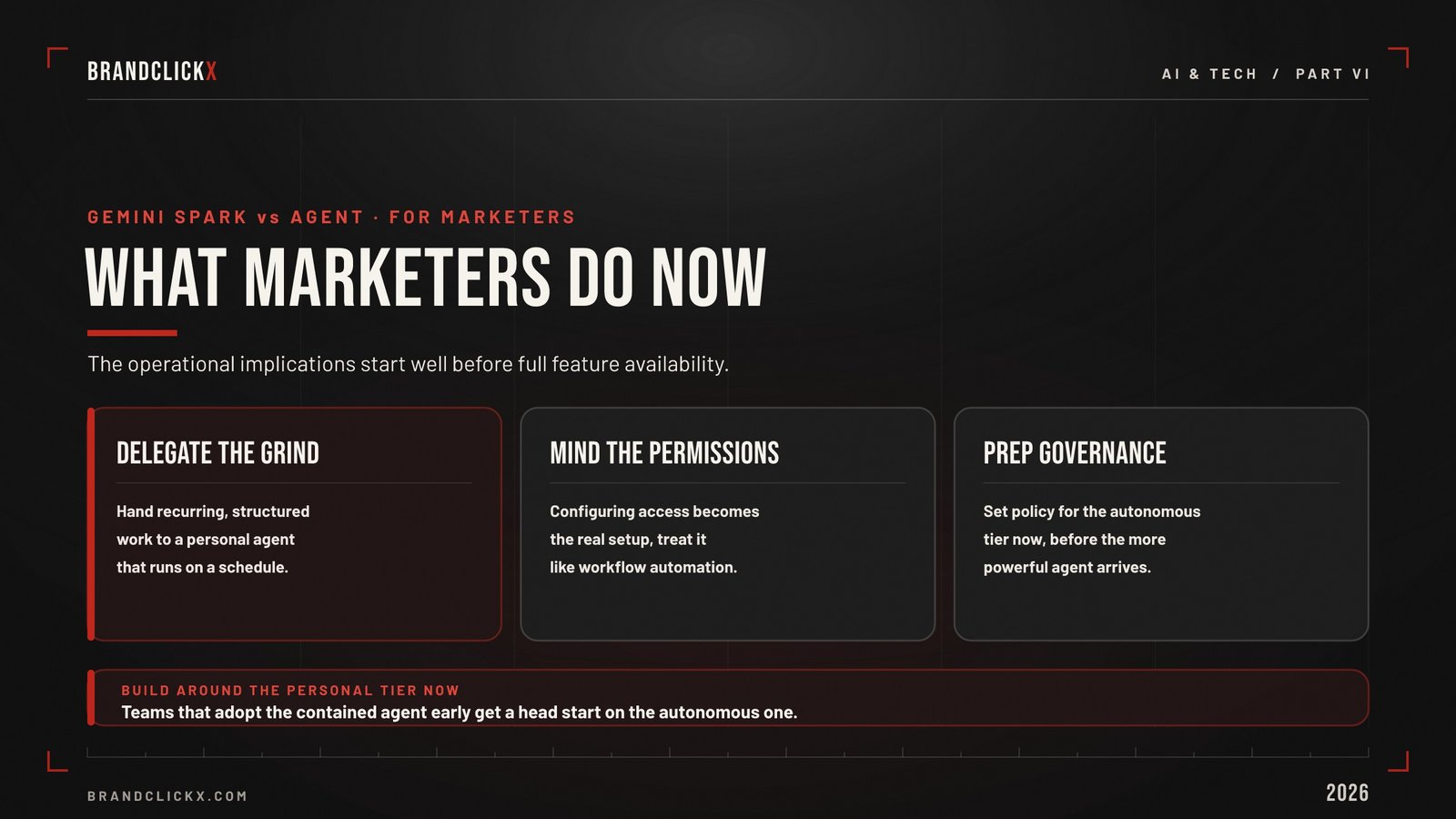
For CMOs and marketing technology leaders, the Gemini Spark and Agent architecture has immediate operational implications that don’t require waiting for full feature availability.
The MCP Ecosystem Is the New API Economy
Every marketing tool that wants to be part of an agent’s workflow needs an MCP integration. Canva’s MCP integration with Spark confirmed at I/O means Spark can create, modify, and export design assets as part of a multi-step campaign workflow.
Instacart’s MCP integration means Spark can place orders on behalf of users. The brands building MCP connectors now are positioning themselves as default tools in agent-mediated workflows that will become the primary interface for knowledge workers within 24 months.
Scheduled Tasks Replace Manual Reporting
Spark’s Schedule functionality time-based triggers that fire even when a device is off directly replaces the recurring manual tasks that consume the most unproductive hours in marketing operations: weekly performance report compilation, inbox triaging, content calendar monitoring, competitor alert tracking, campaign pacing checks.
These are not creative tasks. They are coordination tasks. Spark is designed to own them.
The Permission Screen Is the New UI
As The Neuron correctly observed post-I/O: the permission screen in Spark’s setup flow has become the new user interface. Users who configure which data Spark can access, which actions require confirmation, and which workflows run autonomously are essentially programming their own operational model.
Marketing teams need to think about Spark configuration the way they currently think about workflow automation setup with the same rigor around permissions, escalation rules, and audit trails.
Skills Are the New Prompt Library
The Skill architecture in Spark where users define reusable instruction sets that the agent applies automatically replaces the prompt library concept that marketing teams have been building for two years. The practical shift: instead of maintaining a document of prompts for common tasks, teams will build Spark Skills that execute those tasks automatically when conditions are met.
The skill isn’t invoked by a human. It is invoked by context.
Tactical Framework What Marketing Teams Should Do Now:
| Action | Timeline | Strategic Rationale |
| Audit recurring manual tasks for Spark delegation | Immediate | Identify highest-ROI automation targets |
| Evaluate MCP integrations for core marketing tools | 30 days | Ensure tools remain agent-accessible |
| Build a Spark Skills roadmap for content workflows | 60 days | Replace manual prompt libraries with persistent skills |
| Assess Gemini Agent risk/governance framework | 90 days | Prepare enterprise policy before Agent availability |
| Pilot Spark for campaign reporting automation | Q3 2026 | Generate baseline data for broader rollout |
Part VII: The Trust Problem Google Still Has to Solve
Why the Onboarding Warning Matters More Than Any Feature
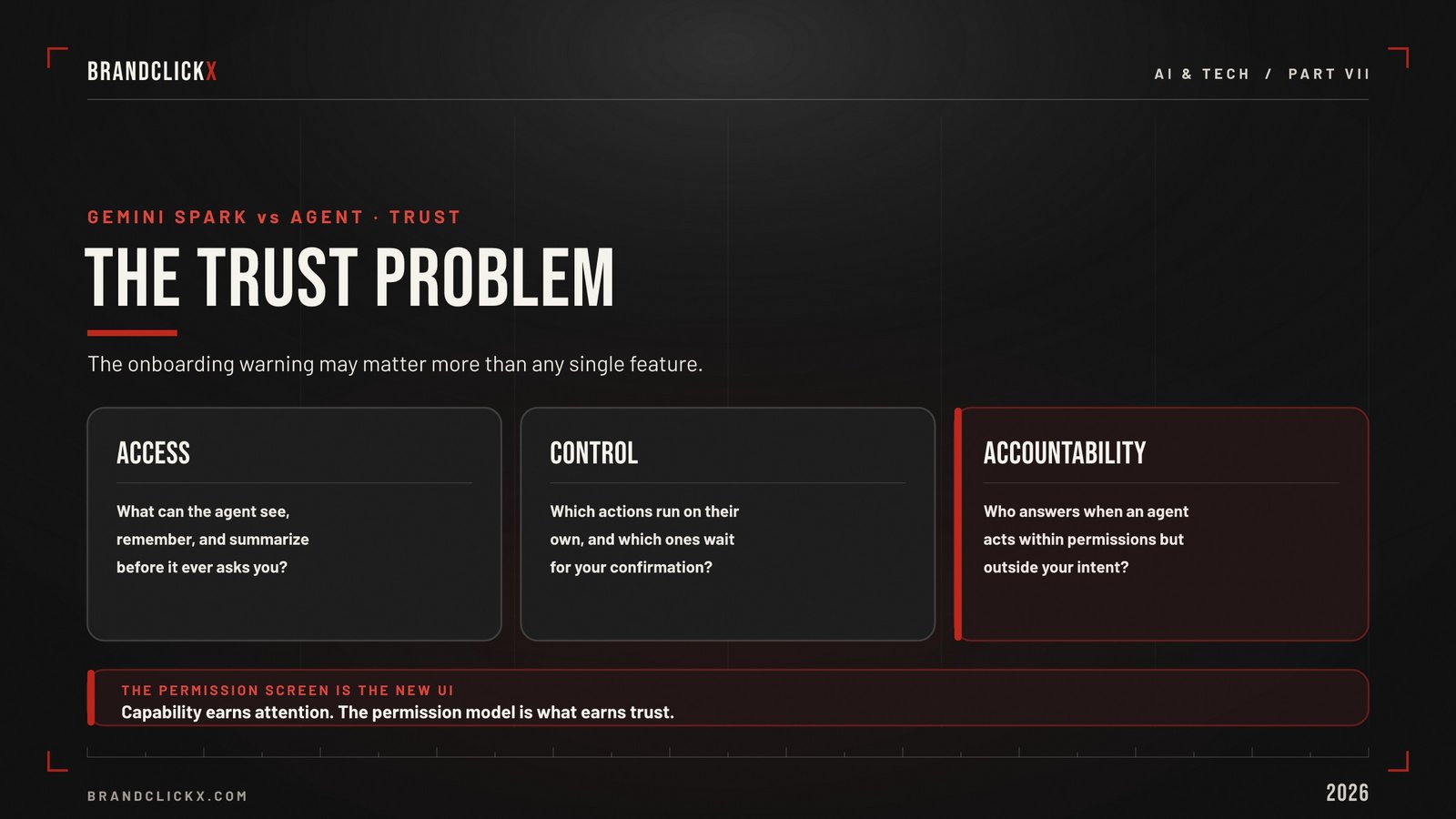
The remote browser data warning in Gemini Agent’s setup flow is, in one sense, just a terms-of-service disclosure. In another sense, it is the most important product signal Google released at I/O 2026 because it acknowledges something that the entire AI agent industry has been circling around without saying directly.
Autonomous agents operating in digital environments generate trust problems that no amount of capability demonstration resolves. Users understand what a chatbot can and cannot do.
They do not yet have a working mental model for what a persistent, autonomous agent running on cloud infrastructure can see, remember, access, and decide before it reaches the confirmation step.
Expert Insight: Google says Spark asks before high-stakes actions like spending money or sending emails. That is the right default. The harder question is how users will understand what an agent is allowed to see, remember, summarize, and decide in the process of reaching that confirmation step.
The permission screen becomes the new user interface precisely because it is the only moment at which the user’s mental model and the agent’s operational reality align.
For enterprise deployment, this trust problem translates into a governance problem. Who configures agent permissions? Who audits agent actions? Who is accountable when an agent takes an action that falls within its permissions but outside the spirit of its instructions?
These are not hypothetical questions. They are the questions that will determine enterprise adoption velocity for the next 18 months.
Market Observation: Google has built a multi-layer security gate limiting which devices qualify for full agent access currently prioritizing recent Pixel and Galaxy hardware. Even Google AI Ultra subscribers at the $100/month tier will face usage caps on Spark and Agent usage.
These constraints are not just supply management. They are trust infrastructure a staged rollout designed to generate behavioral data about how users interact with autonomous agents before the product reaches mass market scale.
The Bigger Picture: From Chatbot to Action Layer
Google’s Real I/O 2026 Announcement
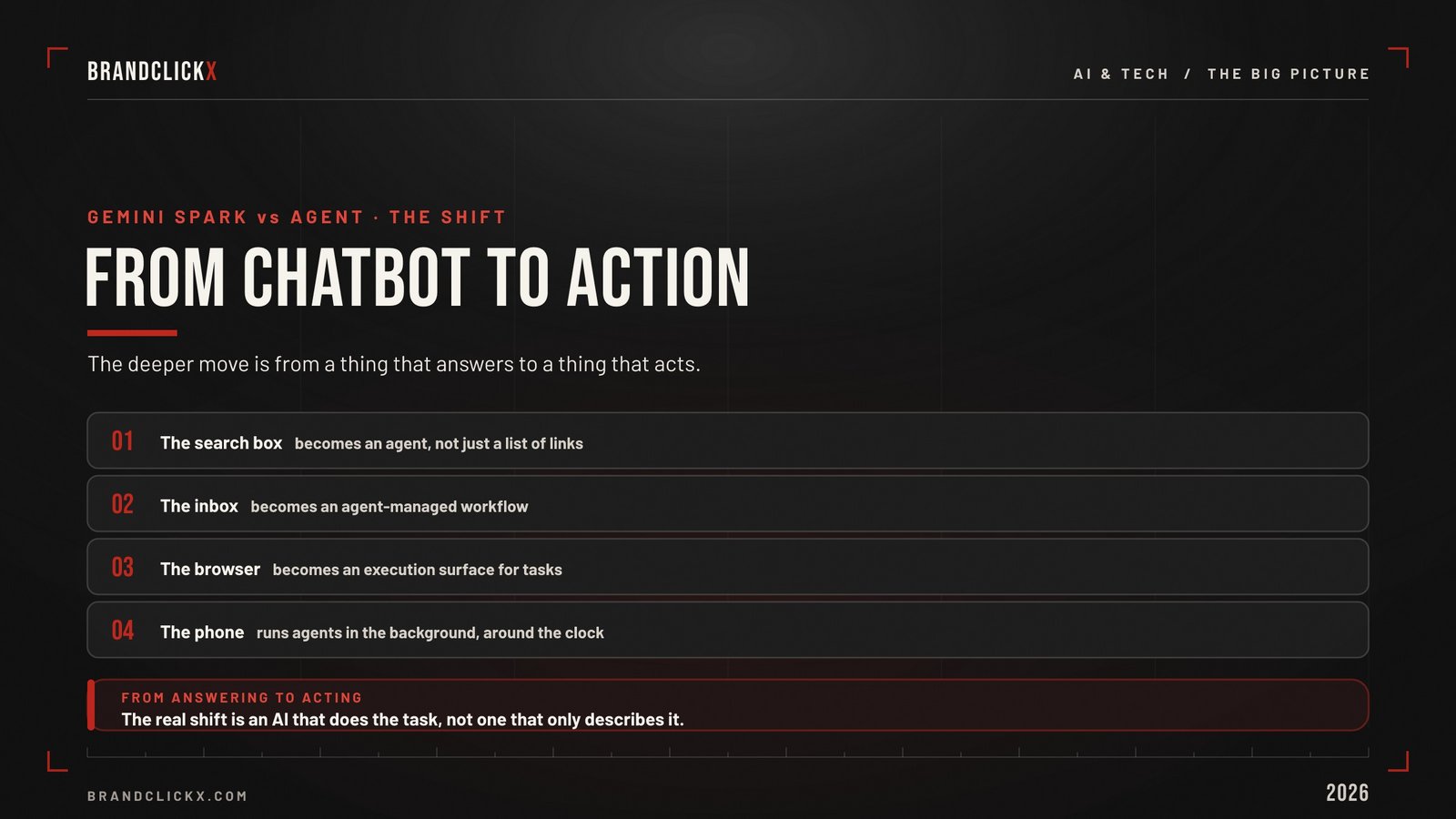
Strip away the demos, the benchmark slides, the XR glasses, and the Gemini Omni video generation capabilities all of which are genuinely significant and Google I/O 2026 made one architectural argument from every direction: Gemini is becoming the action layer across the internet Google already controls.
The search box is becoming an agent. The inbox is becoming an agent-managed workflow. The browser is becoming an execution environment for autonomous tasks. The productivity suite is becoming a system that delegates to agents rather than waiting for human prompts. The phone is becoming a device that runs agents in the background 24/7.
The diamond and the pointer Spark and Agent are the consumer-facing expressions of this architectural shift. But the shift itself is the Antigravity platform, the MCP ecosystem, the Gemini 3.5 model family, and the decision to treat every Google product surface as an agent deployment opportunity simultaneously.
What Happens Next: Spark’s Chrome integration running directly within the browser as an agentic layer across the web is scheduled for later this summer. Android Halo, the new UI surface for viewing live agent updates and task progress, arrives later this year.
Enterprise-grade Spark capabilities with expanded access controls are scheduled for 2026 Q3-Q4. Gemini Agent’s broader availability timeline has not been publicly confirmed.
The code was extracted in May. The keynote confirmed it in mid-May. The industry is still processing what it means.
Key Takeaways
- The code leak wasn’t a leak. It was a preview. Google App production builds rarely contain unreleased animation assets accidentally. The Spark and Agent identities were discoverable before I/O because they were ready and because the ecosystem benefits from pre-briefing its developer and enterprise audience before the keynote lands.
- The diamond vs. pointer distinction defines two different risk profiles. Spark operates within Google’s ecosystem with explicit permission gates. Agent operates on the open web with remote code execution. They are not two versions of the same product. They are two different products solving two different problems for two different risk tolerances.
- MCP is now the integration standard that matters. Google adopting MCP Anthropic’s open protocol as the integration standard for Spark’s third-party connectivity means that MCP is no longer one platform’s API choice. It is the cross-platform standard for agent tool integration. Building MCP connectivity is no longer optional for any software product that wants to remain relevant in agent workflows.
- The permission screen is the product. For agents to achieve mass adoption, users need to trust the permission model before they trust the capability. Google’s onboarding design for both Spark and Agent reflects an understanding that the permission architecture is as important as the task execution architecture.
- This is a platform defense, not a product launch. Google is embedding Gemini agents into Android, Workspace, Chrome, Search, and XR hardware simultaneously because it is defending the interface layer it has built over 25 years against a competitive environment in which autonomous AI agents could make that interface layer irrelevant.
FAQ: Google Gemini Spark and Gemini Agent
What is Gemini Spark?
Gemini Spark is Google’s 24/7 personal AI agent, announced at Google I/O 2026, that runs continuously on Google Cloud virtual machines even when your device is off. Powered by Gemini 3.5 and the Antigravity harness, it executes multi-step tasks, recurring schedules, and personalized skill sets across Gmail, Calendar, Google Docs, and third-party apps via MCP.
What is Gemini Agent and how is it different from Gemini Spark?
Gemini Agent is a separate, more powerful AI agent product revealed in Google App code ahead of I/O 2026. Spark carries a diamond icon and operates within a permission-gated personal productivity context. Gemini Agent uses a mouse pointer icon and includes onboarding warnings about remote browser data access and remote code execution capabilities that enable deeper, more autonomous web and system-level operations.
What is Google Antigravity?
Google Antigravity is the agent orchestration harness powering Gemini Spark and Google’s broader agentic ecosystem. Antigravity 2.0, announced at I/O 2026, is a standalone desktop application for managing and running multiple AI agents simultaneously, integrating with Google Cloud, Firebase, and developer-built custom agents via the Google ADK.
What does the Gemini agent bifurcation mean for enterprise marketing teams?
For enterprise marketing, Spark handles recurring structured tasks content scheduling, inbox management, campaign tracking while Agent is positioned for more complex autonomous web-based execution. Teams building Spark task-skill-schedule workflows now will have a structural advantage when Agent-tier capabilities become broadly available.
Is Gemini Spark available now?
Gemini Spark is rolling out initially to trusted testers, with a broader beta planned for Google AI Ultra subscribers in the U.S. at $100 per month. Enterprise access is available through Gemini Enterprise, connecting to existing Workspace connectors including Microsoft SharePoint, OneDrive, and ServiceNow.
Conclusion: The Most Important Thing Wasn’t on the Keynote Slide
There is a tendency in AI coverage to treat every major platform announcement as the definitive moment the launch, the demo, the benchmark, the number. Google I/O 2026 had all of those. But the most telling signal came from a researcher extracting animation files from an Android app build before the event had started.
Two icons. Two product names. Two fundamentally different architectures for how an AI agent interacts with the world.
The diamond contained, personal, operating within explicit permissions in a trusted ecosystem. The pointer reaching outward, navigating external environments, executing code on remote systems.
Google built both because the agentic computing era doesn’t have one shape. It has a consumer shape and an enterprise shape, a personal productivity shape and an autonomous operator shape. The brands and teams that understand this distinction now that internalize the difference between an agent that executes on your behalf within defined bounds and an agent that navigates the world on your behalf will be positioned to build on top of both when the full platform is available.
The rest will be reading about it in the code after it’s already shipped.