

Introduction: The $12.8 Billion Market That Rewired Who Gets to Build Software
Something fundamental shifted in software development in 2026.
It wasn’t just that developers got faster. It was that the definition of “developer” itself started to dissolve.
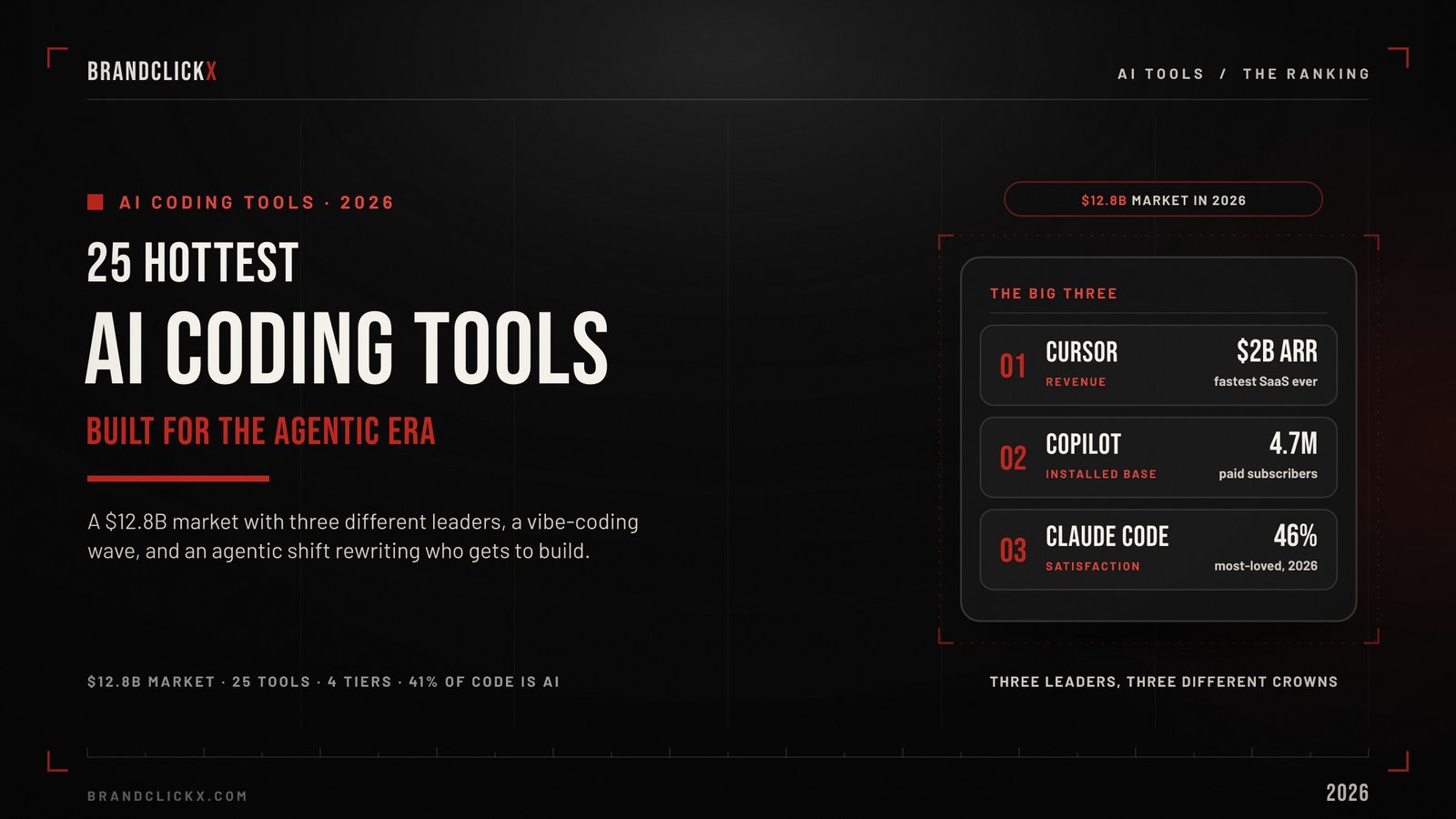
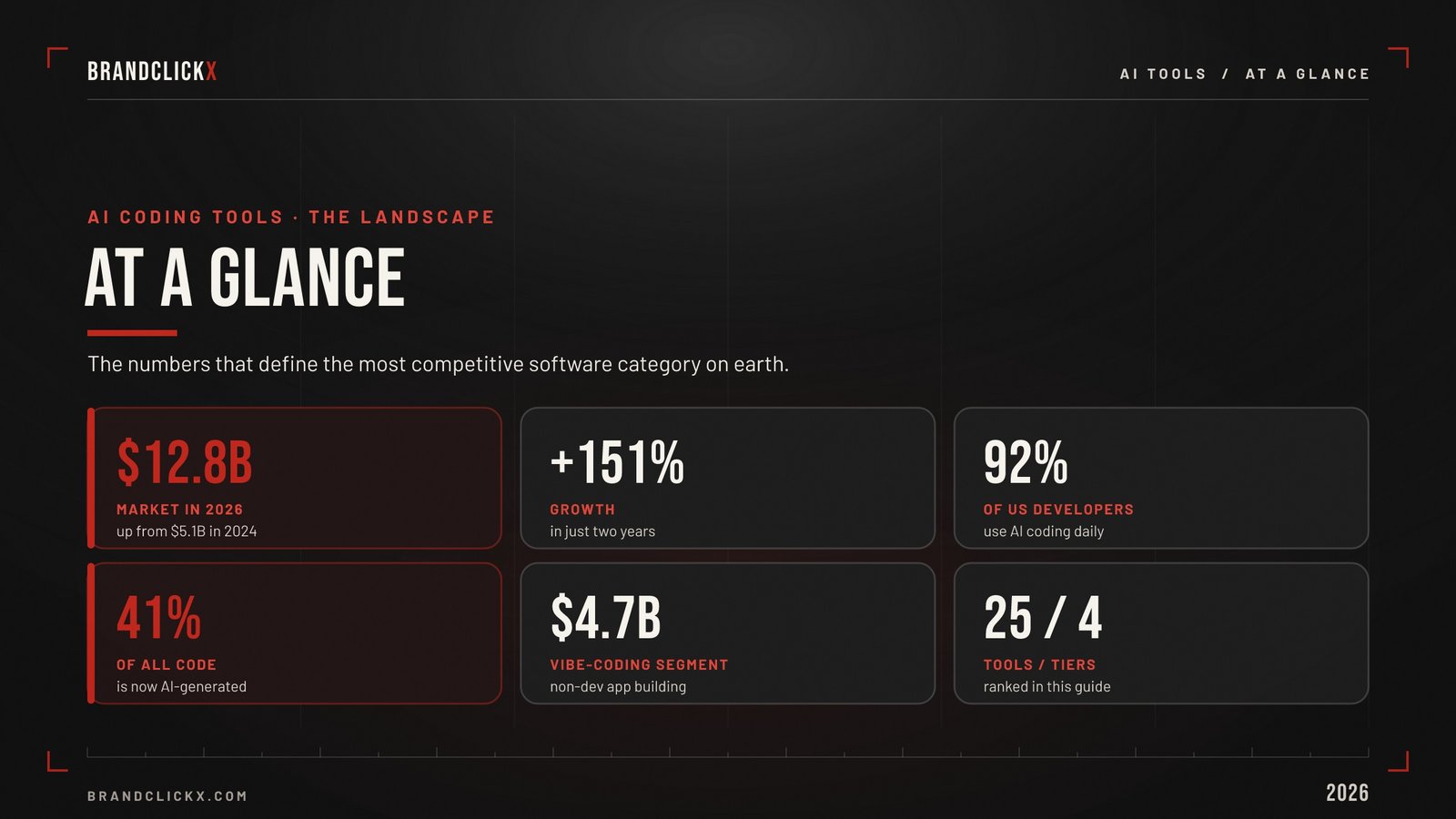
The AI coding tools market hit $12.8 billion in 2026, up from $5.1 billion in 2024. 92% of US developers now use AI coding tools daily. 41% of all code written globally is AI-generated. And in the vibe coding segment alone tools that let non-developers build apps from plain-language prompts 63% of users have no technical background whatsoever.
Cursor built $2 billion in annual recurring revenue in under 24 months the fastest B2B SaaS scaling in recorded history. Claude Code went from zero to a $2.5 billion revenue run rate in nine months. Lovable, which lets anyone build a web app from a sentence, closed a Series B at a $6.6 billion valuation.
And GitHub Copilot the tool that started all of this now has 4.7 million paid subscribers spanning 75% of the Fortune 100.
The hierarchy is clear. The competitive dynamics are fierce. And the tools that matter in 2026 are not the ones from three years ago.
This is the definitive guide to the 25 hottest AI coding tools right now who they’re built for, what makes each one worth your attention, and where each sits in the broader landscape of the most competitive software category on earth.
How We Evaluated These Tools
Every tool on this list was evaluated on five criteria:
- Capability — core performance on real-world coding tasks
- User base and adoption — actual usage data, not marketing claims
- Business momentum — revenue, valuation, funding, growth trajectory
- Who it’s built for — professional developers, non-technical builders, or both
- Where it’s heading — agentic capabilities and 2026 roadmap direction
The list is organized into four tiers: the Big Three market leaders, the challenger pack, the vibe coding platforms for non-developers, and the specialist tools worth knowing.
The Big Three: Market Leaders by Revenue, Users, and Satisfaction
1. Cursor The Fastest SaaS in History
Built for: Professional developers, engineering teams, enterprise
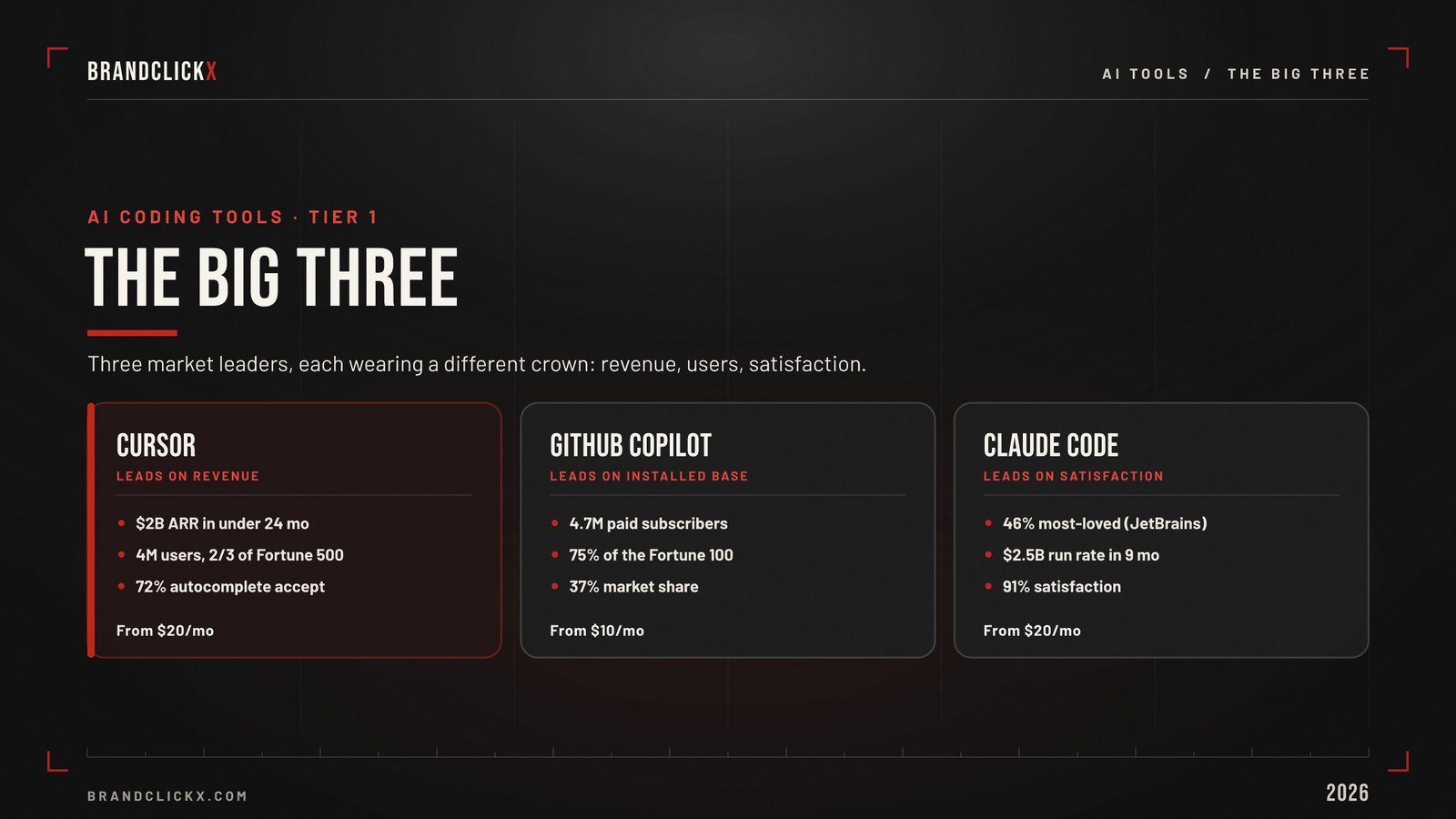
The numbers: $2B ARR in under 24 months. 4 million users. Two-thirds of the Fortune 500 using the product. Currently in talks to raise at $50 billion valuation nearly double its $29.3 billion raise from five months ago.
No B2B software company has ever scaled this fast. Not Wiz. Not Deel. Not Ramp.
Cursor started as an AI-enhanced code editor and has evolved into something categorically different. Its Composer model handles multi-file changes, automated testing loops, and self-correcting code generation. Background agents work on tasks autonomously while developers focus on something else entirely.
The March 2026 Composer 2 update running on the Moonshot Kimi K2.5 model ships a 72% autocomplete acceptance rate, the highest published figure in the category.
Enterprise depth: 60% of Cursor’s revenue now comes from enterprise customers. NVIDIA, Uber, Adobe, Salesforce, and PwC are publicly disclosed clients.
Why it leads: Cursor wins for engineers who do their primary editing in an AI-first IDE. It has the deepest context window in the category, the best multi-file editing, and the strongest enterprise governance features.
Watch: Competition from Claude Code on satisfaction scores is intensifying. Claude Code is taking share on agentic, multi-step coding work Cursor’s most strategically important battleground.
Pricing: Free / Pro $20/mo / Business $40/mo / Enterprise custom
2. GitHub Copilot The Installed Base King
Built for: Enterprise developers already in the Microsoft ecosystem
The numbers: 4.7 million paid subscribers. 75% of the Fortune 100. 37% market share by user base. Present in 90% of Fortune 100 engineering organizations.
GitHub Copilot is not the most loved tool in the category. It scores just 9% in JetBrains’ most-loved survey, versus 46% for Claude Code. But it is the most embedded and in enterprise software, distribution beats satisfaction until satisfaction becomes a switching trigger.
Copilot’s strength is the Microsoft flywheel. It lives inside VS Code and GitHub, the two most-used developer tools in the world. It integrates with Azure, Dynamics, and Microsoft 365 Copilot in ways no competitor can match from outside the ecosystem.
Copilot Workspace its agentic mode for multi-step task execution launched in 2025 and is now the primary battleground with Cursor and Claude Code.
The threat: Satya Nadella publicly acknowledged that flat-fee AI models will shift to pay-per-use as inference costs for autonomous agents become unsustainable at fixed pricing. That transition will pressure Copilot’s pricing model significantly.
Why it leads: Installed base, enterprise procurement channels, Microsoft ecosystem integration. Difficult to dislodge once embedded in an organization’s GitHub workflow.
Pricing: Free tier / Individual $10/mo / Business $19/mo / Enterprise $39/mo
3. Claude Code (Anthropic) The Satisfaction Champion
Built for: Senior developers, autonomous agentic workflows, terminal-first teams
The numbers: $2.5 billion revenue run rate by February 2026 zero to $2.5B in nine months. 46% most-loved in JetBrains’ April 2026 survey, versus 19% for Cursor and 9% for Copilot. 91% customer satisfaction score.
At-work usage grew 6x between April 2025 and January 2026. 75% of startups report Claude Code as their primary AI coding tool.
Claude Code operates differently from every other tool on this list.
It runs in the terminal. It doesn’t have an IDE. It reads your entire codebase, understands the architecture, and executes multi-step tasks writing, testing, debugging, refactoring as autonomous agents. Senior developers prefer it precisely because it treats them as architects setting direction, not beginners needing hand-holding.
The integration with Cursor Claude Code as the model powering Cursor’s agentic workflows has become a common production stack. The tools are as much collaborators as competitors.
Expert Insight: JetBrains’ April 2026 survey found that 46% of senior developers named Claude Code their most-loved tool a satisfaction differential over the market leader that has no historical precedent in developer tooling. Satisfaction at this level is a leading indicator of market share shift.
Why it leads: Deepest agentic capability, highest developer trust, strongest performance on complex multi-file reasoning tasks.
Pricing: Included in Claude Pro ($20/mo) and Claude Max ($100/mo) / Enterprise via Anthropic API
The Challenger Pack: Fast-Growing, Category-Defining
4. Windsurf (formerly Codeium)
Built for: Professional developers who want a Cursor alternative with stronger agentic flows
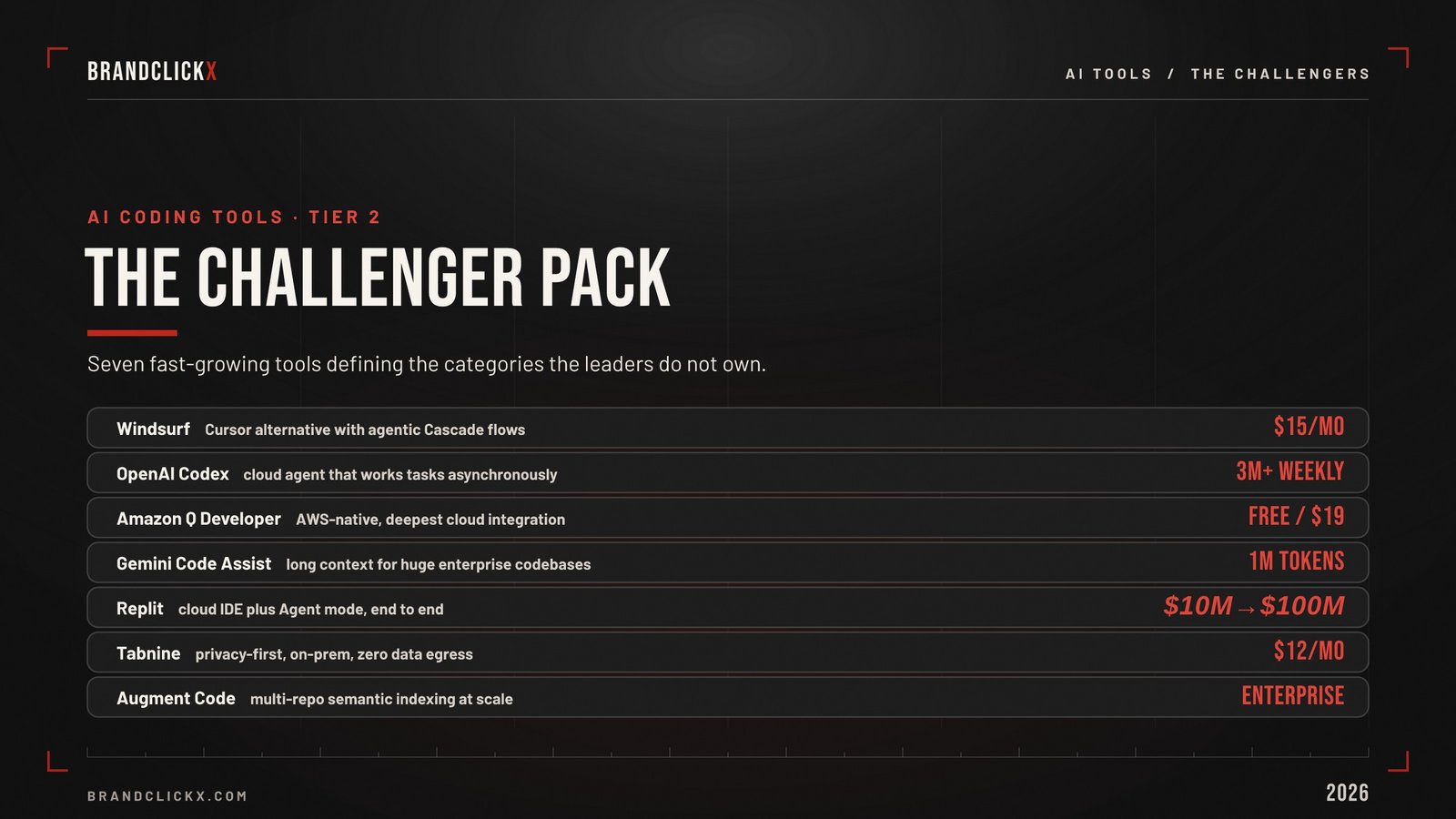
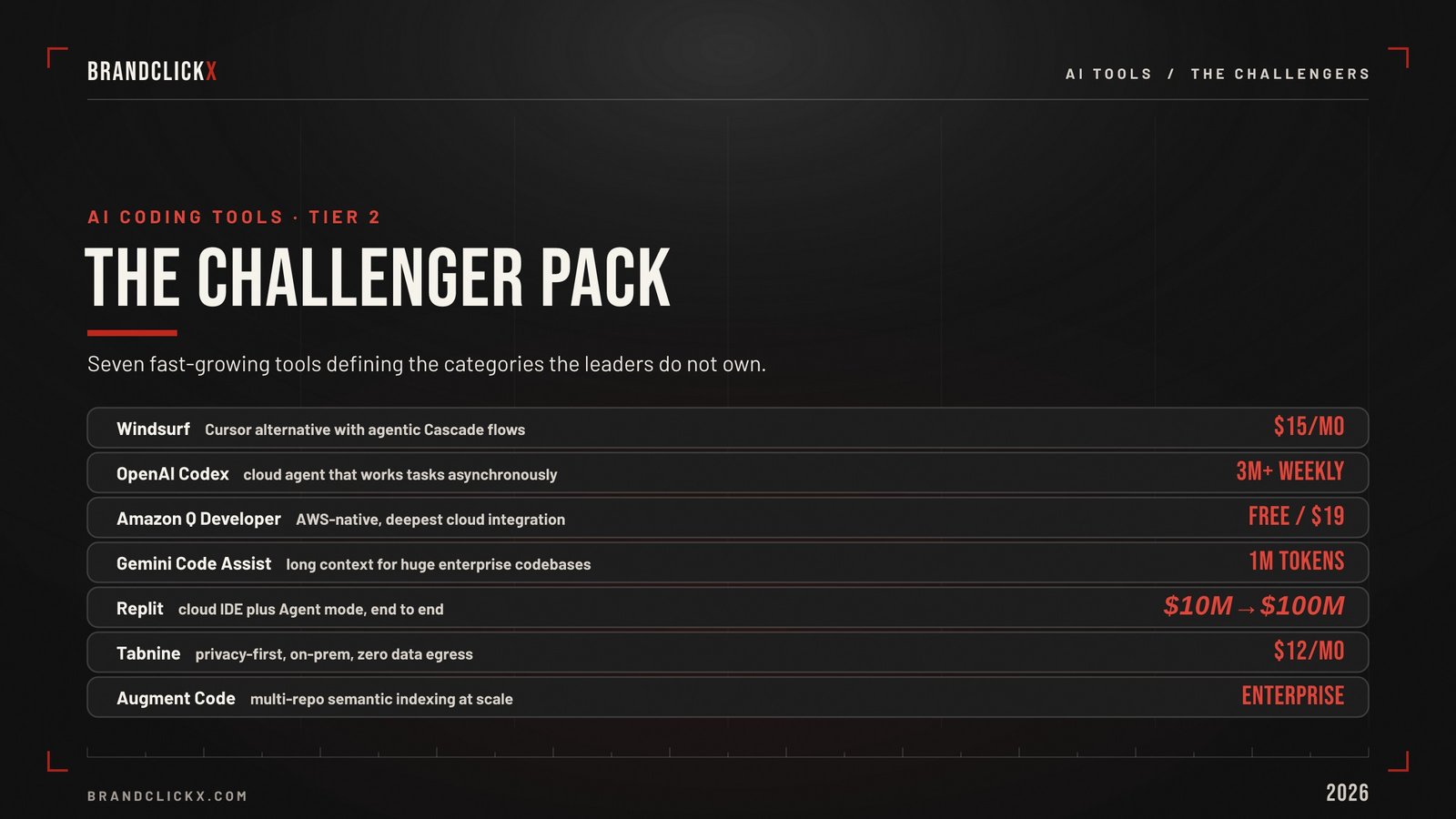
Windsurf is the most dramatic rebranding story in the developer tools market. Codeium which had built a free, privacy-focused AI coding assistant to over 1.3 million users relaunched as Windsurf with a full IDE and a focus on agentic “Cascade” workflows.
The Google-Windsurf deal that fell apart is the story most people know: Windsurf’s CEO and co-founder were set to join Google DeepMind after an acquisition that collapsed. The company now operates independently with new leadership.
Despite the leadership turbulence, Windsurf’s core product is strong. Cascade its agentic multi-step task execution system competes directly with Cursor Composer and Claude Code on deep codebase reasoning. Developers who find Cursor too expensive at enterprise tiers frequently evaluate Windsurf as their primary alternative.
Why it matters: The Windsurf saga is also the clearest signal that major platform players Google, Microsoft, OpenAI view the AI coding IDE layer as strategically important enough to acquire rather than build.
Pricing: Free / Pro $15/mo / Teams $35/mo
5. OpenAI Codex
Built for: Cloud-native agentic coding, API-first developers
The numbers: From near-zero in mid-2025 to 3+ million weekly active users by April 2026.
Codex is OpenAI’s re-entry into the coding tools category as a dedicated product not just a model powering other tools. It runs as a cloud-based coding agent, spinning up sandboxed environments to execute tasks, run tests, and iterate on code without requiring local installation.
The key architectural distinction: Codex operates fully in the cloud, which makes it the natural fit for teams that want to delegate coding tasks to an agent that works asynchronously rather than sitting in an IDE waiting for a developer to review each step.
Why it matters: OpenAI’s distribution advantage 500 million ChatGPT users, deep enterprise relationships makes Codex’s growth trajectory less dependent on developer community adoption than any other tool on this list.
Pricing: Usage-based via OpenAI API / ChatGPT Pro subscribers get access
6. Amazon Q Developer
Built for: AWS-native development teams, enterprise engineering organizations
Amazon Q Developer is the most underrated tool in the enterprise segment because it requires being all-in on AWS to fully appreciate.
For teams already running on AWS infrastructure, Q Developer’s zero-cost entry point (for individual developers on the free tier) and deep AWS service knowledge make it the most immediately useful AI coding assistant available without API configuration.
It understands CloudFormation, Lambda, S3, and the broader AWS service catalog natively not through a generic model trained on documentation.
The workspace agent launched in 2025 handles multi-step code transformation tasks, security scans, and infrastructure-as-code generation across entire repositories.
Why it matters: Q Developer is the enterprise answer to the “which AI coding tool do we standardize on?” question at AWS-native organizations. It reduces the vendor proliferation problem that IT security teams are increasingly flagging.
Pricing: Free tier (individual) / Pro $19/user/month
7. Google Gemini Code Assist
Built for: Google Cloud organizations, enterprise teams using Google Workspace
Gemini Code Assist is Google’s most direct response to GitHub Copilot a full IDE integration for VS Code and JetBrains that brings Gemini’s long-context window (up to 1 million tokens) to bear on large, complex codebases.
JetBrains’ January 2026 AI Pulse survey placed Google’s coding tools at 6% adoption fast for a Google developer product, but still well behind the market leaders. The Windsurf CEO’s planned move to Google DeepMind to work on agentic coding even after the acquisition fell apart signals that Google is taking the agentic coding layer seriously as a strategic priority.
Why it matters: Gemini’s long-context window is a genuine differentiator on large enterprise codebases where most tools hit context limits. For monorepo environments with millions of lines of code, context depth is the deciding factor.
Pricing: Standard tier included with Google Workspace / Enterprise custom
8. Replit
Built for: Beginners, collaborative projects, non-developers building MVPs, education
The numbers: Grew from $10M to $100M ARR in 9 months after launching Agent mode.
Replit is the most complete end-to-end development environment on this list cloud IDE, AI coding assistant, deployment, collaboration, and hosting in a single browser-based platform. It is uniquely positioned between the professional developer tools and the vibe coding platforms, serving both.
The Agent mode launch was the inflection point. Rather than just suggesting code, Replit Agent takes a text description and builds, deploys, and iterates on a complete application handling both the coding and the infrastructure.
Why it matters: Replit is where millions of people learn to code and increasingly, where non-developers build their first real applications. Its educational market dominance creates a user pipeline that will feed professional developer tool adoption for years.
Pricing: Free / Core $25/mo / Teams $40/user/mo
9. Tabnine
Built for: Enterprise engineering teams with strict data privacy requirements
Tabnine is the oldest AI coding assistant on this list and deliberately so. While competitors have raced toward cloud-based agentic capabilities, Tabnine has doubled down on the enterprise privacy use case: local AI models, on-premise deployment, zero data leaving the organization’s infrastructure.
For financial services, healthcare, defense, and any regulated enterprise that cannot use cloud-based AI tools due to data residency or compliance requirements, Tabnine is frequently the only viable option.
Why it matters: Privacy-compliant AI coding is not a niche requirement. It is a prerequisite for a significant portion of the Global 2000. Tabnine owns that segment in a way that no cloud-first competitor can easily challenge.
Pricing: Basic free / Pro $12/mo / Enterprise custom (on-prem available)
10. Augment Code
Built for: Large enterprise engineering teams, complex multi-repo environments
Augment Code is built specifically for the problem that most AI coding tools handle poorly: massive codebases with millions of lines of code, dozens of repositories, and complex interdependencies.
Most AI coding tools struggle when the codebase exceeds their context window. Augment Code’s architecture is designed specifically for this environment using semantic indexing to understand the full codebase without requiring it to fit in a single context window, and building organizational memory that persists across sessions.
Why it matters: Enterprise engineering teams at scale not startups are Augment’s target. As AI coding becomes standard across engineering organizations, the tools that handle enterprise-scale complexity will command premium pricing and deep workflow integration.
Pricing: Enterprise, custom pricing
The Vibe Coding Platforms: Building Software Without Writing Code
11. Lovable
Built for: Non-technical founders, product managers, marketers building MVPs
The numbers: $300M+ ARR. $330M Series B. $6.6 billion valuation (December 2025).
Lovable is the breakout star of the vibe coding movement. Describe an app in plain language. Lovable generates the frontend, the backend logic, the database schema, and deploys it all without a developer in the loop.
The Figma-to-code integration is particularly powerful for design-led teams: import a design, describe the functionality, get a working application. For non-technical founders building B2B SaaS MVPs, Lovable has become the default starting point.
The limitation: Users consistently report the “ejection crisis” the moment a prototype built in Lovable needs to handle real production traffic, complex permissions, or relational data at scale. Lovable gets you to 70% quickly. The final 30% often requires a developer.
Why it matters: A $6.6 billion valuation for a tool launched a few years ago built almost entirely on non-developer adoption is the market’s clearest signal that the vibe coding category is real, large, and durable.
Pricing: Free / Starter $20/mo / Launch $50/mo / Scale $100/mo
12. Bolt.new (StackBlitz)
Built for: Full-stack prototyping, rapid MVP development, browser-based deployment
Bolt.new is the fastest tool on this list from prompt to deployed application. Everything happens in the browser no local environment setup, no deployment configuration, no DevOps knowledge required. Type a description, get a full-stack application running in minutes.
According to Zapier’s hands-on comparison, Bolt.new is particularly strong for “rapid startup prototyping and experimental projects” situations where speed of iteration matters more than production readiness.
The WebContainers technology powering Bolt.new runs a full Node.js environment in the browser which means the generated application isn’t a mockup. It is a running, functional application that can be exported and deployed.
Why it matters: The zero-setup, browser-only model removes the single biggest barrier for non-technical users trying vibe coding for the first time. No environment configuration means first-time success rates are dramatically higher.
Pricing: Free tier / Pro $20/mo
13. v0 by Vercel
Built for: Frontend developers, designers, marketing teams building UI components
Valuation: Vercel is valued at $3.25 billion following its Series E.
v0 does one thing better than any other tool on this list: generate beautiful, production-quality frontend UI components from text prompts.
It outputs shadcn/ui and Tailwind CSS components the two dominant frontend design systems in 2026 as live, editable React code. Import a screenshot, a Figma design, or write a description, and v0 returns a component that is ready to drop into a production codebase.
For marketing teams building landing pages, SaaS teams building dashboards, and agencies prototyping client work, v0 has become the fastest path from design intent to working component.
Why it matters: v0 has almost no competition at the intersection of design quality and code output quality. Most AI UI generators produce functional but ugly interfaces. v0 consistently produces interfaces that look designed because it was trained on some of the best UI libraries available.
Pricing: Free / Pro $20/mo
14. Replit (as a vibe coding platform)
Already covered in the challenger section, but worth noting separately: Replit’s Agent mode positions it as the most capable vibe coding platform for users who need backend logic and database integration, not just frontend generation.
It is the bridge between pure vibe coding and real application development.
15. Google Stitch
Built for: Absolute beginners, marketers, non-technical teams exploring AI app building
Google Stitch is the most accessible tool on this list fully free, browser-based, and optimized for users with no development experience whatsoever.
Launched through Google Labs, Stitch generates mobile-optimized web apps from prompts, with a focus on clean design and immediate shareability. It is not built for production application development.
It is built for quick creation of simple tools, forms, calculators, and landing pages that look professional without requiring any code.
Why it matters: Google’s free-tier strategy Stitch, Pomelli, and other Labs tools is building the first touchpoint for millions of non-developers discovering that they can build software with AI. That installed base feeds the broader agentic tools ecosystem Google is building.
Pricing: Free (Google Labs)
The Specialist Tools: Purpose-Built for Specific Problems
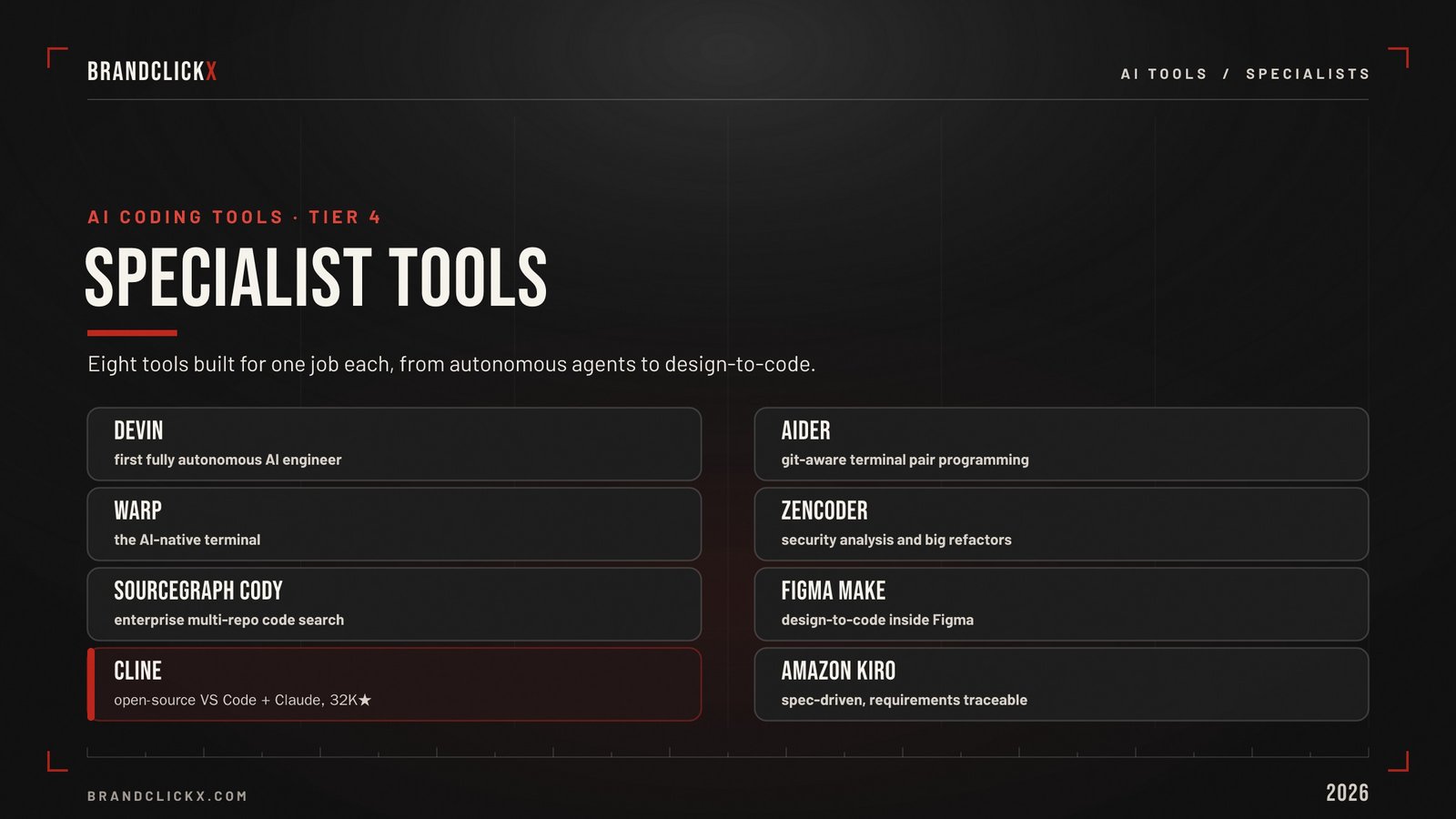
16. Windsurf Cascade (Standalone)
Already covered as Windsurf above but Cascade’s agentic workflow deserves specific mention as a standalone capability. It is one of the three strongest agentic coding workflows in the market alongside Cursor Composer and Claude Code, and the most underrated of the three.
17. Devin (Cognition AI)
Built for: Fully autonomous software engineering tasks
Devin was the first tool to claim the title of “world’s first AI software engineer” capable of completing full software engineering tasks end-to-end, including planning, coding, testing, and deployment, without human intervention at each step.
The Cognition AI team built Devin specifically for the senior engineering use case: hand it a GitHub issue, a bug report, or a feature specification, and it works on the problem autonomously asking for clarification only when genuinely needed.
The reality: Devin’s benchmark performance is impressive. Production performance varies significantly by task complexity and codebase cleanliness. It is the most capable fully-autonomous coding agent available and the most dependent on a well-structured environment to succeed.
Pricing: Enterprise, usage-based
18. Warp
Built for: Developers who live in the terminal
Warp is the AI-powered terminal a replacement for the standard macOS and Linux command line that embeds AI assistance directly into the shell environment.
Rather than switching to a chat interface for coding help, Warp brings natural language command generation, error explanation, and workflow automation into the terminal itself.
For developers who do most of their work at the command line DevOps engineers, backend developers, systems architects it is a more natural AI integration point than an IDE.
Why it matters: Not every developer codes in an IDE. Terminal-native AI tooling is a significant underserved market that Warp is currently the only tool seriously addressing.
Pricing: Free / Team $22/user/mo / Enterprise custom
19. Sourcegraph Cody
Built for: Large enterprise engineering teams, code search and understanding
Sourcegraph built its reputation on enterprise code search the ability to find, understand, and navigate code across massive multi-repository codebases. Cody is the AI layer on top of that infrastructure.
Unlike most AI coding tools that struggle with large codebases by hitting context limits, Cody uses Sourcegraph’s code intelligence engine to understand the full codebase semantically meaning it can answer questions about architecture, find relevant code across repositories, and explain complex interdependencies at a level that general AI coding tools cannot.
Why it matters: Enterprise engineering organizations with 10+ million lines of code across dozens of repositories have a fundamentally different AI coding problem than startups. Sourcegraph Cody is the most purpose-built solution for that specific problem.
Pricing: Free / Pro $9/mo / Enterprise custom
20. Cline (formerly Claude Dev)
Built for: VS Code developers who want Claude’s capabilities in their existing editor
Cline is the open-source VS Code extension that brings Claude’s full agentic coding capabilities directly into Visual Studio Code including terminal access, file system operations, and browser automation.
It is not a product in the commercial sense. It is a community-built bridge between Claude’s API capabilities and the developer’s existing VS Code workflow. But with over 32,000 GitHub stars and a rapidly growing contributor base, Cline has become one of the most-used open-source developer tools in 2026.
Why it matters: Cline represents a significant threat to commercial AI coding tool vendors a free, community-maintained tool that delivers frontier model capabilities at API cost. Its growth is a leading indicator of the sustainability pressure on commercially priced AI coding tools.
Pricing: Free (open source) pay only for Claude API usage
21. Aider
Built for: Developers who prefer command-line pair programming with AI
Aider is the terminal-based AI coding assistant that has built one of the most dedicated communities in the developer tools ecosystem precisely because it is open source, runs anywhere, and supports multiple AI models including Claude, GPT-4, and Gemini.
The key Aider differentiator is git-aware coding it automatically commits changes, writes meaningful commit messages, and maintains a complete history of AI-assisted modifications. For teams with strong version control discipline, this auditability is a significant advantage over GUI-based tools.
Why it matters: Open-source AI coding tools like Aider and Cline are redefining the pricing floor for the category. They are also where many of the most technically sophisticated users the developers who influence platform choices at their organizations spend their time.
Pricing: Free (open source)
22. Zencoder
Built for: Large-scale code refactoring, security-focused teams
Zencoder uses semantic and syntactic analysis to understand and improve code across large projects. Its embedded agents learn from a specific repository over time building contextual understanding that improves with use rather than starting fresh with each session.
The security use case is particularly strong. Zencoder’s codebase analysis can identify security vulnerabilities, suggest remediations, and validate that fixes don’t introduce new issues a workflow that security engineering teams previously handled entirely manually.
Why it matters: Code security is increasingly a board-level concern. AI tools that specialize in security analysis rather than feature development are addressing a compliance and risk management need that is growing faster than general developer productivity.
Pricing: Pro plans starting at $19/mo / Enterprise custom
23. Figma Make (formerly Figma AI)
Built for: Designers who want to generate functional code from Figma designs
Figma Make takes the design-to-code workflow that previously required a skilled frontend developer and makes it accessible directly inside Figma. Describe a component, generate a design, export working code all without leaving the design tool.
The strategic importance: Figma is where product decisions are made. Embedding AI-assisted code generation directly in the design environment compresses the design-to-development handoff from days to minutes.
Why it matters: Figma Make is the most direct competitive threat to Claude Design and v0 in the design-to-code category. Its existing user base designers who already live in Figma gives it distribution advantages that standalone tools cannot match.
Pricing: Included in Figma Professional and Organization plans
24. Amazon Kiro
Built for: Spec-driven development, enterprise software teams
Amazon Kiro, launched at AWS re:Invent 2025, takes a fundamentally different approach to AI coding than any other tool on this list. Rather than generating code from a prompt and iterating, Kiro starts with a specification a structured document describing what the system should do and generates code that conforms to that specification.
The spec-first model has significant implications for enterprise software development, where requirements documentation, traceability, and compliance are as important as the code itself. Kiro maintains the connection between the specification and the generated code throughout the development lifecycle.
Why it matters: Kiro addresses the enterprise concern that AI-generated code lacks the auditability and requirements traceability that regulated industries require. If the spec-driven model gains traction, it could redefine how enterprise software teams use AI in their development workflows.
Pricing: Preview access (AWS customers)
25. Momen
Built for: Serious builders who need production-grade backends without traditional coding
Momen sits at the far end of the vibe coding spectrum closer to a visual development platform than a prompt-based app generator, but still accessible to non-developers.
Where Lovable and Bolt.new get you to 70% of a working application quickly and then hit scaling walls, Momen is designed specifically for the 30% that breaks vibe-coding prototypes: database design, complex business logic, ACID transactions, and production-grade API architecture.
Its AI Copilot generates database schemas automatically. Actionflows let users build complex transactional logic visually. The result is applications that are genuinely production-ready not just impressive demos that collapse under real usage.
Why it matters: The “ejection crisis” that Lovable and Bolt.new users hit when moving to production is Momen’s primary value proposition. As vibe-coded applications need to scale, the tools that bridge from prototype to production will become the most commercially important in the category.
Pricing: Free tier / Pro $29/mo / Team $49/user/mo
The 2026 AI Coding Tool Landscape at a Glance
| Tool | Best For | Pricing Start | Key Stat |
| Cursor | Professional devs, enterprise | $20/mo | $2B ARR, 4M users |
| GitHub Copilot | Microsoft ecosystem, enterprise | $10/mo | 4.7M paid subscribers |
| Claude Code | Senior devs, agentic coding | $20/mo (Pro) | 46% most-loved, $2.5B run rate |
| Windsurf | Cursor alternative, agentic | $15/mo | Rebuilt from Codeium |
| OpenAI Codex | Cloud-native agentic | Usage-based | 3M+ weekly active users |
| Amazon Q Developer | AWS-native teams | Free tier | Deepest AWS integration |
| Gemini Code Assist | Google Cloud, long context | Workspace included | 1M token context |
| Replit | Beginners, MVPs, education | Free | $10M → $100M ARR in 9 months |
| Tabnine | Privacy-first enterprise | $12/mo | On-prem deployment |
| Augment Code | Large codebases, enterprise | Custom | Multi-repo semantic indexing |
| Lovable | Non-dev founders, MVPs | $20/mo | $300M+ ARR, $6.6B valuation |
| Bolt.new | Full-stack browser prototyping | Free | Browser-native, zero setup |
| v0 by Vercel | UI components, frontend | Free | Best design quality output |
| Google Stitch | Absolute beginners | Free | Google Labs |
| Devin | Fully autonomous engineering | Custom | First AI software engineer |
| Warp | Terminal-native devs | Free | AI-native shell |
| Sourcegraph Cody | Large enterprise code search | $9/mo | Multi-repo semantic search |
| Cline | VS Code + Claude, open source | Free | 32K+ GitHub stars |
| Aider | Terminal pair programming | Free | Git-aware, open source |
| Zencoder | Security, large refactors | $19/mo | Learns your repo over time |
| Figma Make | Designers, design-to-code | Figma plan | Direct Figma integration |
| Amazon Kiro | Spec-driven enterprise dev | Preview | Requirements traceability |
| Momen | Production-grade no-code | $29/mo | ACID transactions, real backends |
Key Takeaways
- The category is splitting into two distinct markets. Professional developer tools (Cursor, Claude Code, Copilot, Windsurf) and vibe coding platforms (Lovable, Bolt.new, v0) are diverging. The overlap is shrinking. Choose based on who is building, not what is being built.
- Satisfaction and market share are decoupled and that matters. Claude Code has 46% most-loved versus Copilot’s 9%, but Copilot has 4.7 million paid subscribers. Satisfaction is a leading indicator of eventual market share shift. Watch Claude Code’s paid subscriber numbers in H2 2026.
- The agentic shift is the defining transition. Tools that require a human at every step are losing developer mindshare to tools that can plan, execute, test, and iterate autonomously. Cursor Composer, Claude Code, and Devin represent the direction the entire category is moving.
- Open source is the pricing floor. Cline and Aider deliver frontier model capabilities at API cost. Their growth is structural pressure on commercial pricing across the entire category.
- The vibe coding “ejection crisis” is a product opportunity. The most important unresolved problem in the category is the gap between rapid prototype (Lovable, Bolt) and production-ready application. The tools that bridge that gap Momen, Replit, Augment Code have the most durable commercial opportunity.
FAQ: Best AI Coding Tools 2026
What is the best AI coding tool in 2026?
It depends on your use case. Cursor leads on revenue ($2B ARR), GitHub Copilot leads on installed base (4.7M paid subscribers), and Claude Code leads on developer satisfaction (46% most-loved per JetBrains’ April 2026 survey). For non-developers building apps without code, Lovable and Bolt.new dominate the vibe coding market.
What is vibe coding and which tools support it?
Vibe coding building software by describing what you want in plain language became Collins Dictionary’s Word of the Year in 2025. In 2026, 63% of vibe coding users are non-developers. The primary platforms are Lovable ($300M+ ARR, $6.6B valuation), Bolt.new, v0 by Vercel, Replit, and Google Stitch.
How big is the AI coding tools market in 2026?
The AI coding tools market hit $12.8 billion in 2026, up from $5.1 billion in 2024 a 151% increase in two years. The vibe coding segment alone reached $4.7 billion. 92% of US developers now use AI coding tools daily, and 41% of all code written globally is AI-generated.
What is the difference between AI coding assistants and agentic coding tools?
Traditional AI coding assistants offer autocomplete and single-line suggestions. Agentic coding tools Cursor Composer, Claude Code, OpenAI Codex operate autonomously: planning multi-step tasks, reading entire codebases, running tests, and iterating on their own output without waiting for a human prompt at each step. Agentic coding is the defining shift of 2026.
Which AI coding tools are best for non-developers and marketers?
Lovable (app generation from prompts), Bolt.new (full-stack browser prototyping), v0 by Vercel (UI component generation), Replit (cloud IDE with Agent mode), and Google Stitch (free, beginner-friendly app building) are the best options for non-developers and marketing teams building without traditional coding backgrounds.
Conclusion: The Category Is Just Getting Started
The $12.8 billion market number is real. So is Cursor’s $2 billion ARR. So is the 92% developer adoption rate.
But the more important number is the one that captures where this is all going: 41% of all code written globally is now AI-generated. That figure was close to zero three years ago.
The tools on this list are not productivity enhancers for a software development process that stays fundamentally the same. They are the infrastructure for a new kind of software creation faster, more accessible, and increasingly autonomous that is still in its earliest stages.
Andrej Karpathy declared vibe coding “passé” in February 2026. His argument: the real value has moved to AI systems that plan, execute, test, and iterate on entire codebases. He is right. But that doesn’t mean vibe coding failed. It means the category matured faster than anyone expected.
The tools that survive the next three years will be the ones that bridge the gap between the speed of vibe coding and the reliability of production engineering. The ones that make agentic workflows accessible without making auditability optional. And the ones that prove quarter after quarter that the code they generate is code that actually works in the real world.
The 25 tools on this list are the current leaders. The winners of 2029 may not all be on it.
But they will be built on what these tools are proving right now.