Help desk solutions used to live in the basement of the org chart. They were an IT line item, a cost to contain, a queue someone else managed.
That era is over.
In 2026, the support layer sits closer to the brand than the marketing funnel does. It is where promises get tested. It is where loyalty is won or quietly lost. And it is where the steepest technology spend in customer operations is now flowing.
The market tells the story. The global help desk software space is valued near $14.3 billion in 2025 and is projected to reach roughly $35 billion by 2035, growing at about a 9.4 percent compound rate. Money does not move like that toward a cost center. It moves toward strategic ground.
Why It Matters: The team that answers your customers is now the team that defines your reputation in real time. For CMOs and growth leaders, that makes the help desk a brand asset, not an afterthought.
Why Help Desk Solutions Moved From IT Cost to Brand Strategy
For two decades, the goal of support was simple. Close tickets fast and keep costs down.
The new goal is harder. Resolve the issue, protect the relationship, and capture the data, all at once.
Customer patience collapsed over the past few years. People expect instant answers across chat, email, social, and voice, on a Sunday night, in their own language. They no longer compare your support to your competitor’s support. They compare it to the fastest experience they have ever had anywhere.
This is the part most leaders underestimate. A slow refund or a clumsy bot does not just annoy one customer. It shows up in reviews, in churn, and in the cost of winning that customer back through paid media.
Market Observation: Support failure is now a marketing expense. Every unresolved ticket eventually buys itself a retargeting ad.
That reframing is why budgets shifted. Help desk solutions stopped being judged on cost per ticket alone. They started being judged on retention, lifetime value, and brand trust.
The New Math: What Help Desk Solutions Actually Cost in 2026
Here is where the conversation gets interesting for finance teams.
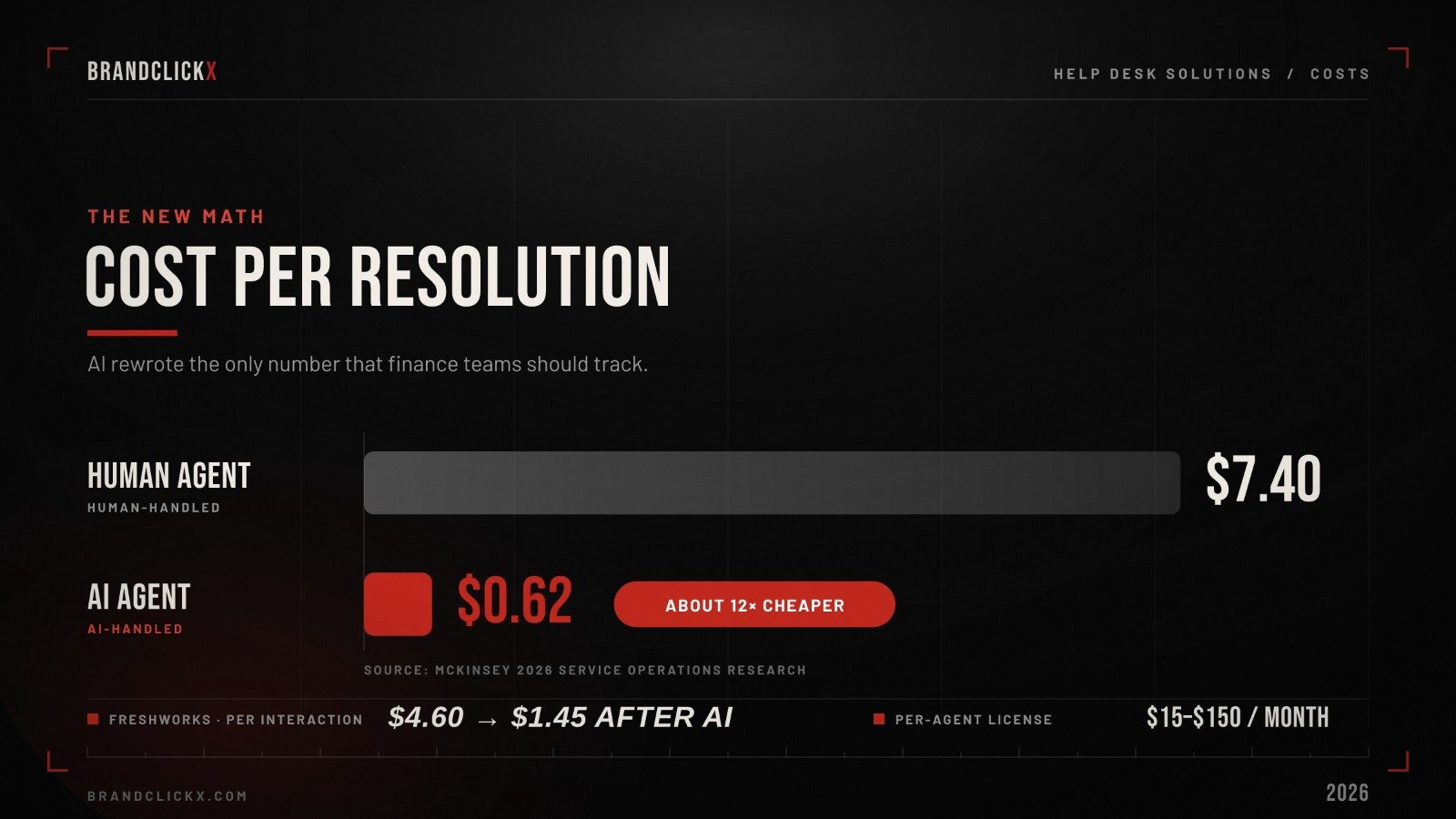
The old per-agent license fee still exists. Most platforms charge somewhere between $15 and $150 per agent each month. But that number is no longer the one that matters most.
The number that matters is cost per resolution. And AI rewrote it.
According to McKinsey’s 2026 service operations research, an AI-handled resolution costs around $0.62, against roughly $7.40 for a human-handled one. That is close to a twelvefold gap on a single interaction.
Real deployments back the theory. Freshworks data shows average cost per interaction falling from $4.60 to $1.45 after AI rollout. The savings compound as volume grows, because the machine does not get tired and does not need a second shift.
Strategic Breakdown: The cost case is no longer the hard part. The hard part is governance, accuracy, and knowing which tickets a machine should never touch.
Human vs AI Resolution: The 2026 Cost Picture
| Metric | Human Agent | AI Agent |
| Cost per resolution | ~$7.40 | ~$0.62 |
| Availability | Shift-based | 24/7 |
| Languages | Limited by staffing | Many, no extra headcount |
| Best for | Complex, emotional, high-value | Routine, repeatable, high-volume |
| Scales by | Hiring | Configuration |
The takeaway is not “replace people.” It is “stop paying premium rates for password resets.”
From Ticketing to Agentic: The Real Shift Inside Help Desk Solutions
Most coverage of AI in support is stuck describing chatbots. That misses the actual change.
A chatbot talks. An agent acts.
A real agentic system can look up an order, check the return window, process the return, issue the refund, and suggest a replacement, all inside one conversation, with no handoff. The intelligence is not the headline. The integration is. The system has to reach into your backend and do something real.
The adoption curve is steep. Salesforce’s latest State of Service data shows 66 percent of service organizations now running AI agents in 2026, up from 39 percent a year earlier. That is a 1.7 times jump in twelve months, which is rare for any enterprise technology.
The pressure is coming from the top. Gartner reports that 91 percent of customer service leaders feel executive pressure to deploy AI this year. The mandate is loud. The execution is uneven.
The Bigger Shift: Support is moving from channel-based and reactive to journey-based and autonomous. The unit of work is changing from “the ticket” to “the outcome.”
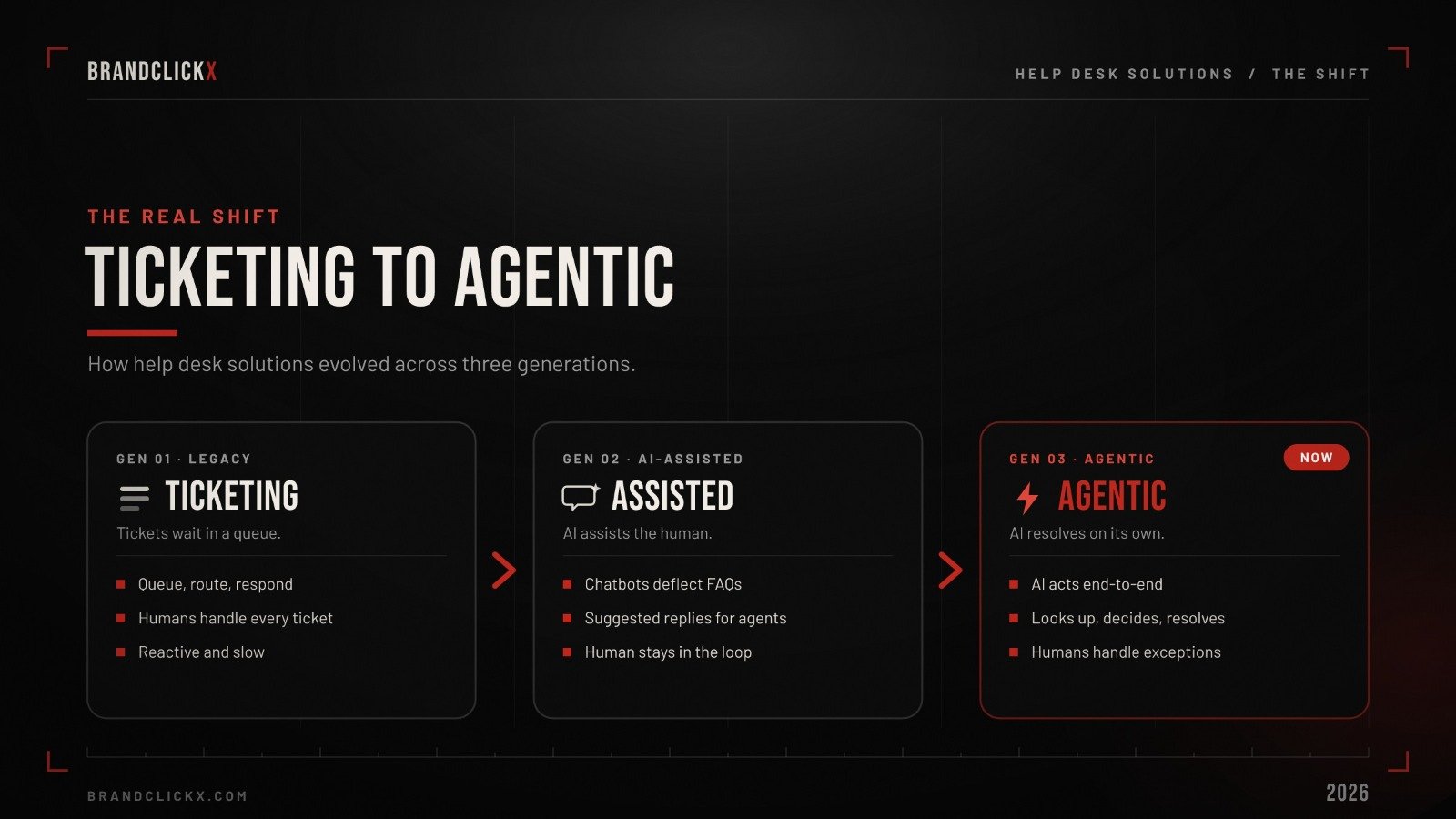
Three Eras of Help Desk Solutions
| Capability | Legacy Help Desk | AI-Assisted Help Desk | Agentic Help Desk |
| Core function | Logs and routes tickets | Suggests replies to agents | Resolves issues end to end |
| Human role | Does everything | Reviews and edits AI drafts | Handles complex exceptions |
| Speed | Hours to days | Minutes | Seconds to under two minutes |
| Backend action | Manual | Partial | Autonomous, within guardrails |
| Learning | None | Limited | Improves from every interaction |
Many vendors claim the third column while delivering the second. That gap is the buyer’s biggest risk in 2026.
What the Klarna and Intercom Results Really Prove
Two case studies keep showing up in boardrooms, and for good reason.
Klarna’s AI assistant took on roughly two-thirds of all customer service chats. Resolution time dropped from about 11 minutes to under 2, and the company tied the work to a $40 million profit improvement.
Intercom’s Fin agent reports resolving 81 percent of support volume for some teams. Without it, one customer would have needed around 100 additional staff to keep up.
Read those numbers carefully. The win was not “we fired our team.” The win was “we removed the repetitive volume so people could do the work machines cannot.”
Expert Insight: The brands seeing real returns treat AI as a capacity unlock, not a layoff plan. They redeploy agents into retention, onboarding, and high-value accounts, which is where revenue actually sits.
The Trust Problem Nobody Wants to Talk About
Speed is not the whole game. Trust is the quiet variable that decides whether AI support helps or hurts the brand.
Customers are wary, and the data is blunt about it. Gartner found that 64 percent of consumers would prefer organizations did not use AI for service at all, mostly out of fear they will get stuck and never reach a human.
So the design challenge is emotional, not just technical. People will accept AI when it is fast, honest about what it is, and one click away from a person when things go wrong.
Cisco’s global research captures the balance well. It projects agentic AI handling a majority of vendor support interactions within a few years, and at the same time finds 89 percent of customers insist on combining human connection with AI efficiency.
Industry Impact: The winning model is human-in-the-loop by design. Hide the AI and you lose trust. Hide the human and you lose the relationship.
What Separates Modern Help Desk Solutions From Legacy Tools
If you are evaluating help desk solutions in 2026, surface features all look the same. The real differences sit underneath.
Strong platforms share a few traits.
They unify every channel into one view, so a customer who starts on chat and finishes on email never has to repeat themselves. They connect to your CRM, billing, and order systems, because an agent that cannot act is just a search bar. They give you governance controls, audit logs, and clear escalation rules, so a regulated business can prove what the AI did and why.
And they report a resolution rate you can trust. Vendor marketing loves to quote 80 percent deflection. Independent field data, including Zendesk’s cross-program numbers, lands closer to a 41 percent median. The gap between the demo and reality is where buyers get burned.
Enterprise Perspective: Ask vendors for blended resolution rates across their full customer base, not a cherry-picked logo. The aggregate tells the truth. The case study sells the dream.
The Enterprise Playbook: Choosing Help Desk Solutions That Scale
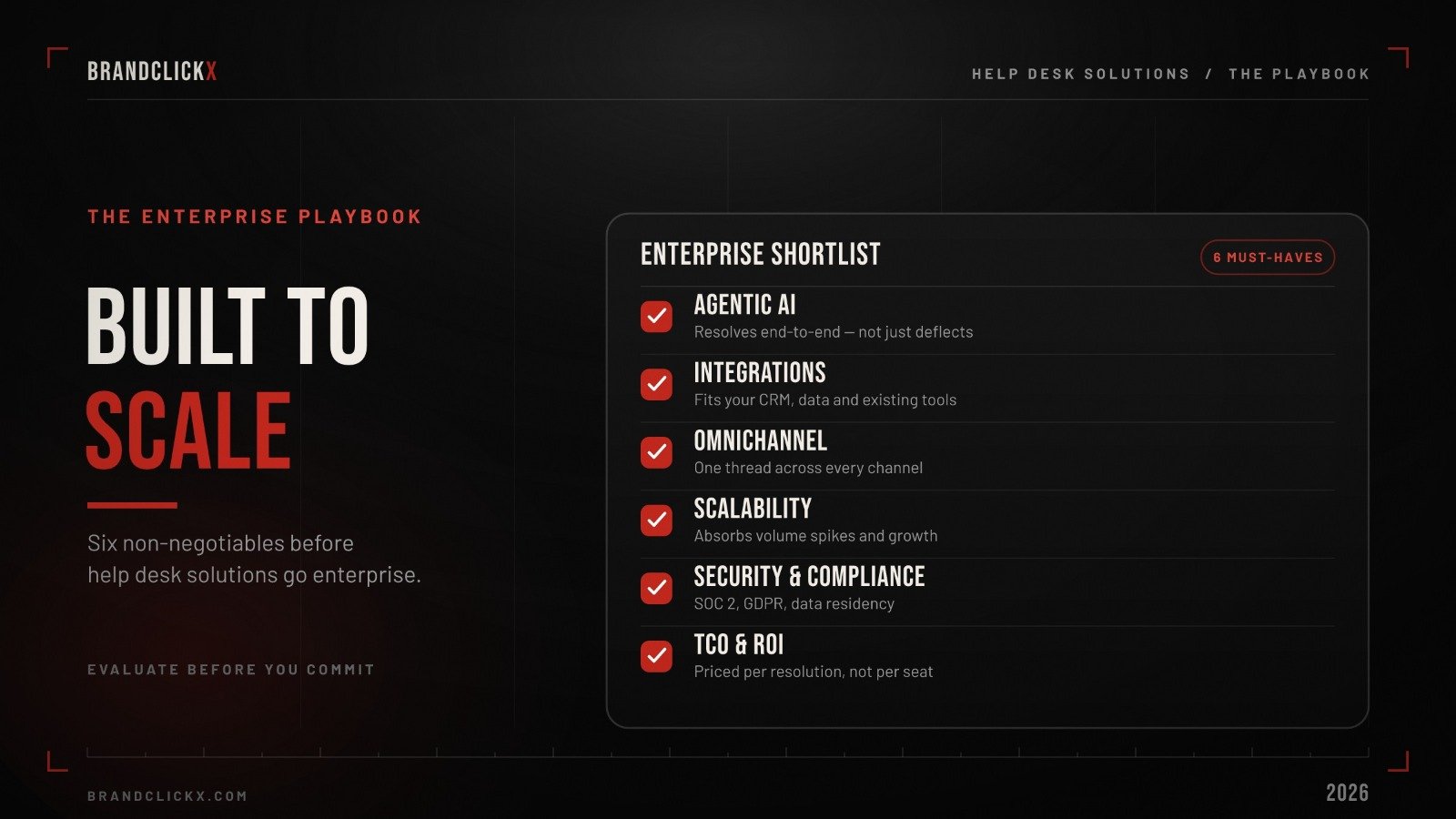
Picking a platform is no longer a feature checklist. It is an operating decision that shapes headcount, data strategy, and customer experience for years.
Here is a tactical framework that holds up under enterprise scrutiny.
Tactical Framework: A Five-Step Selection Path
- Map your ticket mix first. Pull 90 days of tickets and sort them by type and volume. The high-volume, structured queries are your automation targets. Start there, not with the hard cases.
- Score backend integration, not chat quality. A pretty interface means nothing if the tool cannot process a refund or reset an account. Demand a live demo against your own systems.
- Set a resolution benchmark before you buy. Define what “resolved” means for your business and write it into the contract. Pay for outcomes where you can.
- Design the human escalation path on day one. Decide which categories always reach a person. Make the handoff seamless and visible to the customer.
- Build a governance layer. Logging, accuracy monitoring, bias checks, and a kill switch. In regulated industries, this is not optional.
The teams that skip step one almost always overspend. They try to automate everything at once, the accuracy drops, customers revolt, and the project stalls in “pilot purgatory.”
Buyer Comparison: What to Weigh
| Decision Factor | Why It Matters | Red Flag to Watch |
| Agentic action depth | Determines real deflection | Cannot complete tasks without handoff |
| Native integrations | Powers end-to-end resolution | “Coming soon” on your core systems |
| Pricing model | Controls cost predictability | Charges for failed interactions |
| Governance and audit | Protects compliance and brand | No logs, no transparency |
| Proven resolution data | Validates ROI claims | Only single-logo case studies |
Key Takeaways (mid-article): Automate the boring volume, integrate deeply, prove the resolution rate, and keep a human path open. Everything else is detail.
Where Brands Get It Wrong
The most common mistake is treating AI support as a cost-cutting tool and nothing more.
Analysts are united on this point. Gartner, Forrester, IDC, and McKinsey all warn that companies using AI only to slash budgets will lose to companies that use it to build relationships. The cost win is easy. The loyalty win is the durable one.
The second mistake is poor data hygiene. An AI agent is only as good as the knowledge base behind it. Feed it stale articles and contradictory policies, and it will confidently give wrong answers at scale, which is far worse than a slow human who gets it right.
The third mistake is the silent handoff. When a customer asks for a human and the system buries the option, frustration spikes and the brand takes the hit. Make the exit door obvious.
What Happens Next: Expect a wave of “AI support” projects to quietly underdeliver in 2026, not because the technology failed, but because the data, integration, and escalation design were treated as afterthoughts.
Future Outlook: The Help Desk Solutions Roadmap Through 2029
The direction of travel is clear, even if the speed varies by industry.
Gartner projects that by 2029, agentic AI could autonomously resolve up to 80 percent of common customer service issues and cut operational costs by roughly 30 percent. McKinsey’s own work points to similar 30 percent service-cost reductions when agentic systems are deployed well.
Accuracy is climbing fast too. Generative AI support agents now reach about 92 percent accuracy in understanding customer intent, against 65 to 70 percent for the old keyword bots, according to Google Cloud figures. That jump is what makes end-to-end resolution realistic instead of risky.
Three shifts will define the next phase.
Support will go proactive. Instead of waiting for a complaint, systems will flag a delayed shipment or a failing payment and reach out first. The best customer service interaction is the one that never has to happen.
Pricing will move to outcomes. Per-seat licensing is fading. Pay-per-resolution models tie the vendor’s revenue to your success, and they expose tools that cannot actually solve problems.
And the human role will sharpen, not vanish. As machines absorb routine volume, agents will move into judgment, empathy, and revenue-bearing conversations. The job title changes faster than the headcount does.
Future Outlook: By 2029, “AI support” stops being a feature you choose. It becomes the baseline customers assume you already have, the way they assume your site works on mobile.
Strategic Reality Check for Marketing and Growth Leaders
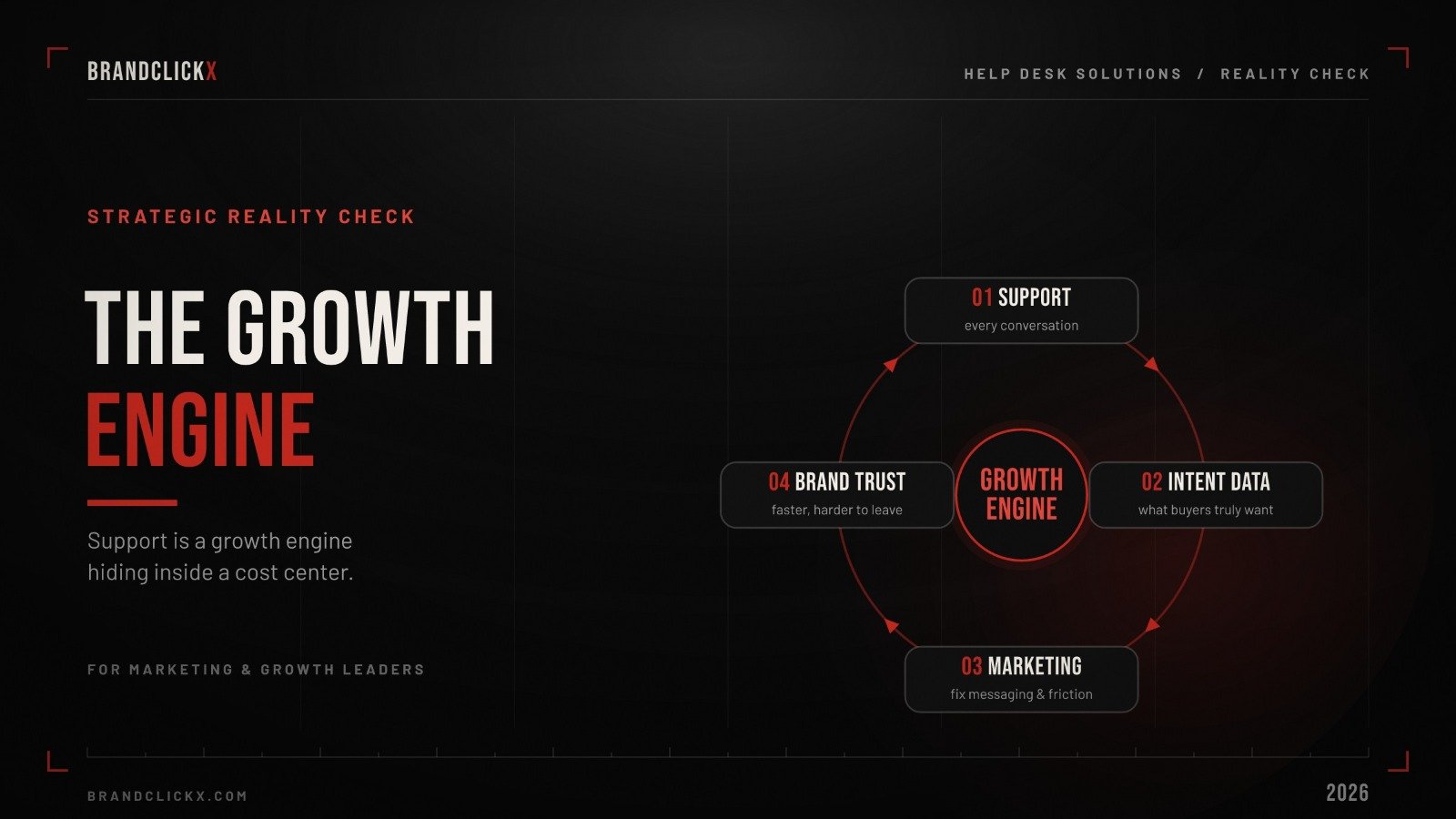
Here is the angle most IT-led coverage misses, and it is the one that should reach your CMO.
The help desk is now a brand publishing channel. Every resolution is a brand impression. Every conversation generates intent data your marketing team would pay a fortune to buy.
Smart organizations are wiring support data back into marketing and product. The questions customers ask reveal the messaging gaps, the friction points, and the features people actually want. That feedback loop is a growth engine hiding inside a cost center.
Why It Matters: When marketing and support share one view of the customer, the brand gets faster, more honest, and harder to leave. That alignment, more than any single tool, is the real 2026 advantage.
KEY TAKEAWAYS
- The help desk is now brand infrastructure. Support spend is flowing toward a market projected near $35 billion by 2035 because resolution quality directly shapes retention and reputation.
- AI changed the unit economics, not just the workflow. With AI resolutions near $0.62 against $7.40 for humans, the cost case is settled. Governance and accuracy are the new battleground.
- Agentic beats chatbot. Tools that act on your backend systems win. Tools that only talk and hand off are a liability dressed as innovation.
- Trust is the limiter. Customers want speed and a visible path to a human. Hide either one and the brand pays for it in churn.
- The human role sharpens. AI absorbs routine volume so people can own complex, emotional, and revenue-driving work. Redeploy, do not just reduce.
- Support data is marketing gold. The questions customers ask are the clearest signal of intent and friction your growth team will ever get.
FAQ
What are help desk solutions?
Help desk solutions are software platforms that capture, route, and resolve customer or employee support requests in one place. They combine ticketing, a knowledge base, automation, and reporting. In 2026, the leading platforms add AI agents that resolve common issues without a human touching them.
How much do help desk solutions cost in 2026?
Most platforms still price per agent per month, roughly $15 to $150 depending on features and AI depth. The more important number is cost per resolution. McKinsey research puts an AI resolution near $0.62 against about $7.40 for a human-handled one.
What is the difference between a help desk and a service desk?
A help desk fixes individual problems and answers questions. A service desk is broader and manages the full lifecycle of IT services, including requests, changes, and assets, usually following frameworks like ITIL. Many enterprise platforms now cover both.
Will AI replace human help desk agents?
Not fully. AI handles most routine, repeatable tickets, while people take complex, sensitive, and high-value cases. Cisco research found 89 percent of customers still want human connection paired with AI speed, so the human-in-the-loop model dominates.
What should enterprises look for in help desk solutions?
Prioritize real agentic action, deep integration with your core systems, omnichannel coverage, strong governance and audit controls, and a resolution rate proven across the vendor’s full customer base. A tool that cannot complete a task without a handoff is a chatbot, not an agent.
CONCLUSION
The help desk spent twenty years being managed like a cost. It will spend the next five being managed like a brand.
The shift is already measurable. AI agents now run in two-thirds of service organizations, resolutions cost cents instead of dollars, and the autonomous era is arriving faster than most roadmaps planned for. By 2029, customers will assume AI resolves their issue instantly, the same way they assume a checkout page loads.
But the lasting advantage will not belong to whoever automates the most. It will belong to whoever earns the most trust per interaction. The brands that connect support, marketing, and product into one honest view of the customer will pull ahead, while the ones chasing pure cost cuts quietly lose the relationships they spent millions to win.
That is the real story of help desk solutions in 2026. Support stopped being where problems go to wait. It became where brands prove who they are.
This is the kind of shift BrandClickX tracks closely, because the next decade of growth will be decided as much in the support queue as in the ad account.