GOOGLE AI OVERVIEW
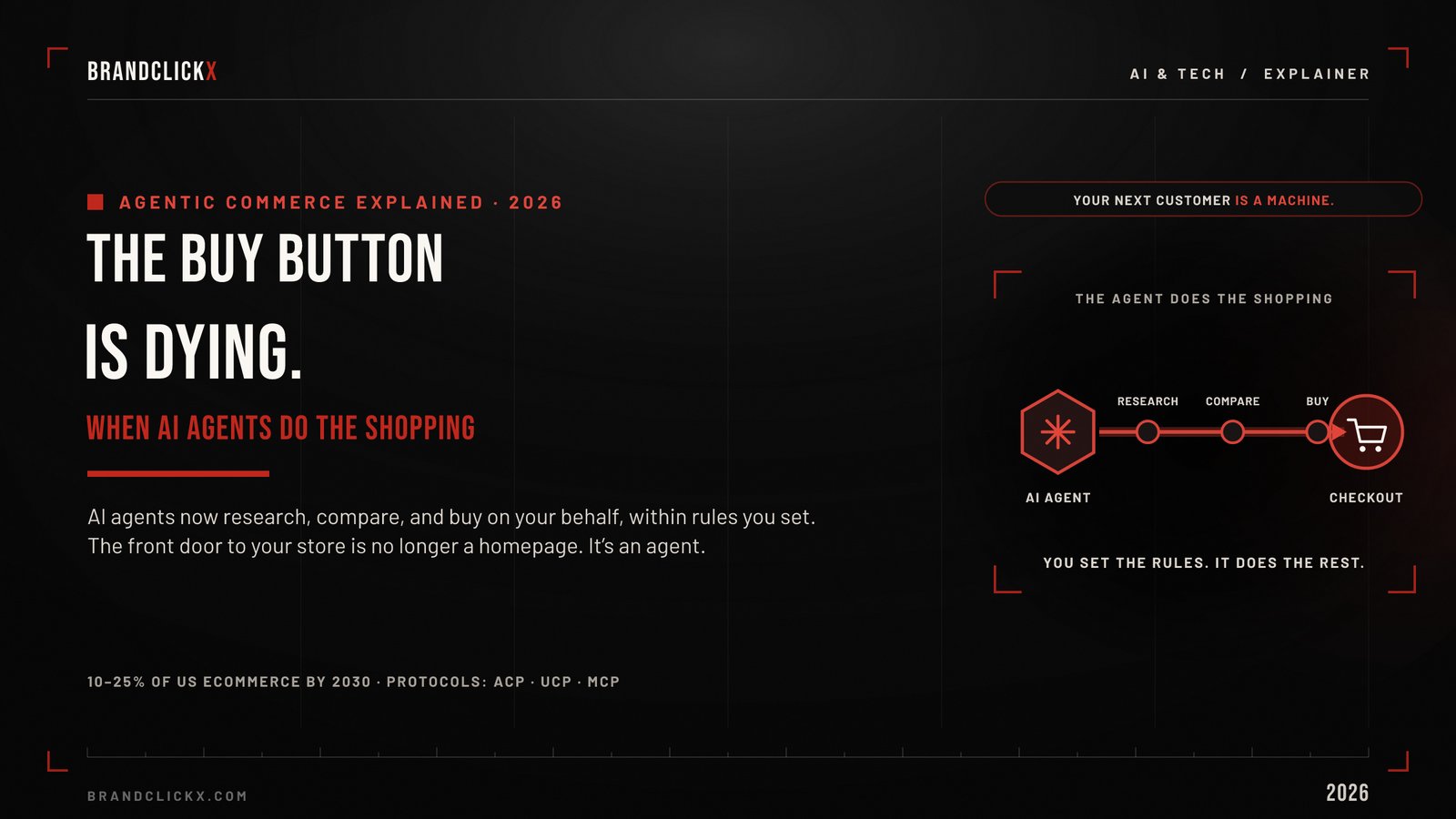
Agentic commerce is a new model of online shopping where AI agents research products, compare options, and complete purchases on a shopper’s behalf. The shopper sets preferences, budgets, and approval rules, while the agent handles the work. Powered by open protocols like ACP and UCP, agentic commerce is forecast to capture 10 to 25 percent of US ecommerce by 2030.
For twenty years, online retail trained shoppers to do the work. Search, scroll, compare, add to cart, check out. Agentic commerce flips that script. Now the software does the shopping, and the human just approves the result.
This is not a forecast. It is already happening at the edges of the market.
Roughly 23% of Americans bought something using AI in the past month, according to Morgan Stanley. On Black Friday 2025, AI traffic to US retail sites jumped 805% year over year. The behavior is moving faster than most brands have noticed.
Why it matters: the front door to your store is changing. For years that door was Google search and a homepage. Soon it may be an AI agent that never sees your homepage at all. It reads your data, compares your offer, and decides in milliseconds whether you make the cut.
So this piece breaks down what agentic commerce actually is, how AI shopping agents work, the protocols quietly being built underneath them, and what brands need to do before the agents start buying at scale.
What Agentic Commerce Actually Means
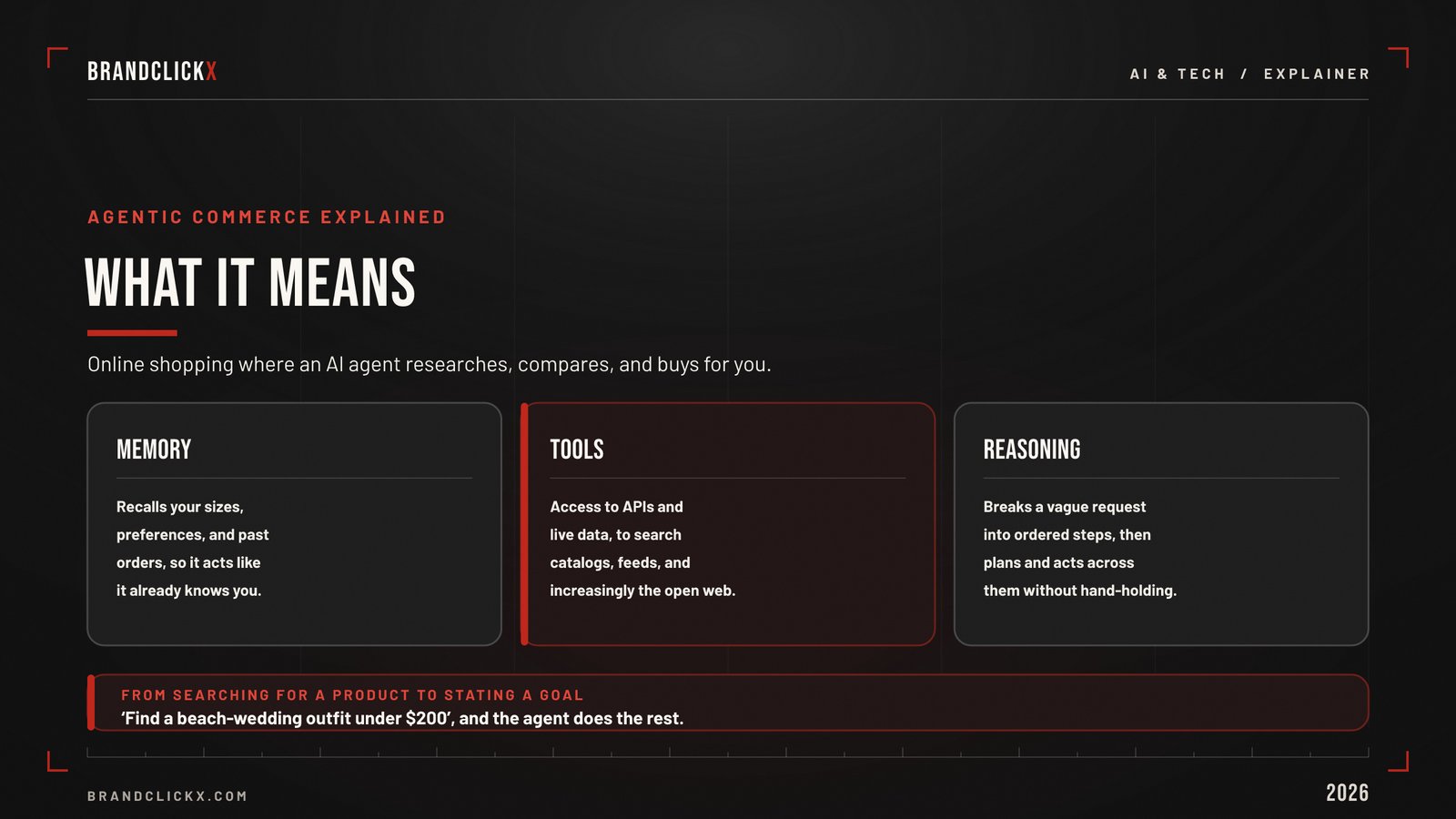
Let us define it cleanly, because the term gets thrown around loosely. Agentic commerce is online shopping where an AI agent acts on behalf of a shopper to research products, compare options, and sometimes complete the purchase, all within rules the shopper sets.
The key word is autonomy. A chatbot reacts to what you type. An agent plans, reasons, and acts across several steps without hand-holding.
Salesforce frames it as a shift from passive AI assistance to AI action. The agent does not just answer a question. It anticipates a need, makes sense of messy data, and takes the next step on its own.
Strategic Breakdown: the model runs on three capabilities working together. Memory lets the agent recall your sizes, preferences, and past orders. Tools give it access to APIs and live data. Reasoning lets it break a vague request into ordered steps.
Put those together and you get intent-based shopping. Instead of searching for a product, you state a goal. “Find me a weekend outfit for a beach wedding under $200.” The agent interprets style, budget, and timing, then goes to work.
That is the real break from the past. Traditional ecommerce is built around human clicks. Agentic commerce replaces much of that effort with machine evaluation at machine speed.
How AI Shopping Agents Work
Under the hood, most agentic commerce flows move through four stages. Understanding them is how you understand where your brand can win or lose.
- Discovery. The agent interprets intent and pulls candidate products from catalogs, feeds, and increasingly the open web.
- Comparison. It evaluates price, delivery, returns, and fit against your stated criteria, often weighing many options at once.
- Checkout. It executes the purchase using a secure payment credential, within the spending limits you approved.
- Post-purchase. It can track the order, manage returns, or reorder when supplies run low.
The payment step is where trust is engineered. As the MIT Initiative on the Digital Economy notes, agents do not get your live card. The payment method is represented as a tokenized credential, paired with a risk signal that merchants and banks can verify.
Expert Insight: this tokenized model is the unlock for autonomous purchasing. A shopper would never hand an algorithm a raw credit card number. A single-use, permission-scoped token is a different proposition entirely. It is the difference between giving someone your wallet and giving them a gift card with a fixed balance.
Mastercard describes the experience well with a travel example. You say book a nonstop flight to London under $600 with no red-eyes, and the agent checks airlines, nearby airports, and your loyalty rewards before buying and reporting back.
That is the promise. Less scrolling, fewer tabs, more time. The shopper sets the destination. The agent drives.
The Protocol Wars: The Plumbing Behind the Promise
Here is the part most consumer coverage skips, and it is the part that matters most for brands. Agents and stores need a shared language. Without standards, every retailer would build a custom connection for every AI platform, and adoption would stall.
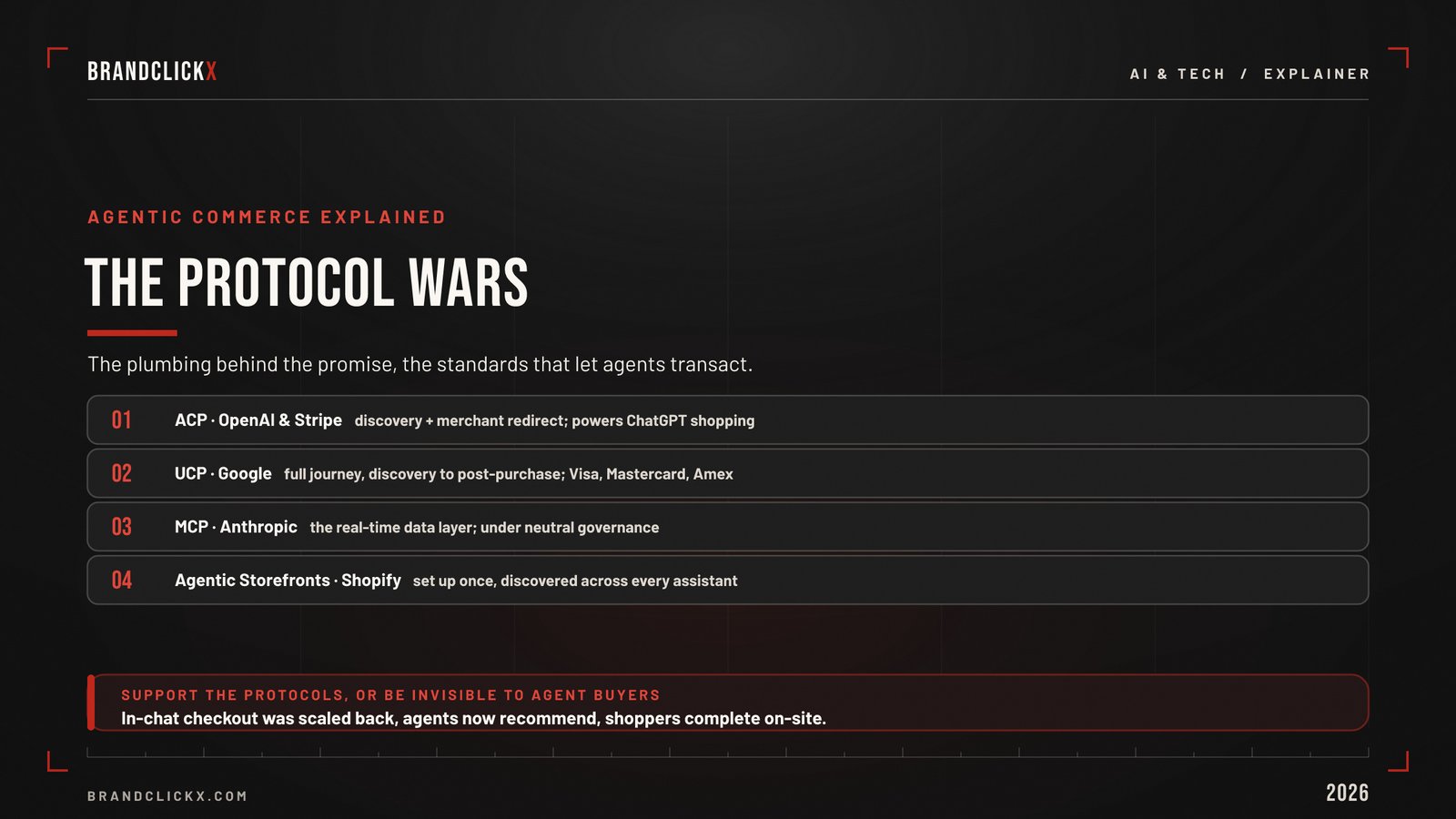
So 2025 and early 2026 became a race to set that standard. Three protocols now anchor the stack.
- Agentic Commerce Protocol (ACP). Built by OpenAI and Stripe, live since September 2025. It powers ChatGPT shopping. Its early in-chat checkout was scaled back in March 2026, and the model shifted toward product discovery plus a redirect to the merchant site.
- Universal Commerce Protocol (UCP). Launched by Google at NRF in January 2026. It covers the full journey from discovery to post-purchase and was co-developed with major retailers and endorsed by payment giants including Mastercard, Visa, and American Express.
- Model Context Protocol (MCP). Created by Anthropic as the data connectivity layer that lets agents read real-time inventory, pricing, and product details. It was placed under neutral governance to stay vendor-agnostic.
Layered on top, Shopify’s Agentic Storefronts let a merchant set up once and get discovered across ChatGPT, Perplexity, Microsoft Copilot, and Gemini at the same time.
Industry Impact: the deprecation of in-chat instant checkout is the tell. Early conversion inside the chat window lagged badly behind the retailer’s own site. So the industry pivoted to a model where agents recommend and shoppers complete the buy on the brand’s property. Brands keep the customer relationship, the login, and the loyalty data. That is a meaningful concession to merchants, and it shapes everything downstream.
A Quick Map of the Protocol Landscape
| Protocol | Backer | What it covers | Where it shows up |
| ACP | OpenAI and Stripe | Discovery and merchant redirect | ChatGPT shopping |
| UCP | Full journey, discovery to post-purchase | Google AI surfaces and partner retailers | |
| MCP | Anthropic | Real-time data connectivity layer | Inventory, pricing, product details |
| Agentic Storefronts | Shopify | Multi-platform merchant setup | ChatGPT, Perplexity, Copilot, Gemini |
The takeaway is simple. Support the major protocols and you are visible across the agent ecosystem. Ignore them and you are invisible to the buyers who never touch a search bar.
The Money: How Big Agentic Commerce Gets
Now the question every executive asks first. How big is this, really? The honest answer is that forecasts disagree, and the disagreement is instructive.
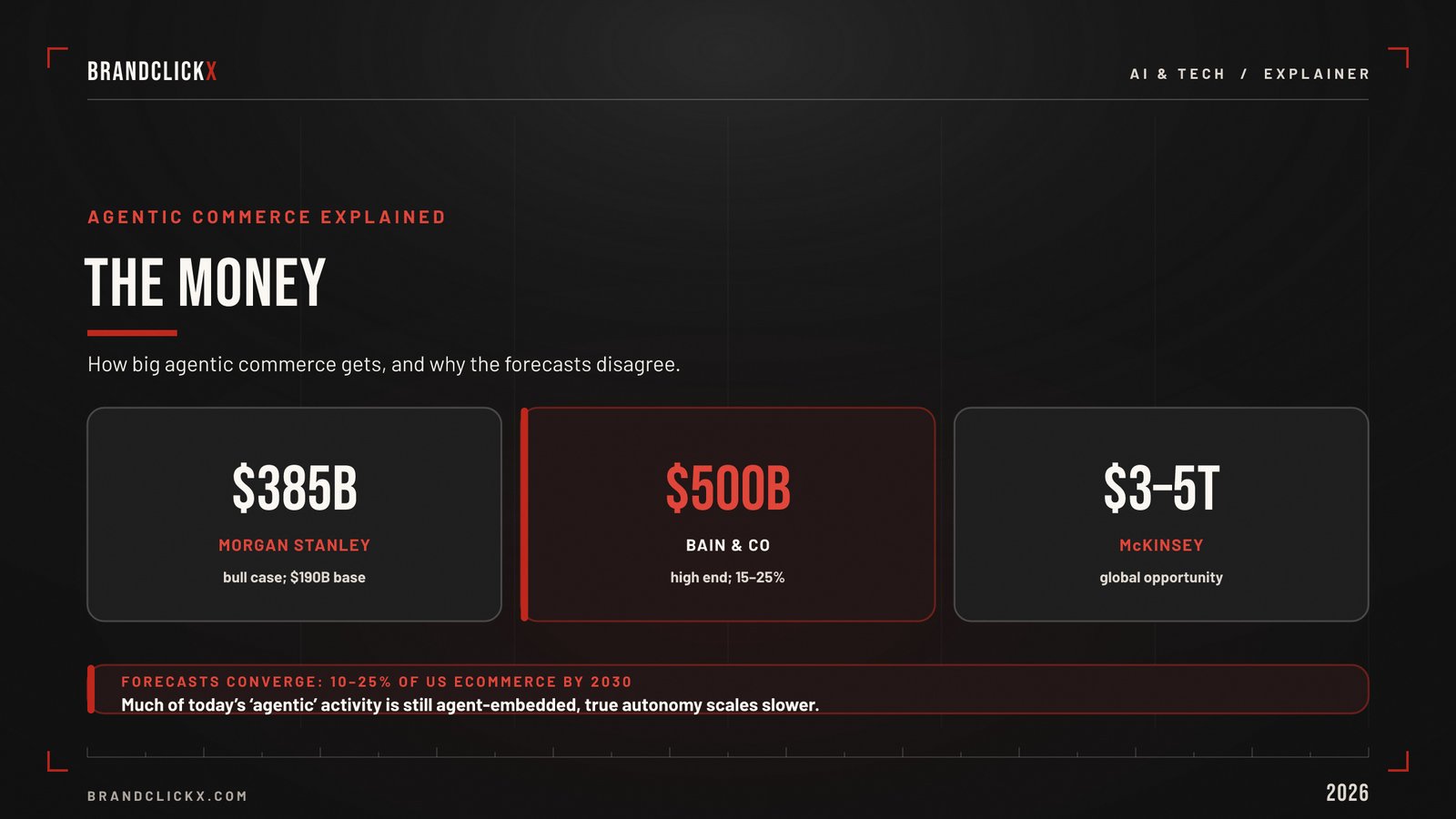
Morgan Stanley projects $190 billion in its base case and $385 billion in its bull case for US agentic spending by 2030, or 10 to 20 percent of ecommerce. Bain & Company goes higher, at $300 to $500 billion and 15 to 25 percent.
McKinsey takes the widest view, modeling a $3 to $5 trillion global opportunity by 2030. The gap between forecasts is not sloppiness. It comes down to definition. A strict view counts only purchases an agent meaningfully drove. A loose view counts any purchase an agent influenced.
Market Observation: when you narrow to US consumer ecommerce, the major forecasts actually converge on a band of roughly 10 to 25 percent of online sales by 2030. That is the number worth planning around. It is large enough to reshape budgets and not so speculative that it requires faith.
J.P. Morgan adds a useful caution. Much of what gets called agentic commerce today is still agent-embedded shopping, closer to social commerce than true autonomy. Fully autonomous buying, where an agent purchases without human approval, will take longer to scale.
So the curve is real, but it is a curve, not a cliff. The smart read is steady acceleration, concentrated first in low-risk, repeat categories.
Who Is Already Shopping This Way
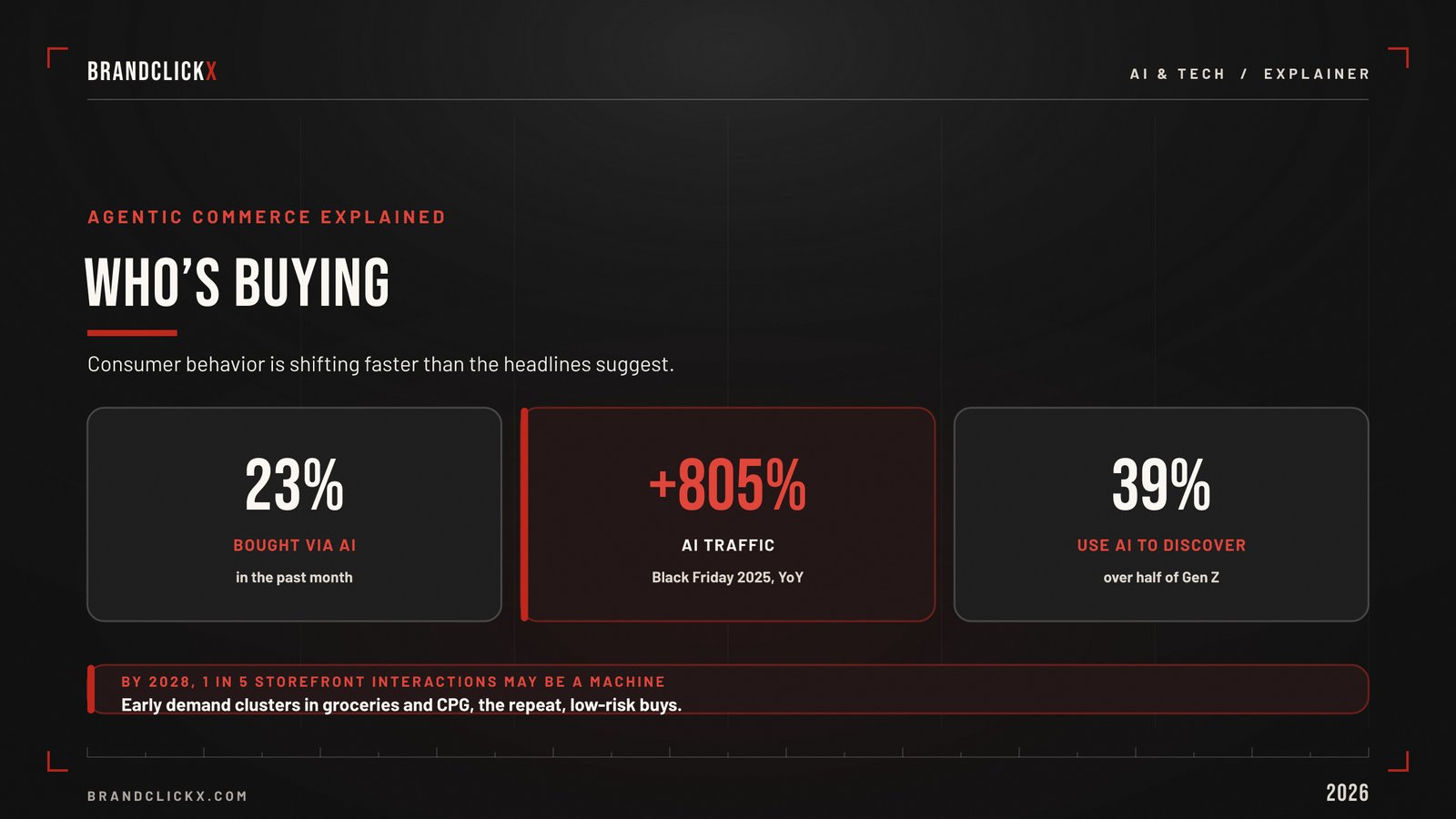
The early adopters tell you where this goes next. Consumer behavior is shifting faster than the headlines suggest.
Salesforce reports that 39% of consumers, and more than half of Gen Z, already use AI for product discovery. Adoption of large language model platforms in the US is nearing half the population, even if dedicated shopping use is still smaller.
The category concentration is telling. AI-driven purchases cluster in groceries and consumer packaged goods, the repeat, low-consideration items where autonomous purchasing feels safe. Nobody is handing an agent a $4,000 watch yet. They are happy to let it reorder coffee pods.
Enterprise Perspective: referral data shows the channel forming in real time. ChatGPT already drives a meaningful share of referral traffic to large retailers, and Kantar projects that by 2028, one in five digital storefront interactions will be handled by a machine customer rather than a person.
That single stat should reframe how every brand thinks about its audience. Part of your traffic is becoming non-human, and it judges you on different signals.
Why This Breaks the SEO Playbook You Just Mastered
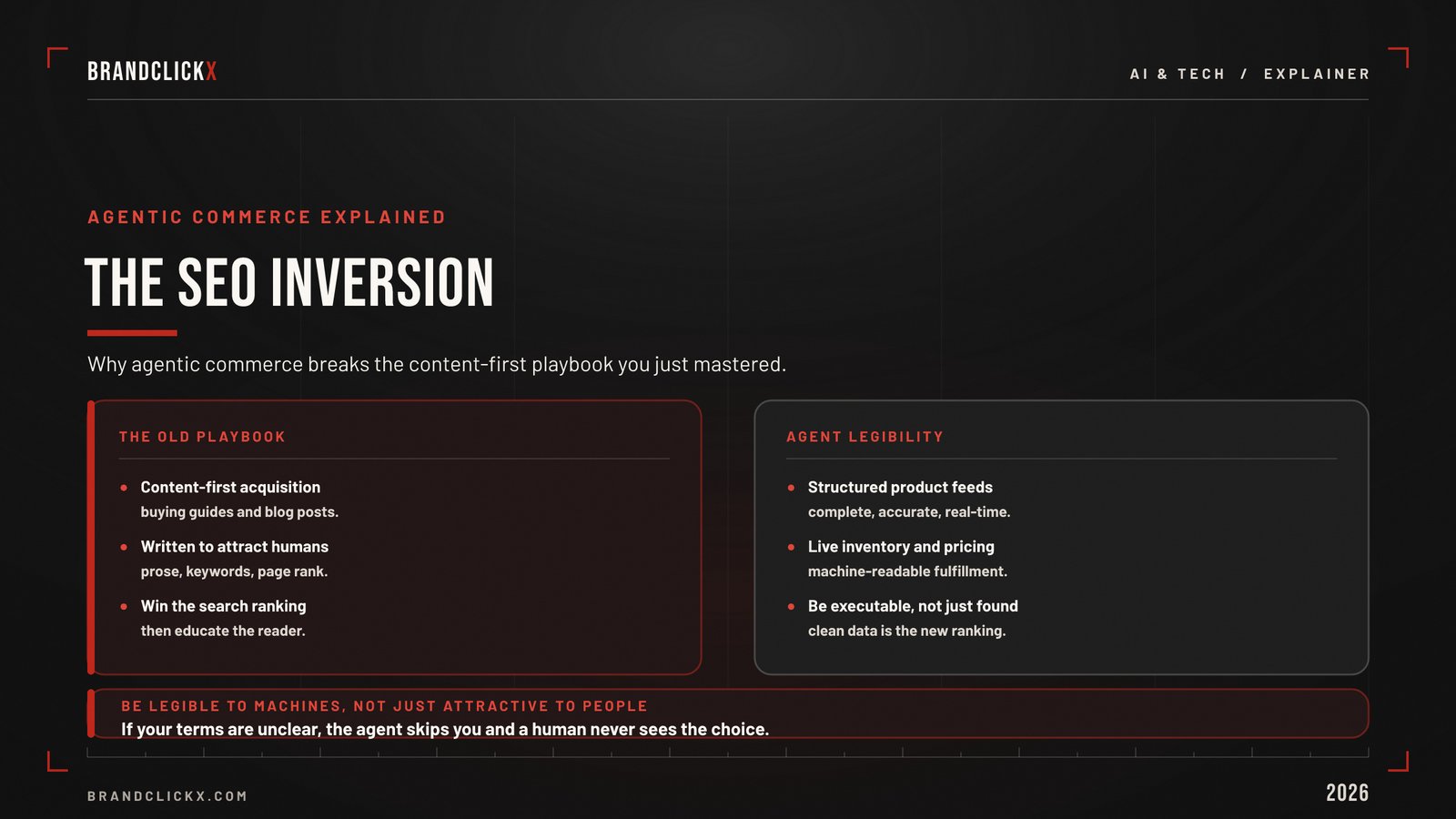
Here is the uncomfortable part for marketers, and it is where agentic commerce becomes a strategy problem, not just a tech story.
The old acquisition model was content-first. You wrote buying guides, category pages, and blog posts to attract and educate humans. Agents do not read your prose the way people do. They evaluate structured data, parse feeds, and execute against APIs.
A detailed article will not lift your ranking in an agent’s shortlist nearly as much as a complete, accurate, real-time product feed. This is a real inversion of the content-first model that defined the last decade of digital marketing.
The Bigger Shift: the industry is calling this agent legibility. Your offer has to be readable and comparable to a machine, not only attractive to a person. If your delivery windows, shipping costs, and return terms are unclear or inconsistent, the agent skips you and a human never sees the choice.
The consequences are concrete. Many shoppers abandon purchases because of insufficient product information. An agent does not abandon in frustration. It simply selects the competitor whose data was clean enough to act on.
So the new mandate reads differently than the old one. Be findable, yes. But more than that, be executable. Structured product data, live inventory, and machine-readable fulfillment terms are becoming ranking factors in their own right.
The Trust Problem Nobody Has Fully Solved
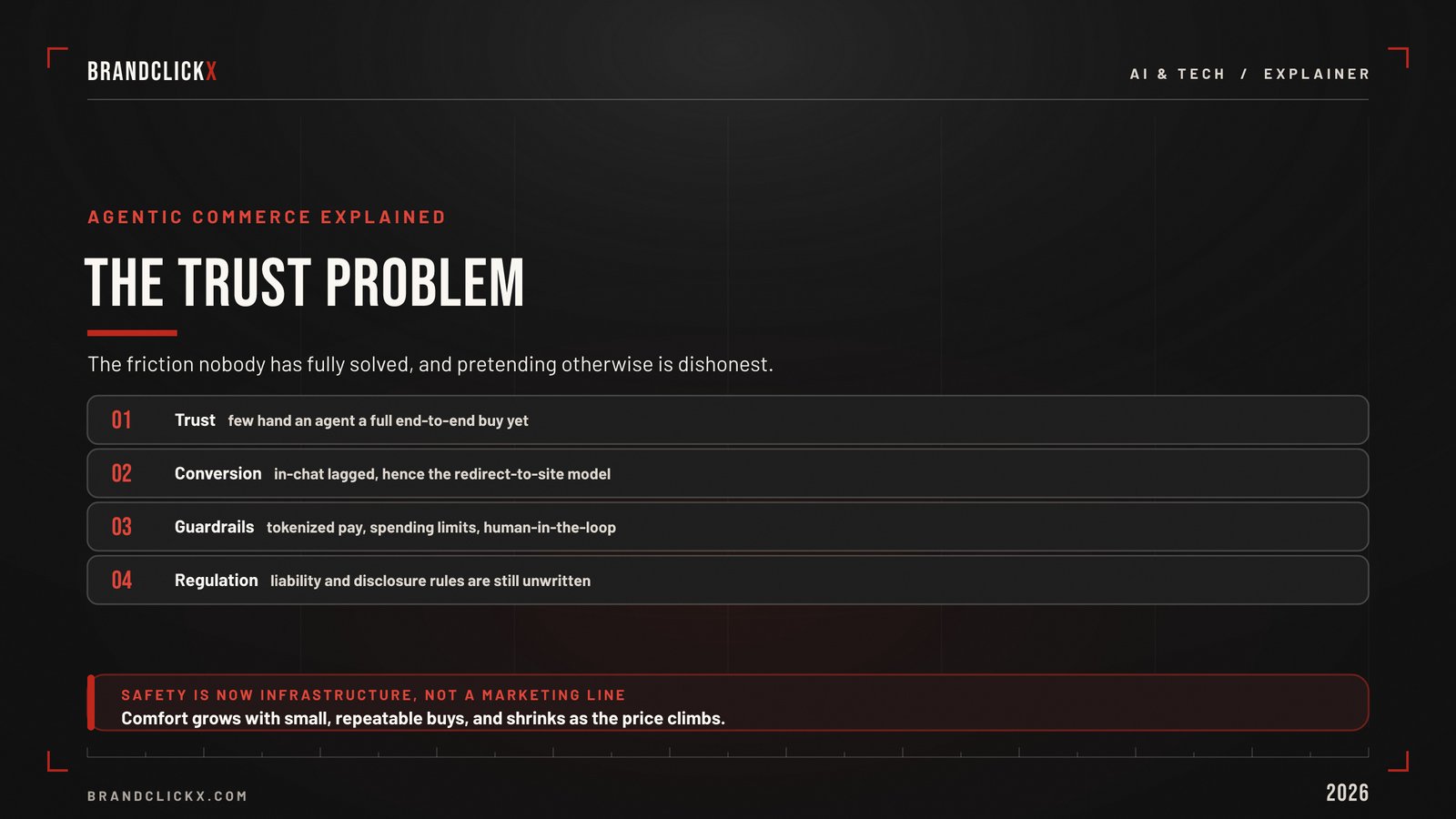
Let us not oversell this. Agentic commerce has real friction, and pretending otherwise would be dishonest.
Trust is the biggest barrier. Most consumers say they are not yet comfortable handing an agent a full, end-to-end transaction. Comfort grows with small, repeatable purchases and shrinks fast as the price tag climbs.
Conversion is the second barrier. Early in-chat buying converted far worse than buying on the retailer’s own site, which is exactly why the industry pivoted to the redirect model. The agent recommends. The human still closes.
Why It Matters: safety is now an infrastructure feature, not a marketing line. PayPal points to the guardrails that make this workable: tokenization that hides card details, spending limits, and human-in-the-loop approval before the agent clicks buy. Opt-in data sharing matters too, so the shopper controls what the merchant sees.
Regulation is the open question hanging over all of it. The rules for liability, disclosure, and data use in autonomous purchasing are still being written. Brands that move early will help shape those norms. Brands that wait will inherit them.
What Brands and Marketers Should Do Now
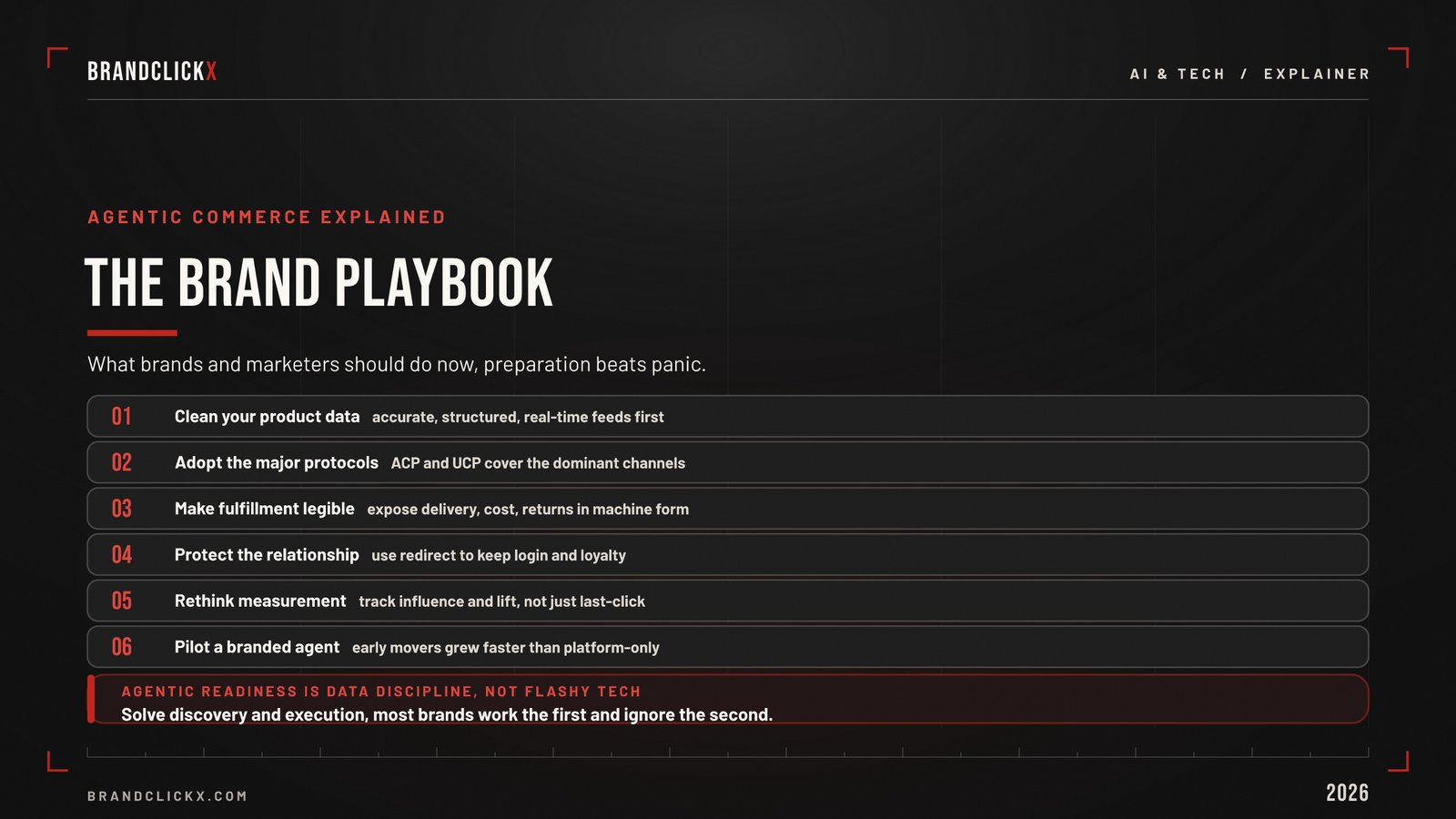
Strategy beats panic. Agentic commerce rewards preparation, and the work is more about data discipline than flashy tech. Here is where to focus.
- Clean your product data first. Accurate, structured, real-time feeds are the foundation. If your catalog data is messy, no protocol will save you.
- Adopt the major protocols. Supporting ACP and UCP covers the dominant agent channels today. Treat it like mobile-readiness a decade ago.
- Make fulfillment legible. Expose delivery windows, shipping costs, and return terms in machine-readable form, since agents weigh those at the selection stage.
- Protect the customer relationship. Use the redirect model to keep login, loyalty, and first-party data on your own property.
- Rethink measurement. Agent channels often lack click data, so build attribution that can track influence and sales lift, not just last-click.
- Pilot a branded agent. Early data suggests retailers running their own agents grew faster than those relying only on third-party platforms.
Tactical Framework: treat agentic readiness as two separate problems. One is discovery, making sure agents can find and understand you. The other is execution, making sure an agent can actually complete a purchase and a return without hitting a wall. Most brands are working on the first and ignoring the second. The gap between them is where deals quietly die.
The Bigger Shift: From Storefronts to Decisions
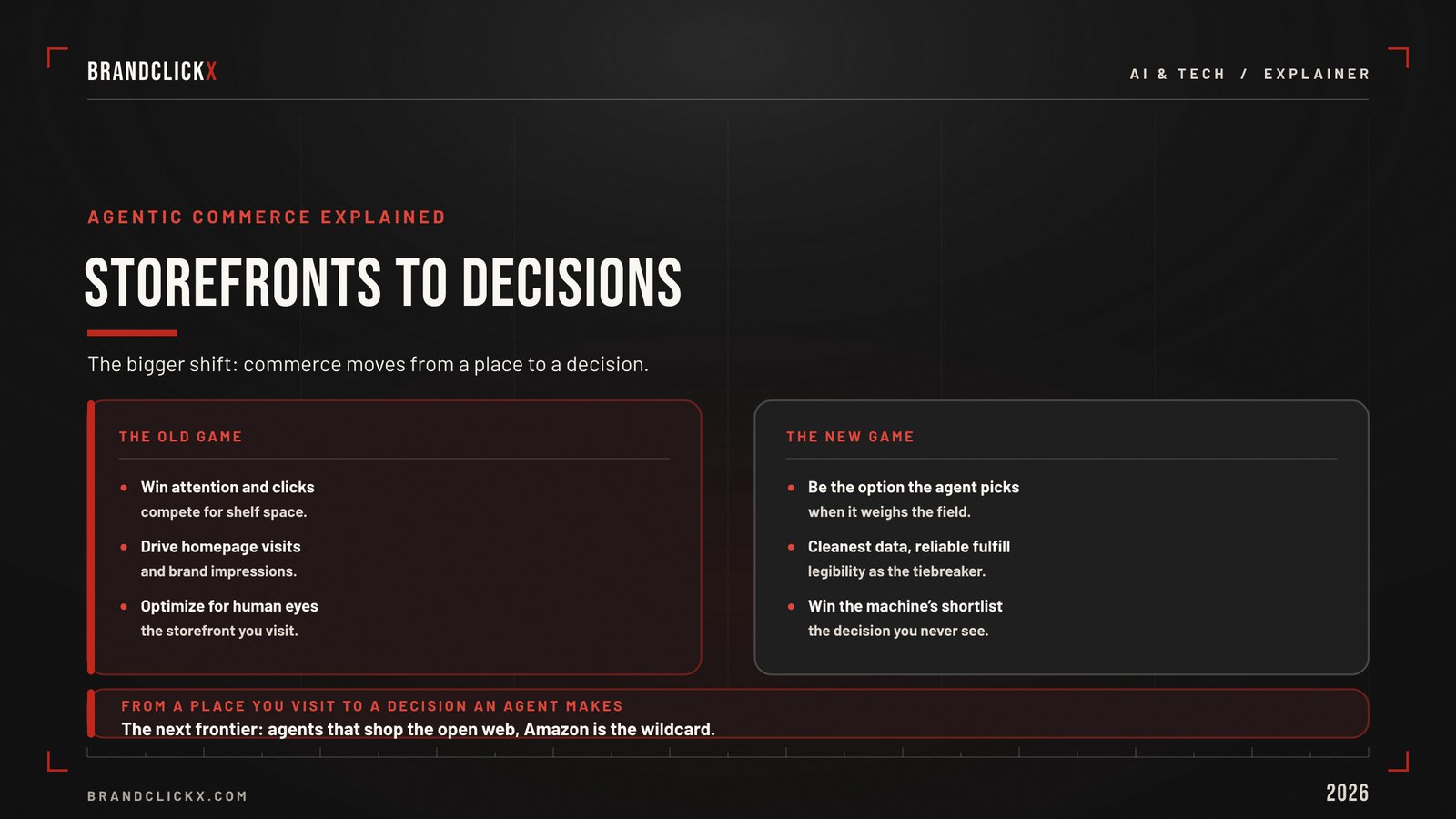
Step back and the pattern is clear. Commerce is moving from a place you visit to a decision an agent makes.
That changes the unit of competition. For years brands fought over attention, clicks, and shelf space. In an agent-driven market, they fight to be the option a machine selects when it weighs the field on a shopper’s behalf.
Future Outlook: the next frontier is agents that shop the open web, not just structured catalogs. When an agent can evaluate any product anywhere at machine speed, the advantage shifts decisively to brands with the cleanest data and the most reliable fulfillment. Price and quality still matter, but legibility becomes the tiebreaker.
Amazon is a wildcard here. It has the scale and the data to build a powerful in-house agent, and it has reasons to stay partly outside the open protocols other retailers are rallying behind. So the agent era may not be one universal layer. It may be a few large walled gardens plus an open ecosystem competing around them.
Either way, the direction holds. Autonomous purchasing is moving from novelty to infrastructure.
What Happens Next
The shift will unfold over years, but the signals to track are already visible. Here is what to watch.
- The pace of protocol adoption among mid-size retailers, which will show whether agentic commerce stays elite or goes mainstream.
- Whether consumer trust expands beyond groceries and subscriptions into higher-value categories.
- How Amazon positions its own agent against the open protocol coalition.
- The first clear standards for liability and disclosure in autonomous purchasing.
- New attribution models built for a channel with little or no click data.
Each of these will tell you more about the future of shopping than any single launch announcement.
COMPARISON TABLE: TRADITIONAL ECOMMERCE VS AGENTIC COMMERCE
| Factor | Traditional Ecommerce | Agentic Commerce |
| Who does the work | The shopper clicks, browses, compares | An AI agent researches and executes |
| Entry point | Search engine and homepage | AI assistant or chat surface |
| What gets you found | Content, keywords, page rank | Structured data, feeds, agent legibility |
| Decision speed | Human pace, many sessions | Machine pace, many options at once |
| Payment | Card entered at checkout | Tokenized, permission-scoped credential |
| Customer relationship | Owned by the merchant | Shared, protected via merchant redirect |
| Best-fit categories | All categories | Repeat, low-risk items first |
KEY TAKEAWAYS
- Agentic commerce is online shopping where AI agents research, compare, and buy on a shopper’s behalf, within rules and limits the shopper sets.
- The channel is real and growing. About 23% of Americans already bought via AI in a recent month, and AI traffic to retail sites surged on Black Friday 2025.
- Open protocols are the plumbing. ACP, UCP, and MCP let agents read catalogs, compare offers, and transact across platforms.
- Forecasts converge on agentic commerce reaching 10 to 25 percent of US ecommerce by 2030, with global estimates ranging far higher.
- The SEO playbook inverts. Structured product data and machine-readable fulfillment now matter more than editorial content for getting picked.
- Trust and conversion remain the real barriers, so tokenized payments, spending limits, and human approval are now core infrastructure.
Frequently Asked Questions
What is agentic commerce?
Agentic commerce is online shopping where an AI agent researches products, compares options, and can complete purchases on your behalf, acting within limits and preferences you set.
How do AI shopping agents work?
They use memory, reasoning, and tool access to read your intent, search catalogs and the web, compare offers, then check out using tokenized payment credentials within your rules.
Is agentic commerce safe?
It can be, with the right guardrails. Tokenized payments hide your card details, spending limits cap risk, and human-in-the-loop steps let you approve the final purchase.
How is agentic commerce different from traditional ecommerce?
Traditional ecommerce relies on you clicking, browsing, and comparing. Agentic commerce hands those steps to an AI agent that evaluates options and buys within approved boundaries.
What is an example of agentic commerce?
Telling an AI agent to book a nonstop flight under $600 with no red-eyes, or having it reorder household supplies when they run low, then confirm the purchase for you.
How big will agentic commerce be by 2030?
Estimates vary widely. Morgan Stanley sees $190 to $385 billion in US spending, Bain projects $300 to $500 billion, and McKinsey models $3 to $5 trillion globally.
CONCLUSION
Agentic commerce is not a feature bolted onto online retail. It is a new layer of decision-making sliding between your brand and your customer.
For two decades, the winners were the brands that earned attention and made checkout easy. The next decade will reward the brands that make themselves legible to machines, reliable in fulfillment, and trustworthy enough that a shopper hands over the keys.
Future Outlook: expect a market that splits in two. A handful of large agent platforms will own enormous demand, and an open protocol ecosystem will give everyone else a way to compete. The brands that prepare their data now will be selected. The brands that wait will be skipped, quietly, by an agent the shopper never questioned.
This is the real shift behind the future of shopping. Not flashier stores, but smarter buyers acting on our behalf, judging brands on signals most marketers have never optimized for.
At BrandClickX, we track these shifts the way operators do. Not as hype, but as the early architecture of how attention, data, and purchase decisions will move next. The agent era will reward the prepared and bypass the rest.
The shopping is about to be automated. The question for every brand is simple. When the agent builds its shortlist, are you on it?