GOOGLE AI OVERVIEW
At WWDC 2026, Apple unveiled its biggest AI update yet: a ground-up rebuild of Siri called Siri AI, powered by Apple Intelligence and a custom Google Gemini model. It runs across iOS 27, iPadOS 27, macOS 27, and more, shipping free this fall. Siri AI is conversational, reads personal context across apps, and acts on a user’s behalf, with privacy handled through Apple’s Private Cloud Compute.
For two years, Apple AI was the punchline of the industry. The company that defined the smartphone watched Google, OpenAI, and Microsoft ship conversational AI at scale while Siri stayed stuck in 2011.
At WWDC 2026, Apple finally answered. And the answer was bigger, stranger, and more revealing than anyone expected.
On June 8, 2026, at Apple Park, the company unveiled a ground-up rebuild of Siri, a new generation of Apple Intelligence, and a sweeping software refresh across six operating systems. It was also Tim Cook’s final WWDC keynote before he hands the CEO role to John Ternus on September 1.
Why it matters: this was not a feature drop. It was a credibility reset. Apple needed to prove it still belongs at the front of the AI race, and the way it chose to do that says everything about where the industry now stands.
So here is the full breakdown of the Apple AI update at WWDC 2026, what it actually does, and why it should reshape how brands and marketers think about the device in every customer’s pocket.
The Headline: Siri AI Is a Ground-Up Rebuild
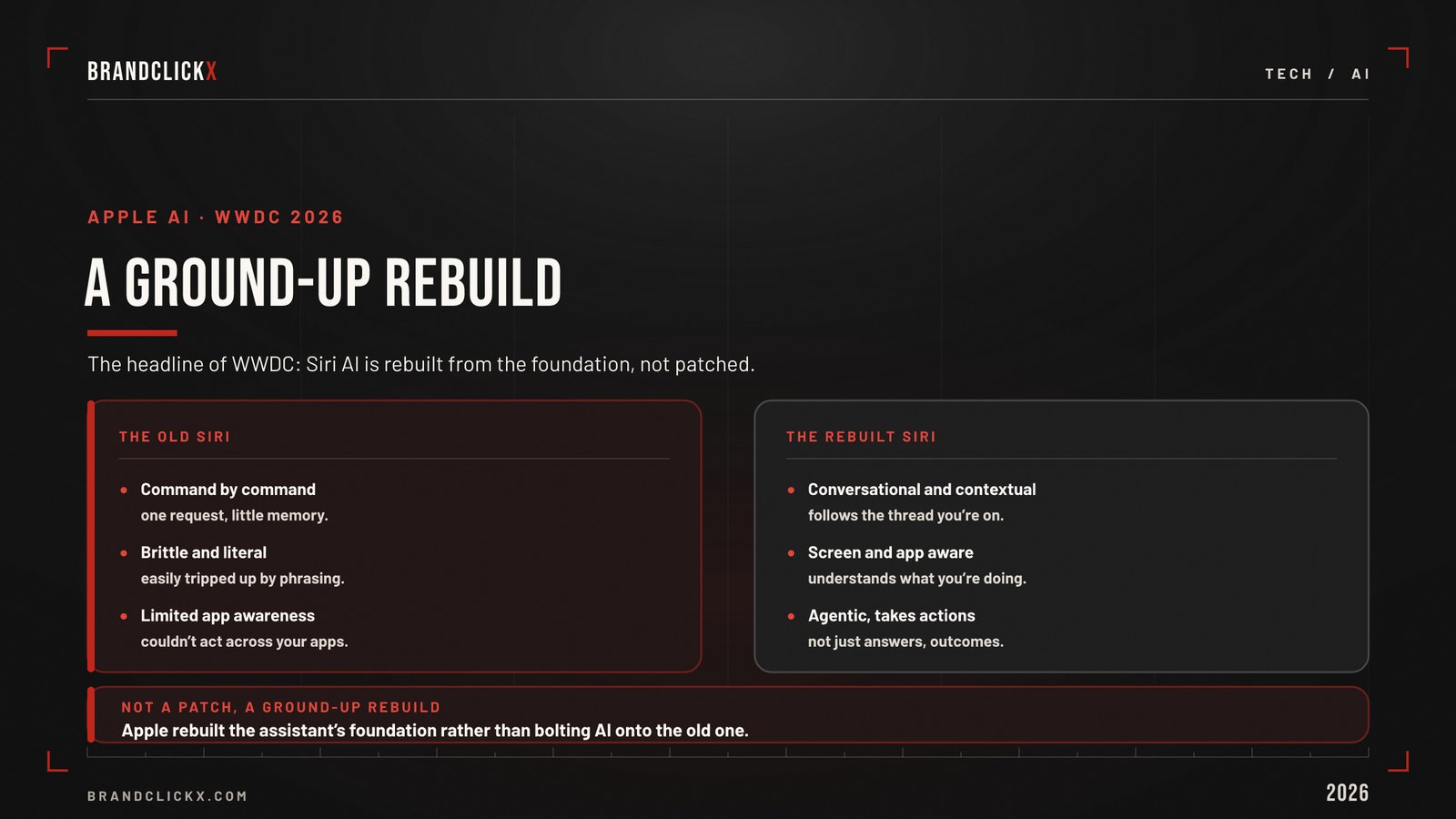
Start with the star of the show. Siri AI is not a patch on the old assistant. It is a complete rebuild, with Apple Intelligence at its core.
The new Siri AI holds real back-and-forth conversations, pulls context from your emails, messages, and photos, answers live questions from the web, and takes action across apps. It operates at the operating system level, so it can work without forcing you to jump between apps.
There is also a standalone Siri app now. You can chat with it, scroll back through past conversations, and treat it like the AI assistant people already use elsewhere.
Strategic Breakdown: the old Siri reacted to single commands. The new one plans. In live demos, it surfaced specific photos with filtered faces without opening Photos, and built a multi-stop route from a single spoken request. That shift from reaction to action is the whole point.
This is the biggest change to Siri since Apple introduced it in 2011. And in a neat piece of symmetry, it was Tim Cook who launched the original. Now he exits as Apple rebuilds it from the ground up.
The Twist: Google Powers the New Siri
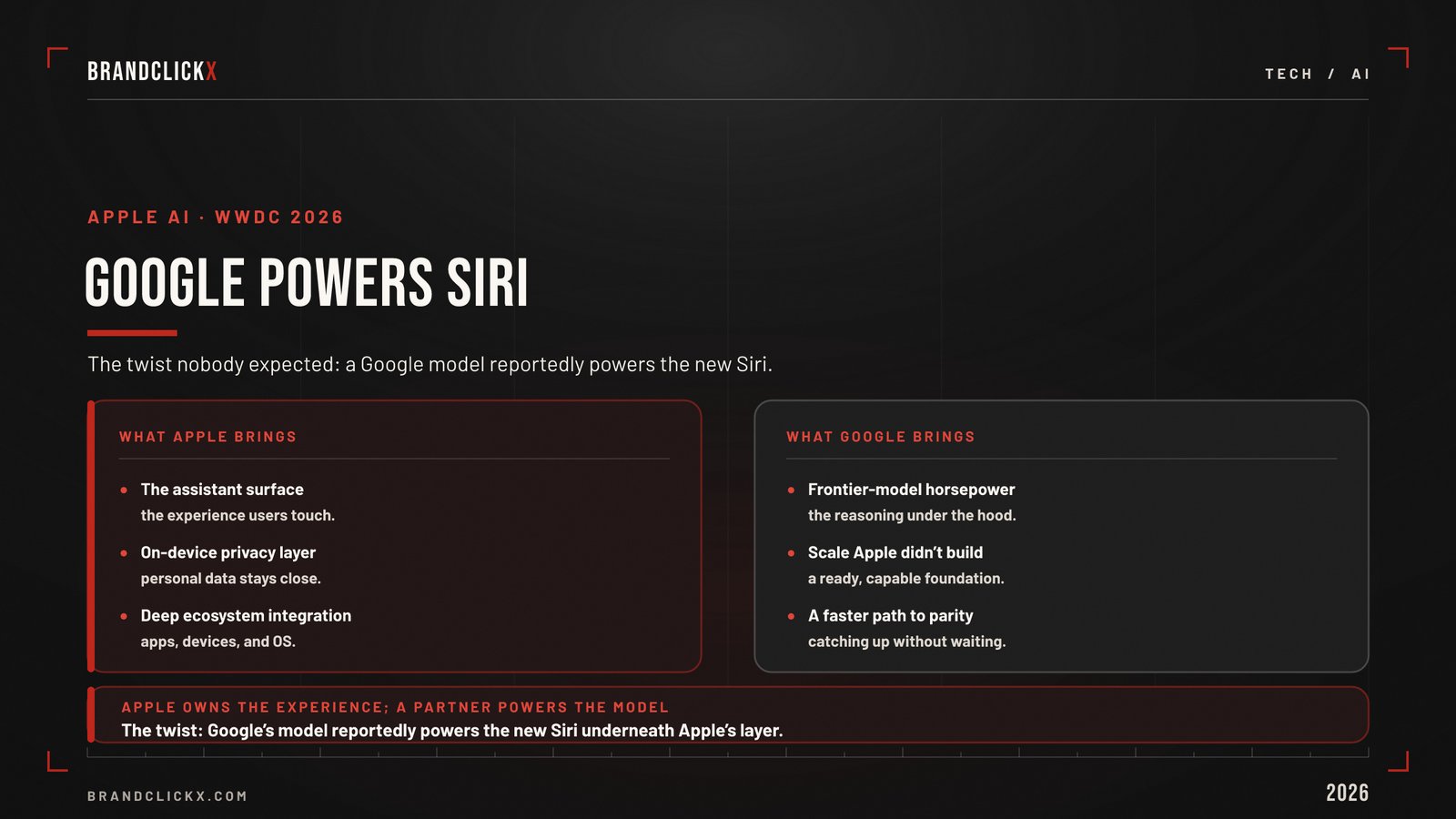
Here is the part Apple watchers will debate for years. The new Siri does not run purely on Apple’s own brain. Its heaviest thinking is handled by Google.
Apple acknowledged a Gemini partnership on stage. On-device tasks run on Apple’s own Foundation Models, while more demanding cloud queries route to a custom Google Gemini model.
According to reporting from Bloomberg’s Mark Gurman, Apple pays Google roughly $1 billion a year for a custom Gemini model reported at around 1.2 trillion parameters. Treat the exact price and parameter count as high-confidence reporting, not an Apple-confirmed spec.
The Bigger Shift: this deal is an admission. For a decade, Apple insisted it could do AI on its own terms. Paying a direct rival to power its flagship assistant concedes that it could not build a competitive large language model in-house on the timeline the market demanded.
Privacy is how Apple squares that circle. Queries that leave the device run through Apple’s Private Cloud Compute, and personal identifiers are stripped before any content reaches Gemini. Craig Federighi told the keynote audience that privacy in AI is “non-negotiable.”
So the architecture is a careful compromise. Google supplies the raw intelligence. Apple keeps the user experience, the data handling, and the trust relationship under its own roof.
What Siri AI Can Actually Do
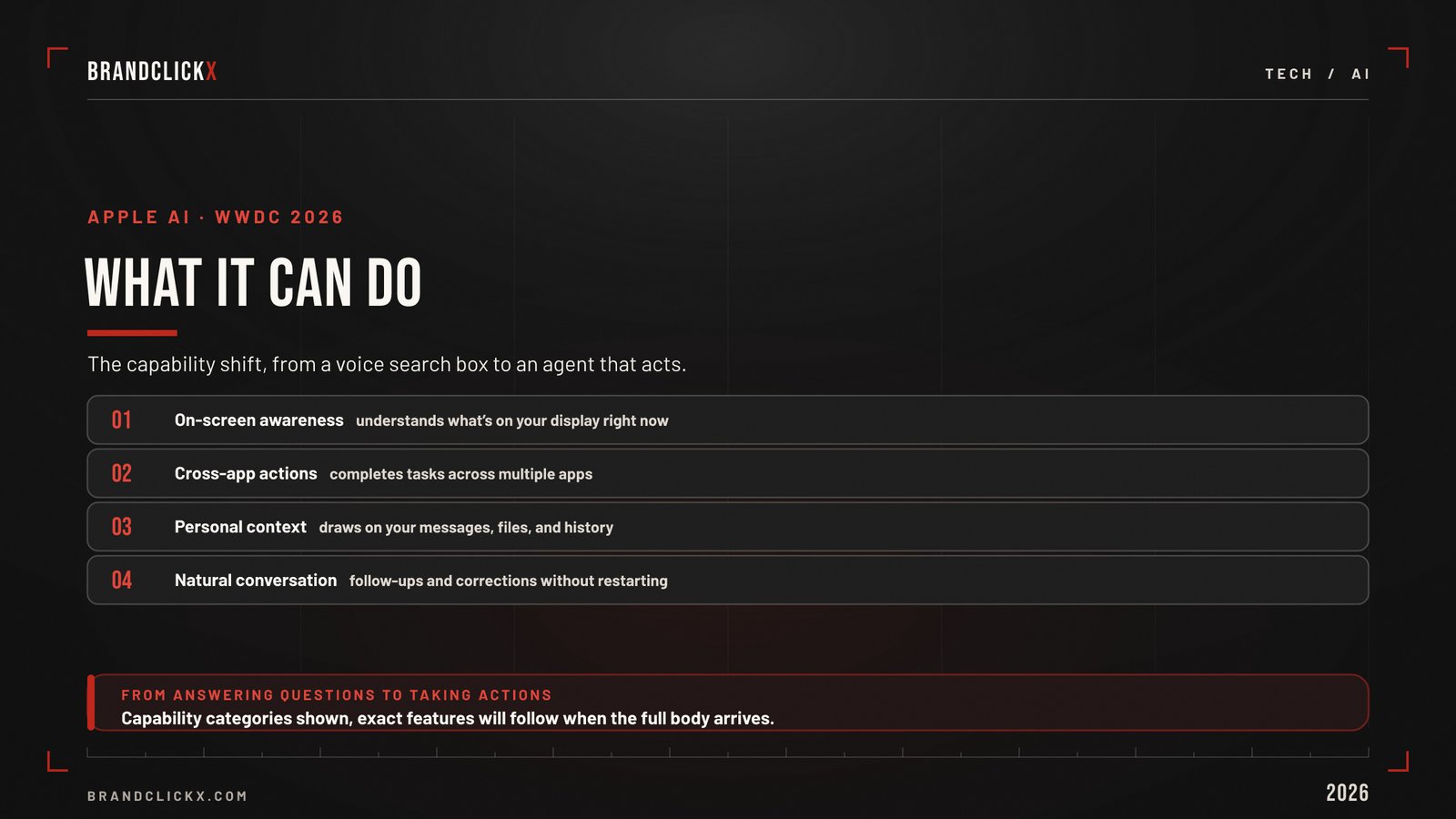
Capability is what matters to real users, so let us get concrete. The new assistant is built around personal context and cross-app action.
Siri AI can read what is on your screen, reference your Mail and Messages, and act across apps in a single chained request. The Phone app can now pull context from other apps mid-call, so details surface without you digging for them.
Messages gets AI-powered reply suggestions and one-tap creation of notes or reminders from a conversation. Safari gains smart tab management. Passwords can be updated in a single tap.
Expert Insight: the quiet revolution here is intent over navigation. Instead of opening four apps to plan an evening, you describe the outcome and let Siri assemble it. That changes the fundamental unit of interaction on the iPhone from the tap to the request. Every app maker and marketer should sit up at that.
The assistant rolls out to developers first, with public access arriving in beta later this year. It launches as an opt-in experience, with more features arriving as the models improve.
iOS 27: The Quiet Power Move
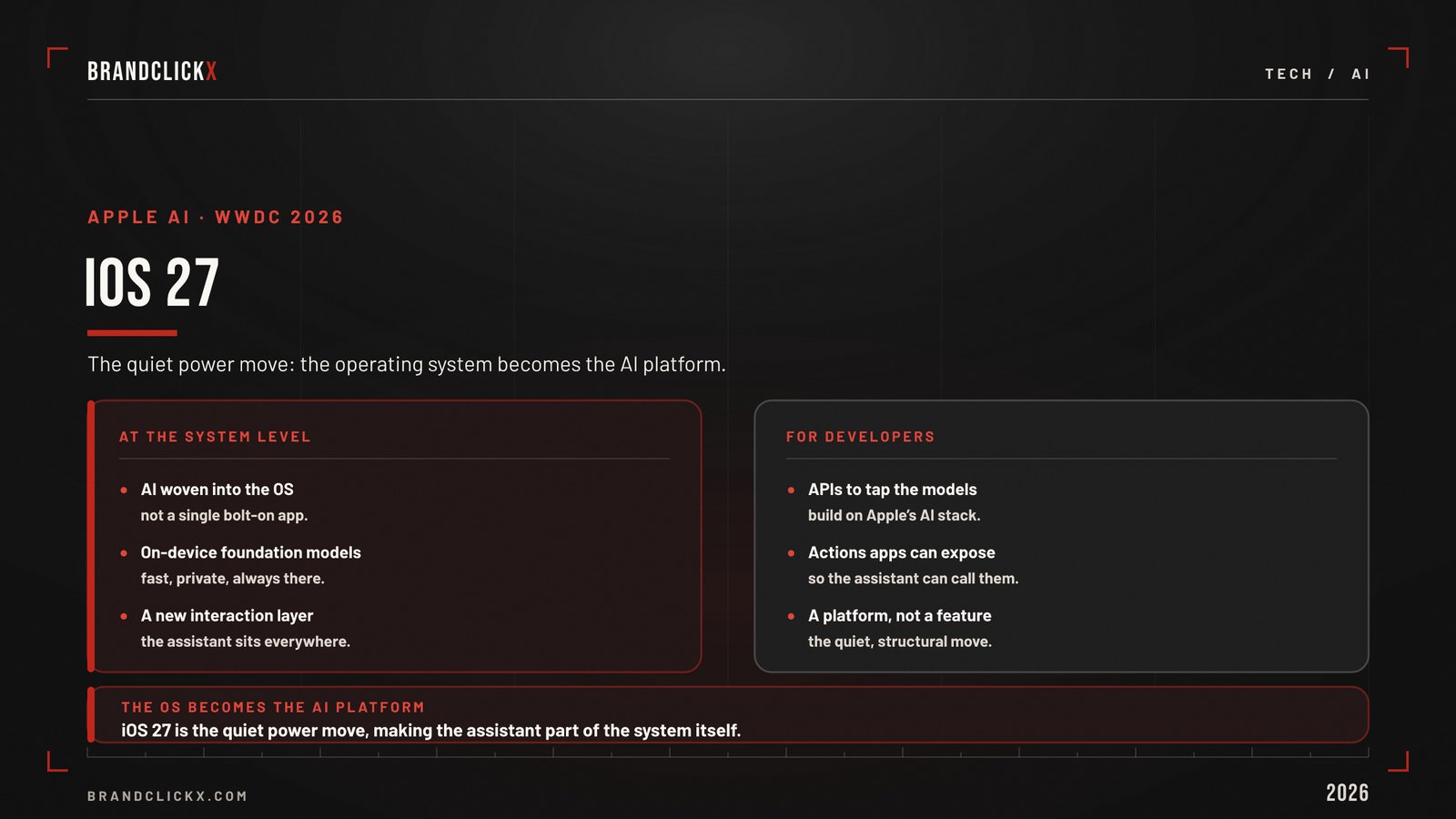
Not every headline was about chat. The platform itself got a deliberate tune-up, and it may matter more than the flashy demos.
iOS 27 is a Snow Leopard-style release, focused on fixing the underlying machinery rather than piling on features. The performance gains are real and specific. Apps launch up to 30 percent faster, photos load up to 70 percent faster after capture, and AirDrop transfers run up to 80 percent faster.
There is polish too. Apple added a personalization slider for its Liquid Glass interface, giving users control over the look introduced last year.
Market Observation: a stability-first release is a confident move in an AI cycle obsessed with novelty. Apple is betting that reliability is a feature, especially when it is asking users to trust an assistant with their personal data. A faster, steadier OS is the foundation that makes the AI feel trustworthy.
This is also smart sequencing. Ship the plumbing fixes and the intelligence layer together, and the whole device feels new without feeling fragile.
Apple Intelligence Across the System
Beyond Siri, the next generation of Apple Intelligence threads through the system. The features are small on their own and meaningful in aggregate.
- Photos gains Spatial Reframing, which improves composition after a shot is taken.
- Image Playground now supports photorealistic image generation, with Apple stating it does not train on images created in the app.
- Messages can turn a conversation into a note or reminder with one tap.
- Safari adds Notify Me alerts and smarter tab handling.
- Cross-app context lets intelligence flow between apps instead of staying siloed.
Apple confirmed these arrive this fall as free updates across its platforms, with broad language support rolling out over time.
Industry Impact: the renewed push on image generation is notable for marketers. Apple framed it around practical uses across the device, with a clear stance on not training models on user-generated images. That privacy posture is a brand signal in itself, and it sets a bar competitors will be measured against.
The Open Door: Third-Party AI as Default
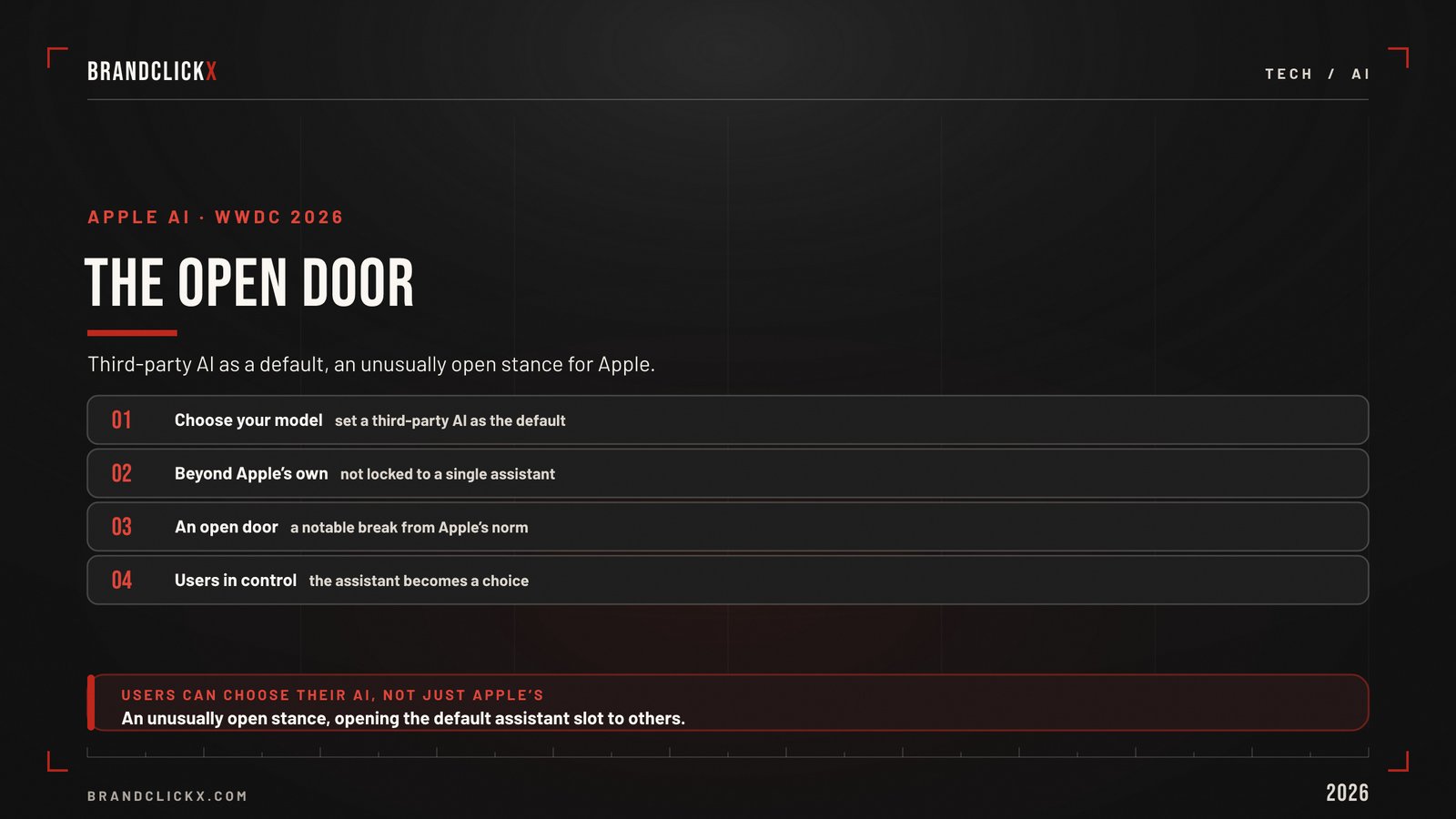
One announcement deserves its own spotlight, because it breaks with Apple tradition. iOS 27 will let users pick a third-party AI model as their default assistant.
That means a user can route requests to Claude or ChatGPT instead of relying solely on Apple’s stack. For a company famous for keeping users inside its own walls, that is a real concession.
Enterprise Perspective: this opening is part competitive pressure and part regulation, since the EU’s Digital Markets Act pushed Apple toward interoperability. The effect is a more open device, where the AI assistant layer becomes a choice rather than a default lock-in. For developers building AI products, the iPhone just became reachable in a way it never was before.
So the assistant war does not end at Siri. It moves onto Apple’s home turf, by Apple’s own hand.
Across the Ecosystem: Vision Pro, Watch, and TV
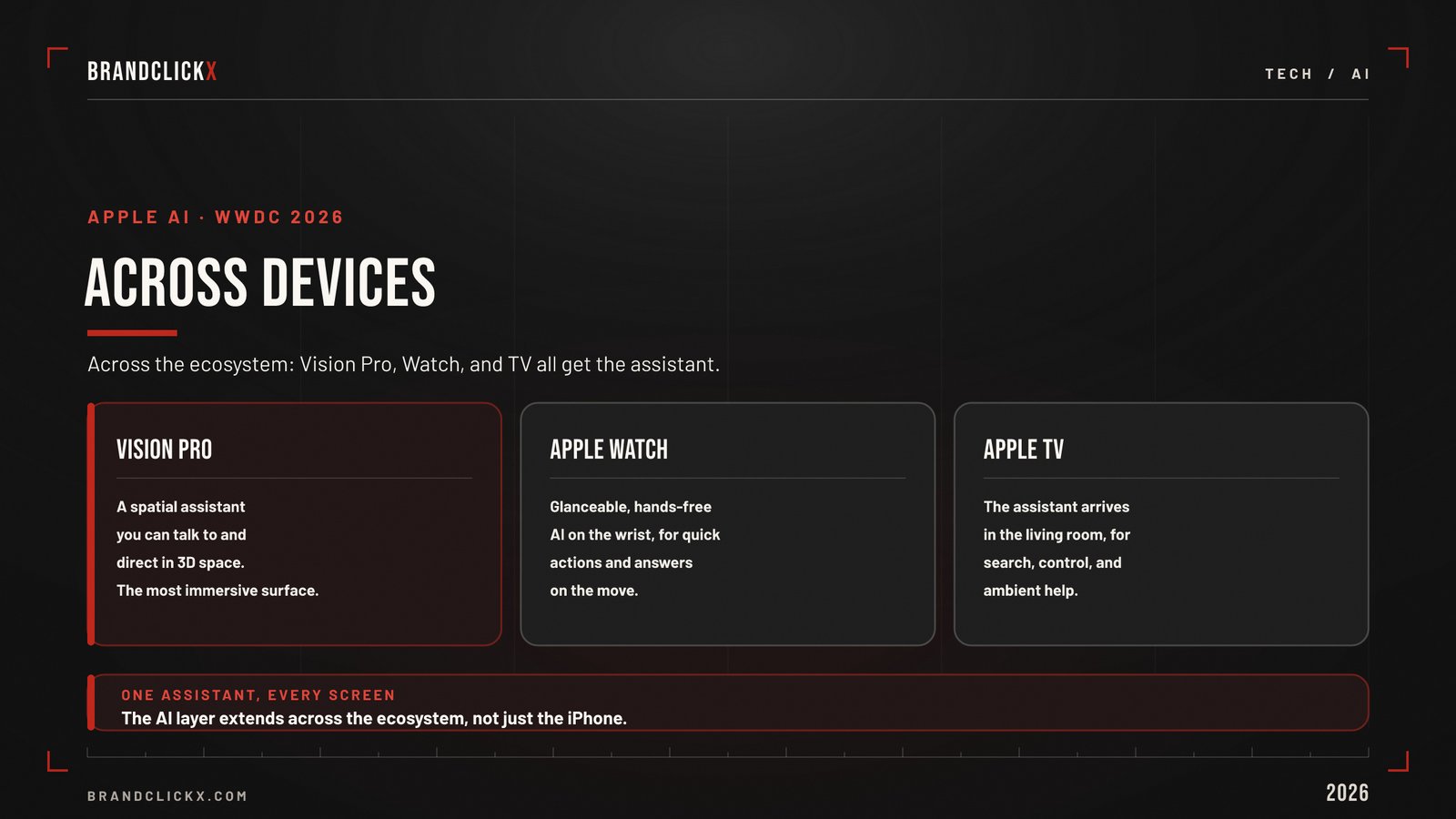
The update spanned every screen Apple makes. The ecosystem story is where the long-term strategy shows.
On Vision Pro, visionOS 27 brought Visual Intelligence to physical objects in your surroundings, turned panoramas into immersive spatial environments, and added a subtle curve to app windows. Wi-Fi on the headset is up to three times faster.
The watch and TV got attention too. Apple Watch added a dynamic app grid surfacing Siri-suggested apps and a consolidated Find My app, while AirPods picked up custom EQ. tvOS 27 delivered a redesigned Podcasts app, Hi-Res Lossless audio in Apple Music, and on-device HomeKit Secure Video.
Tactical Framework: the through-line is ambient intelligence. Apple wants its AI assistant present on every surface, from wrist to face to living room, all sharing context. For brands, that means customer attention is fragmenting across more AI-mediated touchpoints, not fewer.
WWDC 2026 at a Glance
| Platform | Headline update | Who it serves |
| iOS 27 | Siri AI, big performance gains, Liquid Glass slider | iPhone users and app makers |
| macOS 27 Golden Gate | Apple Intelligence and Siri AI on desktop | Pros and developers |
| visionOS 27 | Visual Intelligence on real objects, spatial panoramas | Vision Pro early adopters |
| watchOS 27 | Dynamic app grid, consolidated Find My | Everyday wearers |
| tvOS 27 | Redesigned Podcasts, Hi-Res Lossless audio | Living room and home |
The Catch: Where Siri AI Will Not Be
Now the asterisks, because the rollout has real gaps. Apple was upfront about them, and they matter for any global brand.
Siri AI launches as an English-only beta later this year. It will not be available in China at launch while Apple works through regulatory requirements. And it will not arrive on iPhone or iPad in the EU at launch, due to the Digital Markets Act.
Device support has limits too. Apple Intelligence and Siri AI require iPhone 16 models or newer, the iPhone 15 Pro line, iPads and Macs with M1 or later, Vision Pro, and recent Apple Watches. iOS 27 itself drops older hardware, including the iPhone 11.
Why It Matters: the EU exclusion is the loudest. Federighi said Apple was “deeply disappointed” that European users would not have Siri AI on iPhone or iPad at launch, per the company’s keynote remarks. For brands with European audiences, the new assistant simply will not be part of the customer experience yet.
So the revolution is real, but it is staggered. Geography, language, and hardware all gate who gets it first.
Why It Matters for Marketers and Brands
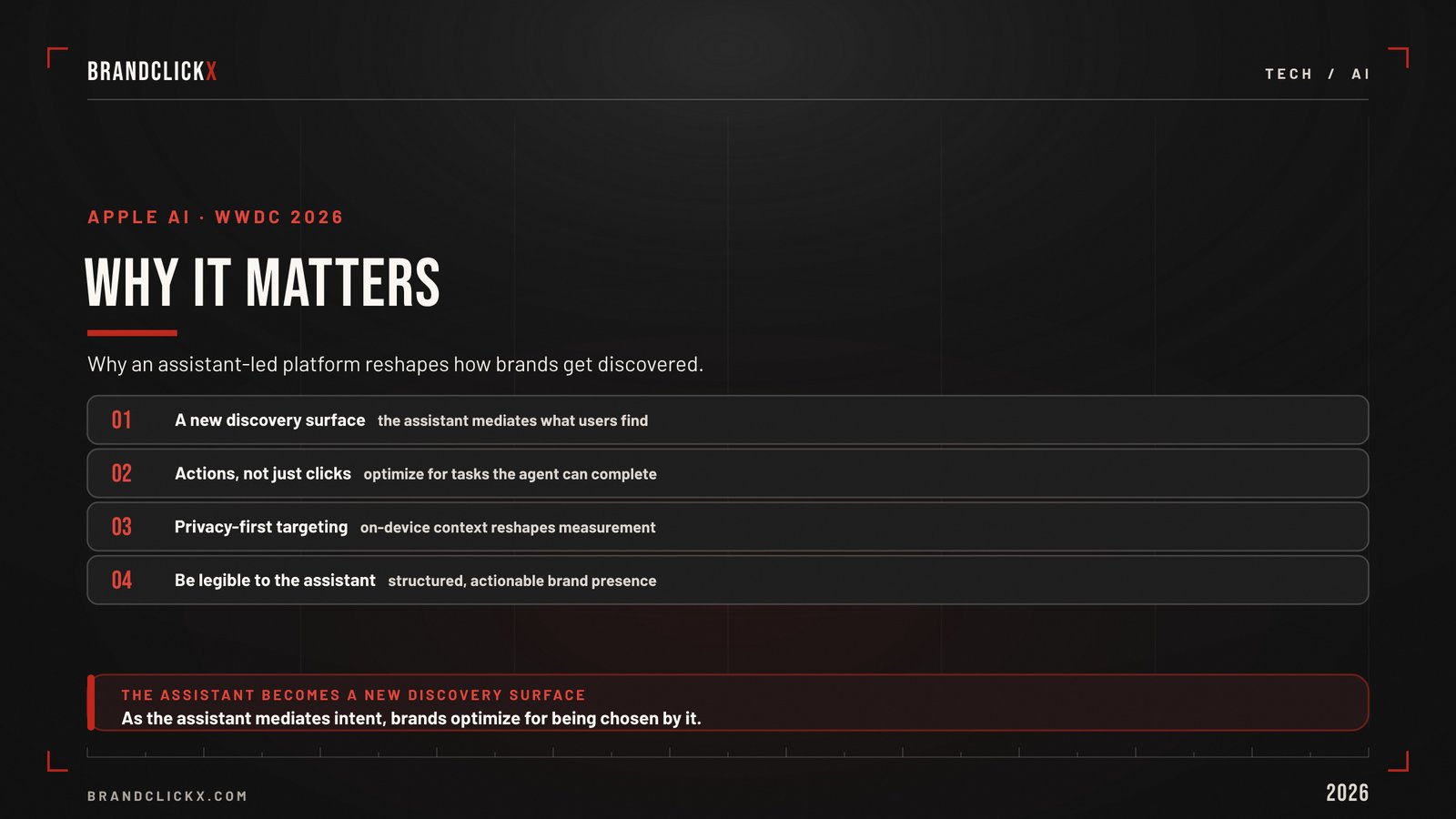
This is where the keynote stops being a gadget story and becomes a strategy problem. The device layer is changing, and marketing has to follow.
Start with discovery. When users describe an intent and let Siri act, the assistant becomes a new gateway to information and products. That sits right beside the shift toward AI search and agentic shopping, where being chosen by a model matters as much as ranking on a page.
Then consider engagement. If Siri completes tasks across apps without opening them, the old playbook of screen time, taps, and in-app sessions starts to bend. App makers will need to expose the right actions and data to the assistant, or risk becoming invisible plumbing.
Future Outlook: Apple also gave developers a free on-device Foundation Models framework. Expect a wave of offline-capable AI features inside third-party apps within two release cycles. The brands that build smart, private, on-device intelligence into their apps will feel a step ahead. The ones that wait will feel generic.
There is a creative angle too. Photorealistic image generation built into the system, with a clear no-training promise, gives marketing teams a native tool and a trust narrative at once. Privacy-first AI is becoming a brand value, not just a compliance checkbox.
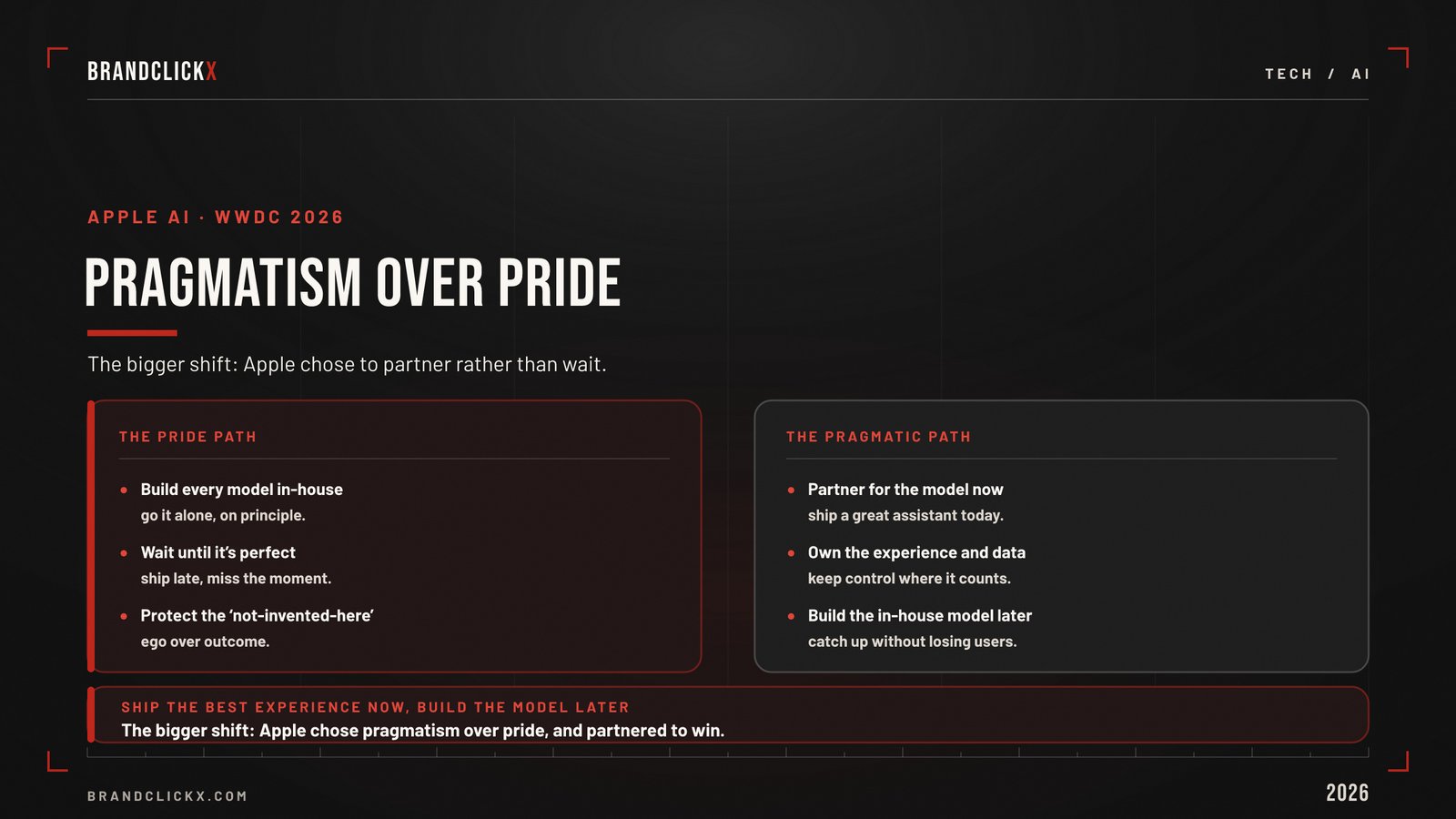
The Bigger Shift: Apple Chose Pragmatism Over Pride
Step back and the real story is about strategy, not software. Apple made a choice this week that would have been unthinkable a few years ago.
It put a competitor’s model at the heart of its flagship product. It opened the door to rival assistants on its own devices. And it shipped a stability release instead of chasing spectacle. Each move trades ego for outcomes.
What Happens Next will test that bet. Analysts widely expect a paid Apple Intelligence tier within a year to help offset the cost of all that cloud compute. The Gemini deal, layered on top of Apple’s existing search arrangement with Google, will also draw antitrust attention in both the US and the EU.
And there is the leadership angle. Cook hands the company to John Ternus with the Gemini dependency and a multi-model strategy as an inherited first decision. The new era of Apple AI starts with a partnership Apple would rather not have needed.
So the pragmatism cuts both ways. It buys Apple time and capability now. It also creates a reliance that the next CEO will have to manage carefully.
What Happens Next
The fall release will tell the real story, but the signals to watch are already clear. Here is where attention should go.
- Whether Siri AI engagement holds up against ChatGPT and Gemini once real users get it.
- The timing and price of any paid Apple Intelligence tier.
- How regulators in the US and EU treat the Apple and Google AI partnership.
- When and whether Siri AI reaches the EU and China.
- How fast developers adopt the free on-device Foundation Models framework.
Each of these will shape the Apple AI story more than the keynote applause did.
COMPARISON TABLE: OLD SIRI VS SIRI AI
| Capability | Old Siri | Siri AI (WWDC 2026) |
| Conversation | Single commands, little memory | Multi-turn chat with saved history |
| Personal context | Limited | Reads Mail, Messages, Photos, on-screen content |
| Cross-app action | Rare and rigid | Chained, multi-step actions across apps |
| Intelligence source | Apple only | Apple on-device models plus custom Google Gemini |
| Interface | Voice overlay | Standalone app plus system-level access |
| Third-party AI | Not supported | Claude or ChatGPT can be set as default |
| Privacy handling | On-device basics | Private Cloud Compute with identifiers stripped |
KEY TAKEAWAYS
- Apple’s AI revolution at WWDC 2026 centers on Siri AI, a ground-up rebuild powered by Apple Intelligence and a custom Google Gemini model.
- The Gemini deal, reported near $1 billion a year, is an admission that Apple could not build a competitive large language model in-house in time.
- iOS 27 is a stability-first release, with apps launching up to 30 percent faster and major speed gains across the system.
- Apple opened its devices to third-party assistants, letting users set Claude or ChatGPT as default, driven partly by competitive pressure and EU rules.
- The rollout is staggered. Siri AI launches English-only, skips China at launch, and will not reach iPhone or iPad in the EU at first.
- For marketers, the AI assistant becomes a new discovery and action layer, and a free on-device model framework will push AI features into many apps.
Frequently Asked Questions
What is Apple Intelligence?
Apple Intelligence is Apple’s built-in AI system across iPhone, iPad, Mac, and Vision Pro. It powers writing tools, image generation, and the rebuilt Siri AI using on-device and private cloud models.
Is the new Siri powered by Google Gemini?
Partly. Apple confirmed a Gemini partnership at WWDC. On-device tasks run on Apple’s own models, while heavier cloud queries use a custom Google Gemini model through Private Cloud Compute.
When does iOS 27 come out?
Developer betas arrived in June 2026, with a public beta expected around mid-July. The general release ships free this fall, alongside the next iPhone.
Is Siri AI free?
Yes. Siri AI and the iOS 27 update are free. Analysts expect a paid Apple Intelligence tier later to offset cloud costs, but the launch features carry no fee.
Which devices support Apple Intelligence and Siri AI?
iPhone 16 models, iPhone 15 Pro and Pro Max, iPads and Macs with M1 or later, Vision Pro, and Apple Watch Series 9 or later. Older devices miss out.
Is Siri AI available in the EU?
Not on iPhone or iPad at launch, due to the EU’s Digital Markets Act. Apple says it hopes to bring Siri AI to the region later. Vision Pro is an exception.
CONCLUSION
WWDC 2026 will be remembered as the moment Apple stopped pretending. The company that built its brand on doing everything itself admitted it needed help, and then engineered a way to take that help without surrendering its principles.
Siri AI is the visible result. The quieter result is a new posture: pragmatic, open to rivals, and willing to trade pride for progress. That is a different Apple than the one that walked on stage two years ago.
Future Outlook: the next twelve months decide whether this lands. If Siri AI earns daily use, the Gemini deal looks like a masterstroke that bought Apple a seat at the table. If engagement lags, it looks like rent paid to a competitor for a product Apple should have owned. The truth will sit somewhere between, and it will move fast.
For brands and marketers, the message is simpler and more urgent. The phone is becoming an AI assistant first and an app grid second. Discovery, engagement, and creative production are all shifting toward a model-mediated layer that most teams have not optimized for.
At BrandClickX, we read launches like this the way operators do. Not as a spec sheet, but as a map of where customer attention is heading next. The Apple AI era has finally begun, on terms nobody quite predicted.
The assistant can act now. The question for every brand is whether you are ready to be the thing it acts on.