

Quick Answer
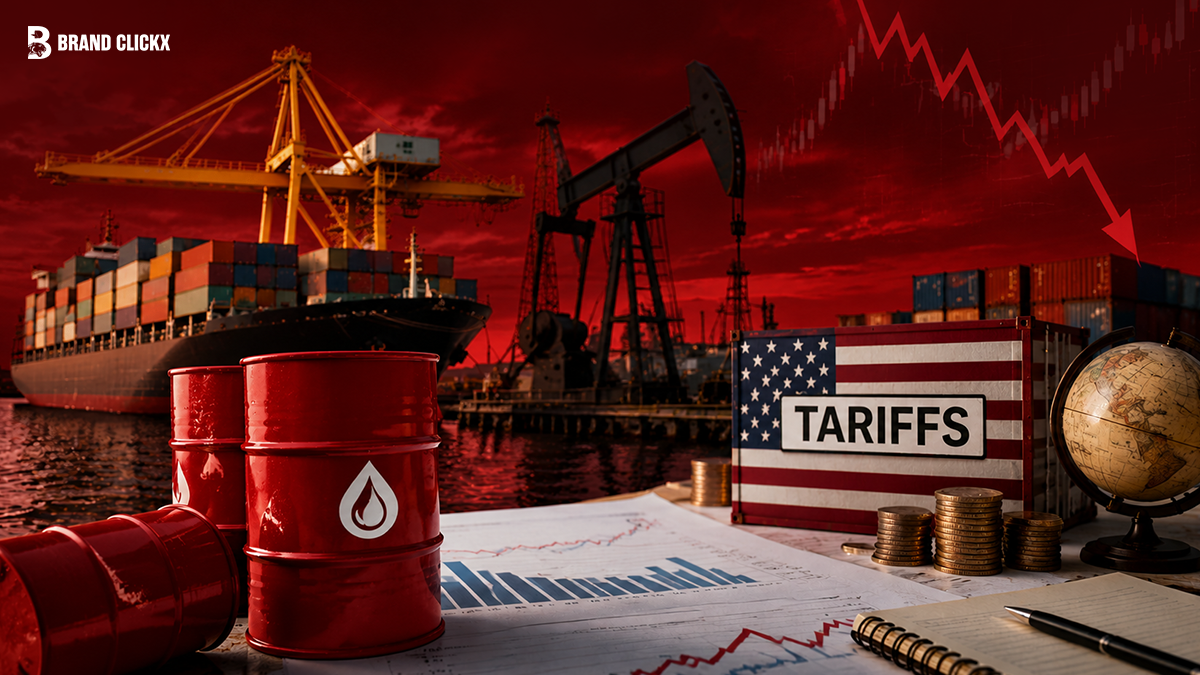
The global economy is dealing with two major pressures simultaneously: oil prices near $100 per barrel driven by the US–Iran war and Strait of Hormuz disruptions, and a fresh round of US tariffs (10–12.5%) on 60 trading partners that took effect July 25, 2026. Together, these forces are pushing up inflation, disrupting supply chains, and slowing economic growth worldwide.
Introduction
The global economy has entered another period of serious uncertainty as two powerful forces converge at the same time: a sharp rise in oil prices caused by active military conflict in the Middle East, and a renewed wave of US tariffs targeting 60 major trading partners.
Unlike previous trade disruptions, today’s environment is not simply a policy debate. The United States has been engaged in an active war with Iran since February 28, 2026 a conflict that has disrupted the Strait of Hormuz, one of the world’s most critical oil transit routes. As of July 24–25, 2026, Brent crude oil has risen to approximately $98–100 per barrel, its highest level since May.
At the same time, the Trump administration introduced a new round of tariffs on July 25, 2026 10% to 12.5% duties on goods from 60 trading partners after the Supreme Court struck down earlier tariff authorities. Together, these twin pressures are making long-term business planning increasingly difficult.
What Is Happening: The Two Key Pressures
1. The US Iran War and Oil Shock
On February 28, 2026, the United States and Israel launched airstrikes on Iranian military targets, triggering the 2026 Iran war. In response, Iran moved to close the Strait of Hormuz — a waterway through which roughly 20% of the world’s oil supply normally passes.
The disruption caused immediate oil price volatility. After a brief ceasefire in June, hostilities resumed in late June when an Iranian drone struck a cargo ship in the strait. By July 23–24, 2026, US Central Command had completed 13 consecutive nights of strikes on Iranian military targets, and Brent crude oil climbed back above $100 per barrel for the first time since May.
Houthi forces in Yemen have simultaneously threatened to blockade the Bab al-Mandeb strait — a key alternative route for Saudi crude — adding further pressure to already stretched global energy supplies.
| Key Event | Date | Impact |
| US–Israel strikes on Iran | February 28, 2026 | Iran attempts Hormuz closure; oil spike begins |
| US–Iran ceasefire MOU | June 18, 2026 | Brent falls back toward $70/barrel |
| Iranian drone hits cargo ship | June 25, 2026 | Ceasefire collapses; hostilities resume |
| 13th consecutive night of US strikes | July 22–23, 2026 | Oil tops $100/barrel again |
| Brent crude price (July 24–25, 2026) | ~$97–100/barrel | Near highest level since war began |
| Houthi Red Sea attacks | July 2026 | Saudi tankers targeted; alternative routes disrupted |
2. New US Tariffs on 60 Trading Partners
On July 24–25, 2026, the Trump administration introduced a sweeping new round of tariffs on 60 of America’s largest trading partners — covering more than 99% of US imports by value.
The new tariffs range from 10% to 12.5% and were enacted under Section 301 of the Trade Act of 1974, a different legal authority from the IEEPA tariffs previously struck down by the Supreme Court in February 2026. The administration cited foreign countries’ failure to ban goods produced with forced labour as the legal basis.
Separately, the US has imposed 25% tariffs on Brazilian goods (effective July 23, 2026) and has announced 50% tariffs on Canadian goods set to begin in August.
| Tariff Action | Rate | Effective Date |
| 60 major trading partners (EU, China, India, UK, etc.) | 10–12.5% | July 25, 2026 |
| Brazil | 25% | July 23, 2026 |
| Canada (certain goods) | 50% | August 2026 (announced) |
| Canada on steel & aluminum | 50% total | Already in effect |
How Oil Prices and Tariffs Reinforce Each Other
Although oil shocks and tariffs are different economic events, they often amplify each other’s impact. Businesses already facing higher fuel and transportation costs now also face higher import taxes — a double squeeze on profit margins that forces difficult decisions about pricing, sourcing, and investment.
| Factor | Oil Shock | Tariffs |
| Primary cause | US–Iran war; Hormuz disruption | US trade policy; Section 301 investigation |
| Main effect | Raises energy & transport costs | Raises cost of imported goods |
| Who feels it first | Manufacturers, logistics, agriculture | Importers, retailers, manufacturers |
| Inflation impact | Broad, economy-wide | Targeted but spreading |
| Business response | Seek alternative energy sources | Diversify suppliers, shift production |
| Government lever | Diplomatic / military action | Trade negotiations |
Industries Most Affected
| Industry | Oil Shock Impact | Tariff Impact |
| Transportation & Logistics | Higher fuel costs directly raise expenses | Imported vehicles, parts more expensive |
| Manufacturing | Production costs rise across all segments | Raw material and component costs increase |
| Aviation | Operating costs rise significantly | Imported aircraft parts more expensive |
| Agriculture | Fuel and fertiliser costs increase | Export markets may retaliate |
| Retail | Higher distribution costs | Imported consumer goods cost more |
| Technology | Energy-intensive data centres cost more | Semiconductors and electronics affected |
Which Regions Are Feeling the Greatest Impact?
Asia: Dual Pressure
Many Asian economies import significant quantities of oil and depend on export-driven manufacturing. The combination of higher energy costs and new US tariffs creates compounded pressure, particularly for manufacturers supplying the American market.
Europe: Energy Costs and Trade Exposure
European economies face higher energy import bills as alternative supply routes lengthen shipping distances and costs. The new 10–12.5% US tariffs on EU goods add trade pressure on top of energy costs.
Middle East: Supply Disruption at the Source
Saudi Arabia’s primary crude export route through the Strait of Hormuz is severely disrupted. Saudi tankers have been targeted by Houthi forces in the Red Sea, forcing consideration of rerouting shipments through the Suez Canal and around Africa — significantly increasing shipping costs and delivery times.
United States: Consumer Price Pressure
American consumers face both higher energy costs passed through from the oil shock and higher prices on imported goods resulting from the new tariffs. The combination is expected to contribute to renewed inflationary pressure in the second half of 2026.
| Economy Type | Main Challenge | Current Position |
| Energy-importing economies | Higher fuel costs from Hormuz disruption | More vulnerable |
| Export-driven manufacturing economies | US tariffs 10–12.5% plus weaker demand | Moderate to high risk |
| Technology-focused economies | Continued demand for advanced products | More resilient |
| Energy-exporting economies | Revenue up, but routes disrupted | Mixed — geopolitical risk high |
| Gulf states | Direct conflict exposure | Significant uncertainty |
Critical Minerals: A Growing Strategic Issue
Trade discussions now extend well beyond finished goods. Critical minerals — including rare earth elements essential for electric vehicles, semiconductors, renewable energy, and defence equipment — have become a strategic priority.
Supply chain disruptions caused by the Iran war are affecting not just oil but also the movement of industrial goods through Gulf shipping lanes. Several Asian buyers have begun discussing rerouting Saudi crude shipments around Africa, which adds weeks to delivery times and increases costs for energy-dependent manufacturing sectors.
How Businesses Are Adapting
Diversifying Supply Chains
Many manufacturers are accelerating moves to source components from multiple countries rather than depending on a single supplier. This approach reduces exposure to both regional conflicts and targeted tariff actions.
Producing Closer to Key Markets
The combination of higher transport costs and tariff barriers has made production closer to end markets more financially attractive. Companies are re-evaluating factory locations and logistics networks in response.
Strengthening Risk Management
Businesses with established supply chain risk frameworks have generally responded more quickly to the current disruptions. Monitoring energy price movements, shipping route alternatives, and tariff policy changes has become a core operational function for large manufacturers.
Practical Steps Businesses Can Take
- Review supplier networks and identify single-country dependencies.
- Monitor daily changes in Brent crude prices and Strait of Hormuz shipping data.
- Track tariff regulation changes under Section 301, particularly for goods in the 60-country tariff list.
- Improve inventory planning for critical materials sourced from affected regions.
- Assess alternative shipping routes and their cost implications.
- Engage trade advisors to understand specific product-level tariff exposure.
- Prepare for fluctuations in transportation and energy costs through Q3 and Q4 2026.
Common Misconceptions
| Myth | Reality |
| This oil shock is just a market fluctuation | It is driven by active military conflict and physical disruption of a major global shipping route |
| Tariffs only affect foreign companies | Domestic importers, manufacturers, and consumers share the added costs |
| Higher oil prices only affect fuel stations | Rising energy costs increase expenses across virtually every industry |
| Supply chains quickly return to normal | The Iran war and ongoing Hormuz disruption mean recovery timelines remain deeply uncertain |
| Every country experiences the same impact | Effects vary significantly based on energy dependence, trade exposure, and proximity to conflict |
| The ceasefire in June resolved the problem | Hostilities resumed in late June; as of July 2026 the conflict is actively ongoing |
Key Indicators to Watch
- Brent crude oil daily price particularly relative to the $100/barrel threshold.
- Strait of Hormuz ship transit numbers currently severely depressed vs pre-war baseline of ~110 ships/day.
- US–Iran diplomatic developments any ceasefire or escalation will immediately affect oil prices.
- Houthi activity in the Red Sea and Bab al-Mandeb.
- Inflation data in the US, EU, and major Asian economies.
- Central bank policy responses to renewed inflation pressure.
- Section 301 tariff developments particularly Canada 50% tariffs in August 2026.
Frequently Asked Questions
What caused the current oil price spike?
The primary cause is the 2026 US–Iran war, which began on February 28, 2026 with US and Israeli airstrikes on Iran. Iran’s attempts to disrupt or close the Strait of Hormuz through which approximately 20% of global oil supply transits caused immediate and significant oil price increases. As of July 24–25, 2026, Brent crude is trading near $98–100 per barrel.
What are the new US tariffs announced in July 2026?
On July 24–25, 2026, the Trump administration imposed tariffs of 10% to 12.5% on goods from 60 major trading partners, including the EU, China, India, and the United Kingdom. These were enacted under Section 301 of the Trade Act of 1974, after the Supreme Court struck down earlier IEEPA-based tariffs in February 2026.
Is the Strait of Hormuz currently closed?
Not fully closed, but severely disrupted. Before the war, approximately 110 ships transited the strait daily. As of mid-July 2026, that number has dropped dramatically. The US military is conducting ongoing escort operations and airstrikes to keep the waterway partially open.
How do tariffs contribute to inflation?
When imported goods become more expensive because of tariffs, businesses generally pass some or all of those additional costs on to consumers through higher prices. Combined with higher energy costs from the oil shock, this creates compounded inflationary pressure.
Which countries are most affected by higher oil prices?
Countries that rely heavily on imported energy including Japan, South Korea, India, and much of Europe — generally experience the greatest economic pressure, as rising fuel costs affect transportation, manufacturing, electricity generation, and household spending.
Can businesses reduce the impact of these pressures?
Many businesses are reducing risk by diversifying suppliers across multiple countries, exploring alternative shipping routes, improving inventory management for critical materials, and monitoring tariff and energy market changes closely. No strategy eliminates uncertainty entirely, but these steps improve resilience.
Conclusion
The combination of rising oil prices driven by the 2026 US–Iran war and Strait of Hormuz disruptions — and the Trump administration’s new round of tariffs on 60 trading partners has created one of the most challenging dual-pressure environments for the global economy in recent years.
Unlike earlier trade tensions, today’s situation involves active military conflict with direct physical consequences for global energy supplies. Oil near $100 per barrel, severely reduced shipping through the world’s most important oil transit route, and sweeping new import duties affecting 99% of US imports are all happening simultaneously.
Businesses are adapting by diversifying supply chains, rerouting logistics, and strengthening risk management. But with the Iran conflict unresolved and tariff policy continuing to evolve, uncertainty remains the defining feature of the global economic landscape in mid-2026.
Key Takeaways
- The 2026 US–Iran war and Strait of Hormuz disruptions are the primary driver of the current oil price spike — not merely market conditions.
- Brent crude oil is trading near $98–100/barrel as of July 24–25, 2026 — a 43% increase year-on-year.
- New US tariffs of 10–12.5% on 60 trading partners took effect July 25, 2026 under Section 301.
- The ceasefire signed in June 2026 has collapsed; hostilities are actively ongoing as of late July 2026.
- The dual pressure of oil costs and tariffs is creating compounded inflationary risk in H2 2026.
- Businesses must monitor both energy markets and trade policy changes closely through Q3–Q4 2026.