The Historic Flip Nobody Expected (But Everyone Should Have Seen Coming)
For more than a decade, the answer to “who dominates digital advertising?” was unambiguous: Google.
Search. YouTube. Display network. Automation. Google had the scale, the user habit, the intent data. The company was synonymous with digital ad revenue.
In 2026, that changes.
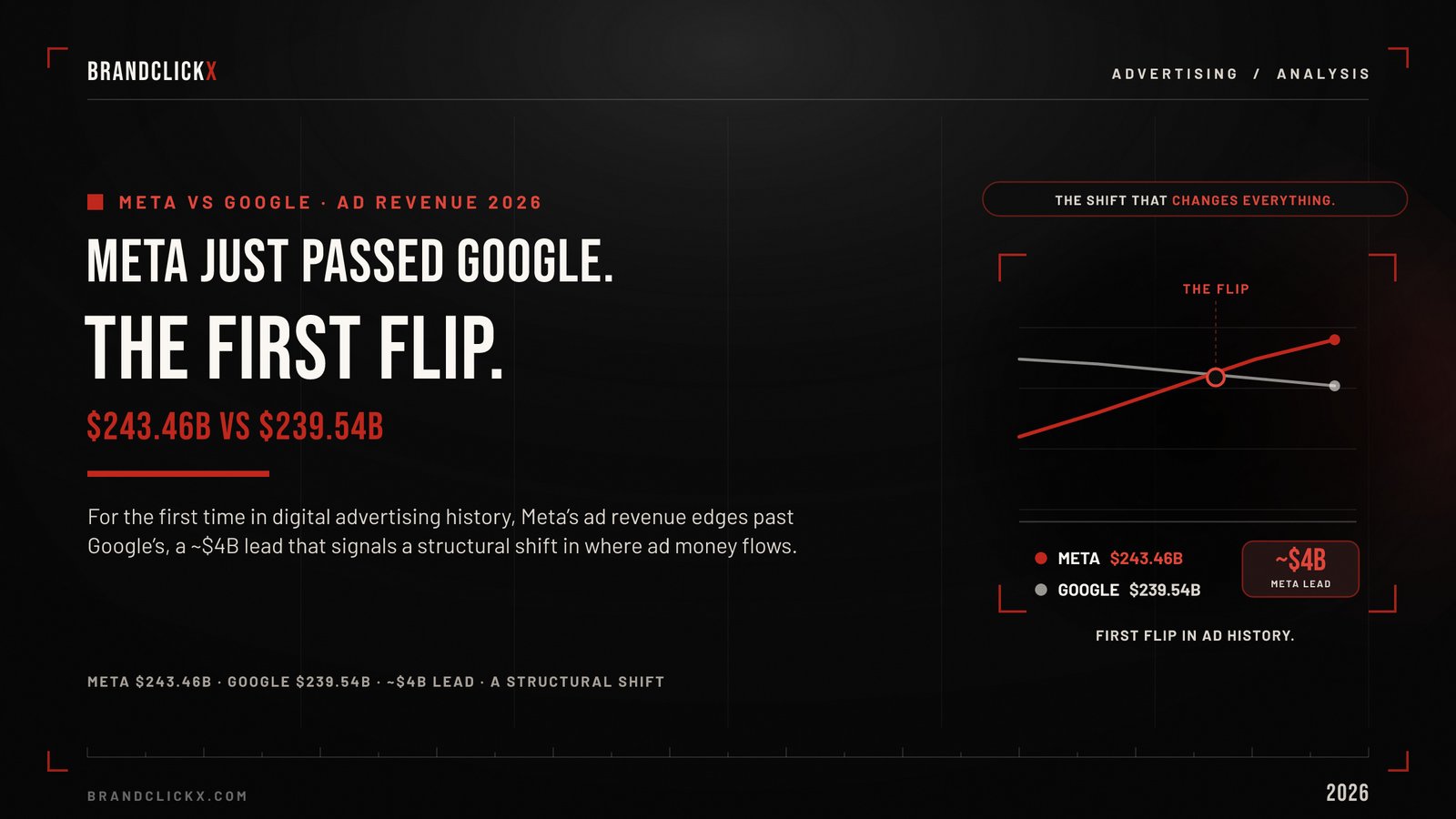
Meta is projected to generate $243.46 billion in global ad revenue. Google will reach $239.54 billion.
For the first time in the history of digital advertising across eMarketer’s 14-year tracking history Google will not hold the top position.
But here’s what matters more than the headline: the gap is closing because Meta is moving fast while Google is moving steady. Meta’s growth rate is 24.1% year-over-year. Google’s is 11.9% and has been flat for two years. When one engine is doubling down and the other is cruising, the distance closes.
The narrow margin ($3.92 billion) means any disruption could reverse the order. But the direction of change is unmistakable.
The Gap: From $17.89B to $3.92B in One Year
To understand the magnitude of this shift, look at the numbers:
2025:
- Google: $214.06 billion
- Meta: $196.17 billion
- Gap: $17.89 billion (Google ahead)
2026 Projection:
- Meta: $243.46 billion
- Google: $239.54 billion
- Gap: $3.92 billion (Meta ahead)
In one year, Meta closed a $17.89 billion deficit and created a $3.92 billion lead.
That’s not incremental improvement. That’s structural momentum.
The Math That Explains Everything:
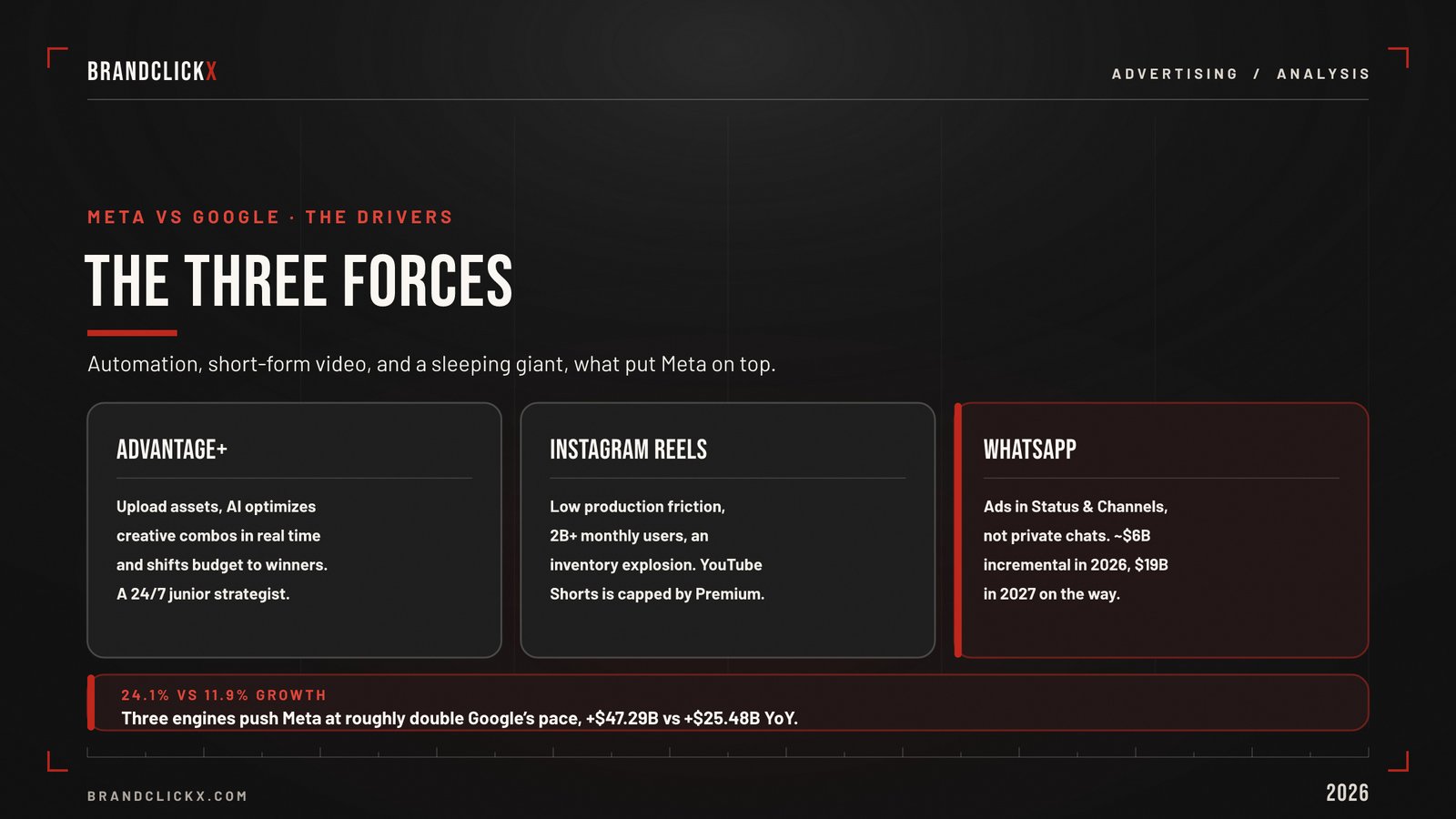
- Meta growth: +$47.29 billion year-over-year (24.1%)
- Google growth: +$25.48 billion year-over-year (11.9%)
Meta is growing at roughly 2x the rate of Google. When one company grows twice as fast as another, markets shift. Platform hierarchies reorder. Advertiser strategies need rebuilding.
What Actually Changed: The Three Forces Behind Meta’s Acceleration
1. Advantage+ Automated Ads: The Force Multiplier
Meta’s Advantage+ suite isn’t revolutionary technology. It’s automation done right.
Advantage+ lets advertisers upload assets (images, headlines, copy variations), set targeting parameters, and let AI optimize creative combinations in real-time. The system learns which creative resonates with which audience segments, and continuously shifts budget toward winners.
For performance marketers, this is the equivalent of having a junior strategist that works 24/7, never gets tired, and never takes vacation.
Why it works:
- Reduces manual optimization burden
- Increases creative velocity (test more combinations faster)
- Scales to smaller budgets (SMBs can compete with enterprises)
- Improves ROI predictability (AI finds consistent patterns)
Google has automation, but Meta’s feels frictionless. Advertisers report Advantage+ just works when fed good creative inputs. That reputation earned through consistent performance is driving adoption.
2. Instagram Reels: The Short-Form Video Goldmine
TikTok created the short-form video ad format. YouTube Shorts followed. Instagram Reels came third but Meta has the monetization infrastructure.
Reels aren’t just cannibalizing YouTube’s market share. They’re creating new advertiser demand because:
- Lower production friction: Brands don’t need cinematic production. Authentic, vertical, 15-60 second content performs.
- Massive scale: Instagram has 2 billion+ monthly users. Reels reach is vast.
- Inventory explosion: Short-form video creates vastly more ad slots than traditional formats.
- Creator partnerships: Influencer marketing on Instagram/Reels is mature. The systems work.
YouTube Shorts is growing, but it faces a constraint: YouTube Premium subscribers don’t see ads. That limits monetizable inventory. Meta doesn’t have that constraint. Every Reels impression is a potential ad placement.
3. WhatsApp: The Unfinished Business That’s About to Print Money
This is the sleeper story.
For years, WhatsApp was a user acquisition cost for Meta a massively expensive acquisition (nearly $20 billion) that generated little revenue. The business model wasn’t clear. Users expected privacy. Advertising seemed impossible.
Then Meta figured it out: serve ads in the Updates section Status updates and Channels without placing them in private chats. Users can opt for premium ad-free versions. Advertisers get a new channel with relatively low competition.
The numbers:
- WhatsApp paid business messaging already crossed $2 billion in annualized run rate in Q4 2025
- Growing 54% year-over-year
- Projected incremental ad revenue: $6 billion in 2026, $19 billion in 2027
That’s not marginal revenue. That’s transformational. WhatsApp alone could become a top-10 ad platform globally if execution continues.
The Counterforce: Why Google Is Slowing Down
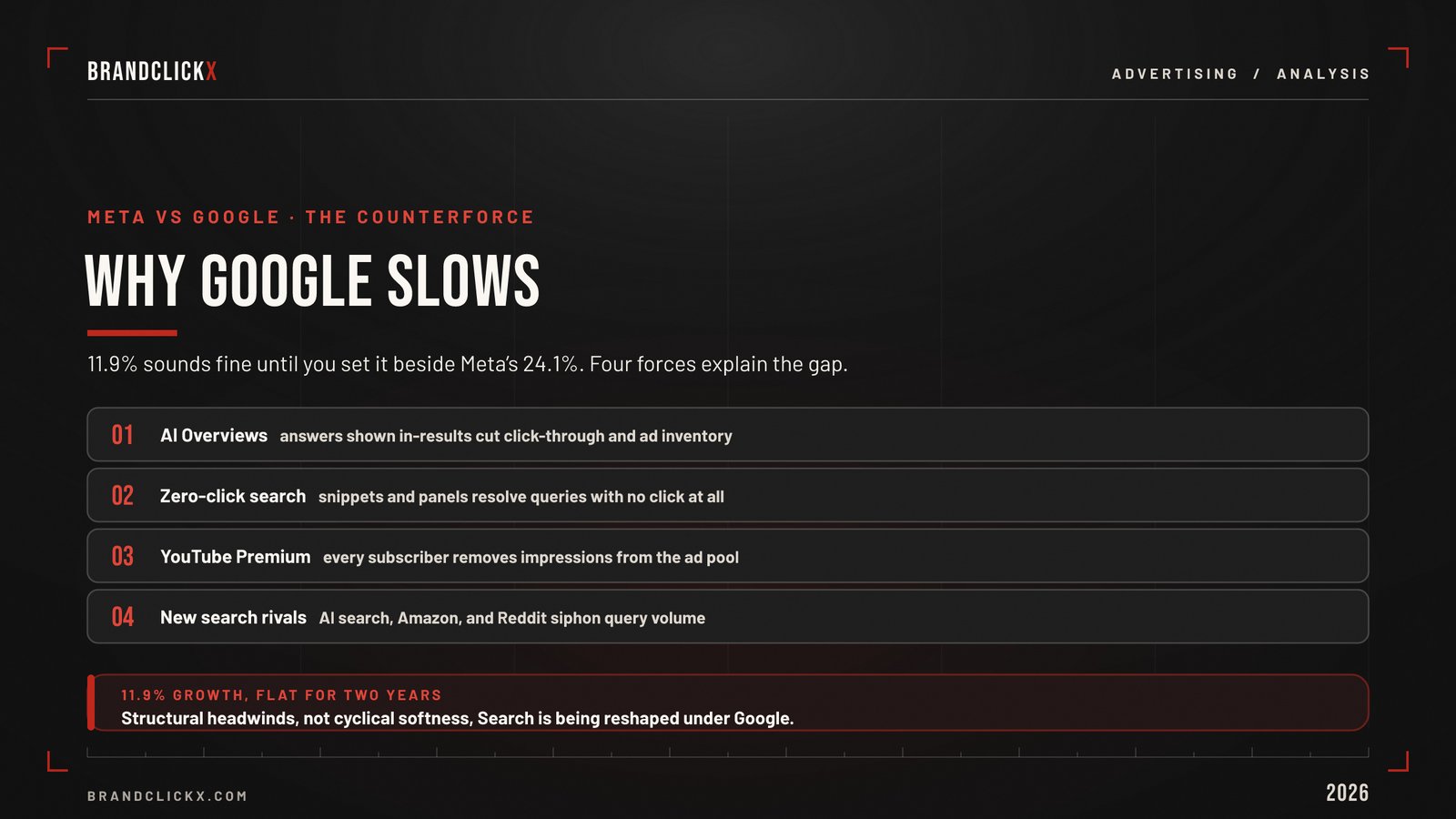
Google’s 11.9% growth rate sounds respectable until you compare it to Meta’s 24.1%. The gap reflects structural headwinds, not cyclical softness:
1. AI Overview Cannibalization
When Google shows answer summaries directly in search results, fewer users click through to organic results. Fewer clicks means less ad real estate, less inventory, lower advertiser demand.
Some searches now resolve without users ever reaching the page. That’s revenue destruction for organic content and for lower-click-through ads.
Google’s fighting this with AI Overviews that include relevant ads, but the math is complex. Showing the answer directly is sometimes better for users and worse for advertisers.
2. Zero-Click Search Growing
More searches result in immediate answers (featured snippets, knowledge panels, local results) without any click. The growth in zero-click search means less inventory available for traditional ad placements.
This is particularly acute in mobile search, where space is limited.
3. YouTube Premium Reduces Ad Inventory
YouTube Premium is successful (millions of subscribers). But each Premium subscriber removes ad impressions from the monetizable pool. For YouTube, subscriber growth is revenue growth. But for Google’s overall ad business, it’s a trade-off: higher ARPU per subscriber, but lower overall inventory monetization.
4. Search Competition (Subtle But Real)
AI search platforms (Perplexity, Claude search capabilities, others) are siphoning query volume from Google Search. Still small percentages, but the trend is visible. Amazon is also taking retail search volume. Reddit is taking informational queries.
Google Search remains enormous and essential. But its growth rate reflects these countervailing forces.
The Broader Market Reality: Concentration at the Top
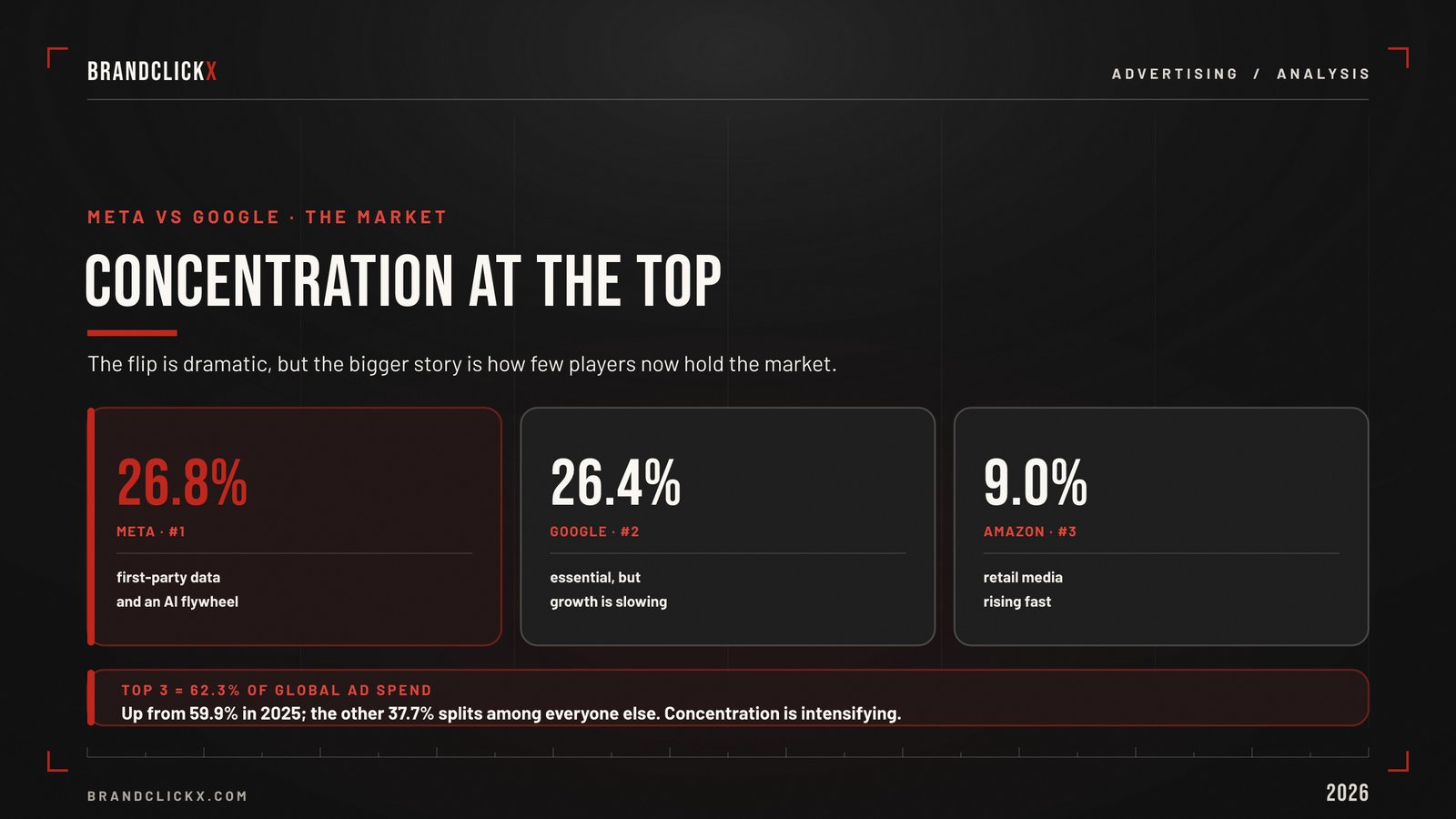
Meta and Google’s flip is dramatic, but the bigger story is market concentration:
2026 Market Share (Global Digital Ad Spend):
- Meta: 26.8%
- Google: 26.4%
- Amazon: 9.0%
- Top 3 combined: 62.3%
That means 37.7% of global digital ad spend is fragmented across TikTok, Microsoft, Apple, the open web, retail media networks, connected TV, and hundreds of other platforms.
Each year the top three grow faster than the rest, the addressable share for everyone else compresses. This isn’t collusion it’s compounding advantages:
- First-party data: Meta and Google have vast user data. Amazon has purchase data. This data feeds their AI targeting systems, making ad performance measurable and predictable.
- AI integration: All three have embedded AI throughout their ad platforms. Automation improves performance. Better performance attracts budget. More budget funds more AI development. Flywheel.
- Scale network effects: The more advertisers spend, the more data flows into the AI systems, the better performance becomes, the more advertisers spend.
Smaller platforms can’t compete at this speed. They lack the data volume, the AI talent, the capital to invest in infrastructure.
What Marketers Must Do Now
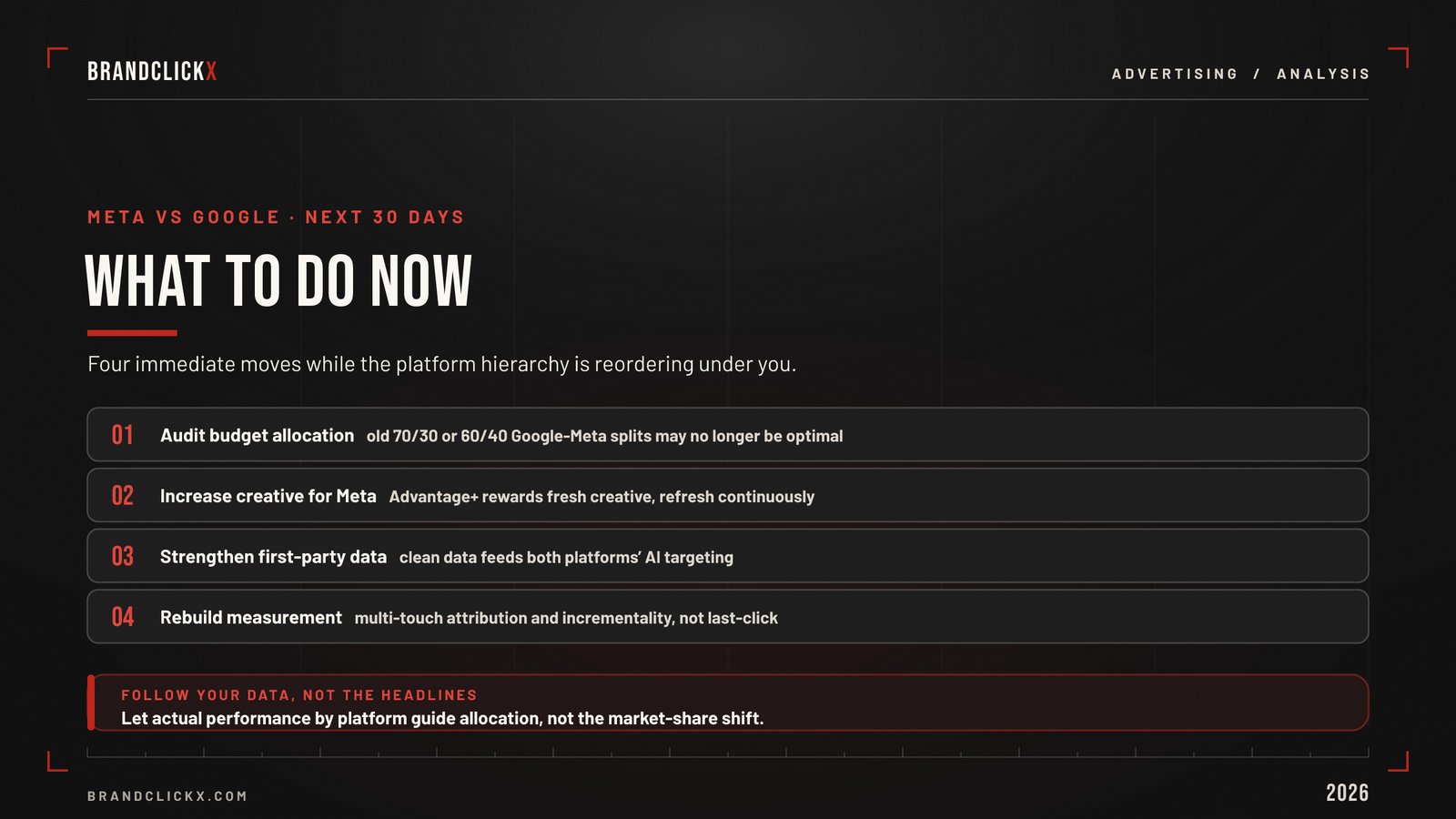
Immediate Actions (Next 30 Days)
Audit Your Budget Allocation
If your Meta/Google split is based on historical conventions (e.g., 70% Google, 30% Meta), reassess it.
The optimal split depends on your business:
- High-intent, bottom-of-funnel campaigns? Google Search is still irreplaceable. Keep healthy Search budget.
- Awareness, consideration, re-engagement? Meta has momentum. Increase allocation. Test Advantage+.
- E-commerce, commerce-adjacent? Amazon’s growing. Audit your Amazon Ads spend.
Don’t just follow the headlines. Analyze your actual performance by platform. Let data guide allocation, not market share shifts.
Increase Creative Investment for Meta
Advantage+ rewards fresh creative. If you’re running the same creative assets across multiple campaigns, Meta’s algorithm will quickly find the most efficient ones, then plateau. Continuous creative testing drives sustained performance.
Allocate budget for:
- Monthly creative refreshes
- A/B testing new hooks, formats, messaging
- Creator partnerships (user-generated content often outperforms polished brand content)
- Reels-specific creative (don’t just repurpose YouTube videos)
Strengthen First-Party Data Collection
Both Meta and Google need clean, first-party data to feed their AI systems. If your CRM is outdated, your conversion tracking is incomplete, or your email list is stale, you’re handicapping both platforms.
Action items:
- Audit your conversion pixel implementation (is every conversion being tracked?)
- Clean your CRM (remove duplicates, update contact data)
- Rebuild audience segments based on first-party data, not platform predictions
- Integrate your email list into both platforms (lookalike modeling improves with more seed data)
Rebuild Measurement for Multi-Platform World
When one platform dominated, measurement was simpler. Now, credit gets distributed across Meta, Google, Amazon, and others. Misattribution is rampant.
Solutions:
- Implement proper multi-touch attribution (not last-click)
- Use incrementality testing to isolate each platform’s true impact
- Build dashboards that show channel contribution, not just channel activity
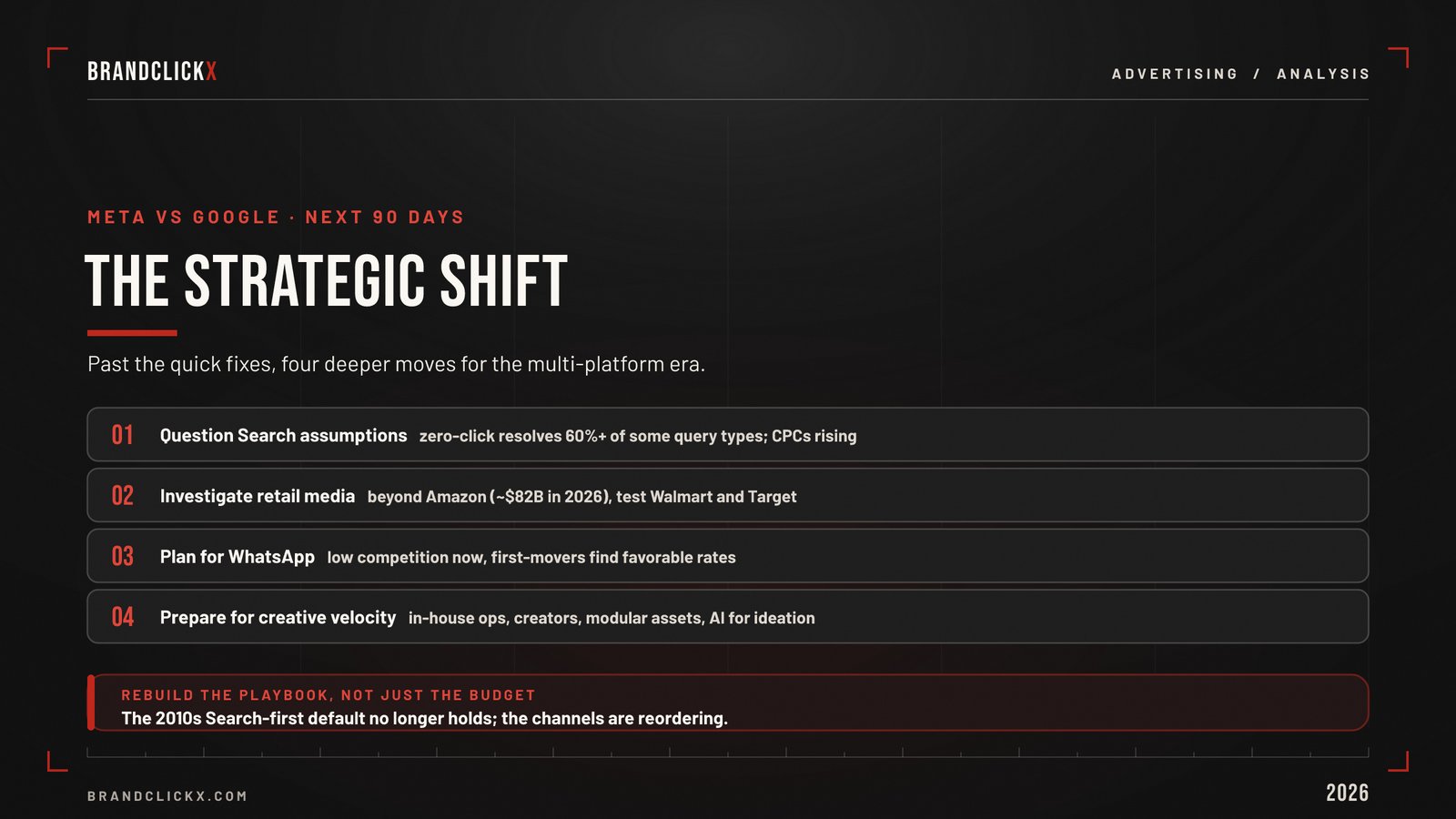
Strategic Shift (Next 90 Days)
Question Google Search Assumptions
For decades, Search was the default high-ROI channel. It still is for high-intent queries. But the channel is evolving:
- Zero-click answers resolve 60%+ of some query types without clicks
- AI Overviews are cannibilizing organic traffic
- Cost-per-click is rising as advertisers compete for shrinking inventory
Audit which queries are actually driving qualified leads. Consider shifting budget away from vanity keywords with high search volume but low conversion intent.
Investigate Retail Media (Beyond Amazon)
Amazon Ads is growing (projected $82.07 billion in 2026). But Walmart, Target, and other retailers are building their own advertising networks. These platforms have something Amazon doesn’t: store transaction data tied to customer behavior.
If you sell CPG, apparel, or other retail products, test retail media networks beyond Amazon. Performance is often superior because intent is higher (people shopping in-store or on retailer sites, not just browsing Amazon).
Plan for WhatsApp Monetization
WhatsApp ads are relatively new. Competition for inventory is lower than Facebook/Instagram/Google. First-movers may find favorable rates.
If your audience is on WhatsApp (particularly high in Southeast Asia, Latin America, India, Europe), start experimenting with WhatsApp ads before the channel gets crowded and rates rise.
Prepare for Creative Velocity Demands
Meta’s momentum is driven partly by creative velocity the ability to test many variations quickly. As Meta grows, advertiser expectations for creative output will only increase.
Consider:
- Building in-house creative operations (faster iteration)
- Partnering with creators instead of agencies (more authentic, faster turnaround)
- Investing in design systems that enable rapid variation (modular assets, templates)
- Using AI tools for copywriting and design exploration (not final output, but ideation)
The Long-Term Implication: What 2026 Signals About 2027-2030
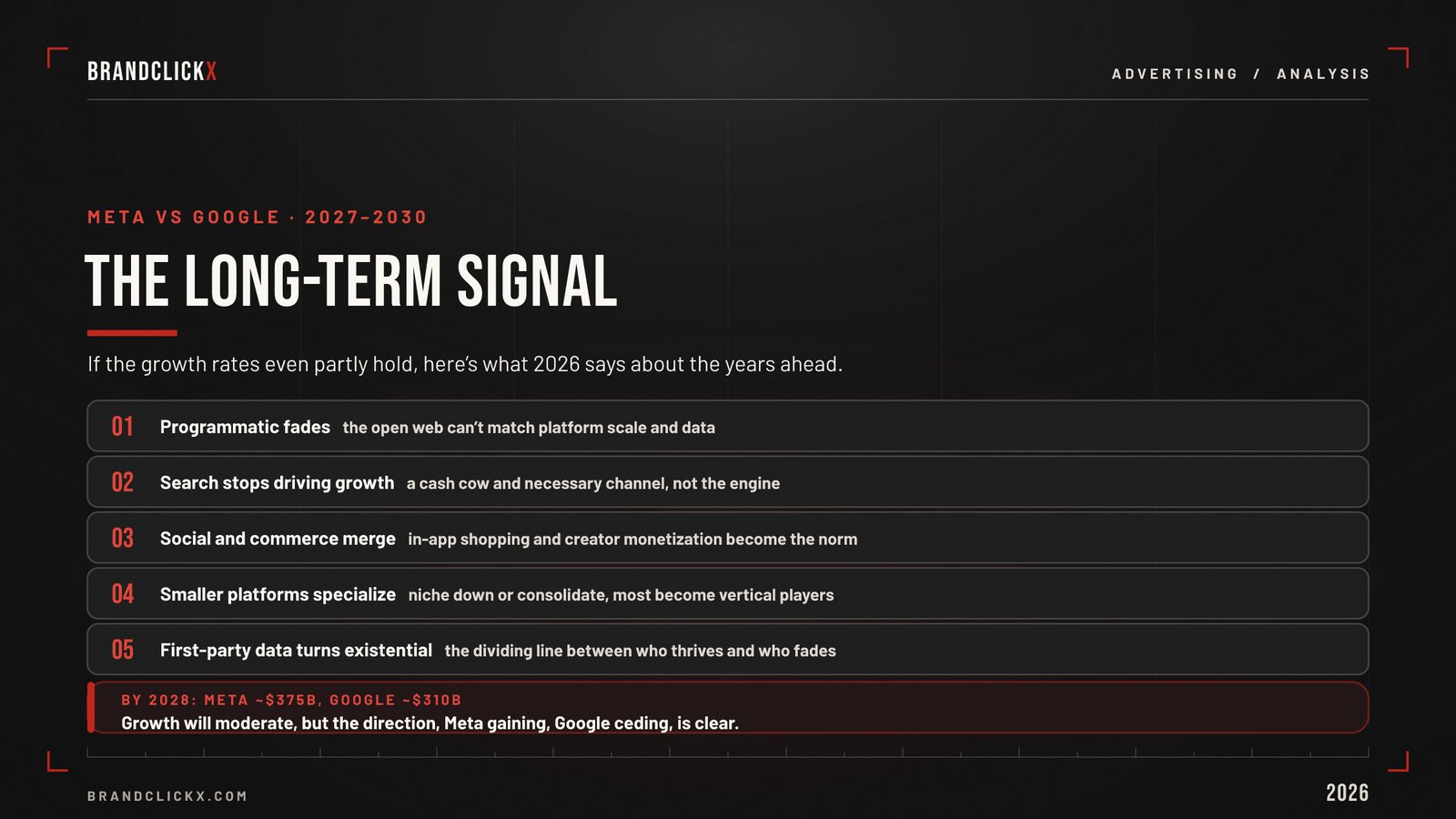
If Meta grows at 24% and Google at 11.9%, by 2028 the gap widens significantly. Meta would reach approximately $375B, Google approximately $310B—assuming these growth rates hold.
Will they hold? Unlikely. Growth moderates as bases get larger. But the direction is clear: Meta is gaining share. Google is losing it.
This has implications:
- Programmatic advertising will become less relevant. The open web can’t compete with Meta’s scale and data. Programmatic buyers will shift to platforms.
- Search as a growth engine is finished. Google Search will remain a cash cow and a necessary channel, but it won’t be the growth driver it was in the 2010s.
- Social and commerce will merge completely. Meta’s vision of in-app commerce, shopping integrations, and creator monetization will be the norm, not the novelty.
- Smaller platforms will consolidate or specialize. TikTok may remain strong through pure user preference. Microsoft may find niche value in B2B search. But most platforms will become vertical specialists or disappear.
- First-party data becomes existential. Companies that build strong first-party data infrastructure will thrive. Those that don’t will become less competitive on both Meta and Google.
FAQ (Short Version)
Q: Does Meta’s lead mean I should stop spending on Google?
A: No. Google Search is still the best channel for high-intent, bottom-funnel campaigns. The shift means relative allocation is changing, not that Google is irrelevant. Audit your performance by platform and adjust accordingly.
Q: When will WhatsApp ads become more competitive?
A: Probably 2027-2028. Early adopters are getting favorable rates and low competition for inventory. If WhatsApp matters for your audience, test now while the channel is still underutilized.
Q: Should I move all my budget to Advantage+ on Meta?
A: Test it, but don’t move everything yet. Advantage+ works well for brands with strong creative pipelines and continuous testing budgets. For brands with one or two static creative assets, traditional Meta campaigns may perform better.
Q: Is Amazon Ads the next big opportunity?
A: For e-commerce and retail, yes. Amazon is growing 26%+ annually. For non-retail (SaaS, B2B services), Amazon Ads is less relevant. Focus on your actual customer journey and where they make decisions.
Bottom Line
Meta’s surpassing Google in 2026 ad revenue is historic. But the real story isn’t the flip itself it’s what the flip reveals about how the advertising market is restructuring.
Scale + AI + first-party data = durable competitive advantage. Meta has all three and is deploying them better than Google right now.
Google will remain enormous. Search will remain essential for certain use cases. But the era of Google’s unchallenged dominance is over.
Marketers who adjust their strategies now auditing allocations, investing in creative velocity, building first-party data infrastructure will thrive in this new environment.
Those who assume yesterday’s playbook still works will wonder why their ROI is declining.