

Last month, a client asked me to help shortlist cloud infrastructure providers for a new AI application.
The conversation started exactly where you’d expect. Amazon Web Services. Microsoft Azure. Google Cloud.
Fair enough. But the deeper we dug, the clearer it became that the most interesting work in cloud computing wasn’t coming from any of the three names everyone already knows.
It was coming from smaller, sharply focused companies quietly solving problems the hyperscalers don’t prioritize.
That realization became this guide.
Below are 12 underrated companies reshaping cloud computing in 2026, why each one matters, how it stacks up against the giants, and which trends could push it from niche player to industry standard.
Quick Answer
Cloud computing is no longer a three-company race. AI demand, GPU scarcity, edge computing, and rising security requirements have opened real space for specialized providers like CoreWeave, Wasabi, Cloudflare, and VAST Data to outperform hyperscalers in specific workloads, object storage, GPU infrastructure, Kubernetes automation, and edge delivery among them. Rather than competing head-on with AWS or Azure across every service, these companies win by building the single best solution in one lane.
Key Takeaways
- Cloud innovation is no longer coming only from the biggest providers.
- AI demand has created genuine market space for specialized GPU and infrastructure providers.
- Smaller companies often move faster because they’re solving one problem, not managing thousands of products.
- Multi-cloud adoption means enterprises actively want alternatives to a single hyperscaler.
- The strongest cloud startups pair real technical differentiation with obvious business value.
- Anyone tracking cloud infrastructure, investors, developers, technology leaders, should have these 12 names on their radar.
What Makes a Cloud Company “Underrated”?

Underrated cloud companies build genuinely innovative infrastructure while getting a fraction of the attention that AWS, Azure, and Google Cloud absorb by default.
Most specialize in one of a handful of areas: AI infrastructure, cloud security, edge computing, developer platforms, or multi-cloud management. Being underrated doesn’t mean being unproven, several companies on this list already outperform much larger competitors in their specific niche.
The 12 companies covered in this guide:
- CoreWeave
- Wasabi Technologies
- Cloudflare
- VAST Data
- DigitalOcean
- Oxide Computer Company
- Render
- Civo
- Platform9
- Akuity
- Flock Safety Cloud
- Verge.io
Why Cloud Computing Is Entering a New Era
The cloud market has matured.
That might sound strange given how fast new services keep launching, but the underlying race has genuinely changed.
A decade ago, the competition was about who could build the biggest platform. Now it’s about who can build the smartest one , infrastructure tuned for AI, compliance, sustainability, and cost, rather than raw scale for its own sake.
Statista projects worldwide spending on public cloud services will exceed $1 trillion before the end of the decade. Gartner separately forecasts public cloud end-user spending will surpass $720 billion in 2025, driven largely by AI workloads and digital transformation initiatives.
Cloud adoption isn’t slowing down. It’s spreading into markets that didn’t exist five years ago, and that expansion is exactly where smaller, specialized providers are finding room to compete.
AI is rewriting the infrastructure layer. Training modern models takes a kind of computing power that traditional infrastructure was never built for. Companies focused on GPU infrastructure and high-performance computing are seeing demand levels that didn’t exist two years ago.
Enterprises want specialized tools, not generalized ones. A healthcare company cares about compliance first. A gaming studio cares about latency first. An AI startup just needs GPUs, now. Trying to satisfy all three equally is exactly the trap broad platforms fall into , and exactly the gap smaller providers are filling.
Smaller teams move faster, almost by design. Without legacy systems to maintain, younger companies can ship features and react to customer feedback at a pace larger platforms structurally can’t match. Today’s niche provider is often tomorrow’s default choice.
How I Evaluated These Companies
This isn’t a list of whoever raised the biggest funding round this quarter.
Each company was assessed against the same criteria: technical innovation, product uniqueness, industry relevance, enterprise adoption, market momentum, competitive differentiation, and long-term growth potential.
Some of these companies are growing fast. Others simply serve a specialized market better than anyone else does. What they share is a willingness to challenge how cloud computing is “supposed” to work.
1. CoreWeave – Purpose-Built GPU Infrastructure for the AI Boom

If you’ve followed the AI industry at all over the past two years, you’ve heard about the GPU shortage.
CoreWeave is one of the biggest reasons AI startups aren’t stuck waiting months for compute.
Headquarters: Roseland, New Jersey | Founded: 2017 | Focus: AI cloud infrastructure
Instead of competing with AWS or Azure across every service, CoreWeave does one thing exceptionally well: high-performance GPU cloud infrastructure, built from the ground up for AI rather than retrofitted for it.
Traditional infrastructure was designed for websites and applications. Training large language models needs something else entirely, large-scale GPU clusters, high-performance networking, and infrastructure genuinely optimized for generative AI rather than adapted to it after the fact.
Best for: AI startups, machine learning teams, research organizations, enterprise AI projects.
Innovation score: 9.8/10. The future of cloud infrastructure isn’t only about storage capacity anymore, compute power is becoming the real bottleneck, and CoreWeave built its entire business around solving exactly that.
2. Wasabi Technologies – Cloud Storage Without the Hidden Fees

Cloud storage costs have a habit of creeping upward as companies grow. Wasabi built its entire business around fixing that.
Headquarters: Boston, Massachusetts | Founded: 2017 | Focus: Object storage
Rather than building hundreds of adjacent services, Wasabi focused on one thing: fast, secure, affordable object storage with none of the hidden egress fees that customers have quietly tolerated from larger providers for years.
Best for: Backup solutions, media companies, video production, disaster recovery.
Innovation score: 9.2/10. Not every disruption needs breakthrough AI behind it. Sometimes fixing a pricing model that’s frustrated customers for a decade is disruption enough.
3. Cloudflare – Bigger Than a CDN
Most people still think of Cloudflare as a website security and content-delivery company.
That’s years out of date.
Headquarters: San Francisco, California | Founded: 2009 | Focus: Edge cloud platform
Cloudflare now runs a full platform spanning networking, Zero Trust security, edge computing, serverless applications, developer tools, and AI inference support. Instead of routing everything through centralized data centers, Cloudflare pushes computing closer to the user , cutting latency while improving both speed and security.
Best for: Global applications, APIs, SaaS products, secure networking.
Innovation score: 9.7/10. Distributed architecture isn’t a side feature for Cloudflare anymore. It’s the whole thesis, and the market is increasingly following that logic.
4. VAST Data – Storage Infrastructure Built for AI Scale
Data is growing faster than most storage systems were ever designed to handle.
Headquarters: New York, USA | Founded: 2016 | Focus: Enterprise data platform
VAST Data’s architecture combines high-performance storage with simplified data management, specifically aimed at the volumes AI training and analytics workloads actually generate. Modern AI systems need rapid access to enormous datasets; VAST reduces the bottlenecks that slow that access down.
Best for: AI workloads, large enterprises, data-intensive research.
Innovation score: 9.6/10. As AI adoption accelerates, data infrastructure is quietly becoming just as critical as raw compute power, and VAST is positioned right at that intersection.
5. DigitalOcean – Simplicity as a Competitive Advantage
When a developer wants cloud infrastructure without wading through enterprise complexity, DigitalOcean is usually the first name that comes up.
Headquarters: New York, USA | Founded: 2011 | Focus: Developer cloud platform
DigitalOcean proves a platform doesn’t need a thousand services to succeed. Predictable pricing, managed Kubernetes, and a genuinely developer-first experience have built a loyal following that’s stuck around for over a decade.
Best for: Startups, small businesses, SaaS applications.
Innovation score: 9.1/10. Developer experience has become a real competitive edge on its own; DigitalOcean keeps proving simplicity can compete directly with scale.
6. Oxide Computer Company – Rebuilding the Data Center From Scratch
Most cloud innovation happens purely in software. Oxide is rebuilding the hardware layer too.
Headquarters: California, USA | Founded: 2019 | Focus: Cloud-native infrastructure
Rather than relying on conventional server design, Oxide treats an entire rack as a single cloud computer, an approach that simplifies operations and gives enterprise teams far more control over private cloud infrastructure.
Best for: Private cloud deployments, large-scale enterprise IT.
Innovation score: 9.5/10. Infrastructure design itself is being reinvented, not just the software running on top of it, and Oxide is one of the few companies actually doing that work.
7. Render – Deployment Without the Operational Overhead
Deploying an application shouldn’t eat an entire afternoon.
Headquarters: San Francisco, California | Founded: 2018 | Focus: Application hosting
Render automates the operational complexity, managed PostgreSQL, background workers, private networking, that traditionally slowed teams down between writing code and shipping it.
Best for: SaaS startups, web applications, APIs.
Innovation score: 9.0/10. Every hour an engineering team doesn’t spend managing infrastructure is an hour spent building product instead.
8. Civo – Kubernetes Without the Steep Learning Curve
Kubernetes runs a huge share of modern applications. Managing it well is still genuinely hard.
Headquarters: Lincoln, United Kingdom | Founded: 2017 | Focus: Kubernetes cloud platform
Civo strips away the complexity most businesses don’t need, offering fast cluster deployment without requiring a dedicated operations team just to keep things running.
Best for: DevOps teams, containerized applications, cloud-native businesses.
Innovation score: 9.2/10. As cloud-native development keeps growing, easier Kubernetes management stops being a nice-to-have and becomes a real requirement.
9. Platform9 – Private Cloud That Doesn’t Sacrifice Flexibility
Plenty of organizations want public-cloud flexibility without giving up control of their own infrastructure.
Headquarters: California, USA | Founded: 2013 | Focus: Private cloud management
Platform9 delivers managed private cloud built on open technologies, helping enterprises modernize existing infrastructure without ripping out investments they’ve already made.
Best for: Large enterprises, regulated industries, hybrid deployments.
Innovation score: 9.3/10. Hybrid cloud isn’t a phase enterprises are passing through. For most of them, it’s becoming the permanent operating model.
10. Akuity – GitOps-Native Kubernetes Automation
Kubernetes is the industry standard for container orchestration. Managing it at real scale is where most teams struggle.
Headquarters: California, USA | Founded: 2022 | Focus: Kubernetes automation
Akuity automates Kubernetes operations using GitOps principles, cutting deployment errors and speeding up delivery for teams running containers at enterprise scale.
Best for: Enterprise DevOps, platform engineering teams.
Innovation score: 9.5/10. Automation has stopped being a luxury feature in cloud operations. It’s quickly becoming table stakes.
11. Flock Safety Cloud – A Vertical Cloud Platform With a Specific Mission
Not every cloud company is trying to serve every industry. Flock Safety is built for exactly one.
Headquarters: Atlanta, Georgia | Founded: 2017 | Focus: Public safety cloud
Its platform combines AI, computer vision, and large-scale data processing specifically for public safety use cases , cities, law enforcement, and transportation networks that need cloud-based video processing at scale.
Best for: Smart cities, public safety, transportation infrastructure.
Innovation score: 9.4/10. Vertical cloud platforms keep proving that deep specialization often creates more customer value than broad, general-purpose infrastructure ever could.
12. Verge.io – One Platform Instead of Five
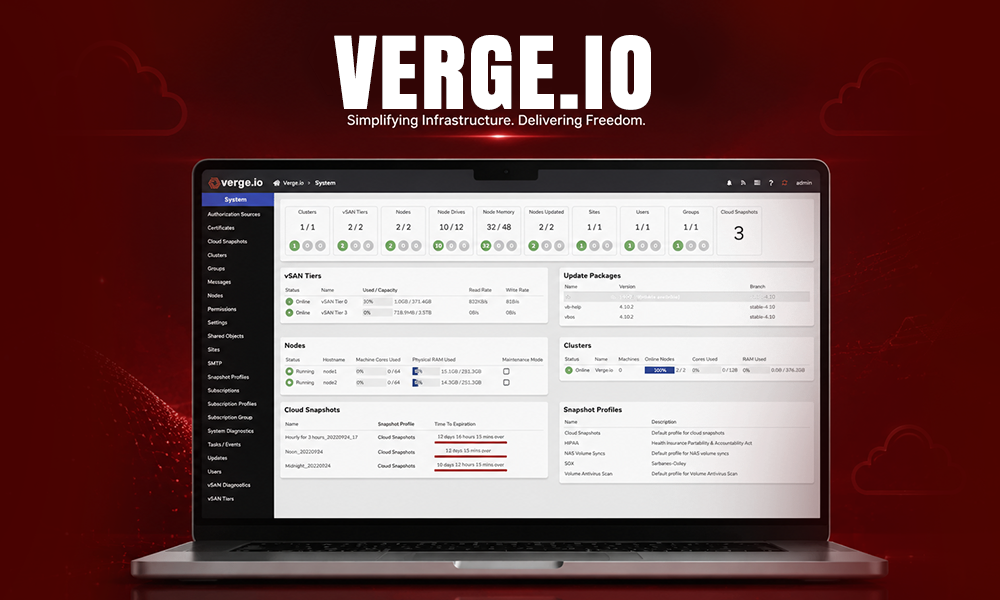
Virtualization, storage, networking, and disaster recovery usually require stitching together multiple separate products.
Headquarters: Texas, USA | Founded: 2018 | Focus: Virtual data centers
Verge.io consolidates all of it into a single software-defined platform, cutting both operational costs and the complexity of managing several vendors at once.
Best for: Enterprise IT, managed service providers, private cloud deployments.
Innovation score: 9.3/10. As organizations look to simplify their infrastructure stack, consolidation platforms like Verge.io are becoming a genuinely attractive alternative to running five separate tools.
Full Comparison: All 12 Companies Side by Side
| Company | Primary Focus | Best For | Score | Why It’s Underrated |
| CoreWeave | AI GPU infrastructure | AI workloads | 9.8 | Purpose-built for modern AI compute demands |
| Cloudflare | Edge cloud | Global applications | 9.7 | Expanded far past its CDN roots |
| VAST Data | Enterprise data platform | AI & analytics | 9.6 | Solves the data bottlenecks AI creates |
| Oxide Computer | Private cloud infrastructure | Enterprise IT | 9.5 | Rebuilding server architecture from scratch |
| Akuity | Kubernetes automation | Platform engineering | 9.5 | GitOps-first cloud operations |
| Flock Safety | Industry cloud | Public safety | 9.4 | Proves the power of vertical platforms |
| Platform9 | Hybrid cloud | Enterprises | 9.3 | Modernizes without replacing existing systems |
| Verge.io | Virtual data centers | Enterprise infrastructure | 9.3 | Consolidates multiple infrastructure layers |
| Wasabi Technologies | Object storage | Enterprise storage | 9.2 | Enterprise performance at honest pricing |
| Civo | Kubernetes platform | DevOps | 9.2 | Makes Kubernetes genuinely approachable |
| DigitalOcean | Developer cloud | Startups | 9.1 | Chooses simplicity over unnecessary complexity |
| Render | App hosting | Developers | 9.0 | Removes deployment friction entirely |
Cloud Computing Trends Driving This Shift
These 12 companies aren’t succeeding by accident. They’re riding several long-term shifts reshaping the entire ind
ustry.
AI-native infrastructure:
Generative AI has driven massive demand for GPU-optimized platforms built for training and inference from day one, not adapted after the fact.
Multi-cloud adoption:
Businesses are deliberately spreading workloads across multiple providers to improve resilience and reduce dependence on any single vendor.
Edge computing:
Autonomous systems, IoT devices, and streaming platforms all need processing closer to the user, and edge infrastructure is the layer making that possible.
Kubernetes and platform engineering:
Containers are now the default deployment model, and companies simplifying Kubernetes management are becoming essential partners for engineering teams.
Cloud security and compliance:
Buyers now evaluate providers on identity management, encryption, and Zero Trust architecture, not just raw performance.
Sustainable infrastructure:
Energy-efficient hardware and environmentally responsible data centers are becoming genuine differentiators, not just marketing lines.
Matching the Right Provider to Your Use Case
| Use Case | Recommended Company | Why It Fits |
| AI model training | CoreWeave | Purpose-built GPU infrastructure |
| Affordable cloud storage | Wasabi Technologies | Predictable pricing, enterprise-grade performance |
| Global applications | Cloudflare | Massive edge network with built-in security |
| Startups and SMBs | DigitalOcean | Easy to use, transparent pricing |
| Simple app deployment | Render | Automated deployments, minimal DevOps overhead |
| Kubernetes management | Civo | Kubernetes-first, genuinely easy to learn |
| Hybrid cloud environments | Platform9 | Modernizes existing infrastructure |
| Enterprise AI data platforms | VAST Data | Built for high-performance analytics and AI |
| Platform engineering | Akuity | GitOps-based Kubernetes automation |
| Smart infrastructure | Flock Safety | AI-powered public safety platform |
| Private cloud modernization | Oxide Computer Company | Modern cloud-native infrastructure |
| Virtual data centers | Verge.io | Unified, software-defined platform |
How to Evaluate an Emerging Cloud Company
Size isn’t the right filter. Use these six criteria instead.
- Does it solve your actual problem? Not a hypothetical one, the specific infrastructure challenge you’re facing right now.
- Look past the funding headlines: A big raise doesn’t mean happy customers. Check case studies, release frequency, and the strength of the developer community instead.
- Confirm real technical differentiation: Faster infrastructure, better security, simpler deployment – there should be something concrete the company does better than the alternatives.
- Test for scalability: Today’s startup could be tomorrow’s default platform, but only if it holds up under heavier workloads, global availability requirements, and real enterprise support demands.
- Look at the leadership team: Many of the strongest cloud companies are founded by engineers who built infrastructure at major tech companies first. That background usually shows up in product decisions.
- Check the long-term roadmap: Companies investing now in AI infrastructure, automation, and edge computing are the ones likely to still matter in five years.
What Cloud Computing Looks Like by 2030
The next five years won’t be about bigger data centers. They’ll be about smarter ones.
AI becomes native, not optional:
Every major cloud platform will need infrastructure built around AI training, inference, and autonomous agents as a baseline requirement, not an add-on.
Specialized clouds keep growing alongside hyperscalers:
Rather than replacing them, healthcare, finance, manufacturing, and media will keep demanding industry-specific platforms.
Multi-cloud becomes the default strategy:
Not a hedge, as businesses spread workloads to reduce vendor lock-in and improve resilience.
Sustainability starts influencing purchasing decisions directly:
As energy-efficient infrastructure becomes a genuine differentiator for enterprise buyers.
AI agents start managing infrastructure itself:
Monitoring, scaling, and troubleshooting shifting gradually from human administrators to automated systems.
Frequently Asked Questions
Which cloud computing companies are underrated?
CoreWeave, Wasabi Technologies, VAST Data, Civo, Platform9, Akuity, Render, and Verge.io all receive far less mainstream attention than hyperscalers despite real innovation in AI infrastructure, storage, and Kubernetes automation.
Which cloud startup is growing fastest?
Growth varies by segment, but CoreWeave has seen exceptional momentum tied directly to GPU demand for generative AI workloads.
Do these companies compete directly with AWS?
Rarely. Most complement AWS, Azure, or Google Cloud by offering specialized infrastructure rather than trying to replace them outright.
Why are specialized cloud providers gaining ground?
Organizations increasingly need solutions tuned for AI, security, edge computing, and Kubernetes instead of one-size-fits-all platforms.
Are smaller cloud companies reliable for enterprise use?
Many are, but businesses should still evaluate SLAs, compliance certifications, and product roadmaps before committing, the same way they would with any vendor.
What should businesses evaluate before choosing a cloud provider?
Workload compatibility, scalability, security, pricing transparency, developer experience, and long-term innovation, not just today’s feature list.
Will these companies eventually replace the hyperscalers?
Unlikely, and that’s not really the goal. Most extend existing cloud ecosystems rather than trying to replace them entirely.
Conclusion
That client conversation from last month stuck with me for a reason.
The lesson wasn’t that AWS, Azure, and Google Cloud had stopped innovating. They clearly haven’t.
It was that some of the most genuinely useful ideas in cloud computing were coming from companies most decision-makers hadn’t even put on their shortlist.
That’s exactly why underrated cloud providers deserve real attention, not just a passing mention. Today’s niche innovator solving one problem exceptionally well is often tomorrow’s default choice.
Whether you’re a CTO planning infrastructure, a founder building an AI product, or an investor tracking where the market is headed next, these 12 companies belong on your watchlist.
The next chapter of cloud computing won’t be written by size alone. It’ll be written by whoever solves the right problem at the right time, and right now, that’s increasingly not the biggest names in the room.