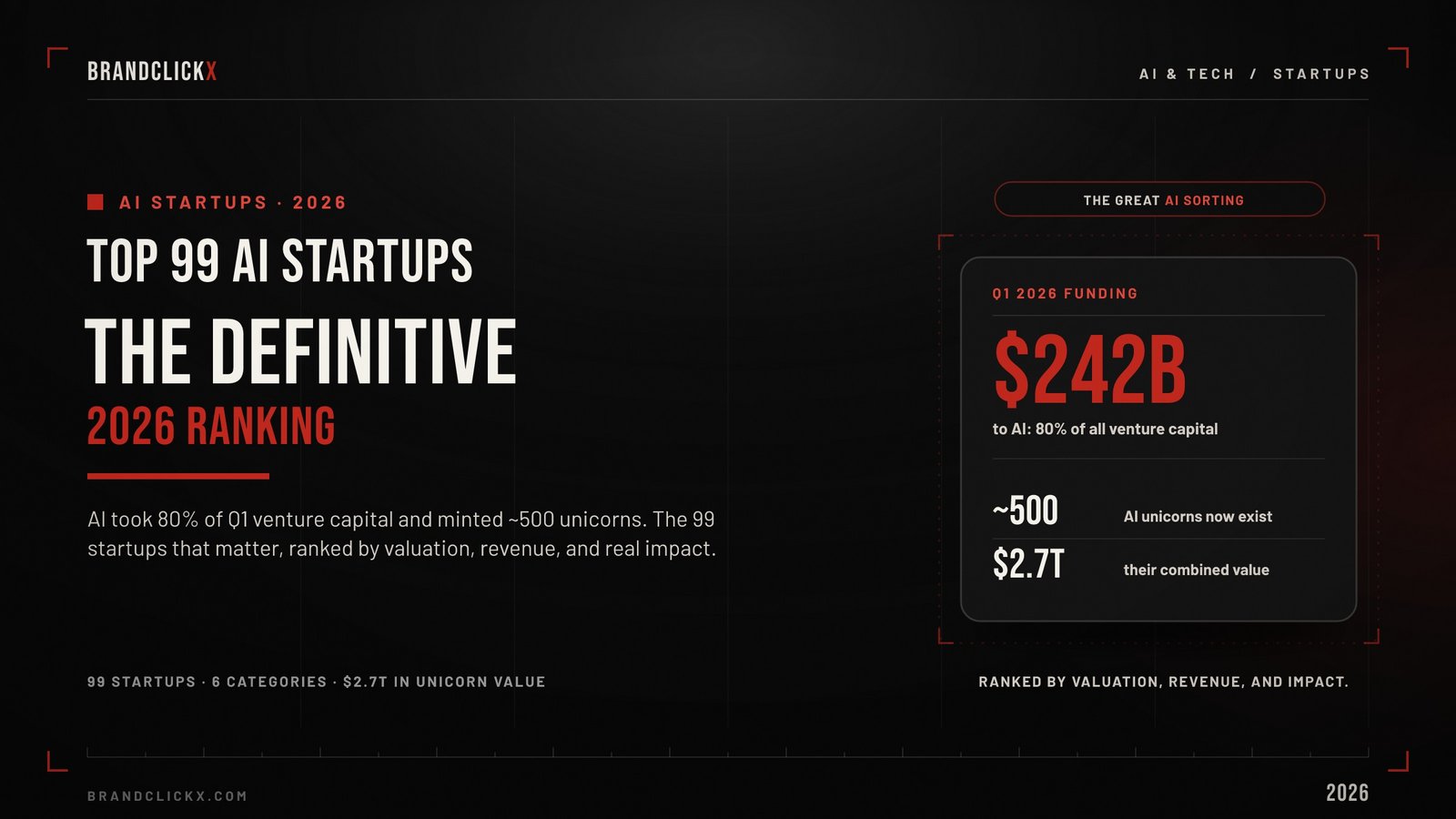
In Q1 2026 alone, global AI startup funding hit nearly $300 billion, with AI companies capturing 80% of all venture capital. These are the 99 startups that matter most right now.
Introduction: The Great AI Sorting Has Begun
The “hot AI startup” label meant something different two years ago.
In 2024, it meant a company that had wrapped GPT-4, raised a seed round at a unicorn valuation, and generated three press mentions. That arbitrage is dead. The market killed it.
In Q1 2026 alone, global startup funding hit nearly $300 billion, with AI companies capturing an unprecedented 80%, or $242 billion, of that total. Nearly 500 AI unicorns now exist globally with a combined value of $2.7 trillion. The capital is real. The sorting has begun.
What separates the AI startups that will define the next decade from those burning through runway? According to CB Insights’ 2026 AI 100 analysis, 64% of AI 100 winners from prior cohorts closed a follow-on equity round, versus just 31% for comparable AI companies. The signal is clear: the right startups are getting more capital, faster, at higher multiples.
This list covers 99 of them, organized by category, assessed by what they’re actually building, and evaluated against the one question that matters most in 2026: are real customers paying real money for real outcomes?
AI startups raised nearly $150 billion in 2025 alone, accounting for more than 40% of global venture capital. Foundation model companies raised $80 billion of that. The wave is not slowing. The question is who’s riding it, and who’s building something that will survive when it passes.
The Six Categories That Define the 2026 AI Landscape
Before the list, the framework. The 99 startups here fall into six distinct categories, each with its own economics, competitive dynamics, and risk profile.
Foundation Models — The labs training the frontier models. Enormous capital requirements, winner-take-most dynamics, and the deepest moats in AI. Also the highest-risk if the training compute efficiency improvements of 2025 continue.
AI Agents — Startups building autonomous systems that execute multi-step tasks without human supervision. The fastest-growing category by deal count and the one attracting the most enterprise contract value in 2026.
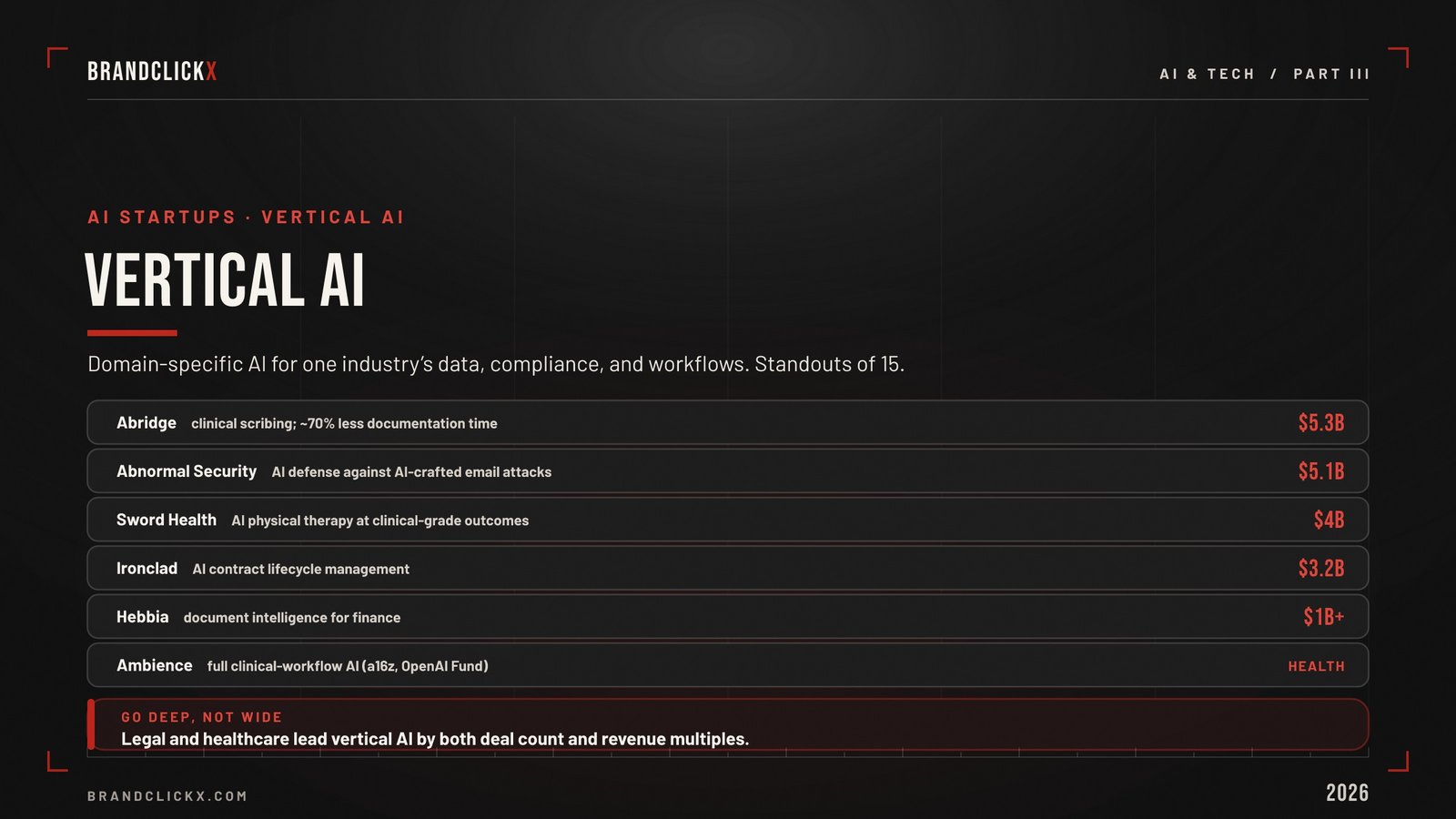
Vertical AI — Domain-specific AI built for the unique data, compliance requirements, and workflows of single industries. Legal and healthcare are the largest sub-categories by both deal count and revenue multiples.
Developer Tools & Infrastructure — The picks-and-shovels of AI. GPU cloud providers, coding tools, data labeling platforms, and inference infrastructure. Less glamorous than foundation models; often more durable as a business.
Creative AI — Voice, video, music, image, and content generation. High consumer adoption, significant legal exposure around training data, and a fast-moving competitive landscape.
Physical AI — Robots, autonomous vehicles, and the software intelligence layer that makes physical hardware autonomous. The newest category at scale, and the one attracting the most venture capital in absolute dollars after foundation models.
Part I: Foundation Models, The Labs Defining the Frontier
1. OpenAI
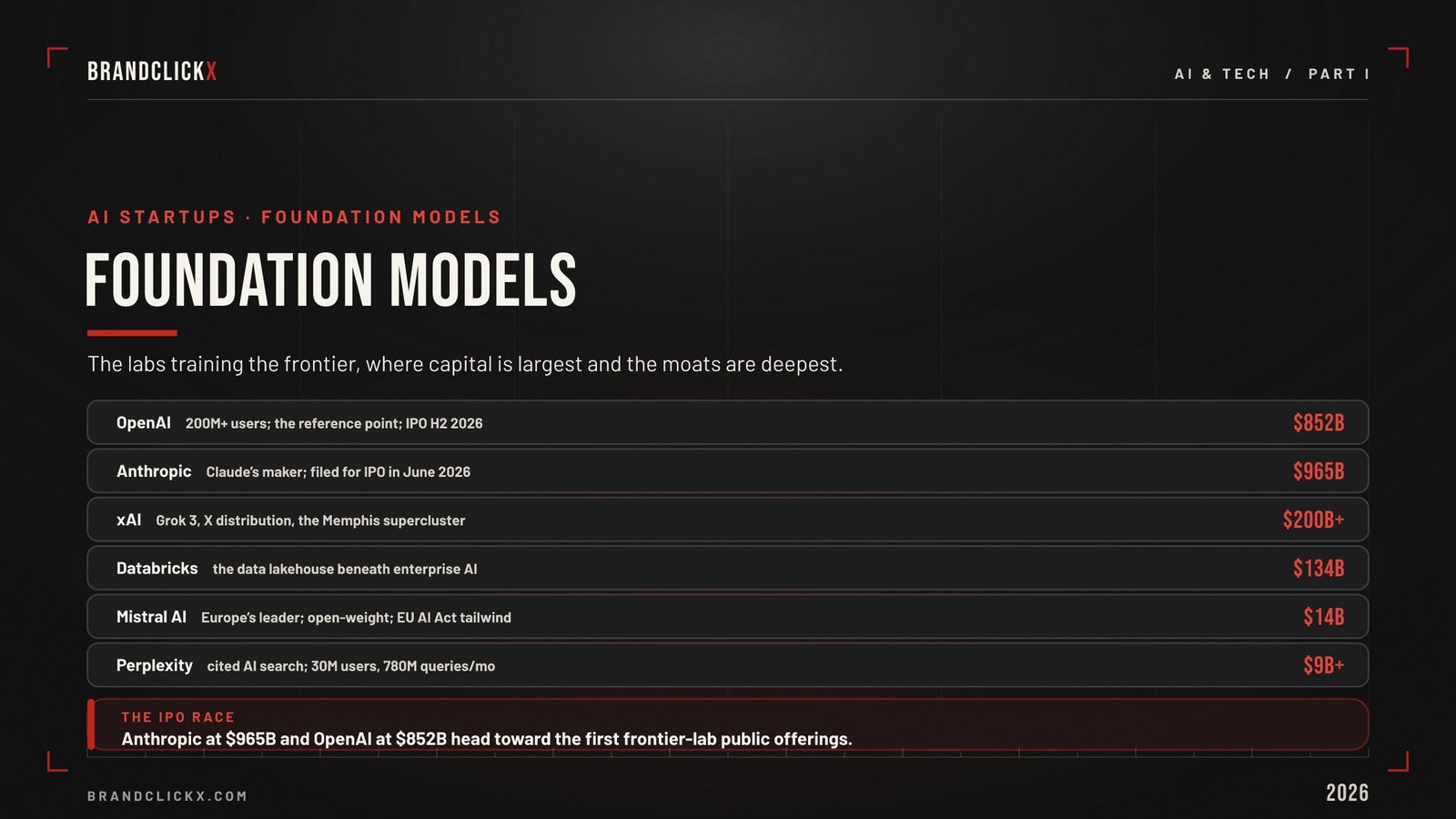
Valuation: $852 billion | Funding: $122 billion (March 2026) | Revenue: ~$25 billion ARR
The most valuable private AI company in history, and the one every other company on this list is either building on, building against, or building to be acquired by. ChatGPT has 200+ million monthly active users. The API powers thousands of enterprise applications. Codex, Sora, and operator products are expanding the revenue surface aggressively.
The strategic risk is also the most visible in the industry: OpenAI’s cost structure is enormous, and the path to profitability at the scale its valuation implies remains unproven. But the brand, the distribution, and the installed base are genuine moats that no competitor has yet eroded.
Why it matters: OpenAI is the reference point against which every other AI company is measured. Its IPO, expected in the second half of 2026, will set the pricing template for the entire AI sector.
2. Anthropic
Valuation: $965 billion | Funding: $65 billion (Series H, May 2026) | Revenue: $47 billion ARR
Claude’s maker is now the most valuable AI startup in history, having filed confidentially for an IPO in June 2026. Claude Code alone reached $2.5 billion in annualized revenue by February 2026. Enterprise clients at 300,000+ businesses. The only frontier model simultaneously available on AWS, Google Cloud, and Azure.
The safety-first positioning has become a commercial advantage, particularly in regulated industries where procurement teams need to justify AI vendor selection to legal and compliance.
Why it matters: Anthropic’s IPO will be the AI industry’s accountability moment, the first time a frontier lab faces public market scrutiny of its revenue quality, cost structure, and margin trajectory.
3. xAI (Elon Musk)
Valuation: $200 billion+ | Funding: $20 billion (January 2026)
Grok 3, released in early 2026, benchmarked competitively with the leading frontier models on reasoning tasks. The integration with X (formerly Twitter) gives xAI a distribution channel that no other foundation model lab can replicate. The Memphis data center, one of the largest GPU clusters ever assembled, provides the compute foundation for continued model scaling.
The risk: Musk’s management of multiple companies simultaneously and the reputational volatility associated with his public persona create governance uncertainty that institutional investors are still pricing.
4. Mistral AI
Valuation: $14 billion | Funding: $2.7 billion total
Europe’s most important AI company, and the one most directly positioned to benefit from the EU AI Act enforcement that begins in August 2026. Mistral’s open-weight model strategy creates a developer ecosystem that proprietary competitors cannot replicate. Le Chat, its consumer AI assistant, has built significant adoption in European markets where data sovereignty concerns give Mistral a structural advantage.
The Cohere-Aleph Alpha merger, backed by $600 million from Schwarz Group, is a direct response to Mistral’s European dominance, evidence that the European enterprise AI market is real enough to fight over.
5. Cohere + Aleph Alpha (Merged Entity)
Funding: $1.6 billion (Cohere pre-merger) + $600 million merger financing
The most significant AI M&A event of 2026. Cohere’s enterprise RAG expertise combined with Aleph Alpha’s European regulatory positioning and government relationships creates a privacy-first AI platform with no direct equivalent. Cohere had raised $1.6 billion prior, backed by Nvidia, AMD, Inovia Capital, and Salesforce Ventures.
The combined entity targets regulated industries, governments, and corporations that require on-premise or sovereign AI deployments, a market that neither OpenAI nor Anthropic can serve without significant architectural changes to their cloud-dependent models.
6. Perplexity AI
Valuation: $9 billion+ | Revenue: $100 million+ ARR
The fastest-growing AI search product of the post-ChatGPT era. 30 million monthly active users, 780 million monthly queries, and the clearest citation architecture in AI-native search. The Snapchat integration and enterprise API partnerships signal Perplexity’s ambition beyond direct consumer search.
The existential risk is Google, which has the distribution, the data, and the financial resources to compress Perplexity’s market with AI Overviews and Gemini. Perplexity’s moat is quality and trust, not distribution. That is a defensible position, but a narrow one.
7. Databricks
Valuation: $134 billion | Funding: $5 billion (February 2026)
The oldest company on this list and one of the most commercially grounded. Founded in 2013, Databricks built the data lakehouse architecture that most enterprise AI systems run on. Its AI platform enables machine learning and generative AI deployment at enterprise scale. The $134 billion valuation reflects both its revenue scale and its position as essential infrastructure for enterprise AI, the database layer beneath most of the applications above it.
8. Scale AI
Valuation: $14 billion+ | Key function: Data labeling and AI training data
No model trains without data. Scale AI has built the most comprehensive data annotation and AI training data infrastructure in the industry, serving OpenAI, the US Department of Defense, and most of the major foundation model labs. Its pivot toward enterprise AI evaluation and safety testing has added a second revenue stream as AI governance requirements intensify.
9. SSI (Safe Superintelligence)
Funding: $1 billion+ | Founders: Ilya Sutskever, Daniel Gross
Founded by Ilya Sutskever after leaving OpenAI, SSI is the most watched stealth AI company of 2026. Its singular focus, building superintelligent AI safely, has attracted top research talent and significant capital despite having no product or public benchmark results. The founding team’s pedigree (Sutskever led GPT development at OpenAI) makes it one of the most anticipated companies in the AI ecosystem.
10. Inflection AI
Status: Pivoted | Founder: Mustafa Suleyman (now Microsoft AI CEO)
Inflection’s pivot from consumer AI to enterprise infrastructure, and Suleyman’s departure to lead Microsoft AI, is itself one of the most instructive stories of the AI era. The company that raised $1.3 billion and launched Pi, a personal AI companion, became an enterprise AI provider for Microsoft’s infrastructure almost overnight. The transition captures the market dynamics of 2026: consumer AI is hard; enterprise AI pays.
Part II: AI Agents, The Fastest-Growing Category
11. Sierra AI
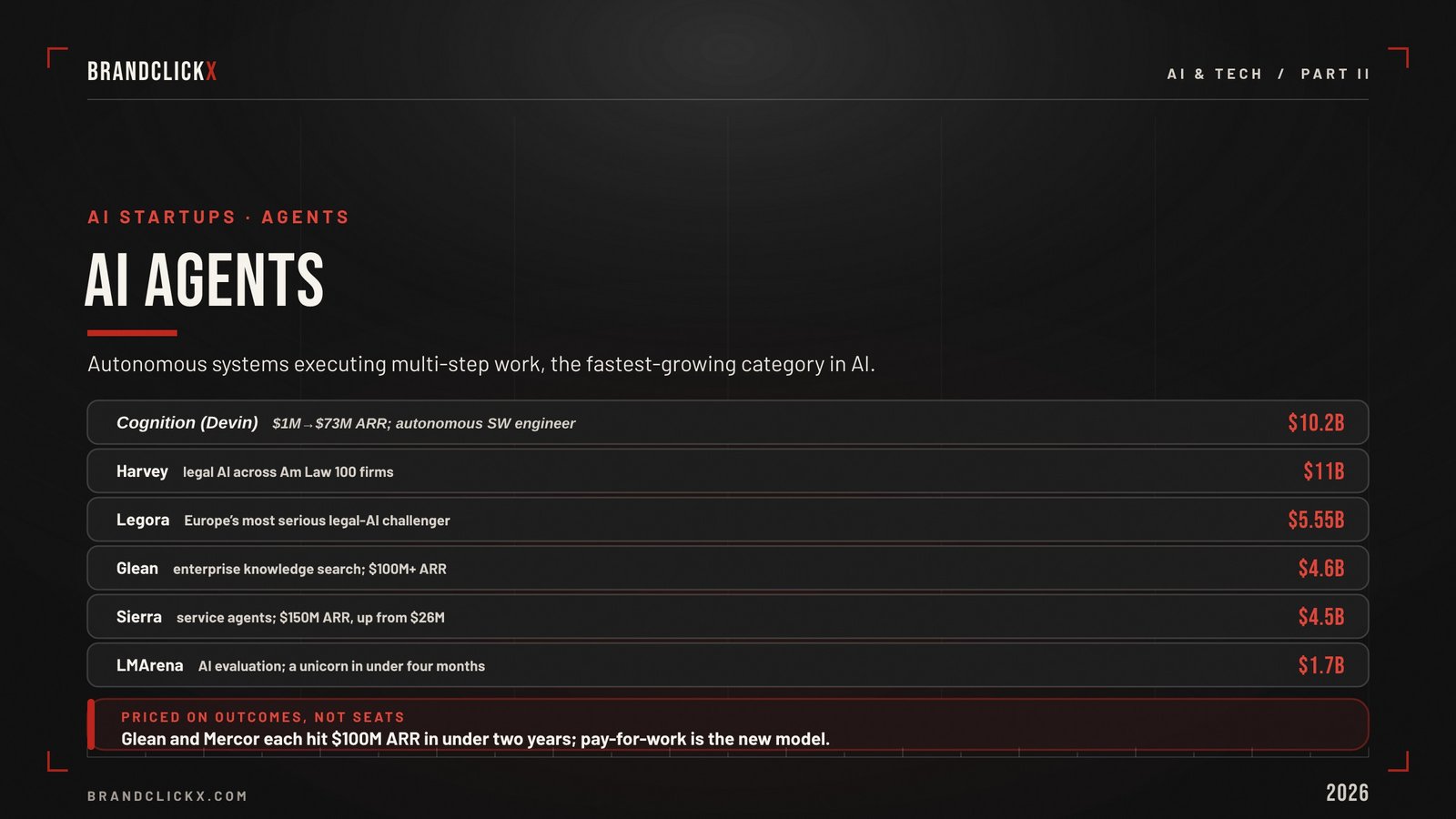
Valuation: $4.5 billion+ | Revenue: $150 million ARR (January 2026)
Sierra hit $150 million ARR in January 2026, up from $26 million at the end of 2024. Founded by Bret Taylor (former Salesforce co-CEO, current OpenAI board chair) and Clay Bavor, Sierra builds customer service AI agents for enterprise brands. Its board-level founders and Fortune 500 customer base make it the clearest “vertical AI agent” success story in the market.
Why it’s winning: Outcomes-based pricing, production-grade accuracy, and founders with the enterprise relationships to close deals that newer companies cannot.
12. Cognition AI (Devin)
Valuation: $10.2 billion | Revenue: $73 million ARR (June 2025)
Devin made the original splash as the first autonomous AI software engineer. Its ARR went from $1 million in September 2024 to $73 million by June 2025, one of the fastest ARR ramps in B2B SaaS history. Founded by Scott Wu, Steven Hao, and Walden Yan, backed by Founders Fund and Peter Thiel.
The moat: First mover in autonomous software engineering with deep enterprise relationships. The limitation: production-grade reliability on complex, real-world codebases remains a work in progress.
13. Decagon
Valuation: $4.5 billion | Funding: $250 million Series D (Coatue and Index, March 2026)
Customer support AI agents targeting mid-market and tech-native companies. Notion, Eventbrite, and Bilt are public customers. Decagon completed its first tender offer at $4.5 billion in March 2026, signaling strong employee and investor confidence in near-term value.
14. Glean
Valuation: $4.6 billion | Revenue: $100 million+ ARR
Enterprise search and knowledge management AI, the system that makes an organization’s internal documents, emails, Slack messages, and databases searchable and queryable through natural language. Glean hit $100M+ ARR in under two years, driven by enterprise deals with companies that need AI to work on private internal data rather than the public internet.
Why it matters for CMOs: Glean is the enterprise AI product most directly useful for marketing operations teams, making institutional knowledge, campaign archives, and research libraries instantly queryable.
15. Harvey AI
Valuation: $11 billion | Funding: $600 million (Sequoia, Google Ventures)
The dominant AI platform for legal professionals. Harvey works with several Am Law 100 firms and differentiates through deep customization for specific practice areas. Kirkland & Ellis’s decision to build a proprietary $500 million AI alternative is the clearest signal of Harvey’s market position, when a firm is willing to spend $500 million to avoid dependency on your product, your product is genuinely valuable.
16. Legora
Valuation: $5.55 billion | Funding: $550 million Series D (March 2026)
Harvey’s most serious European competitor, building comprehensive legal workflow automation from research through document generation. Raised $550 million in March 2026 with virtually every top-tier VC in the cap table. The EU AI Act enforcement creates a structural tailwind for European legal AI players with strong compliance positioning.
17. Mercor
Revenue: $100 million ARR in under 2 years | Function: AI-powered hiring and talent matching
AI-driven recruiting and hiring platform that matches companies with technical talent at unprecedented speed. Hit $100M ARR in under two years, faster than most enterprise SaaS companies at comparable scale. The talent market disruption thesis: if AI can evaluate technical skills as well as human interviewers, recruiting agencies face existential pressure.
18. Imbue
Valuation: $1 billion+ | Function: Reasoning and agent infrastructure
Building AI agents with reliable, auditable reasoning, the capability that makes enterprise deployment of autonomous agents commercially viable. Imbue’s focus on the interpretability of agent decisions addresses the governance problem that is the primary barrier to Fortune 500 adoption of agentic AI.
19. Adept AI
Funding: $415 million | Function: Computer-use agents
Building AI that can operate computers on behalf of users, clicking, typing, and navigating software interfaces autonomously. Adept’s product directly competes with Anthropic’s Claude Computer Use and OpenAI’s Operator. The race to own the computer-use agent layer is one of the most commercially consequential competitions in the 2026 AI market.
20. LMArena
Valuation: $1.7 billion (reached in under four months) | Function: AI evaluation and benchmarking
The fastest unicorn creation of 2026. LMArena’s human preference-based AI evaluation platform, which allows users to compare AI model outputs and generate training signal from their preferences, has become infrastructure for the AI industry’s quality measurement problem. Every foundation model lab needs reliable evaluation. LMArena provides it.
Part III: Vertical AI, Winning by Going Deep
21. Abridge
Valuation: $5.3 billion | Function: Clinical documentation AI
Medical scribing AI that generates clinical notes from doctor-patient conversations in real time. Abridge is deployed at major health systems across the US, reducing physician documentation time by approximately 70%. The clinical documentation market is enormous, and Abridge has established the deepest enterprise penetration of any clinical AI company.
22. Ambience Healthcare
Function: AI for clinical workflows | Investors: a16z, OpenAI Startup Fund
Building the AI layer across the full clinical workflow, not just documentation, but clinical decision support, care coordination, and administrative automation. The OpenAI Startup Fund investment signals deep model access that most clinical AI competitors cannot match.
23. Nabla
Function: Clinical AI assistant | Market: European and US healthcare
The European clinical AI leader, with particular strength in French and UK healthcare systems. Nabla’s approach, building with clinicians rather than around them, has driven adoption rates that North American clinical AI competitors have struggled to replicate.
24. Rad AI
Function: Radiology AI | Investors: Khosla Ventures, ARTIS Ventures
AI that writes radiology reports from medical imaging, a workflow that consumes a significant portion of radiologist time and that AI can perform at clinically validated accuracy. Rad AI is deployed across dozens of hospital systems and radiology groups.
25. Sword Health
Valuation: $4 billion | Function: AI-powered physical therapy
AI-guided physical therapy that delivers clinical-grade outcomes at a fraction of the cost of in-person care. Sword’s outcomes data, measured by validated clinical assessments rather than engagement metrics, is the strongest in digital health, enabling payer and employer contracts that consumer health apps cannot access.
26. EvenUp
Function: AI for personal injury law | Key product: Automated demand letter generation
Vertical AI for the specific, high-volume workflow of personal injury law, generating demand letters that accurately calculate and present damages. A strong example of vertical AI targeting a specific, high-volume legal workflow that previously consumed significant attorney time.
27. Casetext (Thomson Reuters)
Status: Acquired by Thomson Reuters | Function: Legal research AI
The acquisition template for vertical AI, a specialized legal AI tool absorbed into existing legal infrastructure and distribution. Casetext’s CoCounsel product is now available through Thomson Reuters’ enterprise contracts, demonstrating the M&A path that many vertical AI companies will follow.
28. Ironclad
Valuation: $3.2 billion | Function: AI contract management
Contract lifecycle management AI for enterprise legal and procurement teams. Ironclad’s AI reviews, redlines, and tracks contracts at a speed and consistency that legal teams cannot achieve manually. Its integration with major enterprise systems (Salesforce, Workday, SAP) has driven adoption among Fortune 500 procurement operations.
29. Rogo
Function: Financial analysis AI | Investors: Khosla Ventures
AI-powered financial analysis for investment banks, private equity firms, and asset managers. Rogo automates the research, modeling, and document production that junior analysts currently produce manually, targeting the most expensive per-hour labor in professional services
30. Hebbia
Valuation: $1 billion+ | Function: Document intelligence for finance
AI that reads and synthesizes large volumes of financial documents, earnings reports, merger agreements, regulatory filings, research reports, and answers complex analytical questions about them. Used by hedge funds and private equity firms that need to process information at scale without adding research headcount.
31. Fermat
Function: AI for financial services compliance | Market: Banking and insurance
Regulatory compliance is one of the highest-cost functions in financial services, and one of the most directly addressable by AI that can read, classify, and apply regulatory rules to transactions and documentation at scale.
32. Unlearn.AI
Function: Digital twin clinical trials | Investors: 8VC, B Capital
Building AI-powered “digital twins” of clinical trial patients to reduce the number of human participants required for statistical significance, compressing trial timelines and costs simultaneously. The FDA has engaged positively with digital twin methodology, creating regulatory pathway clarity.
33. Galileo
Function: AI evaluation and hallucination detection | Use case: Enterprise AI quality
Building the testing and evaluation infrastructure that enterprises need before deploying AI in production workflows. Galileo detects hallucinations, measures model performance, and tracks AI quality over time, the quality assurance layer that most AI deployments are missing.
34. Corelight
Function: AI cybersecurity | Investors: Accel, General Atlantic
Network detection and response AI for enterprise security operations. The cybersecurity AI market is driven by a simple arithmetic: attackers are using AI to scale their attacks, and defenders need AI to process the signal volume that traditional security tools cannot handle.
35. Abnormal Security
Valuation: $5.1 billion | Function: Email security AI
AI that detects and blocks sophisticated email attacks, including AI-generated spear phishing, business email compromise, and supply chain fraud, at a level of accuracy that rule-based security tools cannot achieve. The product is particularly relevant as generative AI makes phishing attacks easier to craft and harder to detect.
Part IV: Developer Tools and Infrastructure
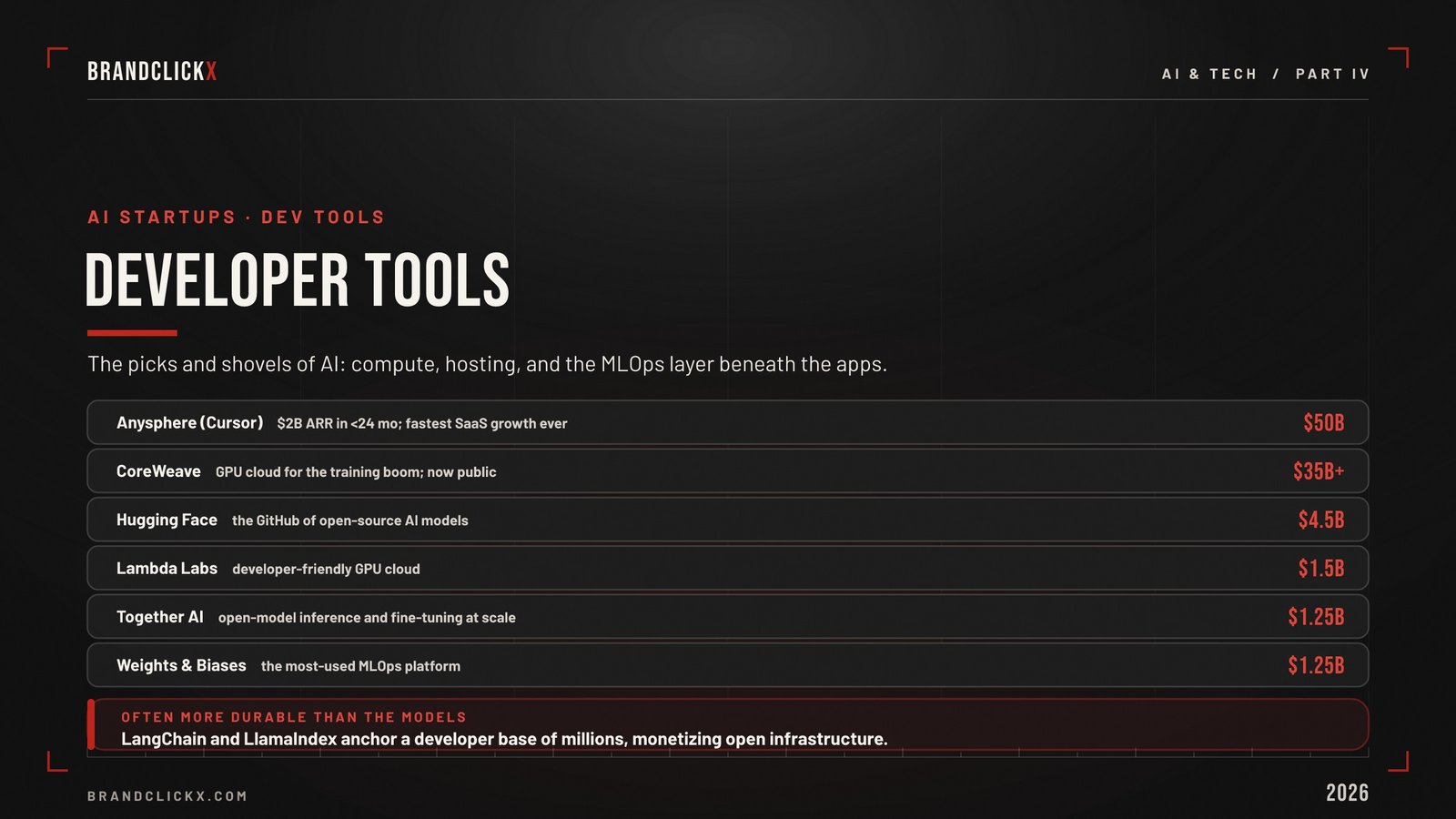
36. Anysphere (Cursor)
Valuation: $50 billion (in talks) | Revenue: $2 billion ARR
The fastest B2B SaaS growth in recorded history. Cursor went from zero to $2 billion in ARR in under 24 months. 60% of revenue from enterprise customers. NVIDIA, Uber, Adobe, Salesforce, and PwC are public clients. The AI-first IDE has become the primary coding environment for professional software engineers at scale.
37. CoreWeave
Valuation: $35 billion+ | Function: GPU cloud infrastructure
The GPU cloud provider that filled the capacity gap created by hyperscaler rationing during the AI training boom. CoreWeave’s Nvidia-focused infrastructure has attracted contracts from OpenAI, Cohere, and dozens of AI startups that need compute without the lead times of AWS or Azure. Now public, CoreWeave is the infrastructure bet on AI training continuing at current scale.
38. Lambda Labs
Valuation: $1.5 billion | Function: GPU cloud for AI
The developer-friendly alternative to CoreWeave, on-demand GPU compute with the UX that AI researchers actually want. Lambda has built a loyal base among academic researchers, AI startups, and enterprise teams that need GPU access without enterprise sales cycles.
39. Together AI
Valuation: $1.25 billion | Function: Open-source model inference and fine-tuning
The cloud platform for running, fine-tuning, and deploying open-source AI models. Together AI makes Llama, Mistral, and other open-weight models available at production scale with the API reliability that enterprise deployment requires. For companies that want frontier model capabilities without vendor lock-in, Together is the infrastructure of choice.
40. Modal
Function: Serverless GPU compute | Investors: Redpoint, Unusual Ventures
Serverless GPU infrastructure for AI developers, run any Python function on GPUs without managing servers. Modal’s developer experience has made it the preferred infrastructure for AI startups that need fast, scalable compute without DevOps overhead.
41. Replicate
Function: Model hosting and deployment | Investors: a16z
Infrastructure for running open-source AI models via API. Replicate hosts thousands of community models and provides the deployment layer that turns a research model into a production API. Its community model marketplace has become a discovery mechanism for AI capabilities.
42. Weights & Biases
Valuation: $1.25 billion | Function: ML experiment tracking and model management
The most widely used MLOps platform in the AI research community. Weights & Biases tracks experiments, visualizes training runs, and manages model versions across the full AI development lifecycle. Used by most of the foundation model labs and thousands of enterprise AI teams.
43. Hugging Face
Valuation: $4.5 billion | Function: Open-source AI model hub
The GitHub of AI models, a platform hosting hundreds of thousands of open-source models, datasets, and demos, with community tools for sharing, fine-tuning, and deploying AI. Hugging Face’s commercial products (Inference Endpoints, Expert Acceleration Program) monetize the community it has built around open AI.
44. Baseten
Valuation: $500 million+ | Function: Model inference infrastructure
Production inference infrastructure for ML teams, the deployment layer between a trained model and a production API. Baseten’s customers are the enterprise AI teams that need reliable, low-latency model serving without managing Kubernetes clusters.
45. Brainlid (Langchain)
Function: AI orchestration framework | Adoption: Millions of developers
LangChain is the most widely used AI application development framework, the open-source toolkit that developers use to build applications on top of LLMs. Its transition from open-source project to commercial company (LangSmith for production monitoring, LangGraph for agentic workflows) is one of the AI industry’s most watched commercialization stories.
Part V: AI Coding Tools
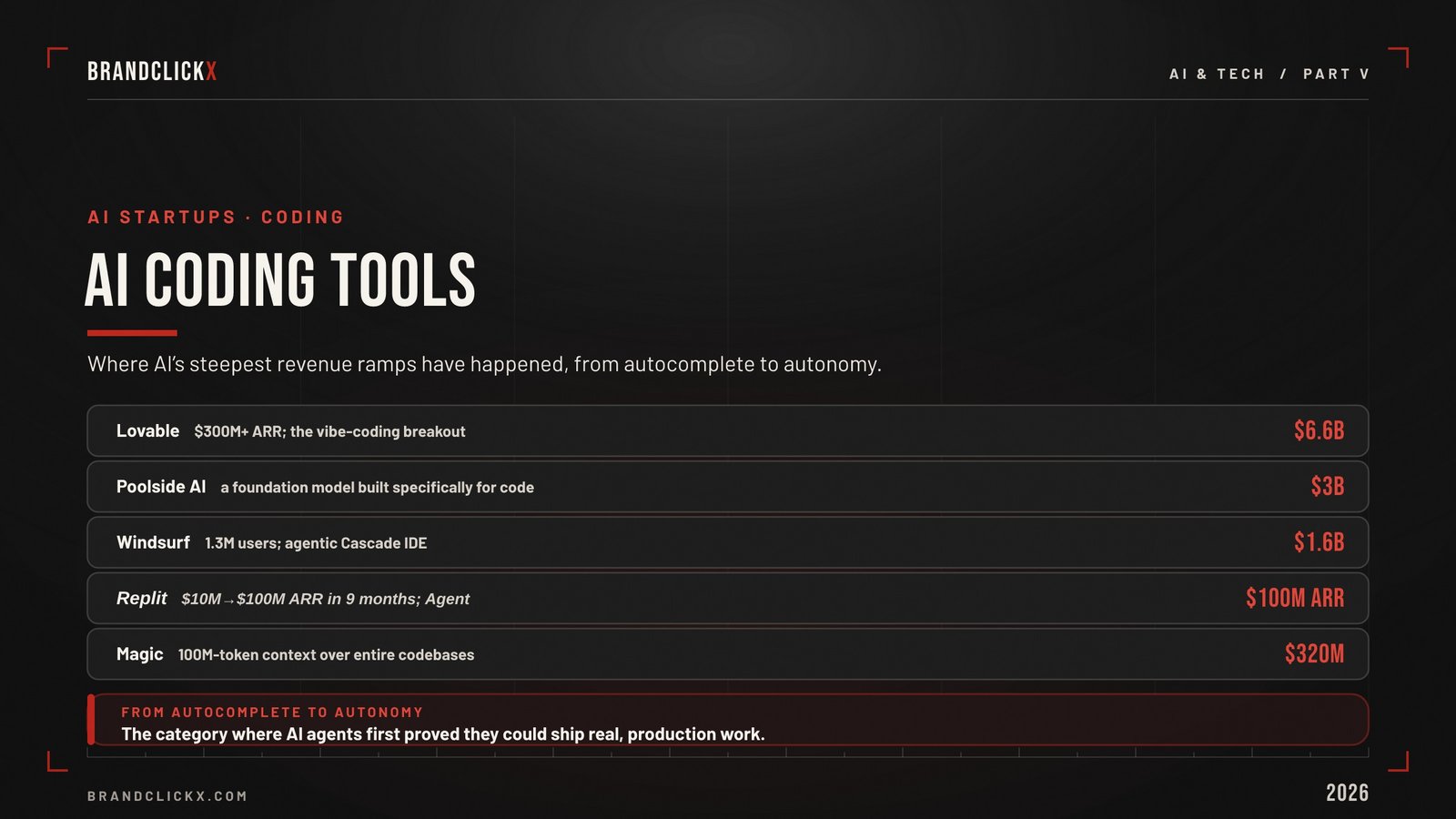
46. Windsurf (formerly Codeium)
Valuation: $1.6 billion | Users: 1.3 million+ prior to rebranding
The most dramatic rebranding in developer tools history. Codeium, which had built a privacy-focused AI coding assistant to over 1.3 million users, relaunched as Windsurf with a full AI-first IDE and agentic Cascade workflows. Despite leadership turbulence following a collapsed Google acquisition, the core product remains a strong Cursor alternative.
47. Replit
Revenue: $100 million ARR | Users: Millions globally
The cloud IDE that went from developer education platform to full AI-native development environment. Replit Agent builds, deploys, and iterates on complete applications from natural language. Its $10M to $100M ARR jump in 9 months following Agent launch is one of the sharpest product-led growth inflections of 2026.
48. Lovable
Valuation: $6.6 billion | Revenue: $300 million+ ARR
The vibe coding breakout star. Lovable generates complete web applications from plain-language prompts, serving the 63% of vibe coding users who have no technical background. $330 million Series B at $6.6 billion valuation. The fastest-growing non-developer coding platform in history.
49. Poolside AI
Valuation: $3 billion | Funding: $500 million
Building a foundation model trained specifically on code, a purpose-built coding intelligence rather than a general model applied to coding tasks. The thesis: domain-specific model training on high-quality code data will outperform general models on coding tasks at equivalent parameter counts.
50. Magic (formerly Magic AI)
Funding: $320 million | Function: Long-context code understanding
Building AI that can understand and operate on entire codebases, not just individual files or functions. Magic’s 100 million token context window makes it the only tool that can reason about a complete enterprise software system as a single context, enabling the kind of large-scale refactoring and architectural analysis that no other coding tool can perform.
Part VI: Creative AI
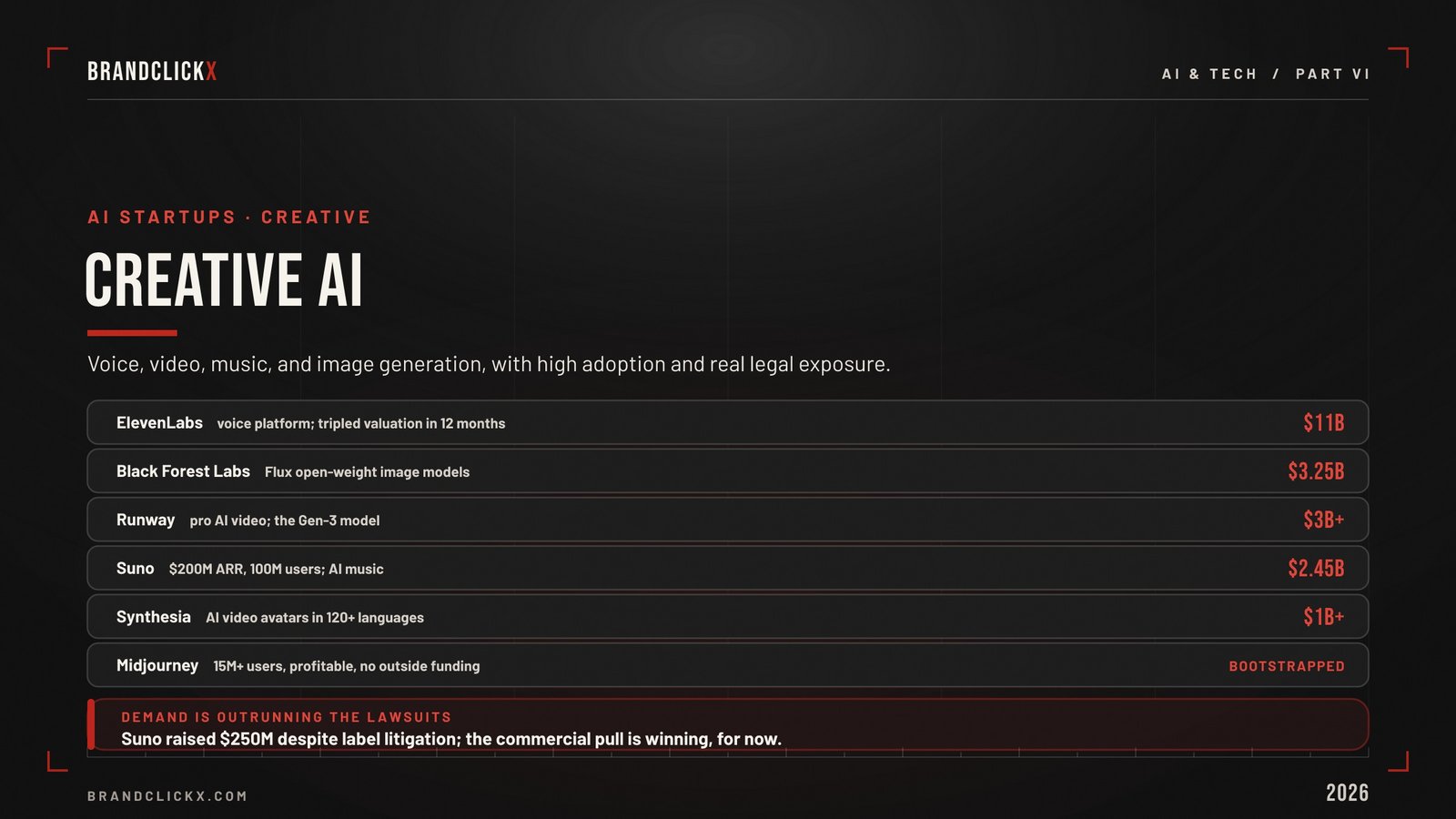
51. ElevenLabs
Valuation: $11 billion | Funding: $500 million (Sequoia-led)
The voice AI platform that won the enterprise market. ElevenLabs more than tripled its valuation in 12 months, from $3.3 billion to $11 billion. Its API processes billions of characters monthly. If you build a voice product in 2026, you almost certainly build it on ElevenLabs’ stack. The expansion into dubbing, sound effects, and real-time voice transformation has moved it beyond TTS into a comprehensive voice platform.
52. Runway
Valuation: $3 billion+ | Function: AI video generation
The professional AI video generation platform used by film studios, advertising agencies, and content teams. Runway’s Gen-3 model produces cinematic-quality video from text prompts at a level that has made it a production tool rather than a toy. The advertising use case is particularly commercial: brands generating video creative at a fraction of traditional production costs.
53. Suno
Valuation: $2.45 billion | Revenue: $200 million ARR | Users: 100 million registered
The AI music generation platform generating full songs from text prompts. $250 million Series C in 2026 despite ongoing copyright litigation from Universal, Sony, and Warner, investors betting on the commercial demand outweighing the legal risk. 100 million registered users and $200 million ARR confirm that demand is real.
54. Midjourney
Status: Bootstrapped | Function: AI image generation | Users: 15 million+
The only major AI creative company that has scaled to massive adoption without external funding. Midjourney’s profitable, subscription-driven model is the counterexample to the capital-intensive foundation model thesis, proving that high-quality AI creative tools can sustain large user bases without venture dependency.
55. Black Forest Labs
Valuation: $3.25 billion | Function: AI image generation (Flux models)
The European image generation startup that built Flux, the open-weight image model that has become the preferred alternative to proprietary image generators for developers who need fine-tuning flexibility. Black Forest Labs’ rapid rise to $3.25 billion valuation reflects how fast open-weight models can build commercial momentum.
56. Synthesia
Valuation: $1 billion+ | Function: AI video avatars
AI-generated video with digital human presenters, used by enterprises for training content, product demos, and localized video at scale. Synthesia’s value proposition: professional video content without cameras, studios, or talent fees. The localization capability, generating the same video in 120+ languages from a single script, is its strongest commercial differentiator.
57. HeyGen
Valuation: $500 million+ | Function: AI video and avatar creation
AI video translation and avatar generation that has found its strongest product-market fit in international content localization. HeyGen’s video translation feature, which lip-syncs original speakers into new languages, has become the fastest path to multilingual video content for creators and brands.
58. Pika Labs
Valuation: $700 million | Function: AI video generation for consumers
Consumer-facing AI video generation built for social media content creators. Pika’s text-to-video and image-to-video capabilities are optimized for the short-form content formats that dominate social media, the creative use case with the highest user volume and lowest enterprise requirements.
59. Luma AI
Valuation: $800 million | Function: 3D and video AI generation
Building AI for 3D scene generation, video, and the visual intelligence layer for physical environments. Luma’s Dream Machine video generation and 3D reconstruction capabilities are particularly relevant for gaming, virtual reality, and spatial computing applications.
60. Ideogram
Valuation: $450 million | Function: AI image generation with text accuracy
The AI image generator that solved the text rendering problem. Ideogram’s ability to accurately render text within images, a capability that DALL-E, Midjourney, and Stable Diffusion consistently failed at, created a specific, commercially valuable use case: marketing materials, product mockups, and social media graphics that require legible text.
Part VII: Physical AI and Robotics
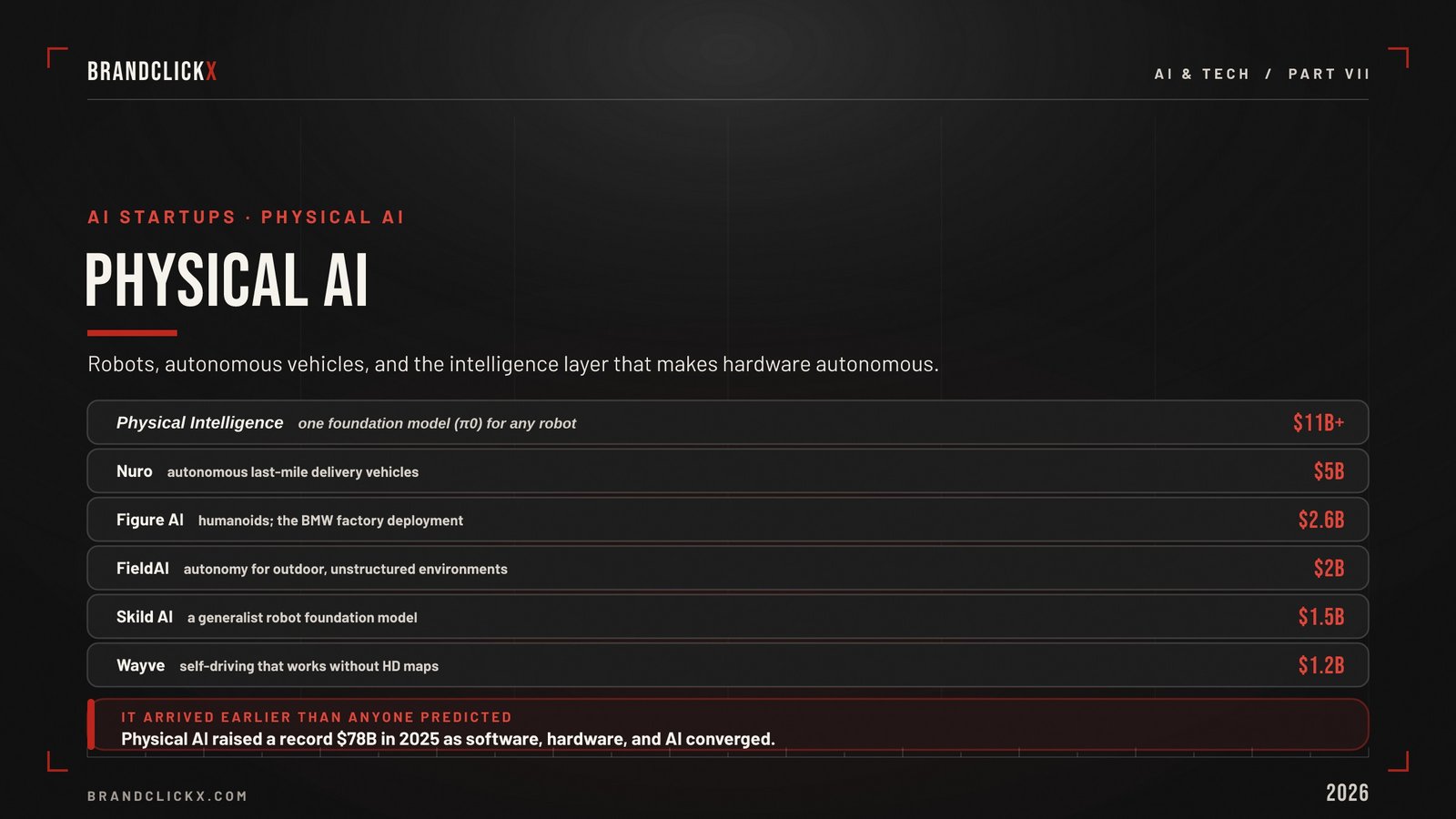
61. Physical Intelligence (Pi)
Valuation: $11 billion+ (raising) | Funding: $600 million (prior round at $5.6 billion)
The pure-software robotics intelligence company, building a single foundation model (π0) that can control any robot, not just robots it was trained on. Physical Intelligence is reportedly raising $1 billion at $11 billion+ as of late March 2026. The “one model for all robots” thesis is the most ambitious in physical AI, and the most potentially transformative.
62. Figure AI
Valuation: $2.6 billion | Funding: $675 million (OpenAI, Nvidia, Microsoft, Bezos)
Humanoid robots powered by OpenAI’s language models, building the physical instantiation of AGI in robot form. Figure’s BMW deployment (robots working alongside humans in a manufacturing facility) is the most commercially advanced humanoid robot deployment in history.
63. 1X Technologies
Valuation: $1 billion+ | Investors: OpenAI, EQT Ventures
The Norwegian humanoid robotics company building androids for commercial deployment, warehousing, manufacturing, and logistics. 1X’s full-size humanoid EVE robot is designed for the environments that existing industrial robots cannot navigate.
64. Apptronik
Function: Humanoid robots for supply chain | Partners: NASA, Mercedes-Benz
Austin-based humanoid robotics company with commercial deployments in automotive manufacturing. Apptronik’s Apollo robot is specifically designed for logistics and manufacturing environments, the commercial use cases with the clearest near-term ROI for humanoid robotics deployment.
65. Skild AI
Valuation: $1.5 billion | Headquarters: Pittsburgh | Function: General-purpose robot intelligence
Named in the Forbes AI 50 2026 list, Skild is building a generalist robot foundation model, intelligence that can transfer across different robot hardware and different tasks. The vision: a pre-trained robot brain that any hardware manufacturer can deploy.
66. Wayve
Funding: $1.2 billion (2026) | Function: Autonomous driving without HD maps
The UK autonomous driving company building AI-first self-driving that works without pre-mapped roads. Wayve’s embodied AI approach, learning to drive from experience rather than from predetermined rules and maps, is the most generalizable autonomous vehicle technology in development.
67. Nuro
Valuation: $5 billion | Function: Autonomous delivery vehicles
Autonomous delivery vehicles for the last-mile logistics problem. Nuro has regulatory approval for public road operation in multiple US markets and commercial partnerships with major retailers. The unit economics of autonomous last-mile delivery, if the technology matures, represent one of the largest cost reduction opportunities in physical retail.
68. InOrbit
Customer growth: 200% year-over-year | Function: Robot operations management
The “Kubernetes for robots”, software infrastructure for managing fleets of autonomous robots across warehouse and logistics environments. InOrbit grew its customer base 200% in the past year according to CB Insights.
69. FieldAI
Valuation: $2 billion | Funding: $314 million Series A (August 2025)
AI for field operations, autonomous systems for outdoor, unstructured environments including construction, agriculture, and infrastructure inspection. The Series A size signals investor confidence that the outdoor autonomous systems market is maturing faster than the indoor market.
70. Gravis Robotics
Deployment: 7 countries | Function: Heavy machinery automation
AI for heavy equipment, automating excavators, bulldozers, and other large machinery used in construction and mining. Founded in 2022 and already deployed across seven countries, unusually fast international deployment for a hardware-dependent AI company.
Part VIII: AI Infrastructure and Observability
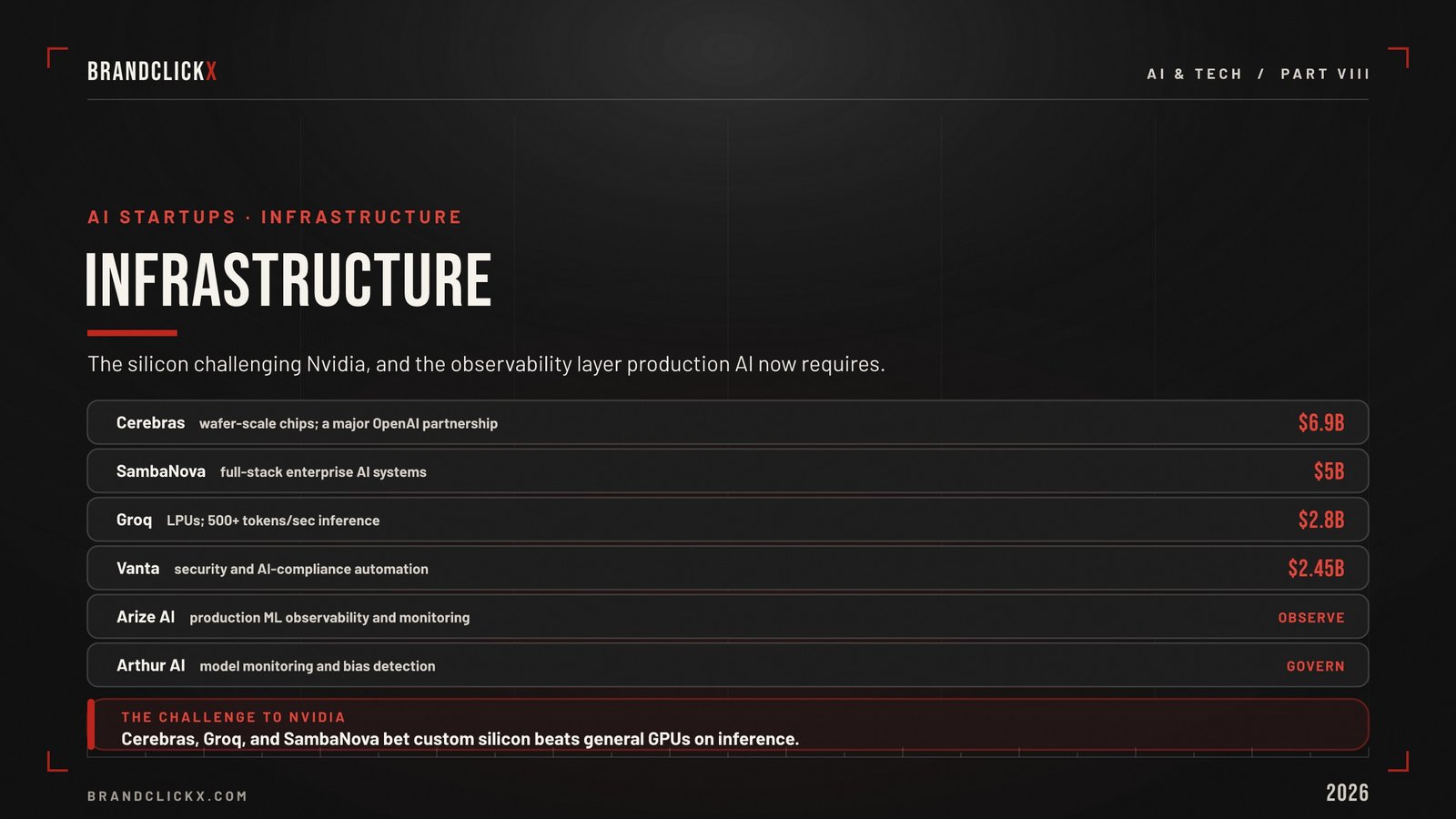
71. Cerebras Systems
Valuation: $6.9 billion | Funding: $750 million (2025)
The most credible challenger to Nvidia in AI chips, using wafer-scale integration to build chips that are physically larger and more powerful than conventional GPU dies. Cerebras has a major OpenAI partnership and has demonstrated inference speeds that outperform Nvidia’s H100s on large models.
72. Groq
Valuation: $2.8 billion | Function: Ultra-fast AI inference chips (LPUs)
Language Processing Units, custom chips designed for inference rather than training. Groq’s demo running Llama at 500+ tokens per second (versus 20-30 tokens per second on standard GPU setups) established the product’s capability. The commercial question is whether inference speed becomes a primary purchasing criterion for enterprise AI deployments.
73. SambaNova Systems
Valuation: $5 billion | Function: AI hardware and full-stack AI systems
Full-stack AI, custom chips combined with a complete software platform for enterprise AI deployment. SambaNova sells complete AI systems rather than individual chips, targeting enterprises that want turnkey AI capability without the integration complexity of assembling a stack from components.
74. Arize AI
Function: ML observability and monitoring | Investors: Battery Ventures
Production AI monitoring, detecting model degradation, data drift, and performance issues in deployed AI systems. As enterprise AI deployments scale, the monitoring problem becomes critical. Arize is the most deployed observability platform for production AI systems.
75. Arthur AI
Function: AI performance monitoring and bias detection
Model monitoring and bias detection for enterprise AI, particularly in high-stakes domains like financial services, healthcare, and hiring where regulatory requirements mandate fairness monitoring. The EU AI Act enforcement creates direct demand for Arthur’s compliance capabilities.
76. Vanta
Valuation: $2.45 billion | Function: AI security compliance automation
Security compliance automation, using AI to continuously monitor and verify compliance with SOC 2, ISO 27001, GDPR, and other security frameworks. As enterprise AI deployments generate new compliance requirements, Vanta’s platform extends naturally to AI governance.
Part IX: Enterprise AI Applications
77. Writer.com
Function: Enterprise content operations | Market: Fortune 500
The enterprise content platform for regulated industries. Writer’s Knowledge Graph grounds AI outputs in verified company information, the compliance layer that makes AI-generated content safe for financial services, healthcare, and pharmaceutical companies.
78. Jasper AI
Revenue: $88 million ARR | Customers: 100,000+
The AI content platform that survived the ChatGPT shakeout by pivoting from writing tool to marketing agent platform. Jasper Campaigns, Jasper Agents, and the Brand Voice governance layer serve enterprise marketing teams that need brand-consistent content at scale.
79. Moveworks
Acquirer: ServiceNow | Function: AI for IT service management
The enterprise AI assistant for IT and HR, automating employee requests, resolving common IT issues, and orchestrating service desk workflows. ServiceNow’s acquisition demonstrates that the enterprise AI assistant market is valuable enough for established software companies to pay premium prices to enter.
80. Aisera
Valuation: $1 billion+ | Function: Conversational AI for enterprise service management
AI-powered service management across IT, HR, and customer service, using conversational AI to automate the most common enterprise support interactions. Aisera’s generative AI upgrade in 2025 significantly expanded its capability for complex, multi-step service workflows.
81. Leena AI
Function: Autonomous HR AI | Deployment: Global enterprises
The HR automation platform targeting zero employee tickets, using AI to resolve all routine HR queries (benefits, payroll, time off, onboarding) without human involvement. The specific metric Leena AI sells toward: measurable reduction in HR ticket volume.
82. Coupa Software (AI layer)
Function: AI for procurement and spend management
Procurement AI that identifies savings opportunities, automates purchase approvals, and manages supplier relationships. The procurement use case has some of the clearest ROI in enterprise AI, every percentage point of spend reduction in a large organization translates directly to margin.
Part X: Emerging and Specialist AI Startups
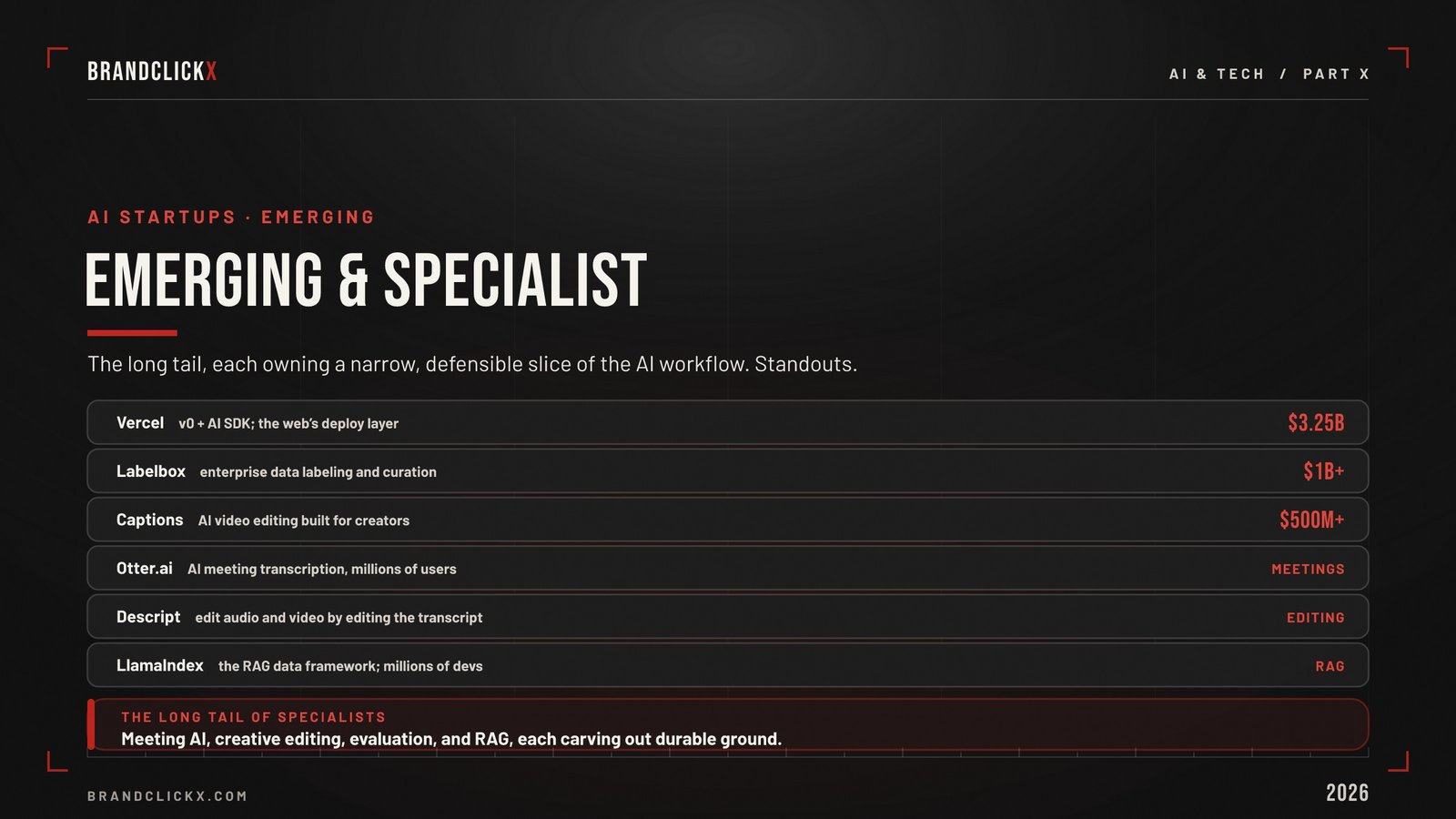
83. Sakana AI
Function: Nature-inspired AI research | Investors: Lux Capital, David Haber
The Tokyo-based AI research lab building AI systems inspired by collective intelligence in nature, the behavior of schools of fish, bird flocks, and ant colonies. Sakana’s research into smaller, collaborative AI models that achieve frontier performance through collective behavior is one of the most intellectually distinct research programs in the AI landscape.
84. Pika Labs (Video AI)
Already covered above, but noting separately that Pika’s consumer-first approach is specifically interesting for brands and agencies building AI-native creative workflows for social media.
85. Hedra
Function: Character AI video | Key product: Character-1 model
AI video generation focused specifically on realistic human characters, a more constrained capability than general video generation but one with direct commercial application in marketing, entertainment, and training video production.
86. Captions
Valuation: $500 million+ | Function: AI video editing for creators
AI-powered video editing tools for content creators, automatic captions, clip selection, background removal, and video enhancement. Captions has built a loyal creator base by solving the specific post-production friction points that gate video content publishing.
87. Descript
Function: Script-based video and audio editing | Investors: Andreessen Horowitz
Audio and video editing where you edit the recording by editing the transcript, delete a word from the text, it disappears from the audio. Descript is the most radical rethinking of audio/video post-production UX since non-linear editing replaced tape.
88. Otter.ai
Function: Meeting transcription and AI summaries | Users: Millions globally
The most widely used AI meeting intelligence tool, real-time transcription, speaker identification, automatic summaries, and action item extraction. Otter’s enterprise tier connects meeting intelligence to CRM workflows and project management systems.
89. Fireflies.ai
Function: AI meeting notes and workflow automation | Users: 20,000+ companies
Meeting transcription with deeper CRM integration than most competitors, automatically logging action items, contacts, and decisions into Salesforce, HubSpot, and other enterprise systems. The distinction from Otter: Fireflies is more enterprise-workflow focused, Otter is more user-experience focused.
90. Tome
Function: AI presentation generation | Investors: Lightspeed, Coatue
AI-native presentation tool that generates complete, well-designed slide decks from text prompts. Tome’s positioning against PowerPoint and Google Slides targets the most time-consuming routine task in most knowledge workers’ weekly workflow.
91. Gamma
Function: AI presentation and document creation
Similar positioning to Tome, AI-generated presentations and documents, with a stronger design quality reputation and a free tier that has driven significant organic growth. Gamma’s viral spread through professional networks is a case study in PLG for productivity AI.
92. Elicit
Valuation: Growing | Function: AI research assistant for academics
The systematic literature review tool already covered in the research section, included here because its commercial trajectory in the enterprise research market makes it a significant AI startup story independent of its academic user base.
93. Comet ML (now Comet)
Function: ML experiment management and model monitoring
Production ML monitoring for enterprise AI teams, experiment tracking, model evaluation, and production performance monitoring in a single platform. Comet’s integration with major MLOps pipelines has made it a standard component in enterprise AI infrastructure stacks.
94. Labelbox
Valuation: $1 billion+ | Function: Data labeling and training data management
The enterprise alternative to Scale AI for data labeling and training data curation. Labelbox’s platform includes both the tooling for human labelers and the AI-assisted auto-labeling capabilities that reduce the cost of training data production.
95. Aquant
Function: AI for field service and maintenance | Market: Industrial enterprises
AI that predicts equipment failures, diagnoses technical issues, and recommends repairs for industrial and commercial equipment. The field service AI market is large, underdigitized, and increasingly competitive as foundation model capabilities make more complex diagnostic reasoning possible.
96. Sanas
Function: Real-time accent translation | Investors: Andreessen Horowitz
AI that transforms spoken accent in real time without changing the speaker’s voice, improving comprehension between callers with strong accents and customer service agents. Sanas has raised from a16z and has commercial contracts with BPOs serving US enterprise customers.
97. AssemblyAI
Function: Speech-to-text API for developers | Customers: Thousands of AI startups
The developer-facing speech recognition API powering thousands of voice-enabled AI products. AssemblyAI’s audio intelligence features, speaker diarization, sentiment analysis, topic detection, summarization, make it the most feature-rich speech API available.
98. Vercel (v0 and AI SDK)
Valuation: $3.25 billion | Function: Frontend deployment and AI development tools
Already covered in the coding tools section, but Vercel’s position as both infrastructure for millions of web applications and the creator of v0 (the premier AI UI generation tool) makes it uniquely positioned at the intersection of AI and web development.
99. LlamaIndex
Function: Data framework for LLM applications | Adoption: Millions of developers
The open-source data framework that connects LLMs to external data sources, the RAG infrastructure layer that makes AI applications aware of data they weren’t trained on. LlamaIndex’s commercial products (LlamaCloud, LlamaIndex Enterprise) monetize the community that has adopted the open-source framework.
The 2026 AI Startup Landscape at a Glance
| Category | Largest Company | Top Valuation | Key Trend |
| Foundation Models | OpenAI | $852 billion | IPO race with Anthropic |
| AI Agents | Cognition / Sierra | $10.2B / $4.5B | Outcomes-based pricing |
| Vertical AI — Legal | Harvey | $11 billion | Proprietary alternatives emerging |
| Vertical AI — Healthcare | Abridge | $5.3 billion | Clinical deployment scaling |
| Developer Tools | Anysphere (Cursor) | $50 billion (talks) | Fastest SaaS growth ever |
| GPU Infrastructure | CoreWeave | $35 billion | First AI infrastructure IPO |
| Creative AI — Voice | ElevenLabs | $11 billion | Platform layer dominance |
| Creative AI — Video | Runway | $3 billion+ | Enterprise creative production |
| Creative AI — Music | Suno | $2.45 billion | Copyright uncertainty |
| Physical AI | Physical Intelligence | $11 billion+ | One model, any robot |
| Robotics — Humanoid | Figure AI | $2.6 billion | Commercial deployment begun |
Key Takeaways for CMOs, Enterprise Leaders, and Investors
- Revenue is now the filter, not funding. The AI startups that raised at high valuations on narrative alone in 2023–2024 are being repriced. The ones generating real ARR, Cursor at $2B, Sierra at $150M, Suno at $200M, are raising at higher multiples than ever. The market has sorted.
- Vertical AI beats generalist AI on commercial metrics. Harvey, Abridge, Ambience, and EvenUp all demonstrate that AI built specifically for a single industry’s data, compliance requirements, and workflows outperforms general AI on every metric that matters commercially: adoption speed, contract size, retention, and pricing power.
- The agent market is pricing toward outcomes, not seats. The shift from per-seat SaaS pricing to outcomes-based pricing, pay for completed work, not for access, is the most significant commercial model change in enterprise software since the move from on-premise to cloud.
- Physical AI arrived faster than anyone predicted. Physical AI raised a record $78 billion in 2025. Physical Intelligence at $11 billion, Figure AI at $2.6 billion, and the CB Insights AI 100 recognizing physical AI as a standalone category for the first time in 2026, the convergence of robotics software, hardware, and AI has cleared the threshold from research to commercial deployment.
- Geography is diversifying. Mistral (Paris), Black Forest Labs (Freiburg), Legora (Stockholm), Lovable (Stockholm), Wayve (London), ElevenLabs (London), the 2026 AI startup landscape is genuinely global. The “European AI is dead” narrative has aged very badly.
FAQ: Top AI Startups 2026
Which AI startup has the highest valuation in 2026?
Anthropic leads at $965 billion following its May 2026 Series H, narrowly ahead of OpenAI at $852 billion. Among non-foundation-model companies, Cursor (Anysphere) is in talks at a $50 billion valuation, the highest-valued AI-native software company outside the foundation model labs.
Which AI startup is growing fastest in 2026?
By ARR growth rate, LMArena reached $1.7 billion valuation in under four months from founding. By absolute ARR growth, Cursor went from $0 to $2 billion ARR in under 24 months. By revenue trajectory, Anthropic went from $9 billion ARR at end-2025 to $47 billion ARR by May 2026.
What categories are AI investors most excited about in 2026?
Physical AI raised a record $78 billion in 2025 and is the fastest-growing category by absolute capital deployment. AI agents are the fastest-growing category by deal count. Vertical AI in legal and healthcare is the fastest-growing by revenue multiples.
How much did AI startups raise in 2025?
AI startups raised nearly $150 billion in 2025, accounting for more than 40% of global venture capital. Foundation model companies raised $80 billion of that total. US AI startups specifically raised $164.6 billion.
Which AI startup is most likely to IPO in 2026?
Anthropic filed confidentially for an IPO in June 2026. OpenAI is expected to file a confidential S-1 imminently. Databricks has been preparing for an IPO. CoreWeave has already completed its public offering. The 2026 AI IPO pipeline is the most consequential in technology market history.
Conclusion: The Sorting Has Begun, and the Winners Are Becoming Clear
The AI startup landscape of 2026 is not the one of 2023.
The hype cycle has been replaced by a commercial cycle. The companies on this list are not raising on narrative, they are raising on revenue, customer contracts, production deployments, and the kind of enterprise adoption that generates retention data rather than just launch press.
The pattern that unites the AI startups winning in 2026 is simple. 70% of the top-funded startups have founders from OpenAI, Google, Meta, or Salesforce. The fastest-growing hit $100 million ARR in under two years. The most durable are the vertical ones, the companies that went deep into a single industry rather than wide across many.
The next two years will produce the first $1 trillion AI company, a wave of public offerings that will make or break the industry’s valuation narrative, and a consolidation that will compress hundreds of competing tools into the platforms that enterprises choose to standardize on.
The 99 companies on this list are the ones worth watching as that sorting accelerates.