Introduction: The Efficiency Machine That Forgot to Change the Price Tag
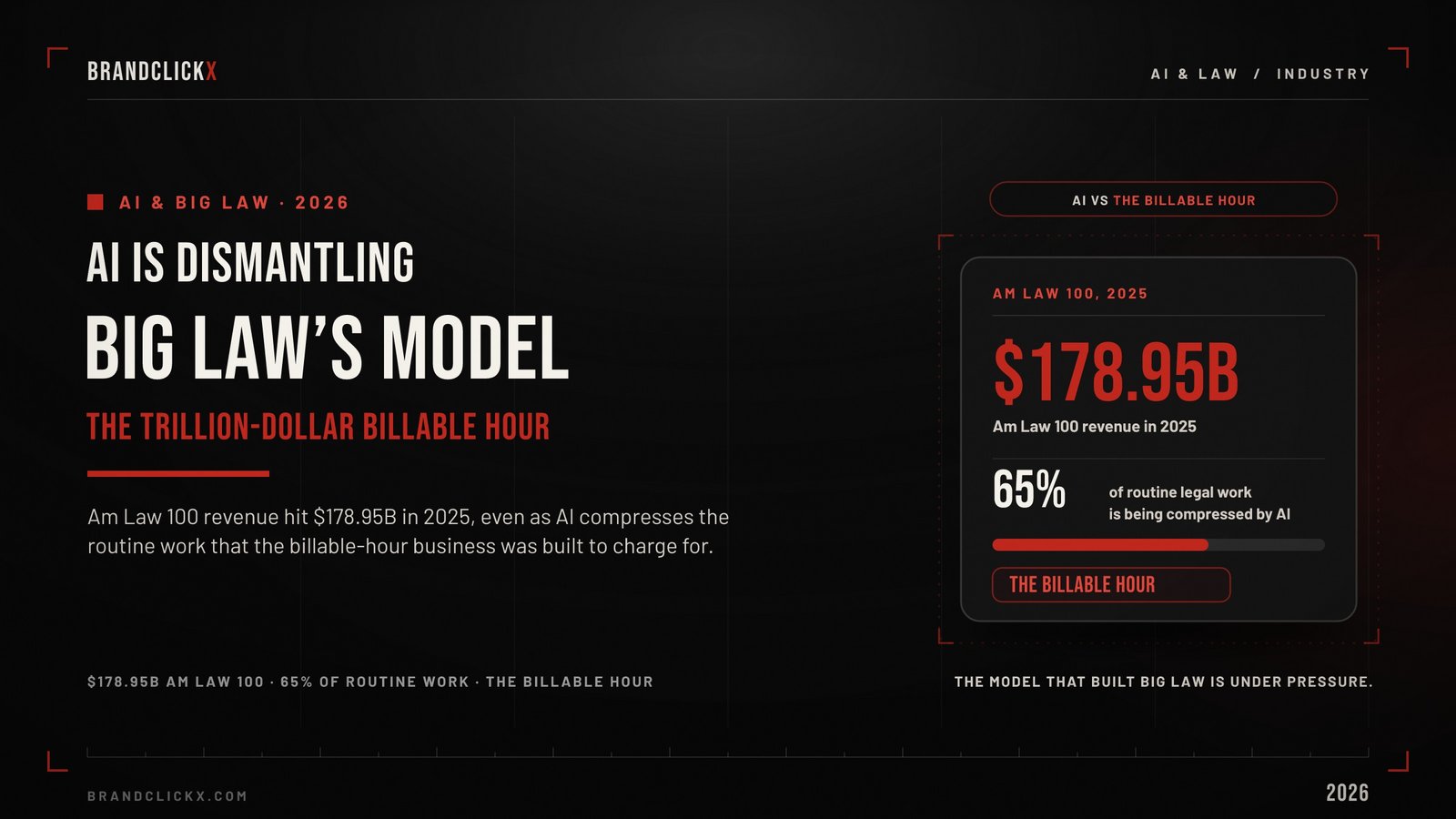
In 2025, the Am Law 100 firms collectively generated $178.95 billion in revenue, a 13% increase over the prior year. Average profits per equity partner rose 14% to $3.59 million. Kirkland & Ellis broke $10 billion in single-firm revenue. Wachtell Lipton broke $12 million in average profits per equity partner.
By every visible metric, Big Law has never been healthier.
And yet, beneath those record numbers, the foundations of the business model that produced them are cracking.
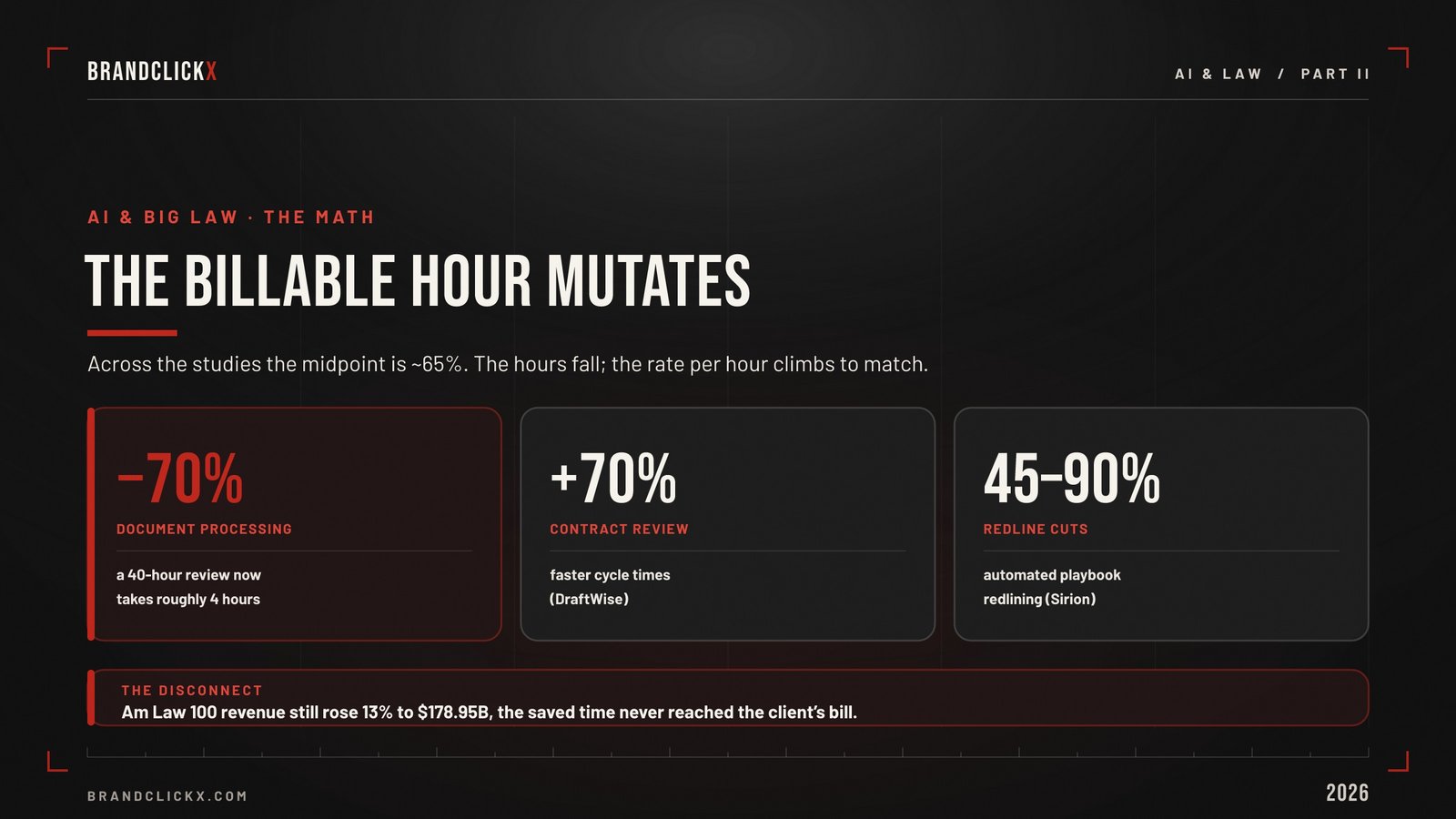
AI can reduce document processing time by 70%, per U.S. Legal Support data. DraftWise puts contract review acceleration at the same figure. Sirion’s 2026 benchmarks show 45% to 90% cycle-time cuts on automated playbook redlining. The midpoint across every credible study is roughly 65%.
The industry is compressing 65% of routine legal work with AI, and billing clients as if it isn’t.
That contradiction is unsustainable. Clients know it. Senior partners know it. And the firms making $500 million bets on proprietary AI infrastructure know it most of all.
Bloomberg’s June 1 investigation into how AI is forcing Big Law to rethink business as usual captured the inflection point precisely. The legal industry is not facing a disruption that might arrive.
It is managing a disruption that is already here, and making a set of consequential strategic decisions about whether to absorb the productivity gains, share them with clients, or use them to build a new kind of competitive moat.
This is that story.
Part I: The Volkswagen Problem That Started Everything
How a Global Compliance Task Showed What AI Could Actually Do
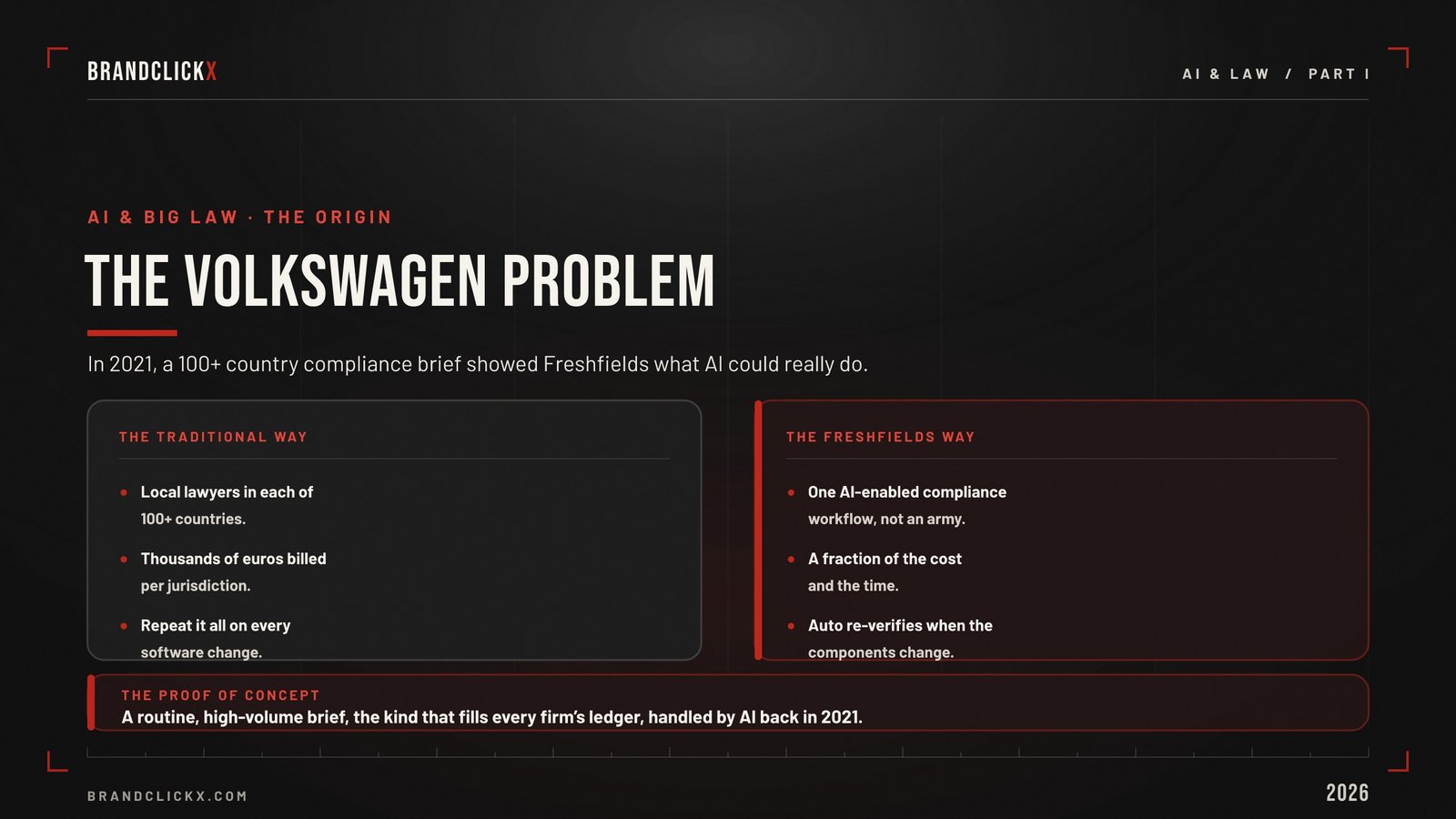
In 2021, Volkswagen AG approached Freshfields with a problem that would have once required a small army of lawyers.
The German carmaker’s technology unit was preparing to release new software features and needed compliance verification across more than 100 countries where Volkswagens are sold. The traditional approach: bring in lawyers from each jurisdiction, budget thousands of euros per country, repeat the process every time a software component changed.
Freshfields deployed its seven-year-old digital innovation unit instead, the team built to integrate technology and legal work into a single workflow. The AI-enabled system processed the multi-jurisdictional compliance analysis at a fraction of the traditional cost and time, with the added benefit of automated re-verification when software components changed.
That engagement became the internal proof of concept that everything that followed was built on.
Why It Matters: The Volkswagen brief wasn’t exotic legal strategy. It was exactly the kind of high-volume, multi-jurisdictional, document-intensive work that fills the billing ledgers of every major global law firm. When AI can do that work faster, cheaper, and with built-in update functionality, the question is not whether the economics change. It’s when clients notice, and what they do about it.
The Bigger Shift: Freshfields’ response to that proof of concept was to double down, not retreat. In April 2026, the firm announced a multi-year co-innovation agreement with Anthropic to deploy Claude across all 5,700 employees in 33 offices globally.
Within six weeks of rollout, adoption had increased by approximately 500%. The firm is also an early adopter of Thomson Reuters’ CoCounsel Legal, fully rebuilt on Anthropic’s technology with Westlaw and Practical Law natively embedded.
The message Freshfields is sending to its clients is deliberate: we are not defending the old model. We are building the new one.
Part II: The Billable Hour Is Not Dead, It’s Mutating
The Uncomfortable Math That Big Law Is Hoping Clients Don’t Do
Here is the productivity reality the legal industry is navigating in 2026.
U.S. Legal Support data shows AI reduces document processing time by 70%. A document review that took a junior associate 40 hours now takes roughly 4. That’s not a projection. That’s the operational reality inside every Am Law firm that has deployed legal AI tools at scale.
The question every general counsel is now asking their outside law firm: if this work no longer takes 40 hours, why is it still billed as if it does?
The answer, so far, is that firms have been absorbing the efficiency gains into three mechanisms: rate increases, expanded scope, and higher matter volume. When AI compresses hours on one matter, firms push the saved time onto more matters. Aggregate revenue climbs. Hours per matter fall. The billable rate per hour rises to compensate.
Am Law 100 aggregate revenue rose 13% to $178.95 billion in 2025 while AI adoption surged across the same firms. The disconnect is the story: firms are saving the time, but clients are not seeing the bill change.
Expert Insight: The Thomson Reuters Institute’s Law Firm Rates Report 2026 identified a counterintuitive finding: regardless of whether firms discount aggressively or hold firm on realization rates, they’re collecting roughly the same amount per hour. The competitive advantage from AI is not showing up in client savings. It is showing up in firm margins.
That cannot last. According to ABA Model Rule 1.5, legal fees must be “reasonable” in light of factors including time, labor, complexity, and results obtained. When AI reduces the time required for research from a week to minutes, the reasonableness calculus changes.
Corporate general counsel are increasingly asking the question directly. And clients are already routing work to cheaper alternatives, midsize firms at $600 per hour rather than Am Law 100 firms at $1,000-plus.
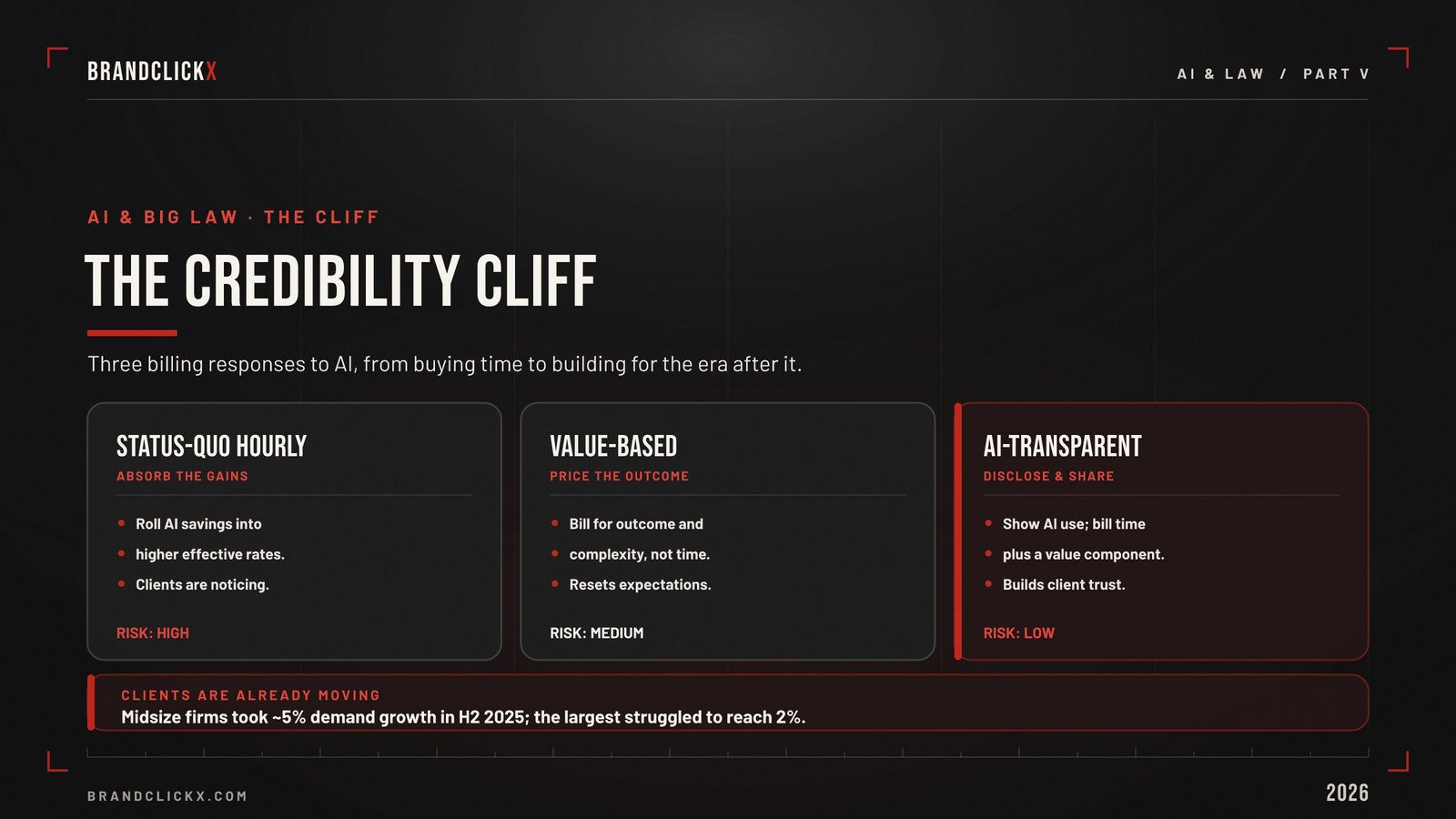
Market Observation: Midsize and Am Law Second Hundred firms captured nearly 5% demand growth in the second half of 2025. The largest firms struggled to reach 2%. That demand migration is the earliest market signal of what happens when clients start doing the AI productivity math themselves.
Part III: The Strategic Divide, Buy, Build, or Partner
The Decision That Will Separate Big Law’s Winners From Its Casualties
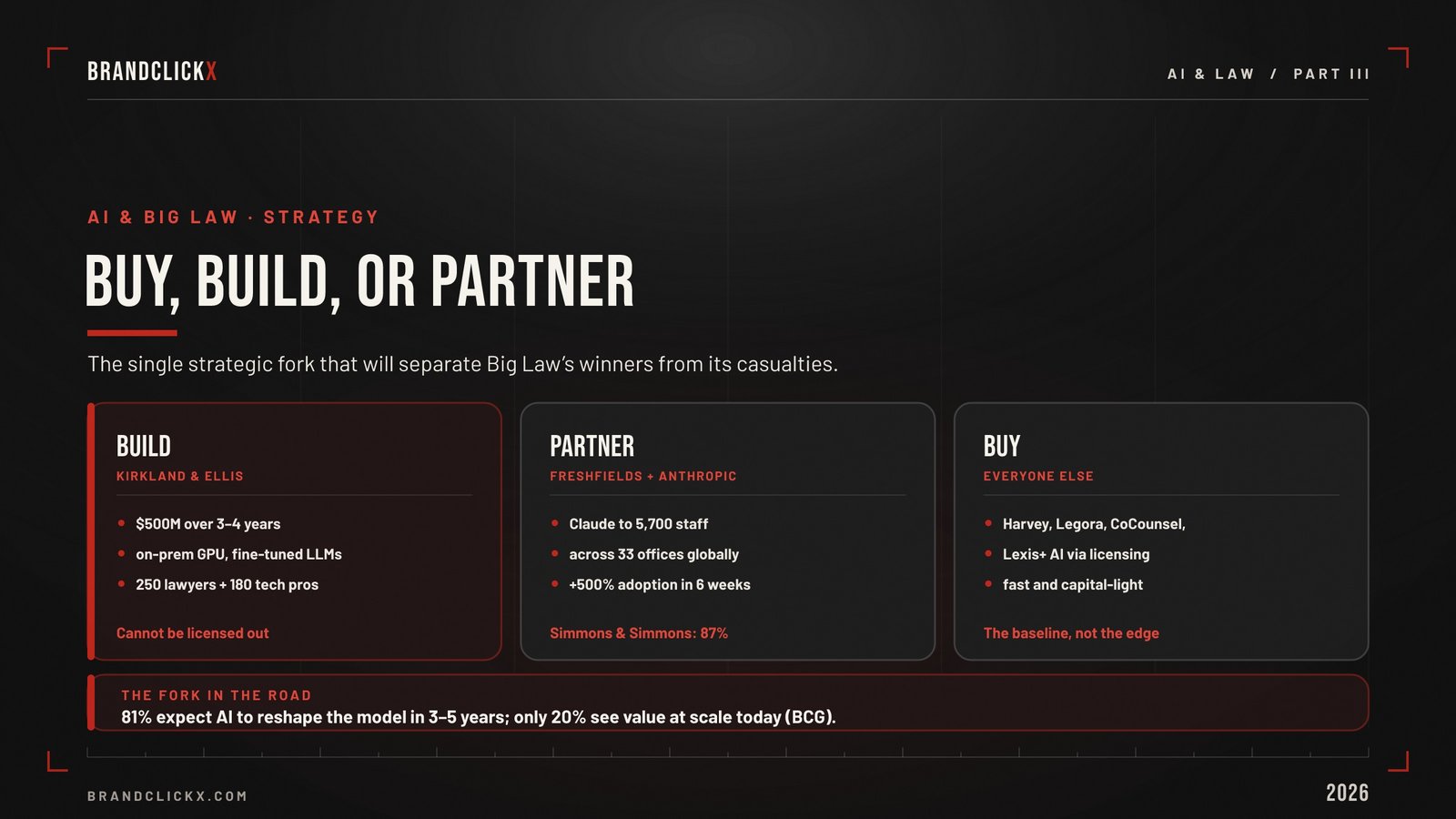
The AI disruption in legal services has crystallized around a single strategic fork: does your firm buy off-the-shelf legal AI tools, build proprietary systems, or partner with AI companies to co-develop bespoke solutions?
The answer is not universal. It depends on firm size, data quality, client base, and tolerance for the capital intensity of the build option. But the firms making the boldest bets are signaling something important: the commodity layer of legal AI is already here, and the competitive advantage will flow to those who move beyond it.
The Build Strategy: Kirkland’s $500 Million Bet
No firm has made a bigger declaration of the build thesis than Kirkland & Ellis.
The world’s highest-grossing law firm, $10 billion in single-firm revenue in 2025, has committed $500 million over three to four years to develop a proprietary AI platform built on Kirkland’s own legal data.
The initiative involves on-premise GPU infrastructure, fine-tuning of open-source large language models, and input from 250 lawyers including 100 partners alongside 180 technology professionals.
The resulting system cannot be sold or licensed to other firms. That exclusivity is the point.
Artificial Lawyer’s analysis notes that Kirkland’s new AI Infrastructure Director job listings specifically require experience with on-premise GPU environments, the technical infrastructure required to fine-tune open-source LLMs on proprietary data.
The firm’s job adverts also reference familiarity with Harvey, Legora, CoCounsel, and Lexis+ AI, the leading commercial legal AI platforms, suggesting Kirkland is using those tools as a benchmark while building something it believes will surpass them.
The logic is clean: if every Am Law firm runs the same Harvey subscription, Harvey becomes the floor, not the edge. Kirkland is betting $500 million that the floor is not good enough.
The Partner Strategy: Freshfields and the Anthropic Alliance
Freshfields chose a different path.
Rather than building entirely in-house, the firm entered a multi-year co-innovation partnership with Anthropic, deploying Claude across 5,700 employees while jointly developing agentic legal workflows with Anthropic’s engineers.
The partnership gives Freshfields frontier model access and direct input into how those models are adapted for legal work. The tradeoff: the resulting workflows are not exclusively Freshfields’. They inform Anthropic’s product development for the broader market.
Legal IT Insider’s analysis of the Freshfields-Anthropic partnership places it in the context of a broader industry split: “While legal AI sometimes feels like a two-horse race between Harvey and Legora at the moment, Kirkland and Freshfields are not the only firms leaning into the ‘build’ or ‘partner’ approach.”
Simmons & Simmons built Percy, a generative AI platform running on a proprietary legal inference engine, entirely in-house, reaching 87% adoption among fee earners within a year of launch. Singapore firm Allen & Gledhill built A&GEL, a custom LLM platform hosted entirely on-premise to meet client confidentiality requirements in the financial services market.
The pattern across all of these firms: the top tier of the legal industry is not treating AI as a subscription service. It is treating AI as infrastructure, and competing to own the most defensible version of that infrastructure.
The Buy Strategy: Everyone Else
The majority of the Am Law 100 and the broader legal market is still in the buy phase, deploying commercial tools like Harvey, Legora, CoCounsel, and Lexis+ AI through standard enterprise licensing.
This is not a wrong decision. It is a fast, capital-light way to access meaningful productivity gains without the organizational risk of a $500 million proprietary build.
The strategic risk is commoditization. BCG’s 2026 Legal AI Survey found that 81% of legal professionals expect AI to materially change the law firm business model within three to five years, but only 20% report significant value at scale. The gap between expectation and scaled execution is precisely where Kirkland and Freshfields are building their respective moats.
Firms that layer AI onto current workflows risk accelerating margin compression instead of preventing it. The tool is not the strategy. The workflow redesign around the tool is.
Part IV: The Junior Associate Pipeline Problem
The Talent Equation Nobody Has Solved
Big Law’s business model has always rested on leverage.
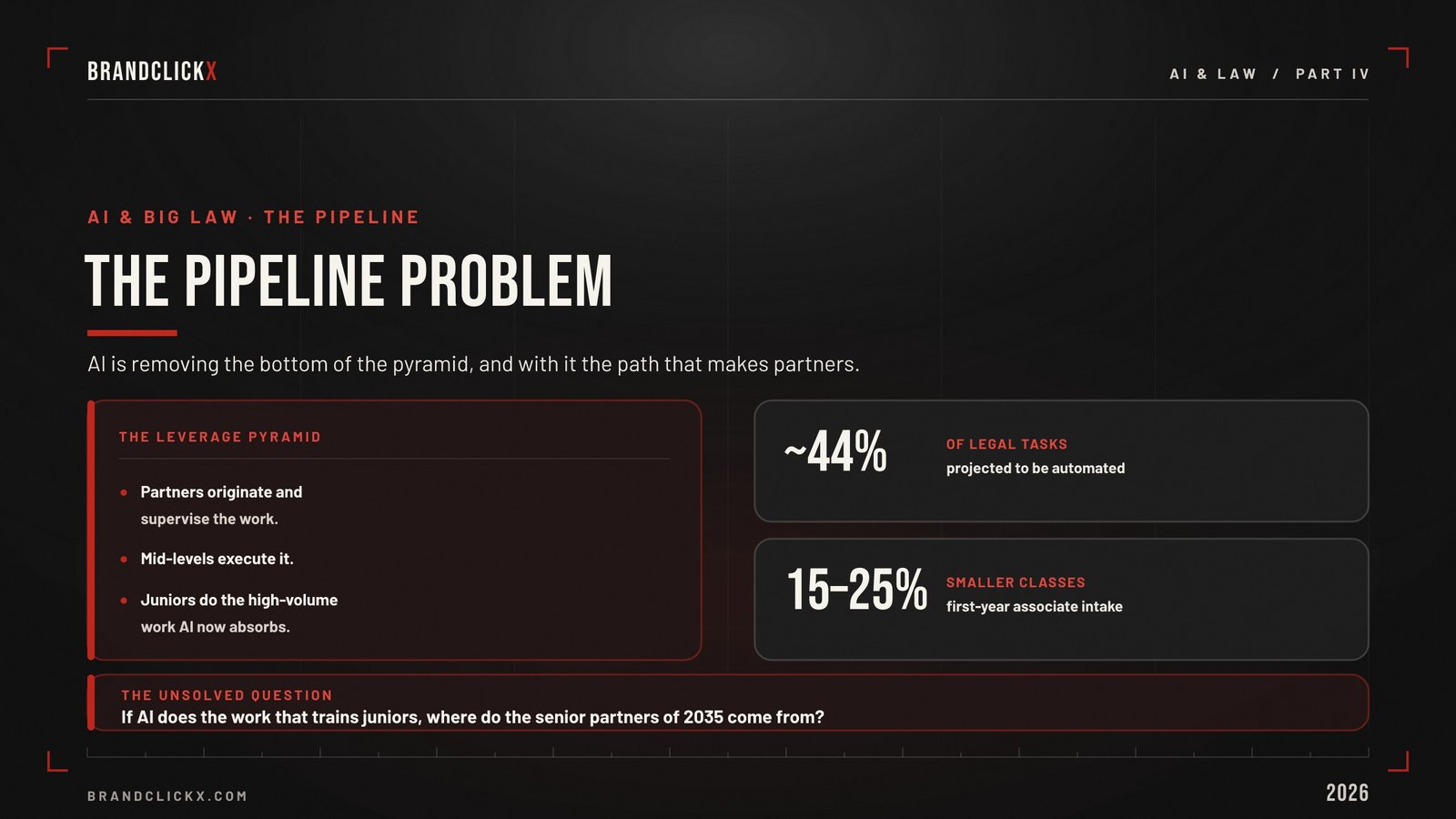
Senior partners originate and supervise work. Mid-level associates execute it. Junior associates do the high-volume, lower-complexity work that generates the billing volume that funds partner compensation. The pyramid works because each layer is profitable.
AI is removing the bottom of the pyramid.
Document review, due diligence, initial contract drafting, basic legal research, the tasks that filled junior associate hours and justified first-year class sizes, are exactly the tasks that AI handles most effectively. AI is projected to automate approximately 44% of legal tasks, with the concentration at the bottom of the experience curve.
Firms may reduce first-year associate classes by 15% to 25% as AI systems absorb this work. Some are already doing so quietly, without press releases.
Enterprise Perspective: The talent pipeline question is the one that will define Big Law’s next decade more than any technology platform decision. Junior associates are not just billing units.
They are how firms develop future partners, the senior lawyers who will originate client relationships, lead practices, and sustain firm culture in 2035.
If the pipeline shrinks because AI has made junior associate work redundant, where do the senior partners of 2035 come from?
The Thomson Reuters Institute’s analysis of lawyer development in AI-enabled firms frames the question directly: “The most valuable skill will be problem framing and workflow design rather than rote legal execution.
Lawyers will approach matters the way technologists approach projects.” That is a fundamentally different lawyer than the one firms have been training for a century.
What Happens Next: The firms that solve this, that find a way to develop the judgment, advocacy, and strategic skills that define senior legal work without the traditional pipeline of junior-level execution, will have a talent moat that no AI tool can replicate. That development model does not yet exist at scale. Building it is the most important non-technology challenge in legal services today.
Part V: The Credibility Cliff That’s Already Approaching
When Clients Stop Pretending the Math Works
The dynamic that National Law Review’s 2026 survey of 85 legal professionals identified as the “biggest surprise” of the year: the speed with which firms are realizing that efficiency gains from legal AI create revenue pressure, forcing a rethink of pricing and business development simultaneously.
The pressure is not theoretical. It is showing up in RFPs.
General counsel at major corporations are including AI disclosure requirements in outside counsel guidelines, asking firms to confirm whether AI tools were used on a matter, and how the billing reflects that use. Some corporate legal departments are building their own AI capabilities specifically to benchmark what work should cost when AI is applied.
Clio’s 2025 Legal Trends Report found that growing law firms have nearly doubled their revenue over the past four years, but those firms are far more likely to use AI than their shrinking counterparts. The AI adoption gap is becoming a revenue gap.
The firms that are growing are using AI to expand scope, win more matters, and serve clients faster. The firms that are shrinking are watching clients route work to more efficient competitors.
Tactical Framework, The Three Billing Model Responses to AI:
| Model | Description | Risk Profile |
| Status quo hourly | Absorb AI gains into higher effective rates | High, client credibility cliff approaching |
| Value-based pricing | Bill for outcome and complexity, not time | Medium, requires retraining revenue expectations |
| AI-transparent hybrid | Disclose AI use; bill time + value component | Low, builds trust; first-mover advantage |
The firms currently in column one are buying time. The firms in column two and three are building for the post-billable-hour era.
Strategic Breakdown: BCG’s legal AI analysis makes the structural logic explicit: “Law firm pricing has always reflected knowledge, expertise, and brand, but fees are typically billed by the hour. When AI reduces time spent on a matter, the economics of the billable hour come under direct pressure even as the underlying knowledge and expertise remain unchanged.”
That is the core of the credibility cliff: the expertise did not become less valuable when AI made it faster to apply. But the billing mechanism that priced expertise through time consumption is now exposed as an artifact of a pre-AI world.
Part VI: The Broader Enterprise Signal
What Big Law’s Reckoning Means for Every Professional Services Firm
The forces reshaping Big Law are not unique to the legal industry.
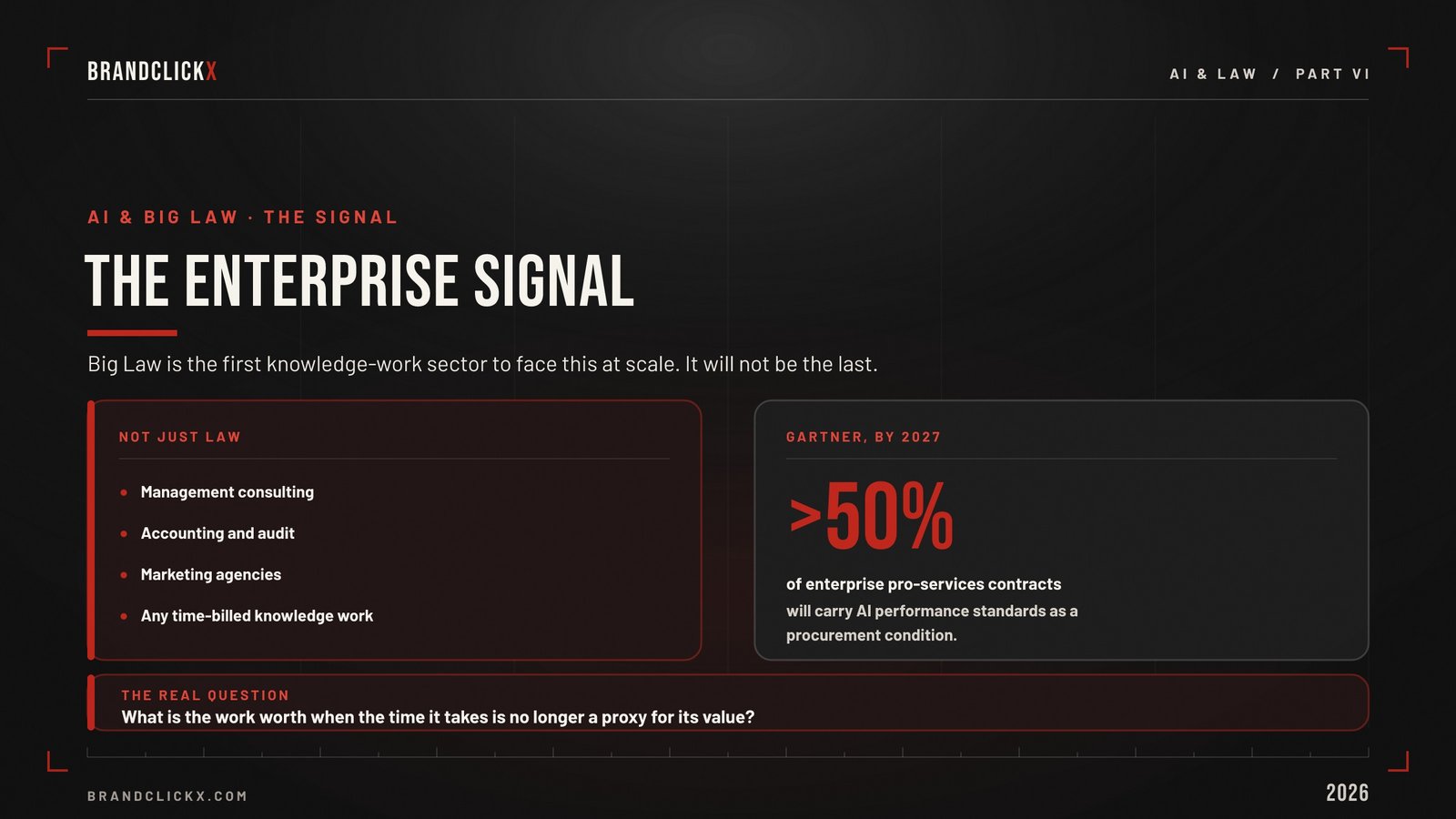
They are the same forces reshaping consulting, accounting, marketing agencies, and any professional services business that has historically monetized knowledge work through time-based billing.
McKinsey’s analysis of AI in professional services consistently identifies the same pattern: AI compresses the time required for high-volume, document-intensive, research-heavy tasks, the tasks that form the foundation of the billing model at most knowledge-work firms.
The Big Law case study is instructive for every enterprise that buys professional services: the productivity gains are real, the billing practices have not yet adjusted to reflect them, and the firms that will survive are the ones that redesign their value proposition before their clients redesign their procurement criteria.
The Bigger Shift: What Bloomberg’s investigation identified as Big Law’s reckoning is actually the professional services reckoning, the moment when AI forces every firm that sells knowledge and expertise through billable time to answer the same question: what is your work actually worth when the time it takes to do it stops being a reliable proxy for the value it creates?
The legal industry is the first major professional services sector to face this question at scale. It will not be the last.
Future Outlook: Gartner’s enterprise AI adoption research projects that by 2027, over 50% of enterprise professional services contracts will include AI performance standards as a procurement condition. That means clients will not just ask whether firms use AI. They will define the baseline productivity expectations that AI-augmented delivery must meet.
The firms building proprietary systems today, Kirkland’s $500 million platform, Freshfields’ Anthropic partnership, Simmons & Simmons’ Percy, are building toward a procurement environment where their AI infrastructure is itself a differentiator in the RFP process.
Key Takeaways
- The revenue numbers are hiding the structural shift. Am Law 100 revenue at $178.95 billion looks like health. It is actually a bridge, firms absorbing AI efficiency gains into rate increases to maintain revenue while the billing model underneath becomes increasingly indefensible.
- The build-vs-buy decision is the most consequential strategic choice in legal right now. Kirkland’s $500M proprietary bet and Freshfields’ Anthropic partnership represent two viable paths to AI differentiation. Standard commercial tool adoption, Harvey, CoCounsel, Lexis+ AI, is the baseline, not the strategy.
- The junior associate pipeline problem is unsolved and urgent. Firms removing the bottom of the leverage pyramid through AI automation are simultaneously removing the development path for their future senior lawyers. No firm has yet articulated a credible replacement model.
- Clients are already moving. Midsize firms captured 5% demand growth while the largest firms struggled to reach 2% in the second half of 2025. The work migration to more AI-efficient, lower-cost providers has started. It will accelerate.
- This is not a legal industry story. It is a professional services story. Every firm that bills for knowledge work through time-based models faces the same structural question. Big Law is simply the first sector large enough, regulated enough, and data-rich enough to make the disruption visible at scale.
FAQ: AI and Big Law
How is AI affecting Big Law revenue and the billable hour?
AI is compressing routine legal tasks by 40–90%. Document review that took 40 hours now takes 4. Despite this, Am Law 100 revenue rose 13% to $178.95 billion in 2025, because firms are absorbing efficiency gains into higher effective hourly rates rather than passing savings to clients. The billable hour is mutating: more expensive per hour, applied to fewer hours, increasingly questioned by clients who understand the AI productivity math.
What is Kirkland & Ellis’s AI strategy?
Kirkland & Ellis has committed $500 million over three to four years to build a proprietary AI platform on its own legal data, using on-premise GPU infrastructure and fine-tuned open-source LLMs. Input from 250 lawyers and 180 technology professionals. The resulting system is fully internal, it cannot be licensed to competitors, specifically to create differentiation rather than commodity access.
What is the Freshfields-Anthropic AI partnership?
In April 2026, Freshfields and Anthropic announced a multi-year co-innovation agreement. Claude was deployed to 5,700 employees across 33 offices globally. Within six weeks, adoption increased approximately 500%. The partnership includes agentic workflow development built jointly with Anthropic’s engineers.
What is Harvey AI and how is it used in legal practice?
Harvey is a legal-specific generative AI platform built in partnership with OpenAI on custom legal models, used for contract analysis, due diligence, compliance, and litigation support. Kirkland & Ellis was a flagship client before beginning development of its own proprietary alternative, signaling a broader trend toward bespoke AI at the highest tier.
What does AI disruption mean for junior associates and law firm hiring?
AI is projected to automate 44% of legal tasks, concentrated at the junior end of the experience curve. Firms may reduce first-year associate classes by 15–25%. The unsolved question: if AI replaces the work that develops junior lawyers into senior partners, where does the next generation of leadership come from?
Conclusion: The Firms That Win Won’t Be the Ones With the Best AI Tool
The legal industry’s AI reckoning is not a future event. It is a present condition, already visible in demand migration, in RFP language, in the $500 million capital commitments from firms that understand what is coming.
The record revenue numbers of 2025 are real. So is the structural pressure beneath them.
The Volkswagen compliance brief that Freshfields solved with AI instead of 100 jurisdictional lawyers was a preview, not an anomaly. The preview has become the operating standard. Every major client with a sophisticated legal department is now asking the same question Volkswagen implicitly posed in 2021: what does this work actually cost when you use AI to do it?
The firms that will win this era are not necessarily the ones with the most sophisticated AI tools. They are the ones that have redesigned their value proposition around what AI cannot do, strategic judgment, relationship trust, courtroom advocacy, high-stakes negotiation, while being honest with clients about what it can.
The billable hour is not dead. But it is no longer a neutral measurement of value. It has become, as LawFuel’s analysis put it, a credibility question.
The firms answering that question now, with transparent billing models, proprietary AI infrastructure, and redesigned talent pipelines, are the ones building the next era of Big Law.
Everyone else is defending the last one.