The Headline Finding: Nike still dominates in raw numbers, $51.4B revenue, 300M+ social followers, but Adidas is winning the cultural marketing moment of 2024–2025, outpacing Nike on brand momentum, product virality, and strategic coherence. This is the story of two giants at an inflection point.
Executive Summary
- Nike FY2024 Total Revenue: $51.4B
- Adidas 2024 Net Revenue: €23.7B
- Adidas 2024 YoY Growth: +12%
Head-to-Head Digital Scorecard, 2024–2025
NIKE
- Social Followers: 300M+
- Annual Revenue: $51.4B
- Marketing Spend: $4.3B
- Online Brand Mentions: 3× Adidas
- Digital Revenue % Drop: −21% (FY25)
- Brand Momentum: Declining
ADIDAS
- Social Followers: 50–60M
- Annual Revenue: €23.7B
- Marketing Spend: €746M (Q1)
- Online Brand Mentions: 1× (baseline)
- Revenue Growth: +12% YoY
- Brand Momentum: Accelerating
Phase 1 — The Setup
Two Brands, One Battle, Zero Mercy
The Nike vs. Adidas rivalry is one of the oldest, most-watched competitions in brand history. But while the fight began on football pitches and running tracks, the battlefield that matters most today is digital, Instagram feeds, TikTok algorithms, YouTube campaigns, search engine results pages, and AI Overview citations.
In 2024 and into 2025, this rivalry has reached a genuinely fascinating inflection point. Nike, long the unchallenged king of sports marketing, is navigating one of its most publicly-acknowledged strategy failures in decades.
Adidas, fresh from the catastrophic Yeezy dissolution, is executing one of the most impressive brand recoveries the sportswear industry has ever seen.
This is not a simple question with a simple answer. Nike still commands a revenue lead of more than 2:1 over Adidas. Its Instagram account dwarfs Adidas. Its athlete roster remains unmatched.
But in the metrics that increasingly define digital marketing leadership, cultural velocity, content virality, search momentum, and generational brand affinity, the gap is closing fast. In some areas, it has already flipped.
This analysis cuts through the noise. We examine both brands across seven digital marketing dimensions: social media reach and engagement, content strategy, influencer and athlete marketing, paid media intelligence, ecommerce and DTC performance, SEO and AI visibility, and brand search momentum. The verdict may surprise you.
Phase 2 — Social Media
Social Media: Scale vs. Velocity
The Followers Paradox
Nike’s social media dominance is staggering in raw numbers. With over 300 social media profiles and more than 300 million combined followers, Nike dwarfs Adidas’s estimated 50–60 million followers across its primary accounts. Nike fans generate almost three times more online mentions than Adidas fans, according to Brand24’s 2025 benchmarking data.
“Those two sports brands produce quite similar content, but when it comes to online reach, Nike wins. Nike’s fans publish almost 3× more mentions than Adidas fans.”, Brand24 Social Media Strategy Analysis, 2025
However, raw follower count is an increasingly hollow metric. The more important story is engagement quality and cultural velocity, how fast a brand’s content travels, how deeply it embeds into consumer identity, and how often it generates organic conversation without paid amplification.
Platform-by-Platform Breakdown
| Platform | Nike | Adidas | Edge |
| ~280M+ followers (main + sub-brands) | ~35M followers | Nike Win | |
| YouTube | Higher subscriber count | 75% of mentions are YouTube comments | Adidas video depth |
| Larger page, very low engagement rate | Higher relative engagement | Neutral | |
| TikTok | Strong but formulaic | Samba/Gazelle organic virality | Adidas Win |
| Twitter/X | 24% of total brand mentions | 14% of total brand mentions | Nike volume edge |
| Brand Presence Score | Higher | Lower, needs work | Nike Win |
The key insight: Nike wins on presence; Adidas is winning on cultural conversation. Nike’s massive Facebook page suffers from extremely low engagement rates, a symptom of its mass-market dilution.
Meanwhile, Adidas’s lifestyle resurgence has generated organic, unpaid virality through the Samba and Gazelle phenomenon that money genuinely cannot replicate.
Phase 3 — Content & Campaign Strategy
Campaign Intelligence: Emotional Power vs. Cultural Credibility
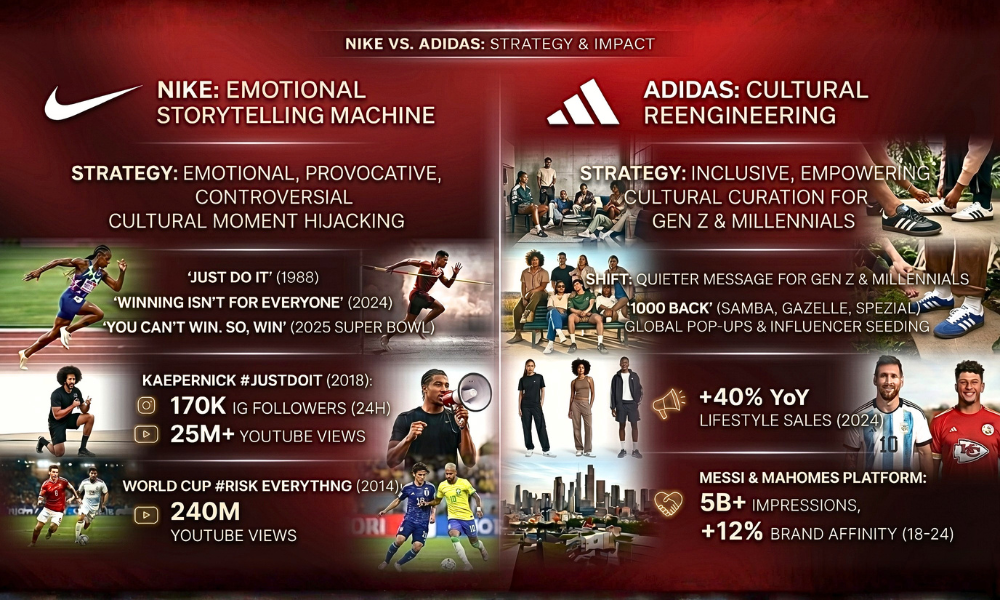
Nike’s Emotional Storytelling Machine
Nike’s content strategy has always been anchored in a single, unifying principle: sport as a metaphor for human aspiration. The “Just Do It” campaign is arguably the most successful brand positioning statement in marketing history.
In 2024, Nike doubled down on this emotional architecture with its “Winning Isn’t for Everyone” campaign, featuring a deliberately provocative tone that generated significant debate, and thus, organic amplification.
For the 2025 Super Bowl, Nike launched the “You Can’t Win. So, Win” spot, reinforcing its lean into paradox-driven emotional tension. The campaign demonstrated Nike’s mastery of cultural moment hijacking, turning controversy into conversation and conversation into reach.
Nike’s history of landmark digital campaigns provides important context. The Colin Kaepernick #JustDoIt campaign in 2018 generated 170,000 Instagram followers in 24 hours, accumulated over 25 million YouTube views, and drove 2 million Twitter mentions.
The 2014 World Cup #RiskEverything campaign accumulated 240 million YouTube views, making Nike the most-watched brand during the tournament despite not being the official sponsor.
Adidas’s Cultural Reengineering
Where Nike focuses on aspiration, Adidas has strategically repositioned around cultural credibility and self-expression. In 2025, Adidas retired its 20-year “Impossible Is Nothing” tagline in favor of “You Got This”, a quieter, more intimate message designed to empower rather than challenge.
The strategic brilliance of this move lies in timing. As Nike amplified competitive intensity, Adidas moved in the opposite direction, creating a positioning gap around warmth, inclusivity, and everyday confidence that resonated profoundly with Gen Z and Millennial audiences.
Adidas’s “1000 Back” campaign celebrating the Samba, Gazelle, and Spezial lines executed city-based pop-ups in London, Shanghai, and Paris alongside influencer seeding, driving a 40% year-over-year increase in lifestyle footwear sales in 2024.
A broader brand platform featuring Lionel Messi and Pat Mahomes generated over 5 billion impressions and a 12% lift in brand affinity among 18–24-year-olds.
Key numbers: Adidas campaign impressions (2024), 5B | Adidas lifestyle footwear YoY growth, +40% | Nike World Cup campaign YouTube views, 240M
Phase 4 — Channel Strategy
Nike’s DTC Crisis: The Biggest Digital Marketing Own-Goal of the Decade
The most consequential digital marketing story of 2023–2025 is not a campaign. It is a channel strategy decision that Nike is still recovering from.
Beginning around 2020, Nike executed a bold pivot: it would cut ties with wholesale partners and go direct-to-consumer. This was presented as a digital-first transformation, owned data, higher margins, deeper customer relationships. Nike pulled products from major retailers, including Foot Locker and Macy’s, and bet the farm on Nike.com and the Nike App.
The strategy failed. The evidence is brutal and documented in Nike’s own SEC filings.
“The consumer is still clearly shopping in multi-brand retail and we need to elevate our brand and positioning to be able to serve the consumer.”, Matt Friend, Nike CFO, Q3 FY2024 Earnings Call
In Nike’s fiscal Q1 FY2025, Nike Brand Digital revenue fell 21%. In Q2 FY2025, Nike Brand revenues were $12.0 billion, down 7% reported and 8% currency-neutral, with Nike Direct falling 13% on a reported basis. CEO John Donahoe acknowledged publicly that Nike was “not performing at its potential.”
By March 2024, Nike had reversed course entirely, re-entering wholesale partnerships with DSW, Macy’s, and re-energizing its Foot Locker relationship.
The DTC failure had direct digital marketing consequences: over-optimization for owned channels created a filter bubble. By pulling back from wholesale, Nike simultaneously reduced its physical touchpoints and its organic brand discovery surface.
The brand became less visible at the precise moment consumers were browsing alternatives. Adidas filled that vacuum.
| Metric | Nike (FY2024–25) | Adidas (2024) |
| Revenue Trajectory | Declining, pivoting back to wholesale | Growing, +12% YoY |
| DTC Digital | −21% Nike Brand Digital (Q1 FY25) | Balanced DTC + wholesale growth |
| Channel Strategy | U-turn from DTC-first back to wholesale | Multi-channel digital + physical balance |
| Inventory Management | Excess inventory issues requiring heavy discount | Tighter, healthier inventory post-Yeezy |
| Gross Margin Pressure | Yes, higher discounts, channel mix shift | Improving, disciplined pricing |

Phase 5 — Product Marketing
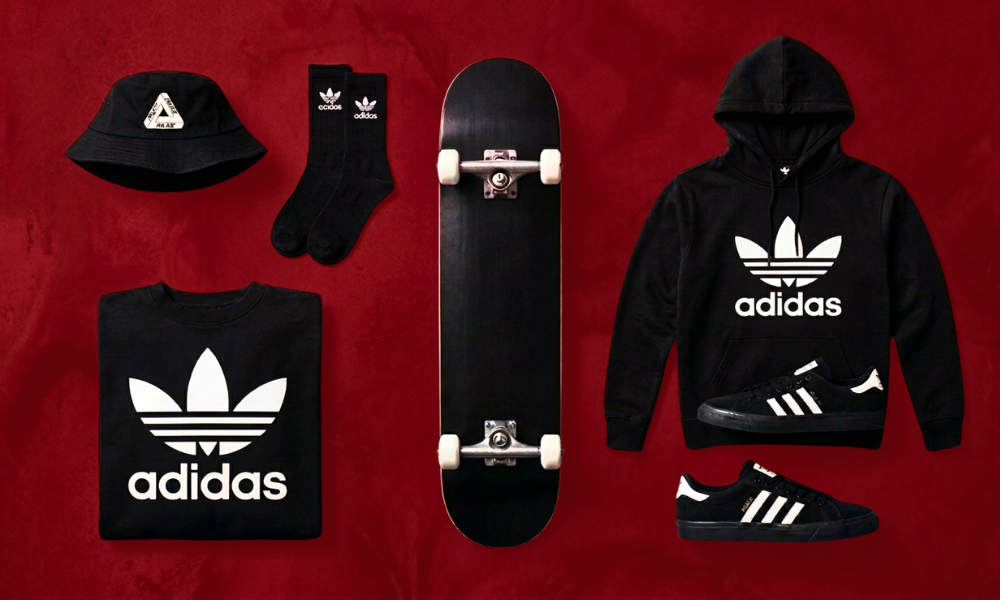
The Samba Effect: Adidas’s Product-Led Marketing Masterstroke
The single best illustration of Adidas’s 2024–2025 digital marketing strength is a shoe that has existed since 1950.
The Adidas Samba, originally an indoor football training shoe, became the defining cultural object of 2023–2024, generating resale premiums, celebrity sightings, and a level of organic social virality that no campaign budget could have manufactured.
How It Happened
Adidas’s strategy was deceptively simple but flawlessly executed. Under CEO Bjørn Gulden, the brand identified that its heritage Terrace silhouettes (Samba, Gazelle, Campus, Spezial) resonated deeply with a generational shift away from chunky dad sneakers toward slim, low-profile, heritage-coded footwear.
Rather than flooding the market, Adidas used controlled scarcity, strategic collaborations with Grace Wales Bonner, Pharrell Williams, and Lotte, limited drops that generated premium resale values and social buzz. This scarcity-seeding model created organic FOMO across TikTok and Instagram without paid amplification.
Celebrity organic adoption accelerated the effect. When Rihanna, Bella Hadid, and Jennifer Lawrence were photographed in Sambas, not paid to wear them, the cultural signal was unmistakable: this was the sneaker of the cultural moment. Adidas Samba’s sell-through rate surpassed 80% at its peak in 2024.
One competitive model, the Taekwondo, saw a 5,650% year-on-year sales increase on StockX, a metric that reveals explosive organic demand rather than marketing-inflated perception.
Nike’s Missing Cultural Moment
Nike, by contrast, struggled to identify an equivalent cultural moment in 2024–2025. While the Air Force 1 and Dunk remain strong heritage franchises, neither generated the velocity or cultural conversation of the Samba cycle.
The brand’s focus on performance technology, the Vaporfly, Alphafly, and ISPA lines, delivered excellence in running markets but failed to capture the broader cultural fashion/sport crossover that defines sneaker culture’s commercial peak.
Key numbers: Adidas footwear revenue Q1 2024, +13% | Taekwondo YoY StockX sales, +5,650% | Samba resale value increase, +50%
Phase 6 — Original Framework
The BrandClickX Digital Marketing Momentum Framework
To assess true digital marketing leadership, beyond raw scale metrics, BrandClickX has developed the Digital Marketing Momentum Framework (DMM). It evaluates brands across four interconnected dimensions: Reach, Resonance, Revenue Coherence, and Regeneration.
DMM Framework: The 4R Model Evaluating sportswear brand digital leadership beyond follower counts and ad spend.
- R1, Reach: Total addressable audience, follower scale, organic mention volume, and share of voice across platforms. Nike wins decisively, 3× Adidas in raw reach and 300M+ social presence.
- R2, Resonance: Cultural embedding, organic virality, brand affinity scores among target demographics, and content engagement quality. Adidas wins in 2024–25, Samba cycle, Gen Z affinity, +12% brand affinity lift.
- R3, Revenue Coherence: Alignment between digital marketing activity and commercial outcomes, revenue growth, margin health, DTC performance. Adidas wins, +12% YoY vs. Nike’s declining digital revenue and wholesale U-turn.
- R4, Regeneration: Capacity to continuously generate new cultural moments, product cycles, and audience relevance without purely paid amplification. Adidas leads, heritage silhouette pipeline vs. Nike’s innovation deficit in lifestyle.
DMM Verdict: Nike leads on R1. Adidas leads on R2, R3, and R4. In a digital marketing landscape where cultural resonance increasingly drives commercial outcomes, this 3:1 advantage in the qualitative dimensions signals a structural shift, not a temporary blip.
Phase 7 — Athlete & Influencer Strategy
Athlete Marketing: The Endorsement Arms Race
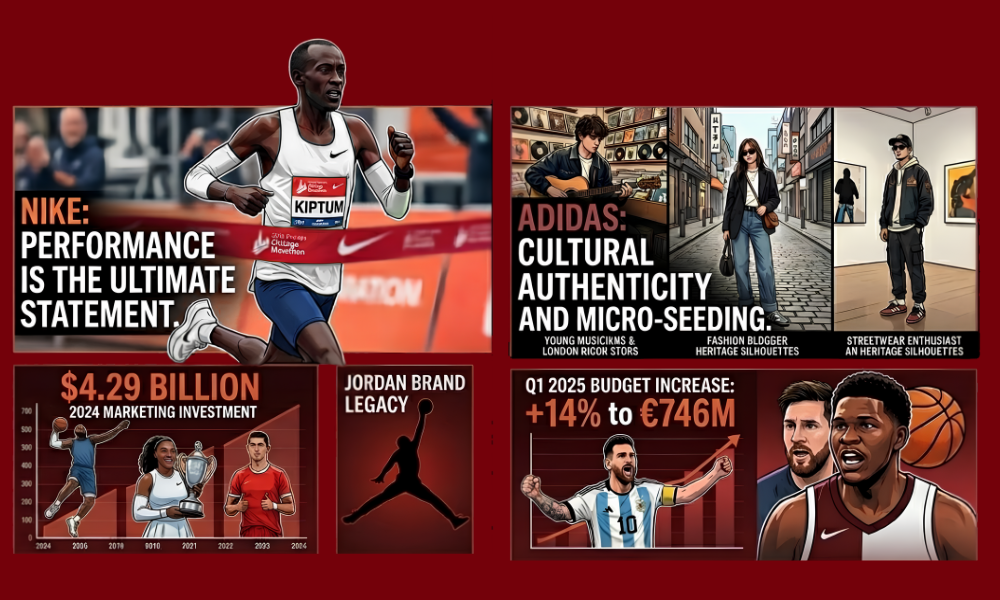
Nike’s athlete endorsement strategy remains the most comprehensive in sports marketing history. The brand invested $4.29 billion in marketing in 2024, with a significant allocation to athlete and celebrity endorsements, a roster that includes LeBron James, Serena Williams, Cristiano Ronaldo, and Jordan Brand’s entire extended legacy.
The Kenyan runner Kelvin Kiptum broke the world marathon record in Nike’s Alphafly 3 at the 2024 Chicago Marathon, a performance marketing statement that no amount of social content can replicate.
Adidas increased its Q1 2025 marketing budget by 14% to €746 million, with a growing emphasis on cultural figures alongside traditional athletes. The Lionel Messi partnership continues to yield global dividends, while Anthony Edwards has emerged as a credible basketball voice.
But Adidas’s most sophisticated influencer strategy is its micro-seeding program, placing heritage silhouettes with nano-influencers and cultural tastemakers to generate authentic, non-transactional endorsement signals across fashion, music, and streetwear communities.
| Dimension | Nike | Adidas |
| Marketing Spend | $4.29B (2024) | €746M Q1 2025 (+14% YoY) |
| Athlete Roster | Broadest in sport, LeBron, Jordan legacy | Messi, Anthony Edwards, strong football portfolio |
| Influencer Tier | Macro-heavy; celebrity-led | Multi-tier: micro/nano seeding for culture |
| Gen Z Affinity | Strong but declining | Growing, +12% 18–24 brand affinity |
Phase 8 — SEO & AI Visibility
Search, SEO & AI Overview Presence
In an era where Google’s AI Overviews, ChatGPT Search, and Perplexity are reshaping how consumers discover and evaluate brands, Search Engine Optimization and Generative Engine Optimization (GEO) have become direct marketing channels, not just technical functions.
Nike benefits from decades of link equity, domain authority, and entity recognition. Google’s Knowledge Graph recognizes Nike as a primary entity in athletic footwear, sports marketing, and endorsement history.
Nike.com commands exceptional domain authority, and the brand appears in AI Overview responses for thousands of sports marketing, footwear, and fitness queries.
However, Adidas has a significant organic search advantage in 2024–2025 specifically because the Samba/Gazelle cultural cycle generated millions of organic editorial mentions across fashion, culture, and news publications, all pointing to Adidas products and brand pages with zero paid amplification.
This editorial velocity drives a disproportionate AI citation advantage: when AI systems source “what sneakers are trending in 2025,” Adidas heritage models dominate the response landscape.
Key SEO Insight for Brands
The Adidas case proves a critical content marketing principle: products that generate genuine cultural conversation produce editorial backlinks, entity citations, and AI Overview appearances that no SEO campaign can buy. Nike’s over-investment in paid and owned channels during its DTC pivot created a relative deficit in earned editorial coverage, precisely when earned coverage was most valuable for AI search visibility.
Phase 9 — Industry Trends
Digital Marketing Trends Shaping the Race: 2026–2028
- AI-Driven Personalization at Scale Both brands are investing in AI personalization infrastructure. Nike’s digital platforms and recommendation engines will be critical for its recovery. Adidas is using AI for localized content adaptation across its global markets, reducing production costs while increasing regional relevance.
- Generative Engine Optimization (GEO) As AI Overviews, ChatGPT Search, and Perplexity grow as discovery channels, structuring brand content for AI citation becomes essential. Nike’s existing domain authority is a GEO asset. Adidas’s current cultural editorial volume is generating real-time AI visibility gains.
- The Micro-Creator Revolution Both brands are investing more in micro and nano-influencer partnerships. Adidas has a structural advantage here, its heritage silhouette positioning naturally appeals to fashion and culture creators, who generate authentic content that outperforms paid celebrity placements in engagement rate and brand trust metrics.
- Sustainability as Digital Marketing Fuel Adidas’s Parley (ocean plastic) program and “Move to Zero” platform generate significant editorial coverage and AI citations. Nike’s sustainability messaging, while substantial, has been less culturally embedded. Sustainability is no longer just ESG compliance, it is a content strategy with direct SEO and AI visibility implications.
- Omnichannel Coherence as Competitive Moat Nike’s DTC failure taught the industry that digital-only channel strategies are fragile. The winners in 2026–2028 will be brands that achieve seamless coherence between physical retail presence, digital touchpoints, and AI-mediated discovery, not those who bet exclusively on owned channels.
Phase 10 — Lessons Learned
Common Digital Marketing Mistakes These Brands Reveal
✗ Channel Monoculture: Nike’s DTC-only pivot reduced brand discovery surface and eliminated the ambient physical retail touchpoints that drive organic purchase consideration.
✗ Over-relying on hero campaigns: Big-budget moments matter, but they do not substitute for continuous cultural presence through product and community storytelling.
✗ Ignoring earned editorial coverage as SEO: Adidas’s Samba cycle generated millions of organic editorial mentions, a massive earned media asset that produced AI search visibility gains without a single SEO investment.
✗ Confusing follower count with brand health: Nike’s 300M follower count is a vanity metric if engagement rates are declining and cultural momentum is stalling.
✓ Best Practice, Scarcity Seeding: Adidas’s limited-edition collaboration model generates organic virality, premium resale signaling, and earned editorial coverage simultaneously.
✓ Best Practice, Heritage Repositioning: Adidas proved that archival product lines, when contextualised within contemporary culture, can outperform new launches on both margin and cultural impact.
✓ Best Practice, Multi-tier influencer balance: Combining mega-athlete endorsements (Messi, LeBron) with micro-influencer seeding across cultural niches creates both reach and authenticity simultaneously.
Phase 11 — Final Verdict
So: Who Won the Digital Marketing Race?
The answer depends entirely on how you define winning.
If winning means raw scale: Nike wins. No other brand in sportswear, or arguably any consumer category, commands Nike’s combination of social reach, revenue size, marketing budget, and global athletic partnerships. The Swoosh is the most recognized brand mark in the world. That is not nothing.
If winning means momentum: Adidas wins, and it is not particularly close. In 2024 and 2025, Adidas outperformed Nike on revenue growth trajectory, Gen Z brand affinity, product virality, cultural embedding, and strategic coherence. It achieved this while spending less than a third of Nike’s marketing budget.
If winning means digital marketing intelligence: Adidas wins by demonstrating that the most effective digital marketing in 2024 is not paid, it is earned. The Samba cultural cycle generated SEO backlinks, AI overview citations, social virality, and editorial coverage simultaneously, at zero incremental cost. This is the strategic ideal that every brand is chasing. Adidas executed it.
Nike is not in decline. Its $51.4 billion in revenue, its Jordan Brand dominance, and its performance technology leadership ensure it will remain the market leader by revenue for the foreseeable future. But the 2024–2025 period represents a genuine inflection point, and Adidas had the better playbook.
BrandClickX Verdict: Nike wins the 20-year war on scale. Adidas wins the 2024–2025 battle on cultural intelligence. The true lesson for every brand strategist: in digital marketing, earned beats paid, culture beats campaigns, and product virality is the highest-ROI marketing asset money cannot buy.
Phase 12 — Frequently Asked Questions
Is Nike bigger than Adidas in digital marketing?
Yes, by raw metrics. Nike has over 300 million social media followers compared to Adidas’s 50–60 million, and spends roughly $4.3 billion annually on marketing versus Adidas’s comparatively smaller budget. However, in cultural momentum, brand affinity growth among Gen Z, and content virality, Adidas outperformed Nike in 2024–2025, demonstrating that digital marketing quality can outweigh scale.
Why did Nike’s digital marketing strategy fail between 2022 and 2024?
Nike’s direct-to-consumer pivot reduced its physical and digital brand discovery surface by withdrawing from major wholesale partners. This over-concentrated the brand’s reach on owned channels like Nike.com and the Nike App, which could not compensate for the loss of ambient retail presence. By March 2024, Nike reversed course entirely, publicly acknowledging the strategy had added “complexity and inefficiency” to its operations.
How did Adidas recover from the Yeezy collapse?
Under CEO Bjørn Gulden, Adidas executed a heritage product revival strategy centered on the Samba, Gazelle, and Campus silhouettes. Using controlled scarcity, celebrity organic adoption, and micro-influencer seeding, Adidas generated mass cultural virality without proportional paid spend. The strategy delivered 12% revenue growth in 2024, recovering from the significant financial hit caused by the Yeezy dissolution.
Which brand is winning with Gen Z in digital marketing?
Adidas holds a growing advantage with Gen Z in 2024–2025. Its Samba/Gazelle cultural cycle, sustainability messaging through the Parley partnership, and authenticity-focused influencer strategy delivered a documented 12% uplift in brand affinity among 18–24-year-olds. Nike remains strong but has lost relative ground in this critical demographic cohort due to its DTC strategy reducing brand touchpoints during formative discovery moments.
What is the most important digital marketing lesson from this rivalry?
The Adidas Samba case proves that the highest-ROI digital marketing is earned, not paid. Cultural credibility, generated through product authenticity, controlled scarcity, and organic celebrity adoption, creates social virality, editorial backlinks, and AI search citations simultaneously. No single paid campaign delivers equivalent returns across all three channels at once. Product strategy is marketing strategy.
Who spends more on digital marketing: Nike or Adidas?
Nike significantly outspends Adidas on marketing. Nike invested approximately $4.29 billion in marketing in fiscal 2024, with projections exceeding $4.6 billion in 2025. Adidas increased its Q1 2025 marketing budget by 14% to €746 million for the quarter. Despite this spending gap of more than 2:1, Adidas achieved stronger brand momentum metrics in 2024–2025, highlighting the efficiency of its cultural marketing approach.