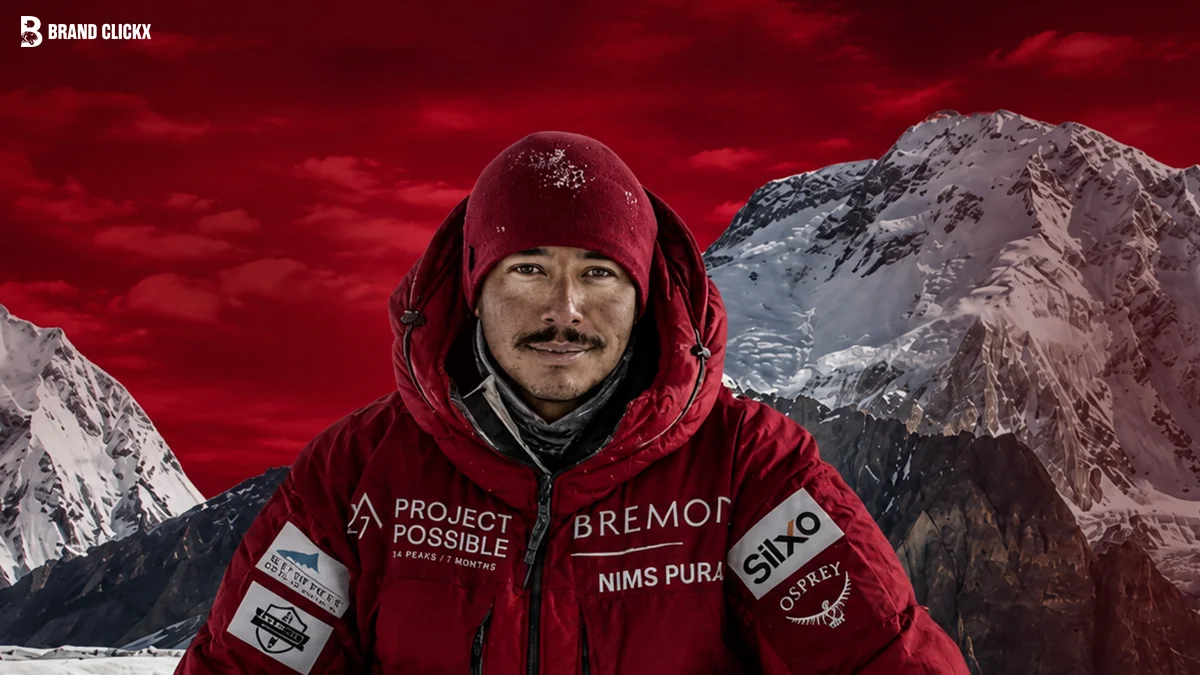
The avalanche struck at 9am on 30 July, sweeping ten climbers up to a vertical mile down the mountain’s west face. Most other teams had already left Broad Peak days earlier over snow conditions.
Published: Monday, 3 August 2026 | BrandClickX News Desk
Recovery operations are ongoing. Not all bodies have been recovered, and some details remain unconfirmed. This report reflects information available at publication.
Summary
Nirmal “Nims” Purja, 43, one of the world’s best-known high-altitude mountaineers, was killed alongside nine others in an avalanche on Broad Peak in Pakistan on Thursday 30 July 2026. His expedition company Elite Exped confirmed his death on Saturday. The avalanche struck at around 9am local time, sweeping the group down the mountain’s main west-facing gulley.
Key Takeaways
- An avalanche struck ten climbers on Broad Peak at around 9am on 30 July 2026
- All ten died, including Nirmal “Nims” Purja, 43
- Elite Exped confirmed his death on Saturday 1 August
- The group comprised Purja, six Nepali guides, a Pakistani guide and three clients
- Bodies recovered to Camp 1 include Purja, Wang Zhong, Nima Sherpa and Kili Pemba Sherpa
- One body remains at a higher position; recovery is considered too dangerous
- Heavy snow had fallen for a week and most other teams had already left
- Purja set the 14-peaks record in 2019 and co-led the first winter ascent of K2 in 2021
What Happened
An avalanche hit a group of ten climbers on Broad Peak, Pakistan’s 8,051-metre peak in the Karakoram range, at around 9am local time on Thursday 30 July.
The climbers were swept down the mountain’s main west-facing gulley a distance reported at up to a vertical mile.
Elite Exped confirmed Purja’s death on Saturday: “Today it is with profound sadness and immense heartbreak that we confirm that Nirmal ‘Nimsdai’ Purja tragically lost his life following the avalanche on Broad Peak.”
The company added that it had received confirmation other members of the expedition had also not survived.
Samson Sharaf, a Pakistani mountaineer who shared images of the site, said the overhang where the accident occurred was clearly visible.
Who Was on the Mountain
The Alpine Club of Pakistan said the ten climbers were Purja, Pakistani guide Sohail Sakhi, five other Nepali guides, and three clients from China, Oman and the United States.
Among those whose bodies have been recovered and brought down to Camp 1 at 5,600 metres:
- Nirmal “Nims” Purja, Nepal
- Wang Zhong, China
- Nima Sherpa, Nepal guide
- Kili Pemba Sherpa, Nepal guide and accomplished climber in his own right
One body was spotted at a significantly higher position on the mountain. The Alpine Club said recovery would not be attempted at this stage because of the risk to rescuers.
Rescuers have faced dangerous terrain and conditions throughout. Two helicopters flew to Broad Peak carrying the well-known local climbers Sirbaz Khan and Sherzad Karim to assist with aerial searching.
The Warning Signs Other Teams Acted On
Heavy snowfall had begun blanketing Broad Peak roughly a week before the avalanche, and most teams at base camp had already gone home.
National Geographic reported that Hungarian climber David Klein and American Ian Overton, who had spent a month below the mountain attempting it without bottled oxygen or porters, packed up and walked out on 25 July five days before the avalanche.
Klein led Hungary’s first ascent attempt on Broad Peak in 2000. Overton is an emergency room nurse. The two had previously attempted Nanga Parbat together in winter 2012.
By late July, in National Geographic’s account, the mountain had “dramatically changed its mood.”
A few teams with summit hopes remained, including Purja’s Elite Exped group, staged at a nearby base camp. Why they decided to stay is not yet clear, and that question will be central to any subsequent analysis of the accident.
Broad Peak was a late addition to Purja’s expedition. In an Instagram post beforehand, he wrote: “Broad Peak, I ask for nothing but safe passage up and back down.”
Who Nims Purja Was
Purja was among the most recognisable figures in modern mountaineering, and among the most consequential for Nepali climbers’ standing in the sport.
Born in Nepal, he served as a soldier in the British Army as a Gurkha, later joining the special forces.
In 2019 he completed Project Possible, climbing all fourteen of the world’s 8,000-metre peaks in six months and six days a feat that had taken Reinhold Messner sixteen years. The record was surpassed in 2023.
The achievement became the Netflix documentary 14 Peaks: Nothing Is Impossible, and his book Beyond Possible was a bestseller.
In January 2021 he was one of ten Nepali climbers who made the first winter ascent of K2, the last 8,000-metre peak never climbed in winter. The team assembled just below the summit and climbed the final metres together, singing the Nepalese national anthem a deliberate assertion of Nepali mountaineers as principals rather than support staff.
He was also a UNEP Mountain Advocate and founder of the Nimsdai Foundation.
In 2019, during Project Possible, he abandoned part of his record attempt to rescue Dr Chin Wui Kin, an anaesthesiologist stranded near the summit of Annapurna for two days without oxygen. Purja was lowered from a helicopter to reach him.
Al Jazeera reported that Nepal’s Prime Minister Balendra Shah offered condolences.
About Broad Peak
Broad Peak is the world’s twelfth-highest mountain, standing in the Karakoram range in Gilgit-Baltistan, Pakistan.
A note on its height: sources give 8,051 metres (26,414 feet) and 8,047 metres (26,401 feet). The former is the more commonly cited figure and is used here.
Purja had summited it before on 26 July 2019, two days after summiting K2, completing a 23-day push through five Karakoram 8,000-metre peaks during Project Possible.
Timeline
| Date | Development |
| ~23 July 2026 | Heavy snowfall begins on Broad Peak |
| 25 July 2026 | Klein and Overton leave; most teams already gone |
| 30 July 2026, ~9am | Avalanche sweeps ten climbers down the west gulley |
| 30 July 2026 | Rescue and recovery operation begins |
| 31 July 2026 | Four bodies located; helicopter search continues |
| 1 August 2026 | Elite Exped confirms Purja’s death |
| 2 August 2026 | Four further bodies brought to Camp 1 |
What This Means for Himalayan Mountaineering
The loss of ten climbers in a single incident is among the deadliest days in recent Karakoram history, and the composition of the group compounds it.
Five Nepali guides died alongside Purja, including Kili Pemba Sherpa, described by Climbing as an accomplished climber in his own right. Pakistani guide Sohail Sakhi was also among the group.
That pattern guides dying alongside the clients and leaders they support is the enduring structural reality of commercial high-altitude climbing, and one Purja himself spent his career trying to reframe.
The unresolved question is the decision to remain. Experienced independent climbers left Broad Peak days earlier specifically because of snow loading. Elite Exped stayed. Understanding why will matter more than any tribute, and it is not yet known.
That is a question for a proper investigation rather than for immediate speculation, and the reporting so far has been careful to say so.
Frequently Asked Questions
What happened to Nims Purja?
He was killed in an avalanche on Broad Peak in Pakistan on 30 July 2026, along with nine other climbers. His expedition company Elite Exped confirmed his death on Saturday 1 August.
When did the avalanche happen?
At around 9am local time on Thursday 30 July 2026. The avalanche swept ten climbers down Broad Peak’s main west-facing gulley, reportedly a distance of up to a vertical mile.
How many people died?
Ten. The group comprised Purja, a Pakistani guide, five other Nepali guides and three clients from China, Oman and the United States. Recovery operations are ongoing.
Where is Broad Peak?
In the Karakoram range in Gilgit-Baltistan, Pakistan. At 8,051 metres it is the world’s twelfth-highest mountain, and it stands near K2 on the Pakistan-China border.
Had other teams left the mountain?
Yes. Heavy snowfall began about a week before the avalanche, and most teams at base camp had departed. Hungarian climber David Klein and American Ian Overton left on 25 July.
What was Nims Purja known for?
Climbing all fourteen 8,000-metre peaks in six months and six days in 2019, documented in the Netflix film 14 Peaks. He was also part of the first winter ascent of K2 in January 2021.
Have all bodies been recovered?
No. Several have been brought down to Camp 1 at 5,600 metres, but one body was spotted at a significantly higher position and the Alpine Club of Pakistan said recovery would not be attempted for now because of the risk.
Who else died in the avalanche?
Those identified so far include Chinese climber Wang Zhong and Nepali guides Nima Sherpa and Kili Pemba Sherpa. Pakistani guide Sohail Sakhi was among the group. Not all names have been released.
Conclusion
Ten people died on Broad Peak on Thursday morning, among them one of the most recognisable mountaineers of his generation and at least six professional guides.
Purja’s last public message about the mountain asked for safe passage up and back down. He had summited it once before, in 2019, during the record attempt that made his name.
Other climbers had read the same snow and gone home five days earlier. Why his team stayed is not yet known, and answering it properly will take longer than the news cycle.