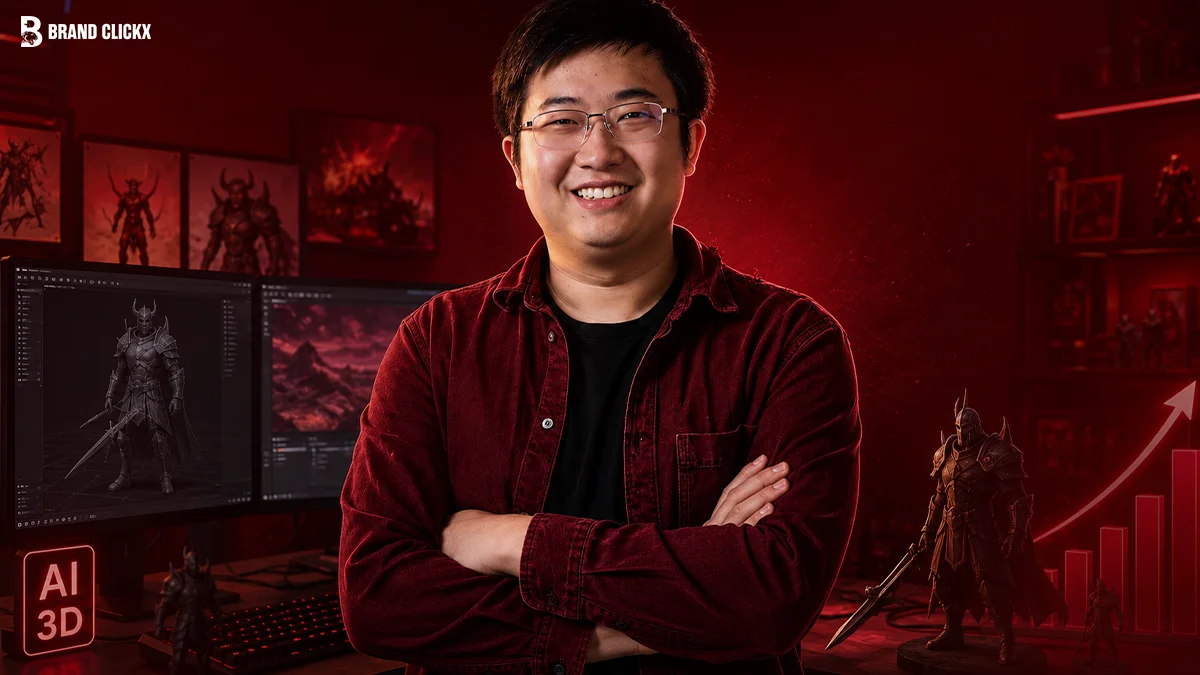
Vast has raised roughly $250 million this year, counts 20 million users and is working with Bank of America and CICC. Its founder helped start MiniMax, which doubled on its Hong Kong debut in January.
Published: Tuesday, 4 August 2026 | BrandClickX News Desk
This is financial news reporting, not investment advice. The IPO report is based on anonymous sources, deliberations are ongoing, and no final decision has been made. Vast has not publicly confirmed any listing plan. Consult a licensed financial adviser before making investment decisions.
Summary
Vast, a Beijing-based 3D-modeling startup backed by Alibaba and Baidu, is considering an initial public offering in Hong Kong, Bloomberg reported on Tuesday 4 August 2026, citing people with knowledge of the matter. The company is working with Bank of America and China International Capital Corporation on a potential share sale. Deliberations are ongoing and no final decision has been made.
Key Takeaways
- Bloomberg reported on 4 August that Vast is weighing a Hong Kong IPO
- Bank of America and CICC are advising; no final decision has been made
- Vast was founded in 2023 by Simon Song, a founding member of MiniMax
- It raised roughly $250 million across two rounds in March and June 2026
- Valuation exceeds $1 billion, with one source putting it near $1.5 billion
- Backers include Alibaba, Baidu, Ince Capital and Primavera Venture Partners
- Around 20 million users, mostly in the US, Europe, Japan and South Korea
- MiniMax closed up 109% on its Hong Kong debut in January 2026
What Was Reported
Bloomberg reported that Vast is weighing a Hong Kong listing and has engaged two banks.
| Detail | |
| Company | Vast (Beijing-based) |
| Venue under consideration | Hong Kong |
| Advisers | Bank of America, China International Capital Corporation |
| Status | Deliberations ongoing, no final decision |
| Sourcing | People with knowledge of the matter, speaking anonymously |
The sourcing caveat matters. The report rests on unnamed people who asked not to be identified because the information is private. Vast has not confirmed anything publicly, no timeline or target valuation has been reported, and companies routinely engage banks for listings that never happen.
What Vast Actually Does
Tripo Studio turns text descriptions and images into 3D models.
The platform is aimed at developers, designers and creative professionals, generating detail-rich 3D objects in seconds — work that traditionally takes hours or days of manual modelling.
| Metric | Figure |
| Users globally | ~20 million |
| Team size | ~150 people |
| Subscription pricing | $20 to $140 per month, plus token-based fees |
| Enterprise pricing | Charged per project |
| Models generated (as of March 2026) | Approaching 100 million |
| Creators on Tripo Studio (March 2026) | 6.5 million+ |
The user base is notably not Chinese. The bulk of its 20 million users are in the United States, followed by Europe, Japan and South Korea, founder Simon Song told Bloomberg. For a Beijing company weighing a Hong Kong listing, that international revenue base is a meaningful part of the story.
Recent releases include the Tripo H3.1 and Tripo P1.0 models, 8K texture support, and a part-segmentation tool that automatically splits AI-generated models for 3D printing.
The Customers
Vast’s flagship deployment is with NetEase. In the role-playing game Where Winds Meet, players can upload photos and instantly generate interactive 3D avatars.
Forbes reported the company also works with Sony, charging enterprise clients on a project basis.
Song has described an upcoming consumer app as an “interactive TikTok” short, playable experiences replacing scrollable video.
The investment thesis was summarised by Joy Dai, a managing director at backer Eminence Ventures: “The internet’s third revolution could be interactive content where AI generates tailored material and 3D becomes the main new medium.”
The Funding Timeline
Vast raised roughly $250 million in three months.
| Date | Round | Detail |
| March 2026 | Series A | $50 million, led by Alibaba and Hengxu Capital |
| June 2026 | Series A+ and A++ | Nearly $200 million, co-led by Ince Capital and a China Life-backed fund |
Other participants included Genesis Capital, Eminence Ventures and Primavera Venture Partners. Baidu is also a backer.
On valuation, sources differ. Vast declined to disclose a figure but said it exceeds $1 billion. Forbes reported that one person with knowledge of the deal put it at about $1.5 billion. A company spokesperson declined to comment on valuation.
We would treat “over $1 billion” as the confirmed floor and $1.5 billion as a single-source estimate.
Who Simon Song Is
He founded Vast in 2023 at 26, and he has watched this exact playbook succeed already.
Song was a founding member of MiniMax, the large language model developer. MiniMax listed in Hong Kong in January 2026 and closed its debut up 109%, raising HK$4.8 billion, or about $620 million.
Before that, Song studied economics and international studies at Johns Hopkins University, returned to China in 2019, and took his first job as an assistant to Xu Li, co-founder and chief executive of the Hong Kong-listed AI firm SenseTime. He built Vast’s founding team partly from SenseTime technologists.
He made this year’s Forbes 30 Under 30 Asia list. Bloomberg described him as an avid gamer who often plays well past midnight.
That biography is relevant to the IPO story rather than colour. A founder who helped build a company that just doubled on its Hong Kong debut, and who worked under the CEO of another Hong Kong-listed AI firm, has unusually direct exposure to how this process works.
Why Hong Kong, and Why Now
Hong Kong has become the venue of choice for Chinese AI listings, and the recent results have been extraordinary.
| Company | Listing | Result |
| Zhipu AI | January 2026 | +13% on debut |
| MiniMax | January 2026 | +109%, closed at HK$345 against a HK$165 offer |
| Creality | 29 May 2026 | 3,829x oversubscribed; opened ~80% above IPO price |
Zhipu and MiniMax are among China’s so-called “AI tigers” startups building large language models to rival US labs. Both went public before OpenAI or Anthropic.
Creality is the most instructive comparison for Vast specifically. It was the first consumer 3D printing company to list on the Hong Kong Main Board, raised about HK$1.272 billion net, and was oversubscribed nearly 3,829 times.
The read is straightforward: Hong Kong investors are currently paying up for Chinese AI and 3D companies, and that window may not stay open indefinitely. Weighing a listing two months after a funding round makes more sense in that context than it would in isolation.
Timeline
| Date | Development |
| 2023 | Song founds Vast in Beijing |
| Jan 2026 | Zhipu and MiniMax list in Hong Kong; MiniMax doubles |
| March 2026 | $50m Series A led by Alibaba and Hengxu Capital |
| 29 May 2026 | Creality lists in Hong Kong, 3,829x oversubscribed |
| 1 June 2026 | Vast confirms ~$200m raise and unicorn status |
| June 2026 | Tripo H3.1 and P1.0 released |
| 4 Aug 2026 | Bloomberg reports Vast weighing a Hong Kong IPO |
Expert Analysis
The case for the listing is the market window. The case against it is how early this would be.
What is genuinely strong: 20 million users, mostly outside China, on a subscription model with enterprise contracts alongside. That is a real revenue base rather than a pre-product story, and the international user concentration insulates it somewhat from Chinese domestic demand.
What makes it early: Vast is a 150-person company founded three years ago, which reached unicorn status two months ago. Companies this young listing publicly are unusual outside exceptional market conditions which is precisely what Hong Kong currently offers.
The strategic logic is about timing, not need. Having raised $250 million this year, Vast does not obviously require public capital. What a listing provides is liquidity for existing backers and a currency for acquisitions, at a valuation the current market is unusually willing to support.
The risk is category concentration. Text-to-3D generation is a fast-moving field, and Vast’s advantage rests on model quality that competitors — including its own investors, Alibaba and Baidu — are capable of replicating. NetEase and Sony partnerships are defensible; the underlying technology may be less so.
The honest position: this is a report of deliberations, not an announcement. It should be read as evidence of how attractive the Hong Kong window looks to Chinese AI founders right now, rather than as a confirmed transaction.
Frequently Asked Questions
What is Vast?
A Beijing-based AI startup founded in 2023 that develops Tripo Studio, a platform generating 3D models from text and image prompts. It has around 20 million users and roughly 150 employees.
Is Vast definitely going public?
No. Bloomberg reported it is considering a Hong Kong IPO, citing people with knowledge of the matter. Deliberations are ongoing, no final decision has been made, and Vast has not publicly confirmed any listing plan.
Who is backing Vast?
Alibaba and Baidu are among its investors, alongside Ince Capital, Hengxu Capital, Genesis Capital, Eminence Ventures, Primavera Venture Partners and a venture fund backed by China Life Insurance.
What is Vast worth?
The company said its valuation exceeds $1 billion after its June round, declining to give an exact figure. Forbes reported one person with knowledge of the deal put it at about $1.5 billion.
Who is Simon Song?
Vast’s founder, a Johns Hopkins economics graduate and Forbes 30 Under 30 Asia listee. He was a founding member of MiniMax and previously worked as an assistant to SenseTime’s chief executive Xu Li.
What is Tripo Studio used for?
Generating 3D models from text descriptions or images, used in gaming, animation, design and industrial applications. Subscriptions run from $20 to $140 monthly, with enterprises charged per project.
Which companies use Vast’s technology?
NetEase deploys it in the game Where Winds Meet, where players generate 3D avatars from uploaded photos. Forbes reported Sony is also a customer.
Why are Chinese AI companies listing in Hong Kong?
Recent debuts have performed strongly. MiniMax closed up 109% in January 2026 and Creality’s May listing was oversubscribed nearly 3,829 times, making Hong Kong an attractive venue while conditions hold.
Conclusion
Vast is three years old, has 150 employees, became a unicorn two months ago, and is already talking to banks about going public.
That sequence would look reckless in most markets. In Hong Kong in 2026, where a large language model developer doubled on debut in January and a 3D printing company was oversubscribed nearly four thousand times in May, it looks like reading the room.
The detail that ties it together is the founder. Simon Song helped start MiniMax, watched it list in Hong Kong, and saw the shares close at more than twice the offer price. Nothing about Tuesday’s report suggests he needs the money.