
There is one thing worth understanding before you start chasing gemini search visibility: Google is not starting from a blank page when it generates an AI answer. It already has a huge search index, crawling systems, ranking systems, and years of information about websites. So, if your content is hard for Google to crawl or isn’t even in its index, an AI-specific optimization tactic probably isn’t going to magically fix that.
That’s the part this article focuses on.
The earlier articles in this cluster covered AEO, GEO, citation strategies, AI Overview traffic, and schema. This one looks at the Google-specific layer sitting underneath those topics: what happens when generative answers are connected to Google’s existing Search infrastructure?
It also clears up something that gets mixed together a lot: AI Overviews, AI Mode, and the standalone Gemini assistant are related, but they aren’t the same surface.
Key Takeaways
- Google AI Search features are connected to Google’s existing Search systems, so basic SEO still matters.
- AI Overviews, AI Mode, and Gemini Apps can behave differently and should be tracked separately.
- Being highly ranked does not automatically mean your page will be cited in an AI answer.
- Structured data can help Google understand your content, but it is not a guaranteed AI citation tactic.
- The best place to start is still conventional search health: crawlability, indexation, and useful content.
The surfaces, and why they are not the same thing
Let’s start with the confusing bit.
When people say “Google AI,” they often mean several different things at once.
There are AI Overviews, which appear directly in Google Search results. There is AI Mode, which gives users a more conversational way to explore a search topic. And then there are Gemini Apps, Google’s standalone AI assistant.
They may use related Google technology, but you shouldn’t assume they all work in exactly the same way.
Google itself says that AI Overviews and AI Mode can use different models and techniques. That means the same question can produce different answers or links depending on which Search experience you’re using.
Gemini Apps are another story. Gemini can provide sources and links when it uses information from the web, but Google also says that not every Gemini response includes sources.
Why does this matter if you’re a marketer?
Because “we’re visible in Google AI” isn’t specific enough.
You might show up in an AI Overview but not in Gemini. You might be cited in Gemini but not appear in a particular AI Overview. And AI Mode can produce yet another set of sources.
So, instead of treating all of these as one giant AI ranking system, think of them as different Google surfaces sitting within a larger ecosystem.
That distinction is one of the most useful things to get right before you start measuring anything.
What grounding in the index changes
Here’s where Google gets interesting.
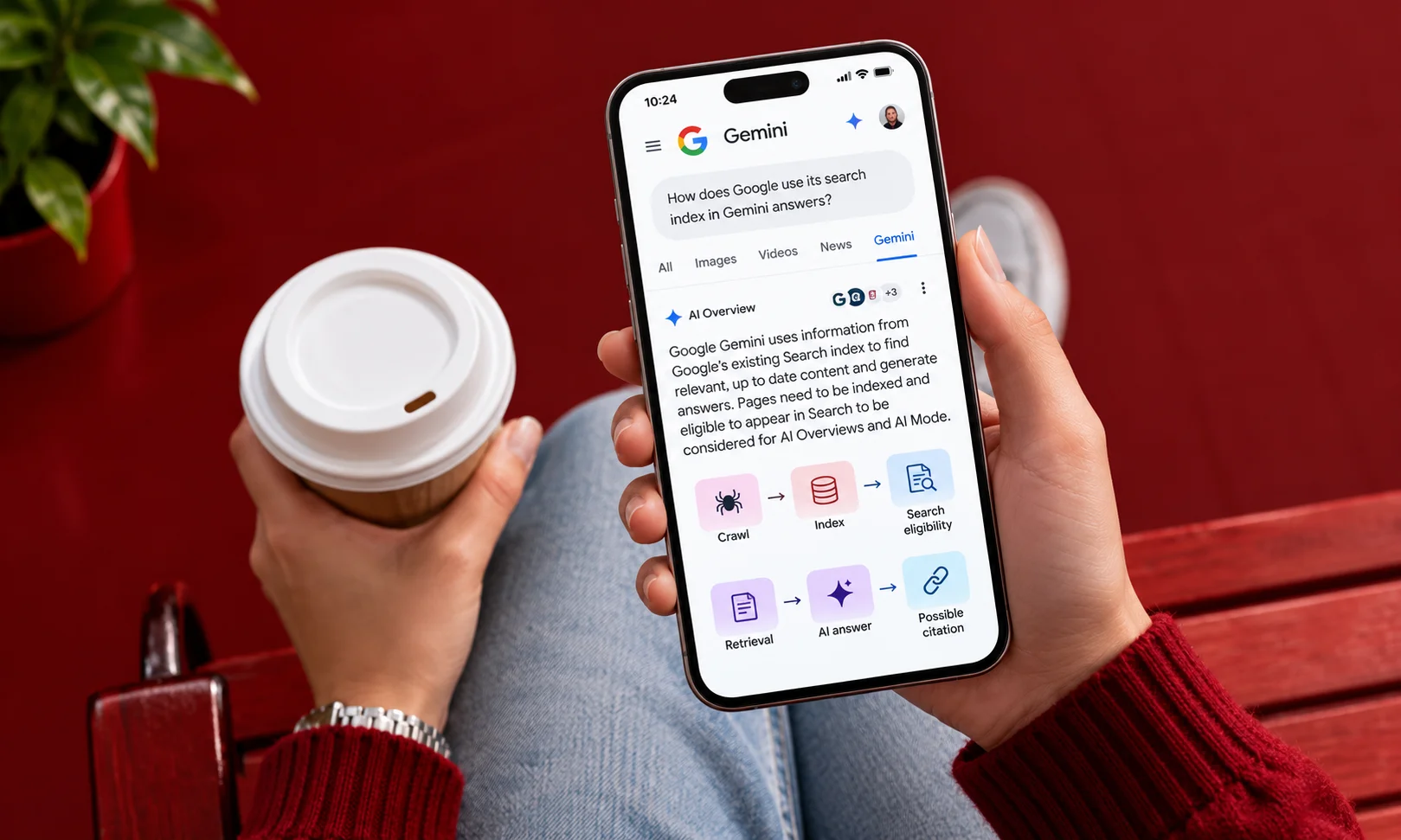
Google’s AI Search features aren’t operating completely separately from Google Search. Google says that, for AI Overviews and AI Mode, pages need to be indexed and eligible to appear in Search. It also says there are no additional technical requirements specifically for appearing in these AI features.
In plain English?
Your normal SEO foundation still matters. A lot.
Think about it like this:
Crawl → Index → Search eligibility → Retrieval → AI answer → Possible citation
The first three steps existed long before AI Overviews.
And they haven’t suddenly disappeared because Google added generative AI.
If Google can’t crawl an important page, or the page isn’t indexed, you have a problem before the AI system even gets a chance to consider the content.
This is also where retrieval augmented generation comes into the picture.
The simple version is that the system can retrieve relevant information and use it when generating an answer, instead of relying only on information stored in the model from training. Google’s documentation describes its AI Search features as combining generative AI with its existing Search systems.
But don’t take that to mean:
“Rank #1 = get cited.”
It doesn’t work that neatly.
For example, an October 2025 seoClarity study covering 362,000 queries found that 94% of AI Overviews had at least one URL that also appeared in the top 20 organic results. But 44% of the cited URLs came from outside the top 20.
BrightEdge has also found meaningful overlap between organic rankings and AI Overview citations, while showing that the relationship is far from one-to-one.
So the better way to think about it is:
Search visibility can give you a seat at the table. It doesn’t guarantee that Google will quote you.
What carries over from the general method
None of this means you can forget everything you already know about making content useful for AI systems.
The basics still matter.
Your important information should be easy to find on the page. Your sentences should actually answer questions instead of circling around them for 500 words. Your company, products, people, and other entities should be clear. Claims should have enough context and supporting evidence.
And if something changes regularly, update it.
These are useful whether the system retrieving your content is Google, another search engine, or a standalone assistant.
The difference is where the Google-specific work happens.
You aren’t replacing general citation optimization with technical SEO.
You’re putting the technical foundation underneath it.
That’s also why citation share is more useful than obsessing over a single citation.
If you test 40 relevant questions and your brand appears in 2 of them, that’s one data point. If it appears in 15, that’s a very different pattern. You can then compare that with competitors, your organic visibility, and changes you make to the underlying content.
The broader citation method is covered in the cluster’s general citation-method article, so there’s no need to repeat those steps here.
The Google-specific point is simpler:
The content still needs to be retrievable through Google’s ecosystem in the first place.
What is specifically Google
This is where you need to be careful with advice.
There is plenty of content online saying things like “add this schema,” “use this word count,” or “optimize for this Google AI crawler.”
Some of that advice is based on useful observations.
Some of it is just a confident guess.
Google’s own documentation gives us a much safer starting point.
First: conventional Search visibility still matters
Google says pages need to be indexed and eligible to appear in Search for AI Overviews and AI Mode.
So before you spend a week rewriting content for AI, check the boring stuff.
Can Google crawl the page?
Is it indexed?
Is something accidentally blocking Googlebot?
Is there a nonindex directive?
Is the canonical pointing somewhere unexpected?
Is the important content actually accessible in the page?
These aren’t exciting questions.
They are also the questions I’d check first.
Then: structured data
Structured data is useful, but don’t oversell it.
Google says structured data helps it understand page content and can make pages eligible for certain Search features.
That does not mean Google says:
Add schema and your page will appear in Gemini.
It doesn’t.
So use accurate structured data where it makes sense. Keep it consistent with the visible content. Validate it.
But don’t treat schema like a secret AI citation switch.
If you want the implementation details, that’s what the cluster’s schema article is for.
And then there are crawler controls
This one gets particularly messy.
Google has different crawlers and different controls, and they’re not interchangeable.
For example, Google documents Googlebot as the crawler associated with Google Search. Google-Extended is a separate product token that publishers can use to control certain uses of content for Gemini Apps and model-related purposes. Google says blocking Google-Extended does not affect a site’s inclusion or ranking in Google Search.
That’s an important distinction.
So when someone says, “Block the AI crawler,” the obvious follow-up question should be:
Which Google crawler, and for what purpose?
The same logic applies to llm crawlers generally. Different AI companies have different products, crawlers, and access policies. There isn’t one universal AI crawler setting that controls all AI visibility.
And this is exactly why Google-specific advice needs to stay Google-specific.
What nobody can tell you
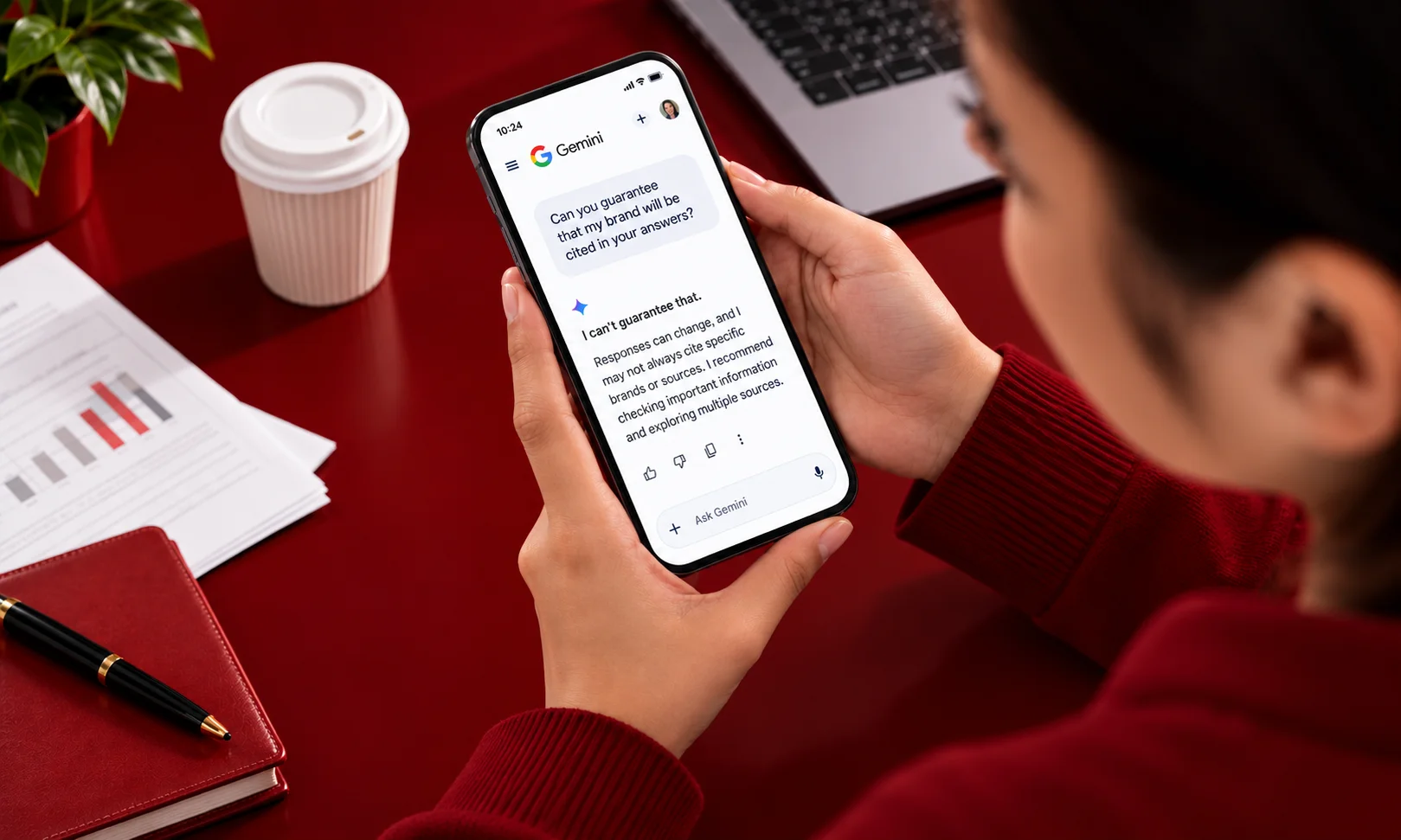
Here’s the uncomfortable part.
Nobody outside Google can give you a guaranteed formula for getting cited.
Google hasn’t published a checklist that says:
Write 1,200 words, add Article schema, mention the entity 7 times, get 3 backlinks, and Gemini will cite you.
If someone has one, they probably aren’t getting it from Google’s public documentation.
Google doesn’t fully document how every source is selected for every AI response.
And the results can change.
A page might appear for one query but not a very similar query. Different searches can trigger different sources. Results can change over time as content changes and Google’s systems change.
Even Gemini’s own documentation warns that its responses can contain mistakes and recommends checking important information.
So generative engine optimisation is better treated as an ongoing optimization process than a guaranteed ranking formula.
You can improve your chances.
You can make your content easier to retrieve and understand.
You can build stronger evidence and clearer entities.
You can measure whether your brand appears more often.
But you can’t promise a client, “We’ll get you into Gemini.”
That’s a much stronger and more honest position.
How to track it
If you’re serious about measuring this, don’t just search your company name once a month and call it “AI visibility.”
Build a fixed question set.
Start with maybe 30–50 questions that actually matter to your business.
Include things like:
- “Best category tools for…”
- “How do I solve problem?”
- “Product vs competitor”
- “Alternatives to competitor”
- “Best software for specific audience”
- “Category pricing”
- “Category features”
- “Industry trends”
Then keep the questions exactly the same.
Run them on a fixed schedule.
And record what you see.
Track:
- The exact question.
- Date and time.
- Google surface used.
- Whether an AI answer appeared.
- Whether your brand appeared.
- Which URL was cited.
- Which competitors appeared.
- Whether the cited URL ranked organically.
- What claim the source was used to support.
- A screenshot of the result.
And please keep the surfaces separate.
Don’t put AI Overviews, AI Mode, and Gemini Apps into one spreadsheet column called “Google AI.”
They can behave differently.
That means your gemini citations should be tracked separately from citations appearing in Google Search.
The same goes for your google ai answer sources.
This won’t give you a perfect measurement of Google’s entire AI ecosystem.
It gives you something much more useful: a consistent sample that you can compare month to month.
For example:
Citation rate = queries where your brand appeared as a source ÷ relevant queries where an AI answer appeared
That’s your own measurement. It isn’t an official Google metric.
And that’s okay.
You aren’t trying to reverse-engineer Google’s entire system.
You’re trying to understand what is happening to your brand.
What to do first if you have done none of this
If you’re starting from zero, please don’t open ChatGPT and start rewriting 100 old articles with “AI-friendly” sentences.
Start with your Search foundation.
GOOGLE AI VISIBILITY: YOUR FIRST 7 CHECKS
- Check indexation
Are your important pages actually indexed by Google? - Check crawlability
Is robots.txt, noindex, a login wall, or a technical error getting in the way? - Check Search eligibility
Are these genuinely useful pages that deserve to appear in Search? - Check your entities
Is your company clearly described? Are products, people, categories, and relationships consistent across your site? - Check structured data
Add relevant schema where it genuinely applies. Don’t add markup just because someone said Gemini likes it. - Build your question set
Pick 30–50 questions that your customers actually ask and start tracking Google Search and Gemini separately. - Improve the pages that keep getting missed
Look for weak information, outdated claims, unclear entities, missing evidence, or poor Search visibility before reaching for another AI tactic.
Notice what’s missing from that list?
A magical Gemini prompt.
A special word count.
A “GEO score.”
A hack that supposedly forces citations.
That’s intentional.
If the Google Search foundation isn’t healthy, an AI-specific tactic isn’t where I’d start.
The read
So, does Google’s index grounding make visibility easier or harder than with standalone assistants?
I’d say it makes the starting point clearer, but the final outcome is still messy.
You already have a Search ecosystem to work with. Google knows how to crawl and index your site. You can check whether pages are indexed. You can improve technical accessibility. You can build conventional search visibility.
But none of that gives you a guaranteed place in an AI answer.
The independent research is pretty clear on that point: organic rankings and AI citations overlap, but they don’t perfectly match.
So don’t think of Gemini visibility as replacing SEO.
Think of it as another layer sitting on top of Google’s existing retrieval system.
If you only do one thing this week, check your 10 most important pages.
Are they crawlable? Indexed? Clear? Useful?
That’s where I’d start.