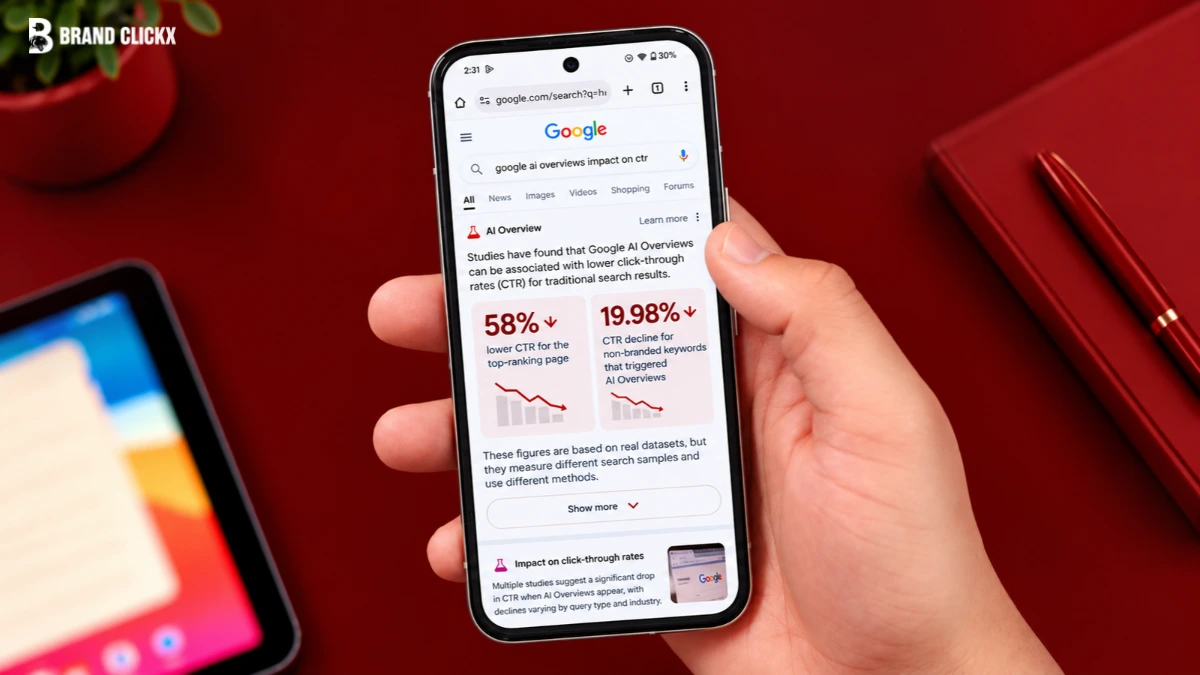
One study found that Google AI Overviews were associated with a 58% lower CTR for the top-ranking page, while another study found a 19.98% CTR decline for non-branded keywords that triggered AI Overviews. Both figures are based on real datasets, but they measure different search samples and use different methods.
That is the problem with google AI overviews ctr. There is no single percentage that explains what happened to every website. The result changes with query type, ranking position, brand status, time period and the way the study measures clicks.
The useful question is not whether search lost a certain percentage of clicks. It is which searches lost them, what replaced those clicks and whether the traffic that disappeared was valuable to the business.
Key Takeaways
- AI Overview CTR losses vary sharply by query type, ranking position and brand status.
- Informational searches show some of the clearest evidence of organic click loss.
- A single AI Overview CTR percentage cannot describe every website or search category.
- Some lost clicks are replaced by visibility inside AI-generated answers rather than website visits.
- Search teams should measure AI Overview exposure, CTR, query intent and business value separately.
What is an AI Overview?
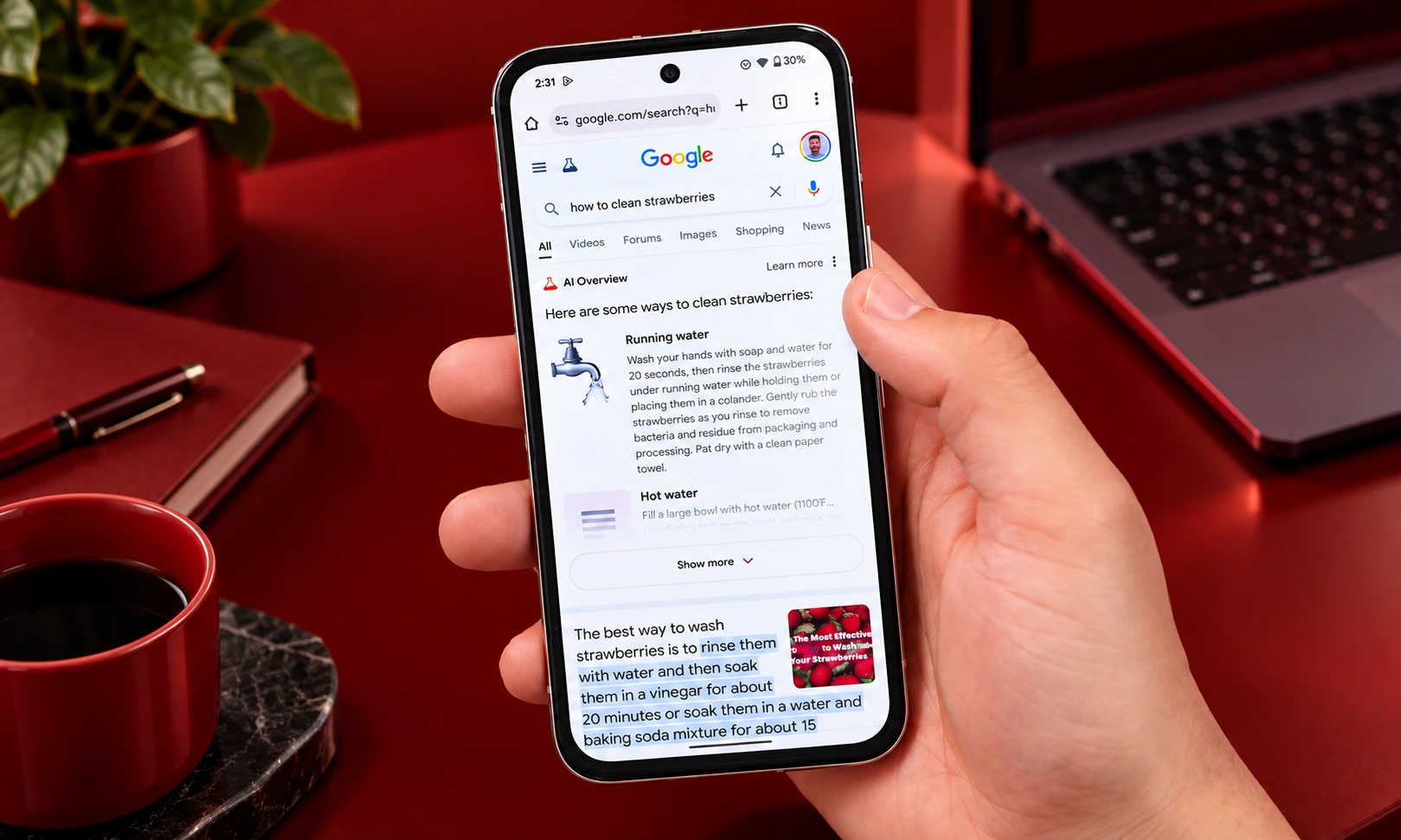
An AI Overview is a generated answer that can appear near the top of a Google results page. It combines information from multiple web sources and can show links to pages used in the answer.
The feature has not stayed limited to simple informational searches. Research covering more than 10 million keywords found that informational queries made up 91.3% of AI Overview-triggering searches in January 2025, but that share had fallen to 57.1% by October as commercial, transactional and navigational queries became more common.
That matters because an AI Overview is another serp feature competing for attention with traditional organic listings. A searcher can read an answer without visiting a website or clicking through when they want more detail.
A 2026 study of 55,393 trending queries also found that AI Overviews appeared on 13.7% of queries overall and 64.7% of question-form queries during its 40-day measurement period. That is evidence of changing coverage, not a measure of traffic loss.
Why do the published numbers disagree so much?
The biggest reason is simple: researchers are often measuring different things.
The metric changes the story:
A study can measure the CTR of the number-one organic result, total organic CTR, clicks per search or actual user behavior after an AI Overview appears. Those measurements are not interchangeable.
One 2026 study compared 150,000 keywords that triggered AI Overviews with 150,000 informational keywords that did not. It used aggregated Google Search Console data and found a 58% lower position-one CTR associated with AI Overview presence.
Another study looked at 3,119 informational and educational search terms across 42 organizations and tracked 25.1 million organic impressions. It reported organic CTR falling from 1.76% to 0.61% for queries with AI Overviews between June 2024 and September 2025.
Both figures show a decline, but neither should be described as the percentage of traffic lost by every website.
The sample matters:
A publisher that gets most of its traffic from informational searches is exposed to a different search environment from a brand that receives a large share of navigational or branded searches.
Time matters too. AI Overviews expanded into more commercial and transactional searches during 2025 and 2026, so a study from an earlier period may describe a narrower version of the feature. Before quoting any number, check four things:
- Metric: Is it CTR, clicks, impressions, sessions or revenue?
- Sample: How many keywords, searches, websites or users were measured?
- Period: What dates were compared?
- Query mix: Were the searches informational, commercial, transactional, branded or local?
Google has also reported a different aggregate picture. In August 2025, it said total organic click volume from Google Search to websites was relatively stable year over year and that average click quality had increased. That is an aggregate claim and does not directly contradict a study measuring CTR on specific AIO-exposed queries because the populations and metrics differ.
What does the loss actually look like by query type?
The evidence is strongest for informational searches, but it does not support one universal loss percentage for every query category.
Informational searches
Informational queries have some of the clearest evidence of reduced organic CTR.
The 3,119-query study mentioned above focused specifically on informational and educational searches because these were considered more exposed to AI Overviews. By September 2025, organic CTR for queries with AIOs was 0.61%, compared with 1.62% for queries without them in the same dataset.
A separate study using 300,000 keywords also focused on informational intent and found a substantial position-one CTR difference when AI Overviews were present.
How-to and answer-first searches
Simple how-to searches face a similar structural issue. If the user can get the steps needed to solve a problem directly from the search page, the need to visit another website can fall. The available studies support lower CTR around answer-heavy searches, but there is no reliable public percentage that applies to every how-to query.
That distinction matters. A study can show that an answer-heavy query group has lower CTR without proving that every individual how-to page lost the same amount of traffic.
Commercial and transactional searches
AI Overviews are moving further down the buying journey, but exposure is not the same thing as traffic loss.
A six-month analysis of more than 600,000 keywords found that the share of commercial-intent SERPs showing AI Overviews increased 71% between November 2025 and April 2026. Transactional-intent SERPs moved in the opposite direction during the same period, declining 5% in average AI Overview presence.
Those figures measure AIO appearance, not lost clicks. That is why a commercial query should not automatically be treated as a traffic-loss query simply because an AI Overview appears.
Branded searches behave differently:
Branded searches can produce a different result again. A study covering 700,000 keywords across 10 websites and five industries found that non-branded keywords triggering AI Overviews had a 19.98% CTR decline. Branded keywords that triggered an AI Overview showed an 18.68% CTR increase in that dataset.
Only 4.79% of the branded keywords in that study triggered AI Overviews, so the finding should not be applied to every branded search.
Local searches remain harder to quantify:
Local searches can also show AI-generated answers, but the public evidence does not provide a dependable universal CTR-loss percentage for local queries.
For that reason, local businesses should measure their own branded, non-branded and location-based queries separately rather than applying a general AI Overview benchmark.
The pattern across the evidence is clear enough to describe but not broad enough to justify one site-wide number: informational searches show strong evidence of click loss, while commercial, transactional, branded and local searches require more specific measurement.
What replaced the click?
The missing click has not always been replaced by another website visit.
Visibility without a visit
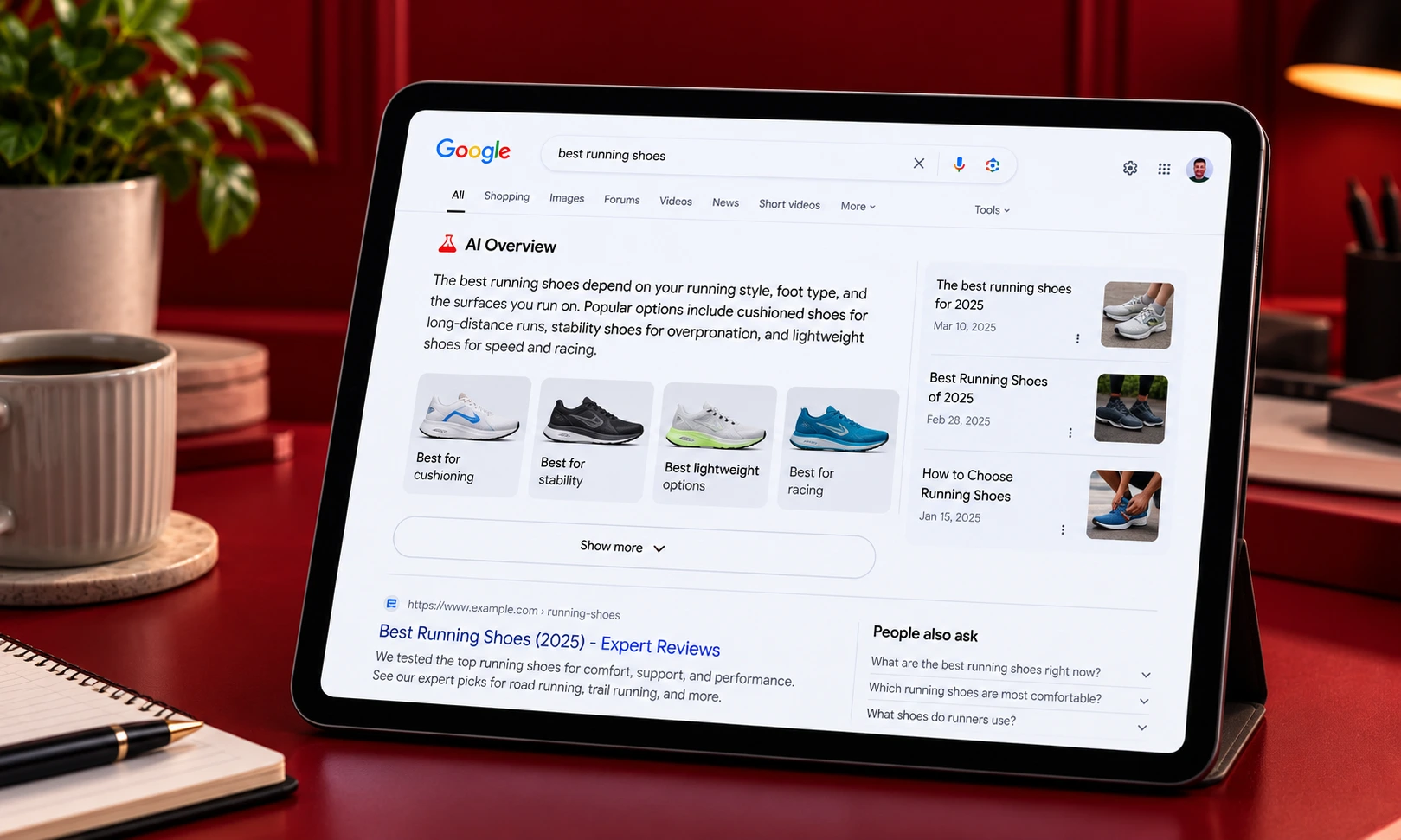
A user can see a brand inside an AI Overview without opening the cited page. That creates visibility, but it does not create the same measurable session as an organic click.
A large user-behavior study tracked 68,879 Google searches from 900 U.S. adults during March 2025. Among searches that produced an AI summary, users clicked a traditional result in 8% of visits. When no AI summary appeared, they clicked a traditional result in 15% of visits.
Clicks on links inside the AI summary itself occurred in only 1% of visits with a summary. That makes zero click search more important to SEO reporting. A page can contribute information to the search experience while receiving no measurable visit from that search.
The same study also found that 18% of the Google searches it examined produced an AI summary and that 88% of those summaries cited three or more sources.
Who lost the most, and why?
The strongest exposure is around content where the answer can be compressed into a short response. Basic definitions, simple factual questions and straightforward how-to searches fit that pattern. If the user gets everything needed from the search page, there is less reason to open the source.
Affiliate and comparison publishers can face another form of pressure. A search summary can provide basic product differences before the user reaches the page where the publisher normally earns value from the visit.
The evidence is less straightforward for pages built around actions that cannot be completed in a short answer. A user may still need to visit a website to use a calculator, compare a real offer, complete a purchase or examine original research.
A recent preregistered field experiment with 1,100 participants adds causal evidence to the traffic discussion. Removing AI Overviews and AI Mode increased publisher CTR in the experiment. That supports a traffic effect, but one experiment should not be treated as a universal estimate for every search category.
What are sites actually doing about it?
The response is spreading across technical controls, commercial arrangements and measurement.
Managing LLM crawlers:
Some publishers are changing how they manage access for AI crawlers. The decision can depend on whether a crawler is being used for search discovery, AI training or another purpose. That makes LLM crawlers part of a wider content-access decision. Blocking a crawler may change how content is used, but it does not automatically recover lost Google Search clicks.
Structured data and entity signals:
Technical clarity still matters. Structured data gives search systems explicit information about what a page contains. Google says structured data can help it understand page content and can make pages eligible for certain search features.
Entity salience is useful as a way to think about how clearly a page communicates the people, organizations, products or subjects it is about. But neither structured data nor clear entity signals guarantee an AI Overview citation. The important point is not to confuse better machine understanding with guaranteed traffic.
Measure what remains:
The most useful response is better segmentation. A search team should track:
- AI Overview exposure
- organic CTR with and without the feature
- branded versus non-branded queries
- query intent
- conversions and revenue from the remaining clicks
The last two are especially important. A 20% CTR decline on low-value informational searches does not have the same business effect as a smaller decline on queries that normally generate qualified leads or purchases.
The Read
The evidence does not support one universal google ai overviews ctr number. There is strong evidence of reduced CTR in some AI Overview-heavy search segments. There is also evidence that the effect varies sharply by query type, ranking position and brand status. Google reports stable aggregate organic click volume, while independent studies of specific query groups report substantial CTR declines.
That is not a contradiction once the samples are separated. I would not put one AI Overview percentage into a leadership report without showing the study behind it. Measure your own queries by intent, brand status and AI Overview exposure, then connect the remaining clicks to conversions and revenue.
The number that matters is not simply how many clicks disappeared. It is which clicks disappeared and what they were worth.