When one major global brand introduced its AI creative system in 2025, it described a workflow designed to turn brand guidelines into adaptive creative assets and produce hundreds of localized campaign variations. The system was introduced as a pilot, with designers still controlling the creative process.
That shows what an in house AI creative studio actually needs to solve. The challenge is not simply generating an image, video or piece of copy. A working studio also needs approved inputs, rights controls, brand rules, people and a review process.
The practical way to build one is through five stages: decide what belongs inside, clean up the rights and inputs, build the review layer, define the people and measure the result.
Key Takeaways
- An in house AI creative studio is an operating model, not simply a collection of generative AI tools.
- Versioning, localisation and repeatable production are easier starting points than claims, hero creative or likeness-based work.
- Rights need to be checked before assets enter the workflow because AI platforms can apply different rules to inputs, outputs and licensed content.
- Review capacity becomes a real cost when a studio moves from a few experiments to large-scale production.
- The business case should compare the complete internal workflow with the cost of producing the same work externally.
What is actually in an in house AI creative studio?

An in house AI creative studio needs more than a generation layer. A practical operating model has five parts: generation, an asset and rights library, review and approval, usable brand rules and people responsible for each part.
The generation layer can produce or modify images, video, audio or text. The asset library provides the material the workflow is allowed to use. The rights layer records permissions and restrictions. The review process determines which work can move forward and which needs another check.
The brand-rule layer is where a brand ai studio becomes different from an employee simply using an AI tool. The rules need to be usable during production, not just stored in a brand guideline document.
One documented enterprise example uses a system that captures creative intent in a structured format and applies that intent to localized campaign variations. The workflow keeps designers involved rather than treating generated output as automatically finished creative.
Job descriptions reviewed for this article also show roles combining concept development, storyboarding, AI-generated visuals, editing, production and brand consistency. That supports a practical point: the studio needs people who own the workflow, not just people who know how to prompt a model.
The exact structure will vary by brand. The important part is that generation, rights, review, brand control and ownership connect to each other.
Stage one: Deciding what goes in scope
The first question is not which model to buy. It is which creative work is structured enough to move into the internal workflow. A useful starting point is repeatable production. That includes resizing, localisation, versioning and creating variants from an already approved concept. These jobs have an existing reference and a defined output, which makes them easier to check.
The harder category includes new campaign ideas, hero assets, factual claims and work involving a person’s likeness. These tasks can still use AI, but they require more human control because the consequences of a wrong output can be greater.
Current copyright guidance also makes an important distinction around human contribution. AI-assisted work can receive copyright protection where a human determines sufficient expressive elements, while providing prompts alone does not generally establish that level of human authorship. That gives a useful test for deciding scope:
| Question | If the answer is yes |
| Is the work repeated often? | It may be suitable for internal automation |
| Is there an approved reference? | The output has something concrete to follow |
| Are the inputs rights-cleared? | The workflow has a defined legal starting point |
| Can the result be checked against clear rules? | Review can be structured |
| Is there a named owner? | Someone can make the final decision |
This is a practical framework rather than an industry standard. Its purpose is to stop a brand from moving high-risk creative into production simply because a model can generate it.
Stage two: The rights and inputs problem
Rights need to be settled before assets enter the production workflow. A brand may want to use its own photography, licensed stock, creator content or material involving a performer. Those inputs can carry different permissions, so the studio needs to know what it can upload, modify, generate from or distribute.
Current AI product terms place responsibility on users to have the necessary rights, licences and permissions for their inputs. They can also distinguish between user-owned output and output that incorporates separately licensed content. Some terms warn that generated outputs may not be unique.
That means the studio cannot treat every generated asset as automatically clear for commercial use. Talent likeness creates another separate rights question. Current performer agreements covering commercial work require consent for creating and using digital replicas and place restrictions on using performer data for AI training.
This makes model governance part of the production process. A brand needs to know which systems are approved, which inputs can be used, what contractual protections apply and who can approve an exception.
The rights library should therefore record the asset, owner or licensor, permission, permitted uses, restrictions and relevant expiry or usage conditions. That is an operating requirement to build, not a feature to assume a model will provide.
Stage three: The review layer
The review layer is the part most likely to determine whether an in house AI creative studio can operate at volume. The studio needs a clear answer to three questions: who reviews the asset, what do they check and when does the review happen? A practical model is to use review tiers based on the risk of the output.
| Review level | Example work | Suggested control |
| Production check | Internal concepts or simple variants | Producer checks the brief and required elements |
| Brand check | Customer-facing versions of approved creative | Brand or creative owner checks consistency |
| Specialist check | Claims, likeness or rights-sensitive work | Legal, compliance or rights owner reviews |
These tiers are a proposed operating model, not a published industry standard. The cost becomes visible when volume rises. For example, if a team reviews 500 assets and spends five minutes on each one, that is 2,500 minutes, or about 42 hours. At 10 minutes per asset, the same workload becomes about 83 hours.
Those figures are simple calculations, not industry benchmarks. They show why review cannot be treated as an invisible task.
External AI content workflows also demonstrate that human review can remain part of commercial AI production. One major content platform describes a review process that checks AI-generated images for potential trademark, copyright and publicity-rights issues and states that the process typically takes 1–2 business days.
An internal studio may use a different process and timing. The useful measurement is therefore its own review workload. A simple calculation is:
Monthly review cost = assets requiring review × average review minutes ÷ 60 × loaded reviewer hourly cost
The same calculation can be used to estimate review capacity before the studio commits to a production target. That changes the business case. If production volume rises while every customer-facing asset still requires human review, review capacity can become the constraint. The cost of that layer belongs in the studio budget.
Stage four: The people
The roles inside an AI creative operation are broader than prompting. The AI Creative Producer job descriptions reviewed for this article combine several parts of the production process, including concept development, storyboarding, generation, editing, production coordination and maintaining visual or brand consistency.
Another current role places generative AI creative production inside a marketing design studio and connects the work with creative automation, production pipelines and brand consistency. These examples support a practical team structure:
- Studio lead: owns the operating model and priorities.
- Creative producers: turn briefs into finished assets.
- Rights or asset owner: maintains permissions and approved inputs.
- Senior creative oversight: owns creative standards and escalation.
- Review owners: handle brand, legal or specialist checks where required.
That is a proposed structure, not a claim that every studio needs every role. Existing agency relationships do not have to disappear. A brand can choose to keep campaign concepts, specialist production or higher-risk work with an agency while bringing repeatable production inside.
Whether that reduces agency spend depends on what work actually moves, how much internal capacity costs and whether external work is genuinely replaced.
Stage five: Measuring whether it worked
Asset volume is easy to count. It is also incomplete. A studio that generates more files has not necessarily created more usable creative. Four measures give a clearer operational picture:
- Cost per usable asset
- Time from brief to live
- Share of output produced in-house
- Rework rate
Cost per usable asset captures the work that survives the review process. Brief-to-live time shows whether the workflow changes production speed. Share of output shows how much work has actually moved inside. Rework rate shows how often production has to be repeated before an asset is usable.
These measures should be compared with the brand’s own baseline rather than with a universal AI benchmark.
The wider investment calculation can then use an existing AI return framework rather than creating a separate set of assumptions for the studio. The goal is to measure the complete production workflow, not simply how many assets a model can generate.
What does an in house AI studio cost, honestly?
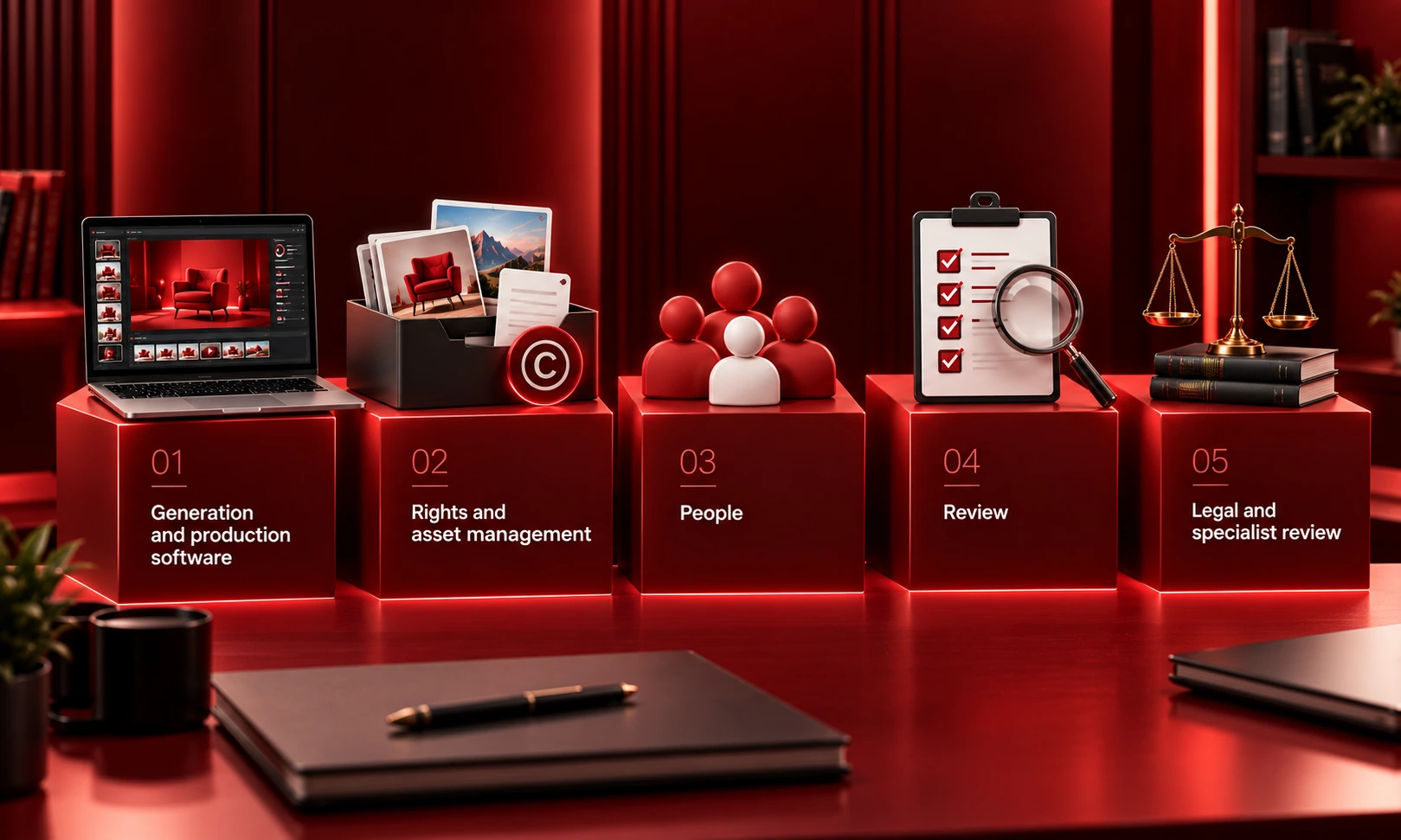
There is no clean public benchmark for the complete cost of running an in house AI creative studio that combines software, rights management, people, review and legal support. The sources reviewed for this article do not provide a comparable 2026 figure, so putting a single dollar range here would create false precision. The cost model is clearer than a generic benchmark.
1. Generation and production software
This includes the AI services and creative software the team actually uses.
2. Rights and asset management
This covers licensed assets, rights administration and the systems used to track approved inputs.
3. People
This includes studio leadership, producers, creative oversight and operational support.
4. Review
This is the human time required to check assets before they move forward.
5. Legal and specialist review
This applies where claims, likeness, licensing or other rights require additional review.
Platform terms can also change the commercial risk. Some enterprise AI arrangements provide specific protections for eligible features, while other terms place responsibility for input rights on the customer. The exact terms need to be checked for the products and plan the brand actually uses. The right comparison is therefore not
AI cost versus zero. It is: complete internal production cost versus the cost of producing the same defined output through an agency, production partner or other external route. That comparison should include review and legal work on both sides where those costs exist.
The practical test: should this work move inside?
Use this before moving a creative workflow into the studio.
Move it closer to the internal studio when:
- The concept is already approved.
- The work repeats often.
- The inputs are rights-cleared.
- The output can be checked against clear requirements.
- A person owns final approval.
- The business can measure usable output and rework.
Keep more external or specialist involvement when:
- The work depends on a new campaign idea.
- The asset is a hero production.
- A physical shoot or specialist craft is central.
- Talent likeness is involved.
- The work contains material claims.
- Legal or regulatory review is substantial.
This is a decision framework, not a universal rule. The boundary should change when the brand’s risk, production requirements or review capacity changes.
Where these studios go wrong
They start with a tool contract:
Start with the creative workflow and define the rights and review requirements before selecting the generation layer.
They skip the rights library:
Create an asset record showing ownership or permission, permitted use and restrictions before the asset enters production.
They underestimate review:
Measure review minutes per usable asset and turn that number into a monthly capacity requirement.
They have no clear owner:
Assign responsibility for brand rules, final approval and escalation before increasing production volume.
They measure generations instead of usable output:
Track cost per usable asset, time to live and rework instead of treating raw generation volume as the result.
The Read
I see the lasting model as hybrid rather than fully internal. The evidence reviewed here shows AI being built into creative production workflows, while current platform terms and performer agreements still leave important rights and control questions around inputs, outputs and likeness.
That makes the operating model more important than the model name. Before committing to a studio, take one repeatable creative workflow and document its current cost, production time, rights position and review workload. Then compare that complete internal model with the external cost of producing the same work.
If the internal case only works when review, rights and legal work are treated as free, the business case is incomplete.