
AI Overview
Sarvam AI, a Bengaluru startup, became India’s newest AI unicorn on June 15, 2026, raising $234 million in the first close of a planned $300 million Series B at a $1.5 billion valuation. HCLTech led with $150 million for a 10.46% stake, joined by Bessemer Venture Partners and existing backers Khosla Ventures and Peak XV Partners. Early investor Lightspeed sat out. The round landed days after the US restricted foreign access to Anthropic’s newest models, turning sovereign AI from a talking point into a purchase order. Sarvam now has to prove a homegrown, from-scratch model can win commercially, something India’s first AI unicorn could not.
Timing tells you what a deal is really about.
Sarvam closed its unicorn round in the same week the US government blocked foreign nationals from using Anthropic’s latest models. Co-founder Pratyush Kumar did not let the moment pass quietly. He tied the raise straight to it, posting that “you should not confuse access with ownership, or adoption itself as advantage.”
That single line explains the deal better than the valuation does.
For two years, “sovereign AI India” was a policy slogan and a pitch-deck phrase. Then, almost overnight, access to the world’s best models started getting rationed by geography. A country’s ability to run powerful AI on its own terms stopped being a nice-to-have. It became a procurement requirement.
That is the backdrop for the $234 million that just made Sarvam India’s newest AI unicorn. The number is big. The reason it happened now is bigger.
The deal, in numbers you can trust
Strip the hype and the Sarvam AI funding round is clean to read.
| Detail | Figure |
| Raised | $234 million (first close of a $300M Series B) |
| Valuation | $1.5 billion, post-money |
| Lead investor | HCLTech, $150 million |
| HCLTech stake | 10.46%, about Rs 1,427 crore |
| Joined the round | Bessemer Venture Partners (new), Khosla Ventures, Peak XV Partners |
| Notably absent | Lightspeed, which led Sarvam’s earlier round |
| Still open | roughly $66 million, on an undisclosed timeline |
The leap is the part most reports underplay. Founded in August 2023, Sarvam raised about $41 million across its seed and Series A. This single round is nearly six times its entire prior funding.
A market does not move like that on momentum. It moves like that when something structural changes underneath it.
Why it matters: This is one of the largest rounds an Indian AI company has ever raised, and it resets the ceiling for what India-built AI can command. But the cleaner signal is who anchored it, and who walked away.
India already had a sovereign-AI unicorn. It blinked.
Here is the context almost no celebratory write-up mentions.
Sarvam is not India’s first AI unicorn. Krutrim was. Founded by Ola’s Bhavish Aggarwal, Krutrim hit a $1 billion valuation in January 2024, faster than any Indian company before it, on a promise to build India’s own models.
Then reality arrived.
Over the past year, Krutrim pivoted away from building frontier models and toward selling cloud and GPU services. It cut more than 200 roles across several rounds. It pulled its Kruti consumer assistant from app stores in April 2026. It halted its chip ambitions, went quiet on launches, and skipped India’s own AI Impact Summit, where Sarvam showed up across multiple sessions.
Krutrim’s numbers tell the rest. It reported roughly ₹3 billion, about $31.5 million, in FY26 revenue. Respectable growth, and a first profit. But earlier reporting suggested close to 90% of its prior-year revenue came from its parent, Ola.
Market observation: That is the cautionary tale sitting underneath Sarvam’s party. The last company handed the “India’s AI champion” crown discovered that training frontier models is brutally expensive, and that the safer money is in renting compute, not building intelligence. Sarvam is now attempting the exact thing Krutrim backed away from.
So the real question is not whether Sarvam can raise money. It just did. The question is whether it can escape Krutrim’s gravity.
The redemption arc that earned the valuation
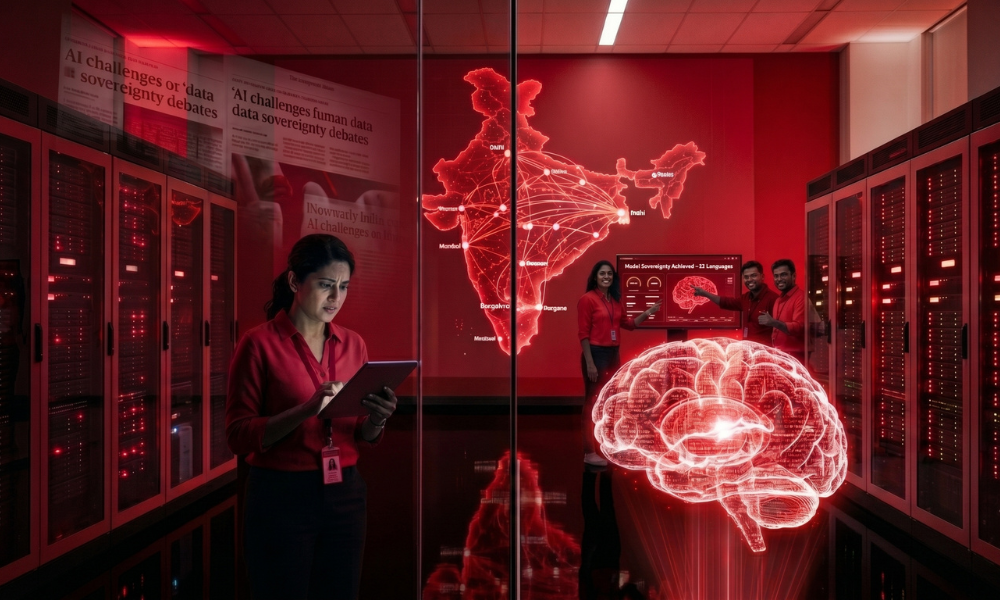
Sarvam did not walk into this round clean. It walked in having survived a credibility crisis, which makes the story more interesting, not less.
Rewind to April 2025. The government selected Sarvam, first among 67 applicants, to build India’s sovereign large language model under the IndiaAI Mission. The prize included access to thousands of high-end GPUs. The catch, critics noted, was that a government-funded model was not going to be fully open, which sparked a “public money, public code” backlash.
Then came the technical embarrassment. Sarvam’s May 2025 model, Sarvam-M, turned out to be a fine-tune of a foreign open model dressed in Indian-language data. For a company branded as India’s sovereign-AI hope, building on someone else’s foundation was an awkward look. Skeptics also pointed to slow progress and low download numbers.
Sarvam’s answer is the part that matters.
At the India AI Impact Summit in February 2026, it launched models trained from scratch on Indian-language data, not fine-tuned on a borrowed base. The flagship, Sarvam-105B, is a mixture-of-experts model with 105 billion parameters, roughly 10 billion active at a time, a 128,000-token context window, and support for all 22 official Indian languages.
The company positioned it against OpenAI’s open GPT model and Alibaba’s Qwen, and ran an OpenAI-style “14 launches in 14 days” sprint to prove velocity. It later open-sourced the weights under Apache 2.0.
Expert insight: The from-scratch pivot is the technical heart of this valuation. Anyone can wrap a foreign model and call it local. Training a 100-billion-parameter model on domestic infrastructure, across 22 languages, is a different order of difficulty, and a defensible reason for HCLTech to pay up. Whether developers adopt it at scale, given the earlier download skepticism, is the open test.
Why a services giant, not a VC, wrote the biggest check
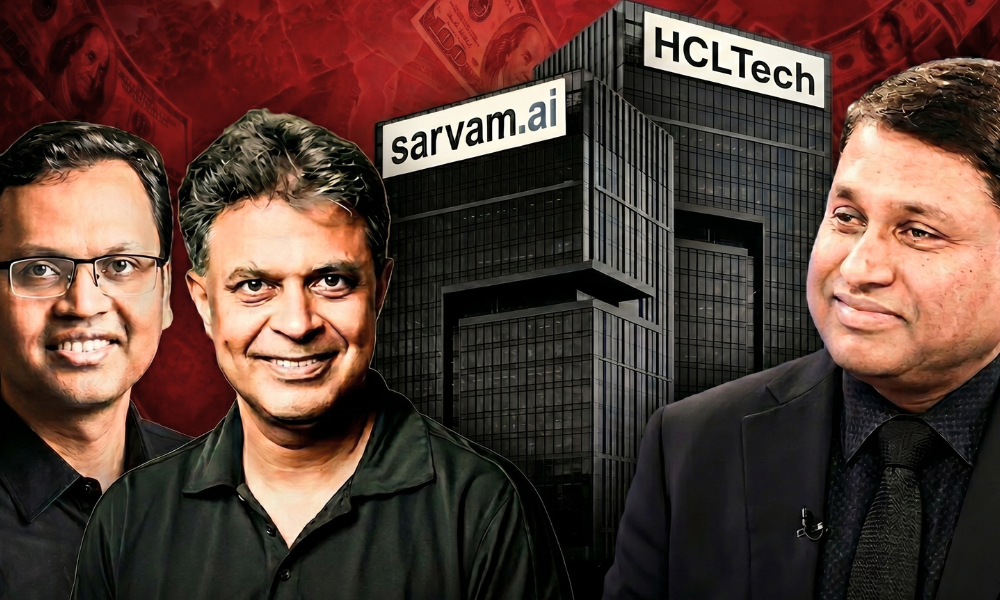
The most telling fact about this round is that the lead is not a fund. It is HCLTech, an IT services conglomerate buying a double-digit stake.
That changes the logic entirely.
A VC buys equity hoping to sell it higher later. HCLTech is buying distribution. It brings thousands of enterprise clients, deep engineering benches, and a global delivery network that a two-year-old startup could never assemble on its own.
The fit is almost too neat. Sarvam builds the model. HCLTech sells it into the banks, insurers, and governments that will not buy frontier AI from a startup, but will buy it from a vendor they have trusted for decades.
HCLTech chief executive C Vijayakumar framed it as building a trusted, globally competitive AI ecosystem from India. Underneath the language is a hard commercial calculation about owning a piece of the intelligence layer instead of just reselling someone else’s.
Enterprise perspective: This is the template to watch. India’s IT majors, TCS, Infosys, Wipro, and HCL, are all pivoting to AI-first strategies. HCLTech just made the boldest move: rather than build a lab from zero or depend on foreign APIs, it bought into the country’s most credible homegrown model maker. Expect rivals to respond.
Strategic breakdown: Sarvam’s side of the trade is real too. It gains instant enterprise reach and a deep-pocketed partner. In return it cedes more than 10% of the company and ties part of its roadmap to one backer’s priorities. For a capital-hungry sovereign-AI play, that is a rational bargain, not a warning sign. The warning sign would be if distribution never converts to revenue.
The frugal-versus-frontier math
Now the uncomfortable arithmetic, because the sovereign-AI story only works if the economics do.
India launched the IndiaAI Mission in 2024 with about ₹10,372 crore, roughly $1.1 billion, to fund an entire national AI ecosystem: models, data, compute, and research.
That is the whole country’s program. For comparison, a single US lab like OpenAI had raised well over $18 billion by late 2024. Anthropic and Europe’s Mistral were each raising in the billions.
| Player | Scale of AI capital | Approach |
| India (IndiaAI Mission) | ~$1.1B for the whole program | National, frugal, shared compute |
| Sarvam Series B | $300M target round | From-scratch sovereign models |
| Reliance Jio | ~$120B AI commitment (2026) | Largest private AI bet in India |
| OpenAI | $18B+ raised by late 2024 | Frontier, capital-intensive |
Two things jump out.
First, Sarvam’s $300 million is large for India and small for the global race. The bet rests on frugal engineering, the same thesis that let China’s DeepSeek reportedly build a capable model at a fraction of US costs.
Second, Sarvam’s toughest competition at home may not be Krutrim or the IT firms. It is Reliance Jio, whose roughly $120 billion AI commitment dwarfs everything else in the market. Sarvam is a sharp, focused startup in a country where a single industrial giant can outspend it a hundred times over.
The bigger shift: The AI map is fragmenting along national lines, and within India it is fragmenting again, into frugal model builders, hyperscale industrial bets, and services giants buying their way in. Sarvam sits in the first camp, now bankrolled by the third. Jio sits alone in the second. How those forces interact will define Indian AI for a decade.
The traction that made the round believable
Valuations need proof, and Sarvam brought production deployments, not demos, to the table.
- A nationwide voice campaign for a leading insurer supported policy renewals for roughly 45 million policyholders, in Indian languages, at a scale English-first models still handle poorly.
- A partnership with SBI Life Insurance put generative AI into customer engagement and sales support.
- A large fintech runs its agentic AI platform across a sales force of more than 350,000 people.
Industry impact: The 45-million-policyholder campaign is the standout for any marketing or growth leader. Voice-first, multilingual AI working at that scale is a genuine commercial moat in a country with 22 official languages, and exactly the kind of use case global models are not optimized to serve.
This is where the BrandClickX audience should pay attention. The next wave of enterprise AI in emerging markets will not be won by the smartest English model. It will be won by whoever handles regulated industries, local languages, and data-residency rules without forcing a compromise.
What the money buys, and what could still go wrong
Sarvam has been specific about the spend, which itself signals maturity. The capital funds a next frontier model focused on agentic AI, coding, and cybersecurity, plus large-scale compute and enterprise rollout.
But a $1.5 billion valuation invites a clear-eyed audit. Here is the honest ledger.
What is genuinely strong
- Real from-scratch foundation models, open-sourced, in 22 languages.
- A strategic partner that solves distribution, the hardest startup problem.
- Production deployments in banking, insurance, and fintech.
- Timing aligned perfectly with the global retreat from open AI access.
What remains unproven
- Only a first close; about $66 million is uncommitted, with no stated timeline.
- An early lead investor, Lightspeed, did not follow on.
- Download and adoption numbers drew skepticism before this round, and broad developer uptake is still the real test.
- Frugal engineering is a bet, not a guarantee, against labs and a domestic giant spending vastly more.
- The Krutrim path shows how fast a model-builder can be forced to retreat into selling compute.
Why it matters: None of these are red flags on their own. Together they define the gap Sarvam now has to close, between being India’s sovereign-AI symbol and being a model the world actually chooses to run.
Tactical framework: Read Sarvam’s roadmap as three commitments. Agentic AI means it wants to sell outcomes, not chat. Coding and cybersecurity target high-margin enterprise budgets. Continued in-house training says it intends to own its intelligence rather than rent it. Watch all three for proof, or for drift.
Frequently asked questions
What is Sarvam AI?
Sarvam AI is a Bengaluru startup building full-stack sovereign AI, including foundation models trained from scratch in 22 Indian languages, for enterprises and governments. It was founded in 2023.
How much did Sarvam AI raise and at what valuation?
Sarvam raised $234 million in the first close of a planned $300 million Series B, at a $1.5 billion valuation, announced June 15, 2026. About $66 million of the round is still open.
Who led Sarvam’s funding round?
HCLTech led with $150 million for a 10.46% stake. Bessemer Venture Partners joined as a new investor, alongside existing backers Khosla Ventures and Peak XV Partners. Lightspeed sat out.
Why is the Sarvam funding significant now?
It landed days after the US restricted foreign access to Anthropic’s newest models, turning sovereign AI from a slogan into urgent demand for AI that countries can own and control.
Is Sarvam India’s first AI unicorn?
No. Krutrim, backed by Ola’s Bhavish Aggarwal, reached unicorn status in 2024. Sarvam is India’s newest AI unicorn and now one of only two, but Krutrim has since pulled back from model-building.
How is Sarvam different from global models like GPT or Gemini?
Sarvam builds India-focused, open-source models trained from scratch on Indian-language data, designed for data sovereignty, voice-first use, and deployment under local rules, not as a localized foreign model.
Key Takeaways
- Timing made the deal. Sarvam’s round closed as foreign AI access tightened, turning sovereign AI from theory into a buying decision. Watch access restrictions, not just benchmarks, drive enterprise demand.
- Strategic capital beats venture capital here. HCLTech’s $150 million is about distribution into regulated industries, not a financial flip. Expect other IT and services giants to copy the move.
- There is a warning named Krutrim. India’s first AI unicorn retreated from models to cloud services. Sarvam is attempting what its predecessor could not finish, so judge it on adoption, not announcements.
- The economics are a frugal bet. A $300 million round is large for India and small globally, dwarfed at home by Reliance Jio’s roughly $120 billion commitment. Sarvam is wagering that lean, from-scratch AI can compete.
- Real traction exists. Deployments reaching 45 million policyholders and a 350,000-person sales force show production-grade, multilingual AI, the genuine moat behind the valuation.
What happens next
The funding question is answered. The execution question is wide open, and it is the harder one.
Building a frontier model, securing compute, and converting HCLTech’s client base into revenue, all at once, is among the toughest assignments in technology. Sarvam has the money, the models, and the moment. It also has a domestic giant outspending it, a skeptical adoption record to overturn, and the ghost of Krutrim reminding everyone how quickly the sovereign-AI dream can shrink into a cloud-hosting business.
Expect the rest of 2026 to test the thesis directly. If Sarvam closes the full round, ships its next model, and turns enterprise pilots into recurring revenue, it becomes the blueprint for sovereign AI across the emerging world. If it stumbles on any one of those, the unicorn label will look early.
The deeper story is already written, though. Access to the world’s best AI is no longer guaranteed by geography, and countries that want a say are choosing to build rather than borrow. India just put $234 million behind that choice.
BrandClickX will keep tracking where it leads, with reporting from people who have built and run these systems, not just watched them from the sidelines.