
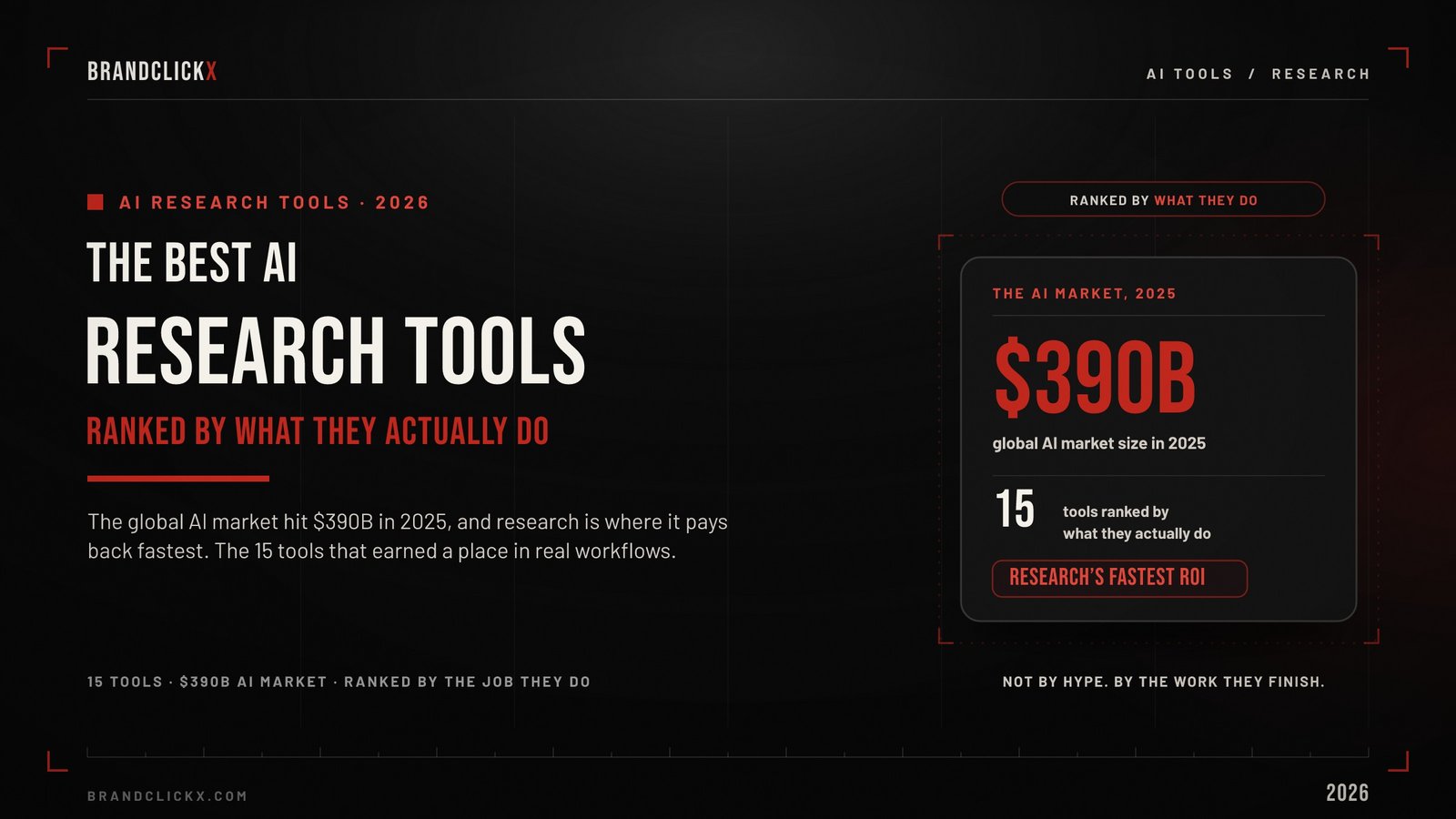
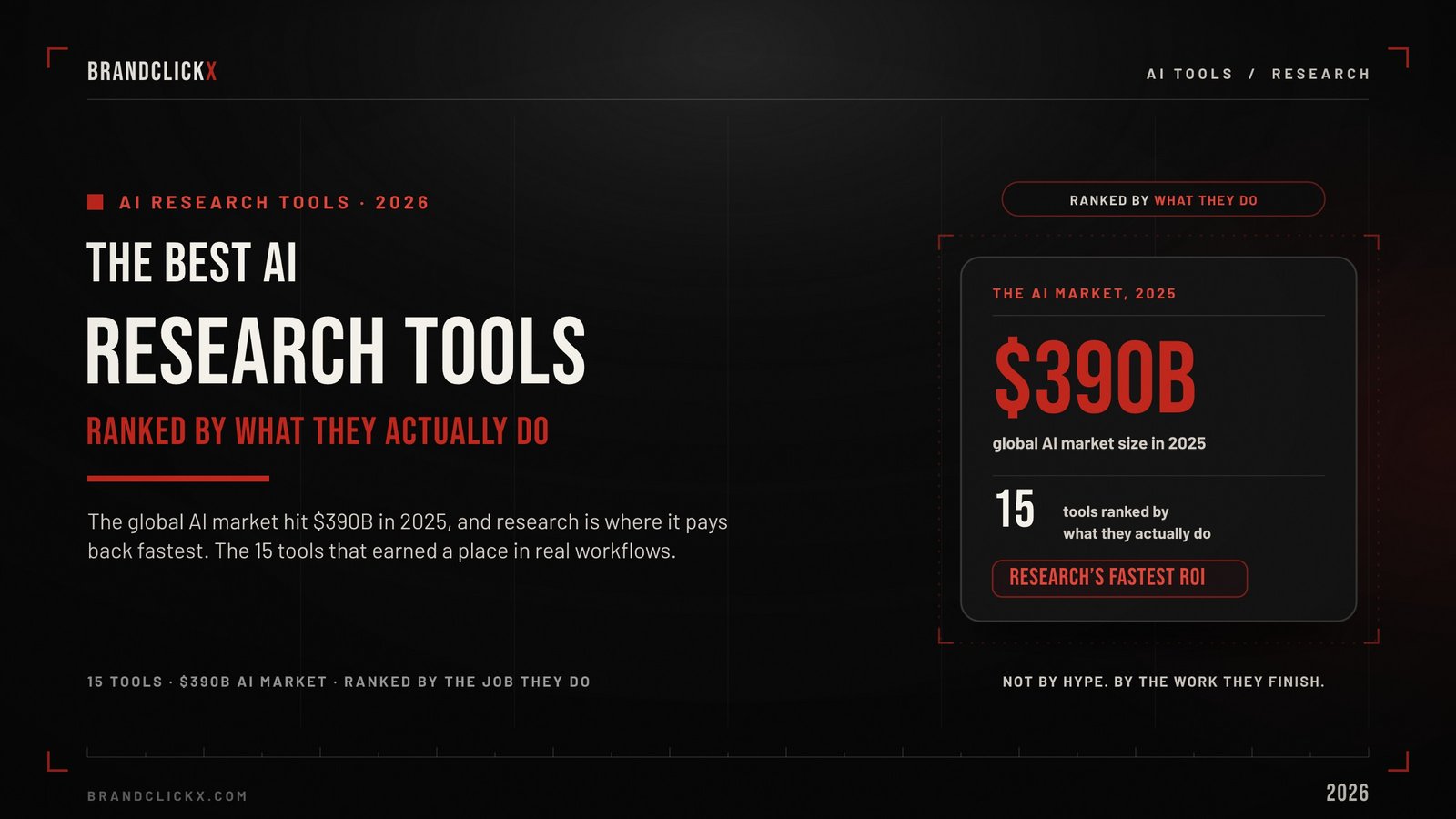
The global AI market hit $390 billion in 2025. Research is where it delivers its most immediate ROI. Here are the tools that have earned their place in serious research workflows.
Introduction: Research Has a New Speed Limit — and Most Teams Haven’t Hit It Yet
The gap between how fast research can happen and how fast most teams are doing it has never been wider.
The global market research industry reached $153 billion in 2025. AI adoption among professional firms hit 20.2% in 2025, up from 14.2% in 2024, with research and professional services leading all sectors. 95% of professional researchers have integrated AI tools into their daily workflows, per Qualtrics’ 2026 report.
And yet, most of those researchers are using ChatGPT as their primary AI research tool, a general-purpose assistant that hallucinates sources, has a knowledge cutoff, and was not built for the specific demands of systematic research.
The AI research tool landscape has matured well beyond that. In 2026, there are dedicated tools for literature discovery, systematic review, citation verification, real-time web intelligence, market sizing, competitive analysis, document synthesis, and trend detection. Each does its specific job better than any general AI assistant.
The median payback on AI research tooling has compressed to 4.2 months in 2026, down from 7.8 months in 2024. McKinsey’s Global AI Survey found organizations achieved an average 5.8x return on AI investment within 14 months of deployment. The ROI is real. The question is whether you’re capturing it with the right tools.
This guide covers the 15 AI research tools that serious researchers, marketers, analysts, and enterprise teams are actually building workflows around in 2026, organized by research type, assessed honestly, and free of the vendor bias that corrupts most tool roundups in this category.
How We Organized This Guide
AI research tools cluster into five functional categories. Understanding which category you need is the first step toward picking the right tool.
Real-time web research — Tools that search the live web and cite sources. Perplexity, ChatGPT with web browsing, Claude with search.
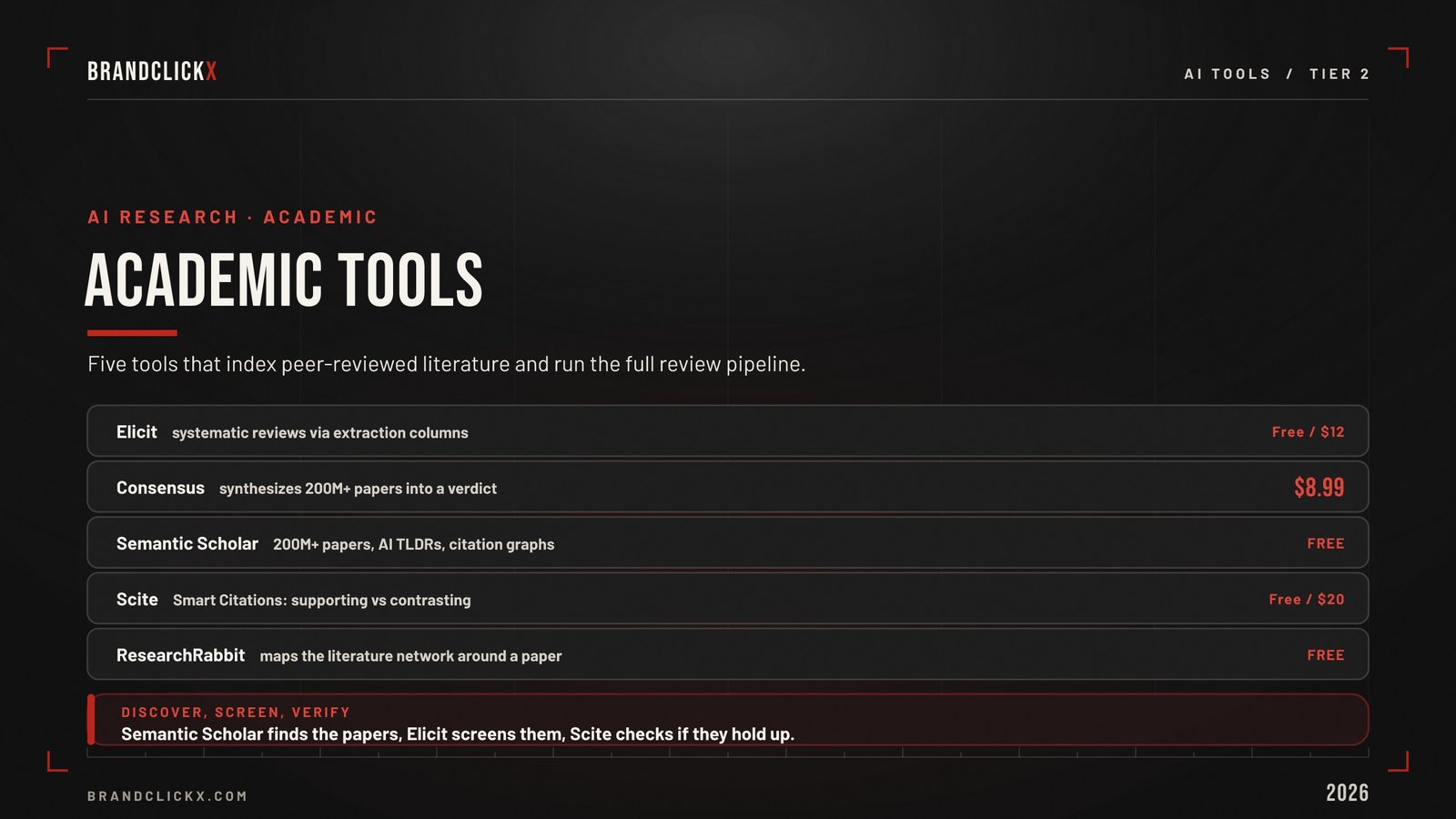
Academic and scientific research — Tools indexing peer-reviewed literature. Elicit, Consensus, Semantic Scholar, Scite, ResearchRabbit.
Document analysis and synthesis — Tools for processing uploaded documents. NotebookLM, Claude, ChatGPT.
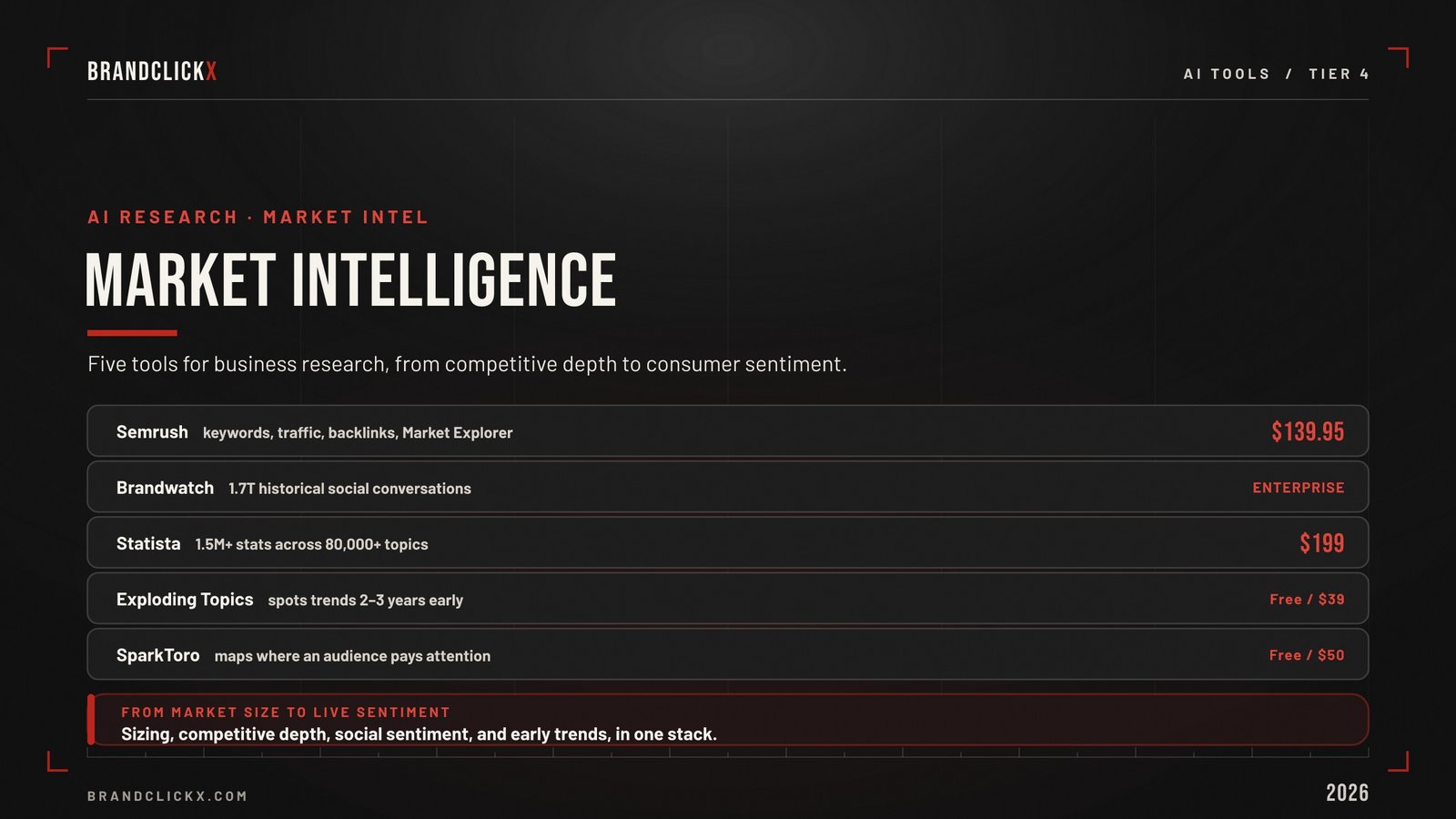
Market and competitive intelligence — Tools for business research. Semrush, Brandwatch, Statista, Exploding Topics.
Trend and audience research — Tools for spotting emerging signals. Exploding Topics, Brandwatch, SparkToro.
Most serious research operations in 2026 use 2-3 tools across these categories. Nobody needs all 15.
Tier 1: Real-Time Web Research Tools
1. Perplexity AI
Built for: Any research question where citation and real-time accuracy matter
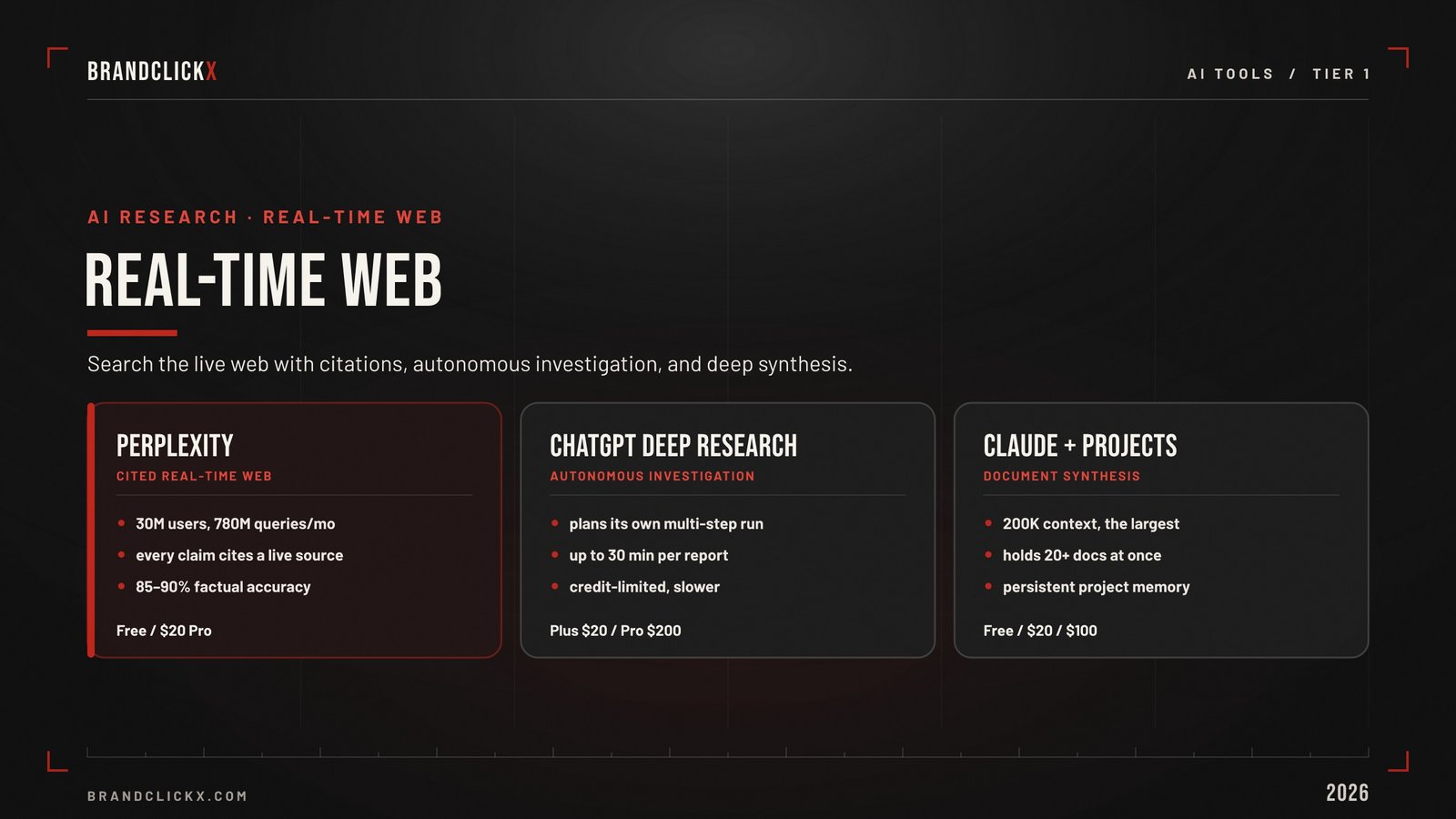
The numbers: 30 million monthly active users as of early 2026. 780 million queries processed in May 2025 alone. Growing at a rate that has made it one of the fastest-scaling AI products outside of ChatGPT.
Perplexity is the most important AI research tool most people are underusing.
Every answer it generates is sourced from the live web, with inline citations attached to every claim. You can verify exactly where each piece of information came from before including it in any document, presentation, or decision. That citation architecture is what separates Perplexity from general AI assistants, the difference between a research tool and a confident guesser.
What it does uniquely well: Speed plus verifiability. A research question that would take 20 minutes of Google searching returns in 30 seconds, with sources attached. For market research, competitor analysis, current events, regulatory changes, and any question where the answer might have changed in the last six months, Perplexity is the fastest credible path to an answer.
The Pages feature generates shareable, cited research reports from conversation threads, a lightweight publishing tool for teams that need to distribute findings rapidly.
The honest limitation: Perplexity draws from the entire web, which means it includes low-quality sources alongside authoritative ones. Its accuracy rate for factual claims runs 85–90%, high for AI, but not sufficient for high-stakes research without verification. For peer-reviewed academic research, Elicit and Consensus are more rigorous.
Who it’s for: Marketers, analysts, consultants, journalists, strategists, anyone who needs cited real-time intelligence fast.
Pricing: Free (limited) / Pro $20/mo / Enterprise custom
2. ChatGPT Deep Research Mode (OpenAI)
Built for: Comprehensive, autonomous multi-step research investigations
ChatGPT’s Deep Research mode, available to Plus and Pro subscribers, transforms a general AI assistant into something closer to a research analyst. It spends up to 30 minutes conducting autonomous web investigation on a complex topic, synthesizing findings across multiple sources into a comprehensive report.
The key distinction from standard ChatGPT: Deep Research mode plans its own research strategy, decides which sources to consult, iterates on findings, and produces a structured output with citations, rather than generating a single response from training data.
What it does uniquely well: Complex, multi-layered research questions that require synthesis across many sources. “What are the competitive dynamics in the AI coding tool market?” is a question that standard ChatGPT handles poorly but Deep Research handles well, because it can spend time actually researching rather than drawing on training data alone.
The honest limitation: Deep Research is slower than Perplexity and uses a credit system that limits how many deep investigations you can run per month. For quick, single-question research, Perplexity is faster and more cost-efficient.
Who it’s for: Strategy teams, consultants, analysts conducting comprehensive market investigations.
Pricing: Plus $20/mo / Pro $200/mo (significantly more Deep Research capacity)
3. Claude (Anthropic) with Projects
Built for: Document-heavy research, long-form synthesis, sustained research conversations
Claude’s 200K token context window, the largest available among frontier AI models, makes it the strongest tool for research that involves processing large volumes of uploaded material.
Upload 20 research papers, a competitor’s annual report, a regulatory filing, and a market study, and ask Claude to synthesize the findings into a strategic brief. The context window holds all of it simultaneously, enabling a quality of synthesis that tools with smaller context windows cannot replicate.
The Projects feature enables persistent context across research sessions, meaning the documents you upload and the research threads you develop stay accessible across multiple conversations rather than starting fresh each time.
What it does uniquely well: Deep analysis of specific documents you provide. If you already have the source material and need a tool to help you understand, synthesize, and extract insights from it, Claude is the strongest available.
The honest limitation: Claude does not search the web in its standard interface, it works with what you give it or what it knows from training. For real-time information, combine Claude with Perplexity: use Perplexity to gather and cite current sources, then bring those into Claude for deeper analysis.
Who it’s for: Researchers processing large document sets, analysts synthesizing complex multi-source reports, strategists building long research documents.
Pricing: Free (limited) / Pro $20/mo / Max $100/mo
Tier 2: Academic and Scientific Research Tools
4. Elicit
Built for: Systematic literature reviews, academic research, structured paper screening
Elicit is the most purpose-built academic research tool on this list. It is designed specifically for how researchers actually work, not as a chatbot that answers questions, but as a workflow tool that handles the full literature review pipeline.
Search a research question. Elicit identifies relevant papers from its database. Screen them by abstract. Extract specific data points across columns, methodology, sample size, findings, limitations. Build the structured dataset that a systematic review requires. Export to citation managers.
For clinical research, systematic reviews, and formal academic work under PRISMA guidelines, Elicit is the closest thing to a genuine research workflow tool available.
What it does uniquely well: The extraction column system, where you define what data you want pulled from each paper and Elicit populates it automatically across dozens of papers simultaneously, compresses what would be weeks of manual screening into hours.
The honest limitation: Elicit’s database is strong but not exhaustive. Very recent papers and niche subdisciplines may have gaps. For discovery, complement Elicit with Semantic Scholar before screening in Elicit.
Who it’s for: Academic researchers, medical researchers, policy analysts, anyone conducting formal systematic literature reviews.
Pricing: Free (limited) / Plus $12/mo / Team $15/user/mo
5. Consensus
Built for: Evidence-based question answering from peer-reviewed literature
Consensus searches more than 200 million peer-reviewed papers and synthesizes what the scientific literature actually says about a specific question, displayed through a Consensus Meter that shows the balance of evidence visually.
Ask “Does intermittent fasting improve insulin sensitivity?” and Consensus returns a synthesized answer grounded in the peer-reviewed literature, with the distribution of supporting, contradicting, and inconclusive evidence displayed clearly.
This is fundamentally different from what Google Scholar or a general AI assistant provides. Consensus is not returning a list of papers, it is synthesizing the evidentiary weight of the literature into an actionable signal.
What it does uniquely well: Binary or comparative evidence questions. “Does X improve Y?” “Which approach is more effective: A or B?” These questions are poorly served by general AI tools and exceptionally well served by Consensus.
The honest limitation: Consensus is a discovery and synthesis tool, not a workflow tool. It tells you what the evidence says; it does not help you screen papers, extract data, or build systematic review documentation.
Who it’s for: Researchers needing quick evidence synthesis, healthcare professionals, policy teams, fact-checkers.
Pricing: Free (limited) / Pro $8.99/mo / Team plans available
6. Semantic Scholar
Built for: Academic paper discovery, citation graph visualization, research mapping
Semantic Scholar indexes more than 200 million academic papers and provides AI-generated TLDRs (too-long-didn’t-read summaries) for each, making it possible to rapidly assess the relevance of a paper without reading it in full.
Its citation graph visualization is the strongest available: trace which papers cite a given study, which papers it cites, and how the intellectual lineage of a research area has developed over time. For researchers mapping a new field or verifying whether a foundational study holds up under subsequent scrutiny, this is an irreplaceable capability.
Semantic Scholar is entirely free, no paywall, no credit system, no enterprise tier required.
What it does uniquely well: Discovery and field mapping at zero cost. If you are entering a new research area and need to understand its landscape, the foundational papers, the most-cited recent work, the researchers generating the most significant findings, Semantic Scholar builds that map faster than any alternative.
The honest limitation: Semantic Scholar is a discovery tool, not an analysis tool. It helps you find the papers. Elicit and Consensus help you analyze and synthesize them.
Who it’s for: Any researcher at any level. The free tier makes it universally accessible.
Pricing: Free
7. Scite
Built for: Citation intelligence, understanding whether a paper’s claims have been supported or contradicted
Scite addresses a problem that every researcher knows exists and few tools solve: a paper can be heavily cited and widely discredited simultaneously. Citation count alone tells you nothing about whether subsequent research supported or undermined a paper’s conclusions.
Scite’s Smart Citations categorize every citation as supporting, mentioning, or contrasting, giving researchers a real-time picture of how a paper has been received by the scientific community since publication.
What it does uniquely well: Claim verification at the citation level. Before building an argument on a specific study’s findings, Scite tells you whether subsequent literature supports or contradicts those findings. That check is one of the most valuable 30-second investments in any serious research workflow.
The honest limitation: Scite’s value is proportional to a paper’s citation volume, for very new or very niche research, there may not be enough citing papers for the Smart Citation analysis to be meaningful.
Who it’s for: Researchers building arguments on existing literature, fact-checkers, research integrity teams.
Pricing: Free (limited) / Plus $20/mo / Team plans available
8. ResearchRabbit
Built for: Iterative paper discovery through citation and co-citation networks
ResearchRabbit builds a visual map of the academic literature around any paper or set of papers, showing related work through citation networks, co-citation relationships, and author connections.
The interface feels more like a research exploration tool than a search engine, you start with papers you know, and ResearchRabbit surfaces the papers you didn’t know you needed. Alert settings notify you when new papers related to your research map are published.
What it does uniquely well: Following the intellectual thread of a research area rather than searching for a specific answer. For researchers building comprehensive literature reviews from the outside in, starting with a few known papers and expanding, ResearchRabbit is the fastest discovery mechanism available.
The honest limitation: ResearchRabbit requires an existing set of papers to start from. It is not a search engine for researchers who have no starting point.
Who it’s for: Academic researchers building comprehensive literature coverage, PhD students mapping their field.
Pricing: Free
Tier 3: Document Analysis and Synthesis Tools
9. Google NotebookLM
Built for: Research synthesis from uploaded documents, audio briefings, source-grounded Q&A
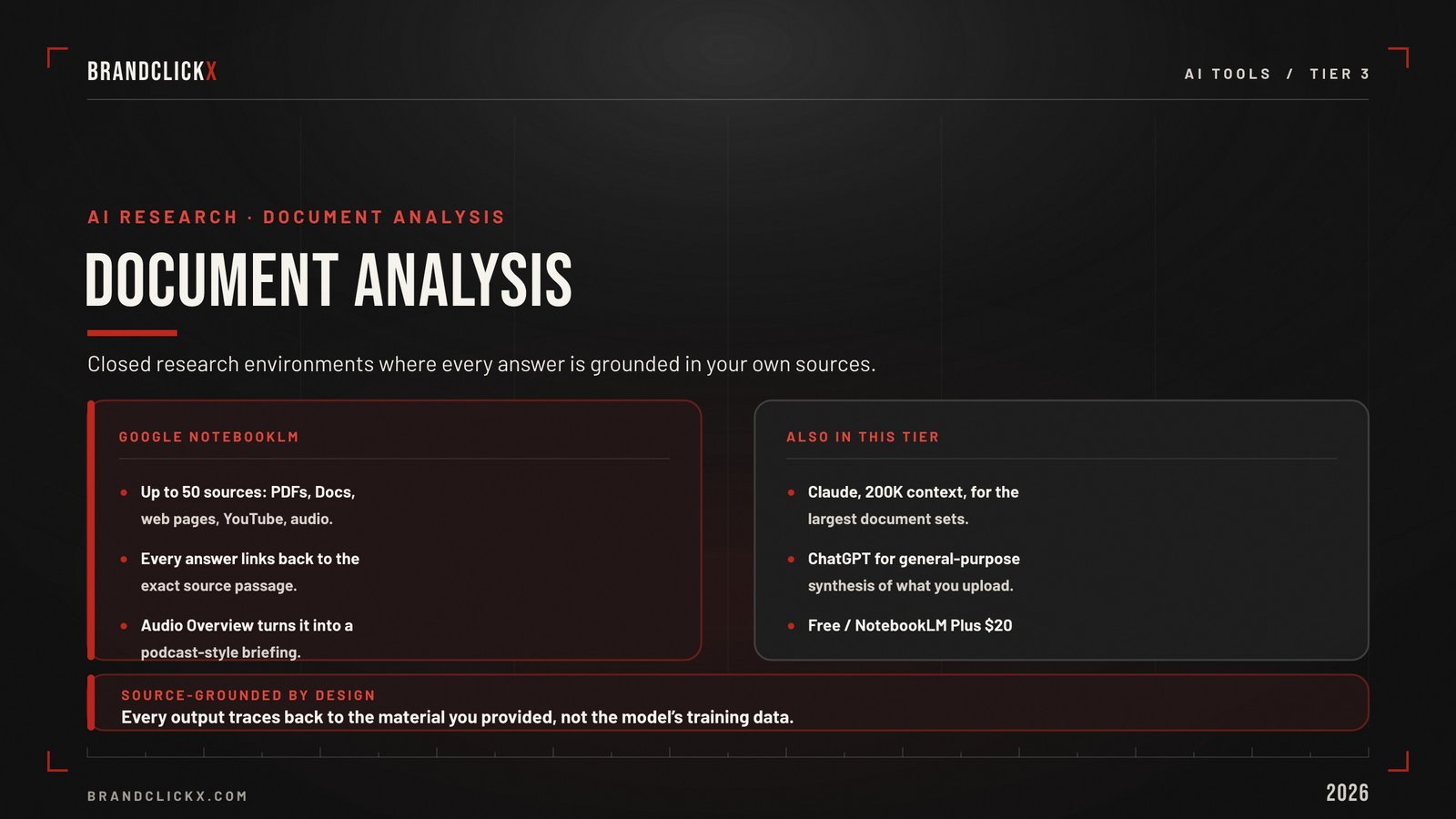
NotebookLM is Google’s most practically useful AI product for researchers. Upload up to 50 sources, PDFs, Google Docs, web pages, YouTube transcripts, audio files, and NotebookLM creates a research environment grounded entirely in those sources.
Every answer it generates is linked back to the specific source passage it came from. You can ask questions, request summaries, generate study guides, and build briefing documents, all grounded in the material you provided rather than the model’s training data.
The Audio Overview feature generates a podcast-style discussion of your source material between two AI voices, genuinely useful for processing large amounts of research material in a different cognitive mode.
What it does uniquely well: Creating a closed research environment from a specific set of sources, where every output is traceable back to the source material. For researchers who need to ensure their analysis is grounded in their actual documents rather than AI-generated extrapolation, NotebookLM’s source-grounding architecture is the most reliable available.
The honest limitation: NotebookLM only knows what you tell it. It cannot search the web, access live data, or expand beyond the sources you upload. It is an analysis tool, not a discovery tool.
Who it’s for: Analysts processing large document sets, researchers preparing for interviews, students synthesizing course reading, teams building knowledge bases from internal documents.
Pricing: Free / NotebookLM Plus $20/mo (via Google One AI Premium)
Tier 4: Market and Competitive Intelligence Tools
10. Semrush
Built for: Competitive intelligence, SEO research, content strategy, market positioning
Semrush is the most comprehensive competitive intelligence platform for marketing and digital strategy research. Its database covers keyword rankings, backlink profiles, traffic estimates, ad copy, content performance, and competitive positioning for virtually any website on the internet.
For market research involving digital presence, understanding who owns what search territory, what content is generating traffic in a category, what keywords competitors are targeting, Semrush provides the most complete data available anywhere.
Its Market Explorer tool generates market landscape analysis, audience overlap data, and competitive positioning summaries from domain inputs, providing a structured competitive intelligence briefing in minutes rather than hours.
What it does uniquely well: Digital competitive intelligence at depth. No other tool provides the combination of keyword data, traffic estimates, backlink analysis, and content performance in a single research environment.
Who it’s for: Marketing strategists, SEO professionals, content teams, competitive analysts, CMOs sizing market opportunity.
Pricing: Pro $139.95/mo / Guru $249.95/mo / Business $499.95/mo
11. Brandwatch
Built for: Social listening, consumer sentiment research, brand perception monitoring
Brandwatch indexes 1.7 trillion historical social conversations and monitors 100 million+ online sources in real time, making it the deepest consumer sentiment and brand perception research tool available.
For market researchers who need to understand how consumers actually talk about a category, a brand, or a trend, as opposed to how they respond to survey questions, Brandwatch provides the most comprehensive dataset available.
Its AI-powered sentiment analysis identifies emotional patterns, emerging topics, and opinion shifts across the full breadth of public online conversation.
What it does uniquely well: Understanding organic consumer sentiment at scale. The 1.7 trillion historical conversation database enables longitudinal research, tracking how sentiment around a brand, product, or category has shifted over time, that no primary research methodology can replicate.
Who it’s for: Brand research teams, CMOs monitoring reputation, marketing strategists doing consumer insight work, PR teams managing brand perception.
Pricing: Enterprise, custom pricing
12. Statista
Built for: Market sizing, industry benchmarks, data visualization for research reports
Statista provides 1.5 million+ statistics across 80,000+ topics, trusted by 23,000+ companies globally. It is the fastest path from a research question about market size, industry trends, or consumer behavior to a citable, sourced data point.
Every statistic includes the source, methodology notes, and publication date. Every data point comes with a downloadable chart in PNG, PDF, PPT, and XLS formats, formatted for direct inclusion in presentations and reports without additional design work.
For marketing teams, consultants, and analysts who need to substantiate claims with credible data quickly, Statista replaces hours of searching through individual research reports with a single search interface.
What it does uniquely well: Compiling credible, citable market data efficiently. The alternative, subscriptions to the individual research firms whose data Statista aggregates, would cost $15,000+ annually.
Who it’s for: Any professional who regularly needs market sizing data, industry benchmarks, or consumer behavior statistics.
Pricing: Basic $199/mo / Professional and Enterprise tiers with expanded access
13. Exploding Topics
Built for: Trend detection, emerging market identification, early signal research
Exploding Topics identifies topics, products, companies, and technologies that are growing in search and social attention before they reach mainstream awareness. Its algorithm surfaces signals 2–3 years before they appear in general media coverage.
For market researchers and strategists looking to identify emerging opportunities, competitive threats, and category shifts before competitors notice them, Exploding Topics provides the most systematic early-warning capability available.
What it does uniquely well: Separating genuine trend signals from noise, distinguishing topics growing consistently over 12+ months from viral spikes that normalize quickly. The database covers every major category across technology, consumer products, health, finance, and culture.
Who it’s for: Strategy teams, product researchers, venture investors, marketers building for emerging audiences.
Pricing: Free (limited) / Entrepreneur $39/mo / Investor $99/mo / Business $249/mo
14. SparkToro
Built for: Audience intelligence, where specific audiences spend their attention online
SparkToro answers a research question that most tools don’t address: where does my target audience actually pay attention? Not which demographics they belong to, but which websites they visit, which social accounts they follow, which podcasts they listen to, which YouTube channels they watch.
For content strategy, media planning, influencer identification, and brand partnership research, SparkToro provides the audience intelligence layer that demographic data cannot.
What it does uniquely well: Mapping attention rather than demographics. Understanding that your target audience over-indexes on three specific podcasts, two newsletters, and a cluster of YouTube channels is more actionable for marketing research than any demographic profile.
Who it’s for: Content strategists, media planners, PR teams, marketers building influencer and partnership strategies.
Pricing: Free (limited) / Basic $50/mo / Pro $150/mo / Agency $300/mo
15. Elicit (for Market Research Use Cases)
Already covered in the academic tier, but Elicit’s extraction column system applies directly to market research workflows beyond academic literature.
Using Elicit to systematically screen and extract data from industry reports, white papers, and regulatory filings, applying the same column-based extraction logic to business documents, is an underutilized capability that compresses competitive research cycles significantly.
The AI Research Tool Stack Matrix
| Tool | Best For | Research Type | Free Tier | Depth |
| Perplexity AI | Cited real-time web research | General, market, competitive | ✅ | ★★★★ |
| ChatGPT Deep Research | Comprehensive autonomous investigation | General, market | ❌ (paid only) | ★★★★★ |
| Claude + Projects | Document synthesis, long-form analysis | Academic, strategic | ✅ | ★★★★★ |
| Elicit | Systematic literature review | Academic, scientific | ✅ | ★★★★★ |
| Consensus | Evidence-based Q&A | Academic, scientific | ✅ | ★★★★ |
| Semantic Scholar | Paper discovery, field mapping | Academic | ✅ Free | ★★★★ |
| Scite | Citation intelligence | Academic, scientific | ✅ | ★★★★ |
| ResearchRabbit | Literature network mapping | Academic | ✅ Free | ★★★ |
| NotebookLM | Source-grounded document analysis | Any uploaded sources | ✅ | ★★★★ |
| Semrush | Competitive digital intelligence | Market, competitive | ❌ | ★★★★★ |
| Brandwatch | Social sentiment research | Market, brand | ❌ | ★★★★★ |
| Statista | Market sizing, benchmarks | Market, industry | Limited | ★★★★ |
| Exploding Topics | Trend detection | Market, strategy | ✅ | ★★★★ |
| SparkToro | Audience attention mapping | Market, audience | ✅ | ★★★★ |
How to Build Your Research Stack
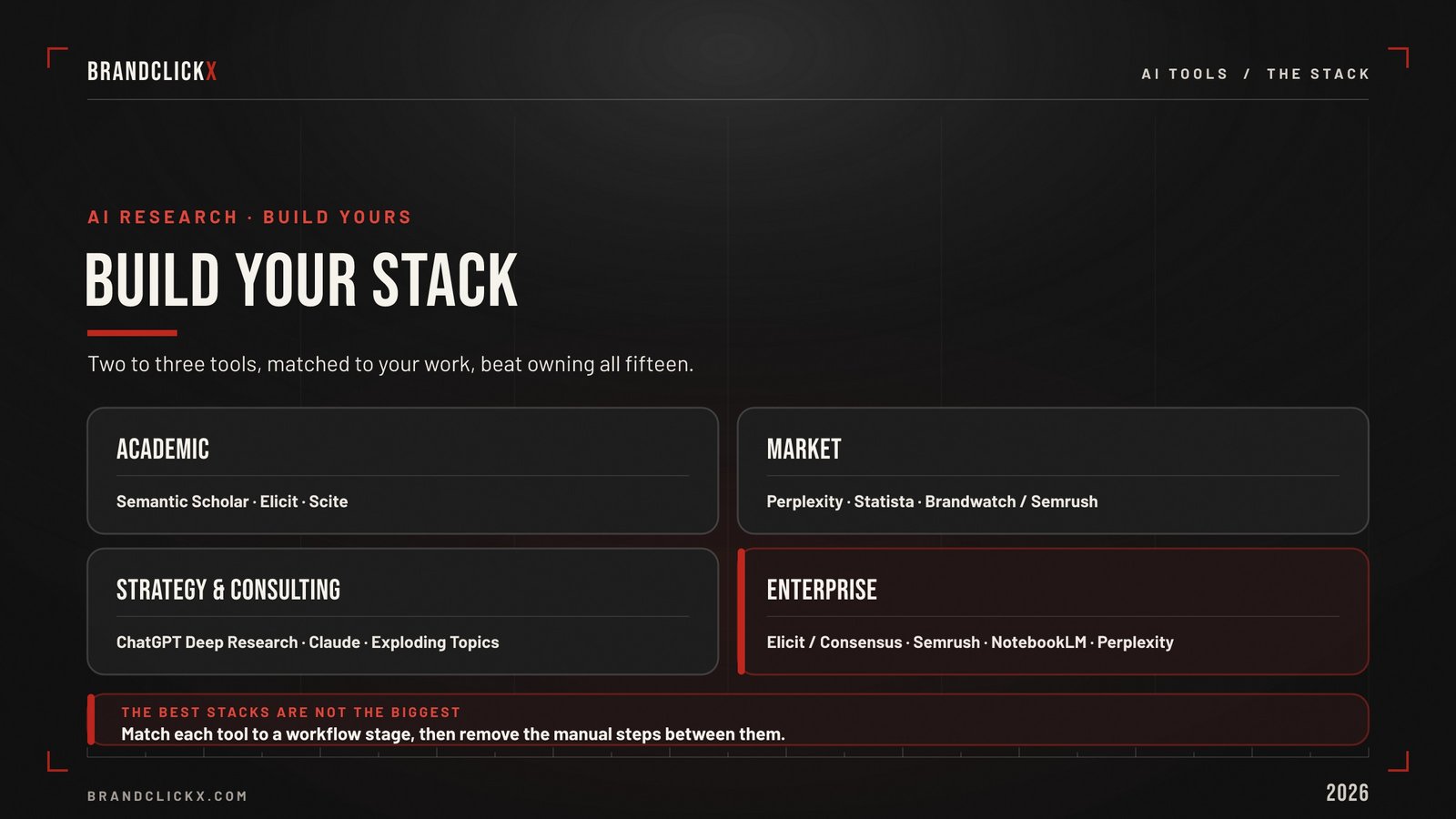
Most serious researchers need 2-3 tools, not all 15.
For academic researchers: Start with Semantic Scholar for discovery, Elicit for systematic screening and extraction, and Scite for citation verification. That stack covers the full academic research workflow at low cost.
For market researchers: Perplexity for real-time cited intelligence, Statista for market sizing data, and Brandwatch or Semrush depending on whether your primary need is social sentiment or competitive digital intelligence.
For strategy and consulting teams: ChatGPT Deep Research for comprehensive investigation briefs, Claude for document analysis and synthesis, and Exploding Topics or SparkToro for emerging trend and audience intelligence.
For enterprise research operations: A combination of an academic tool (Elicit or Consensus), a market intelligence platform (Semrush or Brandwatch), a document synthesis tool (NotebookLM or Claude), and Perplexity for real-time gap-filling.
The research operations achieving the best outcomes in 2026 are not the ones with the most tools. They are the ones that have matched specific tools to specific workflow stages, and removed the manual steps between them.
Key Takeaways
- General AI assistants are the starting point, not the finish line. ChatGPT and Claude are powerful, but they were not built specifically for research. The specialist tools on this list do their specific jobs better than any general AI assistant.
- Citation is the most important capability in a research tool. The difference between a tool that cites its sources and one that doesn’t is the difference between research you can publish and research you have to verify before trusting.
- Most research workflows need 2-3 tools, not one. Discovery, analysis, and synthesis are different tasks. The tools optimized for each are different products.
- The ROI on AI research tools is among the fastest in enterprise AI. The median payback period is 4.2 months. Teams using AI research tools are publishing more, deciding faster, and spending significantly less on research operations than those relying on traditional methods.
- Free tools are genuinely competitive at the top of the market. Semantic Scholar, ResearchRabbit, and Elicit’s free tier cover a significant portion of academic research needs at zero cost. Budget is not the barrier to better research, workflow design is.
FAQ: Best AI Research Tools 2026
What is the best AI tool for research in 2026?
The answer depends on your research type. For cited real-time web research: Perplexity AI. For academic literature reviews: Elicit. For evidence synthesis from peer-reviewed sources: Consensus. For document analysis: Claude or NotebookLM. For competitive intelligence: Semrush or Brandwatch. Most serious workflows combine 2-3 tools.
How much faster does AI make research?
AI research tools compress timelines dramatically. Enterprises report 3-5x faster time-to-insight. The median payback on AI research tooling has compressed to 4.2 months in 2026. McKinsey’s Global AI Survey found a 5.8x average ROI within 14 months of deployment.
Can AI research tools replace Google Scholar?
For approximately 90% of academic research tasks, yes. Consensus and Elicit provide better synthesis than Scholar’s raw results. Semantic Scholar’s 200M+ paper index with AI TLDRs and citation graphs exceeds Scholar’s discovery capabilities for most researchers.
What is the difference between Perplexity AI and ChatGPT for research?
Perplexity cites every claim with a live web source and is optimized specifically for research questions. ChatGPT is a general AI assistant that can hallucinate sources unless Deep Research mode is enabled. For most research tasks, Perplexity is more reliable. ChatGPT Deep Research bridges the gap for comprehensive multi-step investigations.
Which AI research tools are best for marketing and competitive intelligence?
Semrush for competitive digital intelligence and SEO data, Brandwatch for social listening and consumer sentiment, Statista for market sizing and industry benchmarks, Exploding Topics for trend detection, and SparkToro for audience attention mapping.
Conclusion: Research Is Now a Competitive Advantage, If You Have the Right Tools
The researchers who will define the next five years of competitive intelligence, market strategy, academic contribution, and brand decision-making are not the ones working the hardest. They are the ones working with the right tools.
The AI research tool landscape has matured from a collection of over-hyped demos into a genuine professional infrastructure. The tools on this list solve real problems, deliver measurable time savings, and, when combined correctly, compress the gap between question and answer to a degree that fundamentally changes what research teams can accomplish.
The barrier is no longer access. Most of the tools on this list have free tiers that deliver genuine value. The barrier is workflow design, understanding which tool belongs at which stage of the research process, and connecting those stages into a pipeline rather than running them in isolation.
Build the stack. Connect the stages. Move faster than the teams still Googling.