Introduction: The Billion-Dollar Bet on Cutting Out the Middleman
The numbers tell the story better than any pitch deck. The U.S. DTC e-commerce market is on track to reach $212.9 billion in 2026 representing 16.6% growth from 2024. What started as a scrappy experiment in digital-native brand-building has become the dominant commercial architecture of the modern consumer economy.
But the billion-dollar milestone is not a birthright for every brand that builds a Shopify store and buys Instagram ads. It is earned through brand conviction, community investment, and a willingness to treat the customer relationship as a strategic asset rather than a transaction.
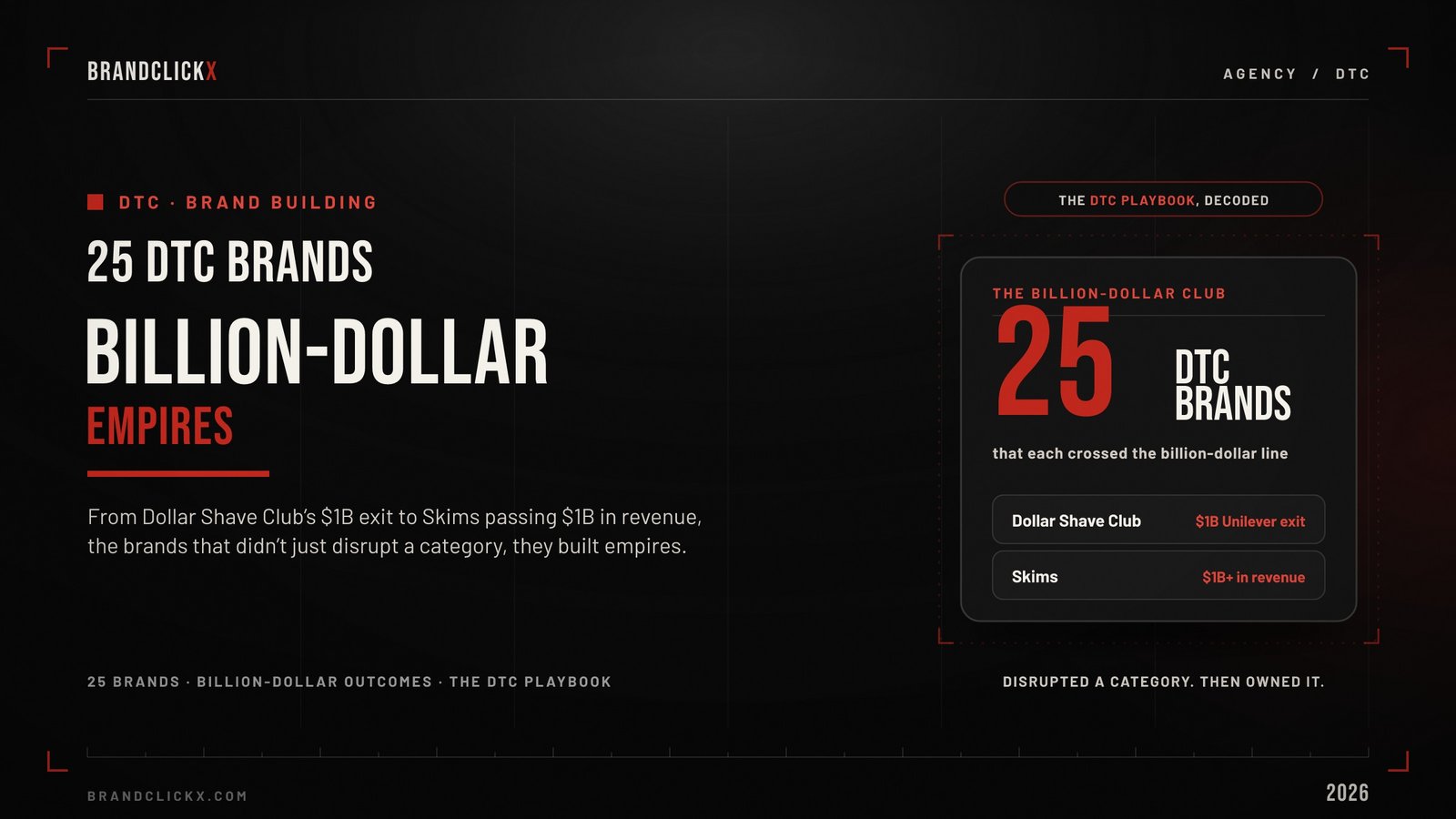
The 25 brands profiled here reached that threshold through radically different paths. Some got there through a single viral moment. Others ground it out over a decade of compounding community trust. A few acquired it, lost it, and rebuilt it on steadier foundations.
What they share is not a funding round or a category it is a fundamental philosophical alignment: the customer is the distribution channel, the product is the marketing, and the brand is the moat.
This is the definitive editorial breakdown of the DTC brands that changed consumer commerce the playbooks, the pivots, the cultural moments, and the hard-won lessons that every CMO, founder, and growth team should understand before building the next one.
Part I: The Original Disruptors DTC Brands That Started the Movement
1. Warby Parker The Blueprint for DTC Disruption
When four Wharton students launched Warby Parker in 2010 with a $95 prescription eyeglass offer and a home try-on program, they weren’t just building an eyewear brand. They were publishing the DTC manifesto.
The thesis was elegant: traditional retail had inflated margins, not justified ones. By removing the optical retailer from the equation and selling direct, Warby Parker could deliver a genuinely better product at one-third the incumbent price and still build a profitable business.
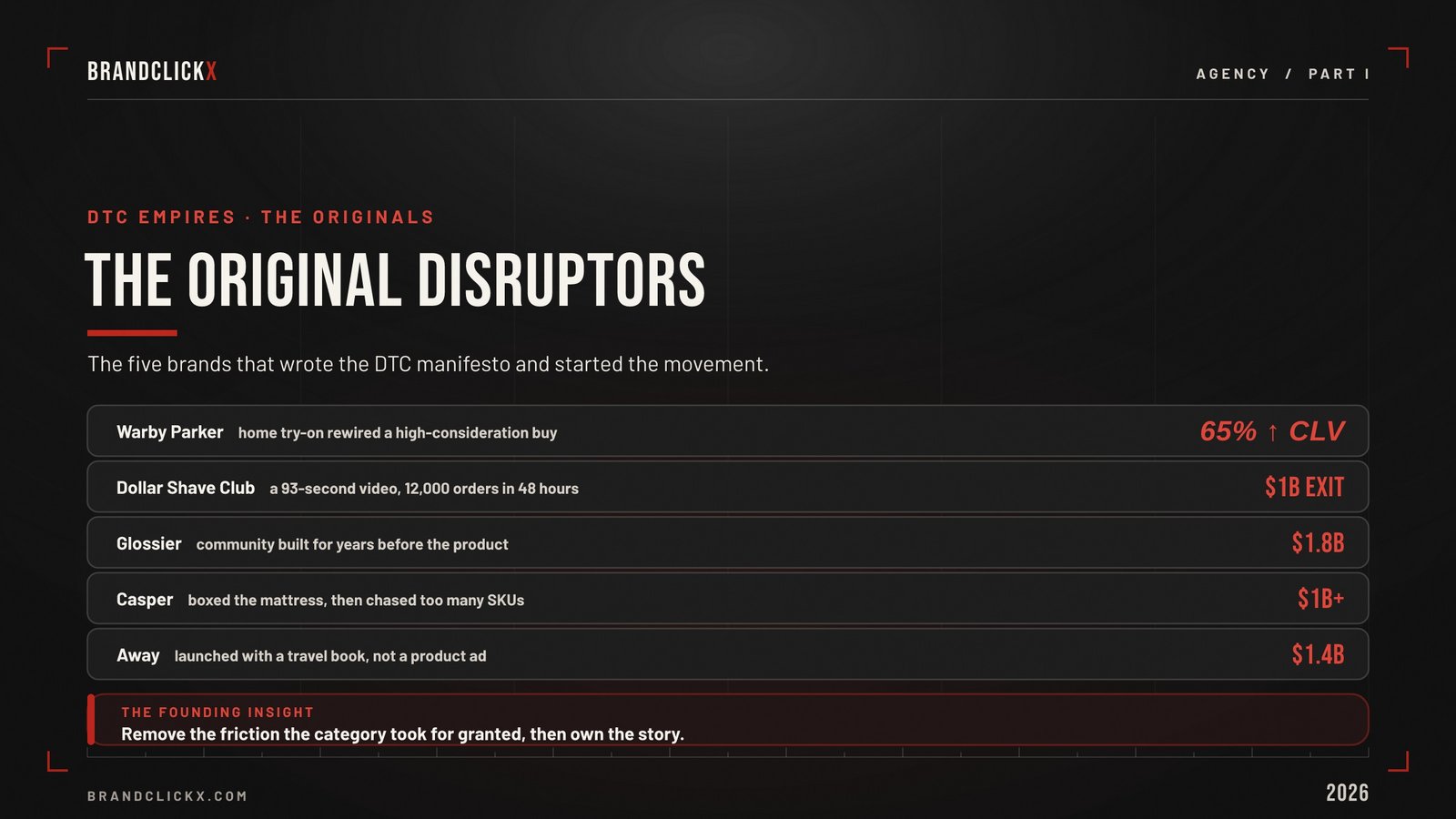
It worked. Warby Parker generates 65% higher customer lifetime value from omnichannel shoppers, a figure that later justified its aggressive brick-and-mortar expansion.
Strategic Breakdown: Warby Parker’s home try-on program was a masterclass in removing the friction specific to its category. Eyewear is a high-consideration, tactile purchase you need to see it on your face. Rather than fighting that reality, Warby Parker designed its entire acquisition model around solving it. Warby Parker reduced purchase friction in a high-consideration category and that insight alone is responsible for more of its success than any campaign or channel investment.
The Bigger Shift: The brand introduced the mission-commerce model at scale: “Buy a Pair, Give a Pair” wasn’t cause marketing bolted on for goodwill it was an acquisition narrative that every customer could share. Within a year of launch, Warby Parker had a waiting list of 20,000 customers and had been named the most innovative company in the world by Fast Company.
Why It Matters for CMOs: Warby Parker established that DTC isn’t a distribution model it’s a brand philosophy. The decision to own the customer relationship directly is a commitment to owning the data, the narrative, and the experience from first impression to final purchase. Every brand that has since described itself as “the Warby Parker of X” understood this, even if they couldn’t always execute it.
2. Dollar Shave Club The Viral Launch That Changed DTC Forever
On March 6, 2012, Michael Dubin uploaded a 93-second video to YouTube titled “Our Blades Are F***ing Great.” It cost $4,500 to produce. It generated 12,000 orders in the first 48 hours. In 2016, Unilever spent $1 billion to buy the company.
The video was not an accident. It was a calculated attack on Gillette’s entire marketing language the pseudo-scientific technology claims, the hyper-produced athlete endorsements, the premium pricing justified by nothing but incumbency.
Dollar Shave Club did the opposite: low production value as a trust signal, direct founder voice, humor as a differentiator, and a subscription model that turned a one-time conversion into recurring revenue.
Tactical Framework: DSC’s growth engine was the subscription. Not because subscriptions are inherently brilliant, but because razors are a replenishment product that consumers genuinely forget to buy. The brand engineered a solution to a real friction point and locked in customer lifetime value in the process.
DSC built continuity around recurring customer need, not forced subscription logic a distinction that separates durable subscription models from the ones customers cancel after 60 days.
Industry Impact: The Dollar Shave Club launch established the YouTube-first DTC launch playbook raw authenticity over production polish, founder voice over celebrity endorsement, category disruption framing over product feature enumeration.
Hundreds of brands have since replicated this formula with varying degrees of success. Almost none have executed it with the same precision.
Expert Insight: The $1B Unilever acquisition validated something the DTC industry had been arguing for years: that brand equity built on customer relationships and community loyalty has quantifiable M&A value, independent of traditional retail distribution footprint.
3. Glossier The Community-Before-Product Model That Built a Beauty Empire
Emily Weiss launched Into The Gloss as a beauty blog in 2010. She spent four years building an audience a community of readers who trusted her editorial judgment and felt genuinely seen by content that celebrated real beauty routines rather than aspirational product shots before launching Glossier as a brand in 2014.
When the products arrived, the community was already there. Not just waiting, but invested. The first product drop sold out within hours. In 2019, Glossier was touting a $1 billion-plus valuation, reaching that threshold within five years of being founded.
Strategic Breakdown: Glossier’s genius was treating media as brand infrastructure, not marketing spend. Into The Gloss wasn’t a customer acquisition tool that happened to produce content it was a brand equity machine that happened to monetize through product.
This sequencing matters enormously: most brands try to build community after launching a product. Glossier proved that building the community first creates a launch mechanism no paid media budget can replicate.
Market Observation: Glossier turned audience attention into product demand, then expanded distribution to reduce channel risk. The later expansion into Sephora a move that some DTC purists criticized as a concession was actually a smart channel diversification play timed precisely when the brand’s earned media velocity had peaked and needed new acquisition infrastructure.
The Bigger Shift: Glossier established that in beauty, the most valuable asset isn’t a formula or a patent it’s a community that trusts you. That trust, accumulated through years of authentic editorial content, translated directly into conversion rates and customer lifetime values that no amount of performance marketing could match.
4. Casper The Mattress That Launched a Category
Before Casper, buying a mattress meant spending three hours on a showroom floor while a commissioned salesperson pressured you toward a $3,000 purchase you couldn’t properly evaluate. Casper identified that the entire purchase experience was broken and rebuilt it from scratch: one mattress, boxed and delivered, with a 100-night free trial that eliminated the decision risk entirely.
In 2019, Casper was touting a $1 billion-plus valuation, reaching that threshold within five years of being founded. It subsequently went public, went private again, and became one of the DTC era’s most cautionary tales about the gap between valuation and unit economics.
Strategic Breakdown: Casper’s original product insight simplify the overcomplicated category was brilliant. Its subsequent strategic error was trying to expand into a full sleep brand (pillows, sheets, dog beds, nightlights) before establishing profitable unit economics on its core product. The brand built extraordinary awareness but never built the margin structure to survive the cost of maintaining it.
Why It Matters: Casper is the essential DTC cautionary tale. A genuinely innovative product, a category-defining launch, and a brand that resonated deeply with its target audience all undone by a business model that depended on perpetually cheap capital to fund customer acquisition. When rates rose and paid social costs compressed margins further, the economics collapsed.
Enterprise Perspective: For growth teams: Casper’s lesson is that a strong brand does not substitute for a profitable unit. The two must be built in parallel. Valuation is not validation.
5. Away The Instagram Suitcase and the Lifestyle Brand Pivot
Away launched in 2015 with a simple insight: luggage was a category defined entirely by function, and nobody had tried to build a lifestyle brand around the travel experience itself. Co-founders Jen Rubio and Steph Korey designed a premium hard-shell carry-on with a built-in phone charger, named it “The Carry-On,” and launched it alongside a book about travel not a product catalogue.
In 2019, Away was touting a $1 billion-plus valuation, reaching that threshold within five years of being founded.
Tactical Framework: Away’s launch book strategy was the DTC industry’s most underappreciated content marketing play. Rather than spending launch capital on performance ads, the brand produced a 140-page editorial publication about travel and offered a $5 store credit with every book purchase, redeemable when the suitcase launched.
It was a pre-launch community-building mechanism disguised as a product launch.
Industry Impact: Away established that DTC brands could compete in hardware categories traditionally dominated by incumbents not by out-engineering them, but by out-narrating them. Rimowa had better zippers. Tumi had better materials. Away had a better story. In the Instagram era, story won.
Part II: The Community-Led Giants Brands That Made Belonging the Product
6. Lululemon The $11 Billion Proof Point for Community-First Brand Building
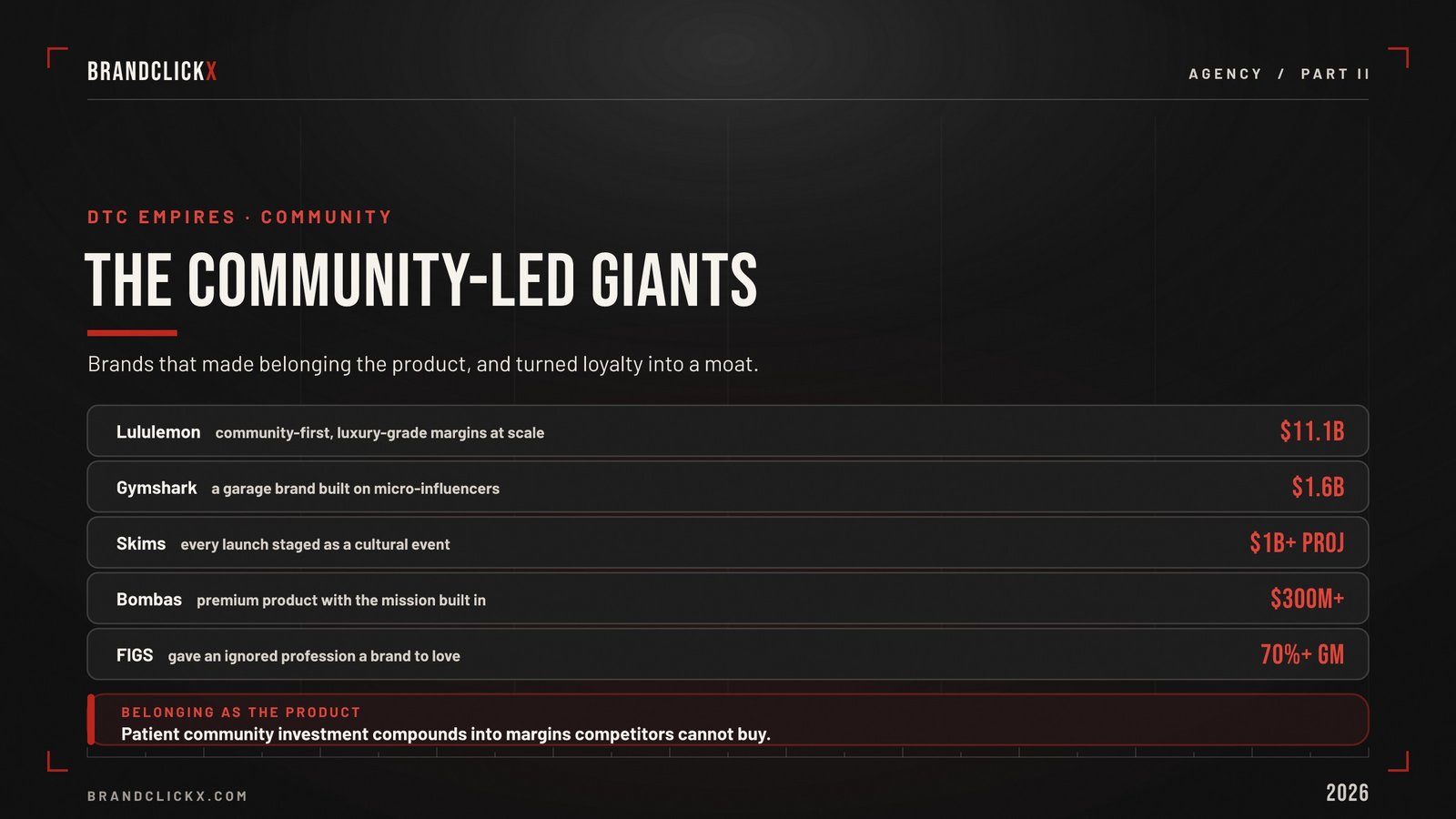
Lululemon is the apex case study in DTC brand architecture. Lululemon leads all publicly-traded DTC and CPG brands at $11.1 billion in fiscal 2026 revenue roughly 6x the next-largest brand in the cohort and generates a 19.9% operating margin, which is closer to a luxury operator than a typical DTC or CPG profile.
The brand built its community engine long before “community-led growth” became a marketing industry framework. In-store yoga classes, local ambassador programs, handwritten customer names on chalkboards every early Lululemon touchpoint was designed to make customers feel like members of a movement rather than purchasers of activewear.
Expert Insight: Lululemon’s G&A leverage at $11B revenue means fixed corporate costs get spread over a revenue base that’s 50–100x most apparel DTC brands. This is the compounding benefit of patient community investment: the brand built customer loyalty so deep that its marketing efficiency at scale is structurally superior to any competitor that tried to buy its way to equivalent awareness.
Strategic Breakdown: Lululemon spends just 5.6% of revenue on marketing compared to FIGS, a comparable premium apparel DTC brand, which spends 22% of revenue on marketing and still generates a lower operating margin.
The differential is not product quality. It is community depth. Lululemon’s ambassador network, its in-store experience, and its product release cadence generate organic demand that paid media cannot replicate at any budget level.
Future Outlook: Lululemon is the clearest evidence that the DTC model, executed with discipline and long time horizons, can produce luxury brand economics in mass-market categories. The brands that will build Lululemon-scale empires in the next decade will be the ones currently investing in community when it’s expensive and the ROI is invisible.
7. Gymshark The Influencer Empire Built From a Garage
Ben Francis founded Gymshark in 2012 at age 19, screen-printing t-shirts in his parents’ garage in Birmingham.
He sent free product to a handful of YouTube fitness creators not celebrities, not professional athletes, but authentic fitness enthusiasts with engaged niche audiences and watched the community build itself.
By 2020, Gymshark had achieved a $1.6 billion valuation through a minority stake sale to General Atlantic, making Francis the UK’s youngest self-made billionaire. It did so without a single piece of traditional advertising.
Tactical Framework: Gymshark invented what the industry now calls “micro-influencer marketing” before the term existed. The strategy was built on two premises that have since been validated by a decade of data: authenticity matters more than reach, and community loyalty converts at higher rates than broad awareness.
Industry Impact: Every DTC brand that now builds an ambassador program, every startup that sends free product to creators with under 100,000 followers, every growth team that prioritizes engagement rate over follower count all operating within Gymshark’s original framework.
The brand proved that a DTC fitness brand could scale to a billion-dollar business on community and authentic influencer relationships alone.
Market Observation: Gymshark also established that DTC is a global model. It built a billion-dollar business from Birmingham not New York, not San Francisco by treating the internet as its primary retail channel and its creator network as its primary media channel.
8. Skims The Cultural Moment as Commercial Strategy
Kim Kardashian launched Skims in 2019 with a $2 million single-day launch. Sacra estimates Skims hit $750 million in revenue in 2023, up 50% year-over-year from $500 million in 2022, with the company projecting surpassing $1 billion in net sales for 2025.
But reducing Skims to “Kim Kardashian’s shapewear brand” misses the actual strategic achievement. Kardashian and co-founder Jens Grede built a brand that didn’t just sell inclusive shapewear it built an identity around inclusivity itself. The product line launched with nine skin tones when competitors offered one or two. The sizing range extended to 5X. Every launch was treated as a cultural event.
Strategic Breakdown: Skims paired cultural relevance with disciplined assortment, sizing, and launch mechanics. This combination founder celebrity with genuine product conviction, cultural moment with operational precision is extraordinarily difficult to replicate. Most founder-led brands get the cultural relevance right or the product discipline right. Skims got both simultaneously.
The Bigger Shift: Skims established that inclusivity is not a brand value it is a product strategy. Serving customers that incumbent brands had historically ignored isn’t charity; it’s an addressable market that nobody else was serving. The revenue proved it.
Enterprise Perspective: The NikeSKIMS collaboration with its Spring ’26 collection available across Europe, the Middle East, Australia, and Korea through Nike’s existing distribution infrastructure represents the ultimate validation: an incumbent athletic giant partnering with a DTC brand to access its cultural relevance and customer loyalty. That is a moat.
9. Bombas Mission Commerce at Scale
Bombas launched in 2013 on the same structural premise as Warby Parker’s “Buy a Pair, Give a Pair” for every pair of socks purchased, one pair is donated to homeless shelters.
But Bombas went further: it designed a genuinely premium product, priced it accordingly, and built the mission into the product quality rather than grafting it onto a commodity.
By 2023, Bombas had donated over 100 million items and surpassed $300 million in annual revenue.
Tactical Framework: Bombas tied mission to a product people already wanted to buy again. This is the key distinction between mission-driven brands that scale and those that plateau: the mission must amplify the repurchase behavior, not substitute for it.
Bombas customers reorder because the socks are excellent. The mission makes them feel good about an economic decision they’d have made anyway.
Why It Matters: Bombas is the proof point that premium mission-driven positioning works in commodity categories. Socks are about as undifferentiated a product as exists in retail. Bombas turned them into a $300M business by engineering both product quality and emotional resonance into the same purchase.
10. FIGS Scrubs as a Status Symbol
Heather Hasson and Trina Spear launched FIGS in 2013 with a mission to redesign medical scrubs a category so commoditized and aesthetically neglected that healthcare workers were either buying shapeless polyester sets from supply catalogues or spending their own money on whatever they could find at uniform shops.
FIGS designed premium scrubs with a fashion sensibility, sold directly to nurses, physicians, and veterinary professionals via DTC, and built a community of healthcare workers who felt genuinely seen by a brand for the first time.
The brand went public in 2021. As of its most recent reporting period, FIGS generates strong gross margins in the 70%+ range among the highest in apparel DTC built on premium pricing and deep professional identity loyalty.
Strategic Breakdown: FIGS identified a professional community with enormous purchasing power and zero brand equity investment from any existing player. It built not just a product but an identity “Awesome Humans” became the brand community rallying point and entered a market where the competitive set was essentially invisible.
Industry Impact: FIGS is the canonical case study for identifying underserved professional communities as DTC brand-building opportunities. The same logic has since been applied to first responders (Grunt Style), teachers (School of Rock branded merchandise), and tradespeople (Duluth Trading Co.).
Part III: The Growth Hackers DTC Brands That Engineered Scale
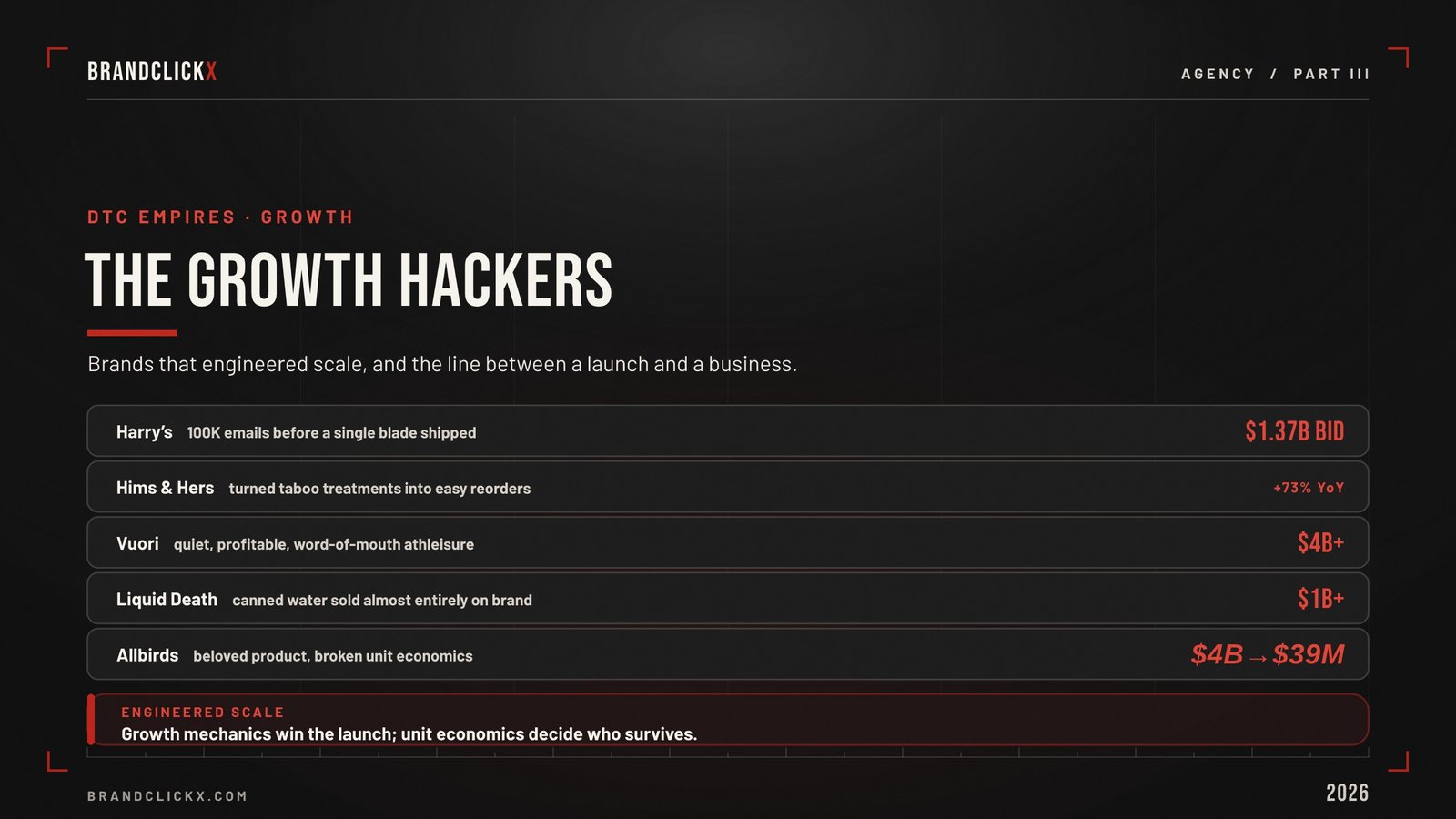
11. Harry’s The Distribution Coup Disguised as a Brand Launch
Harry’s launched in 2013 as a Dollar Shave Club competitor premium German-engineered blades, direct delivery, anti-Gillette positioning. What made Harry’s different wasn’t the product. It was the pre-launch.
The founding team built a referral loop before a single blade had shipped: a landing page that rewarded users for referring friends with free product, scaled via email. They acquired 100,000 email subscribers before launch day. The referral mechanic invite three friends, get a free razor; invite 50, get a year of free blades generated 77,000 referrals in the first week.
Tactical Framework: Harry’s pre-launch referral program is one of the most studied growth engineering moments in DTC history. It established that DTC brands can build significant launch momentum at near-zero cost by designing the acquisition mechanism into the pre-launch experience itself. The product doesn’t exist yet. The community does.
Market Observation: Harry’s subsequent attempted acquisition by Edgewell Personal Care for $1.37 billion was blocked by the FTC on antitrust grounds a validation of the brand’s market position that no analyst report could have provided. It has since continued to scale independently, establishing a retail presence alongside its DTC channel.
12. Hims & Hers Taboo as a Market Opportunity
Hims launched in 2017 with a thesis that the healthcare industry had created a massive untapped market by making certain treatments hair loss, erectile dysfunction, skincare unnecessarily embarrassing to access.
By building a telehealth-adjacent DTC platform with a confident, destigmatizing brand voice and direct-to-door delivery, Hims removed the friction of the pharmacy visit entirely.
Hims & Hers Q2 2025 revenue was up approximately 73% year-over-year.
Strategic Breakdown: Hims & Hers is the defining case study in taboo-market DTC positioning. The brand’s insight was not that people needed hair loss treatments those had existed for decades.
The insight was that the purchase experience was broken: stigmatized, physician-gated, pharmacy-dependent, and deeply uncomfortable. Hims rebuilt the entire acquisition and delivery architecture around dignity and convenience.
Expert Insight: Hims & Hers built continuity around recurring customer need, not forced subscription logic. This distinction matters commercially: a subscription model built on genuine recurring need generates lower churn than one built on inertia. Healthcare is the purest version of recurring need if the treatment works, patients reorder because stopping has consequences.
Future Outlook: As GLP-1 medications (Ozempic-class weight loss drugs) move into DTC distribution channels, Hims & Hers is positioned as the infrastructure brand for a market that could dwarf its current revenue base. The brand already has the telehealth stack, the DTC distribution model, and the consumer trust. The category is arriving at its doorstep.
13. Vuori The $4 Billion Athleisure Underdog
Most people in the marketing industry didn’t know Vuori existed until it was already worth $4 billion. Founded in 2015 in Encinitas, California by Joe Kudla, Vuori built a premium athleisure brand positioned around versatility performance fabric you could wear from the yoga studio to a dinner table and grew almost entirely on word of mouth and a fanatically loyal customer base.
Vuori continues outlier growth in premium athleisure, with sales up approximately 23% year-over-year in late 2024 and an accelerated global retail rollout toward 100 stores by 2026.
Why It Matters: Vuori is the counter-narrative to the “DTC brands need venture capital and paid social to scale” thesis. It grew quietly, profitably, and without generating the kind of press that accompanies venture-backed hypergrowth.
Its $4B valuation arrived without a flashy Series A announcement or a viral campaign. It arrived because the product was excellent and the customer kept coming back.
Strategic Breakdown: Vuori’s retail expansion is strategic rather than defensive. Unlike DTC brands that open stores because their online CAC has made the economics unsustainable, Vuori is expanding physical retail as a brand amplification mechanism using stores in high-traffic markets to drive awareness that feeds back into DTC channels.
14. Liquid Death Brand as the Entire Product
Liquid Death sells canned mountain water. Its competitive advantage is entirely brand there is no meaningful product differentiation between canned water brands.
And yet, through heavy metal imagery, skull branding, “Murder Your Thirst” taglines, and a social media strategy that consistently refuses to behave like a beverage brand, Liquid Death has built a business valued at over $1 billion.
The Bigger Shift: Liquid Death is the purest proof point for brand-as-moat in commodity categories. The product is indistinguishable from its competitors in blind taste tests. The brand is unrecognizable from any of them in cultural presence. At sufficient brand temperature, consumers will choose the story over the substance every time.
Industry Impact: Liquid Death has become the most studied brand in the “brand over product” category cited by marketing strategists as evidence that distinctive brand personality, consistently applied across every consumer touchpoint, can build defensible market share in categories where product innovation is essentially impossible.
15. Allbirds The Rise, The Fall, and the Essential Lesson
Allbirds launched in 2016 with wool shoes, a sustainability mission, and a product so comfortable that Vogue called it “the world’s most comfortable shoes.” By 2021, Allbirds was valued at more than $4 billion on its first day of trading.
By 2026, Allbirds sold for $39M a 99% collapse from its IPO valuation.
Why It Matters: Allbirds is the DTC era’s most important cautionary tale because it had everything that’s supposed to work: a differentiated product, a compelling mission, genuine consumer love, and massive brand awareness. What it didn’t have was a profitable unit economic model.
The company raised approximately $270M in its November 2021 IPO, but the fundamental economics of its customer acquisition model high paid social dependency, a crowded sustainability positioning that attracted imitators, and a product line expansion that diluted focus never resolved.
Expert Insight: Allbirds teaches the hardest DTC lesson: brand equity and business model are separate constructs. Consumers can love a brand and still not generate enough lifetime value to justify the cost of acquiring them. The two must be aligned. They weren’t.
Part IV: The Category Creators DTC Brands That Invented New Markets
16. Peloton The Connected Fitness Empire (and the Rebound)
Peloton launched in 2012 with a $2,000 stationary bike and an audacious promise: bring the energy of a boutique fitness class into your home, on demand. By 2020, pandemic-era tailwinds had pushed its market cap above $50 billion. By 2022, it had collapsed to under $3 billion.
The rise and fall of Peloton is not really a DTC story it is a brand story about what happens when a product’s cultural moment and its unit economics fall out of alignment simultaneously. The brand invented a category.
It built a passionate community. And it over-invested in production capacity at precisely the moment demand was normalizing post-pandemic.
Strategic Breakdown: Peloton’s instructor-as-celebrity model was its most durable brand innovation. Robin Arzón, Cody Rigsby, Alex Toussaint these were not fitness instructors. They were media personalities who happened to teach classes on a bike. The community loyalty they generated is the brand equity that has kept Peloton viable through two years of existential operational challenges.
Future Outlook: Peloton’s 2026 turnaround, driven by a focus on software subscriptions and content licensing rather than hardware, is a textbook pivot from DTC hardware company to media and content platform. The community is the asset. The bike is now the acquisition vehicle.
17. Everlane Radical Transparency as Brand Architecture
Everlane launched in 2011 with a proposition that felt radical at the time: show customers exactly what a garment costs to produce, what the retail markup is, and why the price is what it is. “Radical Transparency” was the brand’s founding value and its primary differentiator in a fast fashion market built on obscured supply chains.
The brand built a $250M+ revenue business on this foundation proving that consumers will pay premium prices for products backed by verifiable ethical commitments.
Market Observation: Everlane’s radical transparency model anticipated by a decade the regulatory and consumer pressure that is now forcing the entire apparel industry to disclose supply chain data. Brands that built transparency into their identity early are structurally better positioned for a market environment where opacity is increasingly a liability.
18. Stitch Fix The Algorithm as Personal Stylist
Stitch Fix launched in 2011 with a thesis that personal styling was a service the mass market couldn’t access and that data science could democratize it.
Customers completed a style profile, received a curated “Fix” of five clothing items from a human stylist assisted by machine learning recommendations, and paid only for what they kept.
The model drove extraordinary customer intimacy data every returned item was a preference signal and built a personalization engine that traditional retailers couldn’t replicate.
Enterprise Perspective: Stitch Fix proved that data-driven personalization, when combined with genuine human curation, can build extraordinary loyalty in a commoditized category.
Its challenges scaling the model profitably as customer acquisition costs rose don’t diminish the original innovation. They demonstrate that data advantages require operational discipline to monetize.
19. Bonobos The Fit Problem as Business Model
Bonobos was founded in 2007 by Andy Dunn and Brian Spaly at Stanford Business School, with a thesis that men’s pants fit terribly and that nobody had designed a pair of chinos that actually worked for normal human bodies. The product solved a real problem. The DTC model made it accessible.
Walmart acquired Bonobos for $310 million in 2017 one of the first significant DTC exits and a validation of the DTC model by the world’s largest traditional retailer.
Tactical Framework: Bonobos invented the “guideshop” physical retail locations where customers could try on clothing and order for delivery, with no inventory held in-store. This hybrid model anticipated the omnichannel future by five years and established a retail format that several DTC brands have since adopted.
20. ThirdLove Data-Driven Fit in an Underserved Category
ThirdLove launched in 2013 with a bra-fit quiz that used customer data to recommend the right size from an expanded size range that traditional lingerie brands had consistently ignored.
The brand identified that the standard retail bra sizing system was inadequate for most women’s bodies and built a business around solving that problem directly.
Within five years, ThirdLove had collected fit data from over 15 million women a proprietary dataset that competitors cannot replicate and used it to expand into 78 sizes at a time when most retailers offered 30.
Why It Matters: ThirdLove established that data collection, when structured as a value exchange give us your fit data, we give you a bra that actually fits is both a customer acquisition mechanism and a product development infrastructure simultaneously.
Part V: The New Guard DTC Brands Defining the Next Billion
21. Rhode The Creator Economy DTC Template
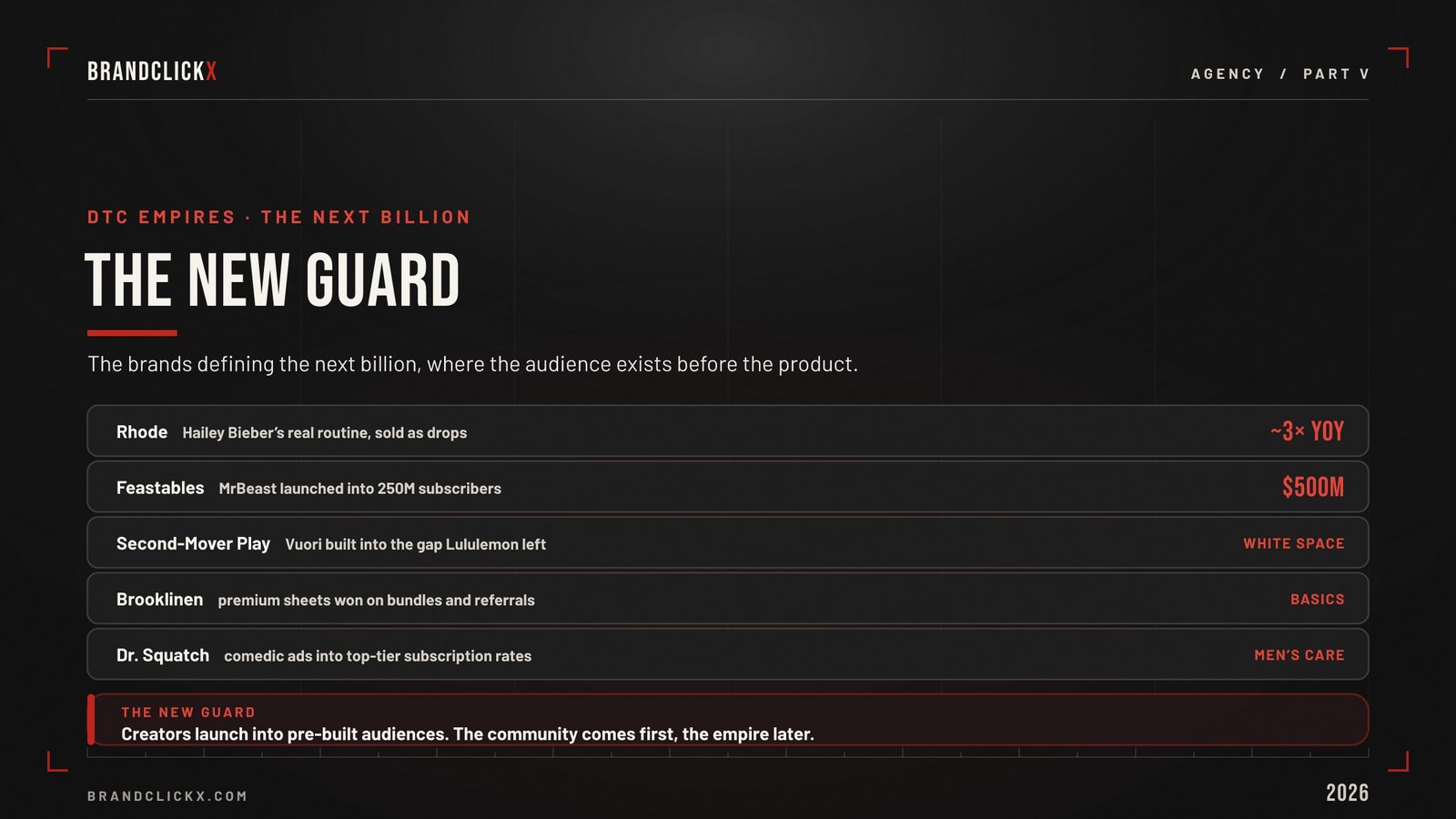
Hailey Bieber launched Rhode Skin in 2022. The brand nearly tripled sales year-over-year, becoming one of the fastest-growing skincare DTC brands in recent history.
It did so by treating every product drop as a cultural event, leveraging Bieber’s social media presence not as a celebrity endorsement vehicle but as a genuine expression of the founder’s actual skincare routine.
The Bigger Shift: Rhode is the clearest signal of where DTC brand-building is heading: founders and creators who are already media entities building brands that extend their existing audience trust. The customer relationship is established before the product exists. The launch is a conversion event, not an awareness event.
22. Feastables The Creator-Led Commerce Era
MrBeast launched Feastables chocolate bars in 2022 with the most powerful distribution mechanism in modern commerce: 250 million YouTube subscribers who trust him implicitly. Feastables was projected to surpass $500 million in revenue by 2025, tripling growth since its 2022 debut.
Strategic Breakdown: Feastables represents the logical endpoint of the creator economy DTC model: a brand that doesn’t need to build an audience because it launched into one.
The traditional DTC challenge building brand awareness at sustainable CAC is essentially eliminated when the founder has a pre-built, engaged, global audience that treats product recommendations as content they actively seek out.
Industry Impact: Feastables signals that the next generation of billion-dollar consumer brands may not emerge from venture-backed startups or traditional CPG innovation they may come from creator ecosystems where distribution is already solved and brand trust is pre-established.
23. Vuori vs. Lululemon The Second Mover Advantage
Worth noting separately from the earlier Vuori entry: Vuori’s strategic patience in entering a market that Lululemon dominated is itself a case study in how DTC brands can find billion-dollar white space in seemingly saturated categories.
Vuori identified that Lululemon’s yoga-first identity left a performance-versatility positioning gap, particularly for men, and built quietly into that gap for five years before its valuation became public knowledge.
Market Observation: The DTC category is not a first-mover-wins game. It is a brand-depth game. The brand with the deeper customer relationship, the higher NPS, and the more defensible community wins regardless of when it entered the market.
24. Brooklinen The White Space in Premium Basics
Brooklinen launched in 2014 with luxury bed sheets at a price point that undercut the established players (Parachute, Frette) while maintaining the quality markers long-staple cotton, high thread count, European finishing that justified the premium over mass-market alternatives.
Brooklinen used merchandising, bundles, and offer structure to win in a crowded category. The brand’s referral program, bundle pricing strategy, and customer education content (thread count is marketing, not just specification) built a loyal customer base in a category where retention is structurally challenging because sheets don’t need to be replaced frequently.
25. Dr. Squatch Men’s Personal Care and the Subscription Conversion Play
Dr. Squatch launched in 2013 with natural ingredient men’s soap and a distinctly masculine brand voice that stood in direct contrast to the clinical, gender-neutral positioning of most personal care brands. Its YouTube advertising long-form, comedic, informative became a masterclass in direct response creative that doesn’t feel like an ad.
Dr. Squatch made consumables easier to repurchase through distinct creative and a clear subscription path. Its conversion from one-time purchase to subscription is among the highest in the personal care DTC category a function of product quality that justifies the subscription and brand affinity that makes the auto-renew feel like a choice rather than inertia.
The DTC Billion-Dollar Framework: What These 25 Brands Share
| Growth Driver | Best Example | What It Enabled |
| Community before product | Glossier | Guaranteed launch demand, zero paid acquisition |
| Friction removal | Warby Parker, Casper | Category entry at scale; purchase barrier eliminated |
| Mission commerce | Bombas, TOMS | Built-in shareability; premium price justification |
| Influencer authenticity | Gymshark | Billion-dollar brand on zero ad spend |
| Subscription mechanics | Dollar Shave Club, Hims | LTV multiplication; churn resistance |
| Cultural moment engineering | Skims, Rhode | Launch-day demand that no ad budget can replicate |
| Data as product | Stitch Fix, ThirdLove | Proprietary competitive moat; personalization at scale |
| Creator-led distribution | Feastables, Rhode | Pre-built audience; CAC effectively zero |
| Brand-over-product | Liquid Death, Allbirds | Premium pricing in commodity categories |
| Patient community compounding | Lululemon, Vuori | Operating margin and LTV that incumbents cannot match |
Key Takeaways for CMOs and DTC Founders
- The purchase friction you remove is often more valuable than the product you sell. Warby Parker’s home try-on, Casper’s 100-night trial, Harry’s pre-launch referral loop each identified the specific friction that was suppressing purchase intent in its category and engineered a direct solution. Finding that friction is a strategic exercise, not a UX one.
- Subscription models only work when the recurring need is genuine. Dollar Shave Club, Hims & Hers, and Dr. Squatch all built subscription models around authentic replenishment needs. Brands that force subscription mechanics onto categories that don’t have genuine recurring need discover their churn numbers in the worst possible way.
- Community built before launch is worth more than community built after. Glossier’s four years of Into The Gloss before a single product sold, Harry’s 100,000 pre-launch emails, Gymshark’s influencer relationships before its first paid ad in each case, the community investment preceded the commercial return by years. The brands that try to short-circuit this sequence with paid media are the ones with mediocre LTV numbers.
- The DTC model has evolved channel agnosticism is the new DTC. The pure-play DTC model is effectively dead for brands seeking scale. Successful brands like Warby Parker and Glossier have proven that DTC is just one channel in a broader ecosystem that includes wholesale, physical retail, and partnerships. The data and margin advantages of DTC remain but distribution breadth is no longer a concession. It’s the strategy.
- Unit economics must be solved before scale, not after. Allbirds is the proof. Casper is the proof. The DTC brands that built billion-dollar empires that endure Lululemon, Bombas, FIGS, Vuori all reached billion-dollar status with business models that worked at smaller scales first. Valuation is not a business model.
FAQ: DTC Brands Billion Dollar
What is a DTC brand?
A DTC (direct-to-consumer) brand sells products directly to customers without retail middlemen, typically via owned e-commerce channels. This model gives brands control over pricing, customer data, and the full purchase experience enabling stronger margins and deeper customer relationships than traditional wholesale distribution.
Which DTC brands have reached billion-dollar valuations?
Notable DTC brands that have reached billion-dollar status include Lululemon ($11.1B revenue in FY2026), Skims (projected $1B+ in 2025), Gymshark ($1.6B valuation), Warby Parker (public, $1B+ market cap), Dollar Shave Club ($1B acquisition by Unilever), Glossier ($1.8B valuation at peak), Away ($1.4B valuation), Hims & Hers (public, strong growth), FIGS (public), and Vuori ($4B+ valuation).
What marketing strategies do successful DTC brands use?
The most successful DTC brands share several common strategies: community-first brand building before product launch, influencer and ambassador programs that prioritize authenticity over reach, subscription models that convert one-time buyers into recurring revenue, UGC-driven content engines that reduce paid media dependency, and omnichannel expansion timed to match brand heat rather than chasing volume.
Why did some DTC brands fail despite high valuations?
Many venture-backed DTC brands including Allbirds, which sold for $39M after a $270M IPO failed because they prioritized growth over unit economics, relied too heavily on paid social acquisition as iOS privacy changes compressed returns, and never built the operational infrastructure needed for sustainable profitability. High valuations masked structurally unprofitable customer acquisition models.
Is the DTC model still viable in 2026?
Yes, but it has matured. The DTC e-commerce market in the United States is set to reach $212.9 billion in 2026, representing 16.6% growth from 2024. However, the most successful brands now operate as channel-agnostic businesses using DTC as a data and margin advantage while expanding into wholesale, retail, and international channels as they scale.
Conclusion: The Billion-Dollar Lesson the DTC Era Keeps Teaching
The brands that built billion-dollar empires in the DTC era did not succeed because the model was easy or the capital was cheap. They succeeded because they understood something fundamental about the relationship between brand and customer that traditional retail had obscured for decades: the direct relationship is the moat.
Every piece of first-party data collected, every community touchpoint built, every subscription converted, every NPS point earned these are compounding assets that incumbents cannot buy and competitors cannot easily replicate. The DTC brands that are still standing in 2026 are the ones that understood this and built around it, rather than treating DTC as a distribution tactic and brand as a marketing expense.
The industry has shifted toward channel agnosticism the goal is no longer to “cut out the middleman” exclusively, but to be available wherever the consumer prefers to shop. The brands that built genuine customer relationships during the DTC era carry those relationships into every new channel they enter. That’s the advantage the next billion-dollar DTC empire will be built on not a smarter algorithm or a cheaper acquisition channel, but a community that chose the brand when it didn’t have to.
The next 25 billion-dollar DTC brands are being built right now. Most of them don’t look like billion-dollar brands yet. They look like a blog with 50,000 readers, or a Discord with 10,000 members, or a YouTube channel with an audience that trusts its creator more than any brand they’ve ever bought from. The empire comes later. The community comes first.