
Quick Answer
The defining healthcare marketing trends in 2026 are AI-powered personalization, Answer Engine Optimization for AI-driven search, omnichannel convergence of HCP and DTC campaigns, privacy-first measurement infrastructure, and clinician-led short-form video replacing polished brand content. Pharma digital ad spend has crossed $26.2 billion versus just $6.9 billion for traditional channels the budget has already shifted; the strategy needs to follow.
The market numbers are striking. The global healthcare marketing and communications market grew to $26.52 billion in 2026 and is projected to reach $43.26 billion by 2032 at an 8.43% CAGR. The healthcare digital marketing segment specifically is valued at $6.4 billion in 2026 and growing at 18% annually. Healthcare organizations that treat marketing as a measurable revenue function rather than a cost center are pulling ahead.
Why 2026 Is a Turning Point for Healthcare Marketing
Three forces converged in 2025-2026 to permanently change how patients find, evaluate, and choose healthcare: the mass adoption of AI-driven search, the collapse of third-party cookie infrastructure, and a sharp shift in patient behavior toward digital-first care journeys.
Nearly 70% of patients now start their care journeys online, and 82% research providers before booking. More than 70,000 health-related Google searches occur every minute. The organizations capturing this intent define the future of patient acquisition.
The AI layer on top of that search behavior is the structural change that most healthcare marketers are still underestimating. 37% of US consumers already use generative AI for health-related research, and those searches don’t always lead back to your website. The implications for healthcare content marketing, SEO, and advertising reach every channel simultaneously.
Trend 1: AI in Healthcare Marketing Moves from Pilot to Production

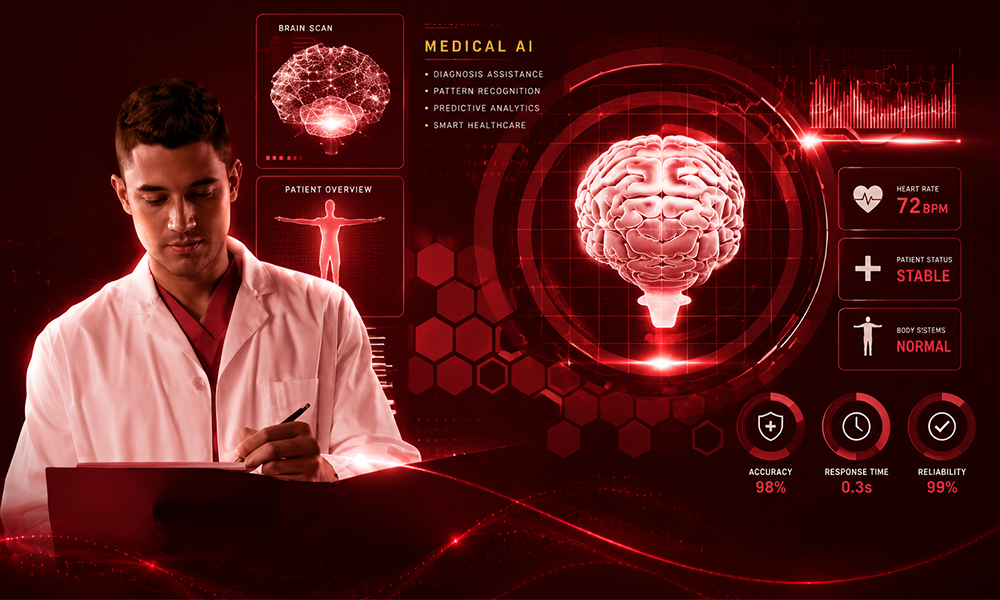
75% of US health systems now use at least one AI application, up from 59% in 2025. 69% of healthcare marketers rank generative AI as a critical technology trend, and about 68% of healthcare providers plan to use AI to improve lead generation and qualification.
The ROI data is beginning to validate the investment. More than half of health systems able to quantify return on their deployed AI solutions reported a 2x ROI. Healthcare marketing shows the fastest growth in AI adoption since 2023, with a 40% increase in implementation over just two years.
But there’s a significant gap between intention and execution. Deloitte’s 2026 Life Sciences Outlook, surveying 280 C-suite biopharma and medtech executives, found that while nearly 80% say future competitiveness depends on effectively harnessing AI, only 22% have successfully scaled it, and just 9% report significant ROI.
What AI is actually doing in healthcare marketing: Generative AI scales personalized content production at 3x to 6x speed. Predictive analytics identify patients likely to need specific services before they actively search. AI-powered chatbots handle scheduling, follow-up reminders, and triage with documented no-show reductions of 30% for practices that implement them. Conversational AI tools analyze call recordings to map patient language patterns directly into content strategy.
The compliance reality: All of this operates under HIPAA. Healthcare marketing automation that uses patient data for targeting requires careful structuring: zero-party data collected directly from patients through symptom checkers, preference centers, and intake forms is consent-based, HIPAA-safe, and more accurate than any inferred data set. Practices that build this asset in 2026 hold an advantage that competitors can’t buy.
Trend 2: Answer Engine Optimization Becomes as Critical as SEO

52% of health-related searches now display Google AI Overviews the highest rate of any industry making authoritative, well-structured content more critical than ever.
This changes the game for healthcare digital marketing in a specific way. AI Overviews and conversational search engines like Perplexity synthesize answers from multiple sources. If your content isn’t structured for extraction clear headings, schema markup, ungated access, plain-language FAQs, and consistent metadata AI systems skip it regardless of how accurate it is.
The patient journey now frequently looks like this: AI Overview answers the initial question → patient is directed to two or three source sites → provider website is one of them, or it isn’t. There’s no second page. For healthcare consumer behavior, this means the top-of-funnel has moved inside the AI response itself.
What this means for healthcare content marketing: Create accessible, indexable content with schema markup, query-oriented headings, and clear author credentials. Topical authority matters to both human readers and AI systems. Physician bylines and verified medical reviewer credits aren’t just trust signals for readers they’re AI citation signals. Healthcare content with clearly identified medical reviewers consistently outperforms anonymous content in both engagement and rankings.
Trend 3: Omnichannel Healthcare Marketing HCP and DTC Convergence

For years, healthcare marketing strategy kept healthcare provider (HCP) campaigns and direct-to-consumer (DTC) campaigns as entirely separate operations. Different agencies, different timelines, different data.
Veeva’s analysis of coordinated HCP-DTC strategies found clear, consistent lift in new patient starts based on how channels were combined. The implication: reaching a patient and their physician with coordinated messaging, not just parallel messaging, drives materially better outcomes.
The separation is now a measurable cost. A patient sees a condition-focused ad. They discuss it at an appointment. If their physician hasn’t received corresponding education through professional channels, the conversation goes nowhere. Coordinated omnichannel healthcare marketing closes that gap by timing HCP outreach to align with patient-facing campaigns.
Pharma marketing implications: With pharma digital ad spend forecast at $26.2 billion in 2026 versus $6.9 billion for traditional channels, the channel shift isn’t speculative it’s already structured into planning cycles. The question for pharma marketing teams is whether the HCP and DTC investment cycles are synchronized or still running on separate calendars.
Trend 4: Privacy-First Measurement as Competitive Advantage
The deprecation of third-party cookies and HIPAA’s strict limits on pixel-based tracking have forced a reckoning across healthcare advertising. The organizations slow to adapt are flying blind on attribution. The ones that moved early now hold a genuine measurement advantage.
What privacy-first measurement looks like in practice: First-party data collected through owned channels, clean room integrations that allow campaign performance analysis without sharing protected health information, call tracking as a primary conversion event (calls convert to 10x to 15x more revenue than web leads), and patient satisfaction surveys that feed back into content targeting. HIPAA compliance is no longer just a legal checkbox it’s measurement infrastructure.
The zero-party data opportunity: Healthcare organizations building consent-based data strategies in 2026 through telehealth triage tools, symptom checkers, and patient preference centers are creating an asset their competitors literally cannot copy.
Trend 5: Clinician-Led Content Outperforms Polished Healthcare Advertising
Short-form, clinician-recorded video has emerged as the highest-performing content format across healthcare digital marketing in 2026. Polished brand videos with actor portrayals and carefully scripted voiceovers are losing ground to physician-recorded clips, patient testimonials, and care team explainers. Authenticity converts better when the topic is personal health.
The data behind this is consistent across sources. Consumers are 2x to 3x more likely to trust healthcare ads featuring real clinicians over branded creative alone. Doctors with active social content see 22% more referral patients. Patient testimonial videos generate 3.8x more engagement and 2.1x more shares than other content types, according to HIMSS benchmarks.
Short-form video now accounts for over 50% of paid social engagement in healthcare campaigns. Instagram Reels drive a 2.7% engagement rate in healthcare, ahead of static posts on every major platform.
The practical model: A 60-second physician-recorded clip, filmed on a phone, published monthly, with explicit patient consent, distributed across a practice website, Google Business Profile, Instagram Reels, and YouTube Shorts, is the single most efficient piece of healthcare content to produce in 2026. It’s also exactly the type of content AI search systems cite because it carries real human context and primary-source authority.
Trend 6: Patient Engagement Strategies Shift Toward Access-First Messaging
A Kyruus survey found that 61% of consumers say the availability of online appointment scheduling is extremely or very important when choosing a new provider, service, or location for care. Patients don’t just want to know who you are. They want to know how quickly and easily they can access care.
Patient engagement strategies that lead with availability same-day bookings, telehealth as default for appropriate visits, transparent wait times outperform awareness-only campaigns in actual patient acquisition. Frictionless access has become the core value proposition in healthcare consumer behavior.
Telehealth has become the primary expansion lever in this area. Healthcare organizations bundling telehealth with in-person care are seeing stronger patient retention, and AI-powered scheduling systems are reducing the front-desk burden that has historically made fast access difficult to deliver.
Trend 7: Healthcare Marketing Automation at Scale
Companies leveraging AI technologies reduce customer acquisition costs by approximately 25%. AI-assisted content speeds production by 3x to 6x. Personalized engagement via generative AI boosts patient retention measurably.
Healthcare marketing automation in 2026 covers the full patient lifecycle: pre-visit education delivered based on appointment type, post-visit follow-up personalized to the care provided, reactivation sequences for patients who haven’t returned, and referral nurturing for physician relationships. The challenge is HIPAA-safe implementation automated sequences that touch protected health information require specific technical architecture that most general marketing platforms don’t provide out of the box.
The AI Care Standard context: In February 2026, a coalition of health systems, clinical innovators, and patient safety leaders launched the AI Care Standard a framework requiring direct patient communication, accuracy, transparency, and accountable governance from any AI system interacting with patients. Healthcare marketing automation now operates against an explicit ethics and governance backdrop, not just a regulatory one.
Healthcare Marketing by the Numbers: 2026 Data Snapshot
| Metric | Figure | Source |
| Healthcare marketing & comms market size | $26.52 billion | Revenue Memo/Grand View Research |
| Pharma digital ad spend | $26.2 billion | Industry forecast |
| Pharma traditional ad spend | $6.9 billion | Industry forecast |
| AI in patient engagement market | $10.91 billion | Toward Healthcare |
| US health systems using AI | 75% | Healthcare analytics |
| Patients who research online before booking | 82% | Industry survey |
| Health searches showing AI Overviews | 52% | Google Health data |
| Consumers using AI for health research | 37% | Industry research |
| Chatbot impact on no-shows | -30% | Healthcare operators |
| Video engagement vs. text in healthcare | 10x | HIMSS |
| Content marketing leads vs. outbound cost | 62% less | Industry benchmark |
Key Takeaways
- AI in healthcare marketing has crossed into production, not pilot. 75% of health systems use at least one AI application, but only 9% report significant ROI execution gap is the challenge, not technology availability.
- Answer Engine Optimization is now table stakes. 52% of health searches surface AI Overviews, the highest rate of any industry. Content structured for AI extraction outperforms content structured for traditional SEO alone.
- HCP and DTC convergence drives measurable lift. Siloed campaigns cost healthcare organizations actual patient starts. Coordinated omnichannel healthcare marketing produces consistently better outcomes.
- Privacy compliance is now a marketing advantage. Organizations with clean first-party and zero-party data infrastructure can measure and personalize in ways HIPAA-constrained competitors cannot.
- Authentic, clinician-led content outperforms polished healthcare advertising. Short-form video featuring real physicians converts 2x to 3x better than brand creative and is the primary format AI systems cite from.
FAQ: Healthcare Marketing Trends
What is the biggest healthcare marketing trend in 2026?
AI-driven personalization and Answer Engine Optimization for AI search are the two structural shifts with the broadest impact both require rethinking how content is created, structured, and distributed.
How is AI changing patient engagement strategies?
AI handles scheduling, follow-up, triage, and personalized content delivery at scale, while freeing clinical staff from administrative burden. Documented outcomes include 30% reductions in no-shows and 2x ROI on AI-deployed health systems.
What is omnichannel healthcare marketing?
Coordinating HCP (healthcare provider) and DTC (direct-to-consumer) campaigns so patients and their physicians receive aligned messaging simultaneously, rather than running parallel but disconnected campaigns.
How does HIPAA affect healthcare marketing automation?
HIPAA restricts how patient data can be used for targeting and automation. Zero-party data collected directly from patients through consent-based tools symptom checkers, preference centers, scheduling intake is the HIPAA-safe approach.
What content works best for digital healthcare marketing?
Short-form, clinician-recorded video. Physicians with active social content see 22% more referral patients, and video generates 10x more engagement than text posts in healthcare contexts.
The Bigger Picture
The healthcare marketing landscape in 2026 is demanding something most organizations haven’t built yet: the infrastructure to be credible, visible, and measurable at the same time.
AI Overviews are answering half the questions patients used to click through to read. Privacy regulation is dismantling the pixel-based measurement systems the industry ran on for a decade. And patients have developed consumer-level expectations for digital access that most health systems still haven’t matched.
The organizations gaining ground aren’t outspending competitors. They’re measuring what matters, building consent-based data assets, coordinating across HCP and DTC simultaneously, and publishing content that AI systems recognize as authoritative.
The era of brand-awareness-only healthcare marketing is over. The organizations that win in 2026 and beyond will be those that connect every campaign to a patient outcome and prove it with data.