
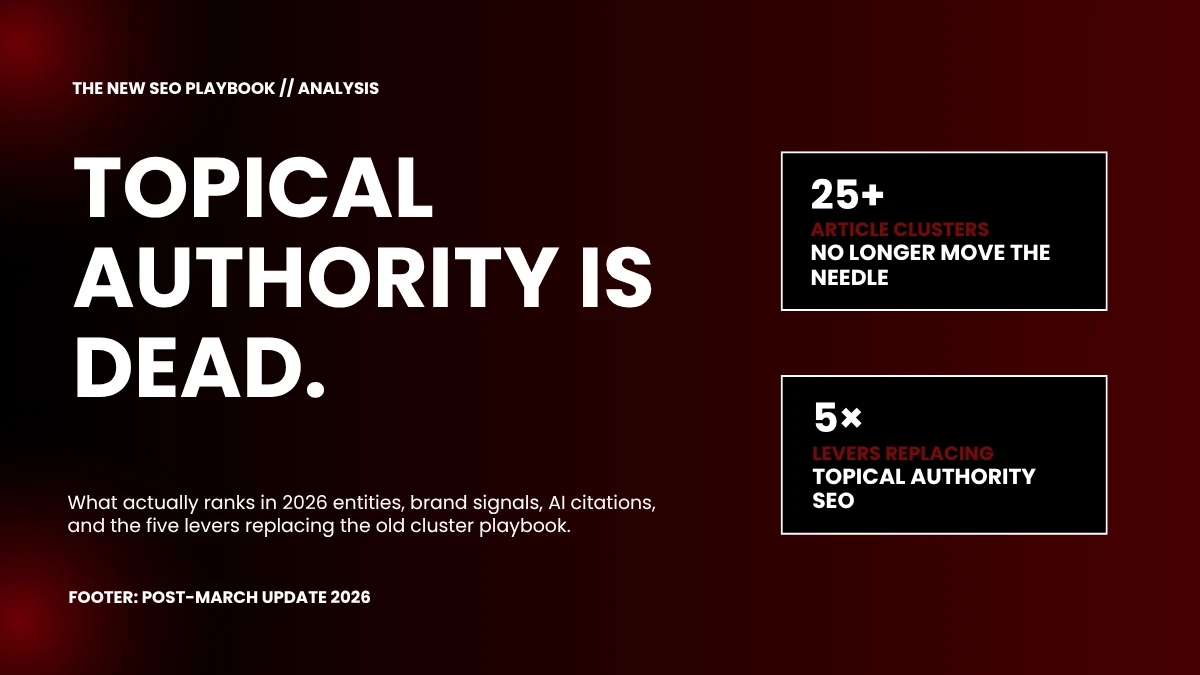
Topical authority SEO used to be the easy answer. Pick a niche, churn out 25 articles around one cluster, link them up nicely, wait. Google would clock you as the expert. Rankings followed.
That doesn’t work anymore. Hasn’t for months actually.
And the weird part is, most agencies are still selling the same playbook. I’ve seen pitch decks from January promising “topical authority builds” like it’s 2022. It isn’t.
Sites that did everything right by the old rules are losing positions. Sites with thinner content but louder brand signals are stealing those slots. The shift wasn’t subtle either. It was fast and it was ugly and a lot of people got caught flat-footed.
So let me walk you through what’s actually moving the needle right now. This is from real client work since the March update, not theory.
What Killed The Old Playbook
Back in 2023 you could pick a niche, write 30 well-linked posts around a pillar, and just watch the rankings climb. Clean strategy. Worked like clockwork.
A few things broke at once.
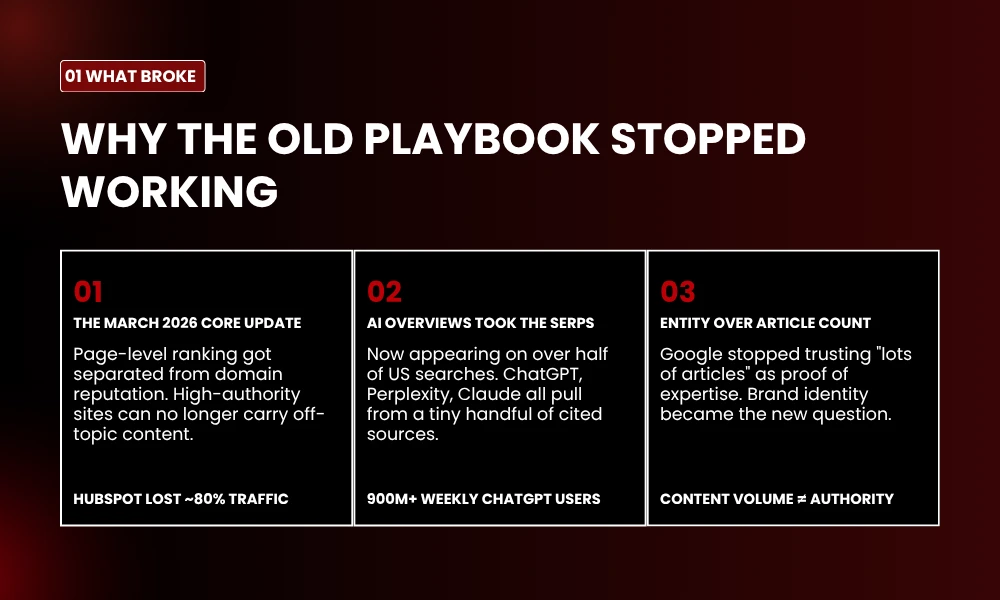
First one. Google’s March 2026 core update did something nasty to a lot of sites. It separated page-level ranking from domain-level reputation. So a high-authority domain can’t carry off-topic content the way it used to.
HubSpot of all places lost something like 80% of their traffic for drifting outside their lane. HubSpot. If that’s what happens to a site with their brand equity, the rest of us are working with zero cushion.
Second. AI Overviews. They’re showing up on more than half of US searches now. ChatGPT crossed 900 million weekly users somewhere this winter. Then there’s Perplexity, Claude, Gemini, Copilot, all of them pulling from a tiny handful of cited sources per answer. The blue-link real estate topical authority SEO was built to win? It keeps shrinking. Every month a little less.
Third one is the one nobody wants to talk about. Entity. Google stopped trusting “I have a lot of articles about X” as proof you know X. The question it’s asking now is different. Who are you actually. Do other trusted places on the internet say you know this stuff. That’s a brand question. Not a content question.
So look, topical authority isn’t dead-dead. Not in the literal sense. It’s just not the lever. It’s the floor you stand on. You need it to even get into the room. Inside the room, other stuff decides who walks out with the rankings.
The Five Things Actually Working Right Now
Let me get specific. These are the things I’m seeing move on real sites in 2026.
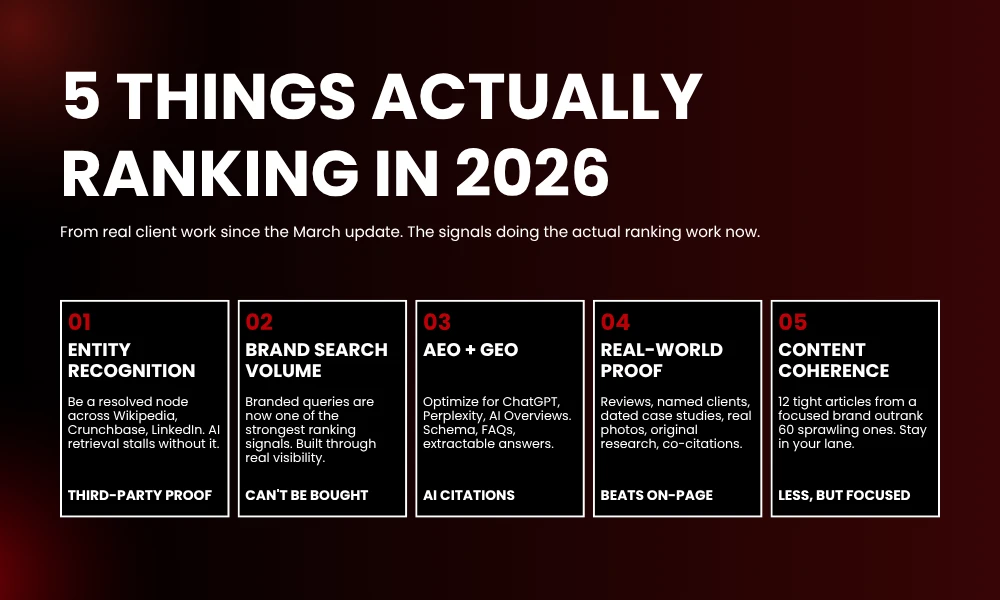
1. Entity Recognition Beats Cluster Volume
Google’s index leans hard on entities now. People. Brands. Places. Products. Concepts. Each one is a node. Each node has connections to other nodes. Your job is to be a recognized node in your space. Not a website with a lot of pages.
In practice that means:
- Your brand name shows up on Wikipedia, Crunchbase, LinkedIn, your industry’s main directories, all with consistent details
- Your founders or authors have actual digital footprints. Bylines on third-party sites. Podcast guest spots. Conference talks. Real stuff.
- Your products are described the same way wherever they’re mentioned online
- Schema markup tells crawlers exactly what entity you are without ambiguity
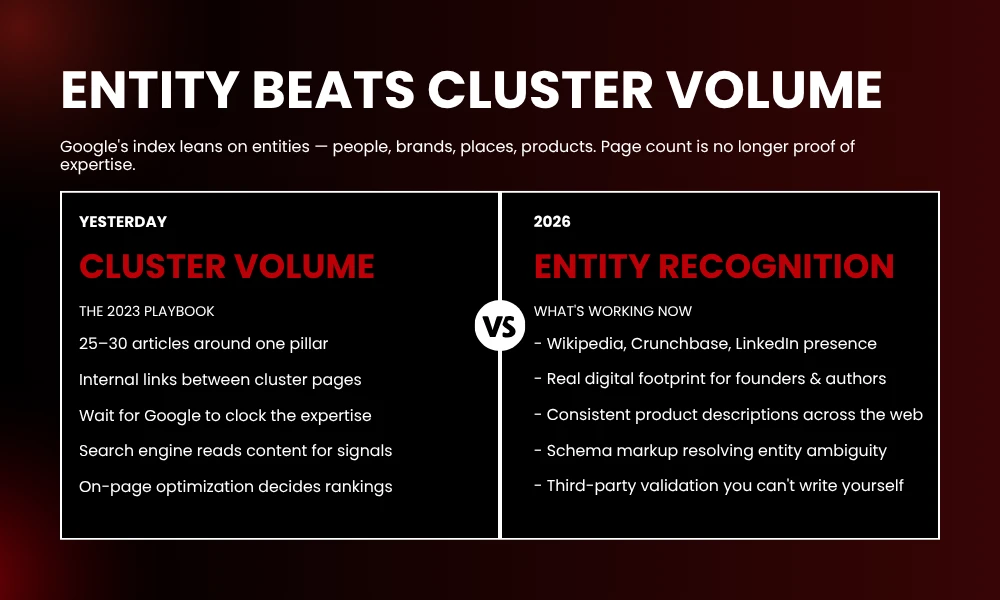
A site without a resolved entity is basically invisible to AI search. The retrieval pipeline literally stalls before it picks you. Old-school topical authority SEO assumed search engines would figure out your expertise just from reading your content. They don’t do that anymore. They want external proof. Third-party validation. Stuff you can’t write yourself.
2. Brand Search Volume Is Now A Real Ranking Signal
If people search your brand name plus a topic (“memorable design SEO tips” instead of just “SEO tips”), Google reads that as a vote. A loud one too. Branded queries went from being a soft, fuzzy signal to one of the strongest indicators that your site deserves to rank in your niche.
You can’t really buy this. You build it. Through being genuinely visible somewhere. Podcasts. LinkedIn. YouTube. Real events with real people. Original research that gets quoted by other people.
Sites recovering from traffic drops in 2026 almost all show the same pattern. Brand searches go up first. Then impressions stabilize. Then clicks come back. Map rankings firm up last. It’s almost predictable at this point.
If nobody is searching for you by name, your topical authority SEO work is sitting on sand. Doesn’t matter how good the content is.
3. AEO and GEO Are Where The Traffic Is Actually Going
Answer Engine Optimization (AEO) and Generative Engine Optimization (GEO). These aren’t future trends anyone needs to “prepare for.” It’s already happening. Some numbers worth chewing on:
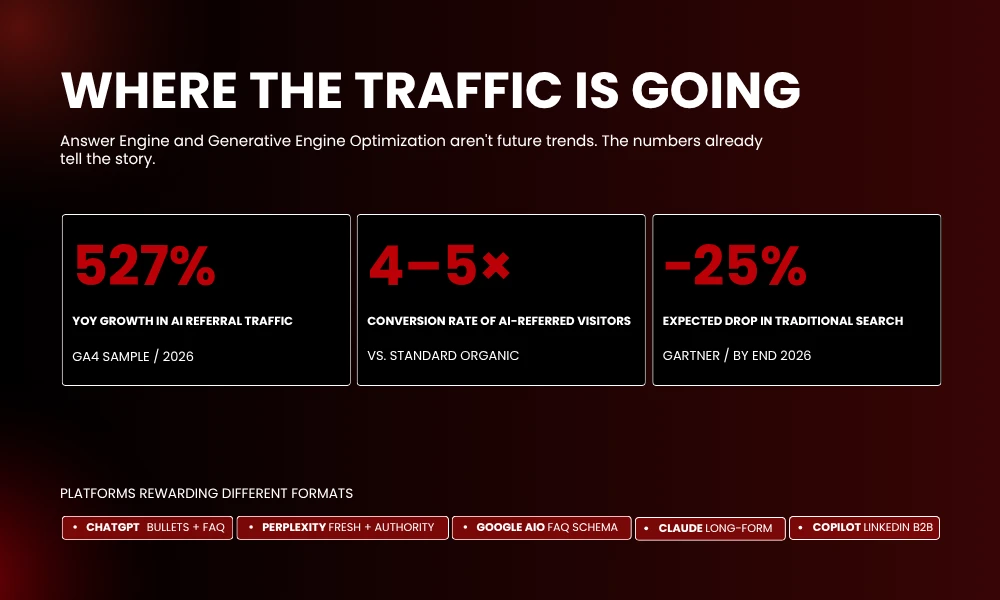
- AI referral traffic grew 527% year over year across one big GA4 sample
- AI-referred visitors convert at 4 to 5x the rate of normal organic
- Gartner expects traditional search volume to drop 25% by end of 2026
Different platforms reward different stuff. ChatGPT lifts structured formats almost verbatim, so bullets and FAQs get pulled straight into answers. Perplexity has this strong freshness bias and pulls heavily from high-authority sources. Google AI Overviews favor FAQ schema, short definitions, and clean question-answer formatting. Claude likes long, comprehensive guides. Copilot leans hard on LinkedIn for B2B stuff.
The pages getting cited share a few things. Clear headings. Short, direct answers near the top of each section. Then expansion below that. Then follow-up questions worked into the flow. AI doesn’t read top to bottom like a person does. It scans for extractable answers. Write for that.
4. Real-World Proof Beats On-Page Optimization
This is the part people don’t want to hear. Search engines are getting weirdly good at telling whether you actually do the thing your site claims you do. Stuff they look at:
- Reviews on third-party platforms (G2, Trustpilot, Google Business Profile)
- Photos of real work, real teams, real locations, not stock library nonsense
- Original research with data nobody else has
- Author bios linked to real LinkedIn profiles
- Co-citations, where your brand gets mentioned next to trusted ones in the same article
A landing page that lists “10 reasons to choose us” with stock photos doesn’t survive the new bar. It just doesn’t. A page with named clients, dated case studies, photos taken on-site, and a real author writing in their own actual voice does survive it. Big difference.
5. Content Coherence Beats Content Depth
Here’s the twist on the whole topical authority story. Volume of cluster content stopped being the prize. Coherence took its spot.
A 12-article tightly themed cluster from a focused brand will outrank a 60-article sprawling cluster from a site that drifts across topics. The March 2026 update specifically went after domains publishing outside their lane. Pages got pulled down. Whole sites lost positions because they had off-topic content sitting around dragging the domain’s coherence score with it.
Less content. Tighter focus. That’s the actual move now. Topical authority SEO still matters, but only when it’s about one thing your brand genuinely owns.
So What Do You Do With This?
Skip the 25-article cluster sprint. The wins aren’t there anymore. Try this stuff instead.
Audit what you have. Map every page on your site to a topic bucket. If you can’t assign a page cleanly to one bucket, that page is a problem. Off-topic pages drag the whole domain down now. Consolidate them. Or no-index them. Or move them to a separate property entirely.
Pick one lane and own it. Decide what your brand is genuinely the best source for. Not what has the most search volume. Not what’s trending. What you can actually defend if a smart competitor came at it. Then make sure every page on the site reinforces that one thing.
Build the entity. Get your brand on Wikipedia if you qualify. Crunchbase, your industry’s main directories, all the basics. Make author profiles real ones. Get cited on third-party sites. Run an original survey or study that other people will reference for years.
Format for AI extraction. On every important page, lead with a short, plain answer to the page’s main question. Use FAQ blocks. Use H2s phrased as questions. Add FAQPage and How to schema. AI Overviews and ChatGPT both lean heavily on this kind of structure.
Track AI citations, not just rankings. Run your top 20 customer queries through ChatGPT, Perplexity, and Google AI Mode every month. Note which brands actually get named. That list is your real competitive set in 2026, and it almost never matches your old SERP competitors.
Refresh, don’t pile up. Update existing pages with new data, fresh screenshots, updated dates. AI engines (Perplexity especially) heavily favor fresh content from authoritative sources. A two-year-old evergreen post is at a disadvantage versus a freshly updated one on the same domain. Even if the content barely changed.
The Hard Truth
The old playbook produced a lot of bland, mediocre content. Sites that did 25 articles around “best running shoes” ended up looking exactly like every other site that did 25 articles around “best running shoes.” Google saw the pattern, watched users bounce, and stopped rewarding the format.
Topical authority isn’t dead. It’s the floor. You still need clean topical coverage. But coverage stopped being a winning play. It became the price of entry. The actual wins now sit on top of that floor. Entity strength. Brand signals. AI citation worthiness. Real-world proof. A tight lane the site refuses to drift out of.
Sites that figured this out in early 2026 are pulling away from sites that didn’t. The gap keeps widening too. Topical authority SEO as a single, standalone strategy is finished. As one input among five or six bigger inputs, topical authority SEO still earns its keep just fine.
Frequently Asked Questions
Is topical authority dead in 2026?
Not entirely. It’s been demoted from a primary ranking strategy to a baseline requirement. You still need clean topical coverage to rank, but coverage by itself won’t move you up the SERPs anymore. Entity signals, brand authority, and AI citation worthiness are doing most of the actual ranking work now.
What replaced topical authority as the main ranking factor?
There isn’t one single replacement. The strongest signals in 2026 are entity recognition (Google sees your brand as a real, resolvable thing), branded search volume (people typing your name into the search box), AI citation frequency (how often ChatGPT, Perplexity, and AI Overviews quote you by name), and topical coherence at the domain level. They work together, not separately.
Should I stop building topic clusters?
Build smaller ones. Tighter ones. The old advice of 25 to 30 articles per cluster created a lot of bloat. A focused 10 to 12 article cluster from a brand that genuinely owns the topic now outperforms a 30-article cluster from a site that publishes across multiple lanes. Quality and lane discipline beat raw volume every time these days.
How is topical authority SEO different from AEO and GEO?
Topical authority SEO is about earning trust on a subject inside Google’s traditional ranking systems. AEO (Answer Engine Optimization) is specifically about getting cited by AI answer engines. GEO (Generative Engine Optimization) is the broader practice of optimizing for any generative AI platform out there. They overlap, but AEO and GEO add structured-answer formatting, schema markup, and brand entity work that goes way beyond what classic topical SEO ever covered.