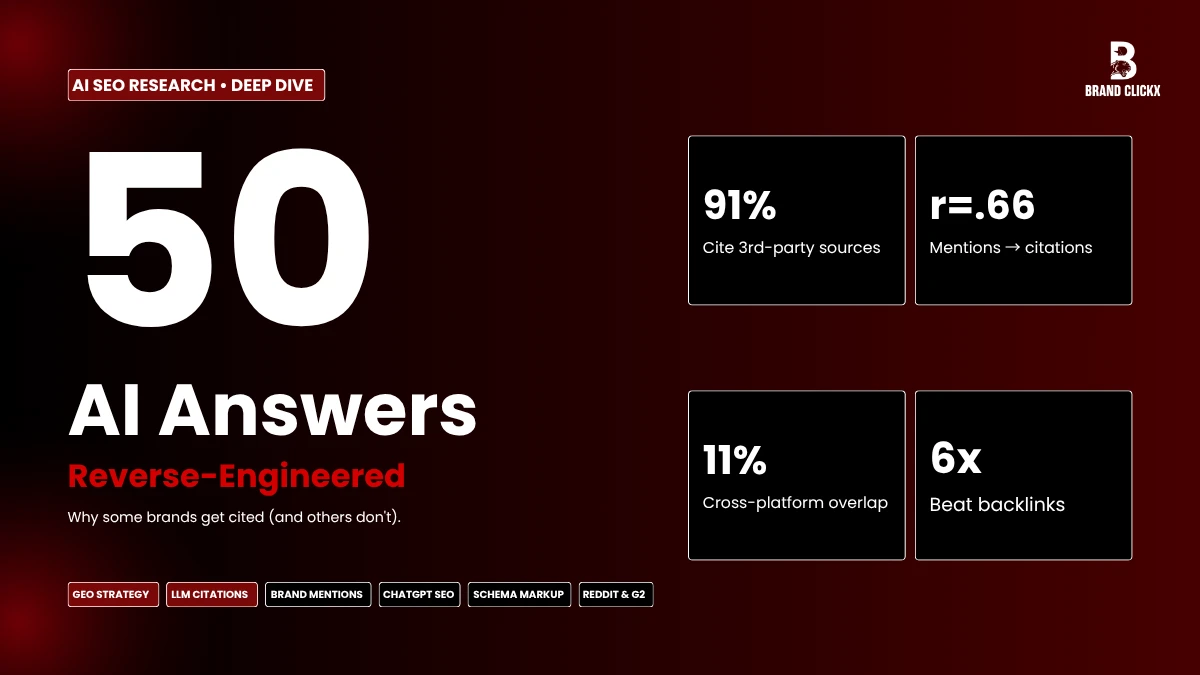
The Experiment: What We Actually Did
We ran 50 queries across five AI SEO strategy platforms in early 2026. ChatGPT. Perplexity. Gemini. Claude. Microsoft Copilot.
The queries spanned ten verticals. B2B SaaS, e-commerce, fintech, health, travel, education, legal, and a few more. Half were category questions like “best CRM for startups.” The other half were brand checks like “Is [Brand X] worth it?”
We ran each query three times on different days, because AI answers shift. Every brand mention, citation, source domain, and structural pattern got logged.
We weren’t just looking at who got cited. We wanted to know why. Why does the same brand dominate ChatGPT but disappear on Perplexity? Why does Gemini name a brand without linking, while Claude gives it a full citation?
What we found changes how most brands should think about AI SEO strategy.
The Citation Landscape Is More Fragmented Than You Think
There is no single AI SEO strategy algorithm. That’s the first thing to get straight. Only 11% of cited domains overlap between ChatGPT and Perplexity.
ChatGPT pulls from a wide pool. Its top 10 most-cited domains make up just 18.5% of total citations. So think long-tail editor.
Perplexity is different. It leans hard on institutional sources. Medical sites, government pages, universities. 86% of its brand mentions show up in position 5 or earlier.
Google AI Mode acts like a commercial aggregator. It pulls from review sites, finance data, and news media. Gemini, oddly, behaves more like ChatGPT than its Google sibling. So your Google SEO won’t carry over to Gemini on its own.
The takeaway is simple. Optimizing for one platform won’t buy you visibility on another. If your measurement plan treats “AI search” as one thing, you’re missing the gaps.
Finding #1: Brand Mentions Beat Backlinks. By a Lot.
If you’re still chasing backlinks for AI SEO strategy, you’re working the wrong lever.
Ahrefs looked at 75,000 brands. Brand web mentions correlate with AI citations at r=0.664. Backlinks sit at r=0.10. That’s 6× weaker. Branded anchor text comes in at r=0.527. Brand search volume sits at r=0.392. All three top predictors are off-site brand signals. Not authority metrics.
This isn’t just correlation. It’s how LLMs actually learn. They don’t follow hyperlinks the way Google’s PageRank does. They train on raw text. So when your brand shows up in Reddit threads, G2 reviews, industry roundups, and news pieces, AI starts to trust you as a real player.
85% of brands mentioned in ChatGPT have no citation link at all. Users see the name. They remember it. They search later. So mentions can be more valuable than backlinks, even when no traffic shows up in your analytics.
Finding #2: The Mention-Source Divide Is Real (And Costly)
Here’s a painful pattern we kept seeing. Brands are 3× more likely to be cited as a source without being mentioned in the answer. Your content shapes the AI’s response. Your competitor walks away with the recommendation.
A real example from our test. We asked: “What’s the best project management software for remote teams?” ChatGPT named Asana, Monday.com, and ClickUp. At the bottom, it cited a comparison guide from a smaller brand as the source. That smaller brand wrote the framework. The big three got the credit.
Only 28% of AI answers include brands that get both mentioned and cited. But brands that earn both signals are 40% more likely to keep showing up in follow-up queries than brands earning citations alone. That dual-signal edge compounds fast.
The fix is not more content. It’s better positioning. If you’re cited but never mentioned, you have a brand problem. Not a content problem.
Finding #3: Content Structure Matters More Than Domain Authority
This one is good news for smaller brands. Traditional SEO strength actually has an inverse link with AI visibility. The top 10% most-cited pages have less traffic, fewer keywords, and fewer backlinks than the bottom 90% of cited pages.
Why? AI cares about extractability. Not authority.
The Princeton and Georgia Tech GEO study (KDD 2024, now cited by 76+ academic papers) tested 10,000 queries across multiple AI engines. Specific content tweaks lifted AI visibility by up to 40%. Here are the ones that actually moved the needle:
- Adding verifiable stats (+40% lift): “Revenue grew 47% in Q3” beats “revenue grew significantly.”
- Citing authoritative sources (+40% lift): Link to primary research, not blog rehashes.
- Including expert quotes (+35% lift): Named experts beat anonymous claims.
- Answer-first structure (+67% citation rate): Pages with the point at the top get cited far more.
- Proper heading hierarchy (+40% citation rate): H1 to H2 to H3, in order. AI parses cleanly that way.
And here’s the kicker. Pages ranked around position 5 in Google saw a 115% jump in AI visibility after GEO tweaks. Position 1 pages saw almost nothing. GEO is a leveler. A small brand with a clean, data-rich page can beat a giant in AI citations even if it can’t beat them in Google.
Finding #4: 91% of AI Answers Come From Third-Party Sources
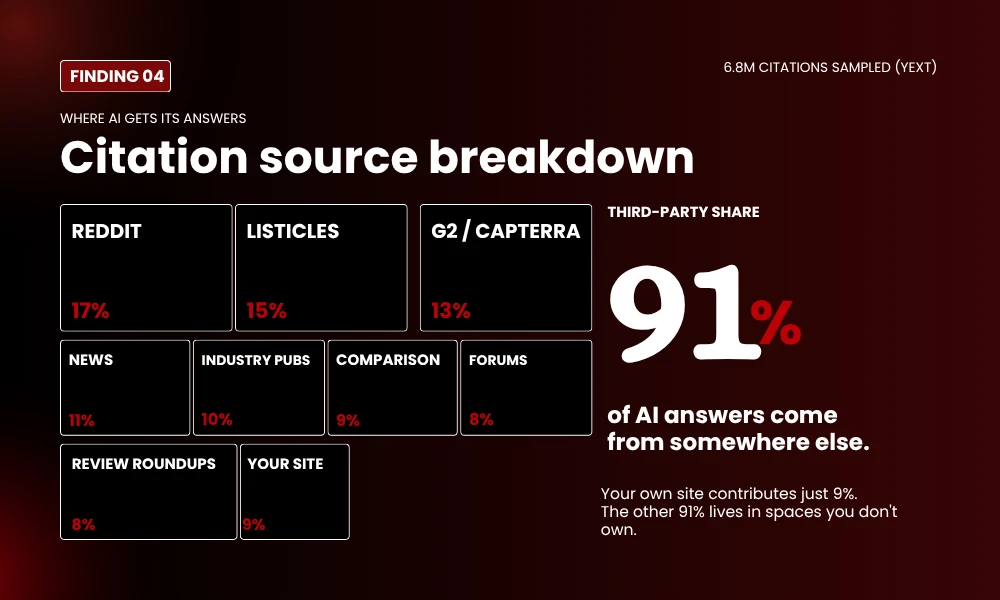
This stat should worry every brand manager. 91% of AI answers cite third-party sources. Your own site? Just 9% of brand mentions in AI responses. The rest comes from Reddit, review sites, industry publications, comparison roundups, and forums.
Yext studied 6.8 million AI citations across ChatGPT, Gemini, and Perplexity. They found 86% of citations come from sources brands already control (websites and listings). But context matters. For unbranded, objective queries, first-party sites and local pages made up nearly 60% of citations. For branded or subjective queries, AI leaned hard on third-party listings and reviews.
Brands are 6.5× more likely to be cited through third-party sources than their own domains during early commercial discovery. Almost 90% of those mentions come from listicles, comparison pages, and review roundups. 80% of mentioned brands sit in the first three spots on those pages.
So what does this mean? Your off-site presence is not a PR side project. It is your AI SEO strategy. If you’re not in the comparison articles, the Reddit threads, and the review roundups that define your space, AI has nothing to verify your claims with. It will recommend the brands that show up.
Finding #5: Freshness Is a Universal Multiplier
AI has a strong recency bias. Content cited by AI is 25.7% fresher than content in regular search results. Pages updated in the last 2 months earn 28% more citations. We watched brands that owned AI responses in late 2025 disappear by March 2026 because they didn’t refresh anything.
Semrush data shows 65% of AI bot hits target content less than 1 year old. 89% target content less than 3 years old. For e-commerce, content updated within 30 days gets 3.2× more citations across platforms.
This is a maintenance burden traditional SEO never had. Your cornerstone content is not done when it ranks #1. It needs regular updates. Not just for accuracy. AI actively pushes stale content down when synthesizing answers.
Finding #6: Schema Markup Is the Underrated Technical Lever
Content structure gets the headlines. But the technical layer decides whether AI can find, parse, and trust your content at scale.
Pages with FAQPage schema markup are 3.2× more likely to show up in Google AI Overviews. Content with proper schema overall has a 2.5× better chance of appearing in AI answers. One study found GPT-4 jumped from 16% to 54% correct responses when content used structured data.
Three schema types matter most:
- FAQPage schema. Structures Q&A pairs for direct AI extraction.
- Article schema. Establishes authorship, date, and publisher for E-E-A-T.
- HowTo schema. Makes step-by-step content readable for AI summaries.
Also, check your robots.txt. Make sure it allows GPTBot, OAI-SearchBot, PerplexityBot, ClaudeBot, and Google-Extended. We found a surprising number of brands block AI bots without knowing it. Every other optimization is wasted if you do.
Finding #7: The Prompt Language Effect
The words users type into prompts change citation rates. Research found prompts with the word “trusted” generate citations 5.77% more often. “Source” lifts citation likelihood by 2.88%. “Recommend” pushes citations up by 0.96%.
This shifts how you think about keyword research. In traditional SEO, you optimize for what people search. In AI SEO, you optimize for how people ask. Brands that match recommendation-style language (“best,” “trusted,” “recommended,” “top-rated”) tend to surface more than brands chasing pure information keywords.
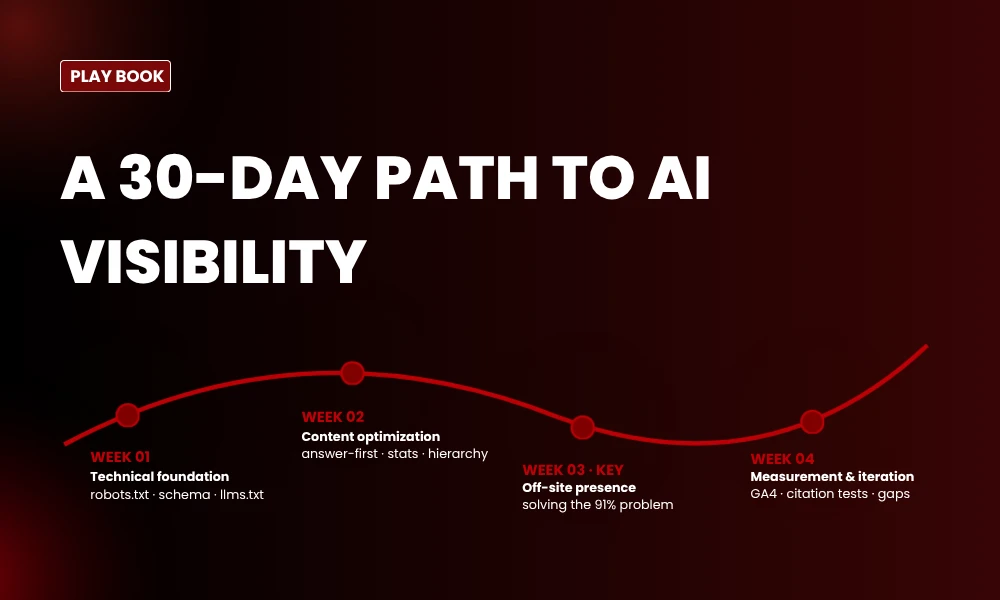
The 30-Day AI SEO Strategy Playbook
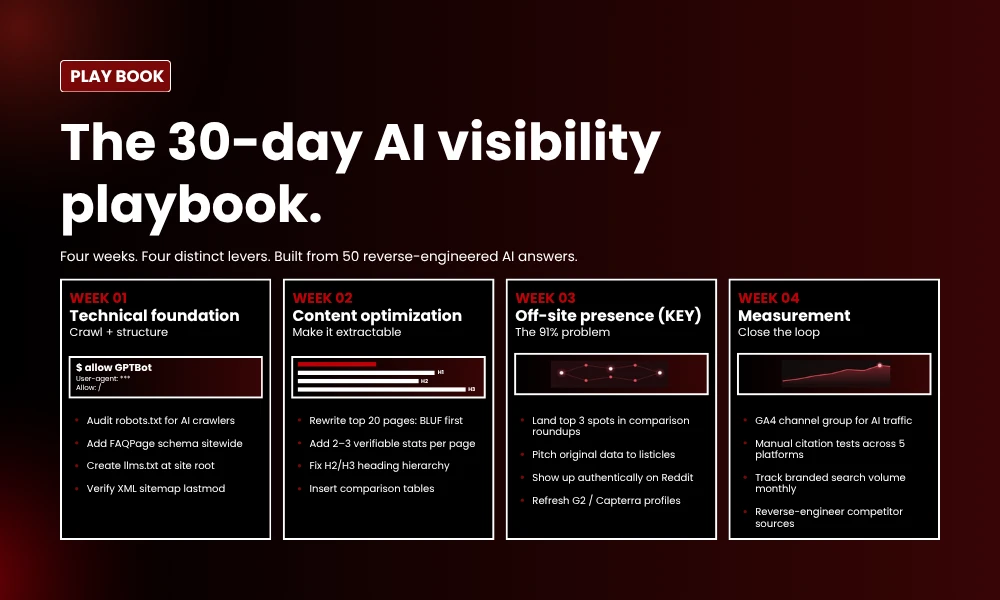
Based on our reverse-engineering and the broader research out there, here’s how to put this to work.
Week 1: Technical Foundation
- Audit robots.txt. Make sure all major AI crawlers can get in.
- Add FAQPage schema to your top 10 pages.
- Create llms.txt at your site root, pointing to your best content.
- Verify your XML sitemap has accurate lastmod dates.
Week 2: Content Optimization (Existing Pages)
- Rewrite the opening of your top 20 pages to answer-first format. Point first. Setup later.
- Add 2 to 3 verifiable stats per page with primary source citations.
- Fix your H2 and H3 hierarchy.
- Add comparison tables where they actually help.
Week 3: Off-Site Presence (The 91% Problem)
- Find the top 10 comparison articles, listicles, and review roundups in your space.
- Pitch original data or expert commentary. Aim for the top 3 spots on each page.
- Show up authentically on Reddit and in industry forums. ChatGPT weights Reddit heavily in training.
- Update your G2 and Capterra profiles. Fresh reviews. Clear positioning.
Week 4: Measurement & Iteration
- Set up a GA4 custom channel group for AI traffic. Regex: chatgpt.com|perplexity.ai|claude.ai|gemini.google.com.
- Run manual citation tests across all five platforms for your top 10 category queries.
- Track branded search volume as a proxy for AI mention impact.
- Spot citation gaps where competitors show up and you don’t. Then reverse-engineer their source URLs.
Frequently Asked Questions
What is AI SEO and how is it different from traditional SEO?
AI SEO is about getting your brand into the answers that tools like ChatGPT, Perplexity, Gemini, and Claude give users. Traditional SEO runs on backlinks and keyword rankings. AI SEO runs on brand mentions across third-party sources, content extractability, and structured data. Brand web mentions correlate with AI citations at r=0.664. Backlinks sit at r=0.10. That’s 6× weaker.
How do I get my brand cited by ChatGPT?
Build mentions across the third-party sources ChatGPT pulls from. Reddit. G2. Capterra. Comparison roundups. Review listicles. 91% of AI answers cite third-party sources, and 80% of mentioned brands sit in the first three positions of those pages. Pitching original data and expert commentary into top comparison articles works better than just publishing more on your own blog.
Does schema markup actually help with AI search visibility?
Yes. Pages with FAQPage schema are 3.2× more likely to appear in Google AI Overviews. Content with proper schema overall has a 2.5× better chance of appearing in AI answers. One study found GPT-4 went from 16% to 54% correct responses when content used structured data. The three biggest schema types are FAQPage, Article, and HowTo.
What is the difference between SEO, AEO, and GEO?
SEO optimizes pages for traditional search rankings. AEO (Answer Engine Optimization) structures content so search engines can pull direct answers into snippets and AI Overviews. GEO (Generative Engine Optimization) targets citations and brand mentions inside AI-generated responses. They stack. Strong SEO supports AEO. Both feed GEO. Extractable structure and verifiable data drive AI visibility.
How often should I update my content for AI search?
Update cornerstone content every 2 to 3 months. Pages refreshed in the last 2 months earn 28% more AI citations than older content. 65% of AI bot hits target pages less than 1 year old. For e-commerce, content updated within 30 days gets 3.2× more citations across platforms. AI actively deprioritizes stale info when synthesizing answers, so updates are now a requirement. Not a nice-to-have.
The Bottom Line
Our test of 50 AI answers showed a landscape that is fragmented, fast-moving, and very different from traditional search. The brands winning in AI SEO aren’t the ones with the highest Domain Rating or the most backlinks. They’re the ones that get this:
AI doesn’t rank pages. It synthesizes consensus.
That consensus is built from brand mentions across third-party sources, machine-readable structure, verifiable data points, and consistent entity signals across the web. The gap between brands that get this and brands still optimizing for 2019 Google is widening. And it compounds every day.
ChatGPT now serves 700 million weekly active users. AI Overviews trigger on 48% of all queries. So the real question isn’t whether AI search will reshape discovery. It’s whether your brand will be part of the answer. Or invisible to the systems that now shape it.
Ready to audit your AI visibility? Start with the technical basics. Robots.txt. Schema. Llms.txt. Then move to content structure and off-site presence. The brands that move now will own the AI citation landscape of 2026. The ones that wait will wonder where their traffic went.