Marketing tactics have the shelf life of milk.
The platform that drove your growth last year is throttling reach this year. The ad format that converted in spring is fatigued by fall. The algorithm changes, the channel of the moment shifts, and half of what you learned becomes obsolete on a schedule.
So here is the question that actually matters: what stays?
The answer is the principles of marketing. The durable logic underneath the disposable tactics. A framework first written down decades ago still runs every strategy meeting, even when no one says its name out loud.
Master the principles and the churn stops scaring you. New tools become new ways to express old logic, not crises to survive. This is a working guide to that logic, the 4 Ps, the 7 Ps, and STP, reframed for how brands actually operate in 2026.
Key Takeaways
- Principles are durable, tactics are disposable. Confusing the two is why marketers feel perpetually behind.
- The marketing mix, the 4 Ps, is the most widely used planning framework in the discipline.
- Services pushed the 4 Ps to 7 Ps by adding people, process, and physical evidence.
- STP, segmentation, targeting, and positioning, usually comes before the mix, because it decides who you serve.
- In 2026, the principles still hold. AI and digital change the execution, not the logic.
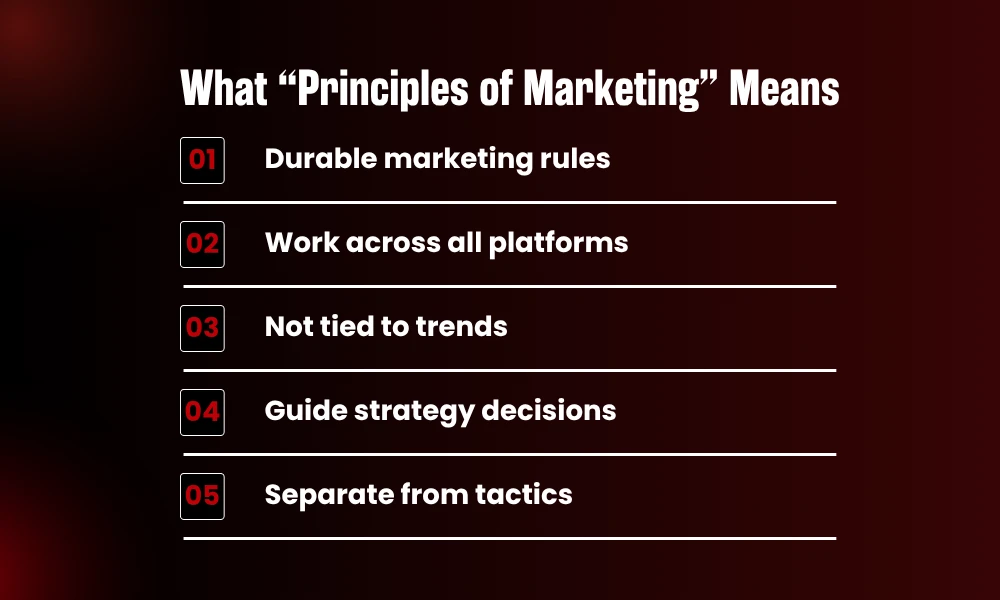
What “Principles of Marketing” Really Means
A principle is a rule that holds across situations. A tactic is a move that works in one.
“Post Reels three times a day” is a tactic. It will be wrong within a year. “Meet your audience where their attention already is” is a principle. It was true before social media and will be true after it.
The principles of marketing are the second kind. They describe the decisions every brand must make, regardless of era or channel.
Why it matters: when you anchor on principles, every new platform becomes a question of application, not reinvention. The marketer who knows the principles adapts fast. The one who only knows tactics starts from zero every time the landscape moves.
Gartner’s 2026 marketing outlook describes a field being reshaped by AI, ambient discovery, and shifting customer behavior. What it does not describe is a world where brands stop deciding what to offer, what to charge, where to sell, and how to communicate. Those decisions are the principles. Everything else is execution.
The Marketing Mix: The 4 Ps
The marketing mix is the core of the toolkit. It is the set of controllable levers a brand combines to influence demand.
- Jerome McCarthy organized these levers into four categories in 1960, and the 4 Ps have anchored marketing planning ever since.
Product. What you offer, and the needs it meets. This covers features, quality, design, branding, and the full experience around the core item. The first principle is simple: get the product right, because no amount of clever promotion saves an offering nobody wants.
Price. What customers pay, and what that price signals. Price is not just a number. It communicates positioning, shapes perceived value, and directly drives profit. Price too low and you erode value and margin. Price too high without justification and you lose the sale.
Place. How and where customers access the offering, also called distribution. This is about being available at the moment of demand, whether that is a shelf, a marketplace, an app, or a direct site. The best product fails if customers cannot easily get it.
Promotion. How you communicate value, including advertising, content, public relations, social, and sales. Promotion is the P that gets the most attention and the least leverage. It can only amplify the value built by the other three. It cannot manufacture it.
The art is in the mix. These four are not a checklist to complete in isolation. They have to align. A premium product needs a premium price, selective placement, and aspirational promotion. Misalign one and the whole position wobbles.
The 7 Ps: Why Services Needed Three More
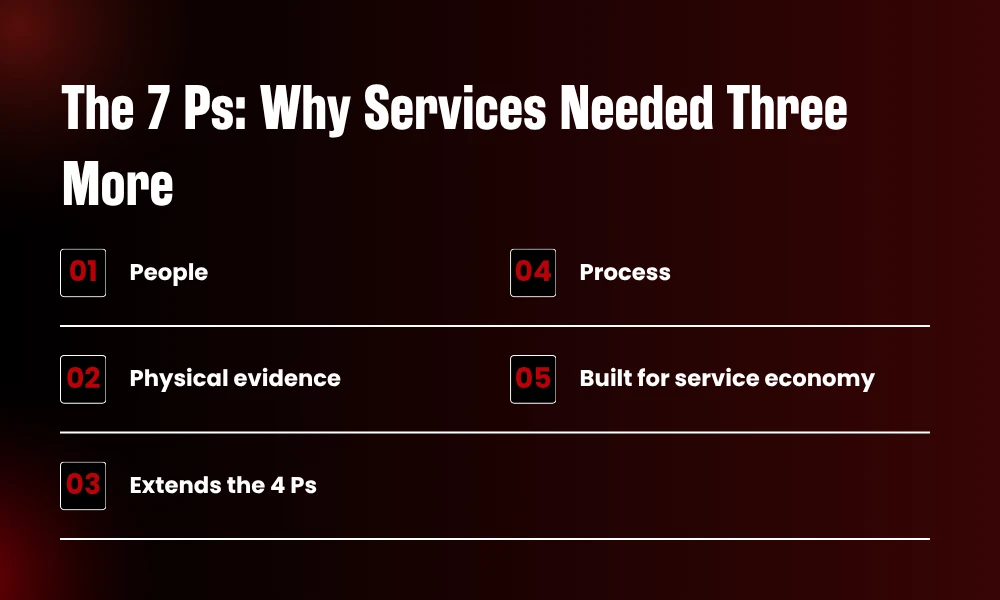
The 4 Ps were built in an era of physical products. As services grew to dominate the economy, marketers found the original four left gaps. So Booms and Bitner extended the mix to seven in 1981.
Services are intangible, variable, and produced in the moment, often by people, in front of the customer. Three additional Ps capture what that demands.
People. In a service, the staff are the product. The barista, the consultant, the support agent, they deliver the experience and shape the brand with every interaction. For service brands, hiring and training are marketing decisions.
Process. How the service is delivered, step by step. A great meal ruined by a 40-minute wait is a process failure. Smooth, consistent, well-designed processes are part of the value, not just operations.
Physical evidence. The tangible cues that make an intangible service feel real and trustworthy. The clean clinic, the polished app interface, the confirmation email, the packaging. These signals reduce the uncertainty customers feel when buying something they cannot hold.
| Element | 4 Ps | 7 Ps | Best fit |
| Product | Yes | Yes | All |
| Price | Yes | Yes | All |
| Place | Yes | Yes | All |
| Promotion | Yes | Yes | All |
| People | No | Yes | Services |
| Process | No | Yes | Services |
| Physical evidence | No | Yes | Services |
Strategic breakdown: product brands can usually plan with the 4 Ps. Service brands, which is most of the modern economy, need all 7. The extra three are where service experiences are won or lost.
STP: The Principle That Comes Before the Mix
Here is a sequencing mistake that sinks campaigns. Teams jump straight to the marketing mix, deciding product and promotion, before they have decided who they are serving.
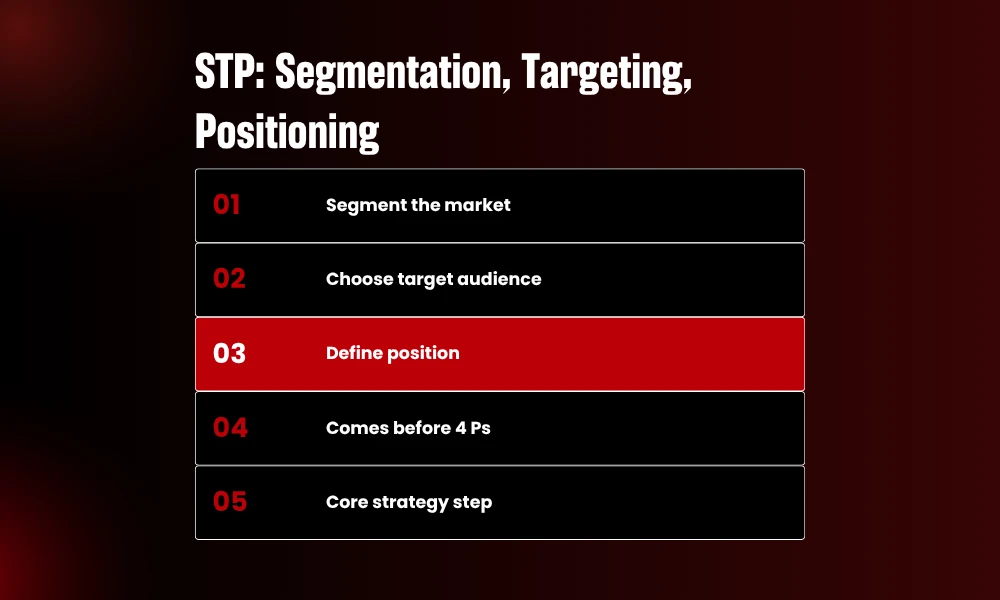
The principle that comes first is STP: segmentation, targeting, and positioning.
Segmentation. Divide the broad market into distinct groups with shared needs or behaviors. Almost no offering serves everyone equally. Segmentation finds the meaningful clusters.
Targeting. Choose which segments to pursue. This is a decision about focus and resources. Trying to win everyone usually means resonating with no one. Targeting picks the battles worth fighting.
Positioning. Decide the distinct, valued place your offering should occupy in the minds of your target. Positioning is the answer to “why us, not them.” It is the idea you want to own.
STP comes before the mix because the mix depends on it. Your product, price, place, and promotion all flow from who you serve and how you want them to see you. Decide the audience and the position first, and the four Ps practically write themselves.
Market observation: the most common branding failure is not a weak logo or a small budget. It is a fuzzy position, because the team skipped STP and tried to be everything to everyone.
This connects directly to building a coherent plan, which we cover in our guide to marketing strategies and the broader marketing fundamentals that tie these principles together.
The Principles in 2026
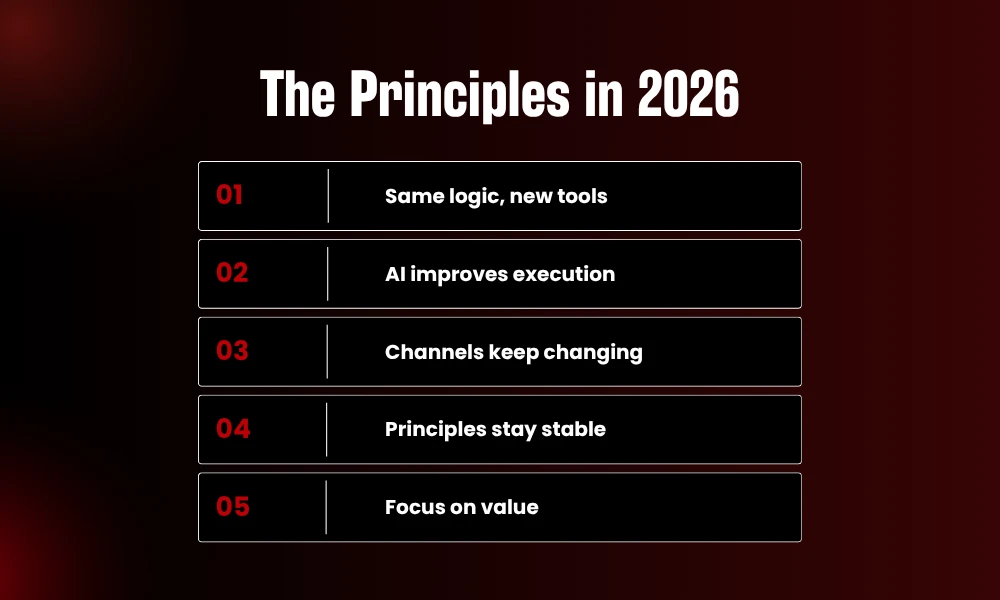
Skeptics love to declare the 4 Ps dead every few years. They are wrong, and the confusion is always the same: mistaking a change in execution for a change in principle.
Look at how each P has evolved, not vanished.
Product now includes digital experience, ecosystems, and continuous updates, not just a static item. The principle holds: get the offering right.
Price now includes dynamic pricing, subscriptions, and freemium models, often optimized by AI. The principle holds: price to reflect and capture value.
Place now includes marketplaces, social commerce, and visual search, where customers discover products by image rather than keyword. The principle holds: be available at the point of demand.
Promotion now includes content, creators, AI-personalized messaging, and ambient discovery. The principle holds: communicate value where attention lives.
The execution layer is unrecognizable from 1960. The decision layer is identical. That is exactly what a principle is.
What AI changes is the precision and speed at which you can apply each lever. Personalization at scale, real-time price optimization, predictive targeting, these make the principles more powerful, not obsolete.
Future outlook: the brands that win the next decade will not abandon the principles for whatever tool is trending. They will apply timeless principles through modern tools faster and more precisely than competitors.
A Tactical Framework: Applying the Principles to a Launch
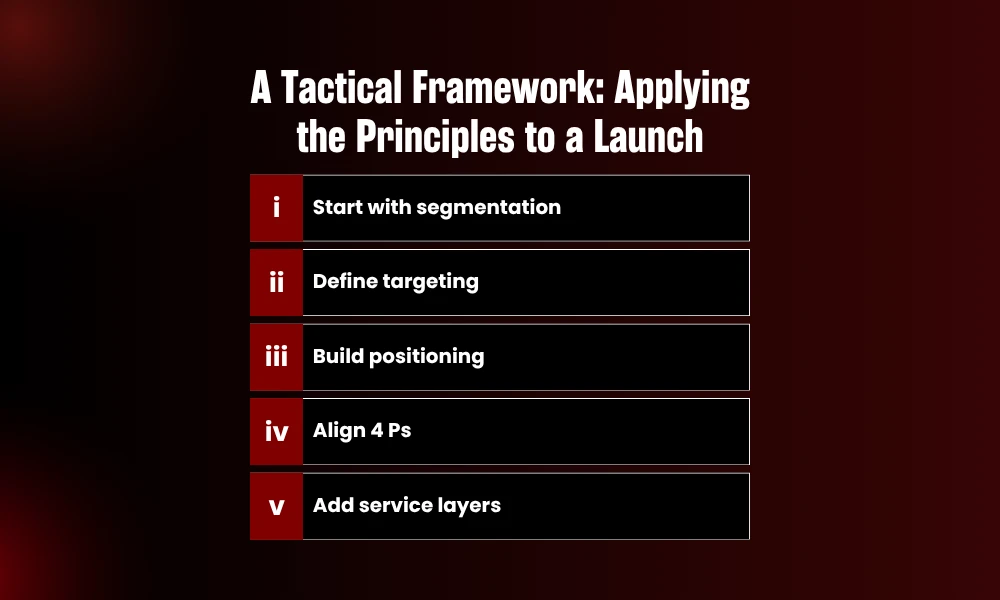
Principles are only useful when they shape decisions. Here is how to run a launch through them, in order.
| Step | Principle | The question to answer |
| 1 | Segmentation | Which distinct groups exist in this market? |
| 2 | Targeting | Which segment is worth our focus and resources? |
| 3 | Positioning | What distinct, valued place do we want to own? |
| 4 | Product | Does the offering truly serve that segment’s need? |
| 5 | Price | Does the price reflect the value and position? |
| 6 | Place | Are we available where this segment buys? |
| 7 | Promotion | Are we communicating value where their attention is? |
| 8 | People, process, evidence | For services, is the experience consistent and credible? |
Run any campaign through this sequence and you will catch the gaps before the market does. Skip a step, and the market will find it for you.
For the underlying philosophy that drives all of this, see our breakdown of the marketing concept, and for the practical starting point, our marketing 101 guide.
Tactical framework: principles first, mix second, tactics last. Most teams run that order backwards and wonder why their campaigns feel scattered.
Frequently Asked Questions
What are the principles of marketing?
The durable rules that guide how brands create and deliver value, independent of platform or tactic. They include the marketing mix (the 4 Ps, extended to 7 Ps for services) and the STP framework of segmentation, targeting, and positioning.
What are the 4 Ps of marketing?
Product, price, place, and promotion. Product is what you offer, price is what customers pay, place is how they access it, and promotion is how you communicate its value. E. Jerome McCarthy introduced them in 1960.
What are the 7 Ps of marketing?
The 4 Ps plus people, process, and physical evidence, added to fit services. People deliver the experience, process is how it is delivered, and physical evidence is the tangible proof of an intangible service. Booms and Bitner popularized the extension in 1981.
What is the marketing mix?
The set of controllable elements a company combines to influence demand. The classic version is the 4 Ps, and together they shape how an offering reaches and resonates with its target market.
What is STP in marketing?
Segmentation, targeting, and positioning. You divide the market into segments, choose which to pursue, and position your offering to own a clear place in that audience’s mind. STP usually comes before the marketing mix.
Are the 4 Ps still relevant in 2026?
Yes. The tools and channels have changed, but the decisions have not. Brands still decide what to offer, how to price it, where to sell it, and how to communicate it. AI and digital change the execution, not the logic.
Key Takeaways for Executives
- Separate principles from tactics. Tactics expire on a schedule. Principles do not. Anchor your team on the durable layer.
- Use the mix as your plan. The 4 Ps, and the 7 Ps for services, remain the most reliable structure for marketing planning.
- Do STP first. Decide who you serve and how you want to be seen before touching product or promotion.
- Align the levers. The Ps must reinforce each other. One misaligned element undermines the whole position.
- Apply old logic through new tools. AI and digital make the principles more precise and powerful, not obsolete.
The Bottom Line
The principles of marketing are the reason some brands compound while others spike and fade. Tactics will keep churning, platforms will keep shifting, and the next obsolete best practice is already being written.
The teams that stay grounded in product, price, place, promotion, and the discipline of STP will adapt to every change without losing the plot. The ones chasing tactics without principles will keep starting over.
Tracking exactly these shifts, where strategy, AI, commerce, and brand collide, is the work BrandClickX exists to do.