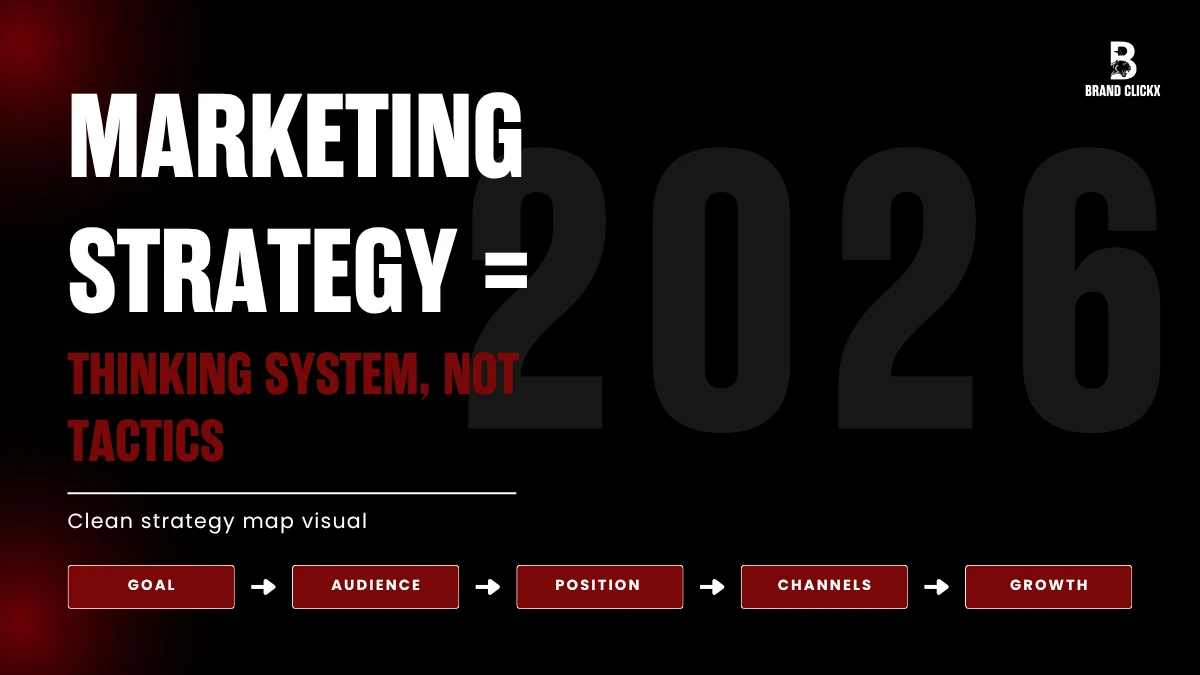
“Our marketing strategy is TikTok.”
You hear sentences like that in real meetings, and they reveal the single most common mistake in the field. That is not a strategy. That is a channel. A tactic wearing a strategy’s name tag.
The confusion is everywhere, and it is expensive. Teams pick tactics, skip the thinking, and then wonder why a pile of activity produces no momentum.
So let’s answer the question properly. Marketing strategies are the high-level plans that connect what a business wants to achieve with who it serves, how it stands out, and where it shows up. The strategy is the reasoning. The tactics are the moves that carry it out.
Get the strategy right and your tactics finally pull in the same direction. Skip it, and you are just staying busy.
Key Takeaways
- A marketing strategy is the plan that links business goals to audience, positioning, channels, and metrics.
- Strategy and tactics are different. “We’ll run ads” is a tactic. “We’ll win this segment by owning this position” is a strategy.
- The main strategic approaches range from content and SEO to paid, social, and account-based marketing.
- Every real strategy includes objectives, audience, positioning, channels, budget, and measurement.
- In 2026, the strongest strategies integrate channels and balance brand-building with performance.
What a Marketing Strategy Actually Is
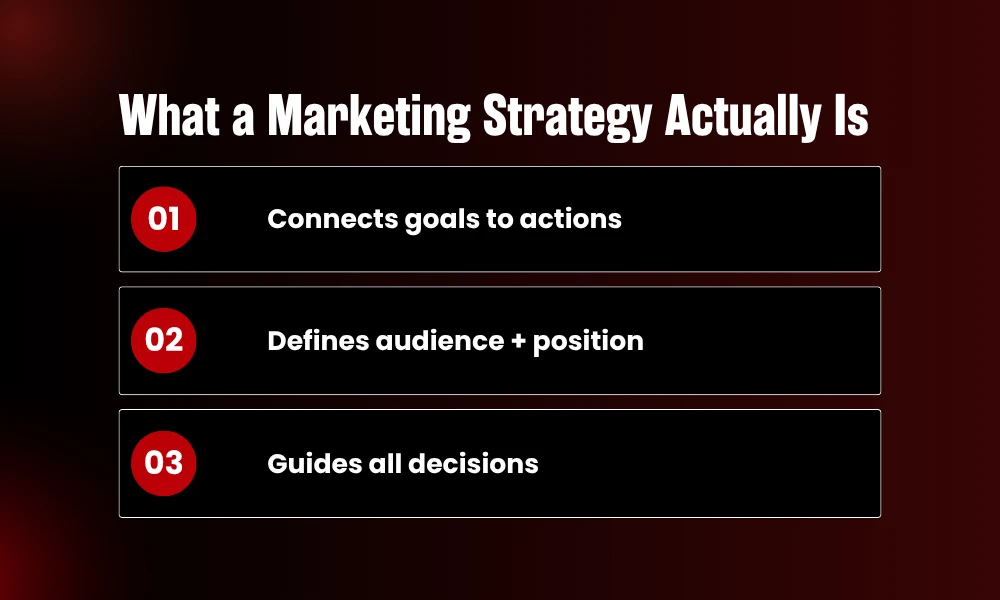
A marketing strategy answers a chain of connected questions before a single campaign launches.
What is the business trying to achieve. Who exactly are we serving. Why would they choose us over the alternatives. Where do we reach them. How will we know it is working.
When those answers connect into a coherent approach, you have a strategy. It is the bridge between a business goal and the day-to-day activity that pursues it.
A good strategy makes decisions easier. When a new platform appears or a budget tightens, the strategy tells you whether it fits. Without one, every shiny new tactic looks equally tempting, and you chase all of them.
Why it matters: strategy is mostly about what you will not do. It is the discipline of focus. A team that tries every channel for every audience has no strategy, just a scattered to-do list and a thin budget spread thinner.
This connects directly to the principles of marketing, where segmentation, targeting, and positioning decide the audience and the position your strategy is built around.
Strategy vs Tactics vs Plan
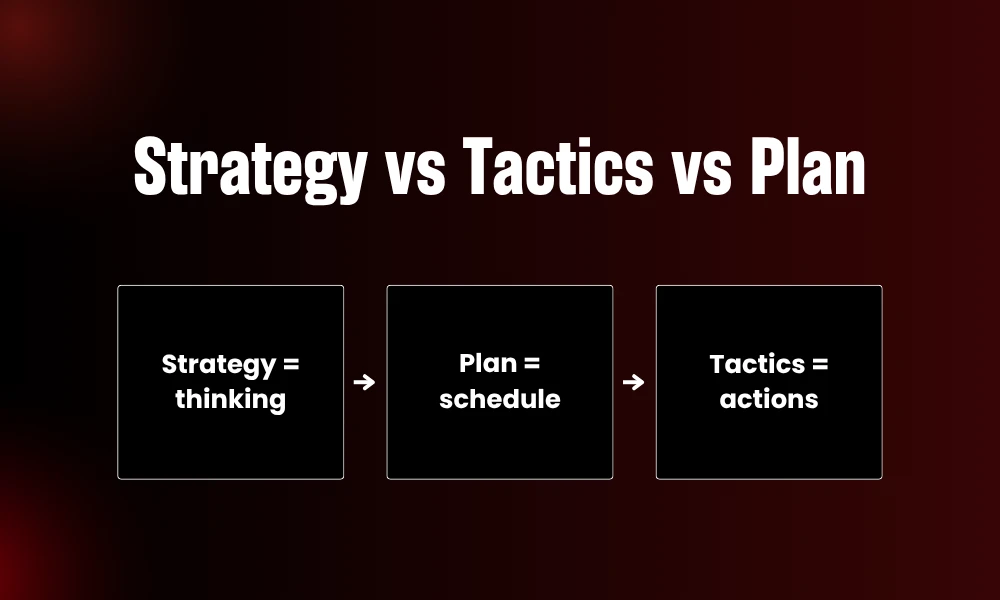
Three words get tangled constantly. Separating them is one of the most clarifying things a marketer can do.
Strategy is the approach and the reasoning. Who you target, how you position, and why. It is the thinking.
Tactics are the specific actions that execute the strategy. A particular ad, a blog post, an email sequence, a campaign. They are the doing.
Plan is the document that organizes the tactics over time, with timelines, owners, and budgets. It is the schedule.
| Element | Question it answers | Example | Time horizon |
| Strategy | Who, what, why | Win mid-market SaaS buyers by owning “fastest onboarding” | Long-term |
| Plan | How and when | Q3 calendar of campaigns, owners, and budget | Medium-term |
| Tactic | What action | Publish a comparison guide, run a LinkedIn ad | Immediate |
Strategic breakdown: tactics without strategy is noise. Strategy without tactics is a daydream. You need the reasoning, the schedule, and the moves, in that order.
The Main Types of Marketing Strategies
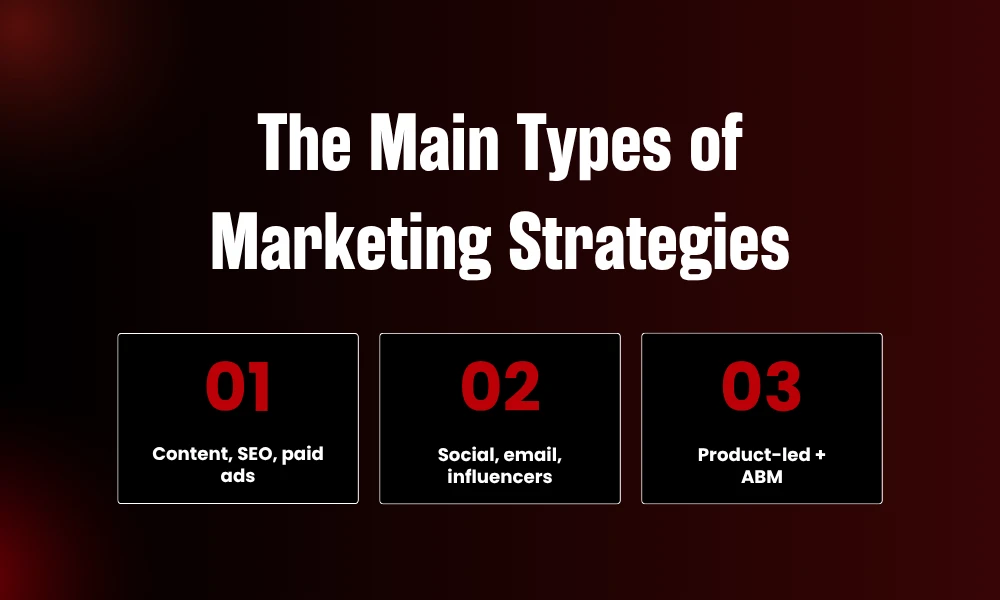
There is no single right strategy. There are strategic approaches you combine based on your audience, goals, and resources. Here are the major ones.
Content and inbound marketing. Attract an audience by creating genuinely useful content, then convert that attention over time. It compounds, but it takes patience.
Search engine optimization. Earn organic visibility so customers find you when they are actively searching. Durable and high-trust, and increasingly shaped by AI search.
Paid advertising. Buy attention and traffic for fast, controllable results. It works while the budget runs and stops when it does.
Social media marketing. Build audience, community, and brand on the platforms where attention lives.
Email marketing. Nurture relationships directly with an audience you own, often delivering the strongest returns of any channel.
Influencer marketing. Borrow the trust creators have built with their audiences to reach new people credibly.
Account-based marketing. A B2B approach that targets specific high-value accounts with personalized campaigns rather than casting wide.
Product-led growth. Let the product itself drive acquisition and expansion, common in modern SaaS.
Cutting across all of these is the most important strategic balance: brand versus performance. Brand marketing builds long-term demand and trust. Performance marketing captures short-term conversions. Lean too hard on performance and you rent demand forever. Ignore performance and you cannot prove returns. The strongest strategies fund both.
Market observation: the channel is not the strategy. Two companies can both “do content,” but one is executing a focused strategy and the other is publishing into the void. The difference is the thinking underneath.
What Every Marketing Strategy Must Include
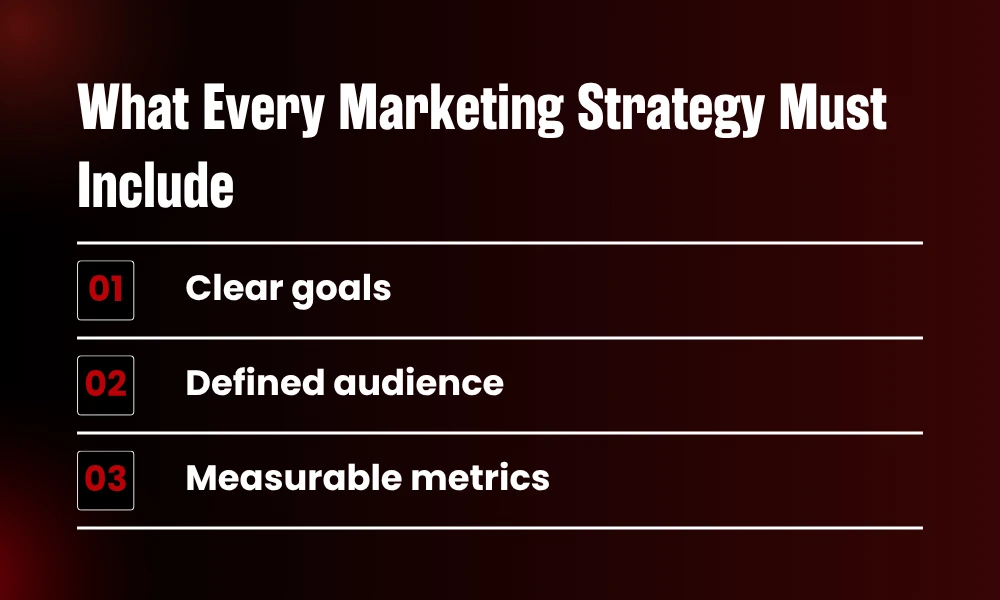
A complete strategy has a recognizable anatomy. Miss a component and the whole thing wobbles.
- Objectives. Specific, measurable goals tied to the business, not vague aims like “more awareness.”
- Target audience. A clear, researched definition of who you serve and what they need.
- Positioning and value proposition. The distinct, valued place you want to own, and why you, not them.
- Channels and messaging. Where you will reach the audience and what you will say.
- Budget and resources. What you are willing to invest, in money and people.
- Metrics. The specific numbers that prove progress and trigger course corrections.
These six turn a goal into something executable. The discipline of writing them down is itself the work, because it forces the trade-offs most teams avoid.
How to Build a Marketing Strategy
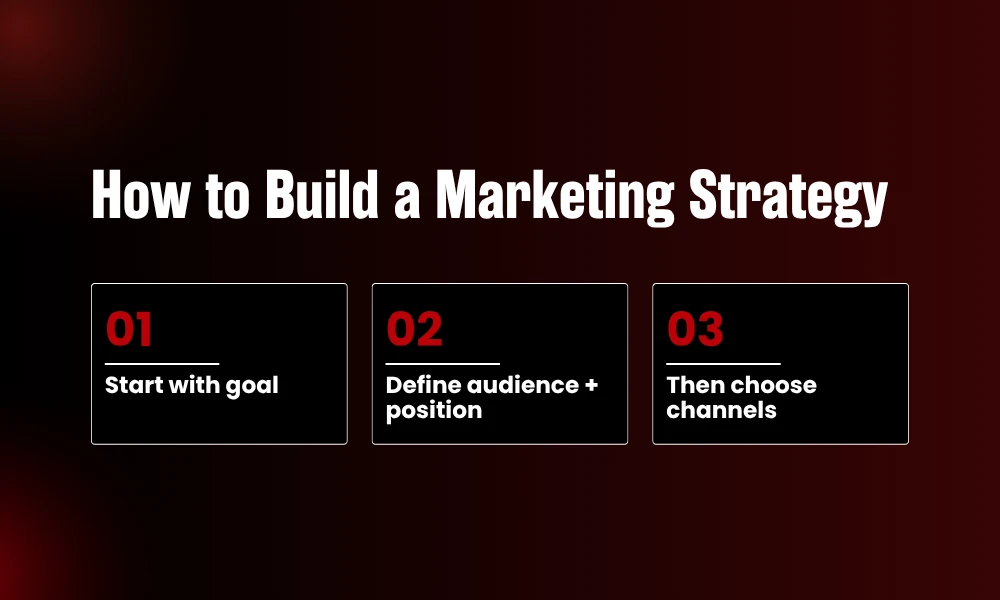
Strategy is built in a deliberate order. Most teams run it backwards, starting with tactics and reverse-engineering a rationale.
| Step | Decision | The question |
| 1 | Goal | What business outcome are we driving? |
| 2 | Audience | Who exactly are we serving, and what do they need? |
| 3 | Positioning | What distinct place do we want to own? |
| 4 | Channels | Where is this audience actually reachable? |
| 5 | Budget | What can we invest, and where? |
| 6 | Metrics | How will we know it is working? |
| 7 | Tactics | Now, which specific actions execute this? |
Notice that tactics come last. Everything before them is the strategy, and it is the part that makes the tactics effective. The practical skills to execute each channel are covered in our guide to modern digital marketing skills.
Enterprise perspective: when leadership asks for a “marketing strategy” and receives a content calendar, they were handed a plan, not a strategy. The strategy is the reasoning that should have produced the calendar.
The 2026 Shift
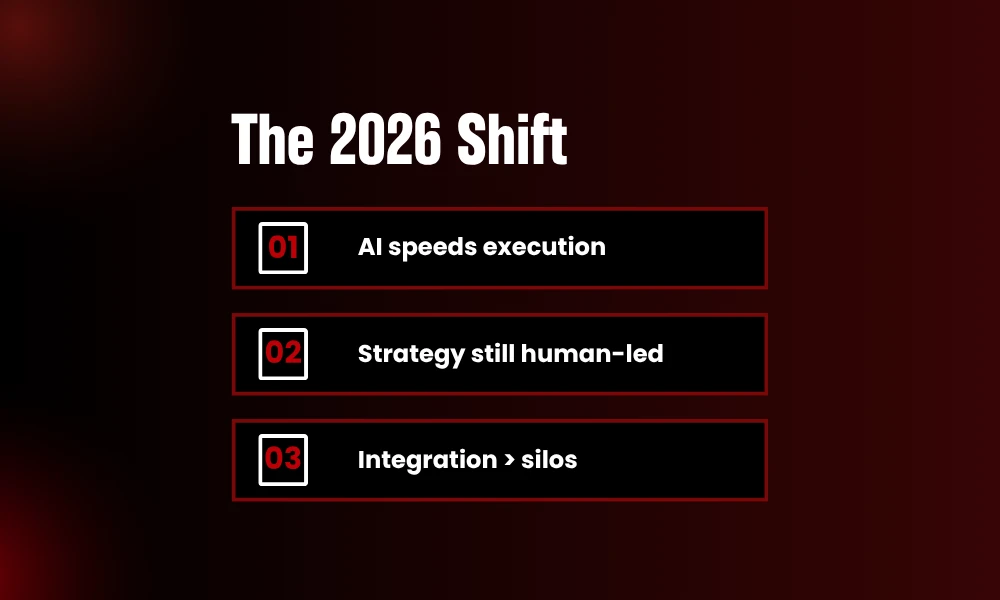
Two changes are reshaping how strategies get built.
The first is integration. Gartner’s 2026 marketing outlook describes a landscape of ambient, context-driven discovery, where customers move fluidly across channels. The best teams have stopped building separate SEO, social, email, and paid strategies. They build one integrated demand system where each channel reinforces the others.
The second is AI. Strategy is becoming faster to model, test, and personalize. AI can simulate audiences, optimize spend in real time, and tailor messaging at scale. What it cannot do is decide what is worth pursuing. That judgment, the essence of strategy, stays human.
The enduring lesson holds. Tools and channels will keep changing. A clear strategy, who you serve, how you win, and how you measure it, is what keeps a brand coherent through all of it. For the deeper foundations, see our overview of marketing fundamentals.
Future outlook: the brands that compound will run integrated, AI-accelerated strategies anchored by sharp human judgment about focus. The ones chasing every channel without a plan will keep mistaking motion for progress.
Frequently Asked Questions
What are marketing strategies?
A marketing strategy is the high-level plan connecting business goals to your target customers, your positioning, and the channels you use to reach them. It defines who you target, how you differentiate, and how success is measured. Tactics are the specific actions that execute it.
What is the difference between a marketing strategy and a marketing tactic?
Strategy is the overarching approach and reasoning: who you target and why. A tactic is a specific action that carries it out, like a single ad or post. Tactics without a strategy are just busywork.
What are the main types of marketing strategies?
Content and inbound, SEO, paid advertising, social media, email, influencer, account-based marketing for B2B, and product-led growth. Most also balance brand marketing with performance marketing.
What should a marketing strategy include?
Clear objectives, a defined target audience, a positioning and value proposition, chosen channels and messaging, a budget, and the metrics that measure success.
How do you create a marketing strategy?
Start with the business goal, define and research your audience, set your positioning, choose your channels, define the budget, and decide your metrics. Move to tactics only after that.
What is the difference between a marketing strategy and a marketing plan?
A strategy is the reasoning and direction. A plan is the detailed document that schedules how and when the strategy is executed, including timelines, owners, and budgets.
Key Takeaways for Executives
- Stop calling channels strategies. “We’ll do TikTok” is a tactic. A strategy explains who you target, how you win, and why.
- Separate strategy, plan, and tactics. Strategy is the thinking, the plan is the schedule, tactics are the moves. You need all three in order.
- Balance brand and performance. Performance alone rents demand forever. Brand alone can’t prove returns. Fund both.
- Build in the right sequence. Goal, audience, positioning, channels, budget, metrics, then tactics. Most teams run it backwards.
- Integrate and stay human. AI accelerates strategy, but deciding what’s worth pursuing is the judgment that stays yours.
The Bottom Line
Marketing strategies are the difference between brands that compound and brands that just stay busy. A strategy is not a channel or a campaign. It is the reasoning that connects a goal to an audience, a position, and a way to win.
Get that reasoning right and every tactic you run has a job and a place. Skip it, and you will keep mistaking activity for progress, funding motion that never adds up to momentum.
Tracking exactly these shifts, where strategy, AI, commerce, and brand collide, is the work BrandClickX exists to do.