Marketing is the most misunderstood word in business.
Ask most people what it means and they will say ads. Billboards, banners, the thing that interrupts their video. That answer is not just incomplete. It is the reason so many businesses market badly.
Advertising is one slice of marketing. A loud slice, but a small one.
Real marketing starts long before any ad exists, and continues long after the sale. It is the entire system of understanding customers and connecting them with value. Get that system right and the ads almost write themselves. Get it wrong and no ad budget can save you.
This is Marketing 101 for people who want the real model, not a list of buzzwords. The mental framework, the vocabulary, and the path to actually getting good at it.
Key Takeaways
- Marketing is not advertising. Advertising is one tactic inside a much larger system.
- At its core, marketing is the work of creating and delivering value to the right people.
- Marketing, advertising, sales, and branding are related but distinct, and confusing them costs money.
- The funnel, awareness to loyalty, is the simplest map of how strangers become customers.
- You learn marketing far faster by doing it on a real project than by only studying it.
What Marketing Actually Is
Here is the cleanest definition. Marketing is everything you do to understand customers and deliver them value in a way that makes them want to buy.
The American Marketing Association frames it as the activities and processes for creating, communicating, delivering, and exchanging offerings of value to customers and society. The keyword is value, and it appears before any mention of promotion.
That ordering is the whole lesson of Marketing 101.
Marketing answers four questions before it ever runs an ad. Who is the customer. What do they actually need. What can we offer that serves that need better than alternatives. How do we reach them where they already are.
Promotion comes last, not first. It amplifies value that the rest of marketing already built.
Why it matters: businesses that treat marketing as “make the ad” skip the work that makes the ad work. They promote a product nobody needs, to people who are not listening, and then blame the ad. The problem was upstream.
This customer-first orientation is the heart of the marketing concept, and it is where every good strategy begins.
Marketing vs Advertising vs Sales vs Branding
Four words get used interchangeably and mean different things. Untangling them is one of the most useful things a beginner can do.
Marketing is the whole system: research, product, price, distribution, and communication. It is the umbrella.
Advertising is the paid promotion piece. The ads, the sponsored posts, the paid placements. It lives inside marketing.
Sales is the act of converting a specific prospect into a customer, usually through direct interaction. Marketing brings many people to the door. Sales walks individuals through it.
Branding is the identity and perception you build over time: what people feel and believe about you. It is the long-term reputation that makes all the other work easier.
| Term | What it is | Time horizon | Scope |
| Marketing | The full value system | Ongoing | Broadest |
| Advertising | Paid promotion | Campaign-based | Narrow |
| Sales | Converting prospects | Immediate | One-to-one |
| Branding | Identity and perception | Long-term | Foundational |
Strategic breakdown: they work as a team. Branding earns trust, marketing creates demand, advertising amplifies it, and sales closes it. A business that funds only one of these and ignores the rest is running on one cylinder.

The Main Types of Marketing
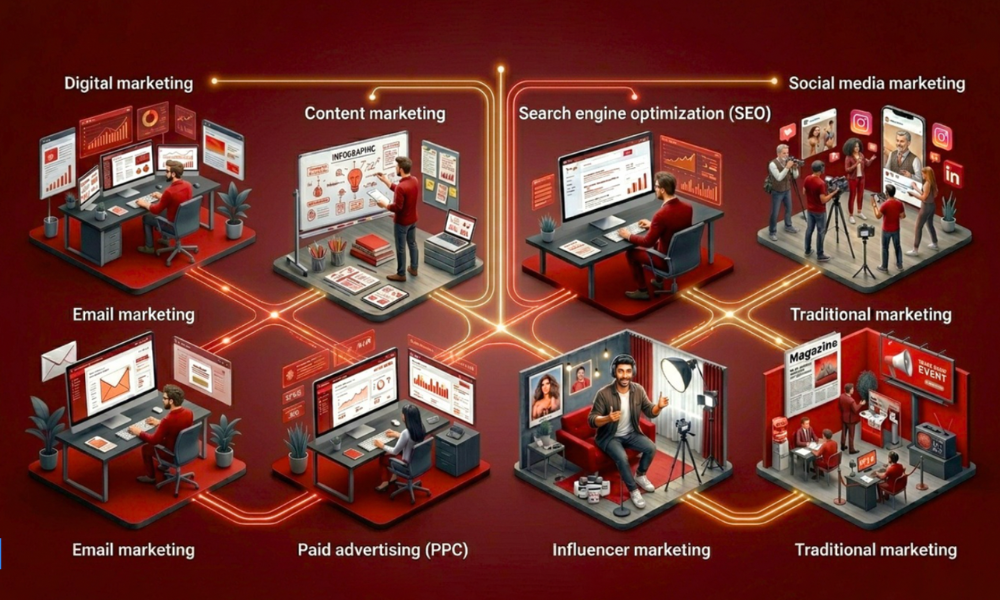
Modern marketing splits into channels and disciplines. You do not need to master all of them, but you should know the landscape.
- Digital marketing is the broad category for everything online. It is where most marketing now lives, and we break it down in our guide to the fundamentals of digital marketing.
- Content marketing attracts an audience by creating genuinely useful content rather than interrupting them.
- Search engine optimization (SEO) earns visibility in search results so customers find you when they are already looking.
- Social media marketing builds audience and community on the platforms where attention lives.
- Email marketing nurtures relationships directly, and still delivers some of the strongest returns in the field.
- Paid advertising (PPC) buys attention and traffic, fast, for as long as the budget lasts.
- Influencer marketing borrows the trust creators have built with their audiences.
- Traditional marketing covers offline channels like print, radio, events, and out-of-home.
The modern principle is integration. The strongest brands do not pick one channel. They combine several into a single system where each reinforces the others.
Market observation: beginners often ask “which channel is best.” The better question is “which channels does my specific audience actually use,” because the right mix depends entirely on who you are trying to reach.
The Marketing Funnel
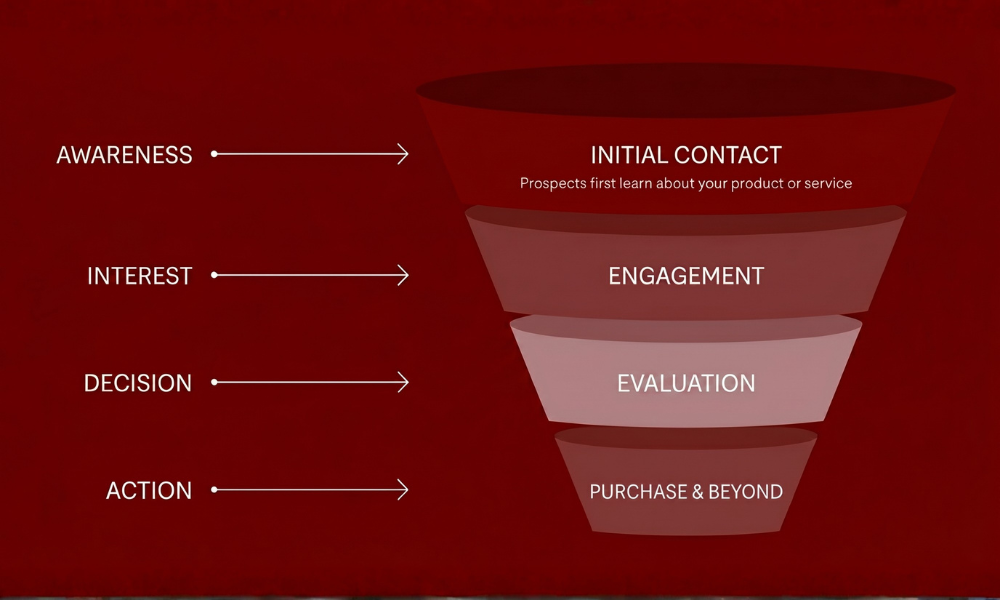
The funnel is the simplest map of how a stranger becomes a loyal customer. Learn it early and the rest of marketing organizes around it.
It has four core stages.
Awareness. The person discovers you exist. This is the top of the funnel, where reach and attention matter.
Consideration. They are evaluating whether you are right for them. Here, education, comparison, and trust-building do the work.
Conversion. They take the action you want, usually a purchase. This is where the offer, the friction, and the proof either close the deal or lose it.
Retention and loyalty. They come back, buy again, and ideally refer others. This is the stage most businesses underfund, and it is often the most profitable.
It is called a funnel because many enter at the top and fewer reach each next stage. The marketer’s job is to understand where people drop off and why, then fix that specific leak.
Why it matters: a leaky funnel cannot be fixed with more traffic. Pouring more people into the top of a broken funnel just wastes more money faster. Find the stage that is failing, then improve it.
How Marketing Actually Creates Growth
Strip it to its engine, and marketing growth is a loop, not a line.
You earn attention. You convert that attention into trust through value and proof. You convert trust into a purchase. You turn that purchase into a great experience that earns retention. And retained, happy customers refer others, which feeds attention again.
Attention, trust, conversion, retention, referral, and back to attention.
The brands that compound understand that the loop matters more than any single campaign. A viral spike that does not convert, or a sale that does not retain, breaks the loop. Sustainable growth comes from a loop that keeps turning, not a moment that briefly trends.
Enterprise perspective: the most expensive customer is the first one. Once the loop is turning, retention and referral lower the cost of every customer after that. This is why mature marketers obsess over the back half of the funnel, not just the front.
How to Start Learning Marketing
Marketing is a doing discipline. You can read about swimming forever and still sink. Here is a practical path.
Learn the fundamentals first. Understand customer value, the marketing mix, and the funnel before chasing tactics. The principles of marketing give you the durable structure everything else hangs on.
Pick one channel and go deep. Trying to learn every channel at once guarantees you learn none. Choose content, SEO, email, or paid, and get genuinely competent at one.
Practice on a real project. Start a blog, a small store, a side project, or volunteer for a cause. Real stakes teach faster than any course, because you get real feedback from a real market.
Pair learning with measurement. Track what happens. Marketing is now a measurable discipline, and the habit of reading data separates operators from guessers. This is also where the modern digital marketing skills come in.
Stay curious and keep shipping. The field changes constantly. The marketers who thrive treat learning as permanent and keep experimenting.
| Stage | Focus | Goal |
| 1 | Fundamentals | Understand value, the mix, the funnel |
| 2 | One channel | Build real competence in a single discipline |
| 3 | A real project | Learn by doing with actual stakes |
| 4 | Measurement | Read data and improve based on it |
| 5 | Continuous learning | Adapt as the field evolves |
Tactical framework: fundamentals, then one channel, then a real project. Skip the project step and your marketing knowledge stays theoretical forever.
Frequently Asked Questions
What is marketing in simple terms?
Marketing is everything a business does to understand its customers and connect them with products or services that meet their needs. It includes research, product, pricing, distribution, and communication, not just ads. In short, it is the work of creating and delivering value to the right people.
What is the difference between marketing and advertising?
Advertising is one part of marketing. Marketing is the whole process of understanding customers, shaping the offering, pricing it, choosing channels, and communicating value. Advertising is the paid promotion piece. All advertising is marketing, but most of marketing is not advertising.
What is the difference between marketing and sales?
Marketing creates demand and brings the right prospects to you at scale. Sales converts individual prospects into customers through direct interaction. Marketing works the many, sales works the one, and they perform best when aligned.
What are the main types of marketing?
Digital, content, SEO, social media, email, paid advertising, influencer, and traditional offline marketing. Most brands blend several into one integrated strategy rather than relying on a single channel.
What is a marketing funnel?
A model of the customer journey from awareness to consideration to conversion to retention and loyalty. It is a funnel because many enter at the top and fewer move through each stage, which helps marketers find where prospects drop off.
How do I start learning marketing?
Learn the fundamentals, then pick one channel and learn it by doing on a real project. Combine courses with hands-on practice, because campaigns teach faster than reading alone.
Key Takeaways for Executives
- Stop equating marketing with ads. Advertising is one tactic. Marketing is the full system that decides whether the ad even works.
- Lead with value. Marketing answers who the customer is and what they need before it answers how to promote.
- Align the four disciplines. Branding, marketing, advertising, and sales are a team. Funding one and ignoring the rest leaves growth on the table.
- Fix the funnel, not just the traffic. More visitors cannot repair a stage that is leaking. Find the failing stage and improve it.
- Learn by doing. Real projects with real feedback build marketing skill faster than any amount of theory.
The Bottom Line
Marketing 101 comes down to one shift in thinking: marketing is not the noise you make, it is the value you create and the system that delivers it. Ads are the smallest, loudest part of a much larger machine.
Understand the machine, the customer, the funnel, and the growth loop, and every tactic you learn afterward has somewhere to fit. Skip it, and you will keep buying ads for a system that was never built to convert.
Tracking exactly these shifts, where strategy, AI, commerce, and brand collide, is the work BrandClickX exists to do.