Ask ten executives if their company is customer-centric and ten will say yes. Watch how they actually operate and the number drops fast.
That gap is the whole story of the marketing concept.
Most brands believe they practice it. In reality, they practice the selling concept dressed up in customer language. They build a product, then spend their energy convincing people to want it. That is not marketing. That is persuasion with a budget.
The marketing concept flips the order entirely. And understanding that flip is the difference between chasing demand and building around it.
The American Marketing Association defines marketing as the set of activities and processes for creating, communicating, delivering, and exchanging offerings of value for customers, clients, partners, and society. Notice the word that anchors it: value. Not product. Not promotion. Value.
This guide breaks down what the marketing concept really means, the five philosophies every company operates under, and why the one you choose quietly decides how you grow.
Key Takeaways
- The marketing concept is a worldview, not a tactic: succeed by understanding and serving customer needs, not by pushing product.
- There are five marketing management concepts, from production-focused to society-focused, and most companies sit somewhere they would not admit.
- The selling concept and the marketing concept are opposites, and confusing them is the most common strategic error.
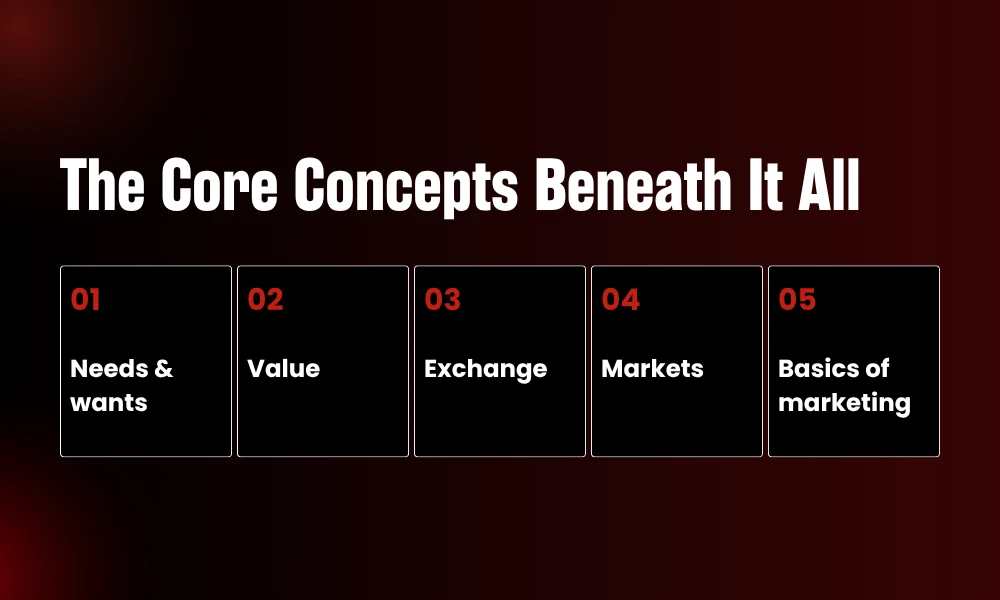
- Beneath every concept sit four building blocks: needs, value, exchange, and markets.
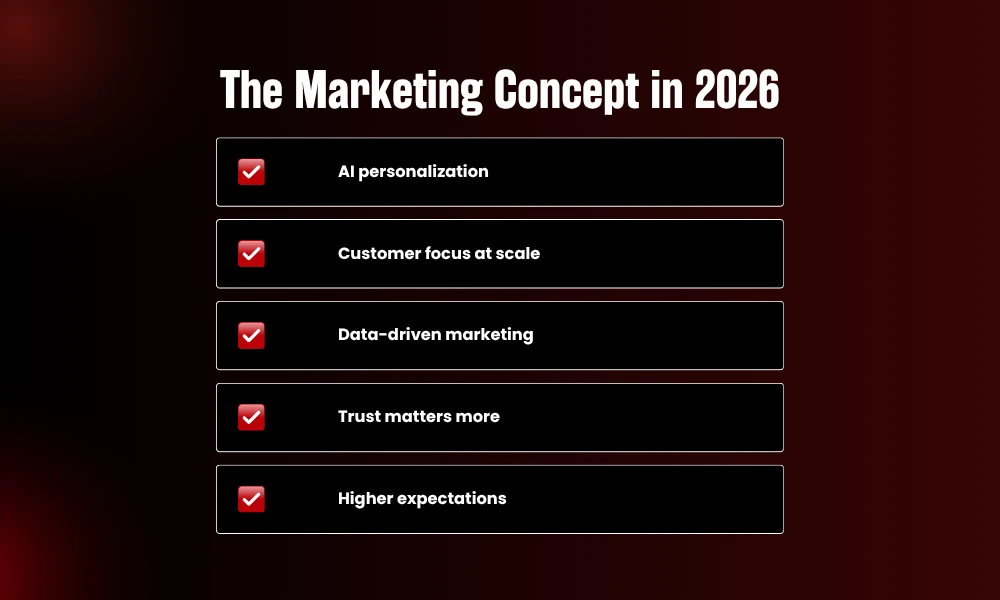
- In 2026, AI and data make true customer-centricity possible at scale, raising the bar for what the marketing concept demands.
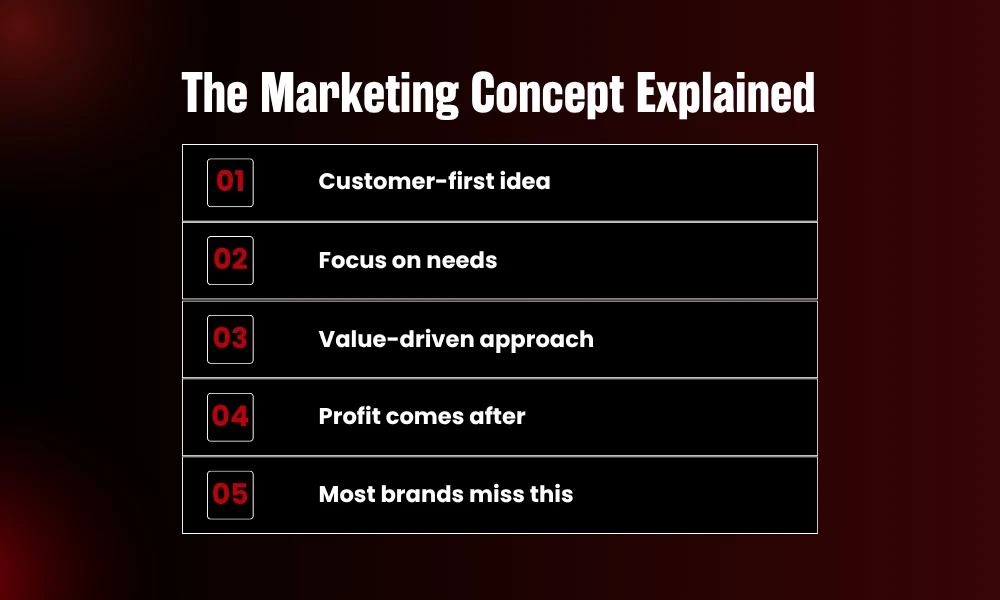
What the Marketing Concept Actually Means
Strip away the jargon and the marketing concept is one idea: figure out what people need, then deliver it better than anyone else.
It is a shift from “make and sell” to “sense and respond.”
A make-and-sell company designs a product in a room, manufactures it, and then asks marketing to move the inventory. The customer enters the story at the end, as a target.
A sense-and-respond company starts with the customer. It studies the need, the context, and the unmet frustration, and only then builds the offering. The customer enters at the beginning, as the brief.
Why it matters: under the marketing concept, profit is an outcome, not an objective. You earn it by satisfying customers so well that they come back and bring others. The company that chases profit first and customers second usually loses both.
This is also where customer-centricity stops being a slogan. The marketing concept demands that the whole organization, not just the marketing department, orient around the customer. Product, support, operations, and finance all serve the same north star.
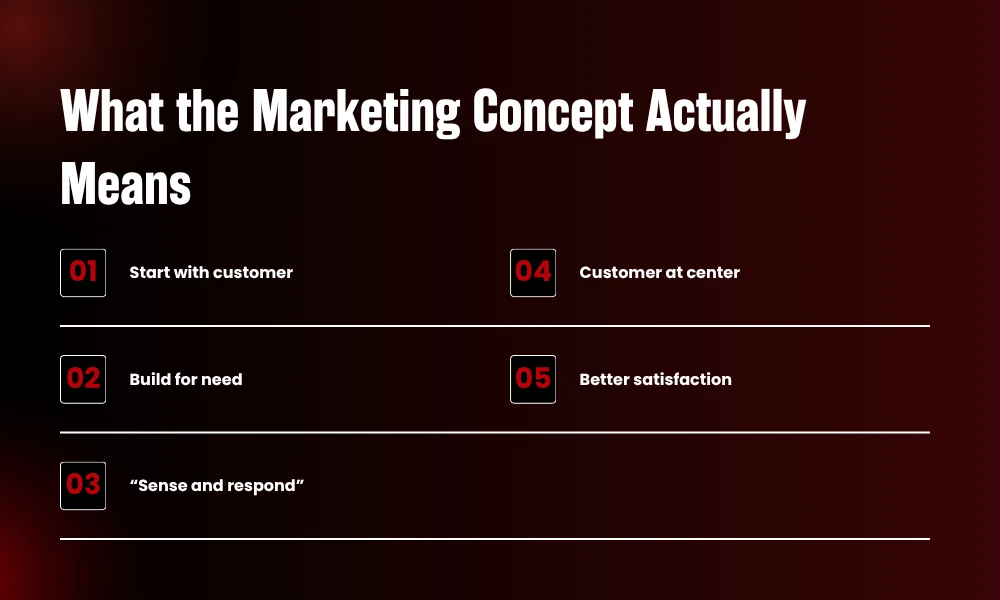
The Five Marketing Management Concepts
Every company runs on a philosophy about its market, even if no one has named it. There are five, and they form a rough evolution.
The Production Concept
This philosophy assumes customers want products that are affordable and widely available. So the company obsesses over efficiency, scale, and low cost.
It works in specific conditions, like high-demand markets or commodity goods. The risk is tunnel vision. A company so focused on producing cheaply can lose sight of whether customers actually want what it is producing.
The Product Concept
Here the belief is that customers favor the highest quality, performance, or features. So the company pours energy into making a better product.
The trap has a name: marketing myopia. A business can build a technically brilliant product nobody wants, because it fell in love with the product instead of the need. A better mousetrap means nothing if the world has moved on from mice.
The Selling Concept
This philosophy assumes customers will not buy enough unless pushed. So the company leans on aggressive selling and promotion.
It shows up most with unsought goods and with companies sitting on overcapacity. The flaw is that it aims to sell what the company makes, not make what the market wants. It treats every sale as a conquest rather than the start of a relationship.
The Marketing Concept
This is the pivot. The belief is that success comes from understanding the target market’s needs and delivering satisfaction better than rivals.
The company starts with the customer, coordinates every function around that customer, and earns profit through satisfaction and loyalty. This is the philosophy most modern brands aspire to, and the one this article is named for.
The Societal Marketing Concept
The newest evolution adds a third party: society. It argues that brands should satisfy customers and turn a profit while also protecting long-term social and environmental wellbeing.
It answers a real tension. Some products satisfy immediate wants while quietly harming people or the planet. The societal concept asks brands to balance customer wants, company profit, and the public good.
| Concept | Focus | Core belief | Main risk |
| Production | Efficiency and availability | People want cheap, available goods | Ignoring real preferences |
| Product | Quality and features | People want the best product | Marketing myopia |
| Selling | Promotion and persuasion | People must be pushed to buy | One-off sales, no loyalty |
| Marketing | Customer needs | Serve needs better than rivals | Requires real discipline |
| Societal | Customer plus society | Balance wants, profit, and welfare | Harder trade-offs |
Strategic breakdown: these are not just academic categories. They describe where your budget, your meetings, and your incentives actually point. Most companies claim the marketing concept and behave like the selling concept.
Marketing Concept vs Selling Concept
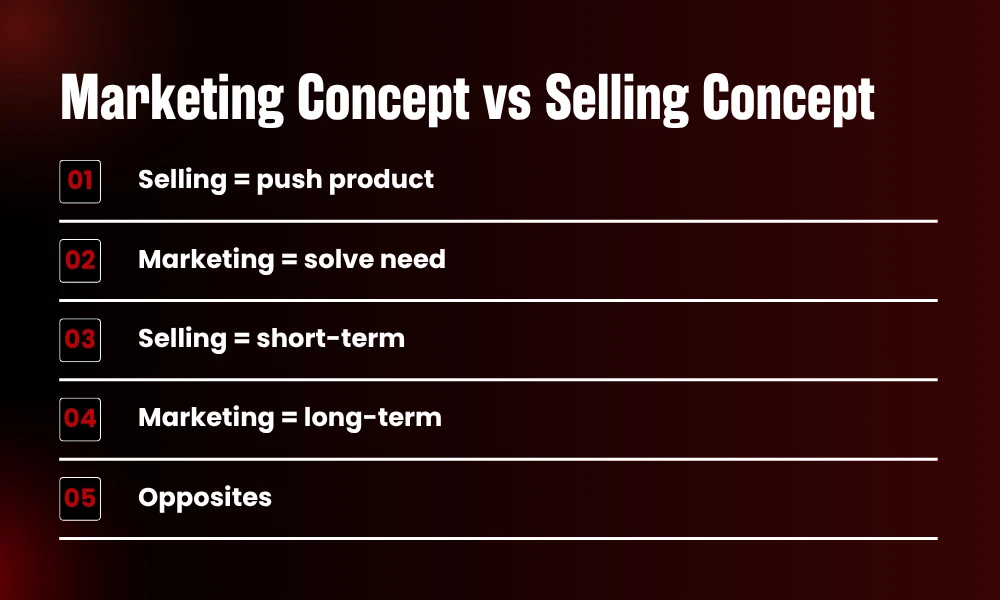
If you remember one distinction from this entire guide, make it this one.
The selling concept and the marketing concept look at the same market from opposite ends.
The selling concept starts inside the factory. It has a product, and the job is to find buyers. The energy goes into promotion, discounts, and persuasion. Success is measured in units moved.
The marketing concept starts in the market. It has a customer need, and the job is to satisfy it. The energy goes into understanding, designing, and serving. Success is measured in satisfaction and retention.
Put simply, selling tries to get customers to want the product. Marketing tries to build the product customers already want.
Consider a simple example. A company with a warehouse full of unsold fitness trackers runs the selling concept: heavy ads, steep discounts, urgency. A company practicing the marketing concept asks why people abandoned their last tracker, learns it was discomfort and dead batteries, and designs a lighter device with a week of battery life. One pushes inventory. The other removes a reason not to buy.
Market observation: the selling concept is not evil, and every business sells. The error is making selling your philosophy instead of your tactic. Selling moves what you have. Marketing decides what you should have built.
The Core Concepts Beneath It All
Under all five philosophies sit four building blocks. These are the core concepts of marketing, the vocabulary the rest of the discipline is written in.
Needs, wants, and demands. A need is a basic requirement, like transport. A want is a need shaped by culture and personality, like a specific car brand. A demand is a want backed by the ability to pay. Marketers do not create needs. They shape wants and meet demand.
Value and satisfaction. Customers choose the offering that gives them the most value, the gap between the benefits they get and the costs they pay. Satisfaction is whether the experience met the expectation. Get value right and satisfaction follows.
Exchange and relationships. Marketing happens through exchange, trading something of value for something else of value. Modern marketing extends single exchanges into long-term relationships, because keeping a customer costs far less than winning a new one.
Markets. A market is the set of actual and potential buyers for an offering. Understanding your market, who they are, what they value, and how they decide, is where every strategy begins.
These four ideas show up in every campaign, every funnel, and every brand decision. They are the grammar of the field. We expand on how they connect in our overview of marketing fundamentals.
The Marketing Concept in 2026
The marketing concept is decades old. The ability to actually deliver on it is brand new.
For most of marketing history, true customer-centricity was an aspiration limited by data. You could not understand millions of individuals, so you served averages and segments.
That ceiling is lifting. AI, behavioral data, and automation now let brands sense and respond at the level of the individual. Personalization that once meant “Dear [First Name]” can now mean genuinely different experiences for genuinely different people.
That raises the bar. When competitors can serve customers with precision, vaguely “knowing your audience” no longer counts as practicing the marketing concept.
There is a catch the societal concept predicted. The same data that enables personalization raises real questions about privacy, consent, and trust. Customers increasingly reward brands they trust and punish those that feel intrusive. The marketing concept in 2026 means serving the customer in ways that respect them, not just track them.
Enterprise perspective: the philosophy did not change. The standard did. Customer-centricity stopped being a differentiator and became the price of entry.
How to Tell Which Concept Your Company Runs On
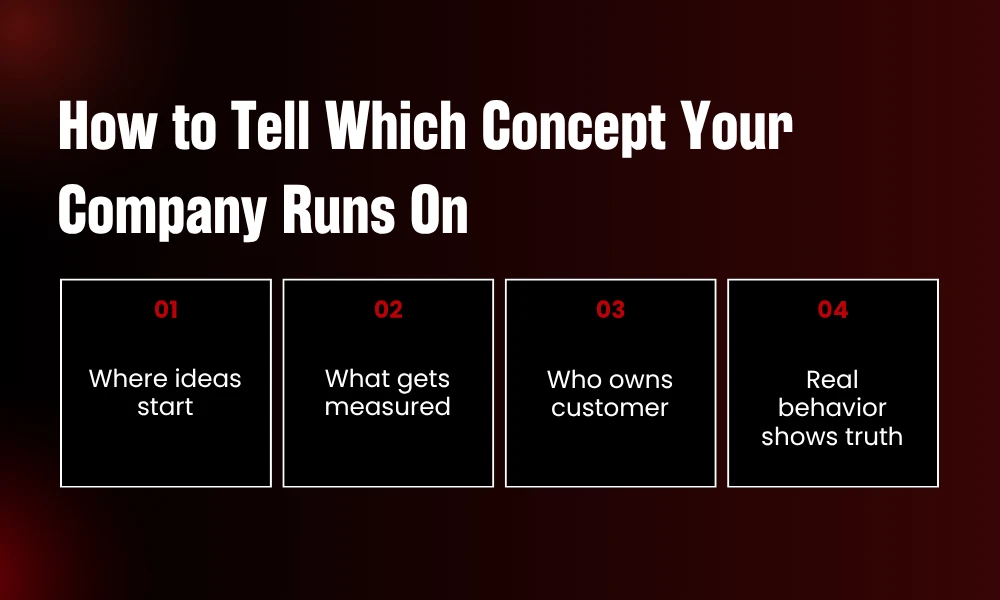
Companies rarely declare their philosophy. They reveal it through behavior. Here is a quick diagnostic.
Look at where decisions start. If new products begin with “what can we build” or “what do we have to sell,” you are running the product or selling concept. If they begin with “what does the customer need,” you are running the marketing concept.
Look at what gets measured. If the dashboards are dominated by units shipped and short-term sales, the selling concept is in charge. If they include satisfaction, retention, and lifetime value, the marketing concept has a seat.
Look at who owns the customer. If only the marketing team thinks about the customer, the concept is cosmetic. If product, support, and leadership all orient around the customer, it is real.
Look at the trade-offs. If the brand satisfies short-term wants while ignoring long-term harm, it has not reached the societal concept. If it weighs customer, profit, and public good together, it has.
Tactical framework: audit one recent decision against these four lenses. The honest answer tells you which concept you actually operate under, regardless of what your mission statement says.
To turn this philosophy into action, pair it with the principles of marketing and the practical foundations in our marketing 101 guide.
Frequently Asked Questions
What is the marketing concept?
The marketing concept is a business philosophy that says a company succeeds by understanding customer needs and delivering value better than competitors, rather than by pushing whatever it produces. The customer sits at the center of every decision, and profit is treated as the result of satisfied customers.
What are the 5 marketing concepts?
The production concept, the product concept, the selling concept, the marketing concept, and the societal marketing concept. Each is a different philosophy about how a company should approach its market, from a focus on efficiency to a focus on customer needs and social wellbeing.
What is the difference between the marketing concept and the selling concept?
The selling concept starts with a product and uses persuasion to sell it. The marketing concept starts with the customer and builds offerings around their needs. Selling makes customers want the product. Marketing makes products customers already want.
What is the societal marketing concept?
It extends the marketing concept by balancing customer wants, company profit, and society’s long-term wellbeing, asking brands to satisfy customers in ways that also protect public and environmental welfare.
Why is the marketing concept important?
Because it aligns the whole organization around the customer, which drives loyalty, repeat business, and sustainable growth. Companies built around real demand tend to outperform those trying to manufacture demand for what they already make.
What are the core concepts of marketing?
Needs, wants, and demands; value and satisfaction; exchange and relationships; and markets. These building blocks describe what customers seek, what they will trade for it, and where that trade happens.
Key Takeaways for Executives
- Name your real philosophy. Most companies claim the marketing concept and operate on the selling concept. Behavior, not mission statements, reveals the truth.
- Start with the need, not the inventory. Sense-and-respond beats make-and-sell, because building around demand is cheaper than manufacturing it.
- Treat profit as an outcome. Satisfy customers well enough that they return and refer, and profit follows.
- Make customer-centricity organization-wide. If only marketing thinks about the customer, the concept is cosmetic.
- Hold the societal line. In 2026, serving customers in ways that respect privacy, trust, and long-term welfare is the standard, not a bonus.
The Bottom Line
The marketing concept is the quiet operating system beneath every brand decision. Choose the selling concept and you will spend forever pushing inventory. Choose the marketing concept and you will build around demand that already exists.
In an era where AI makes genuine customer-centricity achievable at scale, the brands that internalize this philosophy, and resist the gravity of make-and-sell, will own the relationships their competitors keep trying to buy.
Tracking exactly these shifts, where strategy, AI, commerce, and brand collide, is the work BrandClickX exists to do.