Type a name into True People Search and within seconds you can see a stranger’s home address, age, phone numbers, and a list of their relatives. For free. No account required.
That is unsettling enough when you are searching for someone else. It is far more unsettling when you realize the same profile almost certainly exists for you.
People-search sites have turned the scattered public record into a tidy, searchable dossier on nearly every adult. Most people have no idea they are listed, or how much is exposed, until they look.
This guide is the honest version. What True People Search actually is, whether it is legitimate and safe, how accurate it really is, the genuine risks it creates, and the most important part: exactly how to remove your information, step by step.
Key Takeaways
- True People Search is a free, legal data broker that aggregates public records into searchable profiles.
- It is “legitimate,” but the real risk is that anyone, including bad actors, can view your details.
- Accuracy varies, and partial errors do not make your profile safe to ignore.
- You can remove yourself for free at the site’s official opt-out page in a few minutes.
- Listings can reappear, so ongoing protection matters, and in 2026 California’s DROP platform makes broad deletion easier.
What True People Search Actually Is
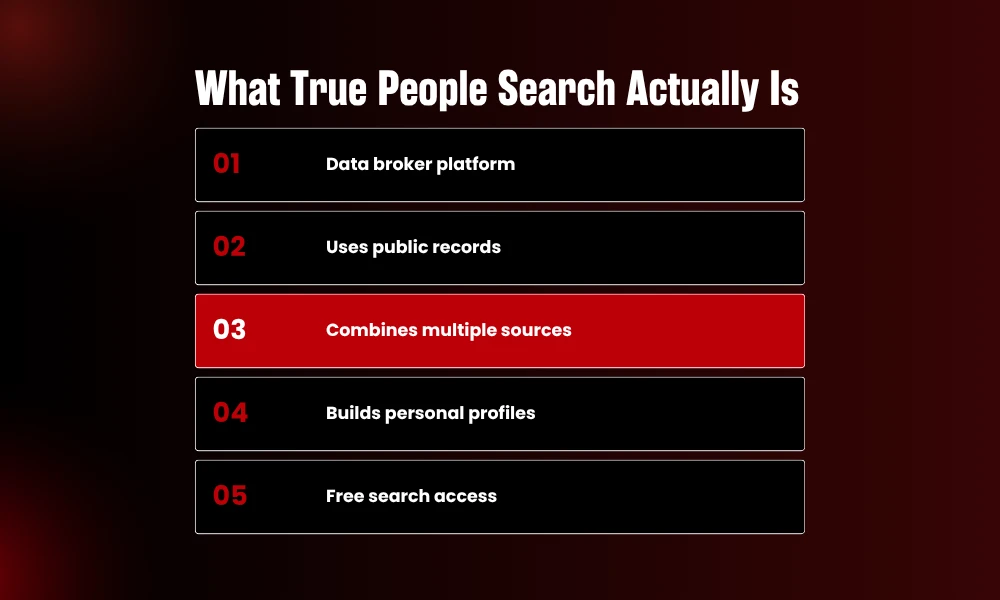
True People Search, found at TruePeopleSearch.com, is a free people-search website. It has operated since 2017, and it belongs to a much larger category known as data brokers.
It does not generate any of its data. Instead, it collects information that is already public and organizes it into a single, searchable profile.
The sources are ordinary public records. Property deeds. Court filings. Voter records. Marriage and address histories. Phone directories. On their own, these records are scattered across dozens of agencies and databases. A people-search site stitches them together.
The result is a profile that can include a person’s full name and aliases, date of birth or age, current and previous addresses, phone numbers, email addresses, and a network of relatives and associates.
Why it matters: the danger was never any single public record. It is the aggregation. A site like this collapses information that used to take real effort to assemble into one click, available to anyone.
To understand the broader system this sits inside, see our explainer on how data brokers collect and sell your information.
Is True People Search Legit, Legal, and Safe?
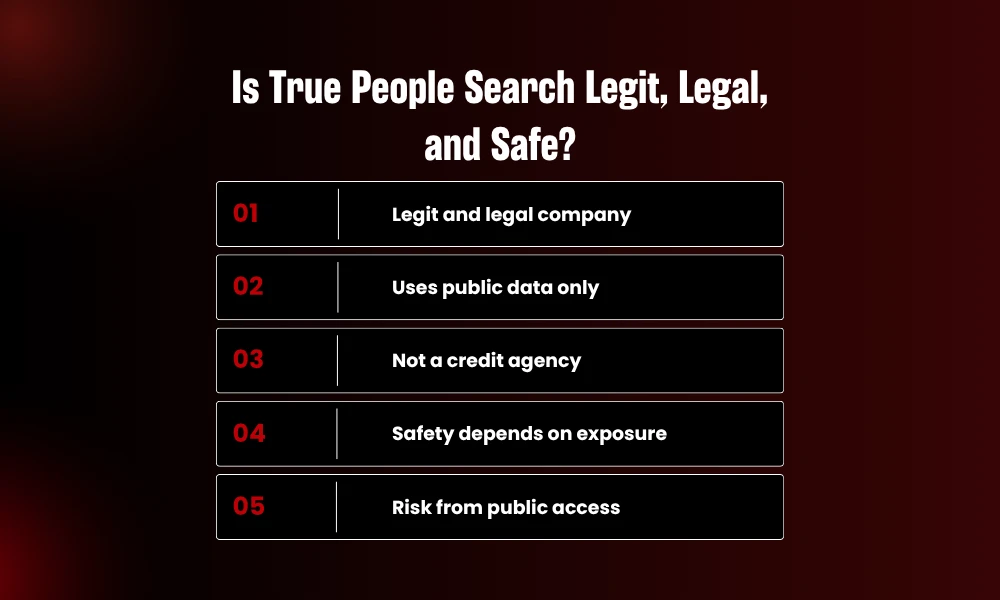
These three words get treated as one question, but they are not the same. Here is the honest breakdown.
Is it legitimate? Yes. True People Search is a real, functioning company that does what it says. It is not a scam site.
Is it legal? Yes. Because it draws from public records and organizes rather than creates that information, its core operation is legal. It also positions itself as not being a consumer reporting agency under the Fair Credit Reporting Act, which means its data is not supposed to be used for decisions like hiring, lending, tenant screening, or insurance.
Is it safe? This is where the honest answer gets uncomfortable. The site itself is not malicious. The risk is who else uses it.
The same free access that lets you look up an old classmate lets anyone look up you. That includes people you would never want holding your address, such as a stalker, an abusive ex, a scammer, or someone running a social-engineering attack to break into your accounts.
Market observation: the most common defense of people-search sites is “it’s only public information.” That is technically true and practically misleading. Public and easily aggregated are very different threat levels, and these sites erase the difference.
How Accurate Is True People Search?
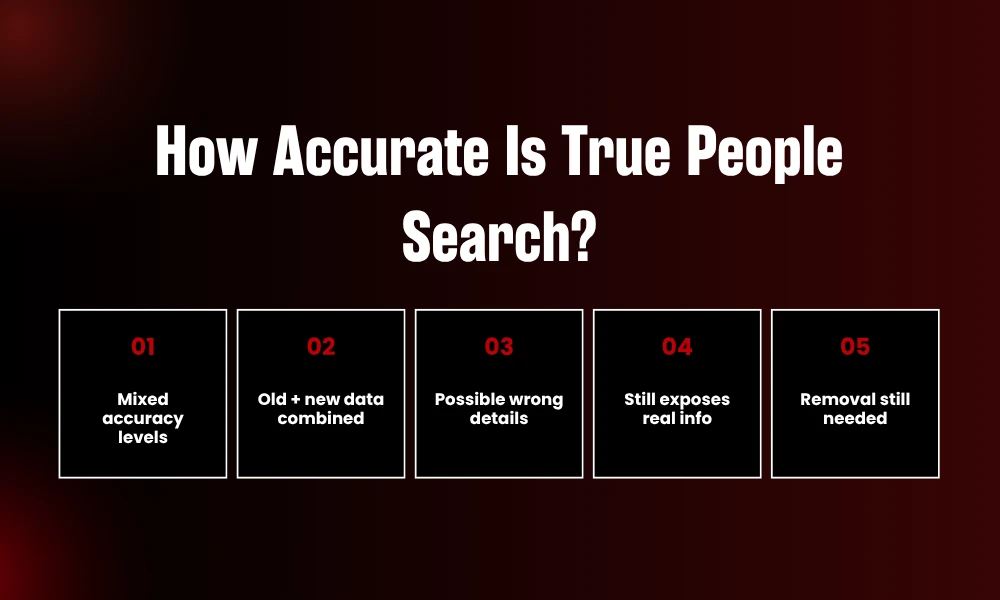
Accuracy is inconsistent, and that cuts both ways.
Because the site blends many sources, a single profile can contain a current address next to an apartment you left a decade ago, relatives who are correctly listed alongside people you have never met, and phone numbers that range from active to long-dead.
Some people use these errors to reassure themselves. That is a mistake.
A profile does not need to be perfectly accurate to put you at risk. A correct current address paired with wrong relatives is still a correct current address. Partial accuracy is still exposure.
So the accuracy question, while interesting, should not change your decision. Whether the profile is flawless or full of errors, if it contains real, identifying details about you, removing it is worthwhile.
What True People Search Exposes, and Why It Matters
To understand why removal is worth a few minutes, it helps to see what is actually at stake.
A complete profile can hand a stranger the building blocks of your identity and your physical location. That enables a specific set of harms.
- Doxxing and harassment. Publishing someone’s home address to intimidate them starts with a site like this.
- Stalking and physical safety. For survivors of abuse, a public address is not an inconvenience. It is a danger.
- Impersonation and identity theft. Date of birth, address history, and relatives are exactly the details used to impersonate someone.
- Social engineering and account takeover. Many security questions and “verify your identity” checks rely on facts a people-search profile readily provides, like a previous street or a relative’s name.
- Scams targeting the vulnerable. Older adults in particular are targeted using details that make a scam call sound legitimate.
Why it matters: you do not have to be famous or wealthy to be a target. You need a profile, and almost everyone has one. The exposure is the point of vulnerability, regardless of who you are.
This is exactly the protective lens we bring to coverage of the data economy, because privacy is no longer a niche concern. It is basic digital safety.
How to Remove Yourself From True People Search
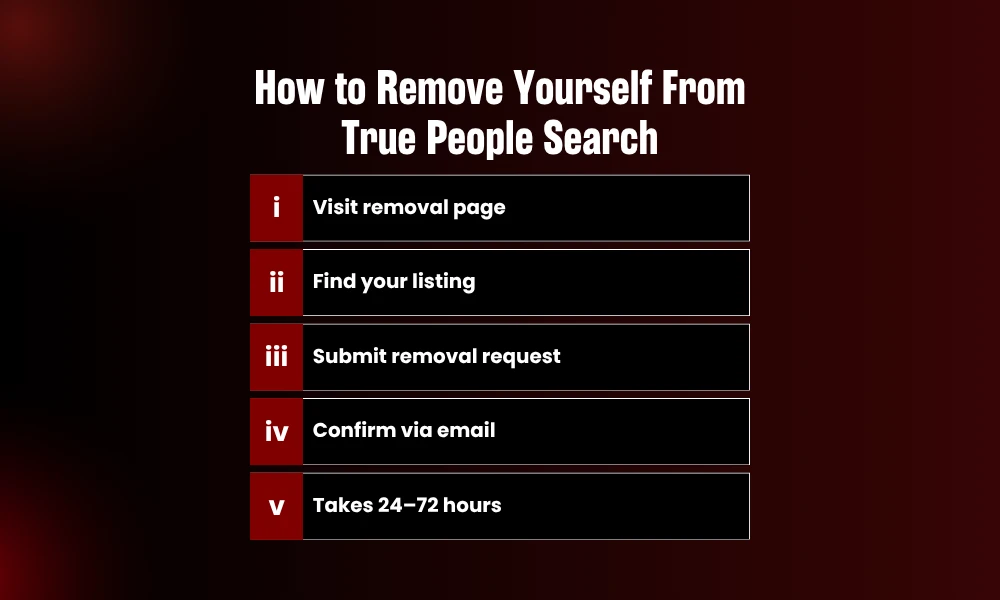
This is the part that matters most, and the good news is that it is free and takes only a few minutes. As of 2026, the process is still manual, so follow the steps carefully.
You will remove your own listing through the site’s official opt-out tool. Here is the process.
| Step | Action |
| 1 | Go to the official removal page at truepeoplesearch.com/removal, or click “Do Not Sell My Personal Information” in the site footer. |
| 2 | Enter a valid email address and complete the CAPTCHA to begin. |
| 3 | Find your own listing by searching your name and location, or by phone or email. |
| 4 | Open the correct record and select “Remove This Record” at the bottom of the profile. |
| 5 | Open the verification email the site sends, and click the confirmation link to finalize the request. |
A few practical tips make this smoother.
Use a dedicated email. Create a separate email address for privacy requests, so you are not handing data brokers the inbox you use everywhere else. You will reuse it for other opt-outs.
Gather your details first. Have your name variations, current and past cities, and known relatives ready, so you can identify the right listing quickly.
Watch for multiple listings. If you share a common name or have moved often, you may have more than one profile. Remove each one that is actually you.
Always click the verification link. The most common reason a removal fails is a missed confirmation email. Check spam if it does not arrive.
Removal usually takes effect within 24 to 72 hours. Re-search your name in a private browser window afterward to confirm it worked.
Tactical framework: removal is not a one-time event, it is a habit. Do it now, then set a calendar reminder to check again in a few months.
Why Your Information Comes Back
Here is the frustrating reality of data brokers. Removal is rarely permanent.
People-search sites continuously ingest fresh public records. So even after a successful opt-out, a new property record, court filing, or updated directory entry can cause your profile to reappear weeks or months later.
This is not necessarily the site ignoring your request. It is the nature of a system that constantly refreshes from public sources.
The practical takeaway is to treat opt-outs as recurring maintenance, not a single fix. Recheck periodically, and re-submit if your listing returns.
This cycle is also why many people graduate from manual opt-outs to a broader strategy, which we cover in our guide to removing your information from data brokers across the board.
The Bigger Picture: Data Brokers and Your Rights in 2026
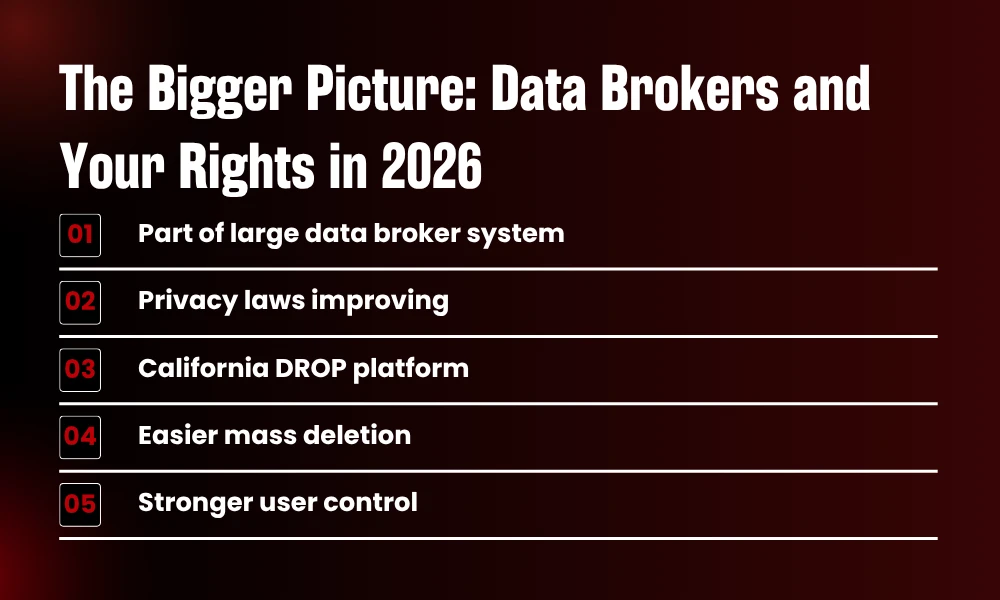
True People Search is one site. The data-broker industry behind it includes hundreds of companies, and the rules governing them are finally changing.
The most significant development is in California. Under the state’s Delete Act, the California Privacy Protection Agency has launched a centralized tool called the Delete Request and Opt-out Platform, or DROP.
DROP went live at the start of 2026 and represents a genuine shift. Instead of opting out of brokers one by one, a California resident can submit a single verified request that directs every registered data broker, more than 500 of them, to delete their personal information. Registered brokers are required to begin honoring these requests on a recurring basis from August 2026, and to process them within set timeframes.
That one-stop model is what privacy advocates have wanted for years, and other states are watching closely.
Your existing rights matter too. The California Consumer Privacy Act and similar state laws already give residents the right to request deletion of their personal information. The Federal Trade Commission has also pushed for clearer, more visible opt-out mechanisms, noting that opt-out links buried in a footer are easy to miss by design.
If you would rather not manage opt-outs yourself, paid data-removal services exist as a category. They monitor brokers and submit removals on your behalf for a recurring fee. They are a convenience, not a necessity, since the core opt-outs can be done for free. We break down your full set of options in our overview of your data privacy rights and how to use them.
Enterprise perspective: the regulatory direction is clear. The era of frictionless, unaccountable data brokering is closing, slowly, and consumer deletion rights are becoming real and enforceable rather than theoretical.
A Practical Privacy Protection Plan
Removing yourself from one site is a good start. Protecting yourself properly takes a short, repeatable routine. Here is a sensible plan.
- Start with the high-exposure sites. Opt out of True People Search and the other major people-search platforms first, since they are the most visible.
- Use DROP if you are in California. Submit a single deletion request through the state platform to cover all registered brokers at once.
- Set a recurring reminder. Recheck your listings every few months and re-opt-out as needed, because profiles return.
- Minimize new exposure. Use a dedicated email for forms and accounts, limit what you share publicly, and tighten the privacy settings on your social profiles.
- Consider a removal service if time is short. For ongoing, hands-off coverage, a reputable service can handle the recurring work.
The goal is not perfect invisibility, which is unrealistic. The goal is to shrink your exposure enough that you are no longer the easiest target.
Strategic breakdown: privacy in 2026 is maintenance, not a one-time setting. The people who stay protected are the ones who treat it as a habit, not a panic.
Frequently Asked Questions
What is True People Search?
True People Search is a free people-search website that aggregates public records into searchable profiles. Operating since 2017, it compiles names, addresses, phone numbers, email addresses, ages, and relatives from sources like property deeds and court filings. It is one of many data-broker sites.
Is True People Search legit and safe?
It is a legitimate, legally operating data broker that uses public records and is not a consumer reporting agency under the FCRA. The site is legal, but the risk is that anyone can view your details, which can enable stalking, impersonation, or social engineering. That is why many people opt out.
Is True People Search accurate?
Accuracy varies, because it blends many sources. Profiles can mix outdated addresses, wrong relatives, and incorrect numbers with accurate details. Errors do not make your profile safe, so removal is still worthwhile.
How do I remove myself from True People Search?
Go to truepeoplesearch.com/removal, enter a valid email and complete the CAPTCHA, search for your own listing, open your record, and select “Remove This Record.” Then click the link in the verification email. It is free and usually completes within 24 to 72 hours.
Does True People Search remove my info permanently?
Not always. Your listing can reappear as the site ingests new public records, so you may need to repeat the opt-out periodically. California residents can use the DROP platform for broad deletion across registered brokers, and others can use a removal service or opt out manually on a schedule.
Is it legal for True People Search to show my information?
Yes. The data comes from public records, which are legally accessible, and the site organizes rather than creates it. Laws like the CCPA give you the right to request deletion, but absent a request, displaying aggregated public records is generally legal.
Key Takeaways for Readers
- Assume you are listed. Almost every adult has a people-search profile, whether they know it or not. Check yours.
- Judge “safe” by who can see it. The site is legitimate, but the exposure to bad actors is the real risk.
- Don’t let inaccuracy fool you. A partially wrong profile with your real address is still a danger. Remove it anyway.
- Opt out for free, then repeat. The official removal takes minutes, but listings return, so make it a recurring habit.
- Use your 2026 rights. California’s DROP platform now enables one-request deletion across registered brokers, and similar protections are spreading.
The Bottom Line
True People Search is not a scam or a hacker’s tool. It is a legal business that turns scattered public records into a one-click profile of you, and that convenience for searchers is exactly what creates risk for everyone listed.
The fix is within your control. Remove your information for free, treat opt-outs as recurring maintenance, and lean on the stronger deletion rights now coming online. Privacy in 2026 is not about disappearing. It is about no longer being the easiest person to find.
Tracking exactly these shifts, where data, privacy, and digital life collide, is the work BrandClickX exists to do.