

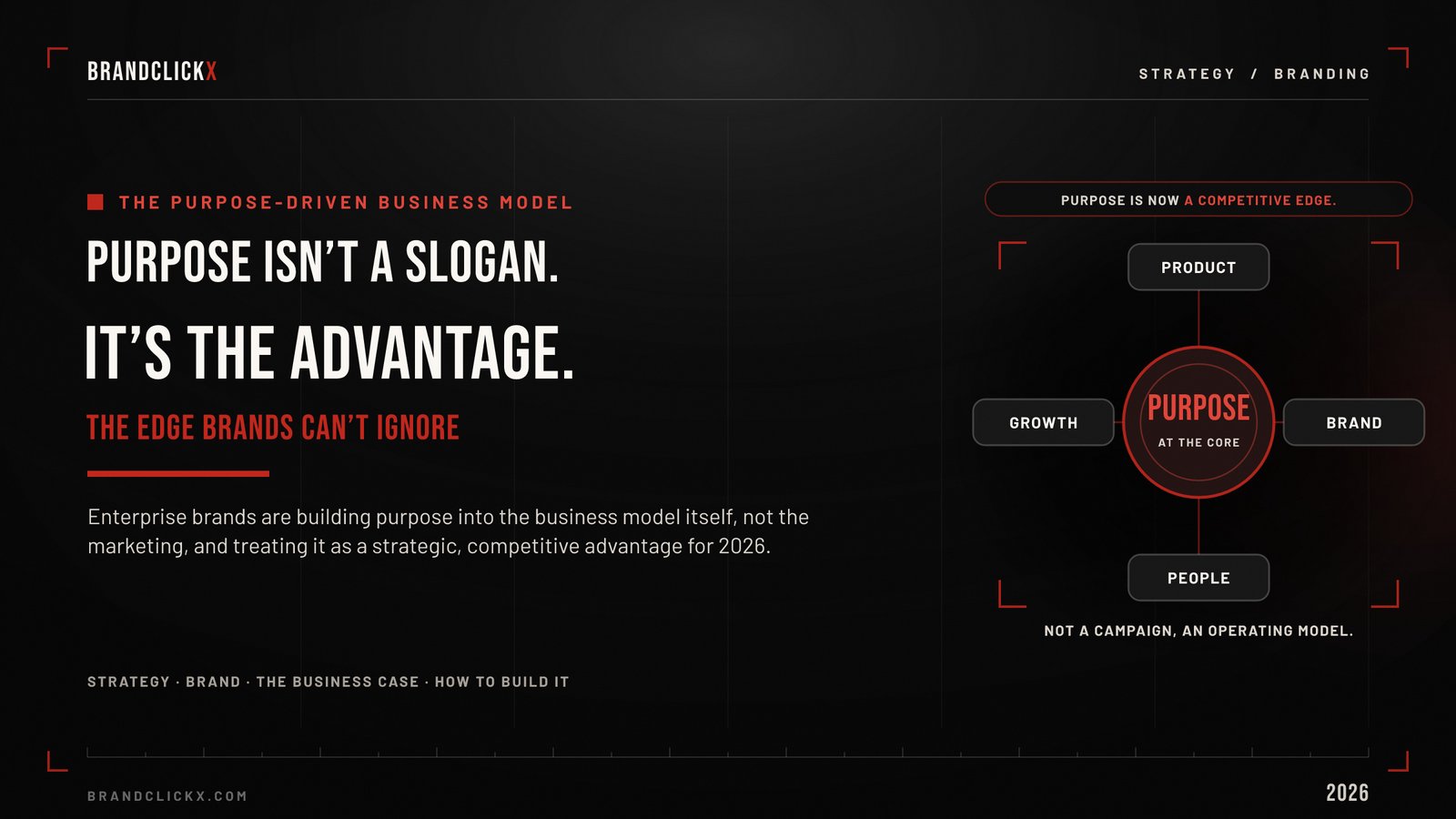
The Shift Is Already Here Most Marketers Just Haven’t Named It Yet
Something fundamental shifted in boardrooms across 2024 and 2025.
It wasn’t a marketing trend. It wasn’t a campaign theme. It was operational. A growing cohort of Fortune 500 companies, SaaS leaders, and enterprise brands began restructuring how they think about their core business model itself.
Not adding purpose. Not launching purpose initiatives.
Rebuilding the model.
MasterCard pledged to bring 1 billion people into the digital economy, and made it a strategic centerpiece, not a CSR footnote. Microsoft repositioned around “empowering every person and organization to achieve more,” which fundamentally changed their cloud strategy, open-source commitments, and go-to-market priorities.
Goldman Sachs committed to deploying $750 billion in sustainable finance by 2030, which reshaped their entire investment thesis.
These weren’t marketing campaigns.
These were operating model shifts. Strategic bets. Capital allocation decisions. The companies didn’t add a purpose layer on top of existing business logic. They redesigned the logic itself.
In 2026, that’s no longer exotic.
It’s becoming table stakes particularly for enterprise brands competing on innovation, talent, and customer trust rather than price alone. The purpose-driven business model is moving from “nice to have” to “essential to scale.”
The question brands should be asking isn’t “Should we adopt a purpose-driven model?” It’s “What is our authentic purpose, and does our current business model actually reflect it?”
What Is Actually a Purpose-Driven Business Model?
Let’s be precise, because the term gets muddled.
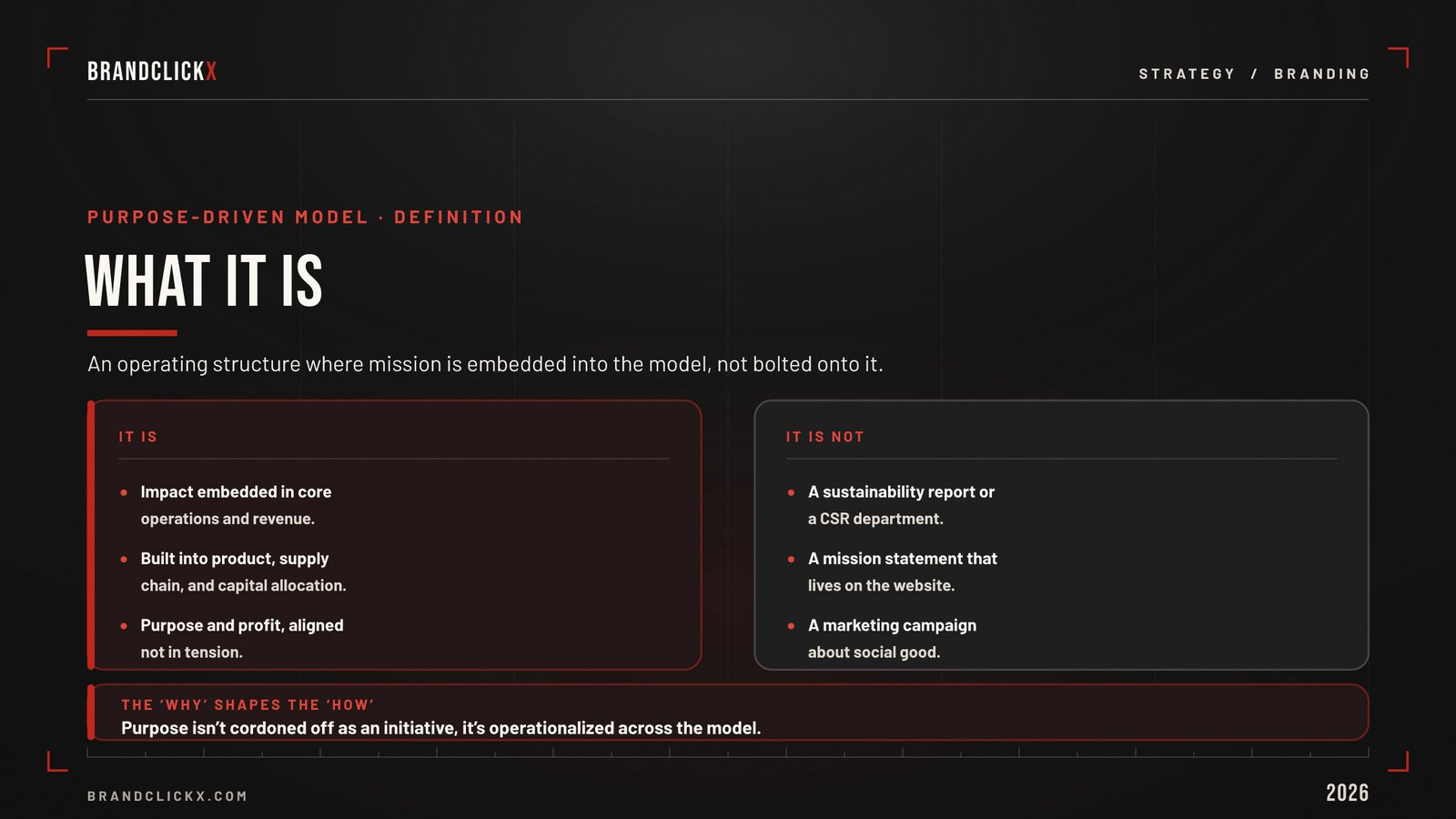
A purpose-driven business model is not:
- A sustainability report
- A CSR department
- A mission statement that lives on your website
- A marketing campaign about social good
- A way to feel better about extracting value
It is:
An organizational structure where social, environmental, or stakeholder impact is embedded into core revenue streams, product design, supply chain decisions, capital allocation, and strategic planning not cordoned off as a separate initiative.
Purpose and profit are aligned. Strategy and values are operationalized. The “why” shapes the “how.”
McKinsey’s research on corporate purpose shows companies that integrate purpose into core strategy outperform peers across six measurable dimensions: brand reputation, sales and innovation, capital access, operational efficiency, talent acquisition, and risk mitigation.
This isn’t conjecture.
It’s enterprise financial reality.
The operating model itself changes. Product roadmaps shift. Go-to-market strategies evolve. Supply chain priorities reorganize. Hiring profiles change. Investor relations messaging transforms. The business, at a structural level, orients around something larger than quarterly revenue.
For a SaaS company, this might mean building data privacy into the product architecture making it a competitive moat, not a compliance checkbox. For a consumer brand, it means supply chain transparency becomes operational infrastructure, not marketing theater. For an enterprise platform, it means accessibility features drive product innovation, not get added as afterthoughts.
The business model fundamentally changes because the value proposition changes.
Why Brands Are Restructuring Now (The Real Drivers)
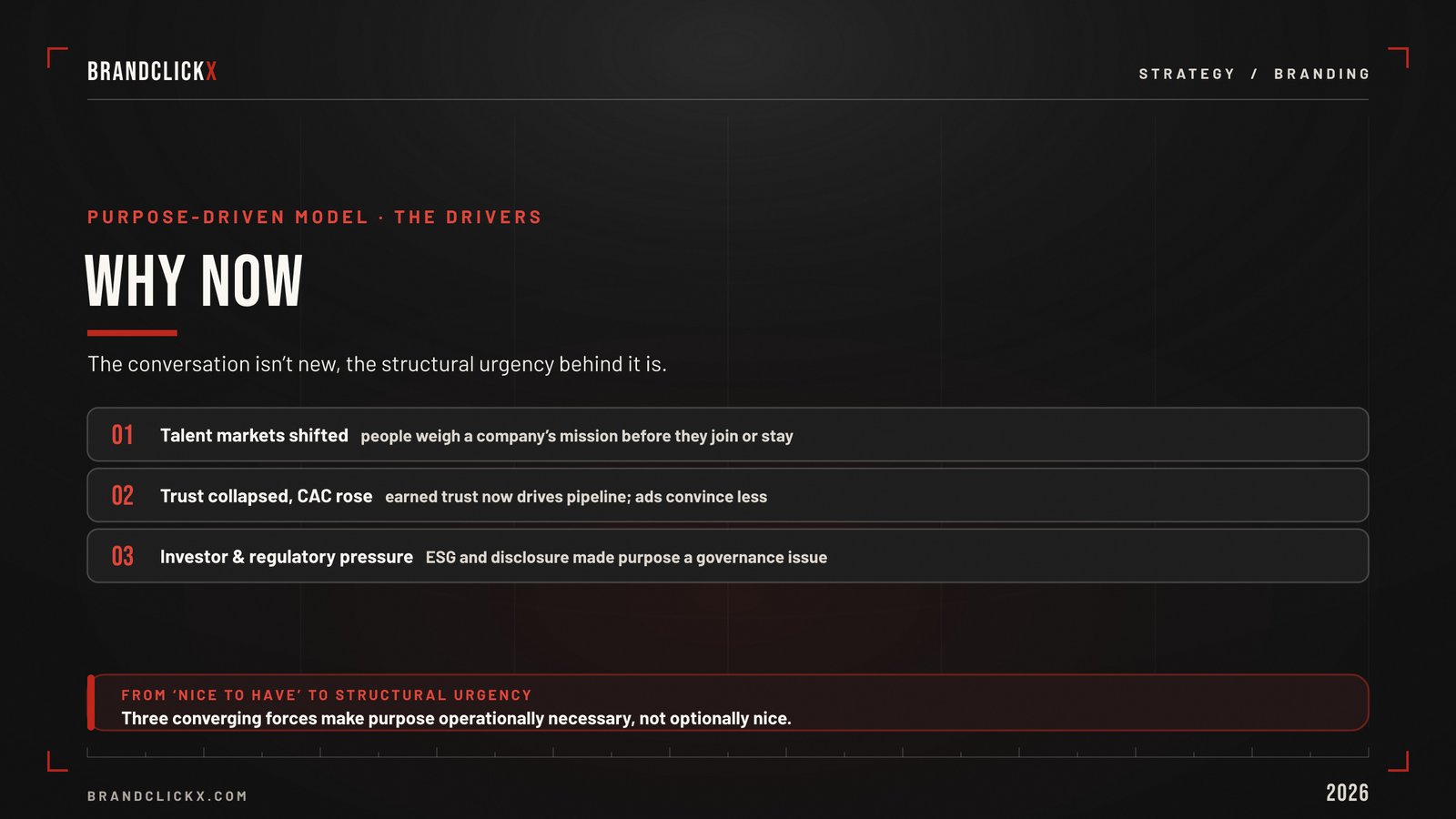
The conversation around “purpose” isn’t new. Corporate mission statements have existed for decades.
What’s new is the structural urgency.
Three converging forces are making this operationally necessary, not optionally nice:
1. Talent Markets Have Fundamentally Shifted
The “purpose premium” in hiring is real and measurable.
Research from HubSpot’s workplace culture studies shows 68% of Gen Z workers consider a company’s social and environmental commitments before accepting a job. For millennial workers, the number is 67%. For Gen X, it’s still 52%.
More importantly: employees at purpose-driven companies show 21% higher engagement and 22% lower turnover.
At enterprise scale, that’s operational.
A Fortune 500 company losing 22% less of their workforce isn’t optimizing marketing messaging. They’re reducing onboarding costs, accelerating time-to-productivity, and retaining institutional knowledge. For tech companies especially, where engineering talent is scarce, this becomes a competitive moat.
You can’t hire your way out of a purpose-driven economy anymore. You have to build it in.
2. Customer Acquisition Costs Have Exploded; Brand Trust Has Collapsed
Paid marketing doesn’t work like it did five years ago.
Adobe’s 2025 Consumer Sentiment Report found that 71% of consumers distrust traditional advertising. Across SaaS, enterprise software, and consumer brands, word-of-mouth referral and earned trust now drive 40-60% of qualified pipeline.
Customers are doing reverse due diligence.
They’re checking supply chains. They’re reading mission statements and asking if companies actually live them. They’re abandoning brands that claim purpose but operate extractively. A CMO can’t hide misalignment between stated values and actual operations anymore not with social media, Glassdoor reviews, and news cycles moving at this velocity.
The brands winning on customer acquisition aren’t spending more on ads. They’re building authentic community and trust through operational consistency.
That only works if the business model actually reflects the mission.
3. Investor and Regulatory Pressure Has Become Structural
ESG mandates, SEC climate disclosure requirements, and stakeholder capitalism frameworks have made purpose-driven strategy a governance issue, not a marketing one.
Public companies can’t ignore it. Private companies raising capital face investor scrutiny on it. Enterprise customers now include purpose alignment in vendor selection criteria.
This isn’t soft pressure.
It’s capital reallocation, contract terms, and investment thesis changes.
The brands that restructured their business models early are now competing at a structural advantage on capital access, customer acquisition costs, and talent retention. The brands that didn’t are playing catch-up, and the gap is widening.
The Enterprise Framework: How Purpose Gets Operationalized
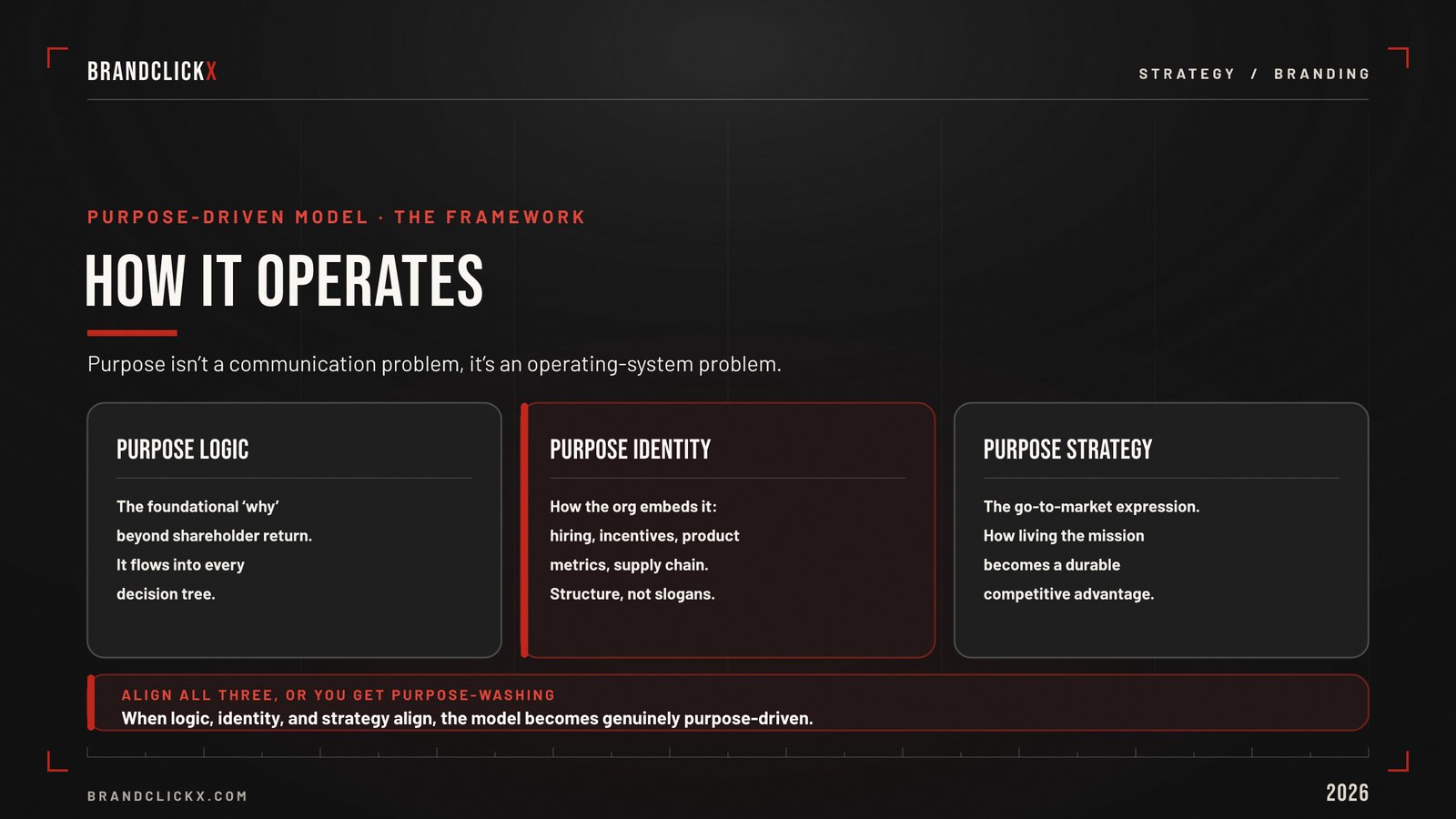
The mistake most organizations make is treating purpose as a communication problem.
They hire a communications agency. They develop a purpose statement. They create a campaign. And then they wonder why employees don’t believe it, customers see through it, and the market doesn’t reward it.
Purpose isn’t a communication problem.
It’s an operating system problem.
The Three Essential Components of a Purpose-Driven Operating Model:
1. Purpose Logic
This is the foundational “why” that goes beyond shareholder returns.
Microsoft’s purpose logic: technology should empower human potential.
That shifts everything. It changes how you evaluate acquisitions. It changes your open-source strategy. It changes how you price enterprise products versus consumer products. It changes how you approach AI governance.
Purpose logic is the operational thesis that flows into every decision tree.
2. Purpose Identity
This is how the organization internally embeds and activates purpose across functions.
It means:
- HR integrates purpose into hiring, onboarding, and promotion criteria
- Finance ties bonuses and incentives to mission impact, not just revenue
- Product development includes mission success as a release metric
- Communications and marketing are honest reflections of operations (not aspirational)
- Supply chain and vendor selection align with stated values
Purpose identity isn’t what you say. It’s how operations are structured, incentivized, and measured.
3. Purpose Strategy
This is the go-to-market expression how purpose differentiates your value proposition and creates sustainable competitive advantage.
For a company like Patagonia, purpose strategy means supply chain transparency isn’t a marketing advantage it’s the core value proposition. The business model itself is built on radical transparency and environmental stewardship.
For SaaS companies, purpose strategy might mean building data privacy, accessibility, or open standards into the product as core competitive feature not bolt-on compliance.
Purpose strategy is how the business model generates returns by living its stated values.
When all three are aligned logic, identity, strategy the model becomes genuinely purpose-driven.
When they’re misaligne when you have a great mission statement but operations don’t reflect it you get “purpose-washing,” and the market eventually prices that in.
The Operating Model Paradox: Purpose Actually Improves Financial Performance
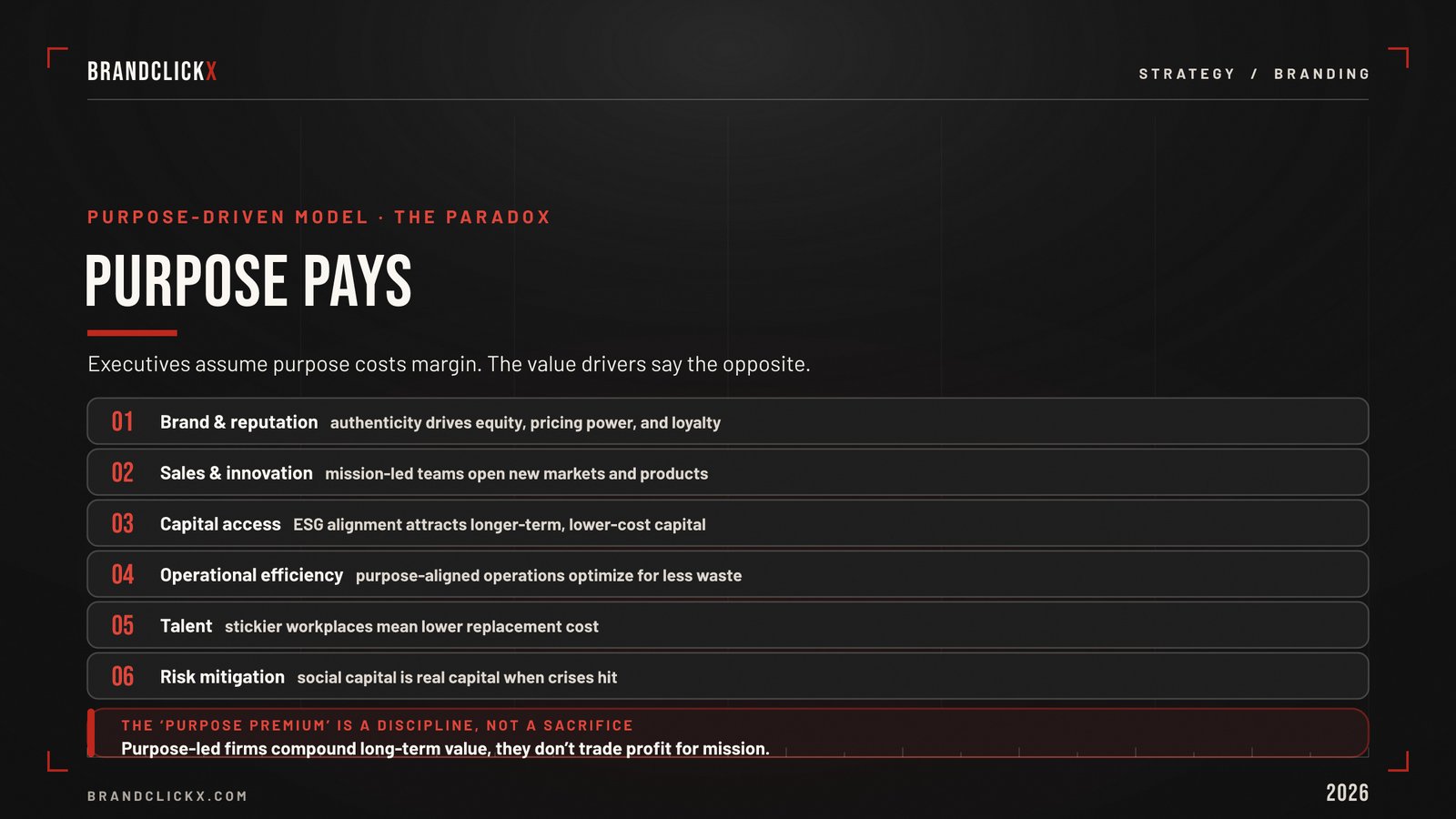
This is the insight that flips the entire conversation.
Executives often assume purpose comes at the cost of profit. Build in more mission focus, sacrifice margins. Care more about community impact, accept lower growth rates.
The data says the opposite.
Deloitte’s “Driving Business Value with Corporate Purpose” research studied six drivers of corporate value creation in purpose-driven organizations:
| Value Driver | Financial Impact | Implementation |
| Brand & Reputation | Enhanced brand equity, pricing power, customer loyalty | Mission authenticity drives perception and word-of-mouth |
| Sales & Innovation | New market entry, product innovation, revenue acceleration | Purpose-driven teams innovate differently, they solve for stakeholder benefit, not just shareholder extraction |
| Capital Access | Lower cost of capital, easier fundraising, institutional investment | ESG-aligned companies attract longer-term capital; shorter capital cycles |
| Operational Efficiency | Cost reduction, waste elimination, supply chain optimization | Purpose-aligned operations naturally optimize for sustainability and efficiency |
| Talent | Lower turnover (22% reduction), faster hiring, higher engagement | Purpose-driven workplaces are stickier, lower replacement costs, higher productivity |
| Risk Mitigation | Regulatory compliance, brand resilience, stakeholder trust | Purpose-driven companies weather crises better, social capital is real capital |
The “purpose premium” isn’t theoretical.
It’s measurable across publicly traded companies. Purpose-led companies in the S&P 500 have historically outperformed the broader index by 3-5% annually over 10-year periods. Over 15 years, the gap widens further.
This isn’t correlation from selection bias.
It’s causation from operating discipline.
Companies that structure around purpose think more systematically about long-term value creation. They optimize for stakeholder resilience, not short-term extraction. They build organizational cultures that retain talent and resist burnout. They invest in customer success because their business model depends on it.
The financial outperformance isn’t from “being good.” It’s from thinking differently about what the business is actually trying to optimize for.
Where It Breaks: The Implementation Gaps
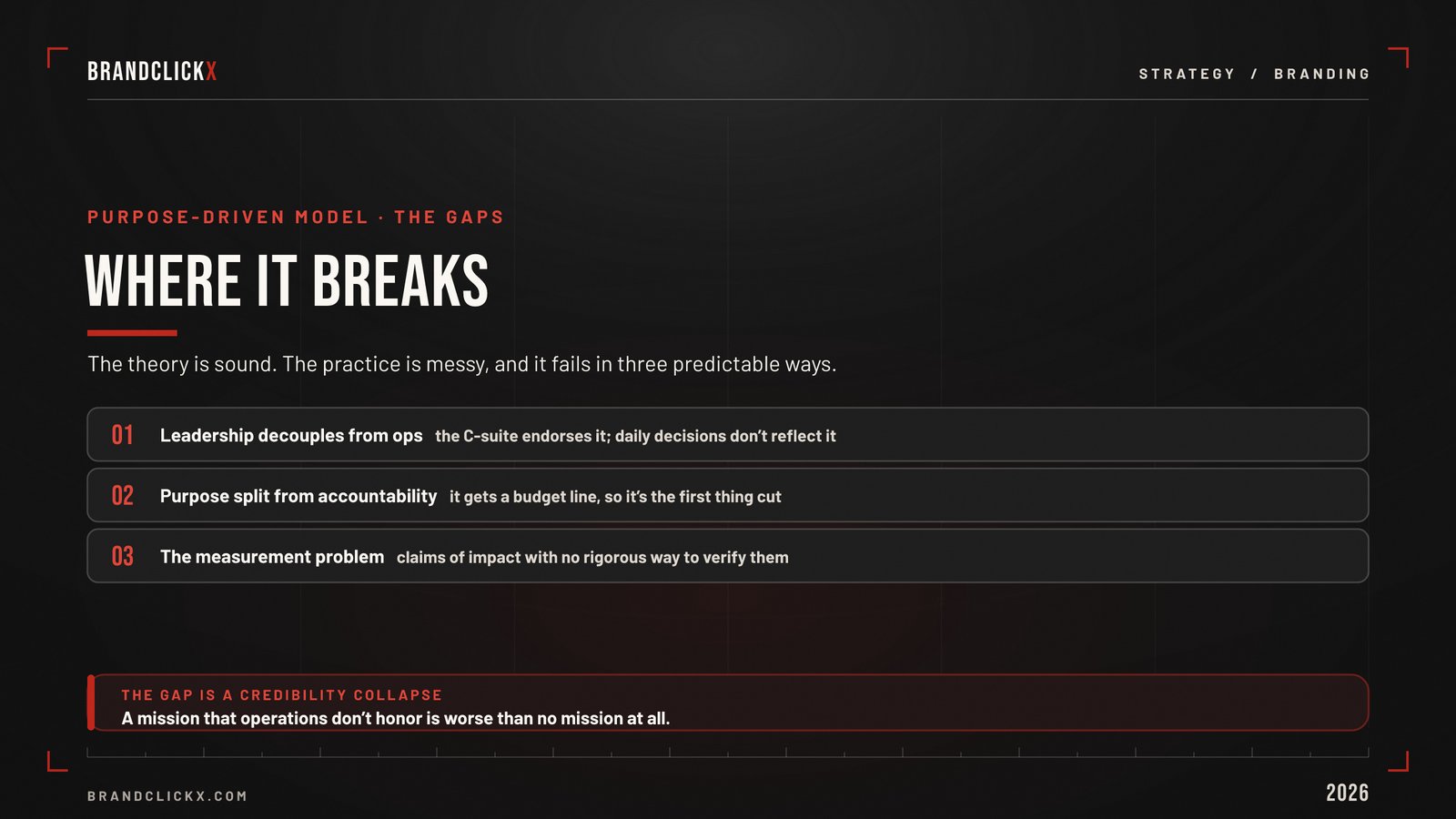
The theory is sound.
The practice is messy.
Most organizations that attempt to restructure around purpose hit the same operational walls:
Gap #1: Leadership Commitment Decouples from Operations
The C-suite endorses the purpose framework. Marketing teams run campaigns. And then compensation structures, capital allocation, and daily decision-making don’t actually reflect the stated values.
An organization might claim environmental stewardship is core purpose but continue optimizing supply chains purely on cost. Or say customer success is paramount but structure compensation to reward new deals over retention. Or state that diversity and inclusion is foundational but maintain homogeneous leadership.
The organization sees this as reasonable. Culture change takes time.
Employees see it as dishonest.
The gap between stated purpose and operational reality creates a credibility collapse that’s worse than having no purpose statement at all. It signals that leadership doesn’t actually believe in the mission.
Gap #2: Purpose Gets Separated From Financial Accountability
Many organizations treat purpose and profit as separate tracks.
Purpose gets a budget line. A department. Annual initiatives.
Financial accountability lives in a different operational stream.
The result is that purpose becomes disposable. When revenue dips, purpose gets cut. When margins tighten, mission-driven investments are the first to go. The organization reveals, through resource allocation, what it actually values.
The most successful purpose-driven organizations integrate purpose metrics into financial scorecards. Mission impact isn’t separate from revenue accountability. It’s embedded in the same operational dashboards.
Gap #3: The Measurement Problem
How do you actually measure “purpose impact” in a way that’s meaningful, not just performative?
A company might claim they’ve impacted “one million lives” or “created sustainable opportunities for communities.” But what does that mean operationally? How did you measure it? What was the counterfactual?
Without rigorous measurement frameworks, purpose metrics become marketing metrics easy to game, hard to trust.
The organizations winning here build what we call “integrated impact scorecards” tracking mission outcomes alongside financial outcomes, with the same rigor applied to both.
Case Study: How SaaS Companies Are Rebuilding Around Purpose
The SaaS industry has been forced into this conversation earlier than most, for competitive and talent reasons.
Example 1: Data Privacy as Core Value Proposition
Five years ago, data privacy was a compliance checkbox. Companies hired privacy officers, filed reports, and moved on.
Today, leading SaaS companies from Notion to Slack to GitHub have made data privacy an actual product feature and go-to-market advantage. Not added on. Built in.
This changed the operating model:
- Architecture decisions now include privacy-by-design as a requirement
- Product roadmaps explicitly prioritize privacy features
- Sales conversations lead with privacy guarantees, not just functionality
- Hiring favors engineers with privacy expertise
- Investors now evaluate privacy architecture as a competitive moat
The business model shifted because the purpose (protecting user data) became the value proposition.
Example 2: Accessibility as Innovation Driver
Accessibility used to be the “do we have to?” category ADA compliance, screen reader support, keyboard navigation.
Now, leading companies are discovering that accessibility constraints drive better product design for everyone.
Microsoft, for instance, found that designing for users with disabilities created products that were better for all users simpler, more intuitive, more predictable. Accessibility became an innovation lens, not a compliance requirement.
The operating model shifted:
- Accessibility is included in all design sprints
- Product testing includes accessibility testing from day one
- Hiring includes accessibility expertise in core product roles
- Market positioning includes accessibility features as competitive advantages
Purpose (creating products accessible to all) became strategy (accessibility drives innovation and market expansion).
Example 3: Open Standards as Competitive Moat
A growing cohort of SaaS companies are building business models around open standards open APIs, open data formats, interoperability commitments.
This is mathematically opposite to traditional SaaS lock-in strategy.
But the purpose-driven logic is: the industry succeeds when it’s open. And the company succeeds by being the trusted player in an open ecosystem.
So they restructured:
- Revenue models shifted from lock-in to ecosystem lock-in (being the trusted partner in an open space)
- Product strategy aligns with industry standards, not proprietary advantage
- Sales and marketing emphasize openness as differentiation
- Engineering focuses on integration and interoperability
The business model shifted because the purpose (industry standards drive innovation) became the competitive advantage.
In all three cases, the company didn’t add purpose on top of existing logic.
They restructured the logic itself.
The Measurement Framework: How Enterprise Brands Track Purpose Impact
This is where theory meets operational reality.
Most organizations lack integrated frameworks for measuring purpose impact alongside financial impact. They have financial dashboards and separate CSR reports. Never the two shall meet.
Integrated Purpose + Profit Scorecards track four dimensions:
Dimension 1: Commercial Performance
- Revenue and growth rate
- Customer acquisition cost
- Customer lifetime value
- Gross margin
- Enterprise retention
This is what gets measured already. No change in rigor or methodology.
Dimension 2: Engagement & Sentiment
- Employee engagement scores (quarterly)
- Customer NPS and sentiment analysis
- Brand sentiment tracking
- Social media engagement on purpose-aligned content
- Earned media (how often mentioned in positive context)
This signals whether purpose messaging is landing with audiences or being seen as performance.
Dimension 3: Mission Impact
- Actual outcomes aligned to stated purpose (not spending)
- Impact per customer or per employee
- Progress toward multi-year mission targets
- Third-party verification (not self-reported)
- Comparison to counterfactual (would this have happened anyway?)
This is where most organizations fail they measure activities (we spent $X on community programs) rather than impact (we created Y actual outcomes).
Dimension 4: Strategic Alignment
- How many product decisions reflected stated purpose this quarter?
- How many hiring decisions evaluated candidates on purpose alignment?
- What percentage of supply chain decisions prioritized mission alongside cost?
- How well did organizational incentives align with stated purpose?
- How transparent were operations in communicating purpose-aligned decisions?
This tracks the operating model itself not the marketing of purpose, but the actual infrastructure that embeds it.
When you track all four simultaneously, you get a picture of whether the business is actually purpose-driven or just purpose-marketing.
The organizations winning here run monthly integrated reviews where a single dashboard shows financial performance, engagement trends, mission impact, and strategic alignment side-by-side.
Purpose becomes a operating metric, not a separate initiative.
The Talent Advantage: Why Purpose-Driven Models Win on Hiring
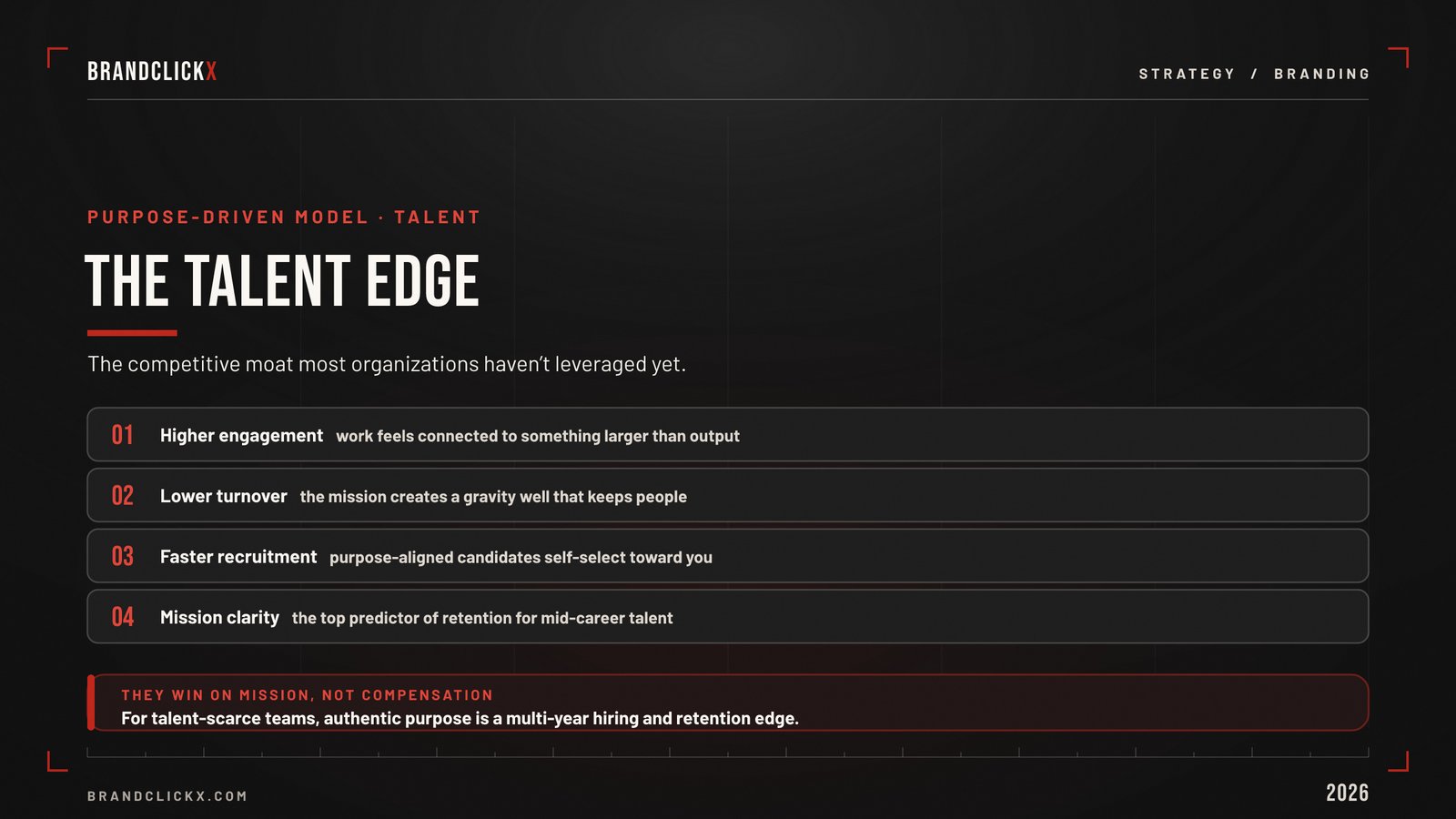
Here’s the competitive moat most organizations haven’t leveraged yet:
Purpose-driven operating models are dramatically better at talent acquisition and retention.
The data is overwhelming. Across industry studies:
- Engagement: Purpose-driven organizations report 21% higher employee engagement
- Turnover: 22% lower voluntary turnover
- Productivity: 18% higher productivity per employee
- Recruitment: 2.3x faster hiring for purpose-aligned companies
- Retention: Purpose clarity is the #1 predictor of retention for mid-career professionals
This isn’t sentimental. It’s operational.
Employees at purpose-driven companies spend less time questioning their work’s value and more time doing it. They experience less burnout because the work feels connected to something larger. They stay longer because the mission creates a gravity well leaving the organization feels like abandoning the mission.
For tech and marketing teams especially, where talent is scarce and expensive, this is a 3-5 year savings in hiring and onboarding costs per employee retained.
The enterprise brands winning on talent right now aren’t winning on compensation.
They’re winning on clarity of mission and operational evidence that the mission is real.
Why Founders and Smaller Companies Actually Have an Advantage Here
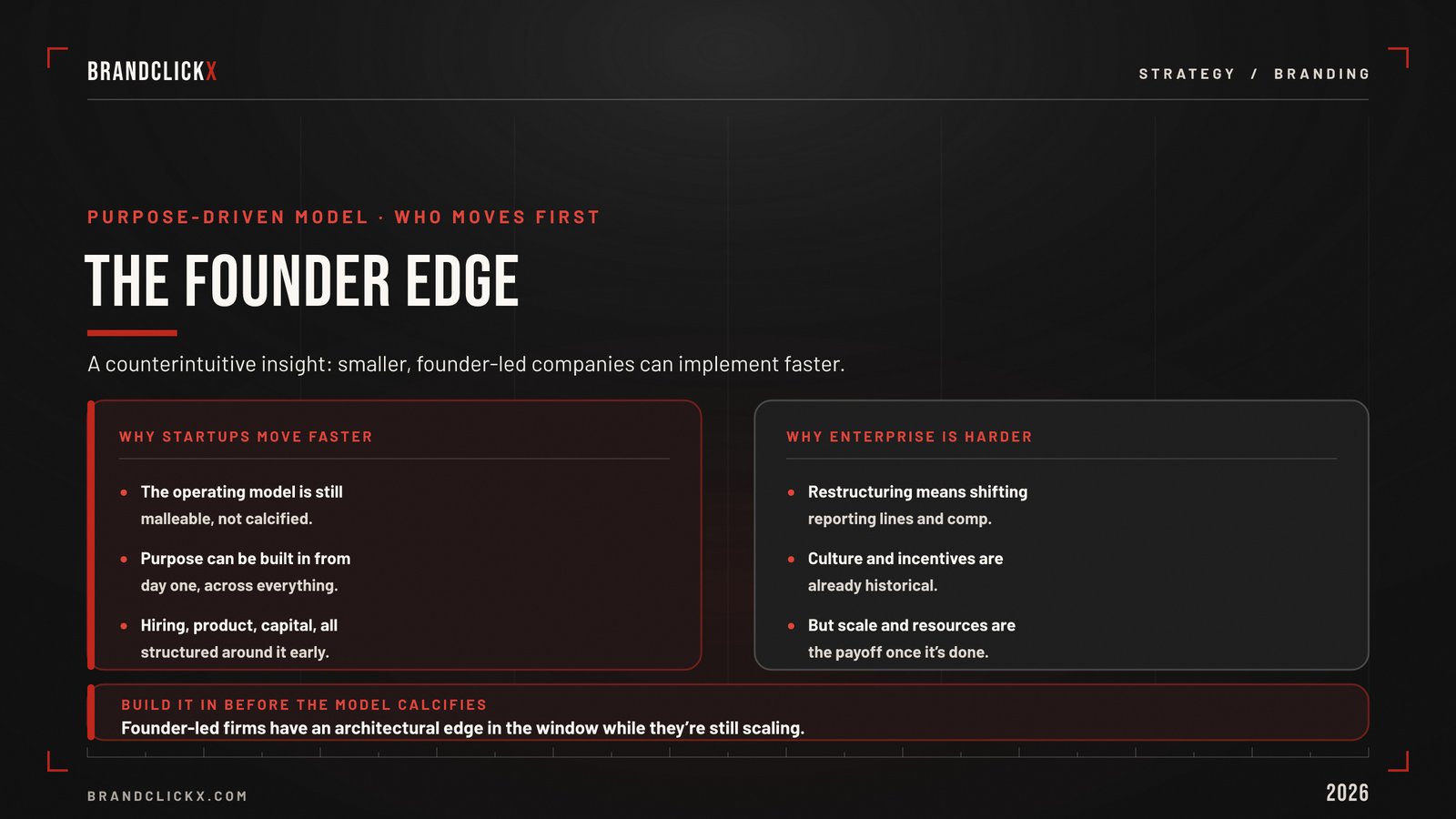
There’s a counterintuitive insight that emerges when you study purpose-driven models:
Smaller, founder-led companies can implement purpose-driven models faster and more authentically than enterprise organizations.
For a startup, the operating model is still malleable. The founder hasn’t calcified decision-making into bureaucracy yet. The culture is emergent, not historical. The go-to-market strategy is still under construction.
A founder can say “We are going to build this company around [authentic purpose]” and then structure literally everything hiring, product, capital raising, partnerships, revenue models, around that purpose from day one.
The operating model is purpose-driven from inception.
For a Fortune 500 company, it requires restructuring changing reporting lines, shifting compensation, reallocating capital, transforming culture. It’s harder. It’s slower. But the upside is that you have scale and resources once you do it.
The companies worth watching are:
- VC-backed startups that are building purpose into their operating model from founding
- Mid-market companies that are consciously restructuring (pre-IPO)
- Fortune 500 companies where the CEO has mandate to restructure (rare but happening)
The advantage isn’t permanent. A startup’s purpose can calcify into meaninglessness as it scales if the founder loses discipline. But for the 5-7 year window where a company is scaling and still malleable, the founder-led model has an architectural advantage.
The Organizational Culture Piece: Where Purpose Gets Real or Fake
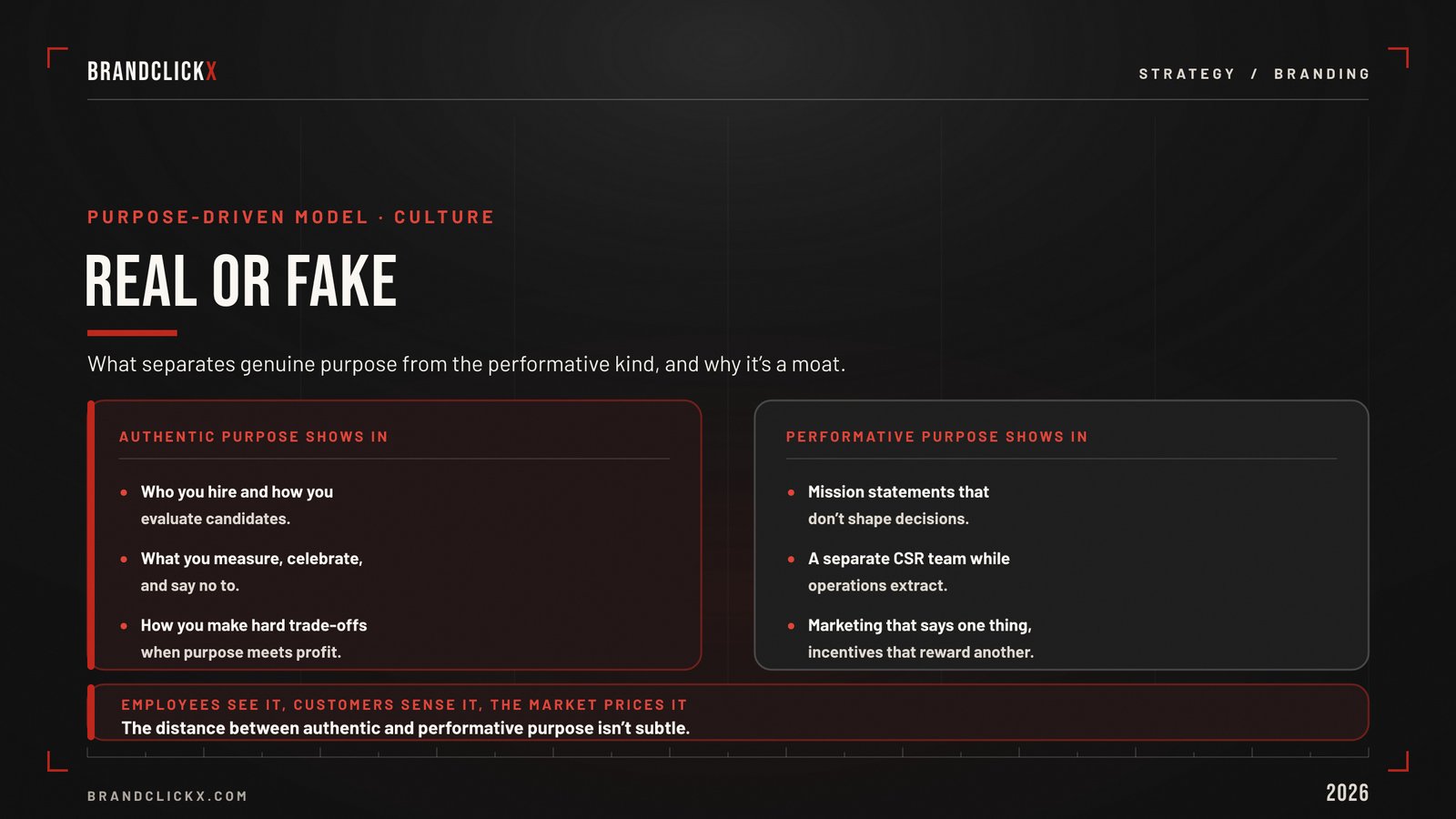
Here’s what separates authentic purpose from performative purpose:
Authentic purpose shows up in:
- Who you hire and how you evaluate candidates (purpose alignment is a real filter)
- What you measure and celebrate (mission outcomes, not just revenue)
- How you make hard trade-offs (when purpose and profit conflict, where do you draw the line?)
- What you’re willing to say no to (which opportunities you reject because they don’t align)
- How you talk about failure (do you own failures on the mission?)
- What the CEO actually spends time on (is purpose reflected in the CEO’s calendar and focus?)
Performative purpose shows up in:
- Nice mission statements that don’t shape decisions
- Separate CSR teams while operations remain extraction-focused
- Annual reports that celebrate purpose while quarterly earnings calls don’t mention it
- Marketing that emphasizes mission while internal incentives reward different behavior
- Talking about purpose while budget decisions reflect different priorities
The distance between the two isn’t subtle. Employees see it. Customers sense it. The market eventually prices it in.
The brands that have genuine credibility on purpose are the ones where operational decisions hiring, product, capital allocation, go-to-market, supply chain, consistently reflect stated values.
That’s hard to maintain, which is why it’s a competitive advantage.
What’s Next: The Evolution of Purpose-Driven Models in 2026+
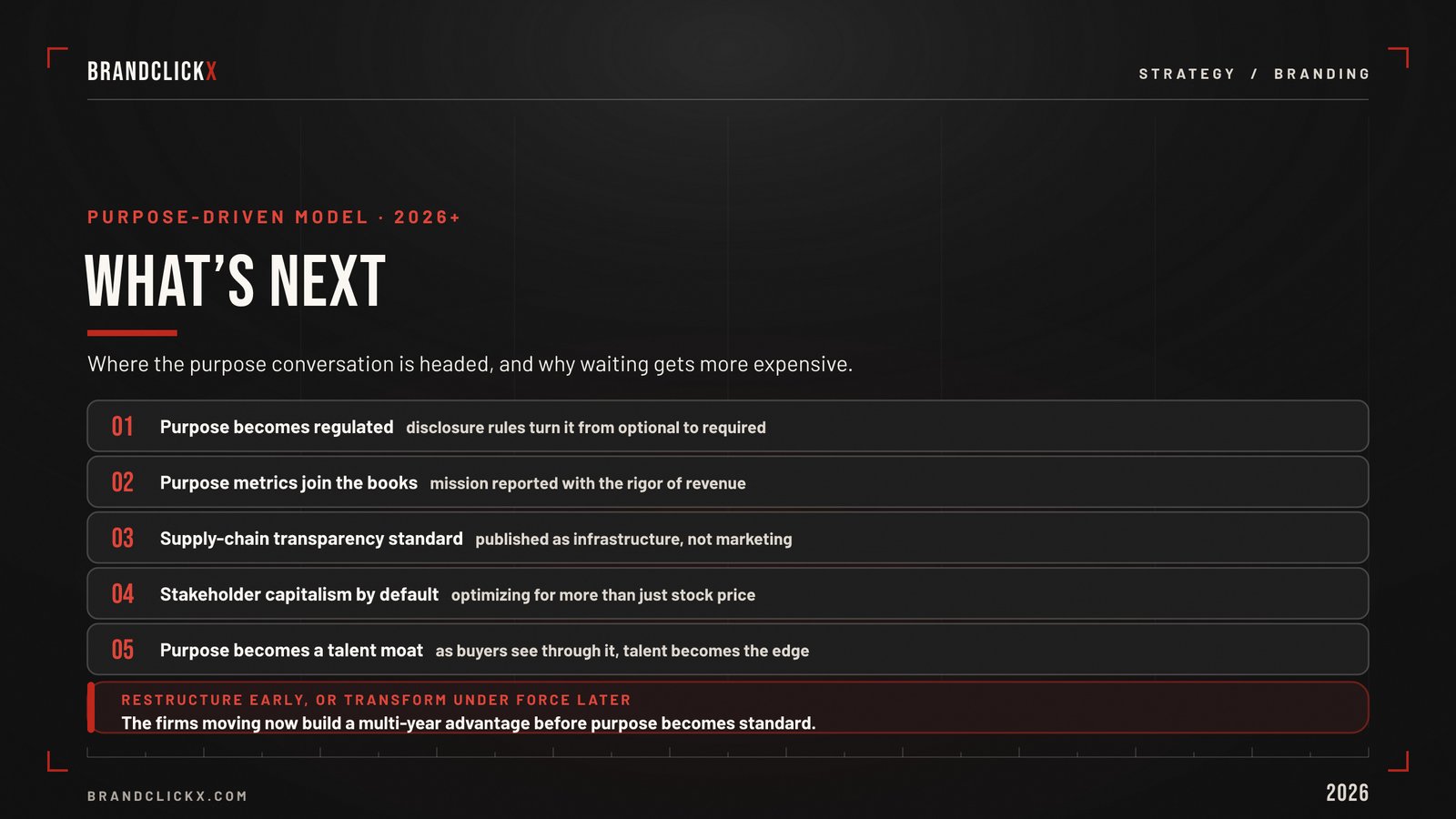
The conversation is moving. Here’s where it’s headed:
1. Purpose Becomes a Regulatory Requirement
SEC climate disclosure rules are already here. ESG reporting is becoming mandated in Europe. Purpose-driven strategy will shift from “nice to have” to “required to operate.”
The organizations that restructure early are avoiding forced transformation later.
2. Purpose Metrics Integrate Into Financial Reporting
Today, purpose metrics and financial metrics are separate. In a few years, expect integrated reporting where mission impact is reported with the same rigor as revenue.
This changes capital markets fundamentally investors will evaluate companies on both dimensions simultaneously.
3. Supply Chain Transparency Becomes Standard
Not as marketing, but as operational infrastructure. Companies will publish detailed supply chain data, wages, conditions, environmental impact as a matter of course. The ones that hide it will be at competitive disadvantage.
4. Stakeholder Capitalism Becomes the Default Model
Shareholder capitalism (optimizing purely for stock price) is being replaced by stakeholder capitalism (optimizing for multiple stakeholders employees, customers, communities, environment, shareholders).
The business model architecture is shifting.
5. Purpose Becomes a Talent Moat More Than a Customer Moat
As consumers learn to see through purpose-washing, the real advantage shifts to talent. Organizations will compete on “which company is actually living its mission” and employees will sort accordingly.
The companies with authentic purpose will have a 3-5 year talent advantage over those without.
Key Takeaways: Strategic Imperatives for CMOs and Enterprise Leaders
1. Purpose-Driven Business Models Are Now Structural, Not Marketing
This isn’t a campaign. It’s an operating system. If you’re not rebuilding your business model around authentic purpose, you’re not really doing this.
2. Purpose and Profit Aren’t in Tension They’re Aligned When Operationalized
The “purpose premium” is real and measurable. Organizations that integrate purpose into core strategy outperform peers on financial metrics, talent retention, customer acquisition, and resilience.
3. The Gap Between Stated Purpose and Operational Reality Is a Credibility Collapse
If your marketing says one thing and your operations do another, employees and customers will price in the dishonesty. Purpose-washing is worse than having no purpose at all.
4. Measurement Matters More Than Marketing
The organizations winning are the ones integrating mission impact metrics into financial scorecards with the same rigor. Purpose becomes a operating metric, not a separate initiative.
5. Talent Is the Ultimate Competitive Advantage
Purpose-driven organizations have 22% lower voluntary turnover, 21% higher engagement, and 2.3x faster hiring. For tech and marketing organizations, this is a 3-5 year ROI advantage.
6. Smaller Organizations Have Faster Implementation Advantage
Startups and mid-market companies can embed purpose into operating models from inception. Enterprise companies can do it, but it requires restructuring and leadership mandate.
7. The Real Competitive Moat Is Authenticity
The brands worth following are the ones that make hard trade-offs to stay aligned with stated purpose. That’s rarer than claimed and worth building.
FAQ: Answering the Questions Enterprise Leaders Are Actually Asking
Q: What exactly is a purpose-driven business model?
A: It’s an organizational structure where social, environmental, or community impact is embedded into core operations, revenue strategy, and decision-making not treated as a separate CSR initiative. Purpose and profit are aligned operationally, not just aspirationally.
Q: How does a purpose-driven business model differ from CSR or corporate social responsibility?
A: CSR is typically a department or annual budget disconnected from revenue operations. A purpose-driven business model integrates mission into product development, go-to-market strategy, hiring, supply chain decisions, and capital allocation. Purpose drives strategy; CSR manages risk.
Q: Can purpose-driven business models actually improve profitability?
A: Yes. Research from Deloitte and McKinsey shows purpose-driven companies outperform peers on six value drivers: brand reputation, sales and innovation, capital access, operational efficiency, talent attraction, and risk mitigation. The purpose premium is measurable across financial markets.
Q: What are the biggest obstacles to implementing a purpose-driven business model?
A: Three primary barriers: (1) organizational misalignment purpose statements don’t match operations; (2) leadership skepticism viewing purpose as cost rather than strategy; (3) measurement challenges lacking frameworks to track mission impact alongside financial metrics.
Q: How do you measure the success of a purpose-driven business model?
A: Leading enterprises use integrated scorecards tracking four dimensions: commercial performance (revenue, CAC, CLV), engagement metrics (employee satisfaction, customer sentiment), mission impact (actual outcomes, verified), and strategic alignment (how well operations reflect stated purpose).
Q: Is a purpose-driven business model right for every company?
A: Purpose-driven models generate the highest ROI in talent-scarce industries (tech, SaaS, professional services) and where customer values drive decisions (consumer brands, B2B SaaS). For commodity businesses, the ROI is lower. The real question isn’t “should we?” it’s “what is our authentic purpose?”
Conclusion: The Purpose Economy Is Now
The question isn’t whether purpose-driven business models will matter.
They already do.
The question is whether your organization is building it authentically or getting caught in the gap between what you claim and what you actually do.
The competitive advantage doesn’t go to the organization with the best purpose statement. It goes to the organization that has restructured its operating model around that purpose aligning hiring, incentives, product decisions, capital allocation, and go-to-market strategy around a genuine mission.
That’s harder to do. It requires leadership discipline. It means saying no to profitable opportunities that don’t align. It means measuring and being held accountable for mission impact alongside financial performance.
But for the organizations willing to do it, the advantage is durable.
Lower turnover. Faster hiring. Higher customer retention. Better capital access. Stronger brand equity. More resilient operations. These aren’t soft benefits. They’re competitive moats.
The organizations restructuring now while purpose is still relatively early as a structural strategy are building a 3-5 year advantage over those that wait. The advantage narrows as purpose becomes standard. But for now, the gap is real.
For CMOs and enterprise leaders, the implication is clear:
Stop treating purpose as a marketing problem. Start treating it as an operating system problem.
Align your business model around your authentic purpose. Measure impact with the same rigor you measure revenue. Build organizational culture that reflects stated values. Hire and compensate based on purpose alignment. Make hard trade-offs visible to the organization.
That’s how you move from purpose-washing to genuine purpose-driven strategy.
That’s where the advantage is.
About BrandClickX
BrandClickX is a marketing intelligence publication where senior marketers get industry news, strategic analysis, and enterprise frameworks from people who have actually run campaign not just written about them.
We cover brands, agencies, media tech, AI strategy, commerce, and digital culture at the enterprise level.
Additional Resources
- Deloitte: Driving Business Value with Corporate Purpose
- McKinsey: How Corporate Purpose Drives Long-Term Value
- HubSpot: 2025 Workplace Culture Report
- Adobe Consumer Sentiment Research