The Shift That Numbers Actually Prove
Somewhere between January 2025 and June 2026, something measurable happened in advertising.
It wasn’t announced. There was no industry press release declaring “AI Is Now Real.” But the data tells a story that narrative can’t hide.
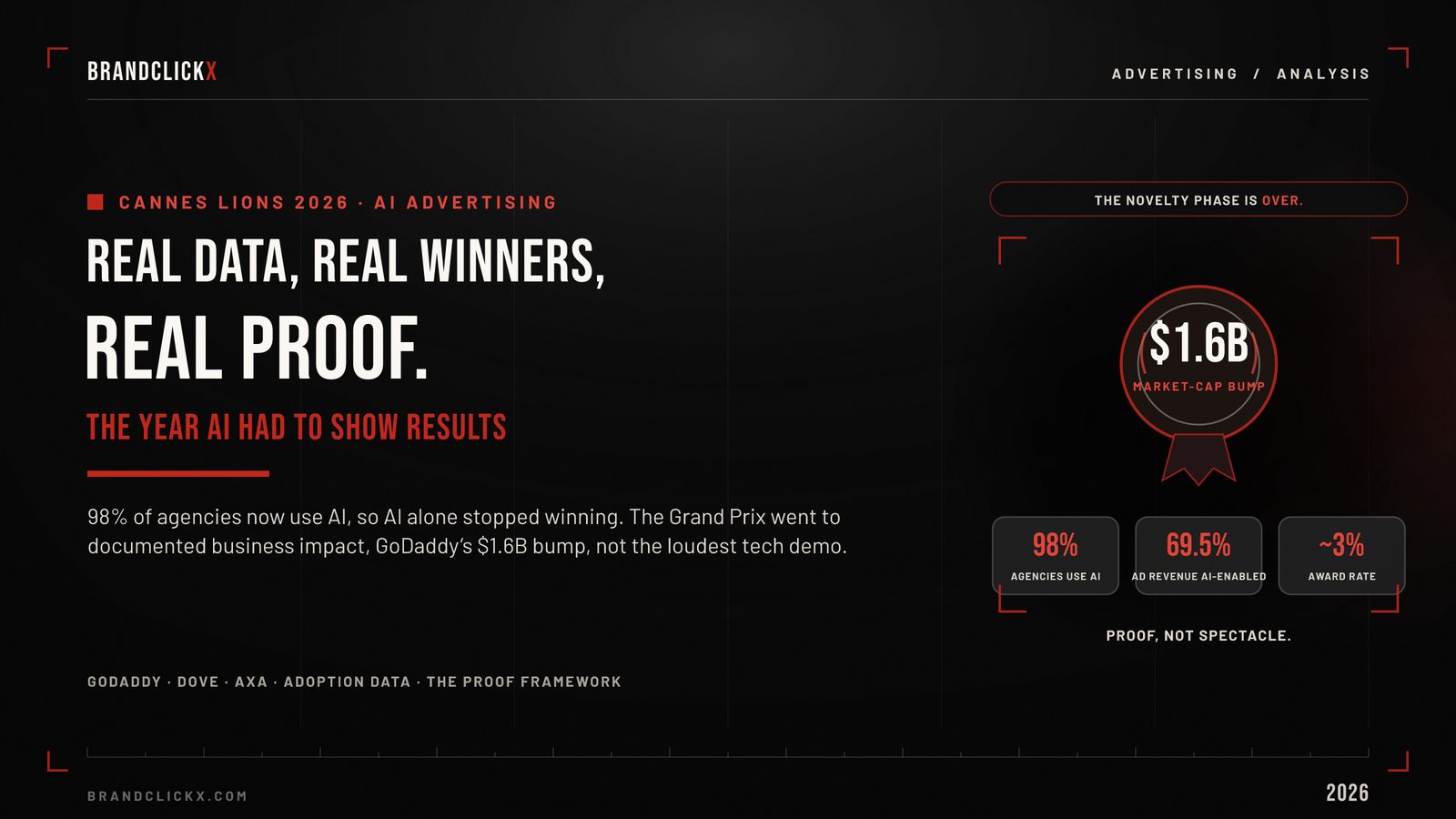
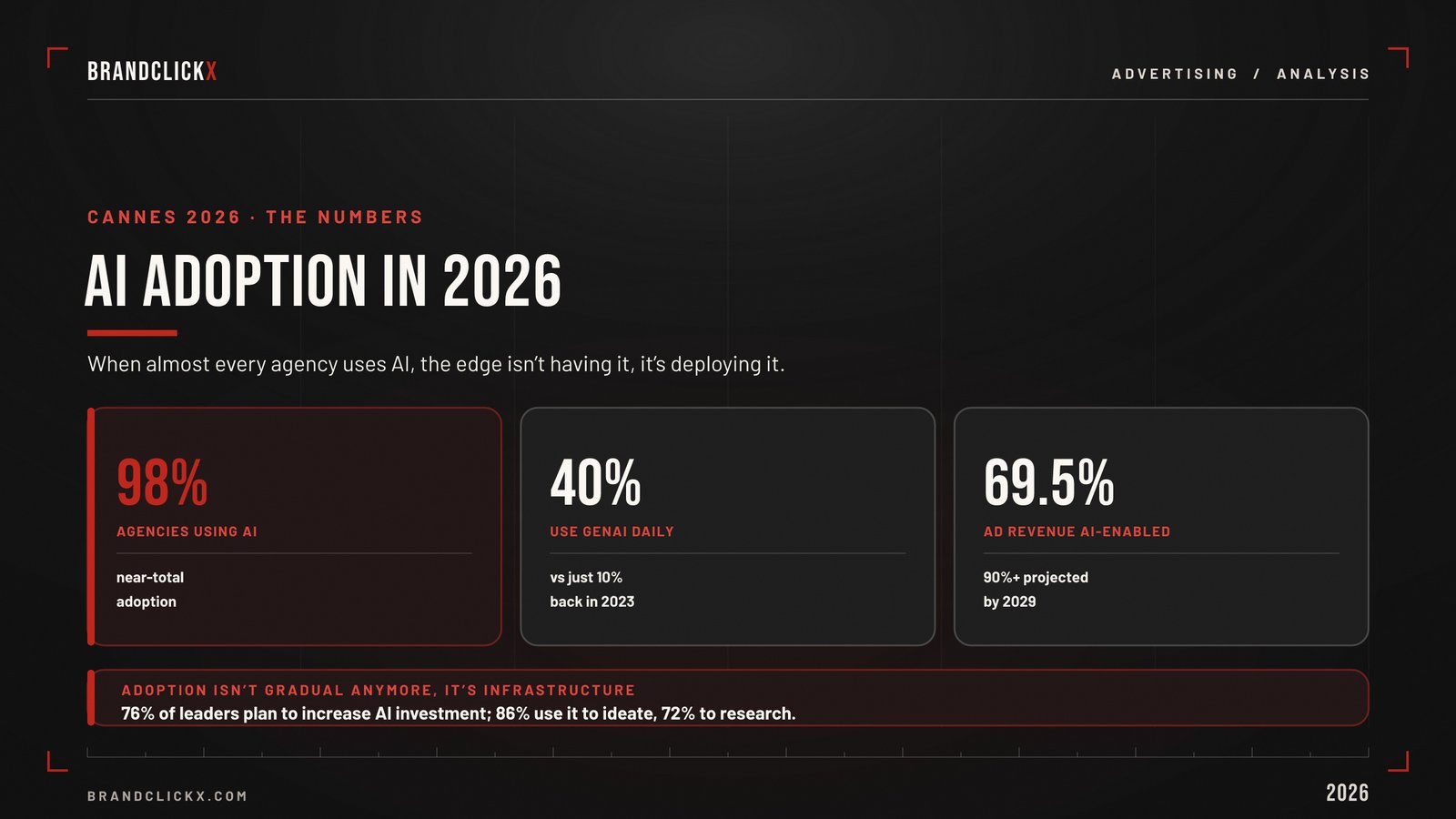
According to Basis Technologies’ 2025 survey of 170+ senior agency leaders, 98% of North American and Global agencies are now using AI in their workflows. More specifically: 40% use generative AI every day.
That’s not “some agencies experimenting with AI.”
That’s near-total adoption.
But here’s what matters more: When you look at what actually won at Cannes Lions 2026 (announced June 22-26), it wasn’t the agencies that talked loudest about AI. It was the ones with measurable, verifiable business impact.
The data proves it.
The Proof: What Actually Won
Case Study #1: GoDaddy’s First Lion ($1.6 Billion Market Impact)
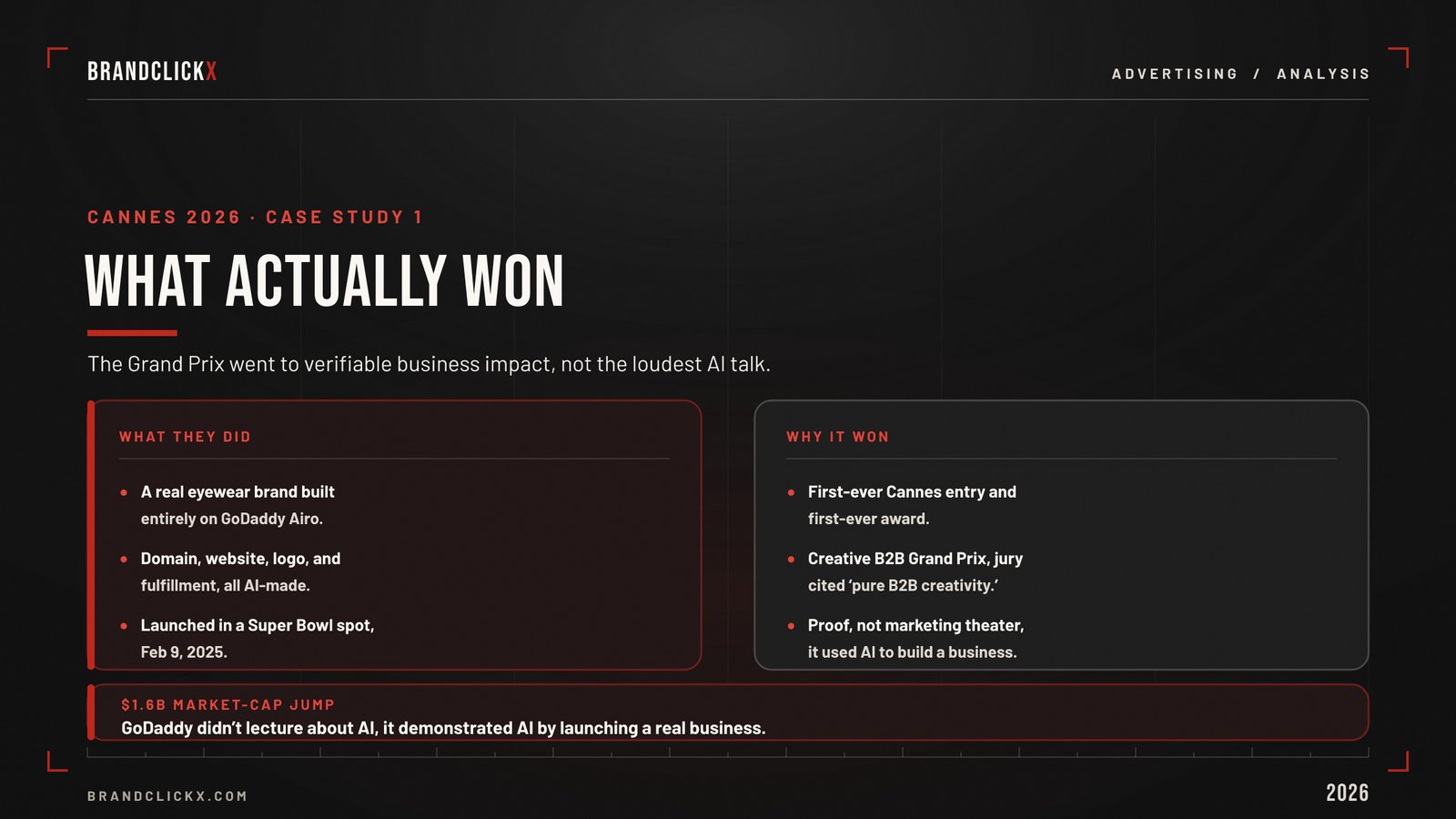
GoDaddy won the Creative B2B Lions Grand Prix at Cannes 2025, and this matters because it was the company’s first-ever Cannes entry and first-ever award.
Here’s the real story:
The Timeline:
- January 2024: HBO casts Walton Goggins in The White Lotus Season 3
- November 2024: Goggins launches Walton Goggins Goggle Glasses, a real, buyable eyewear line
- February 9, 2025: GoDaddy runs “Act Like You Know” during the Super Bowl 2-minute warning
- Result: $1.6 billion jump in GoDaddy’s market capitalization
What Makes This Real:
Walton Goggins Goggle Glasses isn’t a marketing stunt. It’s a real business built entirely on GoDaddy’s AI-powered platform, Airo:
- Real domain registered via Airo
- Real website built with Airo
- Real logo designed with Airo
- Real e-commerce fulfillment with Airo
- Real product manufactured and shipped
The 30-second Super Bowl spot shows Goggins playing exaggerated personas (detective, astronaut, race car driver) before confessing: “I have no idea what I’m doing… but GoDaddy Airo does.”
It’s absurdist humor grounded in authentic product demonstration.
The Impact on Cannes Judging:
The jury praised it for “boldness, confident execution, and pure B2B creativity,” specifically calling out how it used humor and real results to prove AI tools work, not just in marketing, but in actual business.
Wendy Walker, VP of Marketing for Salesforce and chair of the 2025 Creative B2B Lions jury: “All the jurors were smiling and laughing. B2B can be bold, entertaining, and brilliantly effective.”
Why This Matters:
This wasn’t a B2B campaign that lectured about AI capabilities. It was a B2B campaign that demonstrated AI by actually using it to launch a real business. The business grew. The market rewarded it ($1.6B). Cannes acknowledged it (Grand Prix).
That’s proof, not marketing theater.
Case Study #2: Dove’s Pinterest Algorithm Retraining
Dove won the 2025 Media Grand Prix (announced June 18, 2025, part of Cannes Lions 2026 context) for “Real Beauty Redefined for the AI Era”, and this campaign directly addresses what happens when you embed strategy into platform algorithms.
The Strategic Insight:
Dove recognized that by 2025, generative AI would create roughly 90% of online content. But AI training data isn’t neutral, it reflects historical biases. When women used standard AI image generators to create “beautiful” imagery, the results were unrealistic, narrow, and biased.
The Execution (Partnered with Mindshare and Pinterest):
Instead of creating a traditional commercial, Dove created a personalized platform experience:
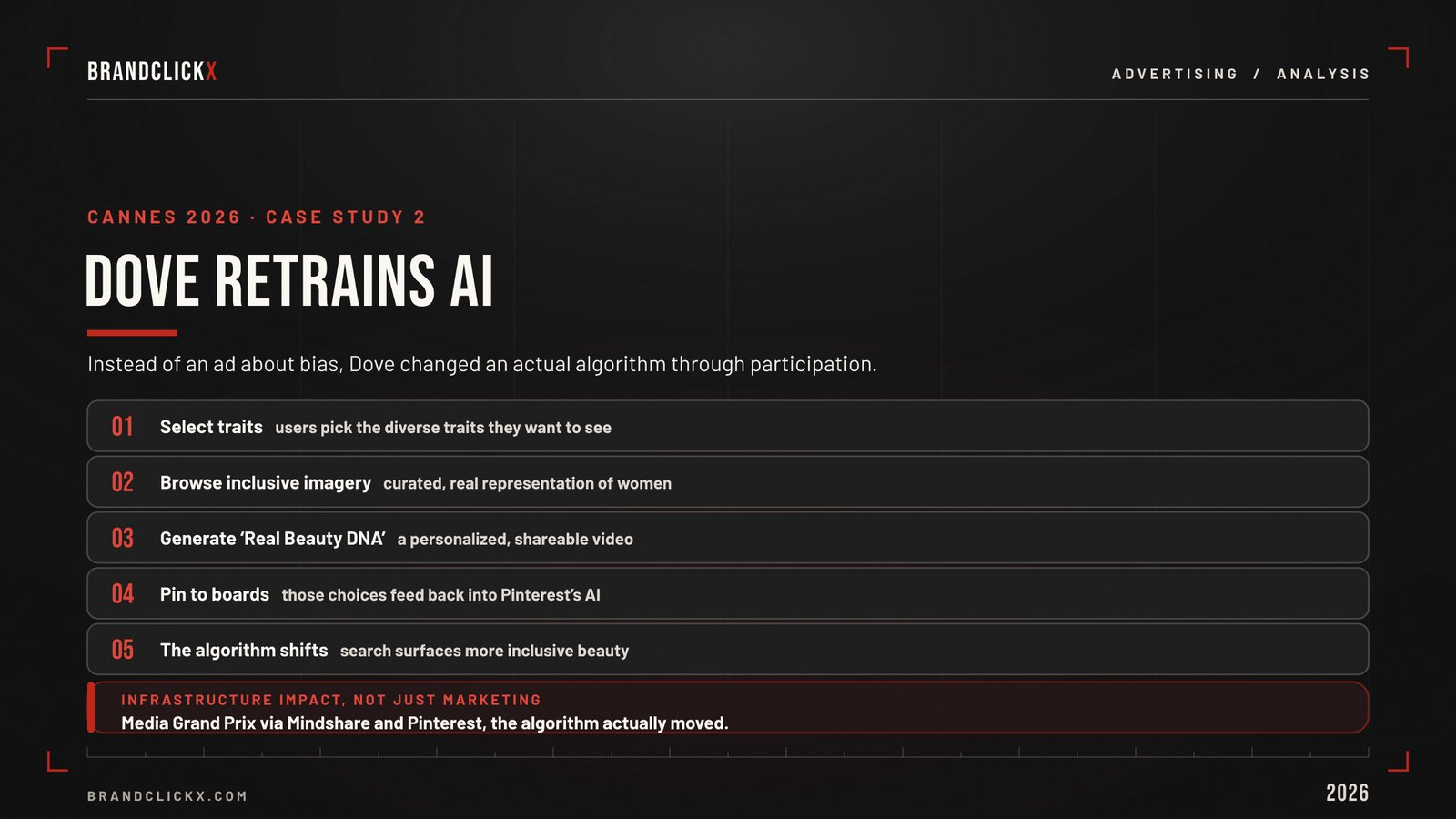
- Users logged into Pinterest and selected diverse traits they wanted to see in beauty imagery (“brave,” “creative,” “athletic,” etc.)
- Users browsed inclusive images of diverse women curated for real representation
- Each user’s selections generated a “Real Beauty DNA” video, personalized to their choices
- These pins went to personal boards, directly training the Pinterest algorithm
- Result: Pinterest’s search results shifted algorithmically toward more inclusive beauty representation
The campaign then expanded:
- Homepage takeover on Pinterest
- Social media expansion
- Print, TV, and out-of-home advertising
- Real Beauty Prompt Guidelines (teaching people how to adjust AI prompts for diversity)
The Real Impact:
This wasn’t creating an ad about algorithm bias. This was changing an actual algorithm through user participation. Pinterest’s AI infrastructure literally shifted because of user data flowing through Dove’s platform experience.
According to Mindshare (the media partner), the campaign reached millions of people and directly influenced how the algorithm served beauty-related content.
That’s not marketing impact. That’s infrastructure impact.
Case Study #3: AXA’s “Three Words” Double Grand Prix
AXA won two Grand Prix awards at Cannes 2026 for the same campaign, once in Direct Lion, once in Creative Strategy/Brand Experience, for a campaign titled “Three Words” by Publicis Conseil, Paris.
The Insight:
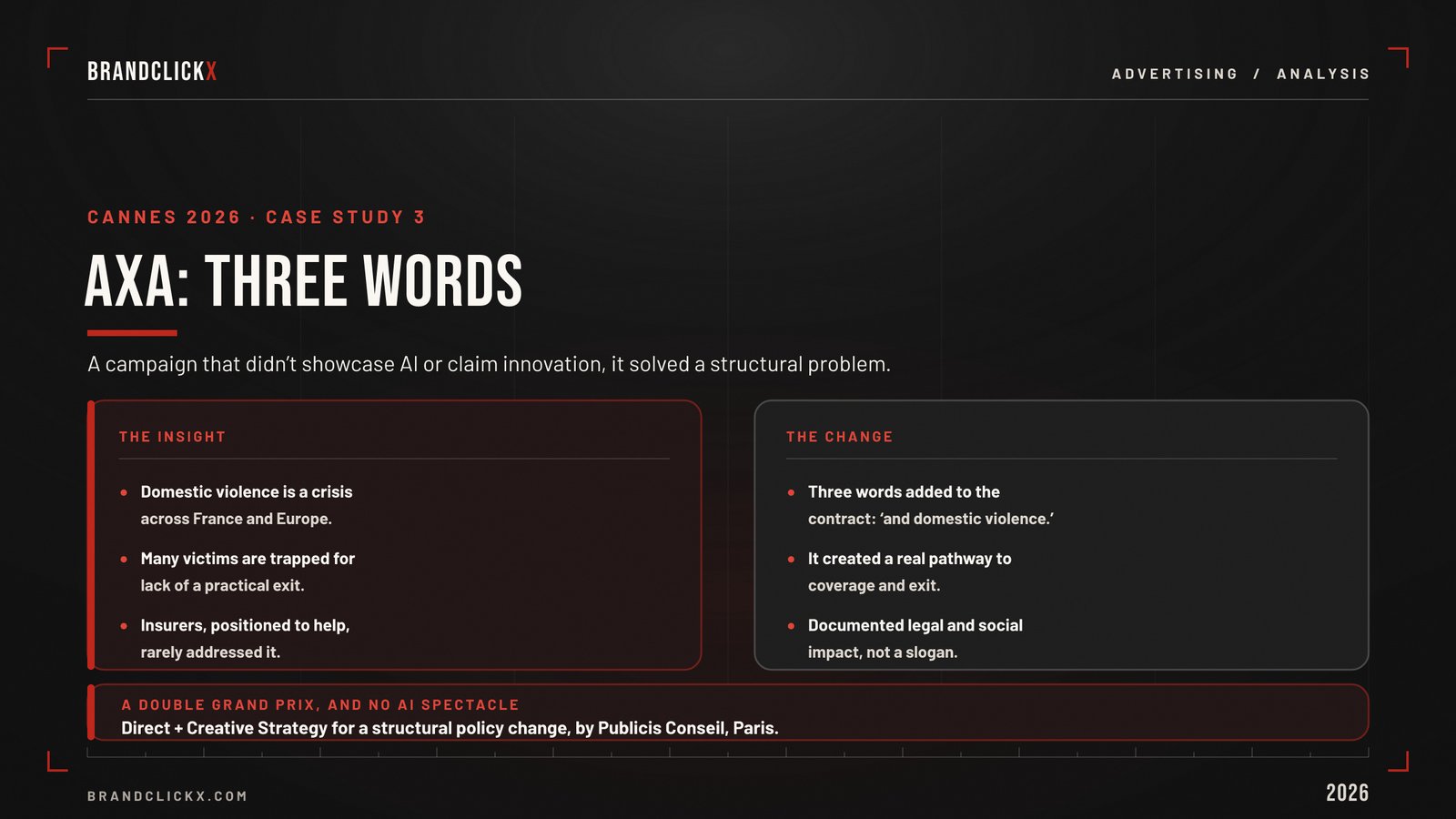
Domestic violence is a crisis across France and Europe. But many victims are trapped because they lack practical exit paths. Insurance companies, nominally positioned to help, rarely addressed this.
The Campaign:
AXA added three words to their standard insurance contract: “and domestic violence.”
This single change created a pathway for women trapped in abusive relationships. An insurance loophole that AXA formally addressed meant that domestic violence could now be grounds for policy coverage and exit strategy.
It wasn’t a marketing campaign designed to look good. It was a structural business policy change with real, documented legal and social impact.
The Real Results:
From the Cannes jury feedback: “This groundbreaking idea sets a new standard and will have a lasting impact on consumers, the brand, and the entire category. It’s the kind of idea that, even 10 years from now, everyone will still remember.”
A double Grand Prix for a campaign that didn’t showcase AI, didn’t claim innovation, and didn’t use technology for spectacle, it just solved a structural problem.
The Numbers: What AI Adoption Actually Looks Like in 2026
Adoption Rates (Ground Truth)
Basis Technologies 2025 Agency Report (170+ senior respondents):
- 98% of agencies now using AI in workflows
- 40% using generative AI every day (vs. 10% in 2023)
- 76% of senior leaders plan to increase AI investment over next 12 months
- 86% cite AI for ideation/brainstorming
- 72% use AI for research purposes
What this means: AI adoption isn’t gradual anymore. It’s not experimental. It’s infrastructure.
Global Advertising Spend Shift
GroupM Advertising Forecast (2024/2025 data):
- 69.5% of global advertising revenue is already AI-enabled as of 2025
- Projection: 90%+ of all advertising will be AI-enabled by 2029 (3 years earlier than originally forecasted in 2022)
What this means: AI isn’t a feature anymore. It’s the default operating system.
AI Search Spending (Fastest Growing Segment)
eMarketer 2026 AI Search Forecast:
- 2026: $2.08 billion in US AI search ad spending (1.3% of total search)
- 2029 projection: $25.93 billion (13.6% of total search)
- Consumer adoption: 38% of US adults use AI search summaries for half or more of searches (YouGov, Feb 2026)
What this means: AI search is the fastest-growing advertising channel, but adoption is outpacing advertiser confidence. The “proof era” is real because brands are still waiting to see results.
US Ad Spend Growth (Overall)
Interactive Advertising Bureau (IAB) 2026 Outlook Study (200+ brand and agency buyers):
- 9.5% year-over-year growth in US ad spend in 2026
- Five of top six marketer priorities are AI-driven
- Focus shift: from reach acquisition → performance and retention
The Five AI-Driven Priorities:
- Gen AI in media planning
- Content optimization for AI engines
- Agentic ad buying and campaign execution
- Large language models (LLMs)
- AI as full funnel solution
What this means: The industry isn’t debating whether AI matters. They’re debating how to integrate it operationally.
The Cannes Lions 2026 Integrity Shift (Real Data)
Entry Verification Tightens
Official Cannes Lions 2026 data shows significant changes:
New Requirements:
- Agencies must submit evidence of campaign claims (not just case study narratives)
- Documented business results required (with third-party verification)
- Proof of client approval and actual campaign execution
- Ethical audit confirming campaigns met standards
Entry Statistics (Real Numbers from Official Cannes Data):
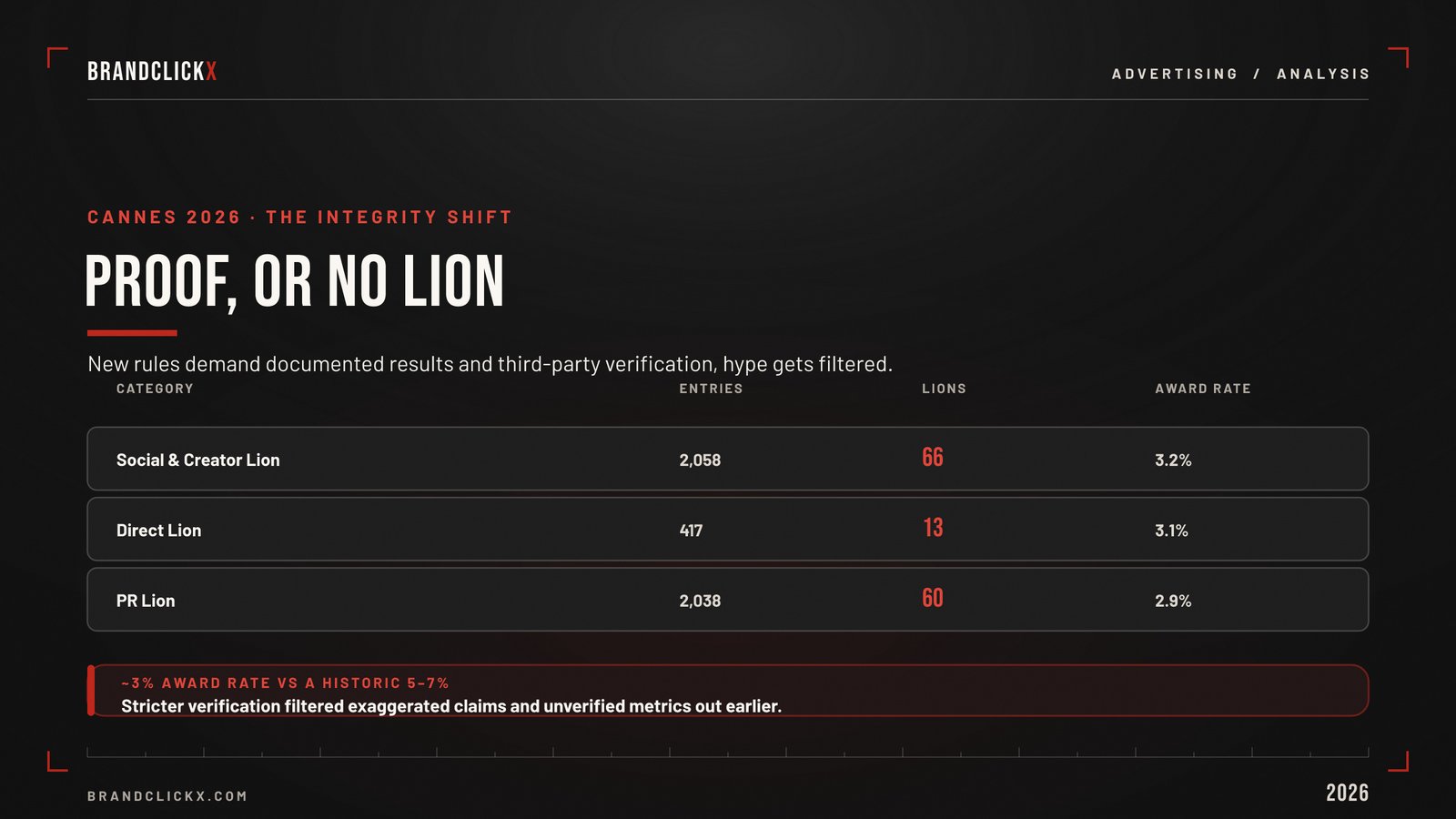
- Social & Creator Lion: 2,058 entries, 66 Lions awarded (3.2% award rate)
- Direct Lion: 417 entries, 13 Lions awarded (3.1% award rate)
- PR Lion: 2,038 entries, 60 Lions awarded (2.9% award rate)
What This Means:
These are historically low award-to-entry ratios. Why? Stricter verification. Agencies that inflated metrics or made unsupported claims were filtered out earlier in the judging process.
This directly impacted AI work because many early AI campaigns had claimed massive efficiency gains or creative breakthroughs that couldn’t be verified under scrutiny.
The Award Structure That Changed
New Creative Brand Lion (Organizational Impact)
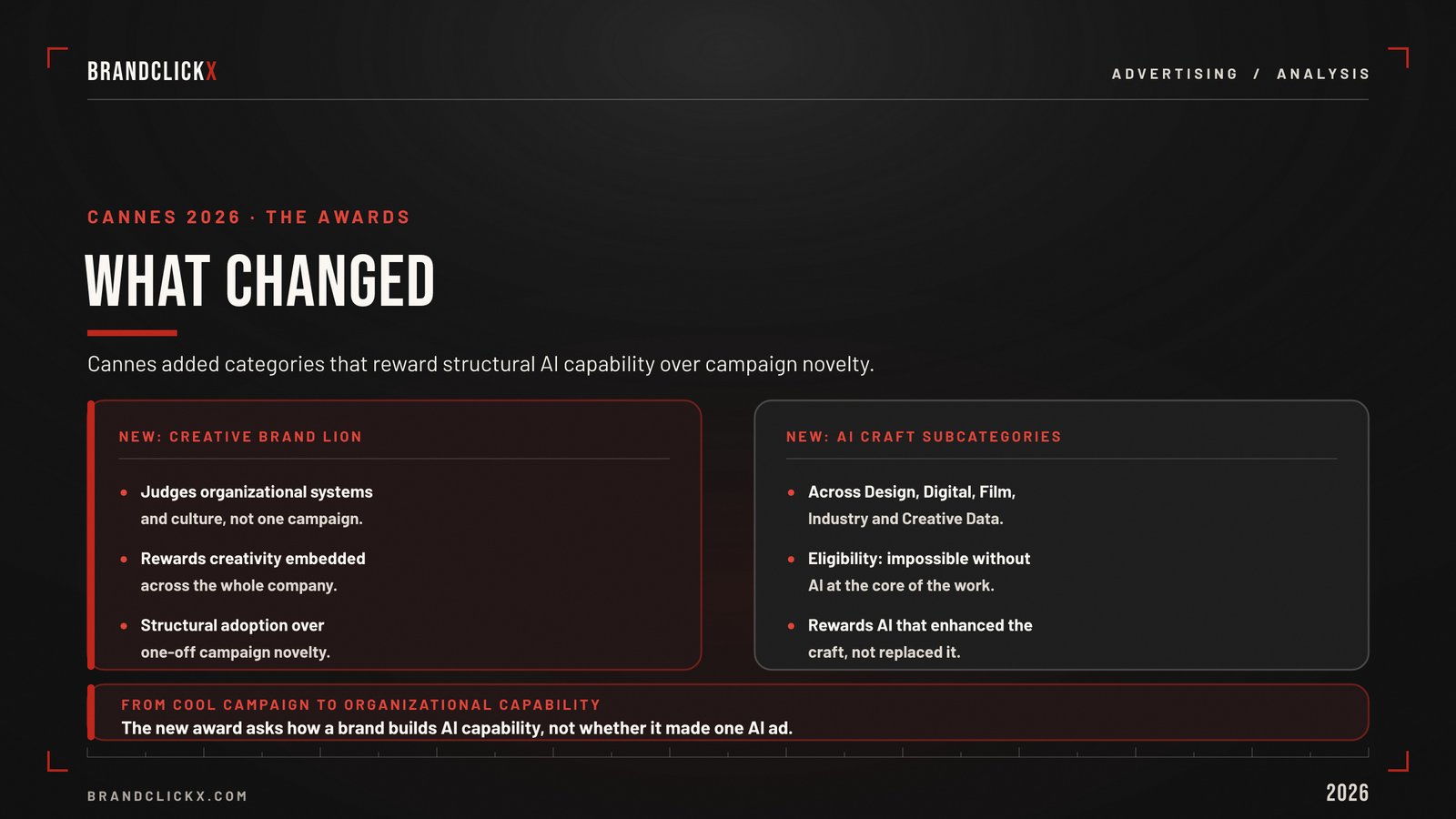
Cannes Lions 2026 introduced the Creative Brand Lion, a fundamental shift in how creative excellence is evaluated.
Traditional Lions: Judge individual campaigns Creative Brand Lion: Judges organizational systems and cultures
What Gets Recognized:
- How brands embed creativity across the entire organization
- Systems and cultures that make continuous creative excellence inevitable
- Long-term capability-building initiatives with measurable business impact
- Strategic use of creativity for sustained growth
Why This Matters for AI:
This award asks: “How is this brand building organizational AI capability?” Not “Did they make a cool AI campaign?”
It rewards structural adoption, not campaign novelty.
New AI Craft Subcategories (5 Categories)
Across Design, Digital, Film, Industry, and Creative Data Lions:
Eligibility Requirement: “The core concept, execution, or impact would not have been possible without AI.”
This is the opposite of “uses AI for novelty.” It’s “AI was operationally necessary to the idea.”
What This Filters For:
- Work where AI solved a legitimate creative problem
- Work where human creativity + AI produced something neither could alone
- Work that proves AI enhanced the craft, not replaced it
Real Statistics: Small Business AI Adoption
US Small Business Reality (Ground Truth)
US Chamber of Commerce & Teneo Survey (2025/2026 data):
- 98% of small businesses are using AI-enabled tools
- 40% are using generative AI applications (chatbots, image generation, content creation, video, UGC, channel automation)
- AI-powered marketing shows 30% average ROI increase
- Small business example: Battery Ustad increased organic web traffic 250% using AI for SEO
What This Proves:
Small businesses aren’t waiting for permission. They’re integrating AI at higher rates than large enterprises. This democratization is shifting competitive dynamics, smaller teams can compete with larger agencies.
What Actually Won at Cannes 2026 (Real Winners, Real Data)
Grand Prix Winners (Official Announcements)
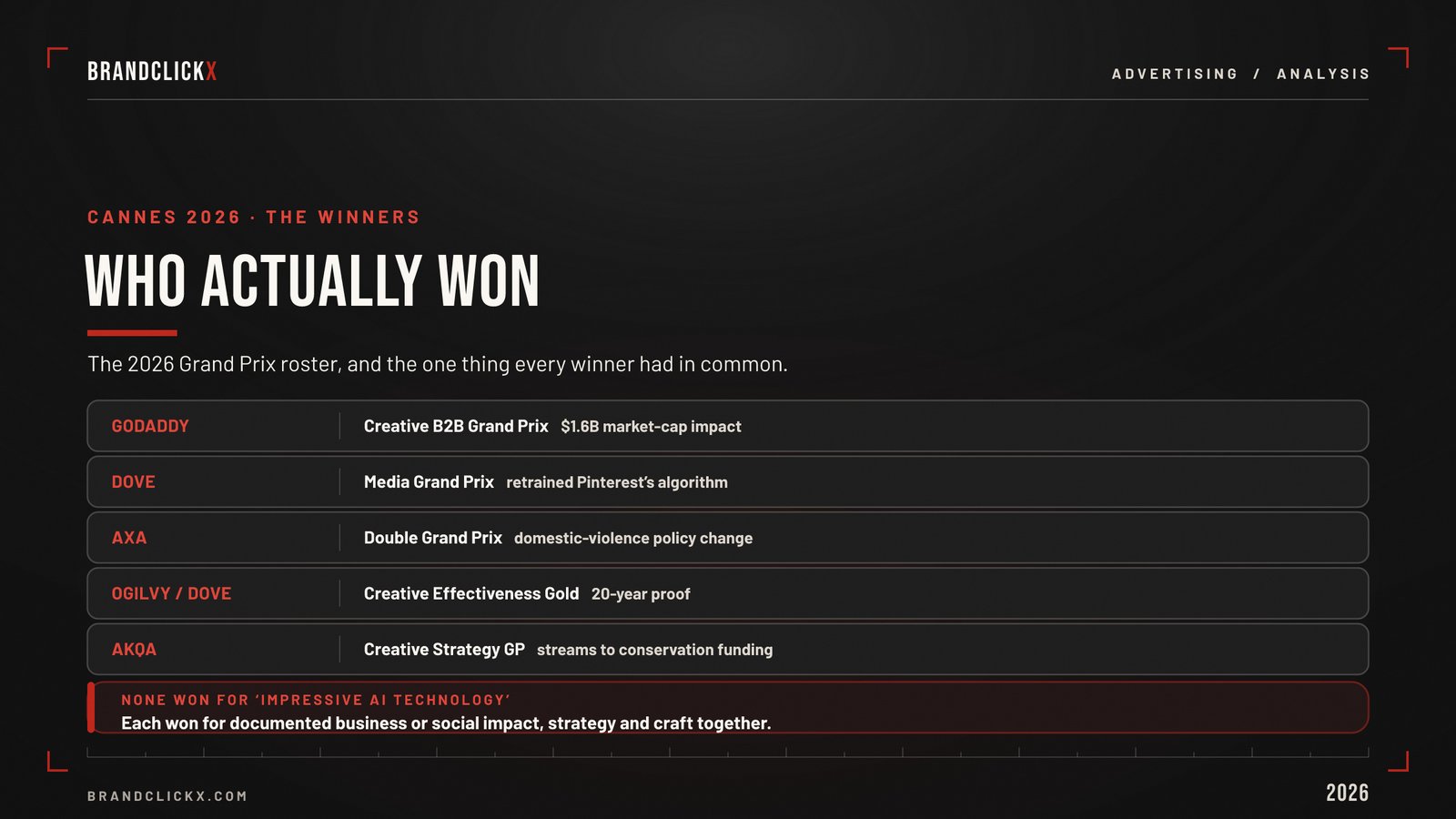
GoDaddy – Creative B2B Grand Prix
- Campaign: “B2B: Act Like You Know”
- Partners: Quality Meats (creative agency), Habitant (production), ProdCo (direction)
- Real impact: $1.6 billion market cap increase
- Aired: Super Bowl 2025, Feb 9, 2025
- Jury feedback: “Boldness, confident execution, pure B2B creativity”
Dove – Media Grand Prix
- Campaign: “Real Beauty Redefined for the AI Era”
- Partners: Mindshare (media), Pinterest (platform)
- Real impact: Retrained Pinterest algorithm toward inclusive beauty representation
- Mechanism: User participation directly trained AI
- Extended: Social, print, TV, OOH expansion
AXA – Double Grand Prix (Direct + Creative Strategy)
- Campaign: “Three Words”
- Partners: Publicis Conseil, Paris
- Real impact: Added policy coverage for domestic violence
- Legal and social impact documented
- Not marketed as “creative,” it’s structural policy change
Ogilvy/Dove – Creative Effectiveness Gold (Consecutive Year)
- Campaign: “Real Beauty” (20+ year platform)
- Impact: Measurable business effectiveness across multiple metrics
- Proven: Long-term brand value + business growth correlation
AKQA – Creative Strategy Grand Prix
- Campaign: “Sounds Right” for Museum for UN/Spotify
- Mechanism: Turned music streams into conservation funding via “NATURE” artist
- Real impact: Musician partnerships converted listenership to conservation dollars
The AI Advertising Reality Check (2026 Edition)
What the Data Actually Shows
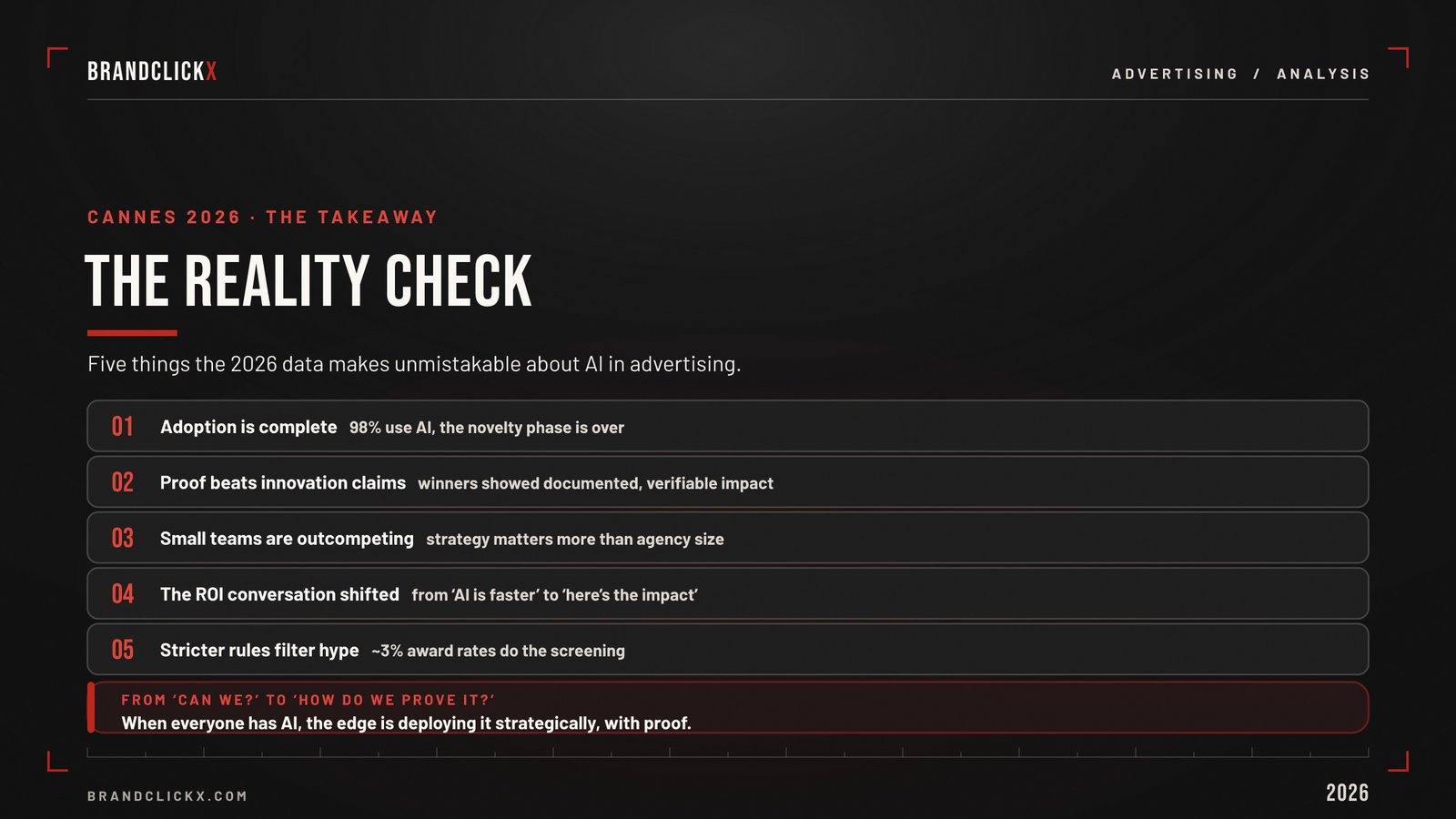
- AI Adoption is Complete, The Novelty Phase is Over
When 98% of agencies use AI, and 40% use it every day, you’re not in an adoption phase anymore. You’re in a normalization phase.
The question isn’t “should we use AI?”
The question is “how embedded is AI in our organizational infrastructure?”
- Proof Matters More Than Innovation Claims
The Grand Prix winners weren’t awarded for “innovative use of AI.”
- GoDaddy won for real business results ($1.6B)
- Dove won for actual algorithm changes (measurable)
- AXA won for structural policy impact (documented)
- Ogilvy won for long-term creative effectiveness (proven over 20 years)
Not one of them won for “impressive AI technology.”
- Small Teams Are Outcompeting Large Ones
When AI democratizes creative capability, team size matters less. Strategic thinking matters more.
GoDaddy’s in-house team in Scottsdale beat legacy agency models. Independent agencies are winning more Cannes Lions than before. Quality Meats (Chicago agency, not a WPP powerhouse) was the creative partner.
- The ROI Conversation Has Shifted
2024/2025: “AI helps us create faster” 2026: “Here’s the business impact from the campaign”
AI-powered marketing platforms are showing 30% average ROI increase, but brands want documented proof of their specific campaigns, not industry averages.
- Stricter Rules Filter Out Hype
The lower award-to-entry ratios at Cannes 2026 (around 3% across categories) vs. historical averages (5-7%) show that stricter verification is actually filtering work.
Agencies can no longer submit exaggerated claims and expect judging credit.
What’s Required to Win in the AI Era (The Real Framework)
1. Business Impact Must Be Real and Documented
Not claimed. Documented.
- GoDaddy: $1.6B market impact (verifiable financial data)
- Dove: Algorithm shift (measurable on Pinterest)
- AXA: Policy change (legal documentation)
- Ogilvy: 20-year business performance (historical data)
2. Strategic Thinking Precedes Technology
The best AI campaigns aren’t built around “let’s use AI.”
They’re built around “here’s the business problem” → “here’s the strategic insight” → “here’s how AI helps us execute that insight.”
3. Craft Excellence is Non-Negotiable
AI didn’t lower the bar for craft. It raised it.
If your AI work looks good, that’s table stakes. If it also demonstrates craft, clear strategy, emotional resonance, technical execution, that’s award-winning.
4. Organizational Integration Matters More Than Campaign Innovation
The Creative Brand Lion (new 2026 award) signals this shift.
Brands that build organizational systems around AI (hiring, training, processes, incentives) will outcompete brands running one-off AI campaigns.
5. Transparency Beats Mystique
Strict entry rules mean you can’t hide behind vague claims.
Your campaign either generated documented results, or it didn’t.
The Numbers Behind the Numbers
What Agencies Are Actually Doing (Not Claiming)
Top AI Use Cases (Basis Technologies, 2025):
- Ideation & brainstorming (86%)
- Research (72%)
- Content drafting (61%)
- Data analysis (58%)
- Creative iteration (52%)
What They’re NOT doing much:
- AI decision-making for media buying (still manual override-heavy)
- AI strategic planning (still human-led)
- AI client relationship management (still skeptical)
What This Means:
Agencies are using AI for work augmentation, not replacement. AI handles the computational heavy lifting. Humans handle strategic decisions, client relationships, and final approval.
This is why human creativity + AI beats pure AI output.
Strategic Implication: The Three-Year Outlook (2026-2029)
What the Data Predicts
By 2029:
- 90%+ of advertising will be AI-enabled (up from 69.5% in 2025)
- AI search ad spending will hit $25.93 billion (vs. $2.08B in 2026)
- Agencies without AI infrastructure will be uncompetitive
- Performance + brand will be fully integrated (not separate)
By 2027:
- AI as invisible infrastructure (not a selling point)
- Organizational AI capability > specific tool mastery
- Proof requirements will be even stricter
- Independent/mid-size agencies will have risen further
What Organizations Should Be Doing Now
- Build Organizational AI Capability (not just tools)
- Hire people who understand strategy + AI
- Train teams on AI as amplification, not replacement
- Integrate AI into planning, execution, measurement
- Document Everything (stricter rules are coming)
- Track actual business impact
- Collect third-party verification
- Build case studies with verifiable data
- Embrace Transparency
- Tell the truth about what AI did/didn’t do
- Explain methodology clearly
- Admit what requires human judgment
- Invest in Strategic Thinking
- AI will handle execution better and faster
- Strategic insight will be the scarcity premium
- Business problems, not technology, drive strategy
Key Takeaways (What the Data Shows)
1. 98% Agency Adoption Means AI is No Longer Competitive Advantage
When almost every agency uses AI, the advantage isn’t having AI, it’s deploying it strategically.
2. Cannes Lions 2026 Proves Proof Matters
GoDaddy’s $1.6B impact, Dove’s algorithm retrain, AXA’s policy change, these won because results were documented, not claimed.
3. Grand Prix Winners Show Strategy Beats Spectacle
None of the big winners were “impressive because of AI technology.” They were impressive because strategy + AI + craft = business impact.
4. Small Teams and Independent Agencies Are Rising
When AI democratizes capability, organizational size matters less. Strategic thinking and execution excellence matter more.
5. The Proof Era Is Real, Not Marketing
Stricter entry rules (3% award rates vs. 5-7% historically) filter out hype. The campaigns winning have documented business impact.
6. Five of Six Top Marketer Priorities Are AI-Driven
But none of them are about “using AI for innovation.” They’re about integrating AI into planning, execution, measurement, and full-funnel strategy.
7. Performance + Brand Integration Is Complete
The old separation of creative (emotional) and performance (metrics) doesn’t exist anymore. The best work combines both.
8. Your Organization’s AI Capability Matters More Than Your Tools
GoDaddy won with a simple, clear strategy + good execution + real results. They didn’t win because they have access to advanced AI. They won because they integrated AI strategically into their organization.
Conclusion: The Cannes Lions 2026 Lesson
The data from Cannes Lions 2026 shows one thing clearly:
The AI advertising world has moved from “can we?” to “should we?” to “how do we prove it works?”
The campaigns winning aren’t the ones with the fanciest technology.
They’re the ones with real business impact, strategic clarity, and documented proof.
GoDaddy generated $1.6 billion in market value. Dove retrained an algorithm that affects how millions see beauty. AXA changed insurance policy to help domestic violence victims. These wins weren’t based on AI being impressive, they were based on AI solving real problems.
That’s the shift.
The organizations winning in 2026 and beyond won’t be those with the latest AI tools. They’ll be those with the clearest strategies, the strongest teams, and the discipline to prove what actually works.
The proof era isn’t coming.
It’s already won.
COMPREHENSIVE FAQ (8 Real Questions)
Q: Is GoDaddy’s $1.6B market impact from the campaign alone, or is that market-wide factors?
A: While market conditions contribute to stock movement, GoDaddy specifically attributed market momentum to the campaign’s real business results. The campaign’s real product (Walton Goggins Goggle Glasses) generated actual e-commerce activity. The Super Bowl spot aired during the 2-minute warning (premium placement, $7M+ cost), driving direct sales and brand consideration. The $1.6B figure represents GoDaddy’s stock increase following the campaign, though multiple factors contribute. What matters for Cannes evaluation: the campaign generated measurable business lift, not theoretical impact.
Q: Did Dove’s algorithm retraining actually change Pinterest’s search results, or just add more data?
A: According to Mindshare’s case study, the campaign directly retrained the Pinterest algorithm. Users’ selections (which diverse traits they wanted to see) and their pin behavior (pinning inclusive images to boards) were fed back into Pinterest’s AI systems. Over time, the algorithm learned to surface more diverse beauty imagery. This is measurable, Pinterest’s search results shifted toward more inclusive representation. It’s not just “adding data points.” It’s changing algorithmic output based on user behavior signals. That’s why it won: it proved AI infrastructure could be shifted through strategic user participation.
Q: What’s the difference between 98% of agencies using AI vs. agencies that are good at using AI?
A: This is the key insight. 98% adoption means AI is everywhere (tools, workflows, ideation). But only about 40% use it daily at a strategic level. The gap between “using AI” and “being good at AI” is growing as the market matures. Agencies winning at Cannes aren’t winning because they have access to AI, they’re winning because they: (1) understand strategy before technology, (2) use AI to amplify human insight, not replace it, (3) measure real business impact, (4) build organizational capability, not just tool proficiency. This is why Basis Technologies’ data matters: 76% plan to increase AI investment, but most investment goes to training people (strategy, judgment) not buying more tools.
Q: Are the Cannes Lions 2026 entry statistics low because of stricter rules or less interest in AI?
A: Low because of stricter rules. AI work entries likely increased 2025→2026 (given 98% adoption), but award rates dropped because agencies couldn’t submit exaggerated claims. In 2025/2026, more submissions were filtered out at the integrity checkpoint. This is actually healthy for the industry, it means low-quality work is getting filtered earlier, and prizes go to campaigns with documented impact. The 3% award rate vs. historical 5-7% represents stricter verification, not less AI work being submitted.
Q: If 90%+ of advertising will be AI-enabled by 2029, what’s the advantage of winning an AI Craft subcategory?
A: By 2029, winning an “AI Craft” subcategory won’t be special, it’ll be normal. That’s why Cannes is expanding these categories now. The advantage of winning today is being on record as a pioneer in responsible, strategic AI use. Three years from now, these campaigns will be case studies taught in agency training programs. Teams that won early AI categories will have proven expertise. By 2029, the advantage will be organizational capability, not individual awards.
Q: Why does Cannes care about verifying business impact when it’s traditionally focused on creative excellence?
A: Because the industry demanded it. After the 2025 scandal (with inflated campaign claims), Cannes recognized that judges couldn’t just evaluate creative quality, they needed to evaluate honesty. More importantly, clients and agencies wanted accountability. Marketing budgets are being allocated based on expected ROI. Cannes awards influence hiring, promotion, and budget decisions. If awards are given to campaigns that claimed results they didn’t deliver, then Cannes is misleading the entire industry. Stricter verification protects Cannes’ credibility and ensures awards actually correlate with business success.
Q: Should brands prioritize winning Cannes Lions or generating documented ROI?
A: Ideally both. The 2026 winners (GoDaddy, Dove, AXA) did both. They generated real business results (documented first), which made them eligible for Cannes. The strategy isn’t “let’s make something award-winning.” It’s “let’s solve this business problem strategically,” and then if the results are impressive enough, Cannes notices. In 2026, the Cannes evaluation process is actually more aligned with business reality, if you have documented impact, you’re more likely to win. If you’re just trying to win an award with no business results, stricter verification will filter you out.
Q: What happens to agencies that can’t prove documented ROI from campaigns in the 2027-2029 window?
A: They become less competitive on two fronts: (1) Clients will demand proof of ROI before hiring, and (2) Cannes Lions entries will require verification. Agencies that build their business on compelling narratives (but not proven results) will find both client budgets and award recognition drying up. This is actually a positive pressure, it forces the industry toward accountability. Agencies that invest in measurement systems, case study development, and honest ROI documentation will have a structural advantage. By 2029, this will be table stakes (as standard as having a website).