

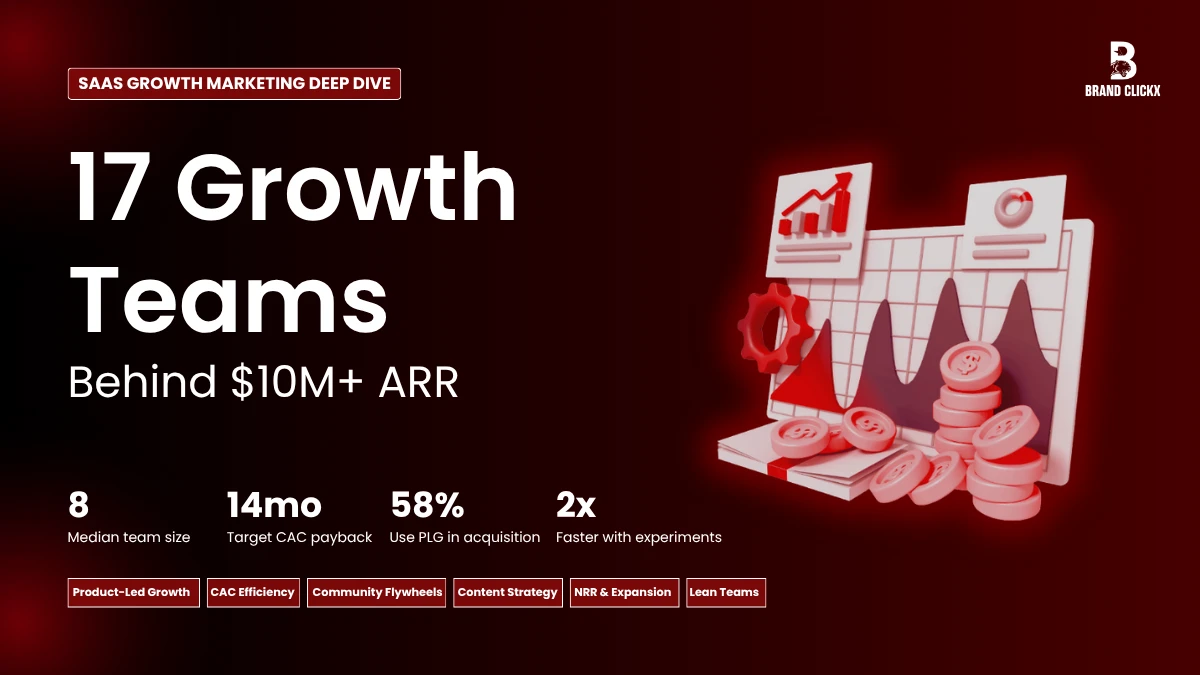
I kept waiting to find the obvious thing, the big budget move, the genius hire, the campaign that changed everything. I didn’t. What actually shows up when you dig into SaaS companies holding $10M+ ARR is something a lot less dramatic. The growth marketing teams are usually small. They’ve picked a lane and they’re not leaving it. And they’ve killed more projects than most teams have ever launched.
I pulled this together from founder interviews, public case studies, a couple earnings reports, and some direct conversations with people running growth at companies in this range. A few things genuinely surprised me. Most of it I’d half-guessed but hadn’t seen laid out in one place before.
The Size of growth marketing teams Teams Will Shock You
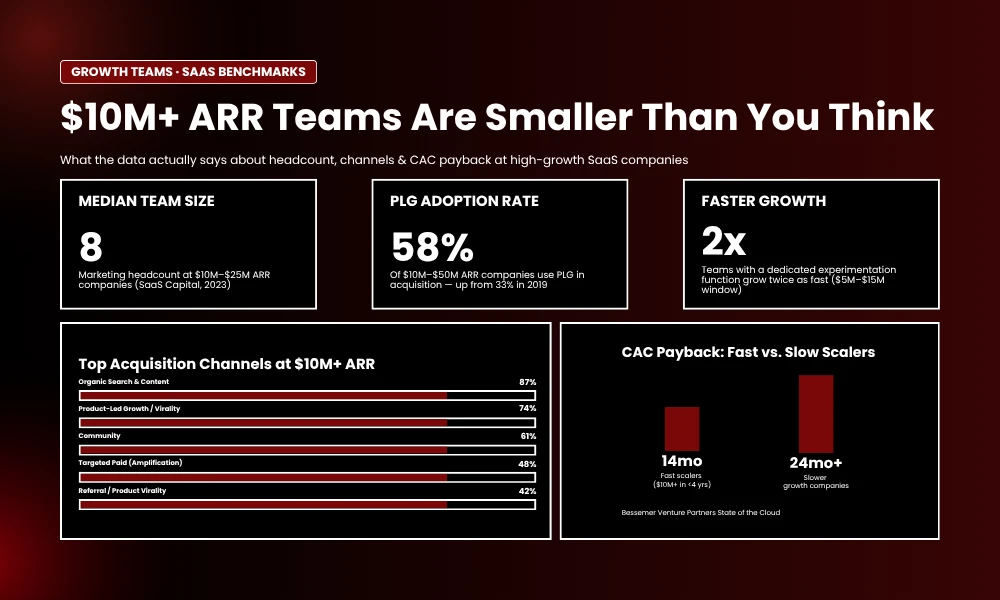
Eight people. That’s the median growth marketing teams size at SaaS companies between $10M and $25M ARR, according to a 2023 SaaS Capital report. Not 80. Not 30. Eight.
Notion was doing hundreds of millions in ARR while running a growth team most companies at a fraction of that revenue would consider dangerously lean. Same story at Loom before Atlassian came in, and at ClickUp during its fastest growth years. The headcount just wasn’t there, and it didn’t need to be.
What makes a team that small work is refusal. Refusal to chase every channel, every format, every trend. Pick the two or three places your buyers actually live, go deep, and ignore the rest. That’s the whole strategy.
What the Data Says About Channel Mix
In 2019, about a third of SaaS growth marketing teams in the $10M to $50M ARR range had PLG baked into how they acquired customers. By 2023, that number was 58%, per OpenView Partners’ annual benchmark. That’s not a blip.
The mistake I see people make is treating PLG like a full swap, replace your sales motion with a freemium product and watch the leads roll in. That’s not what the best teams are doing. They’re using free trial and freemium data to understand which segments actually convert, then pointing paid and organic spend at those specific segments. PLG is a signal layer, not a replacement.
Drift ran this well before Salesloft acquired growth marketing teams. Their growth team didn’t just do lead gen. They staked out an entire content and messaging universe around conversational marketing as a category. That POV fed their SEO, their events, their community. Everything connected back to one idea and it compounded fast.
The Role Structures That Actually Work
Companies that got from $3M to $10M+ ARR without a major stumble tend to share one structural thing that’s easy to miss: someone whose only job was running experiments and documenting what those experiments taught the team.
Not a data analyst. Not someone who builds dashboards and hands them off. Someone embedded in growth whose deliverable is learnings, not reports. Reforge tracked this across hundreds of companies. Their conclusion: teams with a dedicated experimentation function grew roughly 2x faster in the $5M to $15M window. That gap isn’t small.
The other thing that comes up is full-funnel ownership. Most marketing teams at SaaS companies still draw their finish line at the lead. The teams running growth at $10M+ companies often own activation metrics and early retention too, even when that creates friction with product or CS. They don’t see it as stepping on toes. They see it as the only way the numbers make sense.
Acquisition Costs and the Efficiency Obsession
Bessemer Venture Partners tracked CAC payback periods for SaaS companies that hit $10M+ ARR in under four years. The median was 14 months. For companies that took longer? Often north of 24. That gap in payback period has a compounding effect on how fast you can reinvest.
The teams that scale fast are almost annoying about CAC. They’ll kill a paid channel that leadership loves if it can’t justify itself after a real test. They build content and community because those compounds paid doesn’t. And they invest in referral and expansion early because bringing in a brand-new customer has always been the expensive option.
The “Powered by Intercom” badge is the canonical example here. Intercom’s early team wired referral into the product before most companies were thinking about PLG at all. By the time they had real ARR, a meaningful portion of acquisition was coming from the product itself. Nobody paid for that traffic. That kind of move requires marketing and engineering to be in the same room with the same goals, which, at most companies, they aren’t.
The Content Playbooks Running Under the Hood
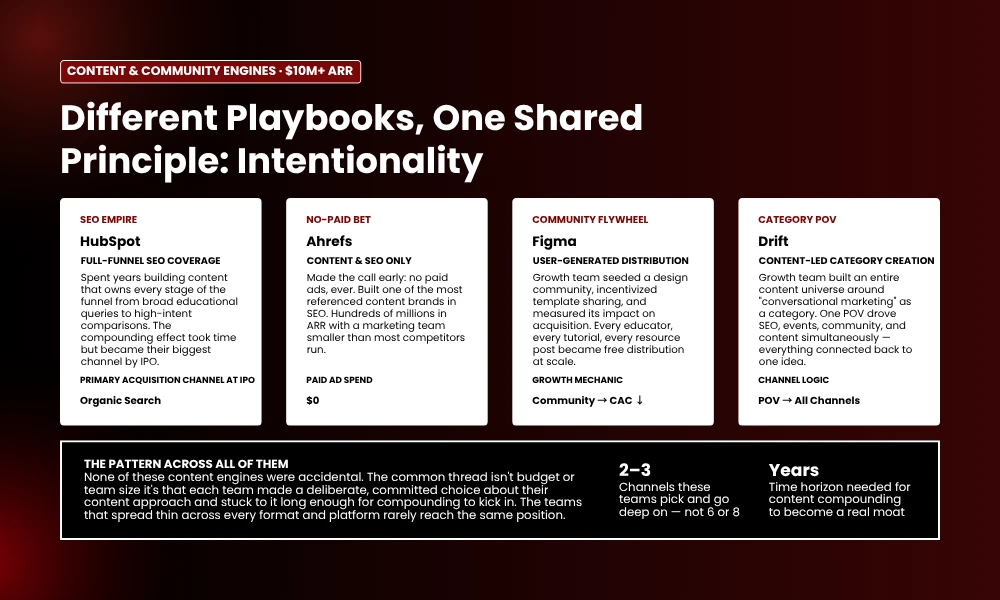
Every company in this cohort has a content engine. None of them look exactly alike. The one thing they share: nobody stumbled into it.
HubSpot gets cited constantly and it’s earned. They spent years building SEO coverage across every stage of the funnel top-of-funnel education, mid-funnel consideration, bottom-of-funnel comparisons. By the time they went public, organic search was their biggest acquisition channel by volume. The compounding effect of that investment was enormous. But it took years.
Not every growth team has years and a content budget to match. What I see newer teams do is go much narrower tight pillar page clusters around 3 or 4 high-value topics, YouTube built around search-intent queries rather than brand awareness, and LinkedIn-first strategies for B2B audiences that genuinely live on that platform. Less surface area, more depth.
Ahrefs decided early they weren’t going to run paid ads. At all. Content and SEO only. They stuck to it, built one of the most referenced content brands in the SEO space, and are doing hundreds of millions in ARR with a marketing team that’s small by any standard. That’s a real thing. You can actually build that way if you commit.
Community as a Growth Channel for growth marketing teams
a16z made the case a while back that community is one of the few genuinely defensible moats a SaaS company can build. Looking at what’s actually happened at companies in the $10M+ range, they were right.
Before Adobe tried to acquire them, Figma had built one of the most active design communities anywhere. That community didn’t just stick around it worked. Users shared templates that pulled in other users. Educators built courses around the tool. Every tutorial, every template, every forum post was free distribution. The growth team’s job was to actively seed that ecosystem, not just watch it grow. They tracked how community activity mapped to acquisition and retention. It was a serious growth channel.
Notion’s version was slightly different but same basic logic. Power users became ambassadors. Templates spread. Reddit communities self-organized. YouTube tutorials from random users accumulated millions of views. None of that was free in the sense of requiring zero effort the growth team had to build the infrastructure for it but the marginal cost per acquired user kept dropping.
This pattern shows up most in collaboration tools, developer tools, and creative software. But the underlying mechanic travels. If you give your users a reason to be publicly invested in your product, they become distribution. That works in a lot of categories.
What These growth marketing teams Spend Their Time On (And What They Don’t)
How PLG Actually Works at Scal
The thing that comes up in almost every conversation I’ve had with growth leads at this revenue tier, when I ask what actually changed as they scaled: they talk about what they stopped doing first.
There’s a kill list. It’s real and it gets used. Paid channels that don’t show clear return after an honest test gone, even when there’s political resistance. Content that doesn’t rank or convert off the roadmap. Conferences and events deprioritized unless someone can show actual pipeline from them.
On the flip side, the things they invest more in as they grow are almost always the same: data infrastructure that lets them move faster, sales and marketing alignment that tightens up as deal sizes grow, and systems that make each experiment cheaper to run than the last. Lower cost per learning is the goal. Cost per acquisition follows.
The Retention Side That Most People Ignore
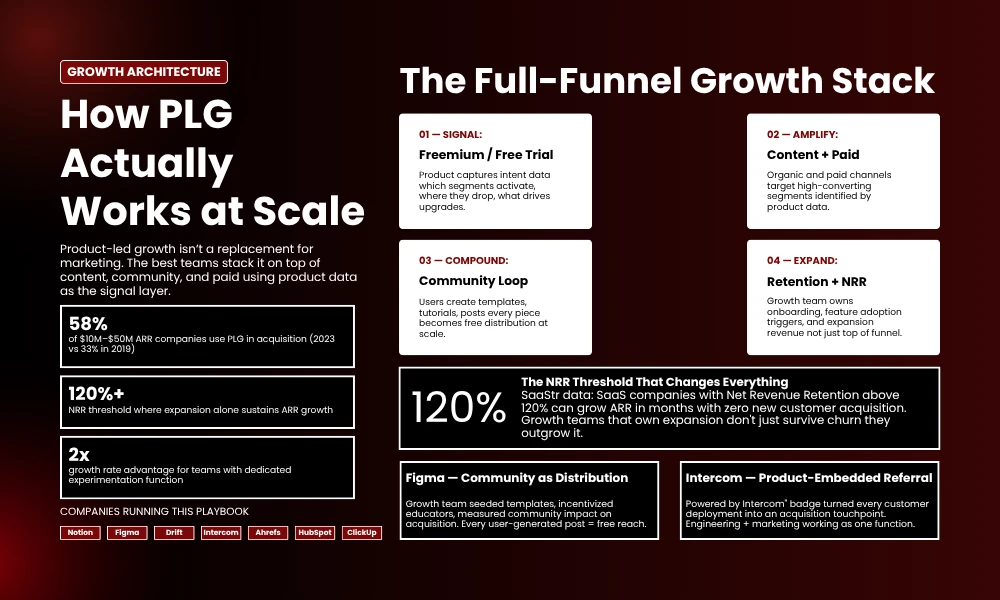
If there’s one thing that doesn’t get talked about enough in growth marketing teams circles, it’s NRR. Net Revenue Retention. SaaStr’s data makes the case pretty cleanly: SaaS companies with NRR above 120% can grow ARR in months where they don’t add a single new customer. Expansion alone carries them.
The growth teams that understand this don’t hand off users to customer success after activation and move on. They own onboarding because onboarding drives feature adoption and feature adoption drives expansion. They build upgrade triggers into the product. They stay close to CS so they can identify accounts that are ready to grow before CS has had a chance to ask.
Teams that see growth as a top-of-funnel job tend to hit a ceiling. The ones holding $10M+ ARR and climbing past it tend to see themselves as owning the whole customer journey. That shift in scope is harder than it sounds.
Closing Thoughts
There’s no formula. I know that’s not a satisfying thing to read but I haven’t found one and I’ve looked. What I have found is a cluster of things that show up repeatedly across the growth teams that are actually doing this at scale.
Small growth marketing teams with real ownership of their channels. A short list of bets they go deep on instead of spraying effort everywhere. PLG that works alongside content and community, not instead of it. An almost irrational focus on CAC payback. And a growth function that owns retention and expansion because it knows the top-of-funnel math alone won’t get them where they need to go.
Winning on budget is getting harder every year. The gap is opening up between teams that are disciplined about what they cut and teams that keep running everything because killing something feels like failure.
Killing things that aren’t working is not failure. It’s the job.
Frequently Asked Questions
What does ARR stand for in ARR SaaS brands?
ARR is Annual Recurring Revenue the standard metric SaaS companies use to measure predictable subscription income on an annualized basis. It drives how companies calculate growth rate, set valuations, and compare themselves to industry benchmarks.
How big are growth marketing teams at $10M+ ARR SaaS brands?
Much smaller than most people expect. SaaS Capital’s 2023 benchmarks put the median at around 8 people for companies in the $10M to $25M ARR range. These teams work by going deep on a small number of channels rather than staffing up generalists across every function.
What is product-led growth (PLG) and why are so many SaaS brands using it?
PLG means your product is doing the acquisition work users get in the door through a free trial or freemium tier, experience the value, and then convert. Sales and marketing still exist but the product is the primary growth engine. OpenView’s 2023 data shows PLG is involved in acquisition at 58% of SaaS companies in the $10M to $50M ARR range, up from 33% in 2019.
What is a good CAC payback period for SaaS brands?
Bessemer Venture Partners’ data puts 14 months as the benchmark for fast-scaling SaaS companies. Once you’re pushing past 24 months, cash flow starts to constrain your ability to reinvest in growth at the pace you need.
How important is community building for SaaS growth marketing teams?
It’s become a serious acquisition channel at the companies doing it intentionally. Figma and Notion are the most-studied cases, but the pattern holds: community reduces CAC, improves retention, and creates distribution that compounds in ways paid channels don’t. The a16z moat argument has aged well across multiple SaaS categories.
What is Net Revenue Retention and why does it matter for SaaS brands?
NRR tracks how much revenue you keep and grow from your existing customer base after accounting for churn and downgrades. SaaStr’s research shows that SaaS companies with NRR above 120% can grow ARR even in months with zero new customer acquisition. That’s why the best growth teams are increasingly owning expansion, not just the top of funnel.
What channels do $10M+ ARR SaaS brands rely on most?
Varies by category, but the combination that shows up most often is organic search and content, PLG or product virality, community, and paid used for amplification rather than as the primary engine. Strategies built entirely on paid acquisition rarely hold past $5M ARR without serious margin pressure.