

Picture a scenario that plays out in SaaS marketing teams every quarter. Leadership decides it’s time to “do content.” A blog launches. A few posts of content strategy agencies go up. Three months later, organic traffic hasn’t moved, sales is complaining that the leads are low quality, and everyone quietly moves on. There was never a real strategy behind it, just publishing with crossed fingers.
Actual SaaS thought leadership runs on a different logic. It changes how your category frames a problem. It puts your name front of mind when buyers are comparing options.This article covers 17 of the strongest ones working in SaaS today. Founder building category presence from scratch, marketing leader scaling an existing program, CMO repositioning through content, there’s something on this list for where you are right now.
17 Content Strategy Agencies Building SaaS Thought Leadership
Animalz
If you’ve spent any time reading about B2B content marketing, you’ve likely already encountered Animalz, their work has a way of circulating. The agency built its name on deeply researched content that trades volume for real impact, and the client roster reflects that positioning: Google, Zendesk, Wistia. Their own blog has become a reference point for anyone who takes the craft seriously. The belief running through everything they do is that a body of high-quality content compounds over time as a competitive advantage, rather than functioning as a production line optimized for output.
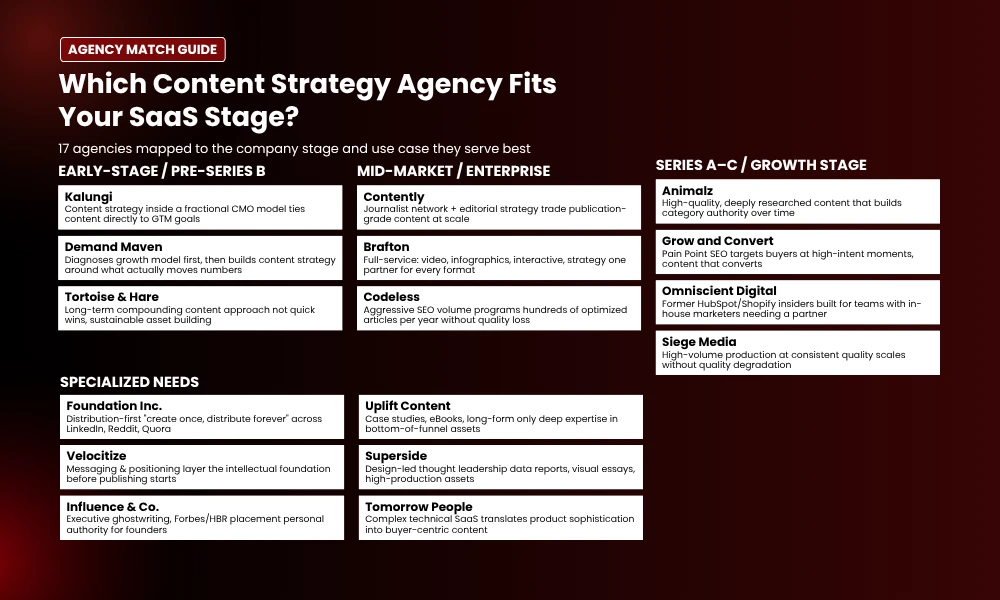
Best for: Series A–C SaaS companies that want content which builds category authority, not just search traffic.
Grow and Convert
The premise behind Grow and Convert is worth understanding before anything else: traffic on its own has almost no value, and SaaS companies should be going after buyers at high-intent moments not casual readers browsing a topic. That premise became the Pain Point SEO framework, which has shaped how a large portion of SaaS marketers approach content planning. For teams whose content needs to show up in pipeline reviews rather than traffic dashboards, this is the methodology to look at closely.
Best for: SaaS companies with a sales-assist or bottom-up GTM motion where content has to move the conversion needle.
Siege Media
Siege Media has solved a problem that trips up most large agencies: producing content at high volume without watching quality erode. Their production systems were built from the ground up to scale, and the results show up in the organic growth numbers clients report. SaaS and fintech make up a strong portion of their work, and combining editorial discipline with serious SEO methodology gives them an edge in competitive content markets.
Best for: Growth-stage SaaS companies that need to build content volume fast across multiple topic clusters.
Foundation Inc.
Ross Simmonds runs Foundation Inc. with a philosophy most content agencies pay lip service to and then ignore: distribution matters as much as creation, sometimes more. “Create once, distribute forever” is the internal mantra, and it shapes how they build programs starting with where buyers actually spend time online, whether that’s LinkedIn, Reddit, Quora, or somewhere more niche, then building backward from there. For SaaS teams that have been publishing into a void, this reframe tends to be clarifying.
Best for: SaaS companies that already produce decent content but haven’t built a real distribution strategy around it.
Contently
Contently connects enterprises with a freelance network of professional journalists and writers, pairing that with strategy work designed to bring editorial standards into branded content. The result reads and feels like trade publication reporting rather than marketing copy a meaningful difference when your buyers are sophisticated enough to tell the two apart. The platform also gives marketing teams workflow visibility that pure agency relationships typically don’t offer.
Best for: Enterprise SaaS and larger growth-stage companies that want editorial-grade content at scale.
Velocitize (formerly Velocity Partners)
Velocity Partners spent the better part of a decade producing some of the most-cited thinking in B2B content marketing their writing on what it means to actually help a buyer, rather than just appear in their feed, shaped the field in ways that are still visible today. Now rebranded and expanded, the sharpest part of the practice remains the messaging and positioning work that comes before any content gets made. The intellectual foundation, in other words, not just the publishing.
Best for: SaaS companies that need to sort out messaging and positioning before scaling content production.
Omniscient Digital
The Omniscient Digital team came up through in-house roles at companies like HubSpot and Shopify, and that background is the most important thing to understand about them. They know firsthand how content programs live or die inside organizations what it takes to get internal buy-in, how to tie content to pipeline in ways that finance will accept, how to build something that holds together when leadership changes. Newer to the agency scene than some on this list, but the experience in the team is real.
Best for: SaaS companies with in-house marketers who need a thinking partner, not a production vendor.
Codeless
Codeless runs high-volume, SEO-driven content programs for SaaS and fintech companies, and the infrastructure they’ve built to do that at consistent quality is what the offering is really about. Hundreds of optimized articles per year, quality checks that don’t fall apart under the weight of that output. For companies with large keyword universes to cover and a need to move quickly across topic clusters, the production capacity here is hard to replicate elsewhere.
Best for: SaaS companies running aggressive SEO programs that need consistent volume without sacrificing search quality.
Kalungi
Kalungi wraps content strategy inside a fractional CMO and full-stack SaaS marketing model, and that changes the nature of the engagement. For early-to-mid-stage companies where nobody internally has the mandate to connect content to business goals, that structure fills a gap a pure content agency can’t. The playbooks they’ve built are specific to B2B SaaS, and the go-to-market perspective they bring is something most content shops simply don’t have.
Best for: Pre-Series B SaaS companies that need content strategy built into a broader GTM framework.
Tortoise & Hare Software
Tortoise & Hare take a deliberately long view. The pitch isn’t quick wins or fast rankings it’s building content assets that keep working for years, generating traffic and leads long after the initial investment. For SaaS companies that have been burned by short-term content programs that spike and fade, the philosophy here is a meaningful counterpoint.
Best for: SaaS companies treating content as a long-term compounding asset rather than a quarterly demand gen tactic.
Influence & Co.
Most content agencies don’t touch executive thought leadership. Influence & Co. built their practice around it ghostwriting for founders, placing contributed articles, earning media coverage in publications like Forbes or Harvard Business Review. Getting a CEO byline into a high-authority publication runs on completely different mechanics than running a company blog, and Influence & Co. has worked those mechanics long enough to know what moves the needle.
Best for: SaaS founders and executives building personal authority alongside company content programs.
Brafton
Brafton operates at a scale that opens up services most boutique agencies can’t offer video, infographic production, interactive content, and strategy consulting without needing to stitch together multiple vendor relationships. For marketing teams that want one content partner capable of handling multiple formats and channels, the range of what Brafton covers is hard to replicate through a smaller shop.
Best for: Mid-market SaaS companies that need multi-format content production and strategy from one integrated partner.
Demand Maven
Before Demand Maven recommends a single content topic, they spend time diagnosing the actual growth model. That might sound like a minor process difference, but the output is a content strategy grounded in what will move your specific numbers not recycled thinking from a different client in a loosely adjacent category. Teams that have sat through content strategy presentations that felt disconnected from the business tend to find this approach refreshing.
Best for: Early-stage SaaS companies where content strategy needs to be anchored to growth model diagnosis.
Uplift Content
Uplift Content stays in a narrow lane case studies, eBooks, long-form content for SaaS and the focus pays off in depth of expertise. The processes they’ve built around these specific formats go deeper than what a generalist agency can offer. For companies that need to produce customer case studies or comprehensive guides at volume, the quality holds up without the coordination overhead that comes with broader agency relationships.
Best for: SaaS companies that need case studies, eBooks, and bottom-of-funnel content assets produced consistently at scale.
Superside
Superside approaches thought leadership from the design side as much as the editorial side, which changes what’s possible. The subscription model gives SaaS marketing teams on-demand access to a full creative team, and that matters most for content programs where design and editorial have to move together data reports, visual essays, heavily produced content assets. Text-first agencies treat design as an afterthought. Superside was built with that integration as the starting point.
Best for: SaaS companies with content programs that need high-production creative tightly integrated with editorial strategy.
Tomorrow People
Tomorrow People work primarily with B2B SaaS and tech companies out of the UK, and their Content Clarity approach tackles one of the harder problems in SaaS content: taking technically sophisticated products and making the value legible to business buyers who don’t share that technical background. It sounds straightforward, but doing it well requires a real understanding of both the product and the buyer and most agencies get one or the other, not both.
Best for: Technical SaaS companies that need complex product value translated into content buyers actually engage with.
Accelerate Agency
Accelerate Agency built their practice around long-term SaaS SEO and thought leadership, and they’ve connected it to digital PR and link acquisition in a way that most content-only agencies haven’t figured out. That combination drives domain authority alongside traffic and brand visibility, which matters in categories where strong incumbents have a head start on authority and new entrants can’t close that gap through content volume alone.
Best for: SaaS companies in competitive SEO verticals where content strategy and link authority need to work in tandem.
Choosing the Right Content Strategy Agency for SaaS
The agencies worth working with push back. They tell you when an idea is generic, when a position isn’t sharp enough, when a content plan is going to generate activity without business impact. That kind of honest engagement is harder to find than the market would suggest, which is why choosing an agency deserves more rigor than a proposal review.
The 17 agencies here cover a wide range of models. Some are built for volume SEO programs; others do their best work on high-concept thought leadership. Some fit companies with in-house capacity looking for strategic lift; others are better for organizations handing off the full operation.
What runs through all of them is a real, developed approach to SaaS content strategy not just a publishing cadence dressed up as strategy. As AI-generated content floods every category, the programs that matter will be built on original research, a distinctive point of view, and distribution that actually reaches buyers. An agency that understands that distinction is worth finding.
Take the time to find one that genuinely knows your category, your buyer, and what building a point of view worth following really takes.
Frequently Asked Questions
What does a content strategy agency actually do?
At the strategy level, the work involves defining a clear editorial point of view, mapping content needs across the buyer journey, building topic clusters and content calendars, and figuring out how success gets measured. Most agencies then execute against that plan as well writing, editing, publishing, distributing. How much of the execution they own versus hand back to the client varies significantly depending on the engagement model.
How much do content strategy agencies charge?
Boutique SaaS-focused agencies with a full program offering strategy, writing, some distribution support typically run between $5,000 and $20,000 per month. Scope, reputation, and what’s actually included drive significant variation within that range. Enterprise-oriented agencies or those with particularly strong reputations can run considerably higher.
How long does it take for a content strategy to show results?
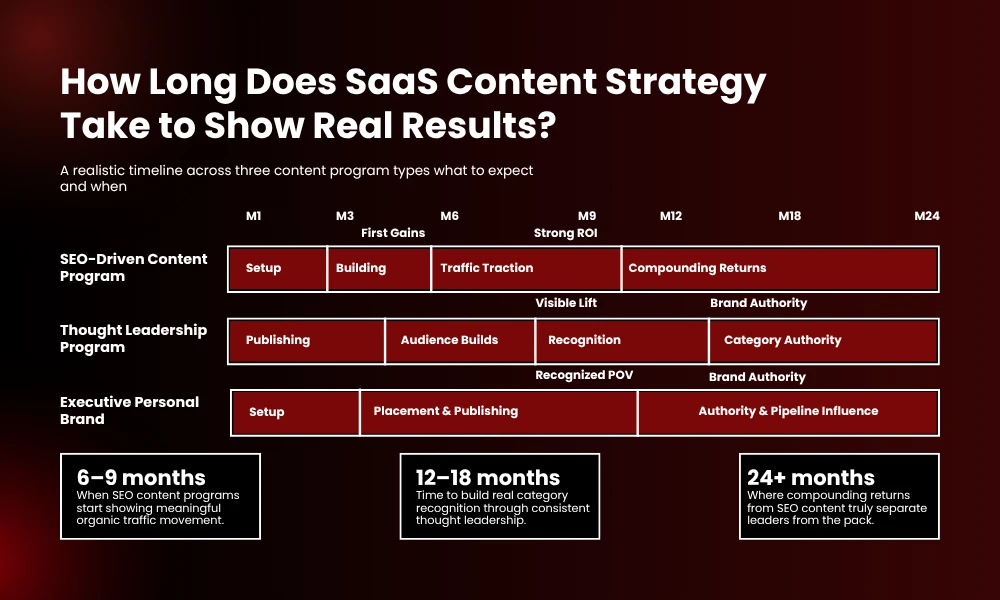
SEO-driven programs usually start showing real organic traffic movement around the six-to-nine month mark, with returns that build on themselves over the following year or two. Thought leadership programs aimed at category recognition tend to take twelve to eighteen months of consistent publishing before the effect becomes visible. Both timelines assume consistent execution stopping and restarting resets most of the progress.
What’s the difference between a content strategy agency and a content marketing agency?
A content strategy agency leads with the planning work, audience analysis, messaging architecture, the editorial framework that determines what gets made and why. A content marketing agency often leads with execution. In practice the line blurs, and many agencies do both, but how a firm describes itself usually signals where their real expertise sits. If you need the thinking first, look for strategy-led; if you have the strategy and need production, execution-led shops tend to move faster.