Most people try to change their lives by setting big goals. James Clear argues that’s the wrong approach. Real change comes from tiny habits ones so small they seem almost pointless at first. Stack enough of them together, and they compound into something remarkable.
Published in 2018, Atomic Habits is now one of the best-selling self-help books of all time, with over 15 million copies sold and a #1 ranking on the New York Times bestseller list. Here’s everything worth knowing 25 lessons, explained clearly, with something you can act on today.
What Are Atomic Habits About?
Atomic Habits by James Clear is a practical guide to building good habits and breaking bad ones using a framework called the Four Laws of Behavior Change. The book is rooted in cognitive science, neuroscience, and behavioral psychology, and presents its ideas through real stories from athletes, businesses, and everyday people.
The central idea: you don’t need to transform yourself overnight. You need a better system.
Part 1: The Fundamentals of Habit Building
Lesson 1: Small Habits Compound Into Remarkable Results
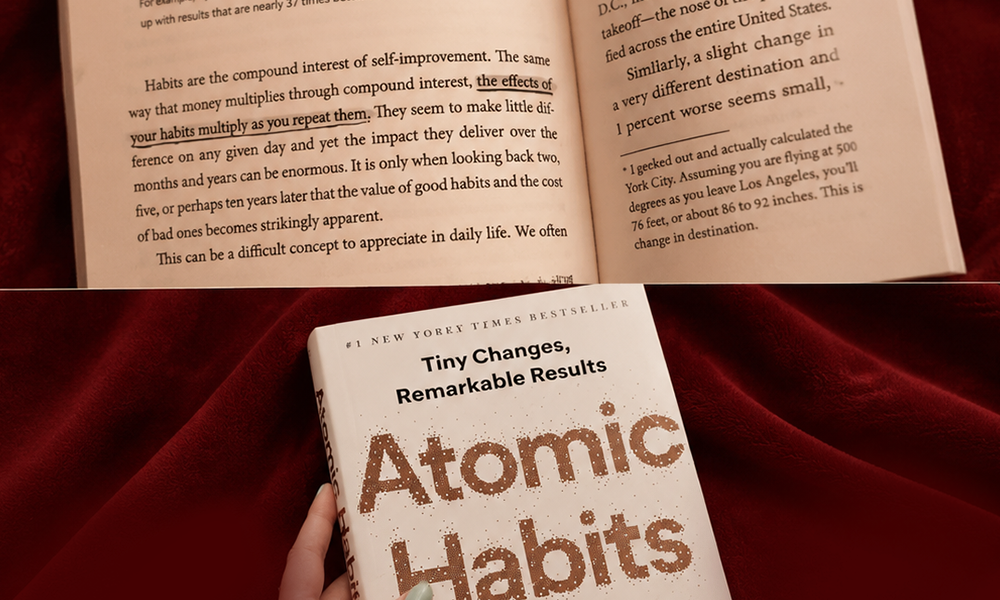
Clear opens with a simple but powerful idea: getting 1% better every day doesn’t make you 365% better in a year it makes you 37 times better. That’s the math of compounding applied to behavior.
The flip side is equally true. Getting 1% worse every day for a year leaves you at nearly zero. Small habits are never neutral over time.
Takeaway: Stop asking “How much can I do today?” and start asking “What can I do consistently?”
Lesson 2: Your Systems Matter More Than Your Goals
Two athletes can share the same goal: win a championship. Only one does. The difference isn’t the goal — it’s the daily system behind it.
Clear’s now-famous line: “You do not rise to the level of your goals. You fall to the level of your systems.” Goals set direction. Systems determine progress.
Takeaway: Focus on building a repeatable process rather than chasing an outcome.
Lesson 3: Forget Outcomes Build Identity-Based Habits
Clear identifies three levels of behavior change:
- Outcome: What you want (lose weight, write a book)
- Process: What you do (diet, daily writing sessions)
- Identity: Who you believe you are (a healthy person, a writer)
Most people work outside-in, starting with outcomes. Clear argues you should work inside-out start with identity. Every habit is a vote for the type of person you want to become.
Takeaway: Instead of “I want to run a marathon,” try “I am becoming someone who runs.” The identity shapes the behavior.
Lesson 4: The Habit Loop Cue, Craving, Response, Reward
Every habit follows the same four-step feedback loop, according to research in behavioral science:
- Cue — A trigger your brain notices (a time, place, feeling, or event)
- Craving — The desire or motivation the cue creates
- Response — The actual behavior you perform
- Reward — The satisfaction that reinforces the loop
You don’t crave the habit itself you crave the change in state it delivers. Understanding this loop is the foundation for everything else in the book.
Takeaway: To understand why a habit exists, trace it back: what’s the cue, and what reward does it deliver?
Lesson 5: Awareness Comes Before Change
You can’t change habits you haven’t noticed. Clear introduces the Habits Scorecard a simple exercise where you list every behavior in your daily routine from morning to night and label each as positive (+), negative (−), or neutral (=).
He also points to the Japanese railway technique of “Pointing and Calling,” where workers verbally narrate their actions to make unconscious behaviors conscious. The same principle applies to habits.
Takeaway: Write down every habit you have this week. Label each one. You’ll spot patterns you didn’t know were there.
Part 2: The Four Laws of Behavior Change
The Four Laws are James Clear’s master framework. To build a good habit, apply each law. To break a bad one, invert it.
Law 1: Make It Obvious
Lesson 6: Use Implementation Intentions
The most common reason people fail to build a habit isn’t laziness it’s vagueness. “I’ll exercise more” is not a plan. “I will go for a 20-minute walk at 7am on Monday, Wednesday, and Friday” is.
Research shows that people who specify when and where they’ll perform a behavior are far more likely to follow through. Clear calls this an implementation intention: “I will [BEHAVIOR] at [TIME] in [LOCATION].”
Takeaway: For every new habit, write down the exact time and place you’ll do it.
Lesson 7: Use Habit Stacking
One of the most reliable ways to build a new habit is to attach it to one you already have. The formula: “After I [CURRENT HABIT], I will [NEW HABIT].”
This is called habit stacking, and it works because your existing habits already have established cues baked in. You’re not creating a new trigger you’re piggybacking on one that already works.
Takeaway: Pick one habit you want to build. Find an existing habit that naturally precedes it. Stack them.
Lesson 8: Design Your Environment
Clear argues that environment is the invisible hand shaping most of our behavior. We think we act on willpower we actually act on what’s most visible and available.
Make the cues for good habits obvious. Leave your running shoes by the door. Put the book on your pillow. Keep fruit on the counter. Conversely, hide the cues for bad habits. Put your phone in a drawer. Move the junk food to the back of the cupboard.
Takeaway: Redesign one room or one surface this week to make your best habit impossible to miss.
Lesson 9: Make Bad Habit Cues Invisible
The inverse of Law 1: to break a bad habit, make its trigger disappear. You can’t ignore a cue you keep bumping into.
If social media is a time sink, delete the apps from your home screen. If you drink too much coffee, stop buying it. Discipline matters but a well-designed environment beats willpower almost every time.
Takeaway: Identify the cue that triggers your worst habit. Remove it from your environment before your next temptation window.
Law 2: Make It Attractive
Lesson 10: Habits Are Dopamine-Driven
The brain’s reward system runs on dopamine but here’s the key insight from Clear: it’s the anticipation of a reward, not the reward itself, that drives action. Dopamine spikes when you expect something good. This is why cravings feel so powerful.
Understanding this helps you build habits that feel genuinely appealing, not just ones you force yourself through.
Takeaway: Build some anticipation into your habits. Having something to look forward to (even small) makes the behavior easier to start.
Lesson 11: Use Temptation Bundling
Pair something you want to do with something you need to do. Clear calls this temptation bundling.
Example: Only watch your favorite show while folding laundry. Only listen to your favorite podcast while running. You’re not bribing yourself you’re making the habit attractive by attaching it to something already enjoyable.
Takeaway: Identify one habit you’re avoiding. What enjoyable activity can you link to it?
Lesson 12: Join a Culture Where Your Habit Is Normal
We imitate the people around us. Clear identifies three groups whose habits we tend to copy: the close (family and friends), the many (the tribe), and the powerful (those with status and prestige).
The most effective environment for building a new habit is one where the desired behavior is already the default. Want to read more? Join a book club. Want to exercise consistently? Join a gym where showing up is the norm.
Takeaway: Find or build a community where the habit you want is already ordinary.
Lesson 13: Reframe the Habit
Language shapes motivation. There’s a difference between saying “I have to go to the gym” and “I get to go to the gym.” One is a burden. One is a privilege.
Clear suggests reframing habits around what you gain rather than what you sacrifice. Associate the habit with positive feelings and it starts to feel attractive rather than effortful.
Takeaway: For any habit you’re struggling with, rewrite it in terms of what it gives you, not what it costs.
Law 3: Make It Easy
Lesson 14: The Law of Least Effort
Humans gravitate toward the option that requires the least work. This isn’t laziness it’s biology. Energy conservation is a survival instinct.
Clear’s solution: reduce friction for good habits, increase friction for bad ones. The easier a good behavior is to start, the more likely you’ll actually do it. This is why preparation matters — laying out workout clothes the night before removes a decision barrier in the morning.
Takeaway: Make your best habit the path of least resistance. Remove every unnecessary step between you and starting.
Lesson 15: The Two-Minute Rule
Any new habit should take two minutes or less to start. Not two minutes total just the beginning. “Read before bed” becomes “open the book.” “Go for a run” becomes “put on your running shoes.”
The two-minute rule works because starting is the hardest part. Once you’ve begun, continuing is much easier. And even on the days you stop after two minutes, you’ve still cast a vote for your identity.
Takeaway: Shrink your next habit down to its two-minute starter. Master that before expanding.
Lesson 16: Automate Good Decisions Once
The most powerful form of making a habit easy is a one-time action that locks good behavior in by default. Set up a recurring savings transfer. Delete social media apps. Put parental controls on your own device. Unsubscribe from junk email.
These are decisions you make once, but they shape your behavior automatically every day after. Clear calls them commitment devices.
Takeaway: What’s one setup decision you could make today that would remove a daily willpower battle?
Lesson 17: Repetition, Not Time, Forms Habits
A common myth: habits take 21 days to form. Clear pushes back on this. Habit formation is a function of how many times a behavior is repeated, not how many days have passed.
The more you repeat something, the more the neural pathway strengthens. There’s no fixed timeline just the gradual automaticity that builds through consistent repetition.
Takeaway: Stop counting days. Start counting reps. Each time you do the behavior, the habit gets stronger.
Law 4: Make It Satisfying
Lesson 18: What Gets Rewarded Gets Repeated
The final law closes the habit loop. <cite index=”51-1″>The first three laws make a behavior more likely to happen; the fourth law makes it likely to be repeated.</cite> If a habit doesn’t feel good in some way, the brain won’t prioritize it next time.
The challenge is that most good habits (exercising, saving money, studying) deliver rewards in the future. Most bad habits deliver rewards immediately. Clear’s solution: add a layer of immediate satisfaction to delayed-reward habits.
Takeaway: Give yourself a small, immediate reward after completing a good habit. Make the feeling of success happen now, not later.
Lesson 19: Track Your Habits
A habit tracker — even just an “X” on a calendar creates two benefits at once. It provides a visual record of your streak, which becomes its own form of satisfaction. And it makes the invisible visible, which keeps you honest.
Clear references Benjamin Franklin, who tracked 13 personal virtues daily in a notebook throughout his adult life. The habit of tracking the habit creates a compounding accountability loop.
Takeaway: Pick one habit to track this week. Use a simple notebook, an app, or even a paper calendar.
Lesson 20: Never Miss Twice
You will miss a day. It’s inevitable. What matters is what you do next.
Clear’s rule: never miss twice. One miss is an accident. Two misses is the beginning of a new (bad) habit. Getting back on track immediately prevents the emotional spiral of “I’ve ruined everything” from becoming self-fulfilling.
Takeaway: When you break your streak, your only job is to show up the next day. One bad day doesn’t undo weeks of progress.
Lesson 21: Use an Accountability Partner
We care deeply about what others think of us. An accountability partner creates a social cost for inaction making the failure to follow through immediately painful, rather than painlessly invisible.
Clear also mentions the habit contract a formal written commitment, signed by witnesses, that specifies consequences for missing the behavior. It sounds extreme, but it works because it makes the cost of inaction concrete.
Takeaway: Tell someone about the habit you’re building. Better yet, put consequences in writing.
Part 3: Advanced Lessons
Lesson 22: Match Your Habits to Your Natural Abilities
The habits most likely to stick are ones that feel less effortful for you than for others. Clear makes a clear distinction: work hard, but work hard on things that suit your wiring. The game you play matters as much as how well you play it.
He recommends the explore/exploit tradeoff spend time experimenting early to find where your natural strengths lie, then double down on the habits that build those strengths.
Takeaway: Ask yourself which habits feel like work to others but come more naturally to you. Build there first.
Lesson 23: The Goldilocks Rule Stay in the Zone of Optimal Challenge
Habits break down at two extremes: when they’re too easy (boredom kills motivation) and when they’re too hard (overwhelm kills motivation). Clear calls the sweet spot between these the Goldilocks Zone tasks that are roughly 4% beyond your current ability.
The best habit systems stay in this zone, gradually increasing difficulty as your capacity grows.
Takeaway: Review your current habits. Are any of them boring you? Slightly increase the difficulty to stay engaged.
Lesson 24: Embrace Boredom It’s Part of the System
This is one of Clear’s most underrated lessons. The difference between professionals and amateurs isn’t motivation it’s the ability to show up when they don’t feel like it.
“The greatest threat to success is not failure but boredom.” People stop habits not because they’re hard, but because they become routine. The pro shows up anyway. That’s the habit beneath the habit.
Takeaway: When a habit feels boring, recognize it as a test not a signal to quit. The reps still count.
Lesson 25: Review and Refine Your System
James Clear does a personal Annual Review at the end of each year, asking three questions: What went well? What didn’t go well? What am I learning? He also does a mid-year Integrity Report that asks: Am I living by my values? How can I adjust?
No system runs perfectly forever. The habits that serve you at one stage of life may not serve you at another. Regular reflection lets you update the system so it stays aligned with who you’re becoming.
Takeaway: Schedule one review session per quarter to assess what’s working. Treat your habit system like a product it needs iteration.
Quick Reference: The Four Laws Cheat Sheet
| Goal | Law | Action |
| Build a habit | Make it obvious | Use implementation intentions; design your environment |
| Build a habit | Make it attractive | Use temptation bundling; join a supportive community |
| Build a habit | Make it easy | Reduce friction; use the Two-Minute Rule |
| Build a habit | Make it satisfying | Add immediate rewards; track your progress |
| Break a habit | Make it invisible | Remove the cue from your environment |
| Break a habit | Make it unattractive | Reframe it negatively; highlight the cost |
| Break a habit | Make it difficult | Add friction; use commitment devices |
| Break a habit | Make it unsatisfying | Add an accountability partner; create consequences |
Atomic Habits Review: Is It Worth Reading?
Yes and it’s worth re-reading. What makes Atomic Habits stand out among habit-building books is that it’s practical to the point of being immediate. The system isn’t theoretical. You can apply the Two-Minute Rule today. You can redesign your environment tonight. You can write an implementation intention in the next ten minutes.
The book draws on real research (neuroscience, behavioral economics, psychology) but never feels academic. James Clear translates complex science into language that makes you want to act, not just understand.
FAQs
What is Atomic Habits in one sentence?
A practical guide to building good habits and breaking bad ones through small, consistent improvements and a four-step behavior change framework.
Who is Atomic Habits written by?
James Clear, a writer and speaker who focuses on habits, decision-making, and continuous improvement at jamesclear.com.
What are the Four Laws of Behavior Change in Atomic Habits?
Make it obvious, make it attractive, make it easy, and make it satisfying and invert each law to break bad habits.
What is the Two-Minute Rule?
When starting a new habit, it should take two minutes or less to begin. Shrink the habit until it’s easy enough to start without resistance.
What is habit stacking?
Linking a new habit to an existing one using the formula: “After I [current habit], I will [new habit].”
How is Atomic Habits different from other self-help books?
It focuses on systems over goals, identity over outcomes, and environment design over willpower and backs every claim with specific, actionable strategies.