
Global equities sold off sharply Wednesday as President Trump declared the Iran ceasefire “over,” sending oil surging more than 6% and triggering a broad risk-off move across Wall Street, European markets, and Asia. By Thursday, stocks had partially recovered but the underlying tension remains, and markets are now pricing in a rate hike, elevated inflation, and a conflict with no clear endpoint.
Here is the full picture of what happened, why it happened, and what it means for markets going forward.
AI Overview
On Wednesday, July 8, 2026, global financial markets sold off after President Donald Trump told the NATO summit in Ankara, Turkey, that the ceasefire between the United States and Iran was “over.” The Dow Jones Industrial Average fell 576.76 points (–1.09%) to 52,348.39. The S&P 500 dropped 0.28% to 7,482.71. The Nasdaq Composite was the sole major index to hold ground, rising 0.2% to 25,870.65, driven by resilience in technology shares.
Oil was the biggest single-day mover. International Brent crude futures surged 5.43% to $78.19 per barrel. West Texas Intermediate futures jumped 4.37% to close at $73.52. European markets fell even harder the pan-European Stoxx 600 closed nearly 2% lower, with Germany’s DAX and the French CAC 40 each dropping more than 2%.
By Thursday, July 9, sentiment had partially stabilized. All three major U.S. indices ended higher the Nasdaq climbing 1.3% to 26,206.89, the S&P 500 rising 0.81% to 7,543.64, and the Dow adding 139 points. But oil remained elevated, the Fed rate hike probability jumped to 87%, and analysts warned that markets may be far from done absorbing the implications of a conflict that has been on-again, off-again since earlier in the year.
Key Market Data: Wednesday July 8 Close
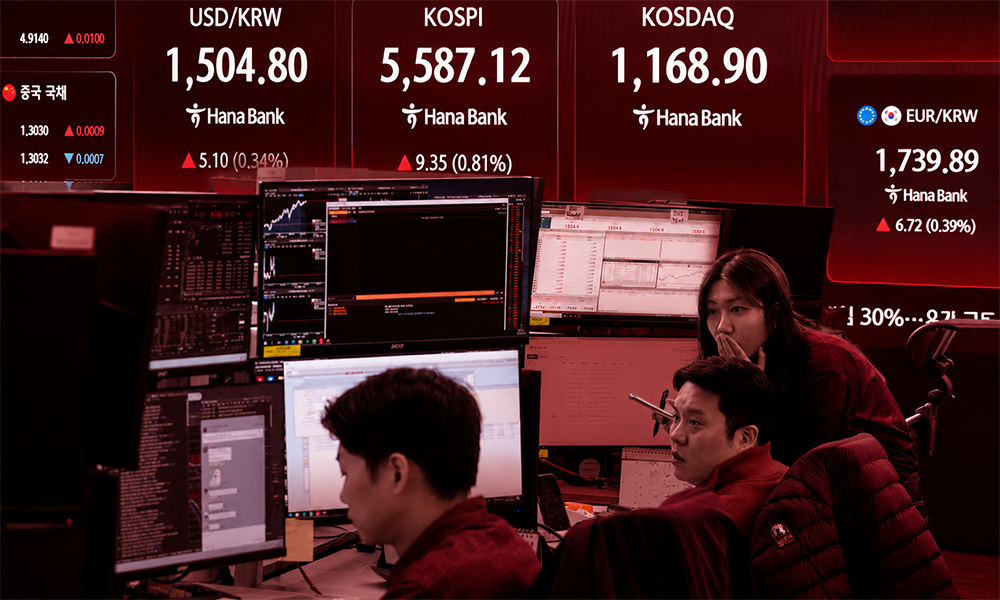
| Index / Asset | Close | Change |
| Dow Jones Industrial Average | 52,348.39 | 576.76 pts / –1.09% |
| S&P 500 | 7,482.71 | 0.28% |
| Nasdaq Composite | 25,870.65 | +0.20% |
| Brent Crude (futures) | $78.19/bbl | +5.43% |
| West Texas Intermediate | $73.52/bbl | +4.37% |
| S&P 500 Materials Sector | — | ~3% (worst sector, biggest loss in over a year) |
| Stoxx 600 (Europe) | — | ~2% |
| FTSE 100 (UK) | 10,489.04 | 1.66% |
| DAX (Germany) | — | 2%+ |
| CAC 40 (France) | — | 2%+ |
| Gold Futures | $4,086.60 | 1.70% |
| 10-Year US Treasury Yield | 4.535% | Higher on inflation pricing |
| Dollar Index (DXY) | 100.88 | 0.14% |
Key Market Data: Thursday July 9 Recovery
| Index / Asset | Close | Change |
| Dow Jones Industrial Average | 52,487.41 | +139.02 pts / +0.27% |
| S&P 500 | 7,543.64 | +0.81% |
| Nasdaq Composite | 26,206.89 | +1.30% |
| VanEck Semiconductor ETF (SMH) | — | +2.5% |
| Micron Technology | — | +4.5% |
| Sandisk | — | +7.6% |
| Stoxx 600 (Europe) | — | +0.8% |
| Nikkei 225 (Japan) | — | +1.4% |
| Kospi (South Korea) | — | +0.62% |
| Gold | $4,121.12 | +1.1% |
What Triggered the Sell-Off
The catalyst was a single press conference in Ankara.
Speaking at the NATO summit on Wednesday morning, President Trump said the US-Iran ceasefire was finished. “For me, I think it’s over,” he told reporters. “It’s just a waste of time dealing with them.” He later threatened to “hit them hard tonight,” and US Central Command confirmed a fresh wave of strikes on Iran overnight described as an “immediate response” to Iran’s attacks on three commercial vessels in the Strait of Hormuz.
Iran’s military said it launched retaliatory strikes targeting 85 US military sites in Kuwait and Bahrain. The US Treasury Department revoked its authorization for Iranian oil sales the same day.
Markets responded in a textbook risk-off pattern. Energy stocks surged. Materials sold off hardest the S&P 500 materials sector fell close to 3% in its biggest single-day decline in more than a year. Technology was split: initial selling in the XLK ETF gave way to selective resilience in semiconductors by Thursday.
The oil move was the single most significant market signal. Brent crude climbing more than 6% in a single session pushing to around $79 a barrel revived concerns about energy-driven inflation at precisely the moment the Federal Reserve is weighing whether to hike rates.
The Oil Dimension: Supply Risk and the Strait of Hormuz
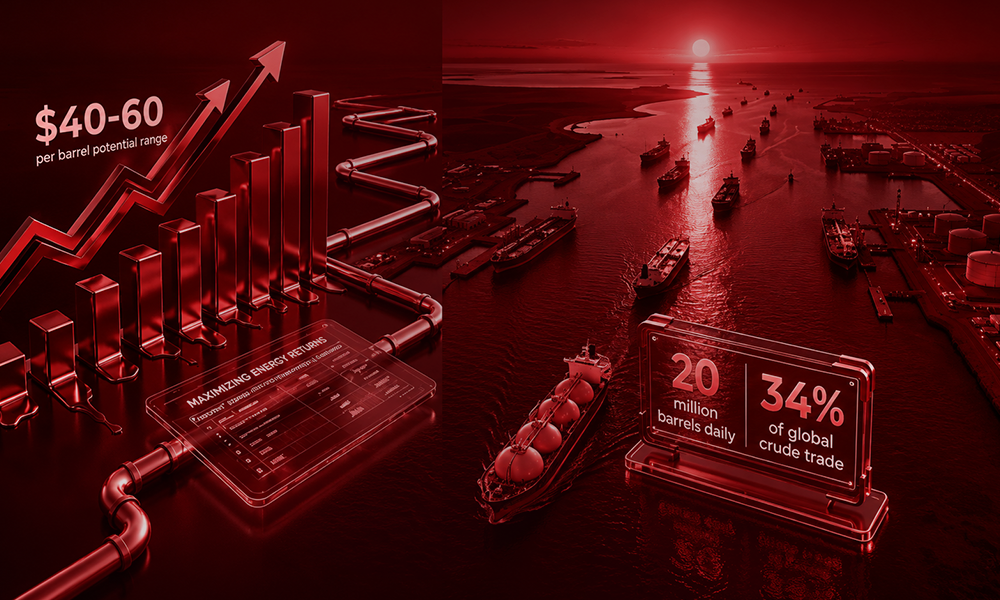
The Strait of Hormuz is the world’s most important oil transit chokepoint. Approximately 20% of global petroleum liquids and a larger share of liquefied natural gas pass through the strait. Any sustained disruption to shipping there generates immediate upward pressure on global energy prices.
Iran’s targeting of three commercial vessels this week is the latest in a pattern of maritime incidents that has already pushed Brent crude from around $60 per barrel earlier this year to a high of $118 at the conflict’s peak, before pulling back to the $70–$75 range during the ceasefire period.
The disruption is also affecting shipping activity more broadly. According to Reuters reporting this week, shipping activity through the Strait of Hormuz has “once again ebbed” following the resumption of hostilities meaning the re-routing costs and insurance premiums that had begun to normalize are rising again.
Oil prices pulled back from Wednesday’s highs on Thursday after New York Fed President John Williams said he did not expect a sustained rise in energy prices for the rest of the year. But Williams also declined to comment on what rate decision he would make later this month a deliberate ambiguity that markets read as hawkish.
The Federal Reserve: Inflation Pressure Compounds
Wednesday’s escalation didn’t just move oil. It moved Fed expectations significantly.
June FOMC minutes the first released under new Federal Reserve Chair Kevin Warsh were published Wednesday and showed growing internal concern about inflation. The minutes indicated that upside inflation risks remain elevated while labor market concerns have eased. Critically, analysts noted that inflationary pressures are “not necessarily limited to energy” cost increases are beginning to show up in electronics and other sectors.
Markets have now priced the implied probability of a Fed rate hike in 2026 at approximately 87%, according to CME FedWatch a sharp jump from where that probability stood before Wednesday’s events.
“It’s highly inflationary and highly uncertain,” said Megan Horneman, chief investment officer at Verdence Capital Advisors. “It could end tomorrow. It could turn into a bigger event. We don’t know that.”
Horneman added that equities at current levels may not be “pricing in the possibility of at least one interest rate hike from the Federal Reserve in the second half of 2026.” Given that markets spent much of the first half of the year pricing in cuts not hikes that reassessment carries significant implications for equity valuations.
The widely tracked analyst estimate for June CPI, due next week, is that headline inflation will remain “uncomfortably high at around 4% year-over-year,” per Phillips Investment Group. Sharp energy price reductions in June may have kept a lid on the monthly number but the year-on-year figure will reflect earlier price surges.
Sectors: Winners and Losers
Energy: The clear winner on Wednesday. The XLE ETF, which tracks the S&P 500 energy sector, jumped more than 2% in premarket and held gains through the session. Diamondback Energy, Occidental Petroleum, and Valero Energy led gains. The Stoxx 600 Oil and Gas Index was the only European sector to end higher on Wednesday, advancing 1.9%.
Materials: The clear loser. Close to 3% decline on Wednesday the biggest single-day loss in more than a year. Materials stocks are sensitive to both energy cost inflation and global growth expectations, and the combination hit the sector hard.
Technology: Mixed. Initial selling in the XLK ETF Sandisk down 4%, Micron down 4% reversed sharply on Thursday. The Philadelphia SE Semiconductor index posted a second consecutive day of gains Thursday, rising 3%. The catalyst was two AI-related reports: China may allow domestic AI firms limited access to Nvidia’s H200 chips, and SK Hynix’s forthcoming $28 billion US share listing was more than seven times oversubscribed. SK Hynix intends to price its American Depositary Receipts at $149, raising approximately $26.5 billion set to be the world’s second-largest share sale after SpaceX’s record $85.7 billion IPO last month.
Financials: Defensive positioning. Treasury yields ticked higher on inflation pricing the 10-year US Treasury yield reached 4.535% on Wednesday which creates revenue tailwinds for banks but headwinds for bond portfolios.
Gold: Fell Wednesday (–1.70% to $4,086.60) as investors sold the safe haven to cover equity losses. Recovered Thursday (+1.1% to $4,121.12) as oil eased and sentiment stabilized.
Global Markets: Asia and Europe
Europe: The pan-European Stoxx 600 bore the brunt of the Wednesday sell-off, closing nearly 2% lower. Germany’s DAX and France’s CAC 40 fell more than 2%. The UK’s FTSE 100 declined 1.66% to 10,489.04. By Thursday, European stocks bounced the Stoxx 600 closing up 0.8% as investors monitored the situation and rotated back into technology and growth stocks.
Asia: Asia-Pacific markets opened lower Wednesday on the back of the US sell-off and rising tensions. Japan’s Nikkei 225 fell 0.55%, South Korea’s Kospi fell 0.72%, Australia’s ASX 200 dropped 1.36%. By Thursday’s close after Wall Street had already staged a partial recovery the Nikkei 225 closed 1.4% higher and the Kospi rose 0.62%. China’s CSI 300 climbed 2.5% on the Nvidia chip access report. Hong Kong’s Hang Seng index remained weak, falling 0.7%.
Currencies: The dollar index fell 0.14% to 100.88 on Wednesday, continuing a trend of gradual dollar softening. The British pound strengthened to $1.3392, reaching four-week highs after striking a seven-month low in late June. Currency markets overall were relatively muted the oil and equity moves captured investor attention more than FX.
Analyst Reaction: “On-Again, Off-Again” Volatility
The dominant analyst theme coming out of Wednesday is not that this event is uniquely surprising it’s that markets may be developing a fatigue problem.
“Investors may be a bit immune to an on-again, off-again dynamic of the conflict,” said Megan Horneman of Verdence. This is a notable concern: if markets partially discount each new escalation because they’ve seen several already, they may be inadequately pricing a genuine supply shock or significant escalation.
The economist at Phillips Investment Group framed the broader concern precisely: the FOMC minutes “demonstrated the Fed’s hawkish bias, highlighting that upside inflation risks remain while concerns around the labor market have eased. While oil prices are still below where they stood at the time of the mid-June meeting, renewed tensions in the Middle East underscore how fragile the backdrop remains.”
The macro picture heading into next week is genuinely complex. Headline CPI for June lands in the next few days, and the Fed’s July meeting is approaching. The base case as of Friday is that the Fed hikes. Whether the market is fully positioned for that is the open question.
Broader Economic Context: The 2026 Iran Conflict’s Market Footprint
Wednesday’s session didn’t happen in a vacuum. The US-Iran conflict has been generating market disruption since early 2026. Brent crude reached $118 per barrel at the conflict’s peak before pulling back during the ceasefire period. The US Treasury Department previously revoked Iranian oil export authorizations. Travel and tourism in the eastern Mediterranean has been disrupted, with the World Travel and Tourism Council estimating losses of approximately $600 million per day at the conflict’s height.
Shipping rerouting away from the Strait of Hormuz has added logistics costs globally. Several LNG-producing countries in the Middle East have faced disruption. The conflict has fed into a broader inflation problem in the US that was already elevated heading into the year and the Wednesday session suggests markets are recalibrating how durably high energy prices may stay.
What to Watch Next Week
June CPI (US): The most important data print of the coming week. Year-on-year headline inflation is expected to remain around 4%. The monthly reading may be softer due to June energy price declines but the comparison base and Iran-related volatility will dominate the narrative.
Fed communications: New Fed Chair Kevin Warsh’s FOMC minutes signaled hawkish intent. Any additional Fed speakers this week will be closely watched for signals on the July rate decision. Market implied probability of a hike is now 87%.
Strait of Hormuz shipping: The most important real-time indicator of how oil markets move from here. If shipping activity remains constrained, oil stays elevated and the inflation impulse continues. If activity normalizes, the Wednesday spike begins to reverse.
SK Hynix US listing pricing: Set to price at $149/share, raising ~$26.5 billion. The world’s second-largest share sale after SpaceX’s $85.7 billion IPO has been more than seven times oversubscribed, and its pricing will be a significant test of institutional appetite for large equity issuance in the current macro environment.
Iran-US diplomatic signals: Trump said Wednesday negotiations were a “waste of time.” But he said similar things before previous ceasefire agreements. Diplomatic channels remain the most direct route to oil price normalization and any softening in rhetoric over the weekend could shift markets sharply on Monday open.
FAQs
Why did stocks fall on July 8, 2026?
President Trump declared the US-Iran ceasefire “over” at the NATO summit in Ankara, triggering a broad risk-off selloff. The Dow fell 576 points, Brent crude surged over 5%, and European markets fell nearly 2%.
How much did oil rise on the Middle East escalation?
Brent crude surged 5.43% to $78.19 per barrel on Wednesday July 8. WTI rose 4.37% to $73.52. Brent had briefly traded as high as $79 intraday.
Why did the Nasdaq hold up better than the Dow?
Technology stocks were more resilient due to AI-related tailwinds particularly news that China may allow access to Nvidia H200 chips and SK Hynix’s oversubscribed US listing. By Thursday the Nasdaq was up 1.3%.
What is the current probability of a Fed rate hike?
As of July 9, CME FedWatch showed the implied probability of a Fed hike in 2026 at approximately 87% up sharply following the FOMC minutes and oil price surge.
What happened to gold during the sell-off?
Gold fell 1.7% on Wednesday to $4,086.60 as investors sold the safe haven to cover losses. It recovered 1.1% on Thursday to $4,121.12 as oil eased and equity sentiment stabilized.
What is the Strait of Hormuz and why does it matter for oil markets?
The Strait of Hormuz is the world’s most critical oil transit chokepoint, through which approximately 20% of global petroleum liquids pass. Iran’s attacks on commercial shipping there directly threaten oil supply and push prices higher.