

A pun is one sentence. It means two things at once. That’s the whole game.
Simple to describe, endlessly varied in practice, and responsible for some of the best and worst moments in the English language. This guide covers everything: the precise definition, all the major types, examples from literature and everyday life, how puns differ from related figures of speech, and how to write your own.
AI Overview
A pun is the humorous use of a word or sometimes two words that sound alike in a way that suggests two or more meanings simultaneously. The result is a single expression that carries double meaning: one intended, one implied, both present at the same time. Merriam-Webster defines it as “the usually humorous use of a word in such a way as to suggest two or more of its meanings or the meaning of another word similar in sound.”
Puns are classified as a figure of speech and a form of wordplay. They appear across comedy, literature, advertising, journalism, everyday conversation, and children’s jokes. They are among the oldest and most universal forms of humor in the English language and in virtually every other language that has enough vocabulary to generate double meanings.
The word “pun” first appeared in English in 1644. Its etymology likely traces to the Italian word puntiglio, meaning “fine point” or “quibble.”
Key Takeaways
| # | Point | Detail |
| 1 | Definition | Humorous use of a word to suggest two or more meanings |
| 2 | Also called | Paronomasia (formal/literary term) |
| 3 | Classification | Figure of speech; form of wordplay |
| 4 | First used in English | 1644 |
| 5 | Etymology | Likely from Italian puntiglio (fine point, quibble) |
| 6 | Main types | Homophonic, homographic, compound, visual, recursive |
| 7 | Used in | Comedy, literature, advertising, journalism, everyday speech |
| 8 | Key mechanism | Double meaning — one surface meaning, one implied meaning |
| 9 | Pun vs joke | A joke is a full narrative with a setup and punchline; a pun is a single expression with dual meaning |
| 10 | Pun vs metaphor | A metaphor substitutes one thing for another; a pun exploits double meaning within one word or phrase |
What Is a Pun? The Full Definition
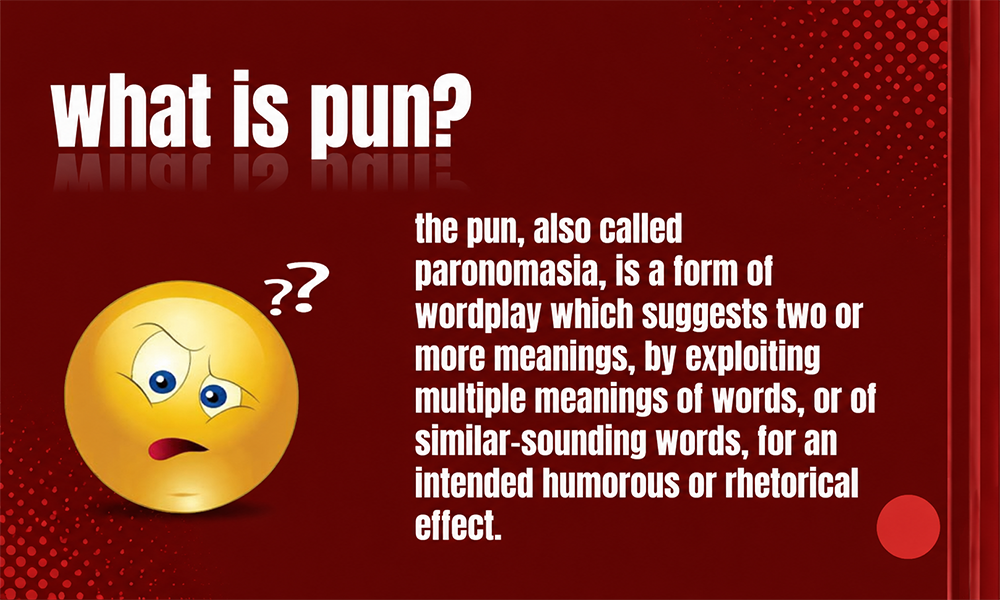
A pun is a form of wordplay in which a word, phrase, or sound is used in a way that activates two meanings at once. One meaning is what the sentence appears to say. The other meaning is what the sentence also implies. The humor or in some cases, the literary effect comes from the collision between both meanings in the mind of the reader or listener.
The formal literary term for a pun is paronomasia, from the Greek para (beside) and onomazein (to name). Paronomasia has been studied as a rhetorical device since ancient Greece and appears in texts dating back thousands of years.
The Merriam-Webster definition is the most widely cited: “the usually humorous use of a word in such a way as to suggest two or more of its meanings or the meaning of another word similar in sound.”
Three things are worth noting in that definition:
“Usually humorous” — puns don’t have to be funny. In serious literature, puns create irony, depth, and ambiguity. Shakespeare used them in tragedies as much as comedies. The humorous use is the most common, but not the only application.
“A word” — technically a pun involves language, not just concepts. The dual meaning has to be carried by the actual words used, not inferred from context alone.
“Similar in sound” — this covers homophonic puns, where two different words that sound alike are played off each other. But puns also work when one word has multiple distinct meanings no sound-alike needed.
Types of Puns
Puns are not a single device. They come in several distinct types, each operating through a different mechanism.
1. Homophonic Puns
A homophonic pun uses two words that sound the same (or very similar) but have different meanings and different spellings. The humor depends on the listener hearing both words simultaneously.
How they work: The speaker uses word A, but the context makes the listener think of word B — or both at once.
Examples:
- “Why did the bicycle fall over? Because it was two-tired.” (Two-tired sounds like “too tired.”)
- “I used to be a banker, but I lost interest.” (Interest = financial interest / personal interest.)
- “Time flies like an arrow. Fruit flies like a banana.” (Flies = moves quickly / a type of insect. Like = as something does / enjoying something.)
- “I’m reading a book about anti-gravity. It’s impossible to put down.”
2. Homographic Puns (or Homonymic Puns)
A homographic pun uses a single word that has two or more distinct meanings the same spelling, the same pronunciation, but different definitions. These puns work on the page as much as they do out loud.
How they work: The word appears once but activates two definitions at the same time.
Examples:
- “The short fortune-teller who escaped from prison was a small medium at large.” (Medium = psychic / size category. Large = at large / size category.)
- “She had a photographic memory but never developed it.” (Developed = practiced a skill / developed film in a darkroom.)
- “I’m on a seafood diet. I see food and I eat it.” (See food / seafood.)
3. Compound Puns
A compound pun strings two or more puns together in a single sentence or exchange. These are structurally more complex and usually require more setup, but the payoff is proportionally larger.
How they work: Two wordplay mechanisms fire in sequence, creating a compounding comedic effect.
Examples:
- “A bicycle can’t stand on its own because it is two-tired. That’s why they’re always looking for a spoke-sperson.”
- “I used to hate facial hair, but then it grew on me.”
- “Did you hear about the man who fell into an upholstery machine? He’s fully recovered.”
4. Visual Puns
A visual pun represents wordplay through an image rather than (or in addition to) language. The image depicts the literal meaning of a word or phrase while the context implies the figurative or alternative meaning. Visual puns appear in logos, advertising, cartoons, and graphic design.
How they work: The eye sees one thing; the brain simultaneously interprets another meaning.
Examples:
- A logo for a flooring company that shows a “hardwood” tree the image is literal (a tree), the meaning is figurative (hardwood flooring).
- The famous “Pardon My Garden” sign showing a winding path (pardon = excuse my path).
- Any graphic that illustrates an idiom literally while meaning it figuratively.
5. Recursive Puns (or Self-Referential Puns)
A recursive pun refers back to itself — the pun is about punning, or uses its own structure as part of the joke.
Examples:
- “I tried to write a pun about clocks but it was too time-consuming.”
- “A pun about stairs is a step in the right direction.”
- “I used to write puns about cheese, but I brie-lieve I’ve moved on.”
6. Tom Swifties
A Tom Swiftie is a specific type of pun where an adverb in a dialogue attribution comments ironically on the content of the speech. Named after the fictional character Tom Swift, whose stories featured colorful adverbs throughout.
How they work: The adverb following “he said” or “she said” relates directly (and humorously) to what was said.
Examples:
- “I’ve lost my balance,” Tom said tipsily.
- “I work at a cemetery,” she said gravely.
- “I can’t find my violin,” he said violently.
- “Pass me the shellfish,” she said crabbily.
Pun Examples in Literature
Puns are not just for jokes. Some of the most celebrated writers in English have used them intentionally and with considerable craft.
Shakespeare
William Shakespeare is the undisputed master of the literary pun. His works contain hundreds of deliberate wordplays, ranging from bawdy double entendres to philosophical ambiguities.
In Romeo and Juliet, the dying Mercutio says: “Ask for me tomorrow and you shall find me a grave man.” Grave = serious (as in dignified) / grave (a burial plot). The joke acknowledges his own death. Shakespeare makes Mercutio pun on his deathbed.
In Hamlet, when Claudius calls Hamlet his “son,” Hamlet responds: “A little more than kin, and less than kind.” The word “kind” activates at least two meanings: natural/appropriate, and gentle/affectionate. He is saying the relationship is neither.
James Joyce
Joyce elevated the pun to a structural device. Finnegans Wake (1939) is built almost entirely on multilingual wordplay and compounded puns — a single word sometimes activating five or six meanings across several languages simultaneously. The book’s opening and closing lines famously form a single run-on sentence, completing a circular pun on the nature of wake/awake/the wake itself.
Oscar Wilde
Wilde’s wit was built on puns and epigrams. In The Importance of Being Earnest, the name “Earnest” is punned against “earnest” (sincere) throughout the entire play. The title itself is a pun.
Charles Dickens
Dickens named his characters as a form of pun Mr. Bumble (officious and pompous), Uriah Heep (creeping, obsequious), Wackford Squeers (squeezed, wretched). The names describe the characters through wordplay.
Simple Pun Examples (Everyday Use)
These are the puns most people encounter in daily life — the kind that provoke a groan, a laugh, or both.
On occupations:
- “I used to be a banker, but I lost interest.”
- “The pastry chef was on a roll.”
- “I’m a barber. I’ll cut right to the point.”
On animals:
- “A fish with no eyes is called a fsh.”
- “The dog trainer was very pawsitive about the results.”
- “I’d tell you a turtle joke, but I don’t want to shell out.”
On food:
- “That chef is really on a roll.”
- “I’m reading a book about eggs. It’s a real page-broiler.”
- “Lettuce celebrate. I’m on a roll and things are really picking up.”
On time:
- “I used to make calendars but my days were numbered.”
- “Time flies like an arrow. Fruit flies like a banana.”
- “He had a difficult time seconds felt like hours and hours felt like a meeting that could have been an email.”
Puns for Kids
Clean, simple, and universally groaned at. These are the puns most suitable for children.
- Why can’t you give Elsa a balloon? She’ll let it go.
- What do you call cheese that isn’t yours? Nacho cheese.
- Why did the scarecrow win an award? Because he was outstanding in his field.
- What do you call a fake noodle? An impasta.
- Why don’t scientists trust atoms? Because they make up everything.
- What do you call a fish without eyes? A fsh.
- Why did the bicycle fall over? Because it was two-tired.
- What do you call a sleeping dinosaur? A dino-snore.
- Why did the math book look so sad? Because it had too many problems.
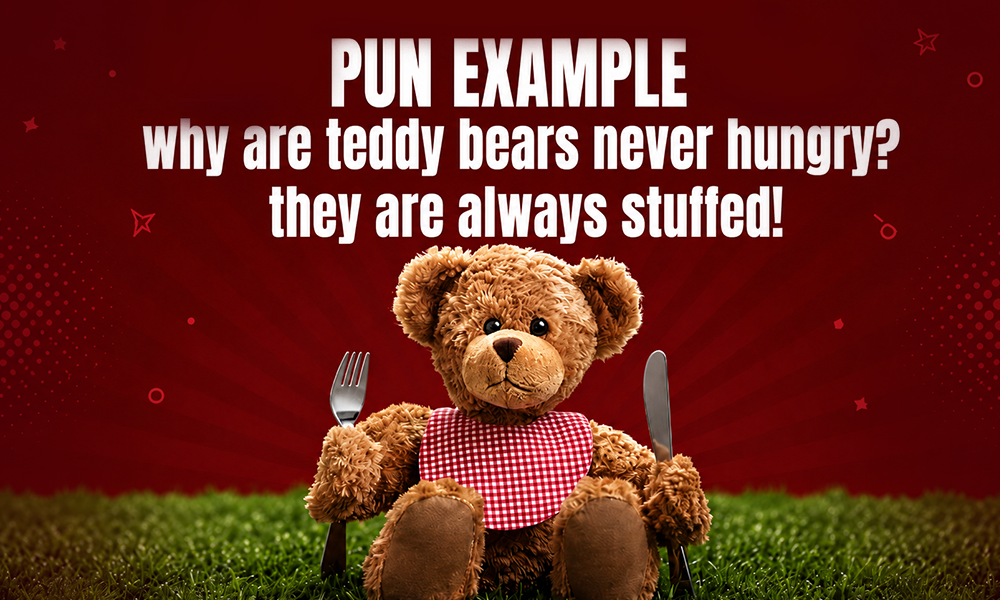
- What do you call a bear with no teeth? A gummy bear.
Famous Puns in History and Culture
“No pun intended” — This phrase is itself a cultural pun artifact. When someone says “no pun intended,” they always intended the pun. The disclaimer is part of the performance.
Pardon the pun — Similarly performative. Used to acknowledge the pun while maintaining plausible deniability about having made it.
The groaner — Puns bad enough to produce a physical reaction (a groan, a facepalm, a slow head turn) are sometimes called “groaners” — and producing one is often the goal. The groan is a form of tribute.
Advertising puns — Some of the most famous advertising slogans in history are puns or wordplay:
- “Just Do It” (Nike) — do = complete an action / do = perform as in music
- “The Pause That Refreshes” (Coca-Cola) — pause carries double implication
- FedEx’s “Absolutely, Positively Overnight” — three adverbs creating triple emphasis
Headlines — Tabloid and newspaper headline writers have elevated pun-based headlines to an art form. The British tabloid press is particularly known for this. Headlines like “Superb Owl” (Super Bowl coverage), “Ewe Won’t Believe This” (sheep story), and “No Bunfight Tonight” (baker’s dispute) demonstrate the form at its most efficient.
Pun vs Joke: What’s the Difference?
A pun and a joke are related but structurally different.
A joke is a narrative structure. It has a setup (context, character, situation) and a punchline (the payoff that reframes or subverts the setup). Jokes can be long or short, but they follow a story arc.
A pun is a linguistic device. It is a single expression sometimes just one word that carries two meanings simultaneously. Puns don’t require narrative structure. They work in the moment of recognition.
Most puns can be embedded inside jokes, but not all jokes contain puns. And a pun can stand alone without any joke structure around it.
Example of a joke without a pun: “Two fish are in a tank. One says to the other: ‘How do we drive this thing?'”
Example of a pun without a joke: “Time flies like an arrow.”
Example of a pun inside a joke: “Why did the bicycle fall over? Because it was two-tired.” (The pun — two-tired / too tired — is the punchline of a short joke.)
Pun vs Metaphor: What’s the Difference?
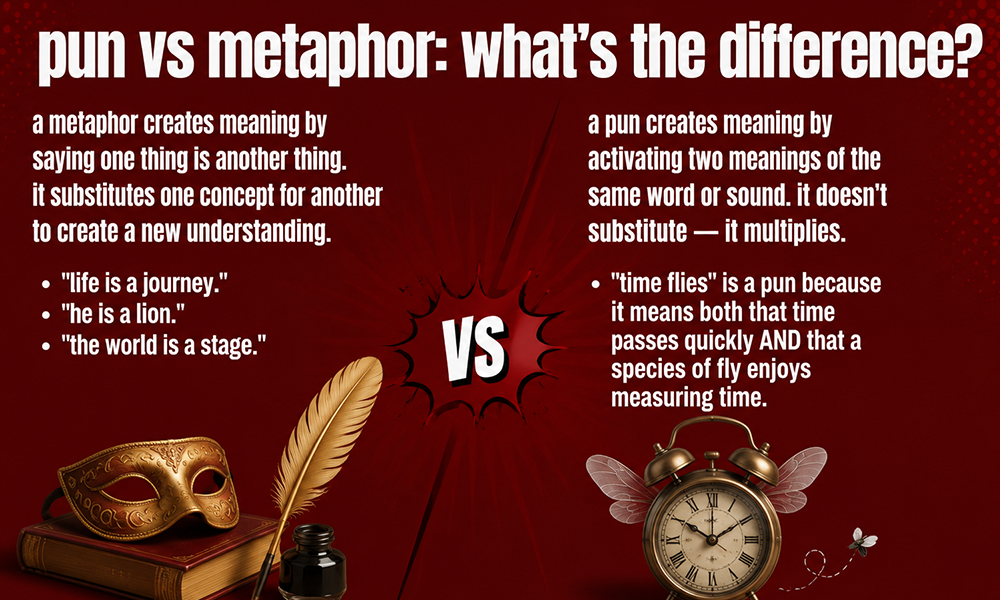
A metaphor creates meaning by saying one thing is another thing. It substitutes one concept for another to create a new understanding. “Life is a journey.” “He is a lion.” “The world is a stage.”
A pun creates meaning by activating two meanings of the same word or sound. It doesn’t substitute — it multiplies. “Time flies” is a pun because it means both that time passes quickly AND that a species of fly enjoys measuring time.
The key distinction: a metaphor replaces one meaning with another. A pun holds two meanings in suspension simultaneously.
Pun vs Idiom: What’s the Difference?
An idiom is a fixed phrase whose meaning is figurative rather than literal. “Break a leg,” “bite the bullet,” “under the weather” — these don’t mean what their words literally say. The meaning is culturally established and understood.
A pun exploits the literal meaning of words to create a second, implied meaning. It works precisely because both meanings are available — the literal and the implied.
Puns often derive their humor from treating idioms literally. If someone says “I’ve been under the weather lately,” a punster might respond: “Well, most of us live under the weather that’s where humans are.” This reactivates the literal meaning of an established idiom.
How to Write a Pun
Anyone can make a pun. The craft lies in making good ones puns that land cleanly, generate genuine surprise, and feel inevitable in retrospect. Here’s how.
Step 1: Choose Your Target Word
Start with a word that has multiple meanings or sounds like another word. Good targets include:
- Words with two clear, distinct meanings (bank, light, spring, fair, ground, pitch, bark, crane)
- Words that sound like other words (bare/bear, knight/night, flour/flower, reign/rain/rein)
- Technical or domain-specific words that also have common meanings (medical terms, musical terms, legal terms, sports vocabulary)
Step 2: Find the Double Meaning
For the word you’ve chosen, identify both meanings clearly. Write them both down. The more distinct and unrelated the two meanings, the more surprising the pun.
“Bark” can mean: a dog’s vocalization / the outer layer of a tree / to speak harshly.
That’s three meanings — already rich territory.
Step 3: Build the Context
Construct a sentence, situation, or story that sets up one meaning while delivering the other. The setup should feel natural and the secondary meaning should emerge from context rather than being forced.
Weak setup: “The dog was near a tree. It barked at the bark.” (Both meanings are telegraphed; there’s no surprise.)
Stronger setup: “The dog trainer told me my spaniel needed more nature exposure. I took her to the forest and she was absolutely riveted she didn’t say a word the whole time, just stood there staring at the tree trunks. First time she’s ever been bark-less.” (The pun lands on “bark-less” could mean no bark on trees / a dog that doesn’t bark.)
Step 4: Let the Secondary Meaning Land
The pun works best when the second meaning arrives slightly after the first when the reader/listener processes the surface meaning, then suddenly catches the second one. That moment of delayed recognition is the engine of pun humor.
Don’t explain the pun. Explanation kills it.
Step 5: Practice Brevity
The best puns are economical. Every word in the sentence should earn its place. Extra words dilute the effect and delay the payoff. The pun should be as short as it can be while maintaining clarity and surprise.
Why Do Puns Make People Groan?
The groan is the classic pun reaction and it’s psychologically interesting. Research in linguistics and humor studies suggests several overlapping explanations.
Cognitive disruption. The brain processes the first meaning of a word almost automatically. When the second meaning arrives, it creates a small cognitive “collision” the brain has to reprocess the sentence. That reprocessing is felt as a physical sensation, which often comes out as a groan or facepalm.
Predictability after the fact. Good puns feel inevitable once you’ve heard them “of course, how did I not see that?” But they were surprising in the moment. The combination of “this was so obvious” and “I didn’t see it coming” produces a distinctive reaction that is neither pure laughter nor pure frustration, but somewhere between.
Social performance. Groaning at a pun is a social ritual. It acknowledges that the pun was heard and processed, without endorsing it as genuinely funny. The groan is a tribute paid under protest.
Linguist Salvatore Attardo, in his work on the General Theory of Verbal Humor, identifies incongruity resolution as the central mechanism of humor and puns are a particularly pure form of this, where the incongruity between two meanings is both created and resolved within a single word or phrase.
FAQs
What is the definition of a pun?
A pun is the humorous use of a word to suggest two or more meanings, or to evoke another word with a similar sound. Per Merriam-Webster: “the usually humorous use of a word in such a way as to suggest two or more of its meanings or the meaning of another word similar in sound.”
What does pun mean?
A pun means exploiting a word’s double meaning for comic or literary effect. The word came into English in 1644, likely from the Italian puntiglio (fine point, quibble).
What is a pun in literature?
In literature, a pun (or paronomasia) is a deliberate double meaning used for irony, ambiguity, or humor. Shakespeare’s dying Mercutio calling himself “a grave man” is one of the most cited literary puns in English.
What is the difference between a pun and a joke?
A joke is a narrative with a setup and punchline. A pun is a single expression carrying two meanings. Puns can be embedded in jokes, but they work independently too.
What are the main types of puns?
Homophonic (sound-alike words), homographic (one word, two meanings), compound (multiple puns in one), visual (image-based), recursive (self-referential), and Tom Swifties (adverb-based).
How do you write a good pun?
Choose a word with multiple meanings or that sounds like another word. Build a sentence that sets up one meaning while delivering another. Let the secondary meaning arrive slightly after the first. Don’t explain it.
Why do puns make people groan?
Puns create a brief cognitive disruption the brain processes one meaning, then has to reprocess when the second arrives. The groan is a social reaction to that moment of recognition, acknowledging the pun was heard without fully endorsing it.
Is a pun a figure of speech?
Yes. A pun is classified as a figure of speech, specifically a type of wordplay. The formal literary term is paronomasia.