Anthropic launched Claude Sonnet 5 on June 30, 2026 and the headline isn’t just a new model. It’s a claim that you no longer need to pay Opus-level prices to get near-Opus performance on agentic work.
Here’s everything you need to know: what’s new, what it costs, how it benchmarks, and how it stacks up against GPT-5.5 and Gemini 3.5 Flash.
What Is Claude Sonnet 5?
Claude Sonnet 5 is Anthropic’s latest mid-tier AI model, positioned between the affordable Haiku models and the flagship Opus line. It replaces Claude Sonnet 4.6 as the default model across Claude’s Free and Pro plans.
Anthropic calls it the most agentic Sonnet yet one that can make plans, drive browsers and terminals, and complete complex multi-step tasks autonomously at a level that, until recently, only larger Opus-class models could handle.
Claude Sonnet 5 Features
The biggest shift in Sonnet 5 is agentic capability. Previous Sonnet models could start complex tasks. Sonnet 5 is built to finish them.
Key improvements over Sonnet 4.6:
Autonomous task execution. Sonnet 5 plans ahead, uses tools independently, and checks its own output without being prompted. Early testers noted it completes multi-step workflows that Sonnet 4.6 would stall halfway through.
Coding and debugging. Strong across the full development lifecycle planning, implementation, debugging, and refactoring across large, messy codebases. Cursor confirmed a jump from 49% to 57% on CursorBench compared to Sonnet 4.6.
Reasoning and knowledge work. On knowledge work benchmarks, Sonnet 5 actually edges past Opus 4.8 — meaning it’s not just a cheaper alternative on straightforward tasks, it genuinely outperforms the flagship on some real-world workflows.
Better safety. Sonnet 5 has a lower rate of hallucination and sycophancy than Sonnet 4.6. It refuses malicious requests more cleanly and is more resistant to prompt-injection attacks in agentic contexts.
Updated tokenizer. Sonnet 5 uses a new tokenizer (similar to the change introduced with Opus 4.7) that can map the same input to roughly 1.0–1.35× more tokens depending on content type. Worth factoring in when estimating costs.
Claude Sonnet 5 Context Window and API Access
<cite index=”31-1″>Sonnet 5 features a native 1 million token context window and is accessible via the Claude API using the model string claude-sonnet-5.</cite> It’s also the default model in Claude Code as of the same release date, and is available across all Claude plans — Free, Pro, Max, Team, and Enterprise.
Claude Sonnet 5 Pricing
Sonnet 5 launches with introductory pricing that Anthropic has designed to make the transition from Sonnet 4.6 roughly cost-neutral, despite the new tokenizer:
| Phase | Input | Output |
| Introductory (until Aug 31, 2026) | $2 per million tokens | $10 per million tokens |
| Standard (after Aug 31, 2026) | $3 per million tokens | $15 per million tokens |
The standard price of $3/$15 is identical to what Sonnet 4.6 cost meaning you get a meaningfully stronger model at the same long-term sticker price.
For comparison, Claude Opus 4.8 runs at $5 per million input tokens and $25 per million output tokens. Sonnet 5 standard pricing is roughly 60% of Opus input cost and 60% of Opus output cost a significant saving for teams running high-volume agentic pipelines.
One important note: because Sonnet 5’s tokenizer can generate up to 1.35× more tokens on the same input, your actual bill may differ from a pure per-token rate comparison. Test on your real workload before drawing conclusions.
Claude Sonnet 5 Benchmarks
Here’s how Sonnet 5 performs on the benchmarks that matter most for developers, sourced from Anthropic’s launch post and third-party evaluation platforms:
| Benchmark | Sonnet 5 | Sonnet 4.6 | Opus 4.8 |
| SWE-bench Pro (agentic coding) | 63.2% | 58.1% | 69.2% |
| OSWorld-Verified (computer use) | 81.2% | — | — |
| Terminal-Bench 2.1 | 80.4% | — | — |
| Humanity’s Last Exam (HLE) | 57.4% | — | — |
| BenchLM Overall Score | 79 | — | — |
The standout numbers: Sonnet 5 closes most of the gap with Opus 4.8 on coding (63.2% vs 69.2%), and actually exceeds it on some knowledge work tasks. <cite index=”27-1″>Anthropic frames it as “close to Opus 4.8,” not a replacement Opus 4.8 remains the pick for the hardest tasks requiring maximum accuracy.</cite>
Claude Sonnet 5 vs GPT-5.5
GPT-5.5 (OpenAI, April 2026) is the other major mid-to-upper-tier model in this space. Here’s how they compare head-to-head:
| Dimension | Claude Sonnet 5 | GPT-5.5 |
| SWE-bench Pro | 63.2% | ~58.6% |
| HLE score | 57.4% | 52.2% |
| BenchLM Overall | 79 | 78 |
| Agentic tasks (avg) | 81.8 | 81.5 |
| Knowledge tasks | GPT-5.5 leads | — |
| Standard API pricing | $3/$15 per million | Varies by tier |
<cite index=”39-1″>Claude Sonnet 5 has a meaningful edge on coding (63.2% vs 58.6% on SWE-bench Pro), and the HLE gap of 57.4% to 52.2% is the single biggest benchmark swing between the two models.</cite> GPT-5.5 hits back on knowledge-heavy tasks, so the right call depends on your workload.
For pure agentic coding throughput, Sonnet 5 leads today. For teams already deep in the OpenAI ecosystem or dependent on GPT-5.5-based tooling, switching may not justify the marginal benchmark edge.
Claude Sonnet 5 vs Gemini 3.5 Flash
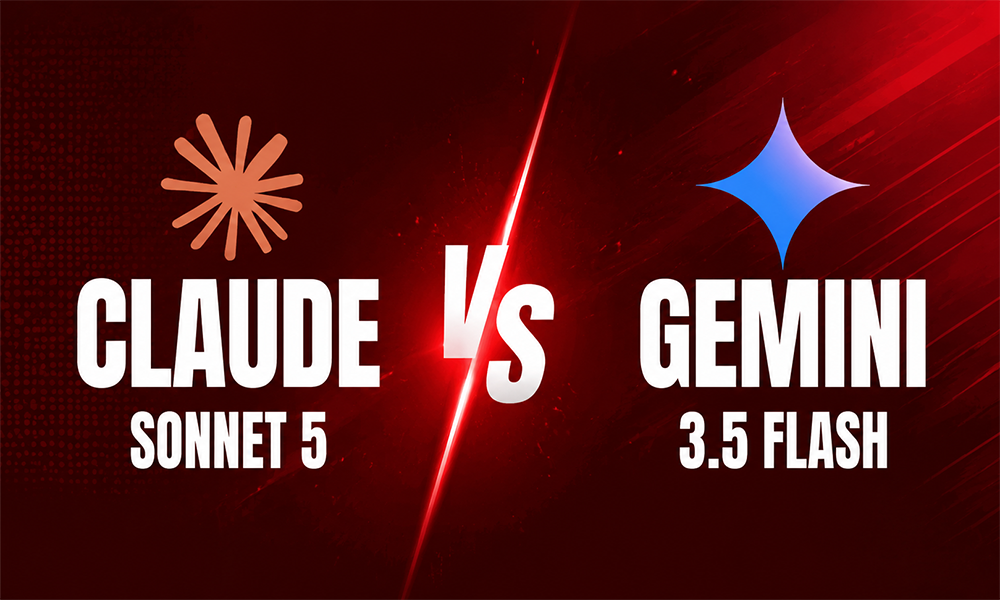
Gemini 3.5 Flash (Google, May 2026) is the other major player in the affordable-but-capable agentic model space. The comparison is more nuanced because the two models are built with different priorities:
| Dimension | Claude Sonnet 5 | Gemini 3.5 Flash |
| SWE-bench Pro | 63.2% | ~55.1% |
| Terminal-Bench 2.1 | 80.4% | 76.2% |
| OSWorld-Verified | 81.2% | — |
| MCP Atlas (tool orchestration) | No published score | 83.6% (field-leading) |
| Output speed | ~60–80 tok/s | ~289 tok/s |
| Standard API pricing | $3/$15 per million | $1.50/$9 per million |
| Context window | 1M tokens | 1M tokens |
<cite index=”40-1″>Sonnet 5 leads every coding benchmark against Gemini 3.5 Flash by 8.1 points on SWE-bench Pro, 4.2 points on Terminal-Bench, and 2.8 points on OSWorld. Gemini 3.5 Flash leads on MCP Atlas (83.6%), the benchmark most directly tied to multi-server tool orchestration, and runs approximately 4× faster.</cite>
Gemini is also significantly cheaper at standard rates half the input cost of Sonnet 5 post-August.
The bottom line: Choose Sonnet 5 if your work is coding-heavy (Claude Code, Cursor, or code-review agents). Choose Gemini 3.5 Flash if you’re orchestrating large API-call chains across multiple services, need real-time speed, or are cost-sensitive on high-volume workloads.
When to Use Claude Sonnet 5 vs Opus 4.8

Sonnet 5 is the right default for most agentic and coding work. <cite index=”24-1″>Opus 4.8 remains the model of choice for higher accuracy on the hardest tasks, while Sonnet 5 provides lower-priced options of much higher quality than what was previously available at this price point.</cite>
A practical routing strategy many teams are using in 2026: run Sonnet 5 for 80–90% of tasks, escalate to Opus 4.8 only for deep research, subtle judgment calls, or tasks where hallucination cost is high.
Who Should Use Claude Sonnet 5?
- Developers building agentic pipelines who previously needed Opus-class models for quality but couldn’t justify the cost
- Teams using Claude Code — Sonnet 5 is now the default model there
- Businesses running sustained coding, debugging, or workflow automation where multi-step follow-through is critical
- Enterprises on Pro, Max, Team, or Enterprise plans looking for a quality uplift over Sonnet 4.6 at no additional standard cost
If you’re just doing basic chat or simple summarization, the Haiku models still offer better cost-efficiency. Sonnet 5’s edge is in tasks that require real planning and multi-tool execution.
FAQs
When was Claude Sonnet 5 released?
June 30, 2026. It’s available now across all Claude plans and via the API.
What is the API model string for Claude Sonnet 5?
Use claude-sonnet-5 when calling via the Claude Platform API.
Is Claude Sonnet 5 better than GPT-5.5?
It leads on coding benchmarks (63.2% vs 58.6% on SWE-bench Pro). GPT-5.5 holds an edge on knowledge tasks.
Is Sonnet 5 replacing Opus 4.8?
No. Sonnet 5 narrows the gap but Opus 4.8 remains the flagship for the hardest, highest-accuracy tasks.
Does Claude Sonnet 5 work with Claude Code?
Yes. It’s the default model in Claude Code from launch day.