AI OVERVIEW SUMMARY
Elon Musk’s SpaceX began trading on Nasdaq on June 12, 2026, under ticker SPCX, after raising $75 billion at $135 per share. The IPO valued the rocket-and-AI company at $1.77 trillion, making it the largest IPO in history, more than double Saudi Aramco’s 2019 record.
The stock gained 19% on its first day, pushing Musk’s net worth past $1 trillion to make him the world’s first trillionaire. SpaceX combines Starlink satellite internet, Falcon and Starship rockets, and xAI artificial intelligence after a February 2026 merger.
SpaceX Just Made Elon Musk the World’s First Trillionaire
It happened on Friday, June 12, 2026.
At the opening bell on Nasdaq, SpaceX stock began trading under the ticker symbol SPCX. Within hours, the rocket-and-AI giant became one of the most valuable public companies on Earth. By the end of the first trading day, the stock had jumped 19% from its IPO price of $135 per share.
That single move did something no business event in history has done before. It pushed Elon Musk past the $1 trillion personal net worth mark, making him the world’s first trillionaire.
This was not a normal IPO. The night before trading began, SpaceX raised $75 billion by selling 555,555,555 shares at $135 each. That broke the all-time record for the largest initial public offering in history. The previous record-holder, Saudi Aramco’s 2019 listing, raised $29 billion. SpaceX more than doubled that.
The IPO valued the company at $1.77 trillion. That puts SpaceX in the same league as Apple, Microsoft, Alphabet, Amazon, and Nvidia from day one.
This guide breaks down everything that just happened: the numbers, the xAI merger that reshaped the company, the Starlink cash machine powering it all, the risks investors should know, and what comes next. Every figure here is sourced from SpaceX’s official S-1 filing or verified financial reporting.
The Headline Numbers: What Just Happened
Here is the IPO at a glance.
| Metric | Figure |
| IPO date (pricing) | June 11, 2026 |
| First day of trading | June 12, 2026 (Nasdaq, ticker SPCX) |
| Shares offered | 555,555,555 |
| IPO price per share | $135 |
| Capital raised | $75 billion |
| IPO valuation | $1.77 trillion |
| First-day gain | +19% |
| Previous record (Saudi Aramco, 2019) | $29 billion |
| Institutional oversubscription | About 2x ($10+ billion in orders) |
| 2025 revenue | $18.7 billion |
| 2025 net loss | $4.9 billion |
| 2025 adjusted EBITDA | $6.6 billion |
| Musk’s voting power post-IPO | 82.4% |
| Elon Musk net worth (after IPO) | Over $1 trillion (world’s first trillionaire) |
These are not estimates. They come straight from the company’s S-1 filing and the official IPO pricing release.
How SpaceX Got Here: From Falcon 1 to the World’s Biggest IPO
To understand why this IPO is such a big deal, you need to know the company behind it.
The Early Years (2002-2010)
Elon Musk founded SpaceX in 2002 with one main goal: make humans a multi-planet species. The company nearly failed three times in its first six years. The first three Falcon 1 rocket launches all blew up. SpaceX had enough money for one more try. The fourth launch in 2008 worked. The company survived.
Becoming the World’s Top Rocket Company (2010-2020)
Over the next decade, SpaceX rewrote the rules of spaceflight. It built the Falcon 9 rocket, which can land and be reused. It became the first private company to send astronauts to the International Space Station. By 2020, it was launching more rockets than any country on Earth.
The Starlink Era (2019-2025)
In 2019, SpaceX started launching Starlink satellites. The idea was simple: build a satellite network that beams fast internet to anywhere on Earth. By the end of 2025, Starlink had over 9 million customers across 160+ countries and territories. By February 2026, that number passed 10 million.
Starlink quickly became the cash engine of SpaceX. It now generates 61% of all company revenue.
The xAI Merger (February 2026)
In February 2026, SpaceX completed a stunning all-stock merger with xAI, Elon Musk’s artificial intelligence company. The deal valued SpaceX at about $1 trillion and xAI at $250 billion, creating a combined entity worth roughly $1.25 trillion.
This merger turned SpaceX from a pure rocket-and-internet company into a rocket-internet-AI conglomerate. Subsidiary xAI now houses two major products: the Grok chatbot and the X social media network. It also owns Colossus, one of the world’s largest AI supercomputers used for training models.
The Final Sprint to IPO (2026)
In March 2026, SpaceX filed confidential IPO paperwork with the SEC. The S-1 became public in April. In May, the company did a 5-for-1 stock split to make shares more accessible. By June 9, MSCI announced it would fast-track SpaceX into its major indexes, which guaranteed billions in passive index fund buying.
On June 11, 2026, SpaceX priced the IPO. On June 12, trading began.
Inside the S-1:
Starlink growth is staggering. From 10,000 beta users in 2021, the service hit 1 million in 2022, then 2.3 million in 2023, then 4.6 million in 2024, then 9+ million by end of 2025. By February 2026, it crossed 10 million customers across 160 countries.
This is the part of SpaceX that already works. It makes money. It grows fast. It has paying customers in nearly every country.
Segment 2: Launch (Falcon and Starship)
This is the original SpaceX. It builds rockets and launches things into space.
| Launch Segment 2025 | Figure |
| Operating result | $657 million loss |
| Starship R&D spending | $3 billion |
| Falcon launches per year | World record pace |
The launch segment posted an operating loss in 2025. The reason is simple: SpaceX is plowing billions into building Starship, its next-generation mega-rocket. Starship is what the company needs for V3 Starlink satellites, satellite-to-mobile service, and eventually orbital data centers.
Once Starship works at scale, the math changes completely. Until then, the launch segment is a strategic investment, not a profit center.
Segment 3: AI / xAI (The Big Bet)
This is the newest and most speculative part of the company. It came in through the February 2026 xAI merger.
| AI Segment 2025 | Figure |
| Revenue | $3.2 billion |
| Operating loss | $6.4 billion |
| Capex (2025) | $12.7 billion |
| Capex (Q1 2026 alone) | $7.7 billion |
| Q1 2026 capex share of total | 76% |
The AI segment is the reason SpaceX as a whole reports a loss. Strip out xAI, and the rest of the company is profitable. The xAI unit burned $6.4 billion in operating losses on $12.7 billion of capital spending in 2025.
That spending is going into Nvidia chips, data centers, and training infrastructure for Grok. SpaceX has also signed major compute deals, including a reported $1.25 billion-per-month arrangement with Anthropic and a $60 billion option to acquire Cursor (Anysphere) in April 2026.
Why This Matters for Investors
Morningstar valued SpaceX at just $780 billion based on a discounted cash flow model. That is less than half the IPO valuation of $1.77 trillion.
Why such a huge gap? Because the public market is paying for the optionality of the AI bet, not just the current financials. At $135 per share, SpaceX is trading at:
- About 94 times 2025 revenue
- About 266 times 2025 adjusted EBITDA
These are aggressive multiples. They only make senThe Three Businesses Behind the $1.77 Trillion Valuation
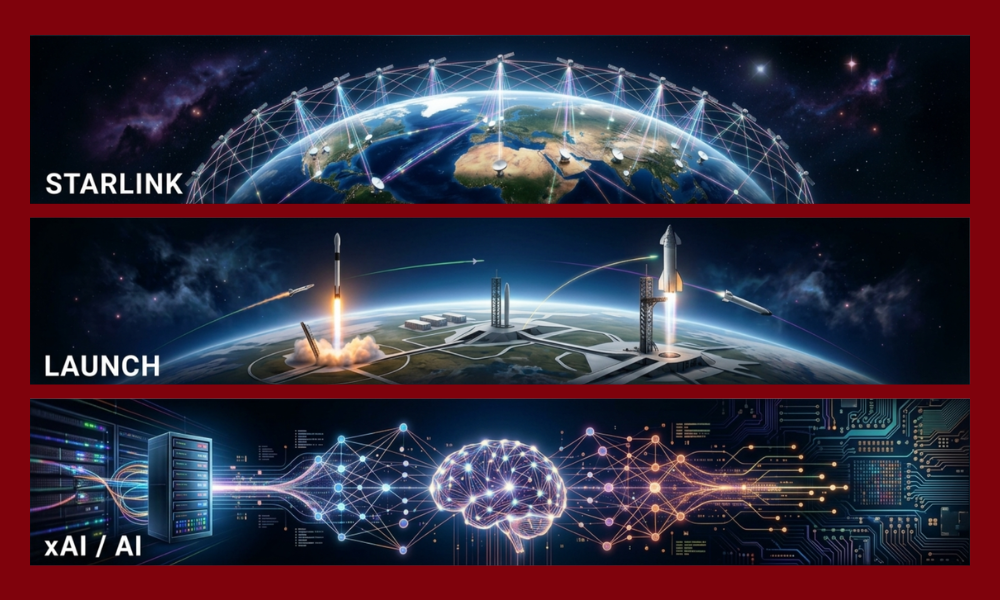
Here is what most competitor articles miss. SpaceX is not one business. It is three.
The S-1 filing breaks the company into three segments. Each has completely different financial profiles. Understanding them is the key to understanding why the IPO is both exciting and risky.
Segment 1: Starlink (The Cash Machine)
Starlink is the satellite internet business. It is the profit center.
| Starlink Metric | 2024 | 2025 |
| Revenue | $7.7 billion | $11.4 billion |
| Operating profit | Healthy | $4.4 billion |
| Active customers (year-end) | 4.6 million | 9+ million |
| Share of total SpaceX revenue | — | 61% |
| Year-over-year revenue growth | — | 48% |
se if you believe xAI becomes a top-tier AI player and Starship unlocks new businesses like orbital data centers.
Elon Musk Becomes the World’s First Trillionaire
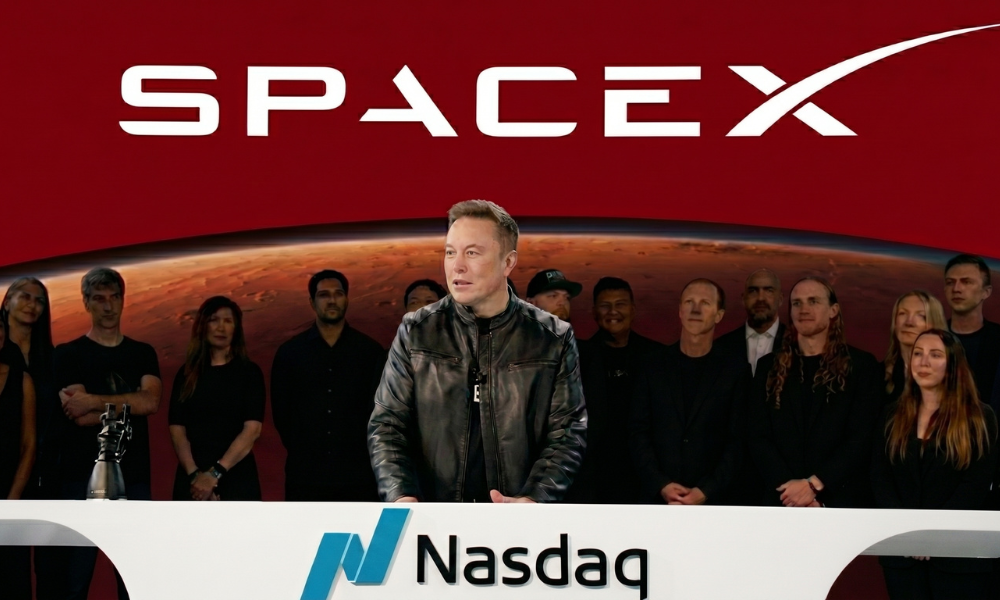
The most newsworthy outcome of the IPO is personal.
After the first day of trading, Elon Musk’s net worth crossed $1 trillion for the first time. He became the world’s first trillionaire by a wide margin.
How Musk’s Trillion Was Built
The IPO did not just raise money for SpaceX. It also crystallized the value of Musk’s huge ownership stake. Here is roughly how his wealth breaks down after June 12:
| Asset | Approximate Value |
| SpaceX stake | ~$650 billion+ |
| Tesla shares | ~$300 billion |
| X (formerly Twitter) and other | ~$50 billion |
| Cash and other investments | ~$30 billion |
| Estimated total | ~$1 trillion+ |
Musk did not sell a single share in the IPO. He took zero cash off the table. He still controls 82.4% of the voting power at SpaceX through a dual-class share structure. That means even though public investors now own shares, Musk still personally controls every major strategic decision.
Why the Trillion Mark Matters
The trillion-dollar net worth is a historic first. No human being has ever held that much wealth before. For context:
- Jeff Bezos peaked at around $250 billion
- Bernard Arnault peaked at around $230 billion
- Musk himself sat at around $400 billion before the IPO
The IPO more than doubled his pre-IPO wealth in a single day. The combined market capitalization of SpaceX and the rest of Musk’s portfolio now exceeds the GDP of most countries.
The IPO Process: How $75 Billion Got Raised
The mechanics of the IPO matter for anyone who wants to understand market history.
The Pricing (June 11, 2026)
SpaceX priced the IPO above its expected range. Early estimates put the offering at $25 to $50 billion. The final raise of $75 billion stunned even bullish analysts. It happened because demand from institutional investors was massive. The book was about twice oversubscribed, with verified institutional orders north of $10 billion just from large funds.
The Banks
Four major Wall Street banks led the offering. CFO Bret Johnsen had been meeting with private investors since December 2025 to prepare existing shareholders and select banking partners.
The Index Inclusion
On June 9, 2026, MSCI announced it would apply its standard fast-track treatment for the SpaceX IPO. This means SpaceX gets added to major MSCI indexes early, which forces passive index funds to buy the stock automatically. This provided structural buying support for the first 30 to 90 days of trading.
The First Day (June 12, 2026)
When trading opened on Nasdaq, demand exploded. The stock jumped 19% on its first day. Buyers of the IPO who got allocations were up 19% in a single session.
The total market value of the company at the close of the first day pushed past $2 trillion.
Why SpaceX Decided to Go Public Now
Elon Musk resisted going public for over 20 years. He often said public markets force too many short-term decisions. So why now?
There are three reasons that explain the timing.
Reason 1: xAI Needs Massive Capital
The AI arms race is brutal. xAI is competing with OpenAI, Anthropic, Google DeepMind, and Meta. All of them are spending tens of billions of dollars per year on chips, data centers, and talent.
xAI alone burned $6.4 billion in operating losses in 2025. Q1 2026 capex was $7.7 billion. To stay in the game, SpaceX needs ongoing access to huge pools of capital. Public markets offer that in a way private rounds cannot.
Reason 2: Starlink Is Mature Enough to Anchor a Valuation
Starlink is profitable, growing, and operating at global scale. With 10 million paying customers, it gives public investors something concrete to value. Without Starlink, the company would be much harder to take public. Starlink provides the floor that makes the AI moonshot tolerable to investors.
Reason 3: Employee Liquidity
SpaceX employees have been holding stock for years. They needed a way to cash out without secondary share sales. An IPO solves this. It also helps SpaceX continue recruiting top talent with liquid equity.
The Risks: What Could Go Wrong
A balanced view of the SpaceX IPO has to include the risks. Here are the biggest ones.
Risk 1: Aggressive Valuation
At $1.77 trillion, SpaceX is priced for near-perfect execution across all three segments. Morningstar’s discounted cash flow model values the company at just $780 billion based on Starlink alone. The gap of nearly $1 trillion is pure optionality. If xAI underperforms or Starship has setbacks, that gap could close fast.
Risk 2: Musk’s Concentration of Power
Musk owns 82.4% of the voting power. The dual-class share structure means public investors have very little say. If Musk’s attention drifts to Tesla, X, his political activities, or new ventures, there is no governance mechanism to push back.
Risk 3: Starship Is Unproven
Commercial Starship operations have not happened yet. The 12th Starship test flight in May 2026 was a major milestone, but the vehicle still needs to prove it can operate reliably at commercial scale. Many of SpaceX’s biggest plans, including orbital data centers, depend on Starship working.
Risk 4: Starlink Competition
Amazon’s Project Kuiper is building a rival satellite constellation. Traditional telecom companies are also offering competing services. If Starlink’s customer growth slows or pricing power weakens, the cash engine that justifies the rest of the valuation gets hurt.
Risk 5: AI Segment Burn Rate
The xAI capex pace of $30+ billion per year is enormous. Even with $75 billion in fresh IPO cash, SpaceX has only 2 to 3 years of runway at that burn rate before needing more capital. The IPO cash will fund growth, not eliminate the need for future raises.
Risk 6: Regulatory Scrutiny
SpaceX now sits at the intersection of space, defense, telecom, and AI. Each industry has its own regulators. The combined entity faces FCC, FAA, FTC, SEC, and international scrutiny. China has already pushed back on Starlink in multiple regions.
How SpaceX Compares to the Biggest Public Companies
The IPO instantly placed SpaceX among the world’s most valuable companies. Here is the new landscape.
| Company | Market Cap (mid-June 2026) | Industry |
| Apple | ~$4.0 trillion | Consumer tech |
| Nvidia | ~$3.8 trillion | AI chips |
| Microsoft | ~$3.5 trillion | Enterprise software, AI |
| Alphabet (Google) | ~$2.4 trillion | Search, AI, cloud |
| Amazon | ~$2.3 trillion | E-commerce, cloud |
| SpaceX (SPCX) | ~$2.1 trillion | Space, internet, AI |
| Meta | ~$1.7 trillion | Social, AI |
| Saudi Aramco | ~$1.6 trillion | Oil |
| Tesla | ~$1.3 trillion | EV, energy |
SpaceX entered the public markets at a valuation higher than every other company except Apple, Nvidia, Microsoft, Alphabet, and Amazon. That is from a standing start as a private company just one day earlier.
What Comes Next: The Trio of AI Mega-IPOs
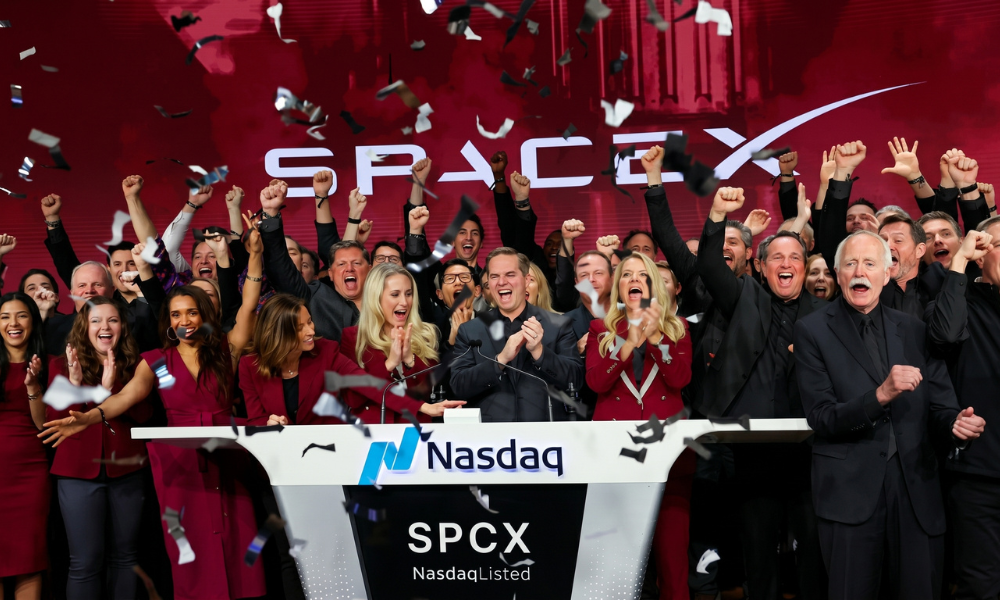
The SpaceX listing is just the first move. Two more massive AI IPOs are expected in 2026.
OpenAI is reportedly preparing an IPO at a valuation of $750 billion to $830 billion. The company that makes ChatGPT could become the next mega-listing on US markets.
Anthropic, the AI safety company behind Claude, is reportedly targeting an IPO at around $350 billion. Anthropic also signed a major compute partnership with SpaceX in 2026.
If all three IPOs happen on schedule, 2026 will be the biggest year in IPO market history. The combined fundraising could exceed $200 billion. This would mark a return of the US IPO market after a quiet period and likely trigger a wave of other big private companies considering public listings.
What This Means for Retail Investors
For everyday investors, the temptation to buy SPCX on day one is huge. But there are important things to know.
The Caution from Vanguard
Rodney Comegys, Vanguard Capital Management’s chief investment officer, warned retail buyers directly: “Investing in an IPO process can be highly speculative, and it’s really difficult to determine the path of an IPO on a given day. Anybody who’s thinking about participating in SpaceX’s IPO, to do it only in a speculative way, it is really not the best way to do long-term investing.”
Realistic Buying Options
Most retail investors cannot buy at the $135 IPO price. That allocation goes to institutional buyers. Retail investors can:
- Buy SPCX on the open market after trading begins. Prices may be significantly above IPO levels.
- Buy index funds that hold SpaceX as part of broader market exposure. MSCI inclusion means many index funds now own SPCX automatically.
- Wait for the lockup expiration. Insider shares are typically locked up for 90 to 180 days after the IPO. After lockup, prices can become volatile.
The Long-Term Question
The big question is whether $1.77 trillion is a fair entry point or an inflated peak. Bulls say it is just the beginning given the AI and space opportunity. Bears say it is priced for perfection and any stumble will hurt.
The honest answer: no one knows. The next 12 to 24 months will test whether SpaceX can deliver on the expectations baked into its IPO price.
FREQUENTLY ASKED QUESTIONS
When did SpaceX go public?
SpaceX priced its IPO on June 11, 2026, and began trading on Nasdaq on June 12, 2026, under the ticker symbol SPCX. The company sold 555,555,555 shares at $135 each, raising $75 billion and instantly becoming one of the most valuable public companies in the world.
How much did SpaceX raise in its IPO?
SpaceX raised $75 billion in its initial public offering. This is the largest IPO ever completed, more than doubling Saudi Aramco’s previous record of $29 billion set in 2019. The offering was about twice oversubscribed, with institutional investors placing more than $10 billion in verified orders.
What is the SpaceX stock symbol?
The SpaceX stock symbol is SPCX. The shares trade on the Nasdaq stock exchange. Trading began on June 12, 2026, the day after the IPO was priced. On its first day of trading, the stock rose 19% from the $135 IPO price.
Is Elon Musk a trillionaire?
Yes. Elon Musk became the world’s first trillionaire on June 12, 2026, after SpaceX began public trading. His net worth crossed $1 trillion primarily because of his SpaceX ownership stake, which is worth more than $650 billion after the IPO. Musk did not sell any shares in the IPO and retains 82.4% of voting power.
What is SpaceX valued at?
SpaceX was valued at $1.77 trillion at its IPO pricing on June 11, 2026. After the 19% first-day gain on June 12, the company’s total market capitalization briefly exceeded $2 trillion. This puts SpaceX among the most valuable companies in the world, alongside Apple, Nvidia, Microsoft, Alphabet, and Amazon.
What businesses does SpaceX own?
SpaceX operates three main business segments. Starlink is the satellite internet division with 10+ million customers in 160+ countries. The launch segment builds and flies Falcon and Starship rockets. The AI segment, added through the February 2026 xAI merger, includes Grok AI, X social media, and the Colossus supercomputer.
How much revenue does SpaceX make?
SpaceX generated $18.7 billion in revenue in 2025, up 43% from $13.1 billion in 2024. Starlink alone contributed $11.4 billion (61% of total revenue) and produced $4.4 billion in operating profit. The company posted a $4.9 billion net loss for 2025 due to heavy AI investment after the xAI merger.
Why is SpaceX losing money if Starlink is profitable?
Starlink earned $4.4 billion in operating income in 2025, but SpaceX as a whole lost $4.9 billion. The losses come almost entirely from the xAI segment, which burned $6.4 billion in operating losses on $12.7 billion of capital spending. Strip out xAI and the launch-plus-Starlink business is profitable.
What is the xAI merger?
In February 2026, SpaceX completed an all-stock merger with xAI, Elon Musk’s AI company. The deal valued SpaceX at about $1 trillion and xAI at $250 billion, creating a combined entity worth $1.25 trillion. xAI now owns Grok (an AI chatbot), X (social media), and Colossus (a major AI supercomputer).
Why did SpaceX decide to go public?
SpaceX went public for three main reasons: to fund the massive capital needs of xAI, which is spending over $30 billion per year on AI infrastructure; to provide liquidity for long-time employees; and to use Starlink’s mature, profitable business as a valuation anchor that supports the speculative AI and Starship bets.
Is SpaceX a good investment?
Analysts are divided. Bulls cite Starlink growth, Starship potential, and AI optionality. Bears note that Morningstar’s discounted cash flow model values SpaceX at just $780 billion, far below the $1.77 trillion IPO price. Vanguard’s CIO warned retail investors to treat any IPO purchase as speculative, not as long-term investing.
How does the SpaceX IPO compare to Saudi Aramco?
The SpaceX IPO raised $75 billion, more than 2.5x Saudi Aramco’s $29 billion raise from 2019. Aramco held the previous record. SpaceX’s valuation of $1.77 trillion is also higher than Aramco’s IPO valuation of $1.7 trillion, making SpaceX the largest IPO by both fundraising and valuation.
Does Musk still control SpaceX?
Yes. Despite going public, Elon Musk retains 82.4% of the voting power at SpaceX through a dual-class share structure. He is the chairman of the board and CEO. This means even though public investors now own shares, Musk personally controls all major strategic decisions about Mars colonization, AI development, and capital allocation.
What is Starlink and why does it matter?
Starlink is SpaceX’s satellite internet service. It uses thousands of low-Earth-orbit satellites to beam high-speed internet anywhere on the planet. By February 2026, Starlink had over 10 million customers in 160+ countries. It generated $11.4 billion in revenue and $4.4 billion in operating profit in 2025, making it the financial backbone of the entire company.
What other AI IPOs are expected in 2026?
Two other major AI IPOs are expected in 2026. OpenAI (the maker of ChatGPT) is reportedly preparing a public offering at a $750 billion to $830 billion valuation. Anthropic (the maker of Claude) is reportedly targeting an IPO at around $350 billion. Together with SpaceX, this trio could make 2026 the biggest year in IPO history.
SOURCES & CITATIONS
This article is based on SpaceX’s official S-1 filing, verified financial reporting, and credible business sources:
Official Filings and Statements:
- SpaceX S-1 Registration Statement filed with SEC (April 2026)
- SpaceX IPO pricing announcement (June 11, 2026)
- SpaceX official communications
IPO and Trading Coverage:
- Bloomberg (June 12, 2026): “SpaceX Prepares for Debut After $75 Billion IPO Smashes Record”
- NPR (June 11-12, 2026): “$75 billion record-breaking IPO” and first-day trading coverage
- Reuters (December 2025 forward): IPO planning and progression
- The VC Corner (May 2026): Full S-1 financial teardown and segment analysis
- TradingKey (June 10, 2026): IPO pricing analysis and S-1 financials
- Intellectia AI (June 2026): IPO analysis at $1.77T valuation
Financial Data:
- Sacra (June 2026): Revenue, segment financials, Starlink growth metrics, xAI merger details
- Morningstar: Fair value DCF analysis ($780 billion baseline)
- Admiral Markets (June 2026): SpaceX business breakdown and history
xAI Merger and AI Strategy:
- Bloomberg (February 2026): xAI all-stock merger details ($1T SpaceX, $250B xAI valuations)
- Multiple sources: Anthropic compute deal ($1.25B/month), Cursor option ($60B implied)
Net Worth and Wealth Reporting:
- Bloomberg Billionaires Index (June 2026): Trillionaire milestone
- Financial reporting across multiple outlets confirming Musk’s $1T+ net worth
All facts, figures, and dates are verifiable through SpaceX’s S-1 filing, the official IPO pricing release, and the sources listed above as of June 13, 2026.
Key Takeaways
- SpaceX began trading June 12, 2026, on Nasdaq under ticker SPCX
- Raised $75 billion at $135 per share, the largest IPO in history
- Valued at $1.77 trillion, beating Saudi Aramco’s 2019 record
- Stock jumped 19% on the first day of trading
- Elon Musk became the world’s first trillionaire
- Three segments: Starlink (profitable cash machine), Launch (Starship investment), AI (xAI burn)
- Starlink hit 10+ million customers in 160+ countries
- xAI merger added Grok, X, and Colossus to the empire
- Musk retains 82.4% voting control through dual-class shares
- Two more mega-IPOs coming in 2026: OpenAI and Anthropic