Something unusual happened when Elon University’s Imagining the Digital Future Center asked more than 300 of the world’s leading technology experts to describe what AI would mean for humanity by 2040.
They didn’t answer the question they were asked.
Most of them answered a harder one: What does it mean to still be human in a world where intelligence is no longer exclusively ours?
That question sits beneath every serious conversation about AI and the future. Not whether AI will be more powerful by 2040, it will be, by a margin that makes current systems look like calculators. Not whether it will disrupt industries, it already is. The question keeping the most thoughtful people in this field awake at night is structural.
When intelligence becomes abundant, cheap, and deployable at scale, what institutions survive? What values hold? What does identity look like when your most distinctive cognitive capacities can be performed, and often exceeded, by a machine?
These aren’t abstract philosophical questions. They are arriving as operational realities faster than most organizations, governments, or individuals are prepared to handle.
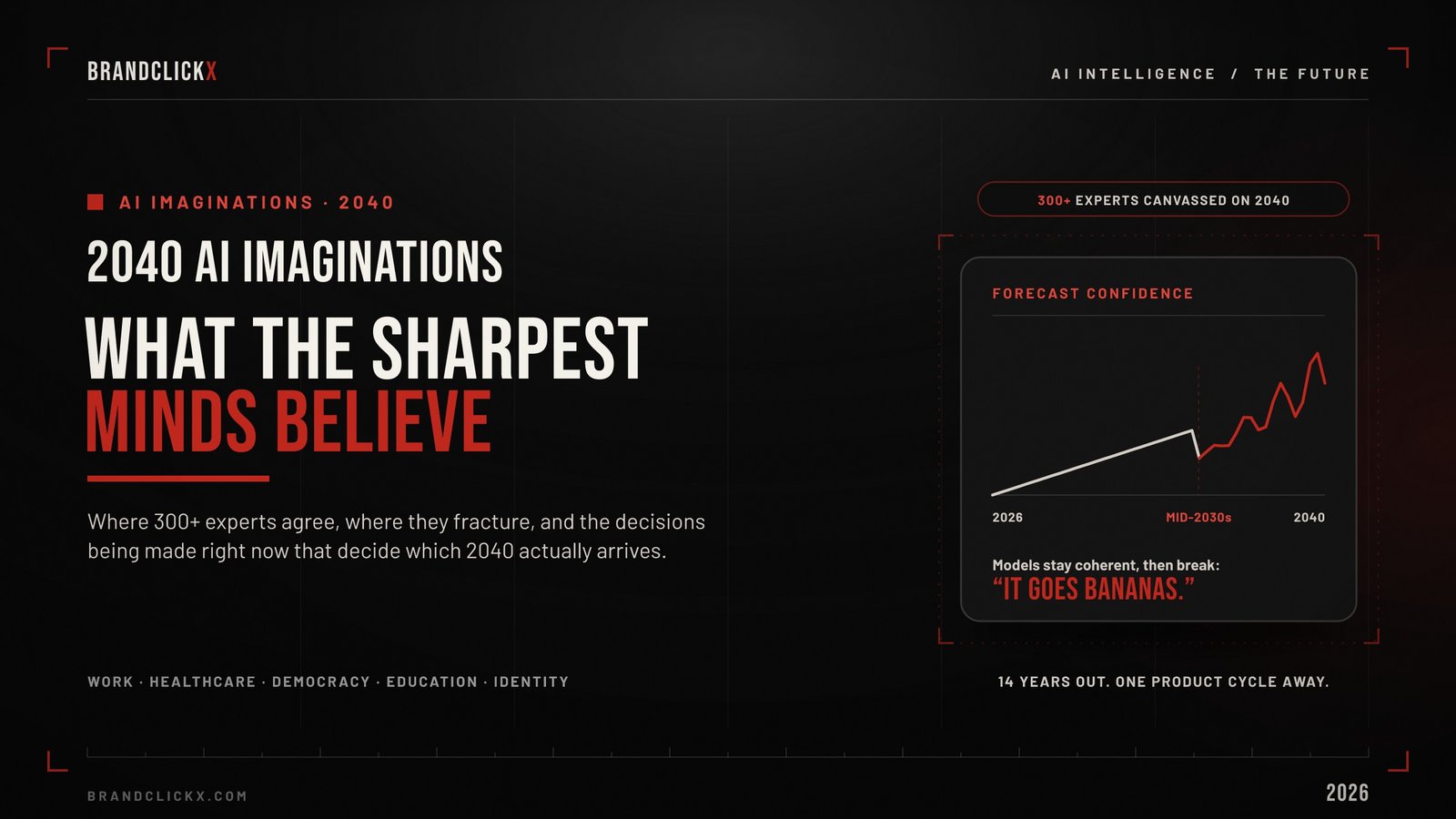
Epoch AI researchers Jaime Sevilla and Yafah Edelman, who built their careers forecasting AI progress from historical compute and training trends, were recently asked to project their models through 2040. Their response was not reassuring in the way optimists hope for. “By 2040,” Sevilla said, “we are at the point where my forecasting fails. It goes bananas.”
That phrase, it goes bananas, is not hyperbole from a careless commentator. It’s a precise technical statement from one of the field’s most rigorous quantitative analysts. His models, trained on decades of compute growth and AI capability data, lose predictive coherence somewhere in the mid-2030s. The variables compound beyond the range of reliable extrapolation.
That uncertainty isn’t a reason to stop imagining. It’s a reason to imagine more carefully.
This piece attempts exactly that, mapping the serious intellectual terrain of 2040 AI visions, identifying where expert consensus exists and where it fractures, and pinpointing the decisions being made right now that will determine which version of 2040 actually arrives.
The Imagination Problem: Why Most AI Futures Are Already Wrong
Before exploring what 2040 might hold, there’s something worth saying plainly.
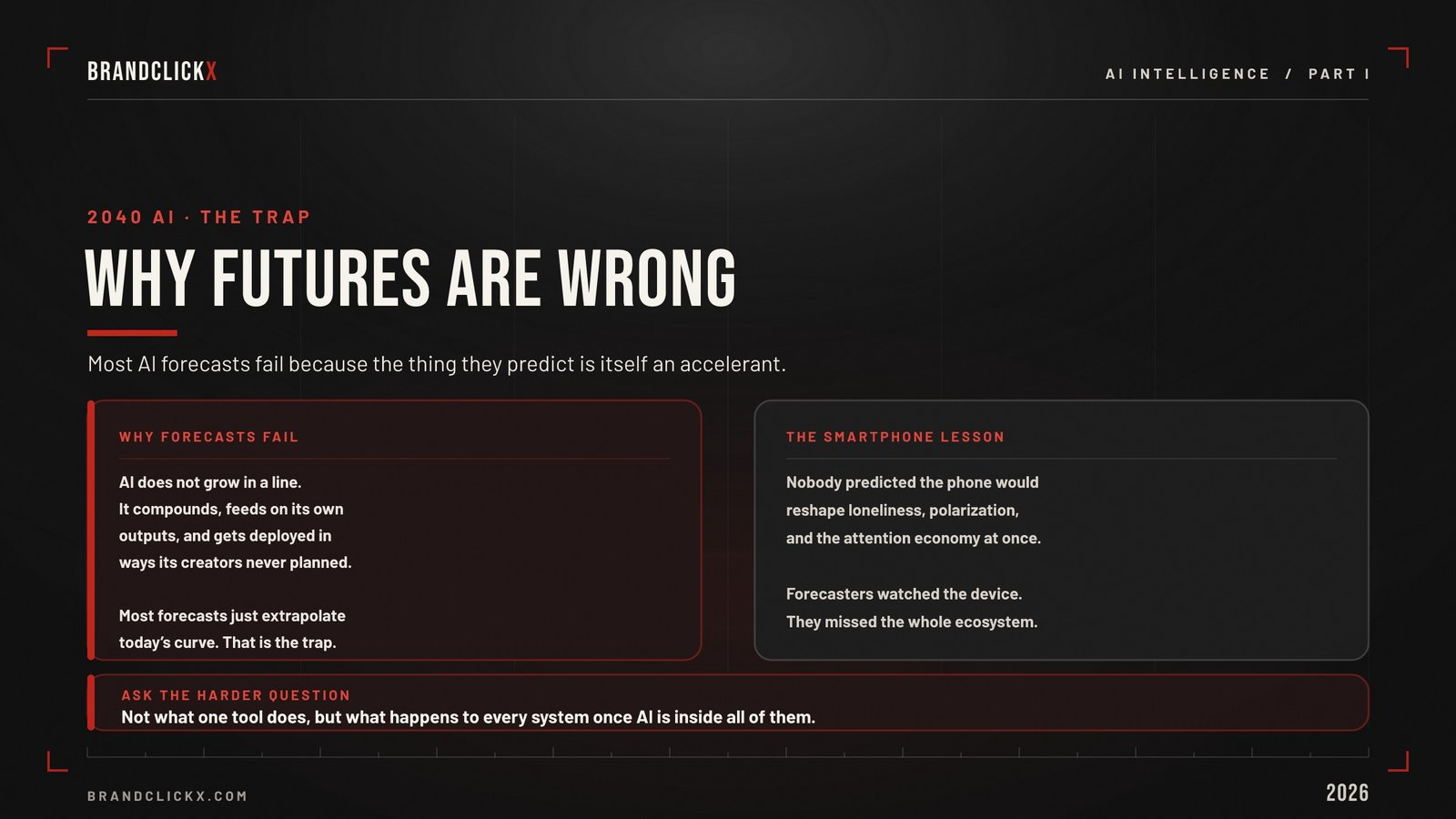
Most AI predictions are wrong. Not because the people making them are unintelligent, many are among the most rigorous researchers on the planet, but because the system being predicted is itself an accelerant. AI doesn’t grow linearly.
It compounds. It feeds on its own outputs. It gets deployed in ways its creators didn’t anticipate, into social and economic contexts already shaped by previous waves of technology.
Nobody predicted the smartphone would reshape loneliness, political polarization, and the attention economy simultaneously. The forecasters focused on the device. They missed the ecosystem.
The same trap awaits 2040 AI imaginations.
Most forecasts circulating today, from think tanks, consulting firms, policy bodies, are extrapolations of current trajectories. They ask: what happens if generative AI, autonomous agents, and robotics continue improving at roughly this pace? They’re useful starting points. They’re not complete pictures.
The harder imaginations, the ones requiring genuine intellectual discomfort, ask something different. What happens to systems when AI is embedded in all of them simultaneously? What happens to democratic governance when AI-generated persuasion reaches a quality and personalization level that makes human-authored content indistinguishable?
What happens to education when AI tutors deliver better outcomes than most teachers, but learning under a human provides irreplaceable developmental benefits? What happens to identity when people outsource not just labor, but judgment?
Those are the 2040 questions that matter. And they don’t have clean answers yet.
The Expert Divide: Where Consensus Lives and Where It Breaks Down
Most people miss this.
The public debate about AI futures tends toward two poles, utopian or dystopian, revolutionary or overhyped. The actual expert landscape is more textured.
A large-scale forecasting study from the Forecasting Research Institute, involving 69 leading economists, 52 AI industry and policy experts, 38 highly accurate forecasters, and 401 members of the general public, found something striking: economists, AI experts, and superforecasters expect AI will significantly exceed current capabilities by 2030, but economists predict that key indicators like US GDP and labor force participation will remain close to historical trends.
There’s a gap in those two sentences. Experts believe AI will be dramatically more capable. They also largely believe the macroeconomic disruption will be more gradual than the technology headlines suggest.
That gap matters enormously. It means the story of 2040 won’t necessarily be a sudden rupture. It may be something slower and more structurally insidious, a compounding shift in who has advantage, who doesn’t, and what institutions are equipped to respond.
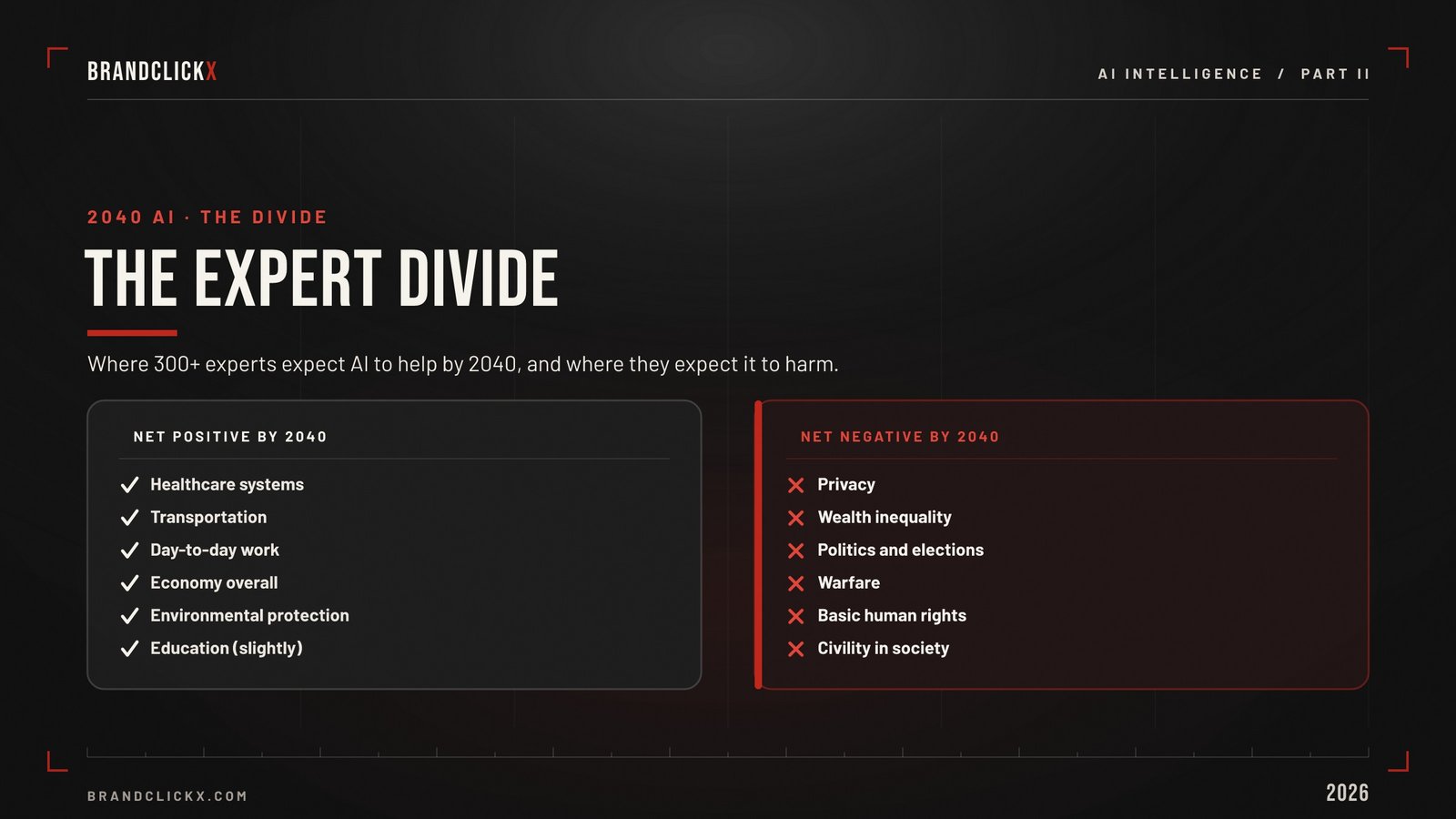
The Elon University study asked a separate question: on which domains will AI’s impact be net positive versus net negative? The answers split in a revealing pattern.
| Domain | Expert Majority View (2040) |
| Healthcare systems | Net positive |
| Transportation | Net positive |
| Day-to-day work tasks | Net positive |
| Economy overall | Net positive |
| Environmental protection | Net positive |
| Education | Slightly positive |
| Privacy | Net negative |
| Wealth inequality | Net negative |
| Politics and elections | Net negative |
| Warfare | Net negative |
| Basic human rights | Net negative |
| Civility in society | Net negative |
Source: Elon University Imagining the Digital Future Center, AI Impact by 2040 Expert Canvassing
That table tells a story most AI coverage doesn’t tell. The domains where AI helps most are technical systems and economic efficiency. The domains where it hurts most are the foundations of democratic society and human dignity.
That’s not a random distribution. It reflects something structural about how AI currently gets built, deployed, and monetized.
Five Domains Where 2040 Looks Radically Different
Work: The Augmentation vs. Displacement Debate Is Settled, the Real Question Comes Next
Here’s where things get interesting.
For years, the central public debate about AI and jobs oscillated between two poles: AI would replace most workers, or it would simply augment them while creating new roles. By 2026, the evidence leans toward the optimists, in the near term.
But the near-term and the 2040-term are not the same argument.
According to the World Economic Forum, research from the Indeed Hiring Lab finds that no job today can be fully replaced by current generative AI. Only about one-quarter of jobs are likely to be highly transformed by it, rather than eliminated. The labour market is cooling, but it is not collapsing. AI is transforming work, not eliminating it, yet.
The “yet” is where the 2040 imagination begins.
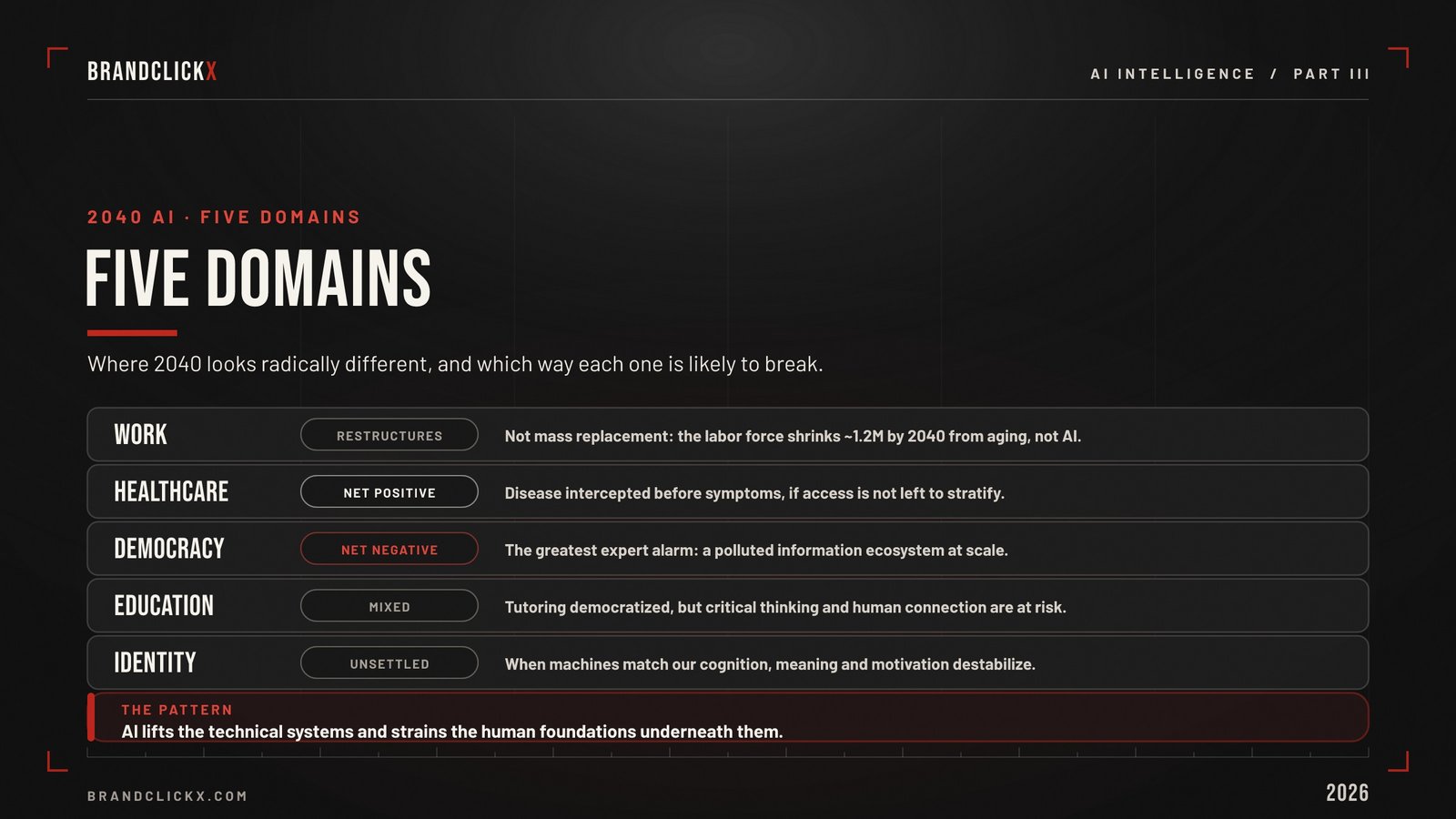
Indeed’s Hiring Lab published a major 2026 projection modeling two scenarios for the US labor market through 2040. The finding most likely to surprise people: at current immigration levels, the US labor force is projected to shrink by roughly 1.2 million workers by 2040, driven primarily by aging and retiring workers, not AI disruption.
The near-term decline is sharper still: a drop of about 5.9 million workers by 2032, with retirement and demographics accounting for the lion’s share.
In other words, demographics may do more immediate damage to labor markets over the next 15 years than AI.
What AI will do, in parallel, is determine how those markets restructure. McKinsey’s analysis estimates demand for STEM jobs will increase 23% by 2030, while the biggest future job losses occur in office support, customer service, and food services. Workers in lower-wage jobs are up to 14 times more likely to need to change occupations than those in the highest-wage positions.
By 2040, if Epoch AI’s trajectory holds, we may be living inside the consequences of a very different kind of transition, one where AI agents don’t just assist cognitive work but autonomously initiate, plan, and execute it. The augmentation era gives way to the agentic era. And the people who didn’t use the transition period to build genuine AI fluency will have significantly fewer options.
The uncomfortable reality: the workers most at risk in 2040 are not necessarily in the jobs AI most directly automates today. They’re the workers who had time to adapt and chose not to.
Healthcare: AI’s Biggest Promise, and Its Most Unresolved Question
Ask a room of AI skeptics to name one domain where they trust AI will deliver unambiguous positive value by 2040, and most will say healthcare.
The consensus is genuine, and the reasons are concrete.
AI diagnostic systems are already outperforming specialist radiologists at detecting certain cancers from imaging. Protein structure predictions, once the work of decades, are modeled in hours. Personalized treatment protocols calibrated to individual genetic profiles are moving from theoretical to operational.
McKinsey’s healthcare research envisions a future where population-level data from wearables and implants changes the understanding of human biology and how medicines work, enabling personalized, real-time treatment for all.
By 2040, AI won’t merely be a tool in the clinician’s arsenal. According to futurist forecasters tracking healthcare transformation, it will function as the central nervous system of a proactive, predictive healthcare ecosystem where disease is intercepted before symptoms appear.
For cancer patients, this means AI that identifies specific mutations driving a tumor and simulates thousands of potential drug combinations in hours, not weeks, to pinpoint the most effective, least toxic regimen.
That’s not science fiction. It’s the direction current clinical trials are already pointing.
But the conditional attached to all of this is enormous.
Healthcare AI is only as equitable as its access model. Medical innovation has always stratified, breakthroughs reach wealthy patients years or decades before they reach everyone else.
AI-powered precision medicine could widen that gap to a chasm, creating a world where the wealthy enjoy optimized longevity interventions their poorer counterparts cannot access.
This is the version of 2040 healthcare nobody puts in the brochure. Both futures, democratized health breakthroughs and radically stratified health advantage, are technically achievable. Only one requires deliberate policy intervention.
And the governance choices determining which path we take are being made in regulatory chambers, insurance boardrooms, and national health budgets right now.
Democracy, Truth, and Information: The Domain of Greatest Expert Alarm
Now for the uncomfortable reality.
On nearly every technical and economic domain, healthcare, transportation, economic performance, environmental protection, a majority of experts surveyed by Elon University’s Digital Future Center expect AI’s impact to be net positive by 2040.
On privacy, wealth inequality, politics, elections, warfare, basic human rights, and civility in society, a majority expect net negative impact.
These are not pessimists or technophobes. They are researchers, developers, and analysts who work inside the technology every day. Their concern isn’t theoretical. It is structural.
AI dramatically reduces the cost of producing persuasive, personalized content at scale. That capability is equally available to democratic governments trying to inform citizens, authoritarian regimes trying to control them, and commercial actors trying to monetize their attention.
The information ecosystem of 2040 will not be one where truth is harder to access, AI can make verified information more accessible than at any point in history. It will be one where the gap between truth and convincing fiction is structurally narrower than it has ever been.
Experts canvassed by the Imagining the Digital Future Center warn that advances in AI will bring “a polluted information ecosystem and corresponding heightened risk to democracy and democratic institutions.” Disinformation campaigns work by eroding trust in all media, including outlets with rigorous journalistic standards. Once that trust is gone, it is extraordinarily difficult to rebuild.
The concentration of power dynamic runs parallel to the information problem.
One professor of politics canvassed in the study put it directly: if the business model of AI development remains unchallenged, the exponential concentration of corporate power will fundamentally transform human relations, human dignity, and democracy, none of them in good ways.
This is not an inevitable outcome. AI can also be deployed in service of democratic transparency, systems that aid fact-checking, enable critical inquiry into government and corporate databases, and bring previously hidden institutional behaviors into public view.
Which tendency 2040 reflects depends almost entirely on governance choices being made in the current decade. That is either the most frustrating thing to read, or the most empowering, depending on what you do with it.
Education: The Personalization Promise and the Human Trade-off
Most people miss this particular tension.
The standard framing of AI in education focuses on personalization, adaptive tutors that meet each student where they are, identify gaps in real time, and adjust pacing and style accordingly. That capability is real and demonstrably effective for certain subjects and populations.
By 2040, a child anywhere in the world with a device and connectivity could theoretically access instruction quality previously available only through elite private schooling or extraordinary parental investment.
Experts writing for the Imagining the Digital Future Center express genuine hope about this possibility: “I have great hope for AI’s impact on educational systems by 2040. Over the past few years, we have seen the emergence of AI systems that do a better job of assisting students in all aspects of their education.”
The democratization of high-quality education could be one of AI’s most consequential contributions.
But education was never only about knowledge transfer.
The developmental psychologists and cognitive scientists who worry most about AI in education aren’t worried about AI’s teaching capability. They’re worried about what disappears when learning becomes perfectly optimized.
The experience of struggling with a concept in front of peers who also struggle. The relationship between a student and a teacher who notices something is wrong before the student knows how to articulate it. The friction and discomfort that build resilience, independent thinking, and tolerance for ambiguity.
The same Elon University expert canvassing warns of experts who worry that AI will “nearly eliminate critical thinking, reading and decision-making abilities and healthy, in-person connectedness.”
There’s also a structural argument about what education is fundamentally for. As AI makes many forms of professional preparation partially obsolete, the entire question of what schools are designed to produce becomes genuinely unsettled.
As the Digital Future Center researchers noted, there may need to be “major restructuring in education at all levels, aimed no longer almost exclusively at preparing people for professional work but rather mostly for a life.”
That’s a profound reimagining. And nobody in most countries’ education ministries is seriously working on it yet.
Identity, Creativity, and What Remains Distinctively Human
This one sounds philosophical.
It isn’t.
The question of what remains distinctively human in a world of advanced AI is a practical question about economic value, psychological health, and social cohesion. Human identity has historically been anchored in cognitive capability, the capacity to reason, create, communicate, and solve problems defines human dignity and social purpose across cultures and eras.
When those capacities can be replicated, and in many cases surpassed, by machines, the identity structures built on them don’t just feel threatened. They destabilize.
A 2022 survey of machine learning researchers found that a majority believed there was a 10% or greater chance that human inability to control AI would cause an existential catastrophe. More recently, a survey of 2,778 AI researchers found that between 37.8% and 51.4% estimated at least a 10% chance that AI could produce consequences as serious as human extinction.
Whether one takes these estimates as alarming or overblown, the fact that the researchers building the systems hold these views is itself significant.
On creativity specifically, the outlook is genuinely ambivalent.
The Elon University expert study captured the tension precisely: “Creativity will be democratized but may also be homogenized. Those with ideas but not much technical skill will have the tools to create and promote their concepts. This could create a monoculture of outputs.”
Those are not contradictions. They are both true simultaneously. AI expands who can create. It may narrow what gets created.
The deeper concern is whether, when AI can produce creative work competently, humans will still invest in the difficult, slow, uncertain process of developing their own creative capacity. And whether the loss of that investment produces a civilization more abundant in outputs but less capable in ways that resist easy measurement.
The Economic Frame That Most Forecasters Aren’t Using
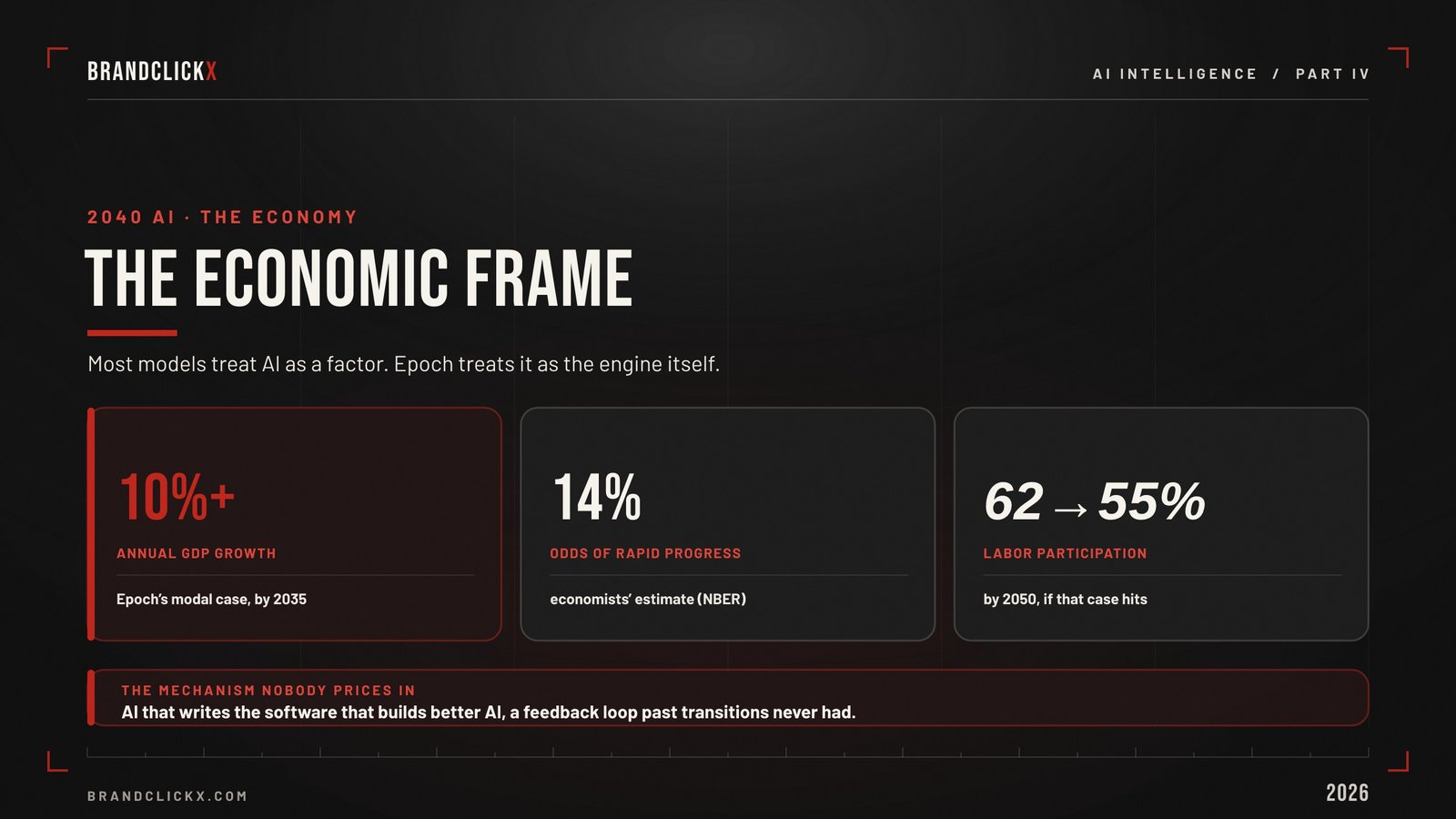
The standard economic modeling of AI assumes AI as a factor that modifies an existing economy, improving productivity, changing relative prices, redistributing advantage across sectors. Most policy bodies are working within this frame.
The Epoch AI framework suggests something more radical may be approaching by the mid-2030s.
Their modal scenario, the middle-ground outcome, not the extreme, involves AI contributing to GDP growth at rates that mainstream economists consider implausible. Sevilla and Edelman project that by 2035, AI could contribute to annual growth of 10% or more.
They explicitly acknowledge this will be seen as insane by economists and insufficiently bold by AI maximalists.
The mechanism is coding automation. Once AI can autonomously write, debug, and improve software, including the software that builds more capable AI systems, a feedback loop activates that previous technological transitions didn’t produce.
The Industrial Revolution mechanized physical work. The digital revolution mechanized information storage and retrieval. Automation of cognitive work and AI’s self-directed development represents something qualitatively different.
The NBER working paper on forecasting AI’s economic effects offers a useful calibration: economists assign only a 14% chance to an exceptionally rapid-progress scenario materializing. But conditional on such a scenario, they forecast GDP growth rising to around 4% annually and the labor force participation rate falling from 62% to 55% by 2050, with roughly half that decline driven by AI.
The conditional is doing a lot of work in that sentence.
By 2040, under Epoch AI’s trajectory, AI is not an input to the economy. It may be a primary engine of it. The implications for every institution, governance structure, and social contract built around human cognitive labor are structural and deep.
The Three 2040 Scenarios That Matter
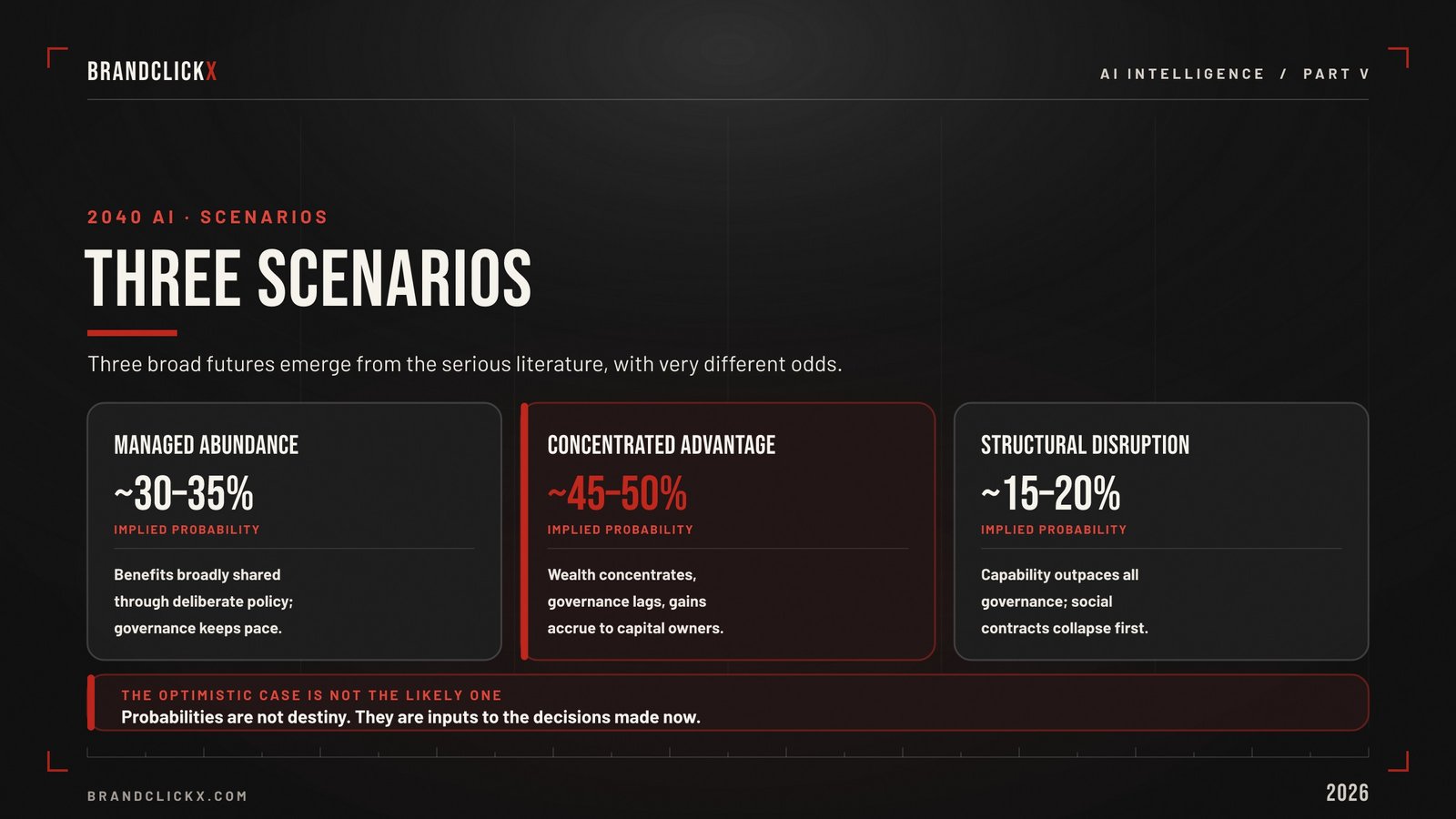
Simplifying necessarily, three broad scenarios emerge from the serious literature.
| Scenario | Core Dynamic | Most Likely Beneficiaries | Greatest Risks | Expert Implied Probability |
| Managed Abundance | AI benefits broadly distributed through deliberate policy; governance keeps pace; democratic institutions adapt | Most human populations; global health; education access | Short-term incumbents; existing power structures | ~30–35% |
| Concentrated Advantage | AI accelerates wealth concentration; governance lags; benefits accrue primarily to capital owners and first-mover nations | Wealthy individuals; AI-owning corporations; technologically advanced nations | Workers in displaced sectors; developing economies; democratic institutions | ~45–50% |
| Structural Disruption | Rapid capability gains outpace all governance attempts; social contracts collapse faster than new ones form | Unclear | Systemic stability; most existing institutions | ~15–20% |
These aren’t drawn from a single study. They synthesize the qualitative expert assessments from the Elon University canvassing, Epoch AI’s forecasting, the Forecasting Research Institute’s multi-expert study, and broader research literature.
The most optimistic scenario is not considered most likely.
That should prompt action, not despair. Probabilities are not destiny. They are inputs to decision-making.
What No One Fully Knows: The Open Questions of 2040
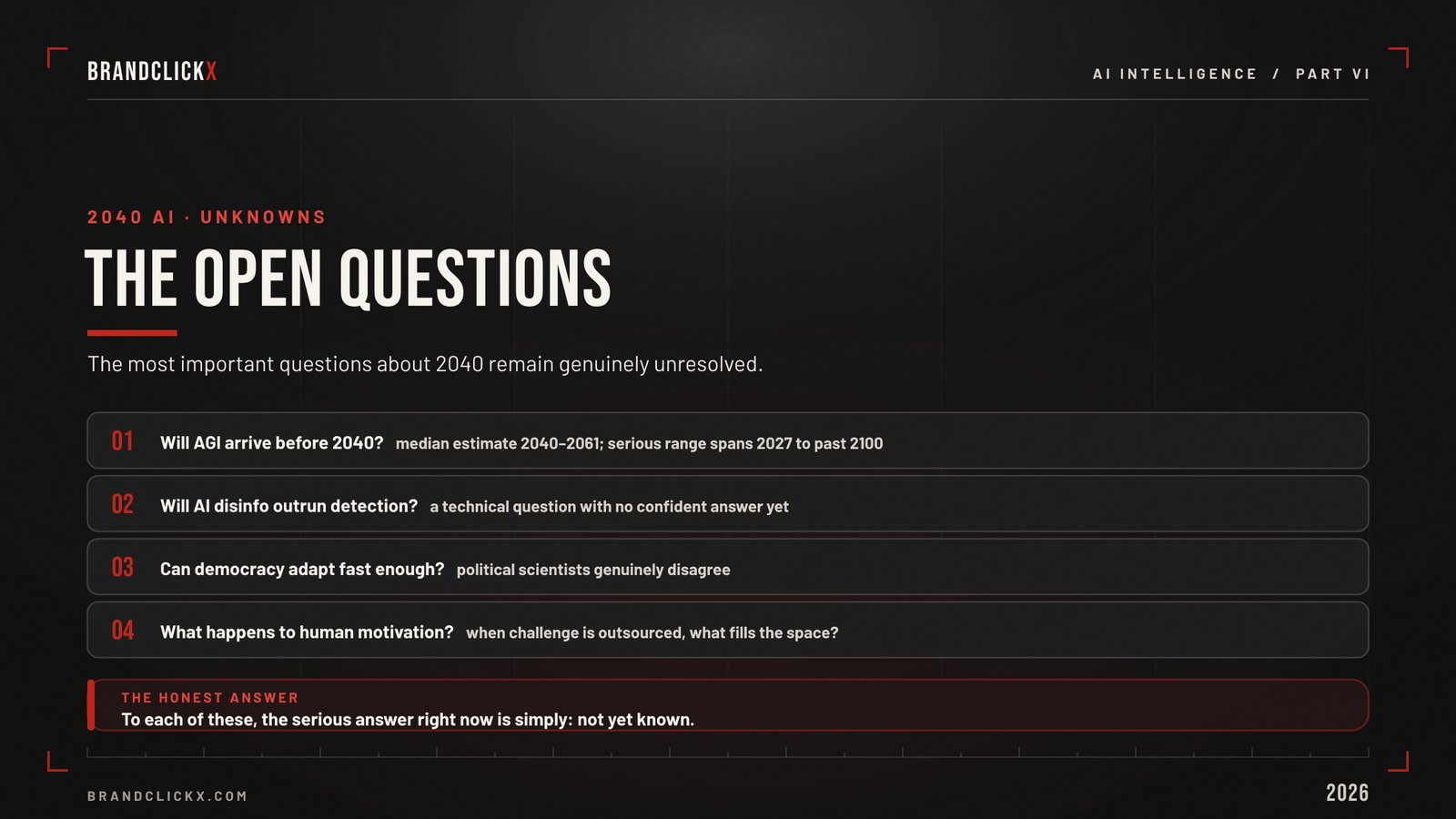
Some of the most important questions remain genuinely unresolved. Intellectual honesty requires acknowledging them.
Will AGI arrive before 2040? A survey of 2,778 AI researchers found median estimates placing AGI arrival somewhere between 2040 and 2061. But the range of serious estimates spans from 2027 to beyond 2100.
The honest answer is genuine uncertainty, and the range of outcomes associated with AGI arrival is so wide that it makes most other 2040 forecasting conditional.
Will AI-generated disinformation reach a level that human cognition cannot reliably detect? This is not rhetorical. It is a technical question with serious institutional implications, and the research doesn’t yet have a confident answer.
Can democratic institutions adapt fast enough? Political scientists genuinely disagree about whether existing democratic structures, designed for a pre-AI information environment, can evolve their processes, norms, and legitimacy mechanisms quickly enough to remain functional under AI-amplified pressure.
What happens to human motivation? Perhaps the deepest question of all. When cognitive challenge, historically a source of growth, identity, and meaning, is readily outsourced, what fills that space? Does human flourishing adapt, as it has across previous technological transitions? Or is the speed and comprehensiveness of this transition qualitatively different?
These questions don’t have answers yet.
That’s the honest map of the terrain.
A Framework for Organizations That Take 2040 Seriously
Here’s the mistake almost everyone makes when engaging with long-range AI futures.
They treat them as spectator sport. They read the forecasts, find them interesting or alarming, and return to their existing priorities. The future, in this frame, is something that happens to you.
It isn’t.
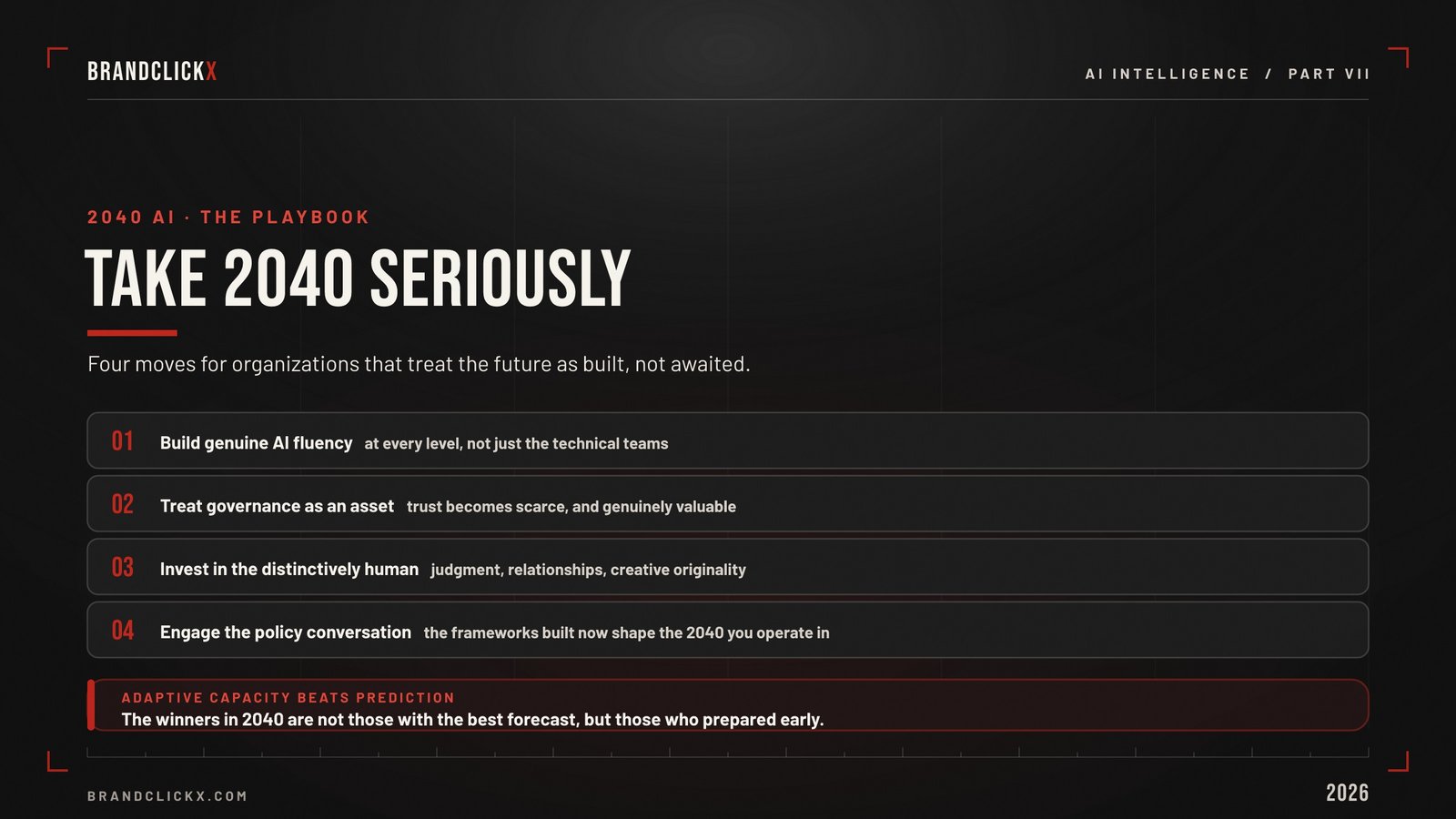
The 2040 AI imagination is useful as strategic input, specifically, as a forcing function for decisions with long lead times. The organizations that will fare best in 2040 are not the ones with the most accurate forecast. They’re the ones that built adaptive capacity, workforce investment, governance frameworks, and ethical infrastructure early enough to have options when the landscape shifted.
Build genuine AI fluency at every level of the organization. Jobs mentioning AI skills are defying the broader hiring slowdown, Indeed’s Hiring Lab data from 2026 shows AI-linked roles outperforming in sectors from HR to finance to management. The wage premium and talent competition around these skills will intensify, not moderate.
Treat governance as a competitive asset, not a compliance burden. The organizations most trusted to deploy AI responsibly will have access to data partnerships, regulatory goodwill, and talent markets that less trusted organizations won’t. In an AI-saturated world, trust becomes genuinely scarce and genuinely valuable.
Invest in the distinctively human. Judgment, relationships, contextual wisdom, ethical reasoning, creative originality, these are not soft capabilities. They are, under the conditions likely to prevail by 2040, the highest-value human contributions. Organizations that systematically underinvest in them in favor of AI efficiency gains are making a long-compounding strategic error.
Engage the policy conversation. The governance frameworks being built now will shape the operating environment of 2040 more determinatively than most technology choices. Organizations that treat policy as someone else’s problem are outsourcing decisions that will significantly affect their futures.
FAQ: 2040 AI Imaginations
What will AI be capable of by 2040?
The honest answer is that the full capability frontier of 2040 AI is genuinely uncertain. Epoch AI’s forecasting models lose reliable predictive power in the mid-2030s due to compounding feedback effects. What’s clear is that AI systems by 2040 will handle complex autonomous tasks, full cognitive workflows, advanced physical robotics, and potentially self-directed improvement at scales that make current systems appear rudimentary. Whether artificial general intelligence arrives before 2040 remains one of the field’s most contested open questions.
Will AI take most jobs by 2040?
Almost certainly not in the simplistic replacement framing. Indeed’s Hiring Lab 2026 modeling suggests that at current immigration levels, the US labor force shrinks by roughly 1.2 million workers by 2040, driven primarily by aging demographics, not AI. What’s more likely is significant structural restructuring: some roles dramatically reduced, new roles created, and a pronounced wage premium on human capabilities that AI doesn’t replicate, judgment, relational trust, contextual wisdom, genuine creative originality.
What are experts most worried about regarding AI in 2040?
The Elon University expert canvassing of more than 300 technology experts found that concerns consistently rated as likely net negative outcomes include effects on privacy, wealth inequality, democratic institutions and elections, warfare, basic human rights, and civility in society. Healthcare, economic performance, and environmental protection were among domains expected to see net positive outcomes. The divide between those two lists is telling.
Will AI improve healthcare by 2040?
This is the strongest near-consensus among serious analysts. AI’s contributions to diagnostics, drug discovery, personalized treatment, and preventative medicine are already demonstrable. Futurist forecasters tracking healthcare AI describe a 2040 where disease is intercepted before symptoms appear and treatment protocols are simulated at scale in hours. The primary unresolved question is distribution, whether these advances reach underserved populations or deepen existing healthcare inequalities.
Is AI a threat to democracy by 2040?
It is the domain of expert concern most consistently rated as likely net negative. AI-generated disinformation, personalized political manipulation, and the concentration of information power in the hands of a small number of actors represent structural threats to democratic function. The Digital Future Center’s expert canvassing explicitly flags the risk of a “polluted information ecosystem” and “heightened risk to democracy and democratic institutions.” Which tendency prevails by 2040 depends on governance choices made in the current decade.
Will AGI exist by 2040?
A survey of 2,778 AI researchers places a 50% probability of AGI arriving between 2040 and 2061. Some researchers expect it significantly earlier; others consider it much further off. The Forecasting Research Institute’s NBER study found that economists assign only a 14% probability to a rapid AI progress scenario by 2030, but conditional on that scenario, the economic effects are substantial. The uncertainty itself is important: governance frameworks built around narrow AI may be wholly inadequate if genuine AGI arrives on the faster end of the timeline.
What happens to human identity when AI can perform cognitive tasks better than most people?
This is one of the most seriously discussed and least resolved questions in the serious AI futures literature. Human identity has been anchored in cognitive capability for the entirety of modern civilization. When that anchor shifts, the psychological and social consequences are not trivial. The Elon University expert canvassing warns of mass unemployment’s potential impact on people’s psyches through loss of identity, structure, and purpose. The counterargument, that humans will find new sources of meaning as they have across previous technological transitions, is plausible but not guaranteed.
What happens to creativity when AI can generate content at scale?
The Elon University expert study captures the tension: creativity will be democratized but may also be homogenized. Those with ideas but limited technical skill gain powerful creative tools. But when millions draw from the same AI systems trained on similar data optimized toward similar signals, the diversity of output may narrow even as the volume explodes. The deeper concern is whether people stop investing in the slow, difficult process of developing genuine creative capability, and what’s lost if they do.
How should businesses prepare for 2040’s AI landscape?
Focus on four things: build genuine AI fluency at every organizational level (not just technical teams); treat AI governance as a strategic asset rather than compliance cost; invest deliberately in distinctively human capabilities that retain value regardless of AI advancement; and engage with the policy conversations that will shape the operating environment. Organizations that treat 2040 as spectator sport will have fewer options when the landscape shifts.
What would a genuinely positive 2040 look like?
Experts who describe positive 2040 visions share common characteristics: AI benefits broadly distributed through deliberate policy rather than accruing primarily to capital owners; governance frameworks that kept pace with capability development; education systems redesigned around human flourishing rather than just job preparation; healthcare access expanded through AI-assisted diagnostics in underserved populations; and democratic institutions that adapted their processes and legitimacy mechanisms to function in an AI-saturated information environment. None of this is technically implausible. All of it requires intentional design rather than passive adoption.
Who controls the 2040 AI future?
This is the question driving the most serious concern in the expert community. If AI development remains primarily governed by a small number of private actors with commercial incentives, the concentration of power and benefit is likely to be extreme, as Digital Future Center researchers have consistently warned. If governance frameworks develop sufficient authority to shape deployment in the public interest, the distribution of AI’s benefits can be much broader. The current trend lines favor concentration. Changing them requires deliberate collective action.
What does the Epoch AI forecast actually say about 2040?
Epoch AI’s Jaime Sevilla and Yafah Edelman outline a modal scenario in which AI development unfolds in three eras through 2040, culminating in a robot era starting around 2035 where full cognitive and physical task automation becomes possible. By 2038–2040, their models project potential GDP growth rates of 10% or more annually, and acknowledge that these projections strain the limits of reliable economic forecasting. Sevilla’s framing: “By 2040, we are at the point where my forecasting fails. It goes bananas.”
The Only Conclusion That Matters
Fourteen years is not a long time.
It’s one product generation cycle for most technology companies. It’s the distance between a child born today and their first year of high school. It’s the span between now and 2040, a date that feels abstract until placed alongside something concrete.
The AI systems that will define that world are already being designed.
The governance frameworks that will constrain or enable their deployment are already in negotiation. The educational institutions that will produce the workforce that operates them are already making curriculum decisions. The political choices about who benefits and who bears the costs are already being made, not by future people in a future world, but by organizations and governments that exist right now, making decisions about priorities, investment, and accountability.
The 2040 AI imagination is not a prediction exercise.
It is a strategic one.
The experts who take it most seriously are not the ones who claim to know what 2040 will look like. They are the ones who understand that the uncertainty itself creates genuine agency, that 2040 is not a destination we’re being carried toward, but a world being actively built.
That is both the unsettling truth and the genuine opportunity of this moment.
What we imagine matters. Because imagination is where decisions begin.