The rapid prototyping market is projected to reach $29.96 billion by 2035. What started as a manufacturing technique has become the operating standard for product development across industries from aerospace to software. Here is everything you need to know.
Introduction: From Idea to Physical Object in Hours
Before rapid prototyping, bringing a new product from concept to physical model meant weeks of waiting.
A designer would finalize a drawing. An engineer would create technical specifications. A machinist would cut the part by hand or on a manually programmed lathe. The whole cycle, from approved design to testable prototype, could take six to twelve weeks. If the test revealed a design flaw, the cycle started again.
The arrival of computer-aided design, combined with digital fabrication technologies that could read those designs directly, collapsed that timeline.
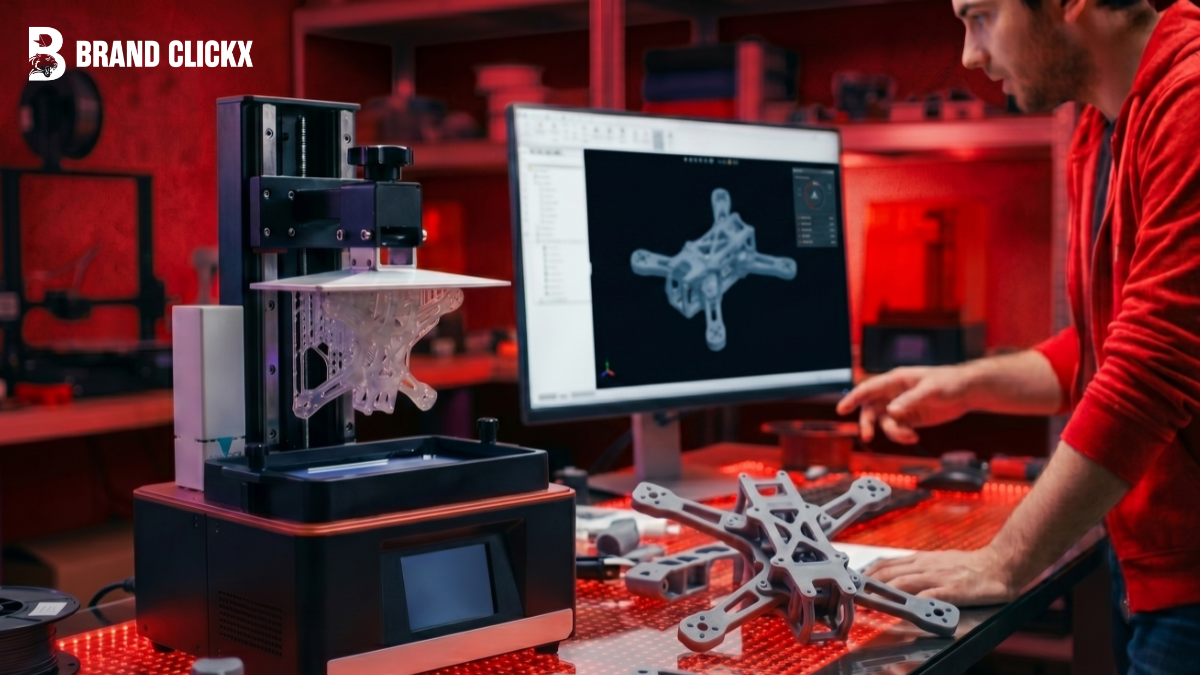
Rapid prototyping is the process of manufacturing a physical representation of a design in the shortest possible time, not mass production, but rapid iteration: design, print, test, tweak, and print again. With a 3D printer and the right digital file, you can have a physical part in hours for a cost that rarely exceeds $50–$100 for basic geometries.
That compression, from months to hours, has transformed product development across industries.
The Rapid Prototyping Market was estimated at $10.01 billion in 2024 and is projected to grow from $11.06 billion in 2025 to $29.96 billion by 2035, at a CAGR of 10.48%. The automotive sector alone accounts for over 30% of the market. Aerospace, healthcare, consumer electronics, and defense are the next largest adopters.
This guide covers everything: what rapid prototyping is, how it works, every major technique, the equipment involved, how to choose a service provider, what it costs, and where AI is taking the field in 2026.
Part I: What Is Rapid Prototyping?
The Definition
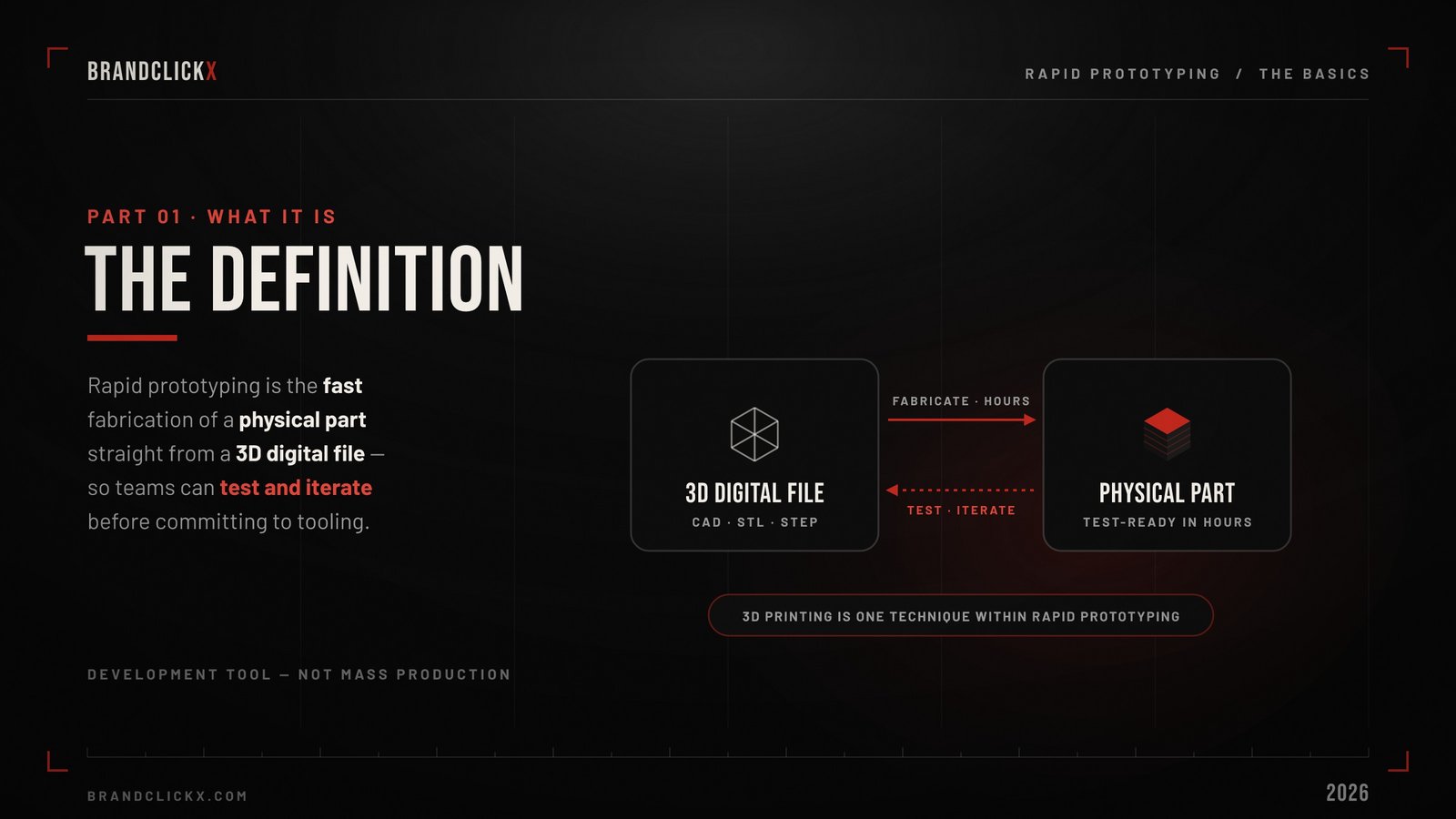
Rapid prototyping is the fast fabrication of a physical model or functional prototype of a product directly from a 3D digital design file, enabling designers and engineers to test, evaluate, and iterate on a design before committing to full production tooling.
What makes it “rapid” is the compression of the design-to-physical-object timeline.
Traditional manufacturing requires custom tooling, molds, dies, jigs, that must be created before a single part can be made. That tooling is expensive and slow to produce. Rapid prototyping bypasses tooling entirely, building directly from the digital file.
The result is a cycle that looks like this: design → fabricate → test → redesign → fabricate → test. Repeated until the design is right. Then, and only then, invest in production tooling.
What Rapid Prototyping Is Not
Rapid prototyping is not mass production.
The techniques that make prototyping fast, additive manufacturing, resin curing, laser sintering, produce individual parts efficiently but cannot match the per-unit cost of high-volume injection molding or die casting once a product reaches production scale.
The value of rapid prototyping is in the development phase, not the production phase. Its purpose is to answer design questions cheaply and quickly, before the cost of answering those questions rises dramatically with tooling investment.
Rapid prototyping and 3D printing are often used interchangeably, but they differ. Rapid prototyping encompasses many techniques for quickly creating prototypes, whereas 3D printing is a specific method within this broader category.
Why It Matters for Product Development
Every physical product has to be tested before it goes to market. Does it fit together correctly? Does it function as intended? Does it feel right in the hand? Does the button click the way users expect?
These questions cannot be answered by looking at a CAD model on a screen. They require a physical object.
Identifying a defect before production prevents thousands in wasted costs. A digital model will never replace the physical perception of a real object.
Rapid prototyping makes that physical object accessible early, cheaply, and repeatedly, turning design validation from a single high-stakes gate into a continuous iterative loop.
Part II: How Rapid Prototyping Works, The Process
Step 1: CAD Modeling, Create the Digital Design
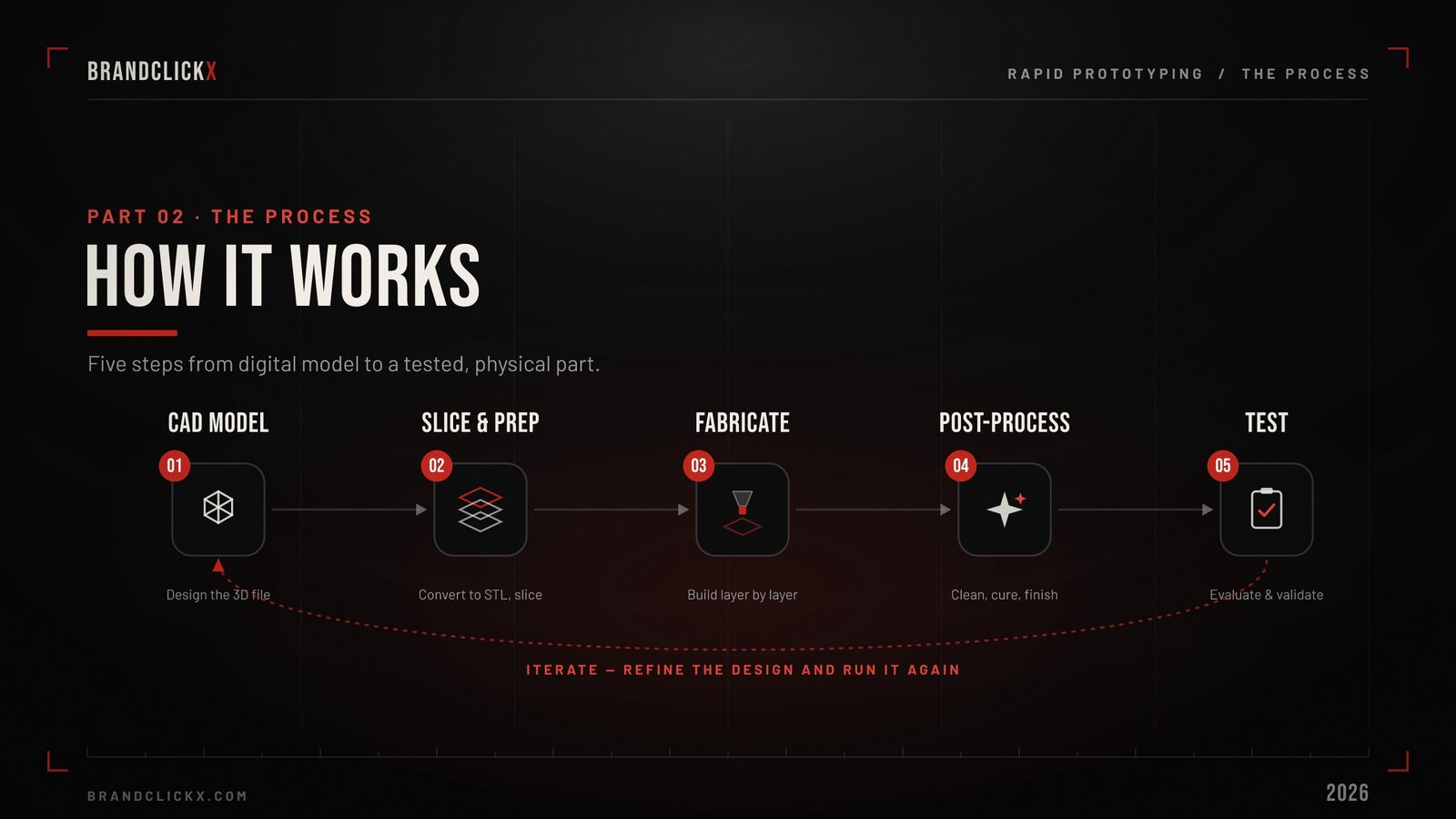
Every rapid prototyping process begins with a 3D digital model.
Computer-aided design (CAD) software, SolidWorks, AutoCAD, Fusion 360, CATIA, or Onshape, is used to create a precise three-dimensional representation of the part to be prototyped. The model defines every dimension, every surface, every feature of the part.
The quality of the prototype is directly limited by the quality of the CAD model. Geometric errors, dimensional inconsistencies, or undefined surface features in the digital file will produce the same problems in the physical part.
For product designers: this is the stage where design decisions have the lowest cost and the highest leverage. Changes in the CAD model cost nothing. Changes after fabrication cost time. Changes after production tooling costs thousands.
Step 2: File Conversion, Export to STL or STEP
Once the CAD model is complete, it is exported in a format the prototyping machine can read.
The most common format is STL (Standard Tessellation Language), which represents the 3D surface as a mesh of triangles. Higher triangle counts produce more accurate surface representations. STEP files are increasingly used for CNC machining because they preserve more geometric information than STL.
The exported file is then processed through slicing software, Ultimaker Cura, PrusaSlicer, or Chitubox are common examples, that divides the 3D model into the thin horizontal layers that the machine will build one at a time.
Slicing software also allows the operator to configure print settings: layer height, print speed, support structure placement, infill density, and material temperature. These settings directly affect print time, surface quality, strength, and material usage.
Step 3: Fabrication, Building the Physical Part
The fabrication stage varies significantly depending on which rapid prototyping technology is being used.
In additive processes (3D printing variants), the machine builds the part layer by layer from the bottom up, depositing, curing, or sintering material according to each successive slice of the digital file.
In subtractive processes (CNC machining), the machine removes material from a solid block, cutting, drilling, and milling until the desired geometry is achieved.
Each technology has its own operating principles, materials, speed profile, and output quality, covered in detail in Part III.
Step 4: Post-Processing, Finishing the Prototype
Raw parts from a prototyping machine rarely represent the final desired state.
FDM parts have visible layer lines that may need sanding. SLA parts have support structures that must be removed and surfaces that require UV curing. SLS parts have a slightly rough surface finish that can be smoothed. Metal DMLS parts may need heat treatment.
Post-processing steps include:
- Support removal, physically or chemically removing the support structures that hold overhanging features during printing
- Surface finishing, sanding, polishing, vapor smoothing, or media blasting to achieve the desired surface texture
- Painting and coating, applying color, protective coatings, or functional surface treatments
- Assembly, combining multiple printed parts or integrating printed components with off-the-shelf hardware
The extent of post-processing required depends on the technology, the intended use of the prototype, and the level of realism needed for testing or presentation.
Step 5: Testing and Iteration
The prototype is tested against the design criteria it was built to validate.
Fit and form testing checks that the part fits correctly with mating components. Functional testing evaluates whether the part performs its intended mechanical, fluid, electrical, or thermal function. User testing presents the prototype to end users to evaluate ergonomics, usability, and aesthetic response.
Test results feed directly back into Step 1, modifying the CAD model, re-slicing, and reprinting. This iteration cycle is the core value of rapid prototyping: the ability to generate real-world test data and respond to it quickly, without the cost and time of production tooling.
This cycle can be repeated several times until the perfect prototype is achieved, and it is the ideal solution for those who want to accelerate product development with professional tools.
Part III: Rapid Prototyping Techniques, Every Major Method Explained
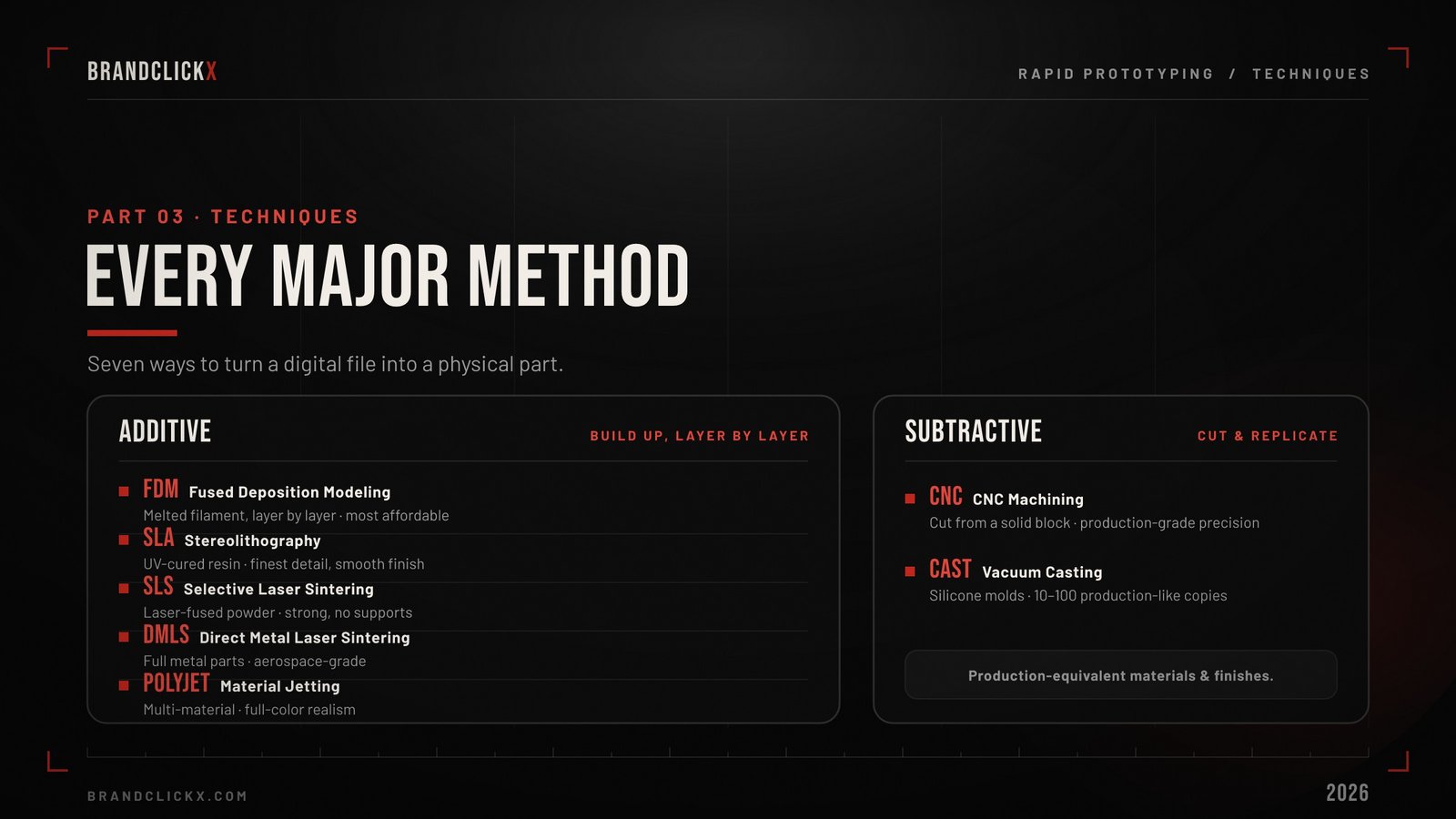
This is the section most engineers and designers need most: a clear comparison of every major rapid prototyping technology, when to use each, and what trade-offs each involves.
Additive Manufacturing (3D Printing) Methods
FDM, Fused Deposition Modeling
How it works: FDM printing deposits molten plastic filament layer by layer, like an ultra-precise hot glue gun. An extruder head heats the filament, usually PLA, PETG, or ABS, until it becomes malleable, deposits it in the pattern of the design, and allows it to cool to solidify.
Best for: Concept models, functional prototypes with moderate precision requirements, large parts, early-stage design validation.
Materials: PLA (biodegradable, easy to print), ABS (higher temperature resistance, tougher), PETG (chemical resistance, food safety compliance), TPU (flexible), Nylon (strong, wear-resistant), and engineering-grade materials including carbon fiber composites.
Surface quality: Visible layer lines are the characteristic FDM surface. Layer heights of 0.1–0.3mm are standard; 0.05mm is possible on high-resolution machines. Surface quality is the lowest of the three primary 3D printing methods.
Advantages: Most affordable technology, widest material range, largest build volumes available, most accessible for in-house production. A capable desktop FDM printer costs $300–$3,000; professional FDM systems run $5,000–$50,000.
Limitations: Slow print speed makes it unusable in some industries when large numbers of parts are needed quickly. The layer-by-layer printing in FDM can sometimes lead to problems with warping and minor shrinking. Layer height is generally larger than a layer in SLA or SLS printing.
Ideal industries: Consumer products, automotive, industrial equipment, education.
SLA, Stereolithography
How it works: SLA uses an ultraviolet laser that draws on the surface of liquid thermoset resin to create thousands of thin layers until the final part is formed. Each layer is cured instantaneously before the build platform moves to expose the next layer of liquid resin.
Best for: High-detail visual models, parts requiring smooth surface finish, clear or transparent components, dental and medical models, jewelry prototyping.
Materials: Photosensitive resins with varying properties, standard (brittle), ABS-like (tougher), flexible, castable, dental-grade, and high-temperature variants. Resin selection has expanded significantly in 2026 with engineering-grade formulations approaching injection-molded part performance.
Surface quality: The best surface finish of the three primary 3D printing methods. Layer lines are barely visible at standard 0.05mm layer heights. Parts can be polished, painted, and finished to production-quality appearance.
Advantages: Highest detail resolution, smoothest surface finish, excellent dimensional accuracy, transparent and clear materials available.
Limitations: Parts are generally more brittle than FDM-printed equivalents. Resin materials are more expensive than filament. Post-processing is more involved, support removal, isopropyl alcohol washing, UV curing. Build volumes are typically smaller than FDM.
Ideal industries: Consumer electronics, dental, medical devices, jewelry, product presentation models.
SLS, Selective Laser Sintering
How it works: A high-powered CO2 laser is used to sinter a thin layer of heat-fusible powder that gradually builds up the 3D model. Powders include plastic, metal, ceramics, and glass. Unlike FDM and SLA, SLS requires no support structures, unsintered powder surrounding the part provides support during printing.
Best for: Functional prototypes requiring mechanical strength, complex geometries with internal features, small production runs, parts that will be assembled or mechanically tested.
Materials: Nylon (PA12, PA11) is the most common, producing strong, slightly flexible parts. Glass-filled nylon adds stiffness. Thermoplastic elastomers (TPE) produce rubber-like parts. Metal powders (in DMLS/SLM variants) produce full metal parts.
Surface quality: Slightly rough, granular surface texture characteristic of powder-bed fusion. Less smooth than SLA but significantly stronger. Surface can be smoothed with secondary operations.
Advantages: No support structures required, enabling complex internal geometries and assembled mechanisms printed in a single build. Strong, functional parts. Good dimensional accuracy. Capable of producing small batches of end-use parts, not just prototypes.
Limitations: Higher equipment and material cost than FDM. Post-processing requires powder removal and cleaning. Colors are limited (typically white or gray) before painting. Systems are industrial-grade, not desktop.
Ideal industries: Aerospace, automotive, industrial equipment, medical devices, complex mechanical assemblies.
DMLS / SLM, Direct Metal Laser Sintering / Selective Laser Melting
How it works: SLM is a rapid prototyping, 3D printing, or additive manufacturing technique designed to use a high power-density laser to melt and fuse metallic powders together. DMLS partially melts metal powder particles to bond them; SLM fully melts them, producing denser, stronger parts.
Best for: Metal functional prototypes, aerospace components, medical implants, tooling inserts, parts that will experience high stress, temperature, or corrosion.
Materials: Stainless steel, aluminum alloys, titanium alloys, cobalt-chrome, Inconel, copper. Material selection depends on the application’s mechanical, thermal, and chemical requirements.
Advantages: Full metal parts with mechanical properties approaching or matching wrought metal. Complex internal features (channels, lattices) that are impossible with conventional machining. No tooling required, direct from digital file to metal part.
Limitations: The highest cost of any 3D printing technology. Requires support structures (unlike SLS) that must be machined away. Post-processing is extensive. Equipment costs $200,000–$1,000,000+. Reserved for applications where metal is required and conventional machining cannot produce the geometry.
Ideal industries: Aerospace, defense, medical implants, high-performance automotive, industrial tooling.
PolyJet / Multi-Jet Fusion (MJF)
How it works: PolyJet jets tiny droplets of photopolymer material onto a build tray, curing each layer with UV light. Multiple materials can be jetted simultaneously, producing parts with varying material properties, rigid and flexible sections in a single print.
Best for: Multi-material prototypes and optically transparent prototypes. PolyJet is particularly suitable for validating unibody designs that incorporate rigid and flexible materials, or for a single-unit multi-material prototype or a high-gloss clear part for optical validation.
Advantages: Highest visual realism of any 3D printing technology. True multi-material, multi-color printing in a single build. Smooth surface finish approaching injection-molded parts. Medical-grade biocompatible materials available.
Limitations: Parts are generally brittle and not suited for mechanical functional testing. Most expensive polymer 3D printing technology. High material cost. Slow build speeds for large parts.
Ideal industries: Consumer product design, medical device visualization, automotive interior design, presentation models.
Subtractive Manufacturing Methods
CNC Machining
How it works: Computer Numerical Control (CNC) machining uses computer-controlled cutting tools, mills, lathes, drills, and routers, to remove material from a solid block (called a billet) to achieve the desired geometry. The cutting path is programmed from the CAD file.
Best for: High-precision functional prototypes, parts that will experience significant mechanical stress, metal prototypes where full density is required, prototypes that must match production material properties exactly, parts requiring tight dimensional tolerances.
Materials: Virtually any machinable material, aluminum, steel, brass, copper, titanium, acetal (Delrin), ABS, polycarbonate, PEEK, wood, foam. The same material that will be used in production can be machined for the prototype.
Surface quality: Excellent surface finish achievable, comparable to production parts. Tight tolerances (±0.025mm or tighter) standard on professional CNC equipment.
Advantages: Production-equivalent material properties. Highest dimensional accuracy. Fastest turnaround for simple geometries. Wide material selection. Parts can be used directly in functional testing under real-world loads.
Limitations: Cannot produce internal voids, undercuts, or complex internal geometries that additive methods can. Material waste (chips and swarf) from removing material from a billet. Higher cost than FDM for complex geometries. Minimum wall thickness and feature size constraints.
Ideal industries: Automotive, aerospace, medical devices, industrial equipment, any application requiring production-equivalent mechanical properties.
Vacuum Casting
How it works: A master pattern (typically made by SLA or CNC) is placed in a silicone mold. The mold is then filled with polyurethane resin under vacuum, producing a part that replicates the master with high fidelity. Each silicone mold can produce 20–50 parts before degrading.
Best for: Small production runs of 10–100 parts, market testing, pre-production evaluation, parts requiring production-like appearance and mechanical properties without injection mold investment.
Materials: Polyurethane resins with properties simulating ABS, PP, rubber, transparent materials, and more. Parts can be painted, plated, and finished like injection-molded components.
Advantages: Production-quality appearance and properties without tooling cost. Multiple identical parts from a single master. Short lead times (5–10 days typical). Cost-effective for small quantities.
Limitations: Not suitable for high-volume production. Silicone mold life limits quantity. Less dimensional accuracy than injection molding. Limited to materials achievable with polyurethane chemistry.
Ideal industries: Consumer products, medical devices, electronics enclosures, pre-launch market testing.
Part IV: Rapid Prototyping Techniques Compared
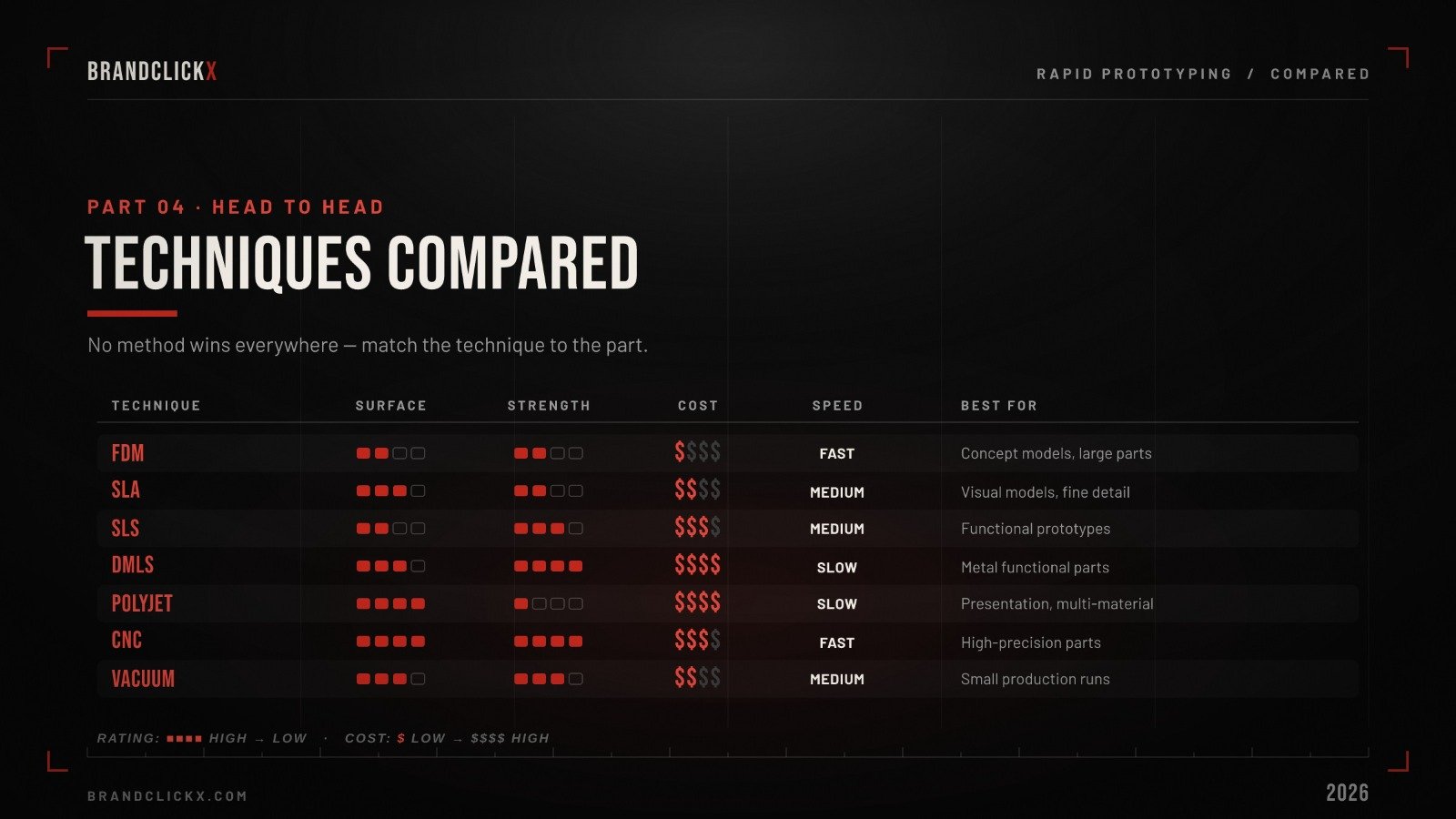
| Technology | Surface Quality | Strength | Materials | Cost | Speed | Best For |
| FDM | Low-Medium | Medium | Thermoplastics | $ | Fast | Concept models, large parts |
| SLA | High | Low-Medium | Photoresins | $$ | Medium | Visual models, fine detail |
| SLS | Medium | High | Nylon, polymers | $$$ | Medium | Functional prototypes |
| DMLS/SLM | Medium-High | Very High | Metals | $$$$ | Slow | Metal functional parts |
| PolyJet | Very High | Low | Multi-material | $$$$ | Slow | Presentation, multi-material |
| CNC Machining | Very High | Very High | Any machinable | $$$ | Fast (simple) | High-precision functional parts |
| Vacuum Casting | High | Medium-High | PU resins | $$ | Medium | Small production runs |
Part V: Rapid Prototyping Equipment
Desktop and Professional 3D Printers
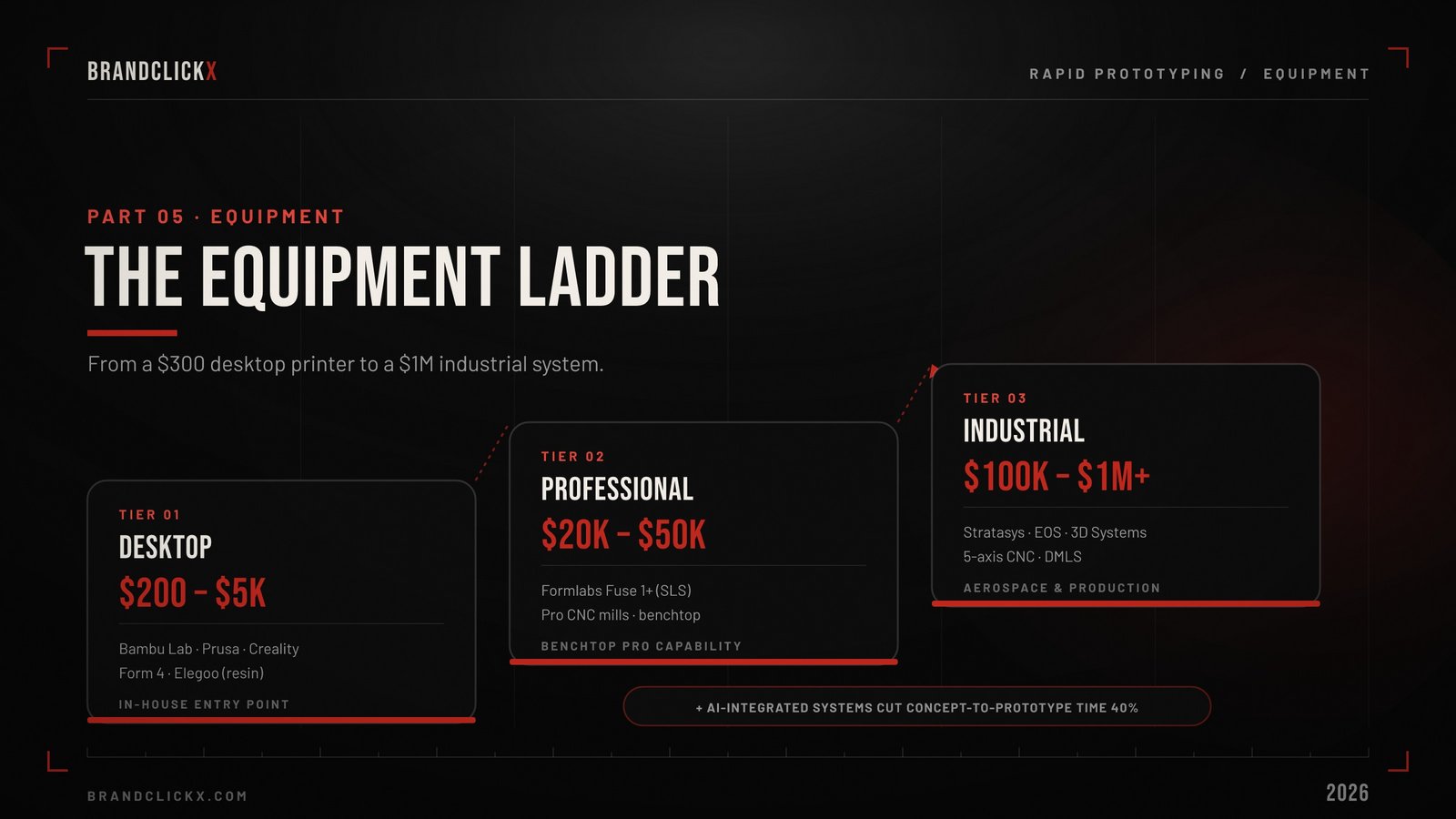
The entry point to rapid prototyping for most teams is a desktop FDM or SLA printer.
Desktop FDM printers, Bambu Lab, Prusa, Creality, and Ultimaker produce desktop machines in the $300–$5,000 range capable of producing ABS, PLA, PETG, and TPU parts with layer heights down to 0.05mm. Bambu Lab’s X1 Carbon, in particular, has become the default choice for professional product designers who need in-house FDM capability at a $1,200 price point.
Desktop SLA printers, Formlabs‘ Form 4 ($4,000–$10,000) is the professional standard for desktop resin printing. Elegoo and Anycubic offer consumer-grade MSLA (masked SLA) printers at $200–$600 for teams with lower precision requirements.
Industrial FDM systems, Stratasys’s F900 and Fortus series produce large, high-quality FDM parts in engineering-grade materials including ULTEM and PEKK. These systems cost $50,000–$300,000+ and are operated by professional services and large in-house teams.
Professional SLA and SLS Systems
Formlabs leads professional desktop SLA with the Form 4 series and SLS with the Fuse 1+ 30W, the most accessible SLS system in the market at approximately $20,000. For teams that need SLS capability in-house without industrial system investment, the Fuse 1+ has been the most commercially significant rapid prototyping equipment launch of the past three years.
EOS and 3D Systems produce the industrial SLS and DMLS systems that dominate aerospace, automotive, and defense rapid prototyping. These systems range from $100,000 to $1,000,000+ and require dedicated facilities, trained operators, and post-processing infrastructure.
CNC Machining Equipment
Professional CNC machining for rapid prototyping requires:
- 3-axis CNC mills, standard configuration for prismatic parts. Haas VF-2, Tormach 1100MX, and Datron Neo are widely used in prototype shops.
- 5-axis CNC mills, required for complex geometries with features on multiple faces. Essential for aerospace and medical prototyping.
- CNC lathes, for cylindrical parts and rotational geometries.
- EDM (Electrical Discharge Machining), for features that cannot be reached by cutting tools, including deep cavities and narrow slots.
AI-Integrated Prototyping Equipment
The integration of generative AI into rapid prototyping tools reduces concept-to-prototype timelines by 40%. Leading platforms now combine 3D simulation, user behavior prediction, and automated UI generation. Physical prototyping systems achieve 25-micron precision, bridging digital and manufacturing workflows.
AI-assisted design tools, including Autodesk’s Generative Design and nTopology’s topology optimization, now generate structurally optimized geometries from performance requirements, which are then directly fabricated via additive manufacturing.
This design-to-print pipeline compresses the design iteration cycle further by automating the generation of designs that are optimized for both performance and manufacturability.
Part VI: Rapid Prototyping Services, When to Outsource
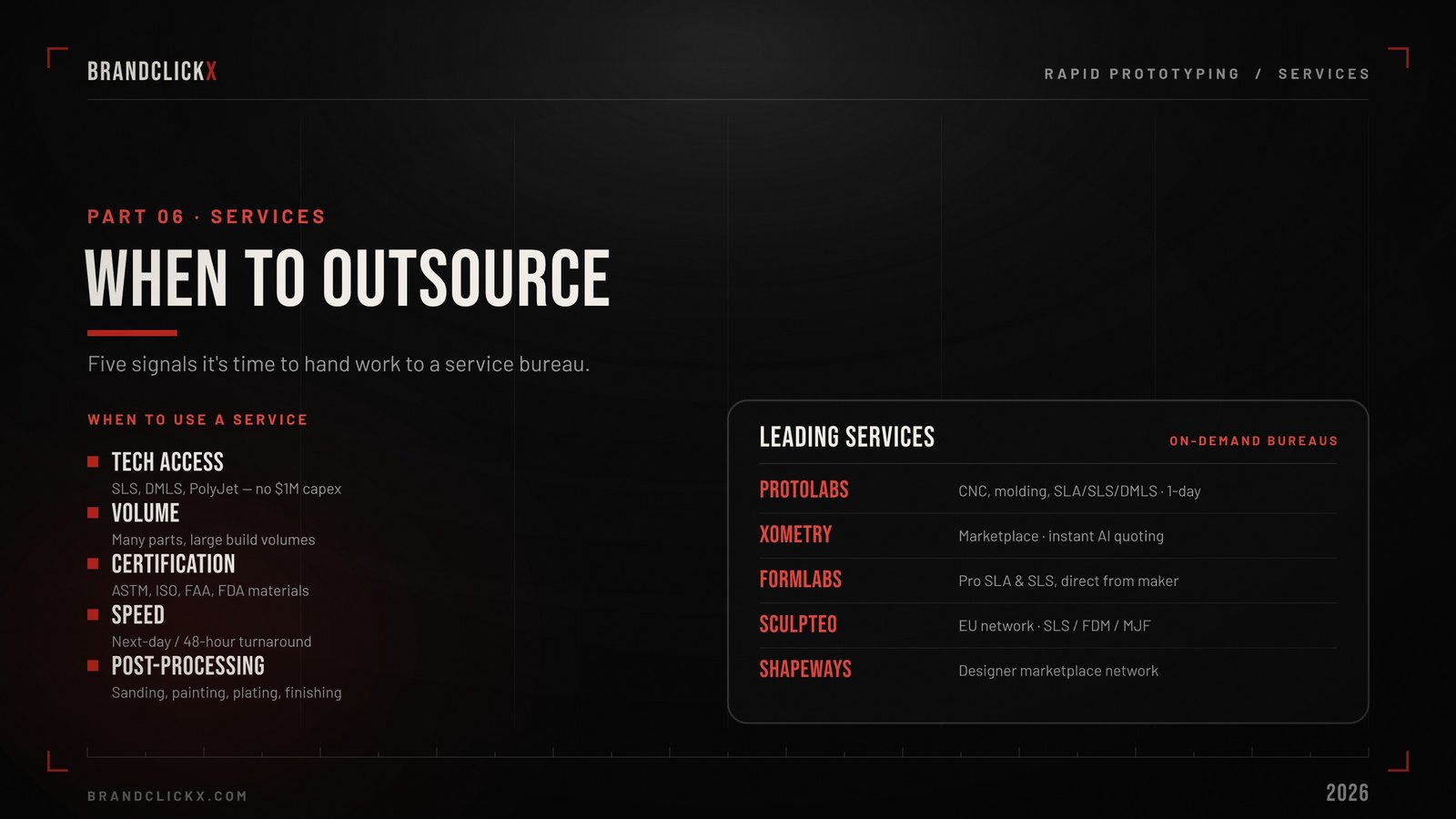
Not every team needs in-house rapid prototyping equipment. For many applications, outsourcing to a professional rapid prototyping service delivers better results at lower total cost than maintaining in-house equipment.
The global rapid prototyping service market revenue is expected to grow from USD 2.87 billion in 2025 to reach USD 9.68 billion by 2033, growing at a CAGR of 16.4% during the forecast period.
When to Use a Rapid Prototyping Service
Technology access, SLS, DMLS, and PolyJet systems cost $50,000–$1,000,000+. For teams that need these capabilities occasionally, service bureaus provide access without capital expenditure.
Volume requirements, Services can produce multiple identical parts simultaneously across large build volumes. In-house desktop printers are limited by build volume and operator time.
Material certification, Aerospace, medical, and defense applications often require material certifications (ASTM, ISO, FAA, FDA) that service bureaus maintain and individual operations rarely hold.
Speed, Many professional rapid prototyping services offer next-day or 48-hour turnaround on standard technologies. Shipping time is often the limiting factor, not production time.
Post-processing, Professional services include sanding, painting, plating, and finishing as standard options. Achieving equivalent results in-house requires dedicated equipment and skilled technicians.
Leading Rapid Prototyping Services
Protolabs, One of the largest rapid prototyping and on-demand manufacturing services globally. Offers CNC machining, injection molding, SLA, SLS, DMLS, MJF, and PolyJet with instant online quoting and lead times as short as one business day.
Xometry, Marketplace-model rapid prototyping connecting customers to a network of vetted manufacturing partners across FDM, SLA, SLS, CNC, and sheet metal. AI-driven quoting engine provides instant pricing.
Formlabs Services, Professional SLA and SLS prototyping direct from the manufacturer of the most widely used professional desktop resin printers. Known for high resin quality and material consistency.
Sculpteo (BASF subsidiary), European-focused online prototyping service with global reach, offering SLS, FDM, SLA, and multi-jet fusion.
Shapeways, Marketplace connecting designers to a global network of professional 3D printing services. Strong in jewelry, consumer products, and design-led prototyping.
How to Evaluate a Rapid Prototyping Service
Technology breadth, Does the service offer the specific technology appropriate for your part requirements, or will it suggest an inferior technology because it only operates one type of machine?
Material certification, Are the materials certified to the standards your application requires? Ask specifically if you are in aerospace, medical devices, or food contact applications.
Dimensional accuracy guarantees, What tolerances does the service guarantee, and how are deviations addressed?
Lead times and rush options, Standard lead time, minimum order for rush processing, and whether rush pricing is predictable or negotiated.
Design for manufacturability support, Will the service review your file and flag design issues before production, or will it produce what you send regardless of whether it is optimized?
Part VII: Rapid Prototyping Applications by Industry
Automotive
The automotive sector alone is expected to account for over 30% of the rapid prototyping market share by 2026.
Automotive teams use rapid prototyping throughout the vehicle development cycle: exterior body styling models, interior trim components, under-hood functional parts, dashboard interface prototypes, sensor housing designs, and aerodynamic testing models.
CNC machining dominates for functional mechanical parts, engine components, suspension pieces, braking system elements, where production-equivalent material properties are required for testing. FDM and SLA handle interior and exterior visual models.
Aerospace and Defense
Aerospace rapid prototyping is dominated by CNC machining and DMLS for functional parts, with FDM and SLA used for non-structural components and tooling aids.
Metal additive manufacturing (DMLS/SLM) has been transformative in aerospace because it can produce complex internal geometries, fuel manifolds with internal cooling channels, structural brackets with topology-optimized lattice structures, that reduce weight significantly while maintaining strength requirements.
Healthcare and Medical Devices
Medical devices represent 17% of rapid prototyping tool adoption, making healthcare the third-largest sector. Applications include surgical instrument prototypes, prosthetic limb designs, medical device enclosures, anatomical models for surgical planning, and dental applications.
Formlabs’ dental resin ecosystem has made desktop SLA the standard tool for dental labs, producing crowns, surgical guides, denture bases, and study models faster and more accurately than traditional casting methods.
Consumer Electronics
Consumer electronics companies use rapid prototyping most intensively in the industrial design phase, evaluating ergonomics, button placement, port positioning, and overall form factor before committing to injection mold tooling that can cost $10,000–$100,000+ per component.
SLA and PolyJet are favored for their ability to produce the smooth, production-quality surfaces needed to evaluate consumer product aesthetics accurately. FDM is used for early-stage structural evaluation where appearance is less critical.
Architecture and Construction
Architectural scale models, once built by hand over days or weeks, are now produced via FDM in hours. 3D printed architectural models allow clients to evaluate spatial relationships and building massing at scales that drawings cannot convey.
Building component prototypes, complex facade elements, custom joinery, structural node details, are machined or printed to verify fit and appearance before fabrication at full scale.
Part VIII: Rapid Prototyping in Software and UX
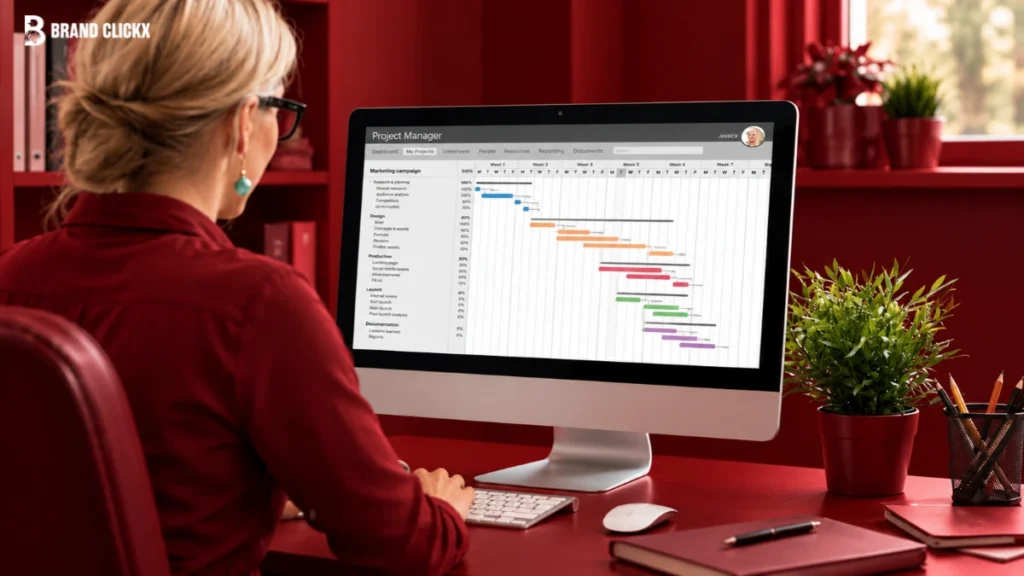
Rapid prototyping is not exclusively a manufacturing concept. In software development and UX design, rapid prototyping describes the same underlying discipline, compressing the design iteration cycle by producing testable versions of a product quickly and cheaply.
In digital contexts, a “prototype” is typically a low-fidelity wireframe or high-fidelity interactive mockup created in tools like Figma, Marvel, or ProtoPie, rather than a physical object. The principle is identical: produce a testable representation of the design as quickly as possible, test it with real users, and iterate based on findings before investing in full development.
The integration of AI into digital rapid prototyping tools has produced the same acceleration that 3D printing produced in physical prototyping. Generative AI tools now produce functional UI wireframes, interactive prototypes, and even deployable frontend code from text prompts, compressing the digital design-to-prototype cycle from days to minutes.
The integration of generative AI into rapid prototyping tools reduces concept-to-prototype timelines by 40%.
Part IX: The Future of Rapid Prototyping
AI-Generative Design
The most significant trend in rapid prototyping is the convergence of generative AI with additive manufacturing.
Generative design tools accept performance requirements, load directions, material constraints, weight targets, and automatically generate geometries optimized to meet them. These AI-generated designs frequently achieve geometries that human designers would not conceive, and that conventional manufacturing cannot produce, but that additive manufacturing can fabricate directly.
The result: AI generates the optimal design, additive manufacturing produces it, and testing validates it, all within a cycle that compresses weeks of traditional engineering into hours.
Multi-Material and Embedded Components
Prototyping systems that can simultaneously deposit multiple materials, conductors and insulators, rigid and flexible sections, structural and sacrificial support, are making it possible to prototype products that integrate electronics, mechanisms, and structure in a single printed part.
The ability to print electronic traces, conductive pathways, and embedded components into structural parts directly compresses the development cycle for smart devices, wearables, and connected products.
Sustainable Materials
Recycled and sustainable prototyping materials are growing as a market segment, driven by enterprise sustainability commitments and regulatory pressure in Europe and Asia-Pacific.
Bio-based PLA formulations, recycled nylon powders for SLS, and sustainable resin formulations for SLA have all reached quality parity with conventional materials in the past two years, removing the quality trade-off that previously made sustainable materials a niche choice.
Digital Twins and Simulation
Physical rapid prototyping is increasingly complemented by virtual prototyping, digital twins and simulation tools that can predict part performance before a physical prototype is produced, focusing physical prototyping on the design questions that simulation cannot answer.
Finite element analysis (FEA) for structural performance, computational fluid dynamics (CFD) for thermal and flow behavior, and kinematic simulation for mechanical assemblies are standard pre-prototyping steps in aerospace and automotive design. The physical prototype validates simulation predictions rather than exploring design space blindly.
Key Takeaways
- Rapid prototyping compresses the design iteration cycle from weeks to hours. Its core value is in enabling faster, cheaper design validation before production tooling investment.
- No single rapid prototyping technology is best for all applications. FDM for cost and accessibility, SLA for surface quality and detail, SLS for functional strength, DMLS for metal parts, CNC for production-equivalent properties. Choose based on your specific part requirements.
- Outsourcing makes sense for technologies you don’t need constantly. Service bureaus provide access to SLS, DMLS, and PolyJet systems without the capital expenditure, appropriate for most teams that need these technologies occasionally.
- Rapid prototyping applies to software and UX as well as physical products. The discipline of fast, testable iteration before full investment is universal, whether the prototype is a 3D-printed part or a Figma wireframe.
- AI is compressing rapid prototyping timelines by 40%. Generative design, AI-assisted slicing, and automated design-for-manufacturability tools are reducing the design-to-physical-prototype cycle further than the technologies themselves have already achieved.
- The market is growing at 10–20% CAGR across multiple segments. Rapid prototyping is not a maturing technology, it is an accelerating one. The combination of better materials, more accessible equipment, and AI integration is expanding both what rapid prototyping can produce and the industries where it is economically viable.
FAQ: Rapid Prototyping
What is rapid prototyping?
Rapid prototyping is the process of quickly fabricating a physical model or functional prototype of a product directly from a digital design file, enabling designers and engineers to test, evaluate, and iterate on a design before committing to full-scale production tooling. Techniques include 3D printing (FDM, SLA, SLS), CNC machining, and vacuum casting.
What is the difference between rapid prototyping and 3D printing?
3D printing is one technique within the broader category of rapid prototyping. Rapid prototyping encompasses many techniques for quickly creating prototypes, including 3D printing, CNC machining, SLA, SLS, and casting. The terms are often used interchangeably in casual contexts but are technically distinct.
How does the rapid prototyping process work?
The process follows four steps: CAD Modeling (creating a 3D digital model), File Conversion (exporting as STL or STEP), Fabrication (building the part layer by layer or removing material from a block), and Post-Processing (finishing, sanding, painting). The cycle is repeated as often as needed based on design testing.
What are the main rapid prototyping techniques?
The main techniques are FDM (affordable thermoplastic 3D printing), SLA (high-detail resin curing), SLS (laser-sintered powder, strongest polymer 3D printing), DMLS/SLM (metal additive manufacturing), CNC machining (high-precision subtractive), PolyJet (multi-material), and vacuum casting (small production runs from silicone molds).
How much does rapid prototyping cost?
FDM parts: $10–$500 depending on size. SLA parts: $100–$1,000 from service providers. SLS: $200–$2,000 per part. CNC machined: $500–$5,000+. Metal DMLS: $1,000–$10,000+. All significantly less than injection mold tooling, which starts at $10,000 and regularly exceeds $100,000.
Conclusion: The Product Development Advantage That Compounds
Rapid prototyping’s value is most visible in what it prevents: the expensive discovery of design flaws after tooling investment, the delayed market entry caused by sequential design-build-test cycles, the miscommunication between design intent and manufactured reality.
Its less-discussed value is in what it enables: the culture of iteration. Teams that can prototype cheaply and quickly try more ideas, kill bad ones earlier, and arrive at better designs than teams constrained by the cost and time of traditional prototyping.
The rapid prototyping market is growing toward $30 billion by 2035 because that compounding competitive advantage, faster iteration, earlier validation, cheaper design exploration, is increasingly accessible to teams that couldn’t previously afford it. Desktop FDM printers at $300. Desktop SLA at $200. Online services delivering CNC-machined metal parts in 24 hours.
The technology democratizes the same design iteration capability that used to be exclusive to companies with large engineering teams and advanced manufacturing facilities. That democratization is accelerating, and the integration of AI into both the design and fabrication steps is about to accelerate it further.
The teams using rapid prototyping most effectively in 2026 are not necessarily the ones with the most advanced equipment. They are the ones that have made rapid iteration the operating standard, the ones for whom designing, printing, testing, and redesigning is not a special project activity but the default way that new products get built.