There is no brand rivalry in history that has generated more academic papers, more marketing case studies, more failed product launches, or more genuinely instructive lessons for every marketer alive today.
It has outlasted wars, recessions, and the complete collapse of traditional media. It survived the internet, social media, and the influencer era. It is now navigating generative AI, algorithmic feeds, and a generation of consumers who consume content at speeds that would have been incomprehensible to the executives who engineered the original Cola Wars.
Coca-Cola and Pepsi have been fighting for the same customers for over a century, and the fight has never looked quite like this.
In 2026, the battleground has shifted again. One brand is building a Chief Digital Officer role specifically to unify data, AI, and marketing into a single enterprise-wide function. The other is running a 50th anniversary Pepsi Challenge, revived for Gen Z with a new identity designed from the ground up for animated digital environments.
Both moves tell you everything you need to know about where the Cola Wars stand today.
Before the Wars: A Pharmaceutical Accident and a Drugstore Drink
The context matters because this rivalry is, at its root, a story about brand power triumphing over product parity, and understanding that dynamic is essential for anyone trying to build a lasting brand in the digital era.
Coca-Cola came first. The brand was created by pharmacist John S. Pemberton in 1886, initially sold as a medicinal tonic and later distributed through soda fountains across the American South. By 1900, it was signing celebrity endorsements, a radical idea at the time, and shipping product internationally.
Pepsi followed in 1893 under the name “Brad’s Drink,” created by pharmacist Caleb Bradham in North Carolina. Renamed Pepsi-Cola in 1898, the brand spent its early decades fighting for survival.
It declared bankruptcy twice, once in 1923 after World War I sugar rationing, and again in the early 1930s. The brand survived by leaning hard into the one thing it could offer that Coca-Cola couldn’t: price.
For much of its early history, Pepsi sold two bottles for the price of one Coke.
That positioning, challenger, value, accessible, would define Pepsi’s brand personality for decades. And understanding it helps explain every major Pepsi marketing decision since, including the ones being made right now.
The Pepsi Challenge: The Campaign That Rewrote the Rules
What It Was
If you had to name the single most consequential marketing campaign of the 20th century, the Pepsi Challenge makes a compelling case.
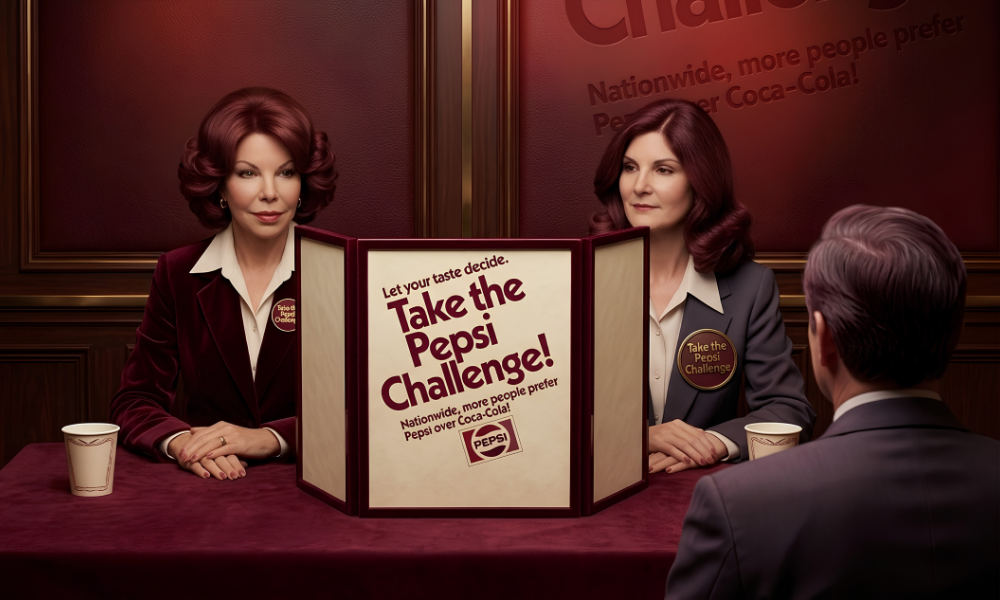
Launched in 1975 in Dallas, Texas, the campaign was architecturally simple: set up tables in shopping malls, supermarkets, and state fairs, give shoppers unmarked cups of Pepsi and Coca-Cola, ask them which they preferred.
By the early 1980s, the Pepsi Challenge had propelled Pepsi’s U.S. market share significantly, and the results, with participants consistently preferring Pepsi in blind conditions, were used in national television advertising to erode Coca-Cola’s psychological hold on loyal consumers.
The campaign’s genius wasn’t just the taste test result. It was the reframing.
Pepsi didn’t try to out-heritage Coca-Cola. It didn’t claim to be older, more American, or more iconic. Instead, it shifted the entire competitive conversation from brand prestige to empirical preference, a battleground where Coca-Cola had no inherent advantage, and Pepsi had carefully engineered one.
What It Forced
The Pepsi Challenge drove Coca-Cola into one of the most catastrophic own goals in corporate history.
Panicked by Pepsi’s taste-test victories and market share gains, Coca-Cola reformulated its flagship product in 1985 and launched “New Coke”, sweeter, designed specifically to beat Pepsi in blind tests.
The consumer backlash was immediate, emotional, and operatically disproportionate. Coca-Cola reversed course within 79 days, relaunching “Coca-Cola Classic” and in doing so, inadvertently running one of the most successful brand loyalty campaigns ever.
The lesson that reverberated through every marketing department in America: brand identity is more powerful than product formulation. Consumers weren’t just drinking Coke. They were defending something.
More recent research confirms this. Studies published in the Journal of Sensory Studies found that when participants taste both colas blind, they cannot reliably distinguish between them. The perceived differences between the two drinks are more a product of marketing and brand associations than actual flavor distinctions.
Coca-Cola had turned nearly identical caramel water into an icon of cultural identity, and Pepsi’s Challenge, for all its tactical brilliance, ultimately proved the same point.
What It Teaches
For modern marketers, the Pepsi Challenge remains the canonical case study in challenger brand strategy. Pepsi didn’t need to be bigger than Coca-Cola. It needed to change what the competition was about.
That instinct, finding a frame where the underdog wins, is exactly what Pepsi has returned to with its 2025 revival of the Challenge, relaunching it as a nationwide taste tour for Pepsi Zero Sugar and explicitly invoking the 50-year-old original to position the brand as bold, empirical, and unafraid.
The Michael Jackson Years: Pepsi Invents the Celebrity Collaboration Playbook
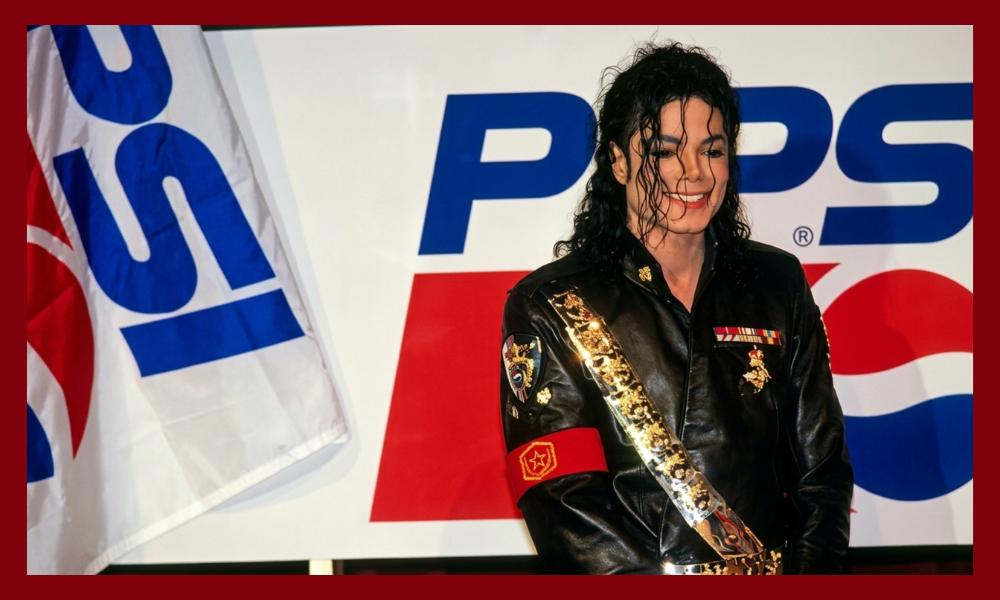
Before Beyoncé brand deals. Before Taylor Swift exclusives. Before Charli XCX at H&M Times Square concerts. There was Michael Jackson and Pepsi in 1984.
The 1984 Pepsi advertisements featuring Michael Jackson, part of the “New Generation” campaign, amplified the brand’s challenger identity by transforming a soda endorsement into a high-profile cultural event, with Jackson’s performance drawing massive viewership and boosting Pepsi’s image as a youthful, rebellious alternative to Coca-Cola.
The strategic logic was precise. Pepsi aligned itself with music, sports, and entertainment figures who embodied youthful exuberance, a “challenger” brand archetype that celebrated human emotion and encouraged consumers to connect with Pepsi’s messages on a personal level.
Over the following decades, the brand recruited Britney Spears, Beyoncé, and generations of cultural icons to amplify its campaigns.
Coca-Cola, meanwhile, was building something different. Not a celebrity roster, a cultural value system.
The Coca-Cola brand invested in happiness as a universal proposition. “I’d Like to Buy the World a Coke.” “Open Happiness.” “Taste the Feeling.” Each campaign was less about a spokesperson and more about a feeling, one that cut across demographics, markets, and decades in ways that no individual celebrity partnership could.
Both strategies were correct. Both were building very different brands for very different reasons.
The Revenue Reality: Two Very Different Companies
Before going further into marketing philosophy, it’s worth understanding the fundamental business model divide, because it shapes every marketing decision both companies make.
Coca-Cola is a focused beverage company. It primarily manufactures, markets, and sells beverages through a franchise bottling system, with an operating model designed around global scale, licensing fees, and concentrated marketing investment in its core brands.
PepsiCo is a diversified food and beverage conglomerate. PepsiCo reported $91.5 billion in revenues for fiscal 2023, while Coca-Cola’s revenues were around half of that at $45.8 billion, because more than 60% of PepsiCo’s revenue comes from its food and snack divisions, including Frito-Lay, Lay’s, Doritos, Quaker, and Gatorade.
This revenue structure explains a great deal about how each brand markets itself.
Coca-Cola’s marketing budget is almost entirely concentrated on beverage brand building, global campaigns, emotional storytelling, cultural moments. Every dollar spent defends or extends the core proposition.
PepsiCo’s marketing budget serves a more diverse portfolio. Pepsi the cola brand competes with Coca-Cola’s cola brand, but PepsiCo as a company competes in snacks, sports drinks, juices, and health foods simultaneously.
PepsiCo consistently generates higher absolute revenue, though Coca-Cola demonstrates far less quarter-over-quarter fluctuation. That stability reflects the difference between a pure-play brand machine and a diversified conglomerate. And it has enormous implications for how each brand shows up digitally.
The Stock Tells the Story
Coca-Cola stock has significantly outperformed PepsiCo over the past two years, shares up approximately 36% compared to PepsiCo’s 12% decline. This divergence highlights how investors, in the current climate, are rewarding focused brand clarity over diversified revenue scale.
For CMOs studying this rivalry, that signal matters. Market cap isn’t a marketing metric, but consistent investor confidence in a brand’s clarity is.
Head-to-Head: The Marketing Stack Comparison
| Dimension | Coca-Cola | Pepsi |
| Core brand proposition | Happiness, togetherness, universal connection | Youth culture, music, challenger energy |
| Revenue (2024) | ~$47B (beverages only) | ~$91B+ (beverages + food) |
| Marketing approach | Emotional legacy + AI innovation | Pop culture + celebrity + rebrand aggression |
| AI marketing activity | “Create Real Magic” + new CDO role | Moderate; focus on digital-native campaigns |
| Social media tone | Aspirational, inclusive | Provocative, trend-reactive |
| Key demographic target | Global, cross-generational | Gen Z, millennials |
| Recent brand signal | Appointed Chief Digital Officer (2026) | Full rebrand + 2025 Pepsi Challenge revival |
| Celebrity strategy | Cultural events and partnerships | Music/sports icon heavy |
| Stock performance (2yr) | +36% | -12% |
| Brand value ranking | Top 10 global brands | Top 100, +17% brand value increase 2022–23 |
The Digital Pivot: How Both Brands Rewired for the Algorithm
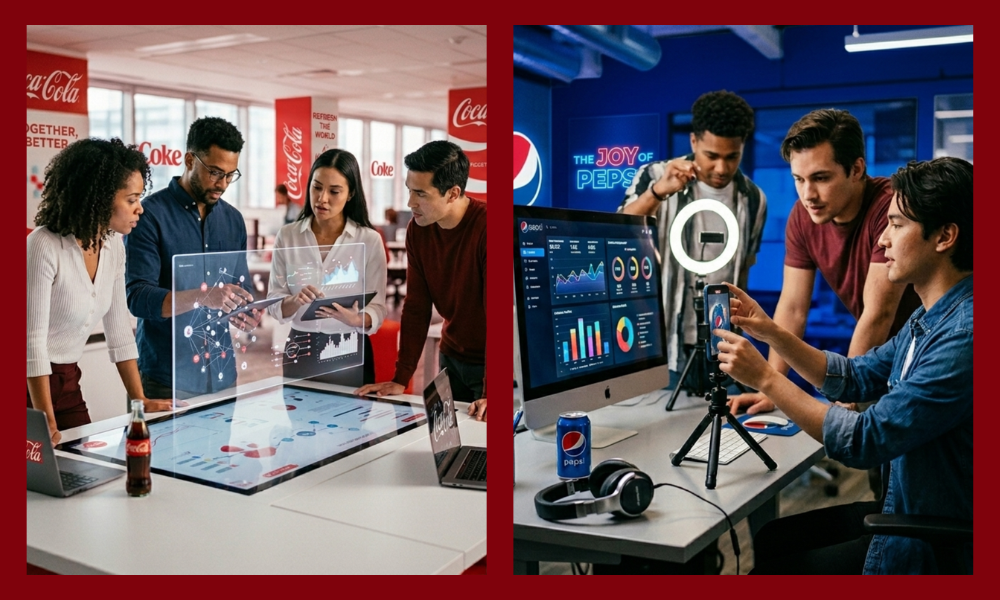
Coca-Cola’s Digital Transformation
Coca-Cola entered the digital era with an enormous structural advantage: the most recognized brand identity on earth.
Its “Share a Coke” campaign, launched in Australia in 2011 and expanded globally through 2013–14, became the first great social media marketing case study of the consumer brand world. The idea was deceptively simple: replace the Coca-Cola logo on bottles and cans with consumers’ first names. The results were staggering.
The campaign generated a 7% increase in sales among young adults and reversed a decade of declining revenue in the US market. More than 500,000 photos were shared using the #ShareACoke hashtag, Coca-Cola gained roughly 25 million new Facebook followers, and the hashtag became a global trending topic.
The campaign expanded to over 80 countries and 500,000+ names, proof that personalisation at industrial scale was possible before personalisation became a marketing buzzword.
What made it work wasn’t the technology. It was the insight: names are the most personal things we own. Give consumers a Coke bottle with their name on it and you’ve turned a commodity product into a personal artifact. Social sharing does the rest.
Industry Impact: “Share a Coke” established the template for UGC-powered brand campaigns that the entire industry has followed for a decade. Every “share this with your [person]” campaign since owes a structural debt to Coke’s 2011 innovation.
Coca-Cola Meets Generative AI
If “Share a Coke” was Coca-Cola’s first great digital marketing breakthrough, its “Create Real Magic” platform may be its second.
Coca-Cola unveiled an AI platform that was among the first of its kind to combine OpenAI’s GPT-4 and DALL-E technologies, developed through a partnership between OpenAI and Bain & Company. Consumers could access Coke-branded design elements to create original AI artwork, with the best submissions featured on digital billboards in Times Square and London’s Piccadilly Circus.
Coca-Cola’s global CMO described it as “just scratching the surface of what we believe will help create the industry’s most effective and efficient end-to-end marketing model.”
That wasn’t marketing speak. It was a genuine strategic signal.
In early 2026, Coca-Cola announced the creation of a new Chief Digital Officer role, specifically designed to unify digital strategy, data infrastructure, and operational excellence across the entire company. The CDO was tasked with integrating the company’s digital network and accelerating end-to-end transformation from strategy to execution.
Creating a CDO role at this level of the organization signals something important: Coca-Cola is treating digital not as a marketing channel, but as an enterprise-wide capability. That’s a different kind of ambition than running good social media campaigns.
Pepsi’s Digital Bet: Identity for the Algorithm
Pepsi took a different approach to digital transformation. Rather than leading with AI infrastructure, it led with brand identity redesign.
In 2023, Pepsi unveiled its first new logo and visual identity in 14 years, introducing electric blue and black into the classic color palette, a bold custom typeface, and an animated “pulse” signature specifically designed for digital-first environments.
The new identity was engineered to move fluidly across physical and digital touchpoints, from packaging and fountain equipment to fashion and social media animation.
PepsiCo’s chief design officer described the goal: to design a modern brand that unlocks flexibility to move between physical and digital spaces, introducing movement and animation into the visual system.
This is smart digital strategy. In an environment where brand identity must perform at speed, in TikTok thumbnails, Instagram Reels, animated social posts, a visual system with inherent motion capabilities is a genuine competitive asset. Static logos designed for print media don’t perform the same way in a kinetic digital environment.
The rebrand also carried a secondary signal: Pepsi Zero Sugar. The black element in the new palette was explicitly linked to Pepsi’s zero-calorie line, a strategic bet that the health-conscious consumer trend would continue to reshape the beverage market.
The Social Media Battlefield: Tone, Tactics, and Tribal Identity
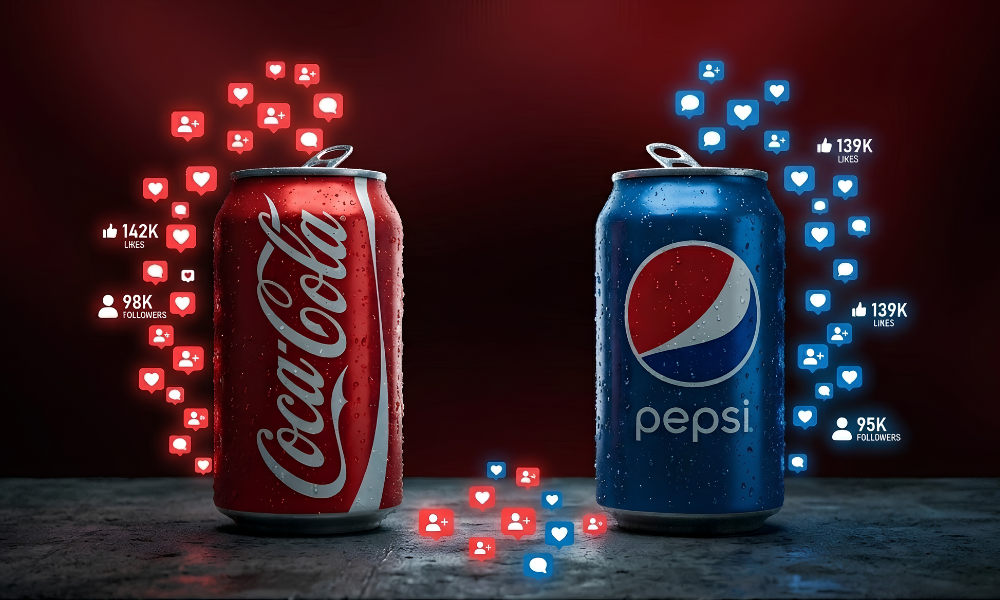
Where Each Brand Lives Online
Both Coca-Cola and Pepsi are described in current analysis as running strategies that are comparable and defensive, with Coca-Cola taking a more international approach and Pepsi focusing more sharply on the US market.
On TikTok, Pepsi boasts 1.1 million fans compared to 915,000 for Coca-Cola. The gap is narrow and the absolute numbers are modest for brands at this scale, which tells you something important. Neither brand is a TikTok-native success story. Both are trying to translate legacy brand equity into an algorithmic format that rewards authenticity over production value.
Coca-Cola’s social media strategy leans into aspirational inclusivity. Its visual identity, the red, the bottle silhouette, the script logo, is so distinctive that even minimal production creates recognizable brand content. The brand’s content philosophy mirrors its campaign history: put the feeling first, the product second.
Pepsi’s social tone is more provocative, more reactive, and more willing to engage in the kind of platform-native humor that Gen Z responds to. Where Coca-Cola posts editorial beauty, Pepsi posts cultural commentary. Where Coke creates emotional moments, Pepsi creates arguments.
Neither strategy is superior in isolation. Both are coherent with their respective brand personalities, and the question of which will win with Gen Z and Gen Alpha is genuinely open.
The Generational Challenge
The challenge both brands face in the social era is structural, not tactical.
Both soda brands have connections to sport, with Coca-Cola still a main sponsor of the FIFA World Cup. Pepsi was the key sponsor of the Super Bowl halftime show until 2022, when it shifted focus toward streaming and digital platform advertising, a move that signals real strategic intent to follow younger audiences to where they actually consume media.
Soccer or football events are brand investments that primarily target consumers aged 30+, who have already decided their preferred beverage. The challenge is to connect with the 12–27-year-old Gen Z demographic, social media-savvy spenders who are still forming their brand allegiances.
This is where the Cola Wars become genuinely consequential for the next decade. Gen Z is the prize. Neither brand has decisively won them.
Market Observation: While Coca-Cola thrives in markets valuing tradition and emotional connection, Pepsi often excels in regions where pop culture, youth identity, and rapid cultural shifts dominate. Geographically, this maps onto the brand war’s global arc, Coca-Cola stronger in legacy markets, Pepsi more competitive in high-growth youth-driven regions.
The Bigger Shift: From Product Wars to Identity Wars
Why This Rivalry Matters Beyond Cola
The most important thing to understand about the Cola Wars in 2026 is that neither Coca-Cola nor Pepsi is fundamentally a beverage company anymore.
Both are identity companies that happen to sell beverages.
This wasn’t always true. For most of the 20th century, the Cola Wars were fought over distribution networks, price points, fountain contracts, and shelf space. Marketing was important, but it was one weapon among many.
In the digital era, the product matters less and the brand experience matters more. When research consistently shows that consumers cannot distinguish between Coke and Pepsi in blind taste tests, that perceived differences are a product of marketing, not flavor, you’re no longer competing on product quality. You’re competing on meaning.
And in the competition for meaning, the digital era has fundamentally changed what “winning” looks like.
Consistency vs. Virality
Coca-Cola has historically chosen consistency. Its brand identity, red, classic, global, emotional, timeless, has remained recognizable across 140 years, dozens of campaign platforms, and hundreds of individual executions.
The brand rarely chases trends. It rarely responds to Pepsi directly. It creates the emotional frame and trusts consumers to enter it.
Pepsi has historically chosen virality. Its greatest marketing moments, the Pepsi Challenge, the Michael Jackson campaign, the 2023 rebrand, the Pepsi Challenge revival, are about disruption. Breaking into the conversation. Getting people to look up and reconsider something they thought they already knew.
Expert Insight: The tension between consistency and virality is one of the most enduring strategic questions in brand marketing. Coca-Cola’s model builds multigenerational brand equity that compounds over decades. Pepsi’s model maximizes cultural relevance in the moment. Both require discipline to execute, and both fail when they drift from their core logic.
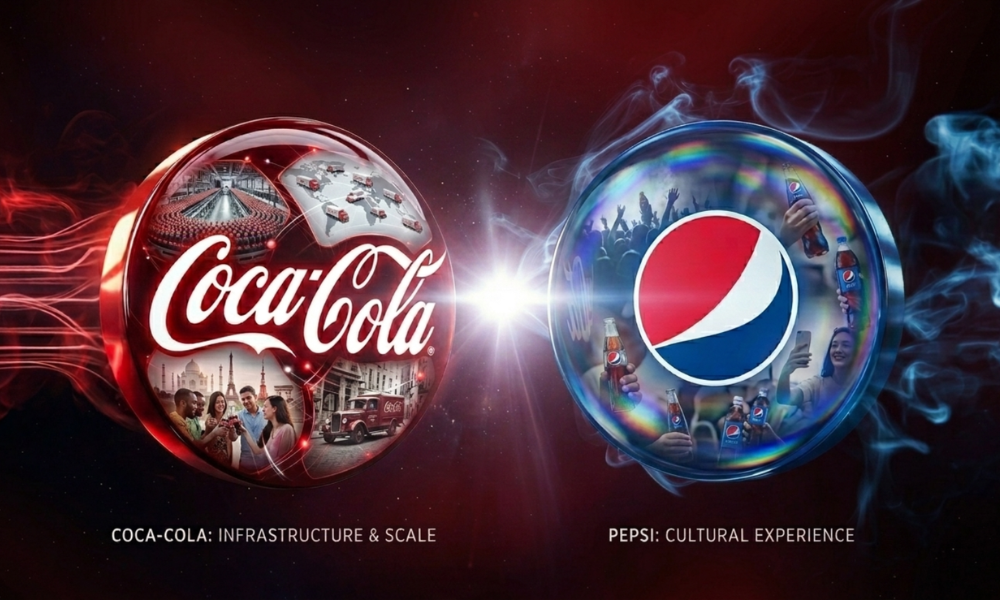
The AI Frontier: Who Has the Better Long Game?
Coca-Cola’s AI Ambition
Coca-Cola’s “Create Real Magic” wasn’t just a consumer engagement campaign. It was a proof of concept for a fundamental rethinking of how the brand produces content at scale.
The logic is straightforward. A brand with Coca-Cola’s global footprint needs to produce an enormous volume of marketing content across hundreds of markets, dozens of languages, and thousands of consumer touchpoints.
AI-powered content production, with brand assets, guardrails, and creative direction built in, doesn’t replace the creative function. It scales it.
The Chief Digital Officer appointment in 2026 confirms this is a strategic commitment, not an experimental activation. Coca-Cola is building toward a future where AI infrastructure powers the entire marketing system, from consumer research to content creation to performance optimization.
Strategic Breakdown: For enterprise brands watching this rivalry, Coca-Cola’s AI infrastructure investment is the more important signal. It points toward a world where brand consistency is maintained not by rigid campaign guidelines but by intelligent systems that know the brand’s identity better than most individual creators do.
Pepsi’s AI Position
Pepsi’s approach to AI marketing has been more cautious and culturally focused. Rather than building AI infrastructure, the brand has leaned into cultural events, physical experiences, and digital activations that respond to the AI moment without necessarily building for it.
The 2025 Pepsi Challenge revival, updated for Pepsi Zero Sugar and designed to tour the country with a new visual identity built specifically for digital motion, is more experiential than technological. It invites participation. It generates UGC. It revives a half-century of brand mythology for an audience that was born long after the original.
That’s a smart play. Nostalgia combined with participatory experience is one of the most reliable engagement formulas in digital marketing. But it’s a marketing tactic, not a platform-level transformation.
Tactical Framework: What Marketers Can Take From Each Playbook
From Coca-Cola
- Brand consistency is a compound asset. Every consistent execution adds to the emotional equity accumulated over 140 years. The investment in a unified visual identity, tone, and emotional proposition pays dividends that individual campaigns can’t replicate.
- AI marketing requires infrastructure, not just activation. Coca-Cola’s move to appoint a CDO signals that serious AI marketing isn’t running a viral campaign, it’s rebuilding the enterprise architecture so that AI is embedded in every stage of the content and insights pipeline.
- Personalization at scale is the next frontier. “Share a Coke” proved that personalizing a mass-market product generates extraordinary social sharing. AI now allows this to happen not on millions of bottles, but on millions of individual content pieces served to individual consumers. That’s the logical next chapter.
- Emotional marketing is data-resistant. Blind taste tests consistently show parity between the two colas. Coca-Cola’s market position cannot be dislodged by product evidence, because it was never built on product evidence. The brand equity is stored in emotional memory, not rational preference.
From Pepsi
- Challenger strategy requires perpetual reinvention. Pepsi’s most effective moments come from reframing the competitive conversation, the Pepsi Challenge attacked taste, Michael Jackson attacked culture, the 2023 rebrand attacked digital relevance. The common thread is refusing to fight on the market leader’s terms.
- Rebrand for the format, not just the audience. The 2023 Pepsi visual identity redesign was explicitly engineered for digital motion and animation. This is the right order of operations, designing the brand system before redesigning the content. Most brands do it backwards.
- Own a cultural territory, then defend it aggressively. Pepsi’s association with music and youth culture isn’t a campaign mechanic, it’s a brand platform. Owning “the drink of the new generation” has given Pepsi a coherent framework for celebrity partnerships, sponsorships, and digital activations for four decades.
- Revivals require new context. The Pepsi Challenge 2025 isn’t just a nostalgia play, it’s repositioned around Pepsi Zero Sugar, targeting both old loyalists and new health-conscious consumers. Reviving a historic campaign without updating its context is tribute content. Reviving it with a new strategic frame is brand evolution.
Enterprise Perspective: The Boardroom View
For CMOs and growth leaders watching this rivalry from the outside, the structural question is this: which model scales more efficiently in the digital era?
Coca-Cola’s model, focused brand, consistent identity, AI-powered content infrastructure, is optimized for depth. It builds brand equity that compounds, creates content that scales, and maintains a unified consumer experience across global markets.
PepsiCo’s model, diversified portfolio, category-specific marketing, cultural moment capture, is optimized for breadth. It can respond faster to cultural shifts, activate across multiple categories simultaneously, and absorb product-level failures without existential brand damage.
In the current environment, where attention is fragmented, Gen Z is still forming brand loyalties, and AI is reshaping content production, Coca-Cola’s focused model appears structurally better positioned.
But dismissing Pepsi is a mistake that analysts have made repeatedly for 130 years. Every decade, the challenger finds a new frame.
Why It Matters: The Cola Wars are not an artifact of 20th-century marketing. They are a live real-time experiment in the limits of brand power, the leverage of challenger strategy, and the intersection of AI infrastructure with consumer psychology. Every CMO who studies this rivalry closely is studying the future of their own industry.
What Happens Next
Coca-Cola is building the digital infrastructure for the next century of the brand war. The Chief Digital Officer appointment, the “Real Magic” AI platform, and the €-scale investment in content personalization infrastructure signal a brand that intends to own the AI marketing era as completely as it owned the television advertising era.
The company’s 2025 performance confirms the trajectory: Coca-Cola reported organic revenue growth of 6% in Q3 2025, with margin expansion despite currency headwinds and a global trade environment that rattled most consumer goods companies.
Pepsi’s trajectory is more complex. PepsiCo cut its full-year forecast in 2025, citing tariffs, economic volatility, and a more cautious consumer in North America. The beverage division faces ongoing pressure from zero-calorie competitors, health-conscious consumer shifts, and the same Gen Z disconnection that Coca-Cola is grappling with.
But Pepsi’s challenger instinct, visible in the Zero Sugar pivot, the 2023 rebrand, and the Pepsi Challenge revival, suggests a brand that knows how to navigate adversity. It has done it before: two bankruptcies, New Coke, the Super Bowl exit. Every time Pepsi has appeared to be losing, it has found a new frame.
In 2026, that frame appears to be digital-first brand identity paired with a cultural challenger narrative built around Gen Z’s taste for authenticity, nostalgia-remix, and zero-compromise product positioning.
Key Takeaways
- The Cola Wars were never really about taste, and the digital era proves it. Blind taste tests have consistently shown consumer parity between the two colas for decades. The competition was always about identity, cultural meaning, and the psychology of loyalty. Digital marketing has made this even more true.
- Coca-Cola’s AI infrastructure investment is the most significant brand marketing move of 2026. Creating a Chief Digital Officer role specifically to unify data, AI, and marketing at the enterprise level signals a company rebuilding its entire content and insights architecture for the AI era, not just running AI campaigns.
- Pepsi’s 2023 rebrand was designed for the algorithm, not the shelf. Introducing motion, animation, and digital flexibility into the visual identity system was the right strategic decision for a brand competing in a content environment that rewards kinetic, shareable, platform-native visuals.
- Both brands are competing for Gen Z with different strategies. Coca-Cola is pursuing Gen Z through consistent emotional resonance and AI-powered personalization. Pepsi is pursuing them through cultural alignment, nostalgia-remix, and a Zero Sugar repositioning that speaks to health-conscious consumption behavior.
- The revenue structure tells you what the marketing must do. Coca-Cola’s beverage-only model requires that every marketing dollar protect and extend the core emotional proposition. PepsiCo’s diversified model allows more flexibility but also demands more coordination across competing internal brand priorities.
- Challenger strategy requires perpetual reinvention. Pepsi’s greatest failures have come when it tried to compete on Coca-Cola’s terms, legacy, permanence, universal belonging. Its greatest successes, the Pepsi Challenge, the Michael Jackson campaign, the Zero Sugar rebrand, came from inventing a new competitive frame entirely.
- The Cola Wars are the most valuable free education in brand strategy ever created. Every major principle of modern marketing, from challenger positioning to emotional branding to AI-powered content to UGC campaigns, has a canonical illustration somewhere in this 130-year-old rivalry. Marketers who ignore it are ignoring a century of documented evidence.
Conclusion
The question “who’s winning the Cola Wars?” has never had a clean answer, and it never will.
Coca-Cola wins on brand equity, consistency, stock performance, and the long arc of cultural trust. It has spent 140 years building an emotional proposition so durable that no product parity research, no taste test campaign, and no algorithmic disruption has ever permanently dented it.
Pepsi wins on cultural agility, demographic relevance, and the relentless willingness to reframe. It has spent 130 years refusing to accept the terms of competition that the market leader preferred, and in doing so, it has repeatedly forced its rival to make expensive, sometimes disastrous, reactionary moves.
In the digital era, both brands are being tested in new ways. The feed rewards virality, but brands that chase virality without identity end up with moments and no moat.
The algorithm rewards consistency, but brands that prioritize consistency over cultural relevance end up speaking to audiences that are aging out of the market.
Coca-Cola’s AI infrastructure investment is the more significant long-term play. Building intelligence into the enterprise, rather than just into campaigns, is how a 140-year-old brand stays relevant across every future platform, every new format, and every emerging generation of consumers it hasn’t met yet.
Pepsi’s challenger instinct is still its most valuable asset. No brand has ever been more creative about losing, and no brand has ever extracted more marketing leverage from the underdog position.
In 2026, the Cola Wars are more instructive than ever. Not because the product has changed, it hasn’t, in any meaningful way, for most of the last century.
But because the two strategies being executed in real time represent the two most coherent paths available to any large brand trying to navigate the AI era, the Gen Z transition, and the fragmentation of attention.
One bets on depth. One bets on disruption.
The market will tell us, eventually, which bet pays off.
Until then, the brand war continues. And for marketers paying close attention, that’s not a problem. That’s the curriculum.
FAQ: Coca-Cola vs. Pepsi Digital Marketing
Q: Who is winning the Cola Wars in 2026, Coca-Cola or Pepsi?
On pure financial metrics, Coca-Cola holds the stronger position. Its stock has outperformed PepsiCo significantly over the past two years, and its beverage-only focus produces more stable, predictable margin performance. In digital marketing and brand perception, Coca-Cola leads with a more cohesive AI marketing strategy, while Pepsi competes aggressively through cultural sponsorships, its 2023 rebrand, and a challenger mindset that continues to resonate with younger consumers.
Q: What was the Pepsi Challenge and why did it matter for marketing history?
Launched in 1975, the Pepsi Challenge invited shoppers to blind taste-test both colas in public venues. Pepsi consistently won, and PepsiCo used these results in national advertising to erode Coca-Cola’s dominance. The campaign forced Coca-Cola into the catastrophic “New Coke” reformulation and permanently established Pepsi as a legitimate challenger. It remains the canonical case study in how an underdog brand can reframe competitive conversation.
Q: How is Coca-Cola using AI in its marketing strategy?
Coca-Cola launched the “Create Real Magic” platform using GPT-4 and DALL-E, allowing consumers and artists to create original AI artwork with Coca-Cola brand assets. It used AI for its 2024 holiday campaign. In 2026, Coca-Cola created a new Chief Digital Officer role to unify data, AI, and operational excellence enterprise-wide.
Q: How do Coca-Cola and PepsiCo’s business models differ?
Coca-Cola is a focused beverage company using a franchise bottling model. PepsiCo is a diversified food and beverage conglomerate with more than 60% of revenue from food and snack divisions. PepsiCo generates nearly double Coca-Cola’s revenue in absolute terms, but Coca-Cola’s pure-play model produces more consistent margins and stronger stock performance.
Q: What was Pepsi’s 2023 rebrand and why was it significant?
Pepsi unveiled its first new logo in 14 years, introducing electric blue and black, a bold custom typeface, and an animated “pulse” designed specifically for digital environments. The rebrand was engineered to move fluidly across digital and physical touchpoints, explicitly designed to appeal to Gen Z and signal Pepsi’s strategic commitment to its Zero Sugar line.
Q: What can modern marketers learn from the Coca-Cola vs. Pepsi brand war?
The rivalry offers several enduring lessons: challenger brands should reframe the competitive conversation rather than fight on the market leader’s terms; emotional brand identity outperforms product claims over the long run; and the digital era requires choosing between consistency and virality, with both approaches requiring executional discipline to work.