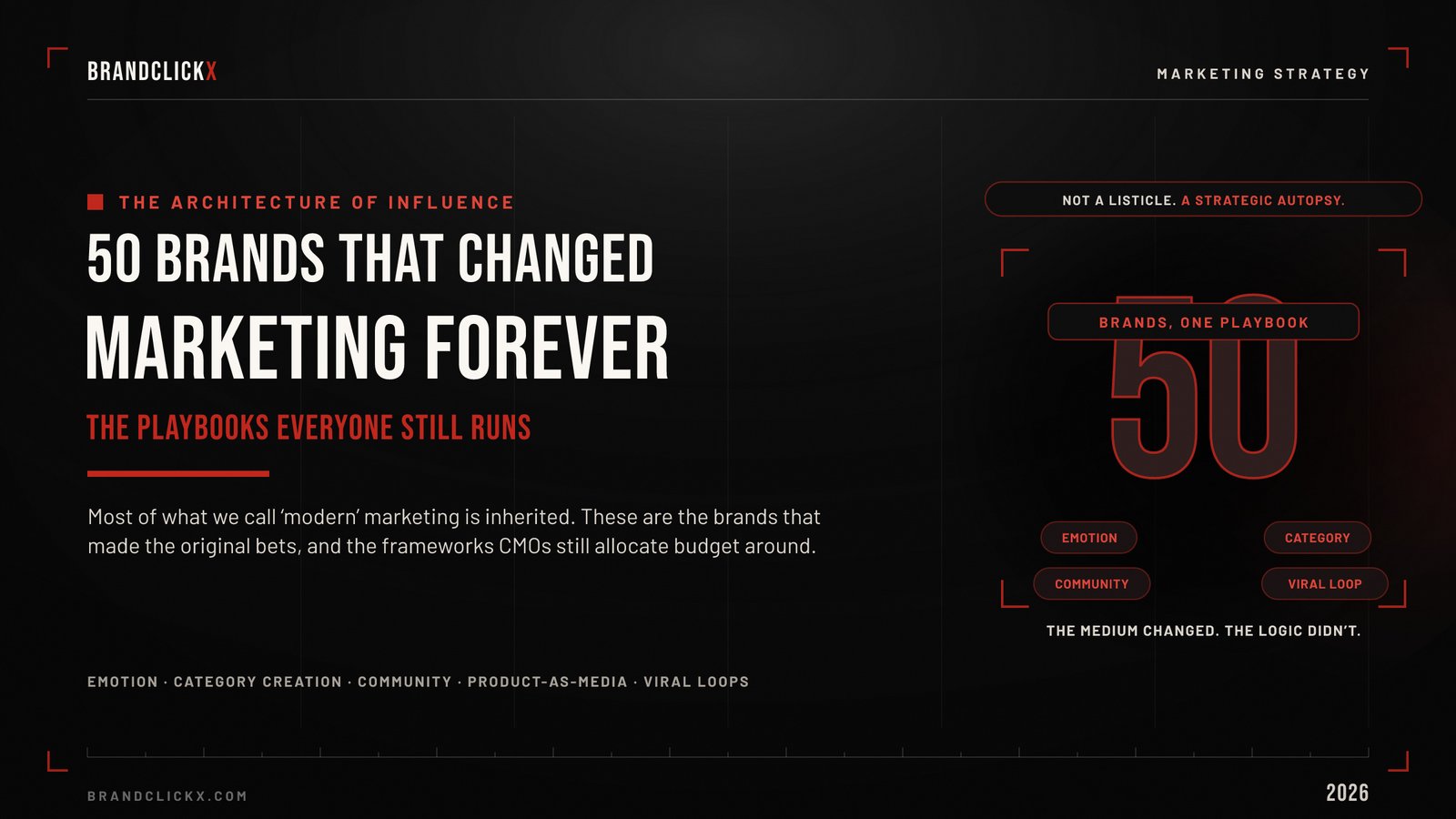
Introduction: The Architecture of Influence
Marketing has a short memory. In an industry that reinvents its vocabulary every 18 months, from funnel marketing to flywheel, from growth hacking to brand-led growth, it’s easy to forget that most of what we consider “modern” is actually inherited.
The programmatic ad buying, the emotional storytelling, the community-first brand architectures, the influencer ecosystems, none of these emerged from algorithm updates or venture-backed software platforms. They were built, brick by brick, by brands that were willing to bet on ideas that had no precedent.
According to Kantar’s 2025 BrandZ Global Report, brands that invest in long-term brand building generate 50% more value per marketing dollar than those focused exclusively on performance channels. But the irony is that most of the brands setting that standard today are standing directly on the shoulders of companies that made those bets 20, 40, or even 100 years ago.
This is not a listicle. It’s a strategic autopsy.
The 50 brands profiled here aren’t ranked by revenue or market cap. They’re selected for the lasting structural change they caused, the playbooks they introduced, the industry behaviors they normalized, and the frameworks that still govern how CMOs allocate budgets and creative teams build campaigns today.
Understanding how brand strategy actually works at scale means tracing these original bets back to their source.
Some of these brands are still dominant. Others have faded or failed. But their marketing legacy is either still active in the industry or has been directly inherited by the brands that replaced them.
Consider this your field guide to understanding where modern marketing came from, and why the best practices of 2026 are often just reruns of brilliant thinking from decades past.
Part I: The Pioneers Brands That Invented Modern Marketing
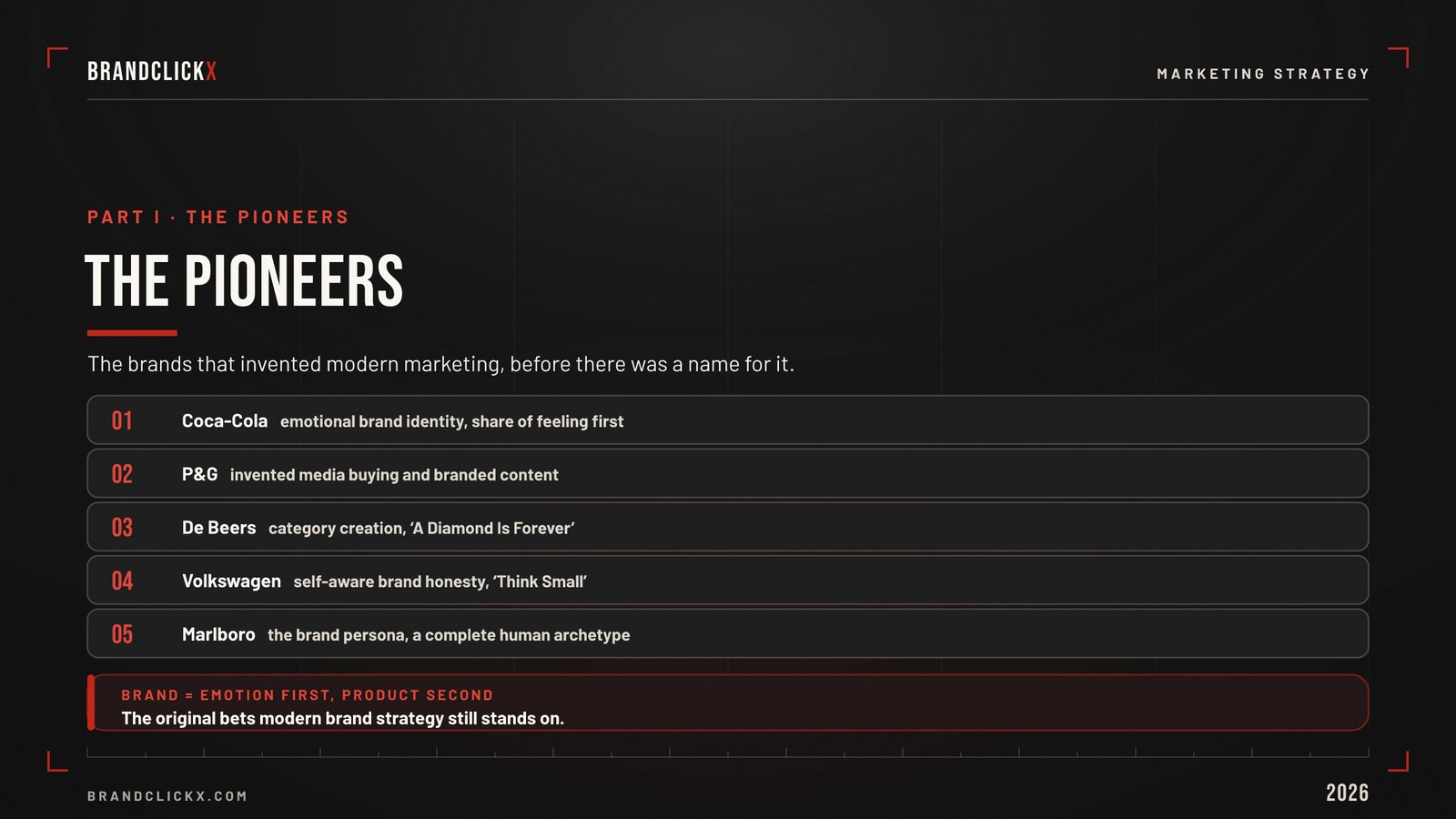
1. Coca-Cola, The Architect of Emotional Brand Identity
Before Coca-Cola, advertising was largely transactional. Products were described. Prices were stated. Benefits were listed. Coca-Cola changed all of that with a deceptively simple idea: what if a product wasn’t just purchased, but felt?
The brand’s 1931 collaboration with illustrator Haddon Sundblom to create the modern image of Santa Claus is perhaps the most documented example of brand mythology building in marketing history.
Coca-Cola didn’t invent Santa, but it standardized a visual identity so thoroughly that the red-and-white jolly figure became globally synonymous with both Christmas and the brand simultaneously.
Why It Matters: This was the first major case study in what we now call emotional brand architecture, the deliberate construction of feelings, associations, and cultural meaning around a product that has no inherent emotional value on its own. For a deep dive into building this layer for modern brands, see our guide to emotional brand positioning in digital-first markets.
Strategic Breakdown: Coca-Cola’s genius was understanding that share of feeling precedes share of wallet. Every “Share a Coke” campaign, every holiday ad, every “Open Happiness” tagline is a direct descendant of this original insight.
The Bigger Shift: Modern brand strategy, from Nike to Airbnb, is built on this exact foundation. Brand = emotion first, product second.
2. Procter & Gamble The Inventors of Media Buying and Content Marketing
P&G didn’t just sell soap. It essentially invented the soap opera, a genre of entertainment designed specifically to deliver captive audiences to advertisers. When radio became the dominant media platform in the 1930s, P&G was already funding serialized drama programs aimed at housewives, embedded with subtle brand messaging.
This was content marketing before the term existed. It was also media buying in its most strategic form: don’t just advertise on the content, own the content entirely. The same logic now drives brand-owned content studio strategy for enterprise teams in 2026.
Expert Insight: P&G’s model of owning the media environment around its audience is precisely what Amazon did with Prime Video, what Red Bull did with its media house, and what dozens of SaaS brands are now attempting with original content studios.
Industry Impact: Every branded content play, every brand-owned podcast, every company that has pivoted to “media company” positioning is operating directly within P&G’s original framework.
3. De Beers The Most Effective Marketing Campaign in History
“A Diamond Is Forever” debuted in 1947. It was written by copywriter Frances Gerety of N.W. Ayer for De Beers. It is, by most accounts, the most financially successful advertising slogan ever written.
But the genius wasn’t the tagline. It was the entire manufactured mythology around which the tagline was anchored. De Beers didn’t just sell diamonds, it invented the cultural expectation that diamonds were the only appropriate symbol of romantic commitment. It created a market where none existed, then dominated it.
Tactical Framework: This is the playbook that SaaS brands now call category creation. You don’t compete in an existing market. You create the category, define its language, and position your product as the only logical answer to a problem you’ve convinced the market exists.
Market Observation: Salesforce did this with CRM cloud. HubSpot did this with “inbound marketing.” Gainsight did this with Customer Success. All three are running De Beers’ original operating system.
4. Volkswagen The Disruptors of American Advertising
In 1960, Volkswagen ran an ad with a tiny photo of the Beetle in the upper corner of a stark white page, under the headline: “Think Small.”
This was a direct challenge to every convention of American advertising at the time, big visuals, bold claims, aspirational framing. The Doyle Dane Bernbach-created campaign did the opposite and changed advertising forever. It embraced the car’s limitations (it was small, slow, and ugly by American standards) and made those limitations the charm.
Strategic Breakdown: The “Think Small” campaign introduced the concept of self-aware brand honesty, a technique that has since become the signature move of every challenger brand that ever admitted a flaw to build consumer trust. Dollar Shave Club’s launch video, Oatly’s anti-corporate copy, Patagonia’s “Don’t Buy This Jacket” ad, all direct descendants.
Enterprise Perspective: For marketing teams: the most dangerous thing a brand can do is tell the truth strategically. It signals confidence, earns credibility, and instantly differentiates against competitors who are still making claims nobody believes.
5. Marlboro The Transformation of Brand Persona
Before 1954, Marlboro was a women’s cigarette. Phillip Morris needed to pivot into the male market and turned to advertiser Leo Burnett, who created the Marlboro Man. Within a year, Marlboro’s sales increased by 5,000%.
The Marlboro Man wasn’t a product mascot. He was a complete brand persona, a fully realized human archetype into which consumers could project their own aspirations. Understanding brand archetype strategy starts here: this was the template that Nike, Apple, and Harley-Davidson all inherited.
Why It Matters: Every brand that claims an archetype, Nike as the Hero, Apple as the Creator, Harley-Davidson as the Outlaw, is working in Leo Burnett’s original framework.
Part II: The Television Age Brands That Built Mass Market Dominance
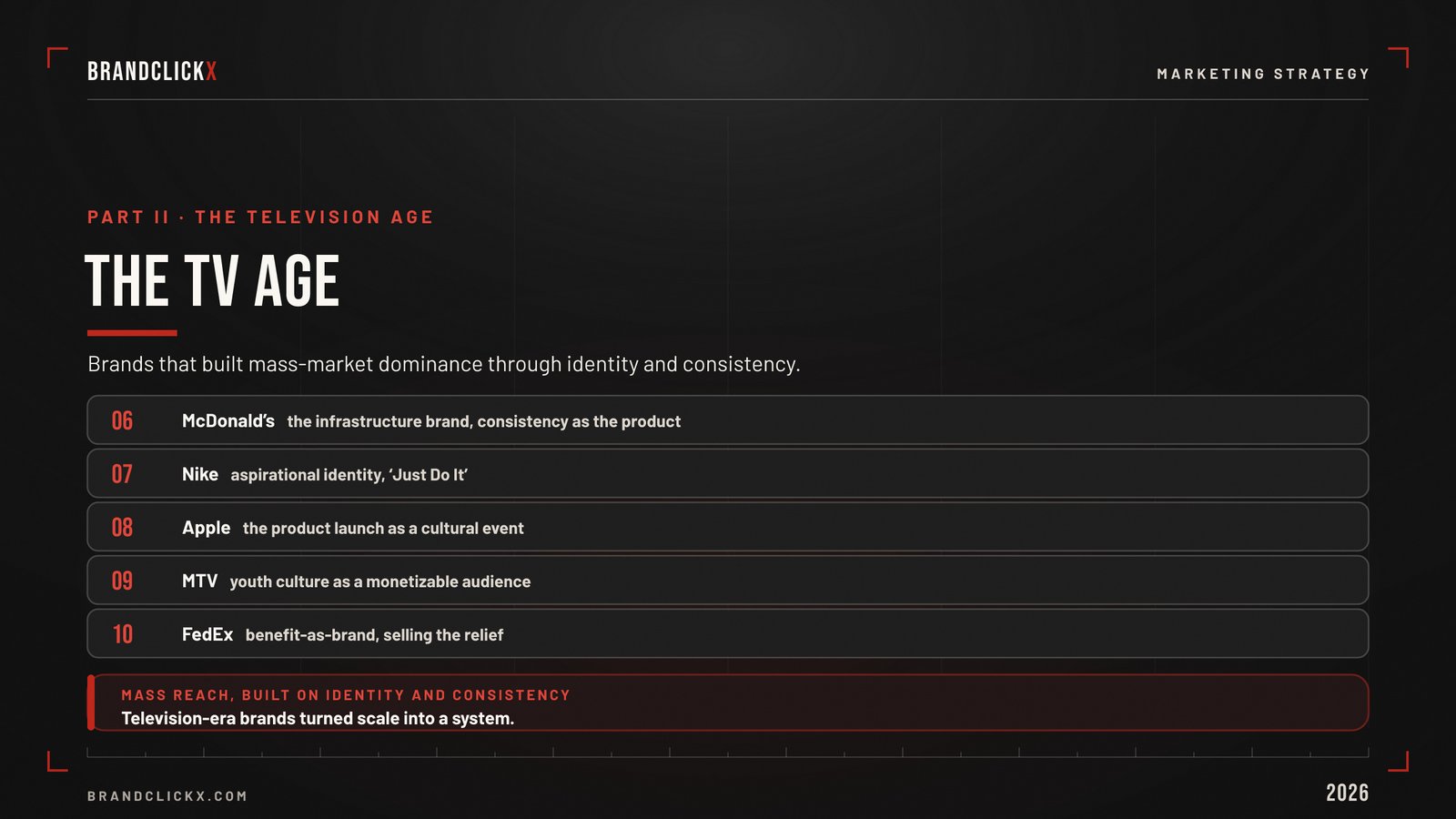
6. McDonald’s The Infrastructure Brand
McDonald’s didn’t just sell hamburgers efficiently. It built a visual, sensory, and experiential brand so consistent across 100+ countries that “consistency” itself became the product. The Golden Arches are the most recognized symbol in human history, more recognized globally than the Christian cross, according to multiple studies.
Tactical Framework: The McDonald’s playbook is the gold standard for franchise brand systems, consistent visual identity, standardized customer experience, localized cultural adaptation. It’s why Starbucks, Subway, and global SaaS brands obsess over brand standards documentation. The brand isn’t the logo.
The brand is the system. See how enterprise teams operationalize this in our breakdown of brand system design for scale.
7. Nike “Just Do It” and the Athlete-as-Identity Model
Nike’s 1988 “Just Do It” campaign is the most studied tagline in marketing academia, not because of the words, but because of what the words made possible. “Just Do It” had nothing to do with shoes. It was a philosophy. An identity. An invitation to join a community of people who pushed limits.
The Bigger Shift: Nike invented aspirational identity marketing, the idea that buying a product isn’t consumption, it’s self-declaration. This became the operating model of every lifestyle brand that followed: Lululemon, Peloton, Rapha, Supreme.
Future Outlook: In a world where AI makes product differentiation increasingly temporary, identity-layer marketing, the Nike model, is becoming the only durable moat. We explore this further in our analysis of AI’s impact on brand differentiation.
8. Apple The Reality Distortion Field as Marketing Infrastructure
Apple’s “1984” Super Bowl ad is the most written-about commercial in history. Directed by Ridley Scott, it ran once on national television and created more earned media than any planned campaign could have purchased.
But Apple’s real marketing achievement wasn’t any single campaign. It was Steve Jobs’ understanding that product launches are cultural events, retail stores are brand theaters, and every user interface decision is a brand statement.
Expert Insight: Apple made marketing invisible. It embedded brand experience into every touchpoint, packaging, typography, store architecture, keynote theater, so completely that “marketing” ceased to feel like marketing. It felt like membership in something meaningful.
Industry Impact: Every product launch that creates a queue. Every unboxing moment designed for social sharing. Every “Welcome to the ecosystem” onboarding experience. All of it is running Apple’s underlying code.
9. MTV The Birth of Youth Culture Marketing
When MTV launched in 1981, it didn’t just create a cable channel. It created an entirely new advertising medium, the music video, and established the model of youth culture as a distinct, monetizable audience segment.
Strategic Breakdown: MTV proved that young people could be reliably reached through culture-first, product-second positioning.
It also established the influencer model decades before Instagram existed: artists who appeared on MTV became the de facto endorsers of the brands that advertised around them. The evolution from MTV’s artist-as-endorser to today’s creator economy is a straight line.
10. Federal Express The Problem-First Marketing Era
FedEx’s “Absolutely, Positively Overnight” campaign in the 1970s was one of the first examples of benefit-as-brand positioning. The tagline didn’t describe the company. It described the relief the customer would feel.
Market Observation: Every SaaS startup pitch that opens with a customer pain point, every landing page headline that leads with “Stop wasting time on X,” every product demo that opens with a horror story, all of it is Federal Express’s original architecture.
Part III: The Digital Revolution Brands That Rewired Marketing for the Internet
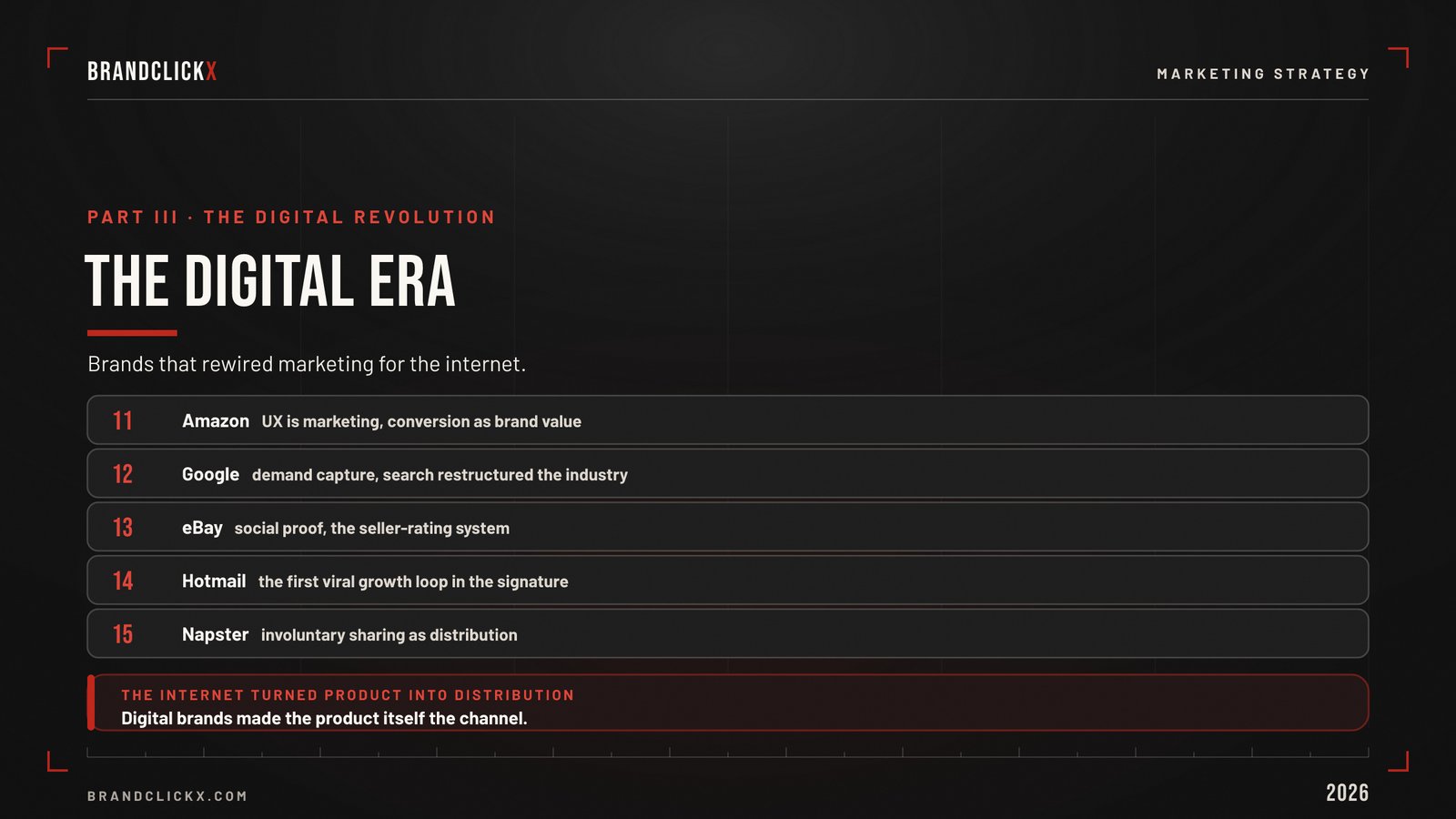
11. Amazon The Conversion Rate as Brand Value
Amazon’s early design philosophy, everything in service of the purchase decision, established conversion optimization as a marketing discipline. Jeff Bezos famously approved a checkout flow that removed every possible friction point, including the one-click patent that Amazon held for years.
Tactical Framework: Amazon established the principle that UX is marketing. Every abandoned cart email, every recommendation engine, every “customers who bought this also bought” prompt is a form of brand communication. The line between product and marketing disappeared. This thinking directly informs modern conversion rate optimization strategy.
12. Google Search as the Distribution Layer for All Marketing
Google didn’t change advertising. It restructured the entire marketing industry around a new fundamental logic: demand capture instead of demand creation.
Before Google, brands had to generate awareness, then desire, then action, all through interruption. After Google, brands could position themselves in front of audiences at the exact moment of intent. The search bar became the world’s most precise targeting tool.
The Bigger Shift: This gave rise to SEO as a discipline, PPC as a budget category, and content marketing as an organic search play. Every marketing team with a keyword strategy is operating inside Google’s original paradigm. For teams building their first search strategy, our enterprise SEO framework maps the full architecture.
13. eBay The Community Commerce Model
eBay built the first major trust infrastructure for online peer-to-peer commerce. The seller rating system was, functionally, an early form of social proof architecture, and it established the model that now drives Amazon reviews, Airbnb host ratings, Uber driver scores, and Yelp.
Industry Impact: Social proof is now one of the most studied conversion levers in digital marketing. It was invented, functionally, by eBay’s feedback system.
14. Hotmail The First Viral Growth Loop
When Sabeer Bhatia and Jack Smith launched Hotmail in 1996, they added a single line to every outgoing email: “Get your free email at Hotmail.” Every email sent was a distribution vehicle for user acquisition. Within 18 months, they had 12 million users.
Tactical Framework: This is the original growth hacking play, now called product-led growth. Every “Sent from my iPhone” signature, every “Powered by HubSpot” email footer, every Zoom background with a logo, every Loom video with a CTA, all operating on Hotmail’s 1996 insight.
15. Napster The Disruption Model as Involuntary Marketing Lesson
Napster didn’t have a marketing budget. It didn’t need one. Its product spread through peer networks with zero paid acquisition, and in doing so, taught the music industry, movie industry, and every incumbent that the most powerful distribution mechanism is when users want to share.
Future Outlook: The brands that grow fastest in 2026 are still running Napster’s playbook, social sharing built into the product architecture, not bolted on as an afterthought.
Part IV: The Social Era Brands That Built Marketing for the Attention Economy
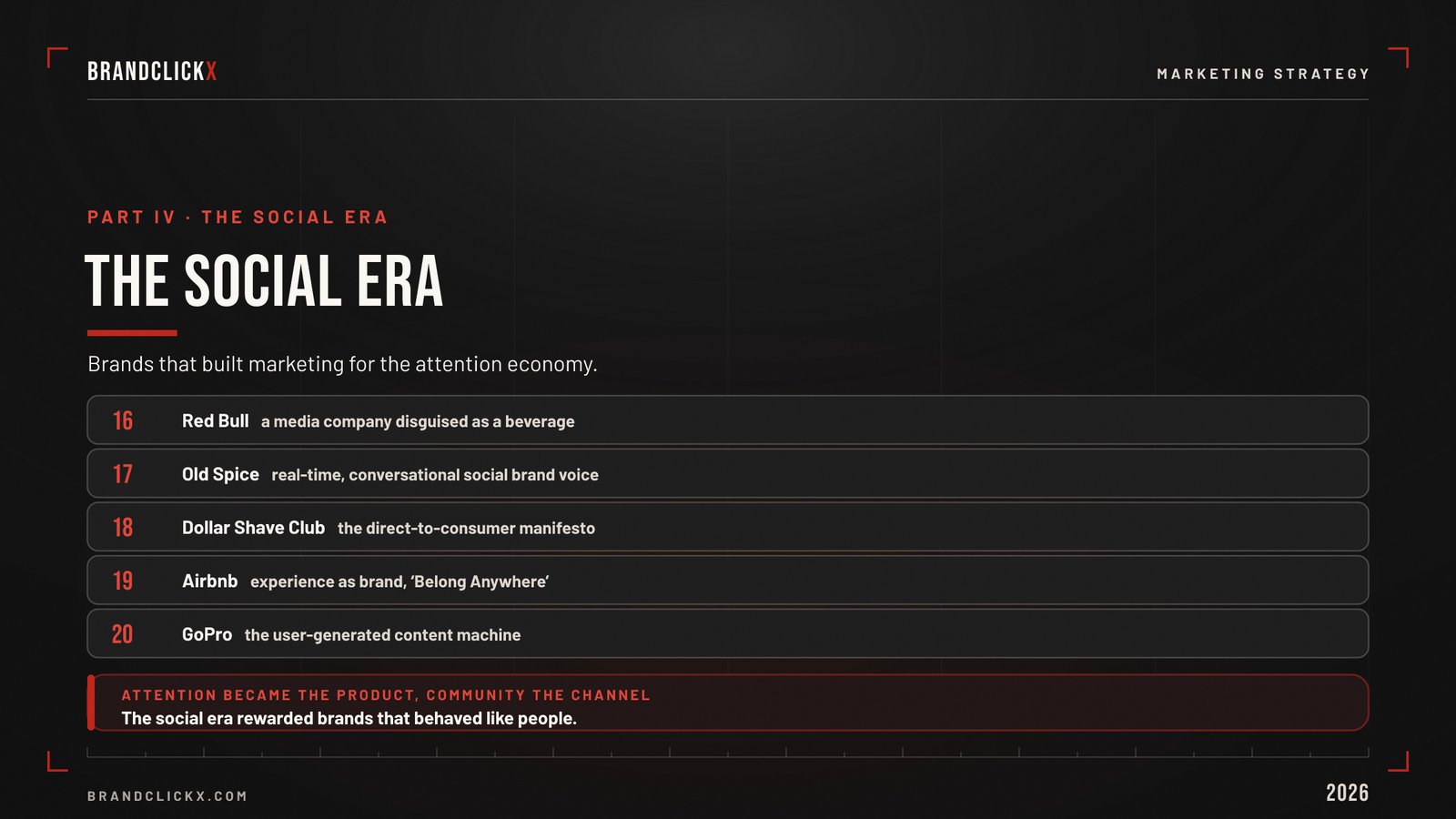
16. Red Bull The Media Company Disguised as a Beverage Brand
Red Bull’s Felix Baumgartner jump from the edge of space in 2012 wasn’t a stunt. It was a media production, live streamed, globally distributed, editorially produced, that generated more earned media than most Super Bowl campaigns.
Red Bull now operates a media division with 600+ journalists, a film production company, a music label, and dozens of owned media properties. The product funds the media. The media builds the brand. The brand sells the product.
Enterprise Perspective: Red Bull Media House is the most cited case study in B2B content marketing strategy because it proves that media investment isn’t a cost center. At scale, it becomes a revenue line. This model is examined in depth in our guide to building a brand-owned media operation.
17. Old Spice The Real-Time Social Brand Pivot
Old Spice’s “The Man Your Man Could Smell Like” campaign in 2010 didn’t just win advertising awards. It established a model for real-time social brand responsiveness that the industry is still trying to replicate.
When the campaign launched, the Old Spice social team created personalized video responses to individual tweets, at scale, in real time. The internet had never seen a brand behave like a human before.
Industry Impact: This was the origin point of conversational brand voice in social media. Every brand that has developed a platform personality, every brand that responds to customer posts with wit, every brand that “goes viral” for a social interaction, is running Old Spice’s original playbook.
18. Dollar Shave Club The Direct-to-Consumer Manifesto
“Our Blades Are F***ing Great.” Dollar Shave Club’s 2012 launch video cost $4,500 to produce and generated 12,000 orders in the first 48 hours. Within five years, the company sold to Unilever for $1 billion.
The video wasn’t just funny. It was a direct attack on the marketing language of its competitor, Gillette, which used hyper-produced ads with athletes and pseudo-scientific razor technology claims. Dollar Shave Club was the meta-commentary that broke the category.
Strategic Breakdown: DSC established the DTC playbook: direct voice, cultural confidence, low production value as a deliberate signal of authenticity, YouTube-first distribution, subscription model. Hundreds of brands have since followed this exact path. See how modern teams execute this in our DTC brand launch playbook.
19. Airbnb Experience as Brand Architecture
Airbnb’s rebrand in 2014, which introduced the “Bélo” symbol and the tagline “Belong Anywhere,” was one of the most sophisticated brand positioning exercises of the decade.
The company wasn’t selling room rentals. It was selling the feeling of belonging somewhere you’ve never been. That emotional positioning enabled Airbnb to charge premium prices, generate fierce user loyalty, and build a brand that survived regulatory crises, pandemic collapse, and competitor pressure.
Expert Insight: Airbnb’s brand architecture proves that hospitality isn’t about the room, it’s about the story told before and after the stay. Every touchpoint, from search results to host communication to post-trip email, was designed to reinforce the feeling of genuine human connection.
20. GoPro The User-Generated Content Machine
GoPro didn’t create an advertising department. It created a user community that became its advertising department. By designing a camera specifically for extreme sports footage, and then building social channels to surface the best user content, GoPro built a content engine that required almost no brand production budget.
Tactical Framework: GoPro is the purest early case study in community-led growth. Every brand that now runs user-generated content campaigns, every SaaS company with a customer success story video program, every consumer brand that re-shares customer content, is operating GoPro’s model.
Part V: The Platform Era Brands That Understood the Algorithm
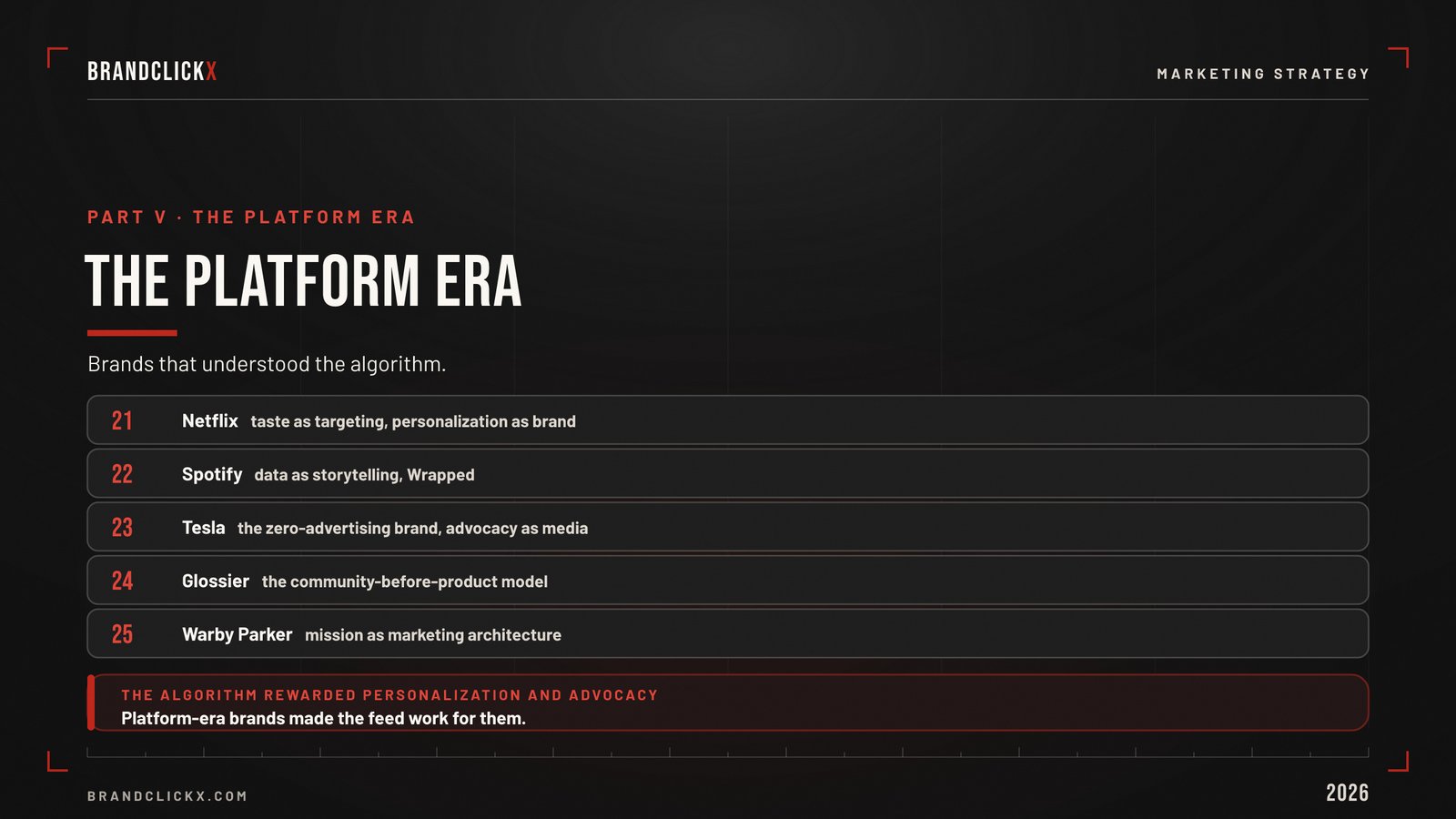
21. Netflix Taste as Targeting
Netflix’s move from DVD mail service to streaming pioneer to original content studio is the most discussed digital transformation in media history. But its marketing contribution is often underappreciated: Netflix built the first major algorithm-driven personalization engine as a brand experience tool.
The recommendation system wasn’t just a product feature. It was a brand statement: we know you better than you know yourself. This level of personalization became a competitive moat and a brand differentiator simultaneously.
The Bigger Shift: Netflix established personalization as a brand expectation, not a feature. Today, customers expect Spotify, Amazon, and even B2B platforms to anticipate their needs. The brands that don’t personalize are now actively communicating indifference.
22. Spotify Data as Storytelling
Spotify Wrapped is arguably the most successful annual marketing campaign of the 2010s. By turning user listening data into a shareable personal narrative, distributed natively through social media, Spotify created a brand moment that generates millions of impressions at zero media cost, while simultaneously building emotional loyalty through the gift of self-reflection.
Market Observation: Wrapped is a masterclass in data-as-emotional-product. It takes something users already experienced (their music year) and gives it back as a curated, shareable identity artifact. Every brand with customer data should be asking: “What is our Wrapped?” Our customer data storytelling framework helps marketing teams build their own version of this engine.
23. Tesla The Zero-Advertising Brand
Tesla spent $0 on traditional advertising for most of its history and became one of the most recognized automotive brands in the world. Its marketing strategy was entirely built around product drama (the Roadster, the Autopilot unveils, the Cybertruck), CEO spectacle, and earned media from a community of passionate brand advocates.
Enterprise Perspective: Tesla proved that brand salience, being mentally present in the category, doesn’t require paid media at scale. It requires consistent product theatrics, a newsworthy founding narrative, and a CEO who is also a media character. Its core insight, that advocacy is the most efficient media buy, is broadly applicable.
24. Glossier The Community-Before-Product Model
Emily Weiss launched Into The Gloss, a beauty blog, in 2010. She spent four years building a community before launching Glossier as a brand. When the products arrived, the community was already there, already invested, already evangelical, already waiting.
Strategic Breakdown: Glossier proved that brand equity can be built entirely in the media layer before a product even exists. It’s the model that every direct-to-consumer brand now attempts: build the audience first, then monetize with product.
25. Warby Parker The Mission as Marketing Architecture
Warby Parker’s “Buy a Pair, Give a Pair” model wasn’t just social responsibility. It was a marketing mechanism, a built-in story that every customer could share, a differentiator that was impossible to commoditize, and a positioning device that made purchasing feel like participation in something larger.
Tactical Framework: Mission-driven marketing, when authentic and operationally embedded, creates a differentiation layer that pricing, product features, and distribution advantages can’t easily erode. Patagonia, TOMS, and Bombas have all used variations of this model.
Part VI: The AI and Platform Native Era Brands Building Marketing for the Future
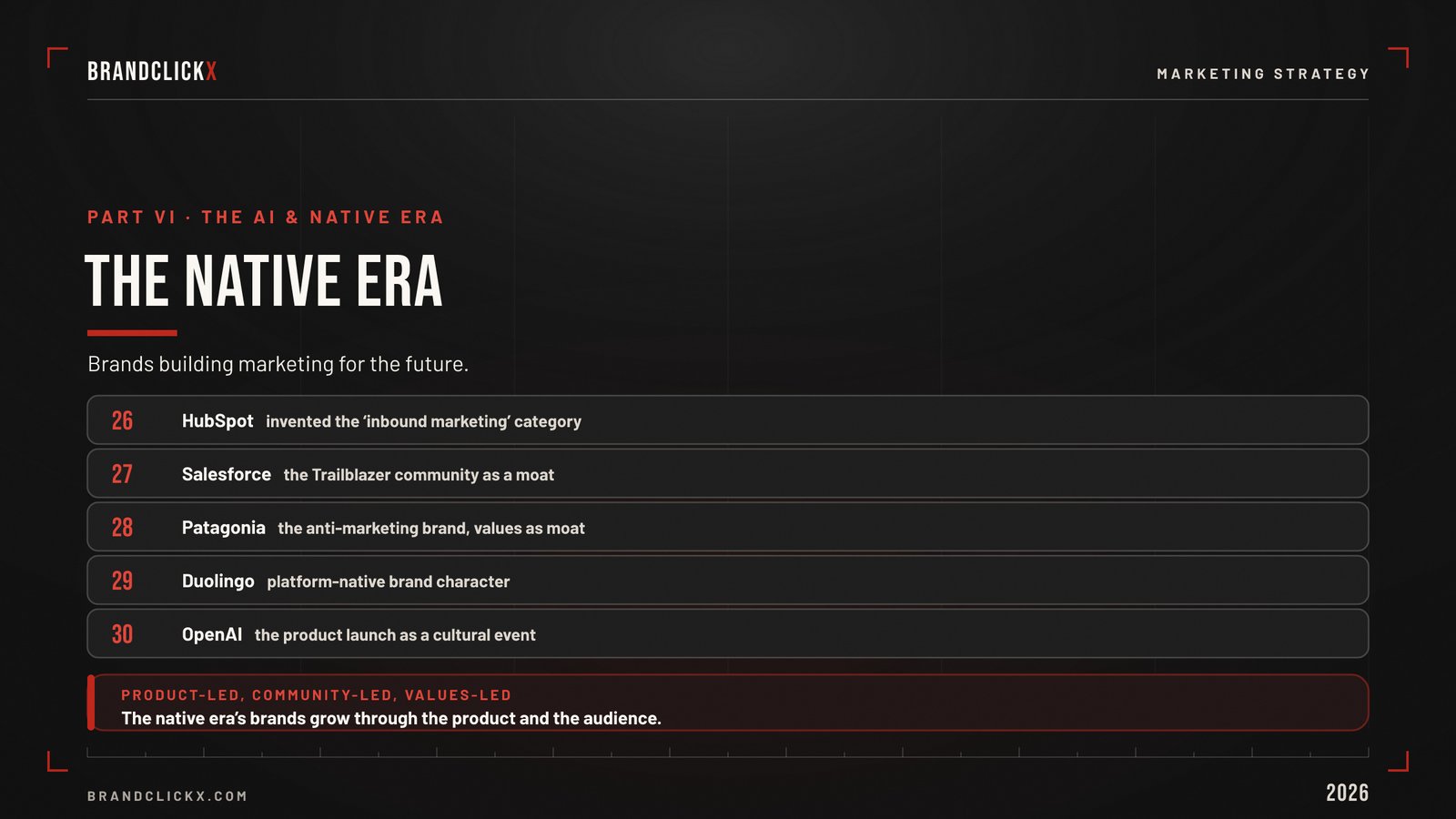
26. HubSpot The Inbound Marketing Category Creator
HubSpot didn’t invent content marketing. It invented the category name and built the infrastructure to support it, then sold the infrastructure to the very businesses it was teaching.
By creating the term “inbound marketing,” producing the definitive educational resource library around it, and building software tools that formalized the practice, HubSpot did something remarkable: it made its target customers financially dependent on a concept HubSpot had invented, then sold them the tools to execute it.
Expert Insight: This is the most sophisticated category creation strategy in B2B SaaS history. HubSpot’s Marketing Blog is still one of the highest-trafficked content properties in the marketing industry, and it generates leads for a platform that helps marketers replicate what HubSpot itself does. The recursion is the strategy.
27. Salesforce The Trailblazer Community as Brand Moat
Salesforce built Trailhead, its learning platform and community ecosystem, as an ostensibly free educational resource. In reality, it’s the most sophisticated customer retention and expansion mechanism in enterprise SaaS.
By gamifying CRM certification, creating a community of “Trailblazers” who evangelize the platform, and making Salesforce expertise a career credential, the company made switching costs psychological and professional, not just technical.
Market Observation: Community-led growth is now the dominant retention strategy in enterprise software. Notion, Figma, Slack, and Airtable all have community programs that function as brand loyalty systems. Salesforce invented the architecture.
28. Patagonia The Anti-Marketing Brand
Patagonia has built one of the strongest consumer brands in the outdoor industry while actively discouraging consumption. Its “Don’t Buy This Jacket” Black Friday ad, its Worn Wear repair program, its anti-growth corporate stance, all of it is marketing genius disguised as principled anti-capitalism.
The Bigger Shift: Patagonia proved that values-alignment, genuine, operational, verifiable values alignment, is the most durable brand differentiator in a commoditized market. Consumers in 2026 have unprecedented access to information about how brands actually behave. Patagonia’s marketing works because the marketing and the operations are the same thing.
29. Duolingo Platform-Native Brand Character
Duolingo’s green owl mascot Duo became a viral social media character not through advertising, but through a series of increasingly unhinged social media posts that leaned into the meme-ification of the brand’s reminder notifications.
The “threatening” Duolingo owl became a globally recognized internet character, and a case study in the power of giving a brand genuine personality rather than scripted voice guidelines.
Industry Impact: Duolingo’s social media team proved that brand personality, executed with real creative autonomy and platform fluency, can generate millions of impressions at zero media cost. It’s why every brand now wants a social media manager who “gets the internet” rather than one who can execute a content calendar. We outline the principles in our guide to building a brand voice that actually works.
30. OpenAI The Product Launch as Cultural Event
ChatGPT’s November 2022 launch was marketing history made without a traditional marketing campaign. OpenAI released a product into a market of non-experts and watched it spread, through user fascination, media coverage, and the fundamental strangeness of the experience, to 100 million users in two months.
Enterprise Perspective: OpenAI’s growth was not accidental. The decision to launch publicly rather than privately, to make the product free at the access tier, and to allow users to share conversations on social media were deliberate product-marketing decisions that created a compounding viral loop.
Future Outlook: In the AI era, the most powerful marketing strategy is a product experience so novel that users become involuntary evangelists. The brands that will define the next decade will be those that engineer product moments that are inherently shareable because they are inherently surprising.
Part VII: The Brands That Defined Category-Specific Innovation
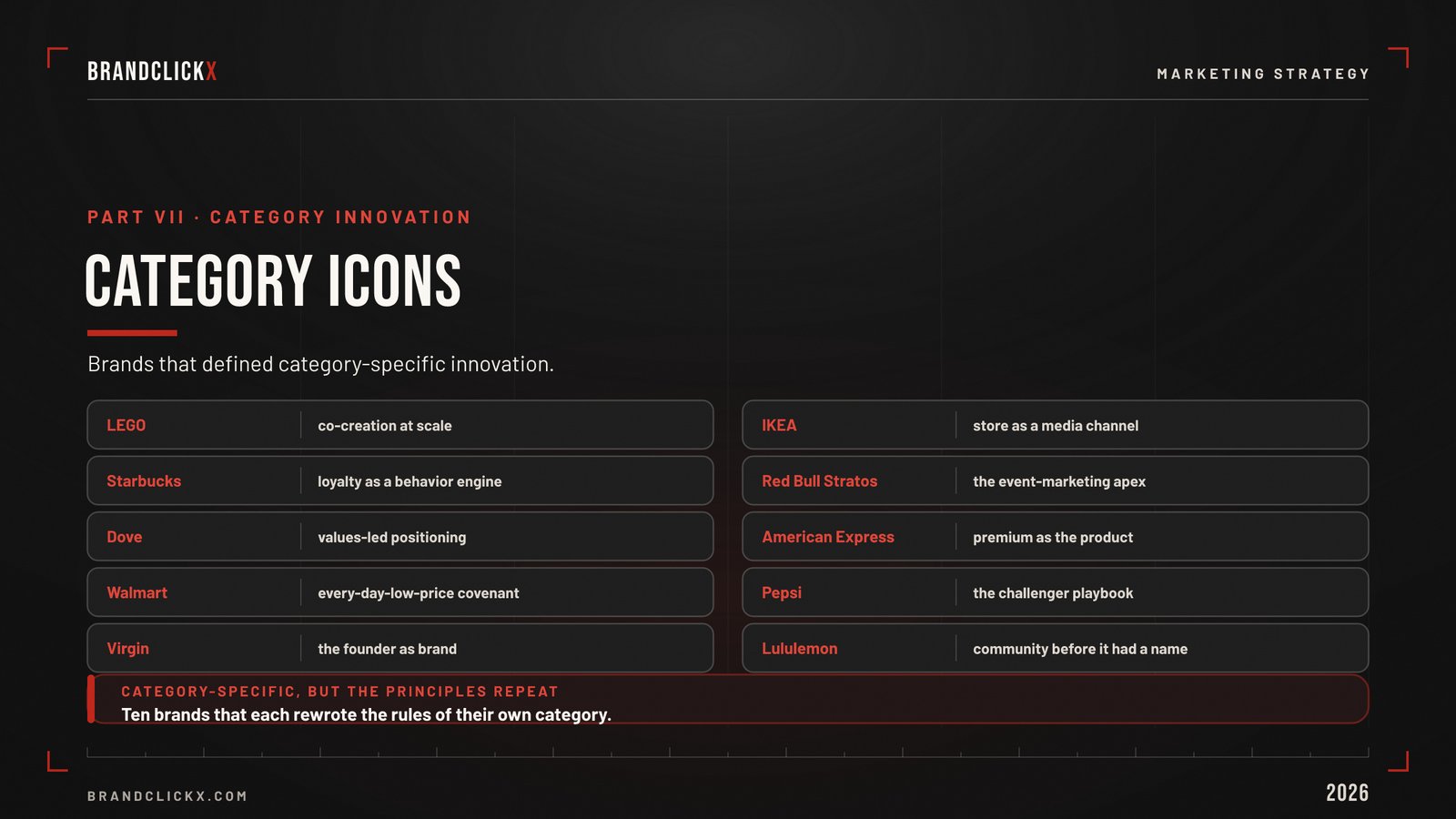
31. LEGO Community as Product Extension
LEGO Ideas, the platform that lets fans submit set designs for potential official production, turned its most passionate customers into an unpaid design and marketing department. The winning sets come with commercial production runs, and the creator receives a royalty.
Tactical Framework: LEGO proved that co-creation, at scale, is not just a community strategy, it’s a product development methodology that generates marketing content, deepens loyalty, and surfaces market intelligence simultaneously.
32. IKEA The Experience Funnel as Marketing Infrastructure
IKEA’s store layout is engineered for maximum time-on-site and purchase probability. The showroom model, the in-store restaurant (designed to extend visits), the flat-pack efficiency model, and the IKEA Family loyalty program are all marketing mechanisms disguised as operational decisions.
Strategic Breakdown: IKEA established that physical retail is itself a media channel, one that can be optimized for conversion just as precisely as a digital funnel. The playbook for experiential retail, now studied obsessively by DTC brands opening their first physical locations, is essentially IKEA’s operating manual.
33. Starbucks The Loyalty Program as Behavior Engine
Starbucks Rewards is the most successful retail loyalty program in American history. But it’s not just a points system, it’s a behavior modification engine. Mobile order-ahead, gamified star collection, free birthday rewards, personalized offers, all designed to convert occasional purchasers into habitual ones.
Market Observation: Starbucks Rewards proved that the most sophisticated marketing operates below conscious awareness, by making the desired behavior (returning more frequently, spending more per visit) feel like self-interest rather than brand strategy.
34. Red Bull Stratos The Event Marketing Apex
The Felix Baumgartner jump from the edge of space was the highest-viewed live stream in YouTube history at its time, generated over $500 million in earned media value, and was planned and executed by a marketing team, not a PR agency or production company.
Industry Impact: The Stratos jump established that live events designed for global streaming are the apex of content marketing. Every brand-produced live event, every product launch with a global stream, every “watch party” brand moment is working in this framework.
35. Dove The Campaign for Real Beauty
Dove’s 2004 “Campaign for Real Beauty” was the first major mainstream brand to directly challenge the advertising industry’s beauty standards, using the advertising industry’s own medium to do it.
The campaign generated $1.2 billion in sales and launched Dove as a brand that stood for something beyond moisturization. It created a template: use the brand’s advertising to critique the advertising category, and emerge as the trustworthy alternative.
The Bigger Shift: This established values-led brand positioning as a commercially viable strategy, one that Aerie, Fenty Beauty, and dozens of others have since built entire brands around. This connects directly to mission-driven marketing as a growth strategy.
36. American Express The Premium Brand Tax
AmEx established the model of premium pricing as brand signal. While Visa and Mastercard competed on ubiquity, AmEx competed on exclusivity, annual fees, travel benefits, Centurion status, airport lounges. The price was the product. The card in your wallet was the statement.
Tactical Framework: Premium positioning requires not just higher pricing, but visible markers of exclusivity that justify the premium and communicate status to observers. Every premium SaaS tier, every “Enterprise” plan with white-glove onboarding, every invitation-only community is running AmEx’s original positioning logic.
37. Walmart The Every Day Low Price Brand Covenant
Walmart’s “Every Day Low Prices” promise is arguably the most powerful value proposition in retail history, not because of the prices themselves, but because of the trust covenant it created with customers who never had to wonder if they were being manipulated by promotional pricing.
Expert Insight: The EDLP model demonstrates that simplicity and consistency in value proposition can outlast complexity every time. Its durability, across multiple generations, recessions, and competitive onslaughts, is a master class in brand positioning clarity.
38. Pepsi The Challenger Brand as Marketing Innovation Engine
Pepsi’s marketing legacy isn’t built on dominance, it’s built on disruption. The Pepsi Challenge, Michael Jackson, Cindy Crawford, Pepsi vs. Coke, the brand’s entire marketing history is a masterclass in how to market against a category leader without directly attacking them.
Market Observation: Pepsi proved that challenger brand positioning, consistently, creatively executed, can generate cultural relevance and market share without ever achieving market leadership. It’s the playbook used by every number-two brand in a duopoly: Burger King vs. McDonald’s, AMD vs. Intel, Lyft vs. Uber.
39. Virgin The Founder as Brand Architecture
Richard Branson didn’t hire a brand manager to define Virgin’s personality. He was the brand’s personality, bold, irreverent, customer-advocating, and willing to personally challenge the incumbents he was entering into combat with.
Strategic Breakdown: Virgin established that a founder’s public persona, consistently maintained across decades and diverse business categories, can serve as the unifying brand architecture for a portfolio of entirely different companies, a model that several modern founders have attempted to replicate with varying commercial success.
40. Lululemon The Community Brand Before Community Was a Strategy
Lululemon’s early growth was built entirely on community: in-store yoga classes, local ambassador programs, customer names written on store chalkboards. The brand made customers feel like members of a lifestyle movement rather than purchasers of activewear.
Industry Impact: Lululemon built a community retention machine before the marketing industry had language for it. Its ambassador program, giving free product to local instructors in exchange for brand advocacy, is now called “micro-influencer marketing” and is standard practice across consumer and B2B brands. See how modern brands structure this in our community-led growth playbook.
Part VIII: The Remaining Icons
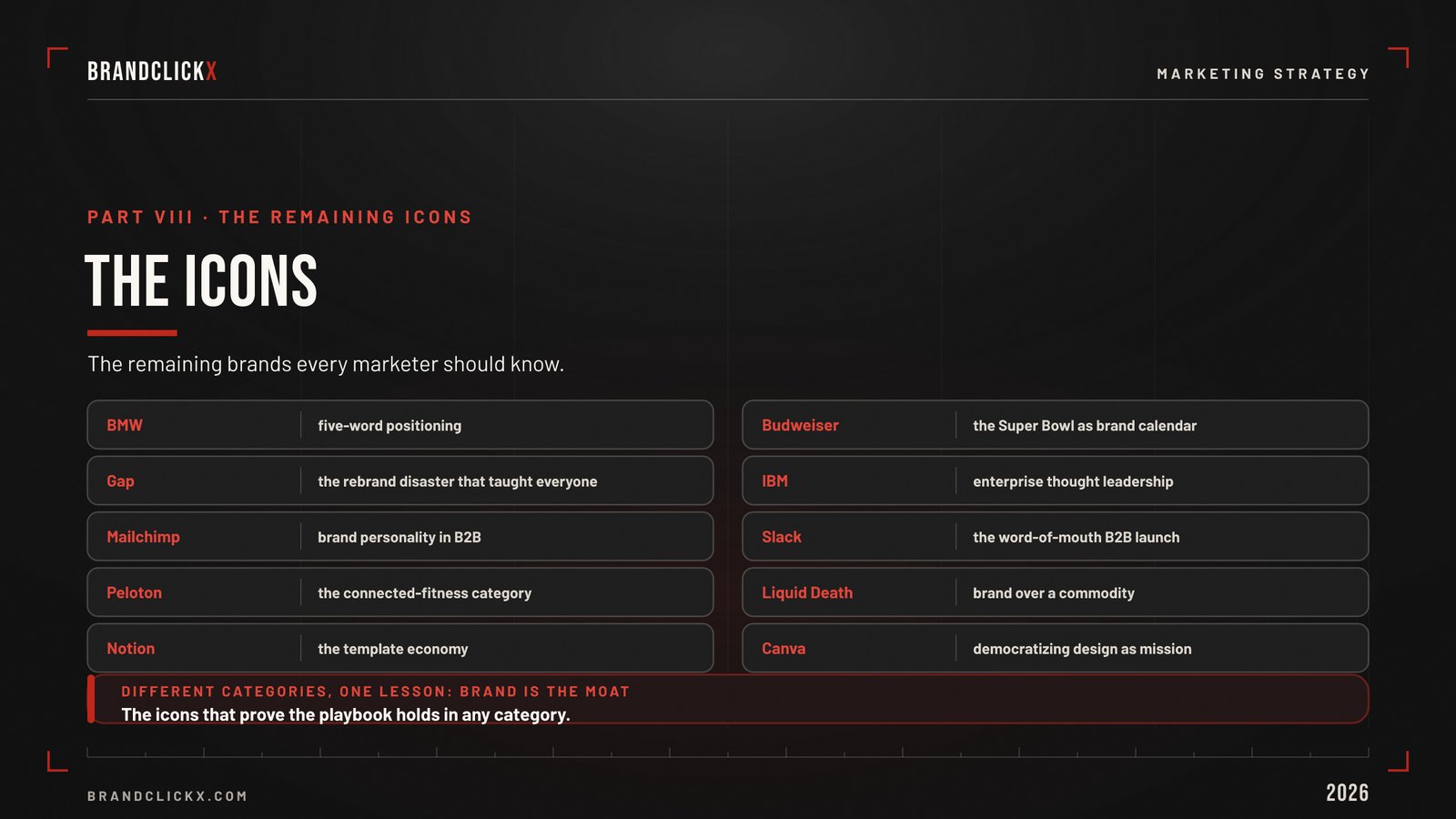
41. BMW The Power of Self-Explanatory Positioning
BMW’s tagline “The Ultimate Driving Machine” does what most brand strategy frameworks spend millions trying to achieve: it tells you exactly what the brand believes in, differentiates it from competitors immediately, and appeals to precisely the right psychographic, with five words.
42. Budweiser The Super Bowl as Brand Calendar
Budweiser’s Super Bowl advertising tradition established the cultural moment of the big game as an annual brand event. Its “Wassup” campaign, its Clydesdales, its Bud Light characters, all created at the highest possible media moment. Budweiser made Super Bowl advertising a brand institution and demonstrated that consistent presence in peak cultural moments compounds over time.
43. Gap The Visual Identity Rebrand Disaster That Taught Everyone
Gap’s 2010 logo rebrand, unveiled without explanation and reversed within a week following social media backlash, was the first major case study in what not to do with a brand identity update. It established that brand equity lives in community memory, not corporate design files.
44. IBM The Enterprise Thought Leadership Playbook
IBM’s transition from hardware giant to “solutions” company in the 1990s was a masterclass in repositioning, driven as much by brand communication as by product strategy. IBM established that enterprise brands can lead with ideas rather than products, using thought leadership as the primary acquisition channel. This model now underpins every B2B content marketing strategy in enterprise technology.
45. Mailchimp Brand Personality in B2B
Mailchimp’s monkey mascot, playful tone, and self-deprecating marketing voice were radical departures from B2B SaaS convention when the company launched. It proved that enterprise software users are human beings who respond to warmth, humor, and personality, not just feature tables and enterprise pricing.
46. Slack The Word-of-Mouth B2B Launch
Slack’s 2013 launch drove 8,000 sign-ups in 24 hours through a single blog post and a waiting list. Its product-led growth model, free tier, viral collaboration invitation mechanics, channels that spread organically within organizations, established the B2B PLG playbook that Notion, Figma, and Linear have all since followed.
47. Peloton The Connected Fitness Category
Peloton created a category, connected fitness, that didn’t exist before it. Its hardware-software-community integration, its instructor celebrity culture, its leaderboard mechanics, and its cult-like community transformed what might have been a premium exercise bike company into a lifestyle identity brand.
48. Liquid Death The Most Audacious Brand Positioning in Beverage History
Liquid Death sells canned mountain water. It uses heavy metal imagery, skull branding, and “Murder Your Thirst” as its tagline. It has driven hundreds of millions in revenue, selling the most commoditized product on earth through sheer force of brand personality.
The Bigger Shift: Liquid Death proved that brand is still the highest-leverage investment a company can make, even when the product is water. Category doesn’t limit brand ambition.
49. Notion The Template Economy as Growth Strategy
Notion’s template gallery, where users share their custom workspace setups, created an organic content marketing and community acquisition machine. Every template shared was both a use-case demonstration and a referral mechanism. It’s one of the cleanest modern executions of product-led growth fused with community flywheel mechanics.
50. Canva Democratizing Design as a Brand Mission
Canva’s marketing genius is the alignment between its product mission and its brand story: design for everyone. By making professional design tools accessible to non-designers, and by building a massive free tier to drive adoption, Canva built one of the fastest-growing SaaS companies in history, powered almost entirely by product satisfaction and word-of-mouth.
The Common Framework: What These 50 Brands Share
| Principle | Key Example | Modern Application |
| Emotion over transaction | Coca-Cola | Brand storytelling in every channel |
| Category creation | De Beers, HubSpot | SaaS positioning strategy |
| Community before product | Glossier, Lululemon | DTC brand-building playbook |
| Product as media | GoPro, Red Bull | Content marketing infrastructure |
| Mission alignment | Patagonia, Dove | Values-driven brand differentiation |
| Viral mechanics | Hotmail, Slack | Product-led growth architecture |
| Persona-driven brand | Marlboro, Virgin | Founder-led brand strategy |
| Data as storytelling | Spotify | Customer data monetization |
| Simplicity as trust | Walmart, BMW | Value proposition clarity |
| Experience as brand | Apple, IKEA | Experiential retail and UX design |
Key Takeaways for Marketing Leaders
- Brand is infrastructure, not decoration. Every brand on this list treated their marketing architecture as a foundational business asset, not a cost center or a quarterly campaign.
- The most powerful marketing is built into the product. Hotmail, Slack, GoPro, Spotify Wrapped, the highest-ROI marketing these companies ever did was designed into the product experience itself.
- Category creation beats category competition. De Beers, HubSpot, Peloton, and Salesforce all built businesses that dominated categories they invented. The margin in category leadership is structurally higher than the margin in competition.
- Community is the only marketing moat that compounds. Lululemon, Salesforce, LEGO, and Notion all built community as a retention, acquisition, and differentiation mechanism simultaneously.
- The brand voice is a strategic asset. Dollar Shave Club, Mailchimp, Liquid Death, and Duolingo all grew outsized brands from under-resourced positions through the sheer force of distinctive brand voice.
FAQ: Brands That Changed Marketing
What makes a brand “change marketing”?
A brand changes marketing when it introduces a technique, framework, or cultural behavior that is then widely adopted by other brands, permanently altering what is considered standard practice in the industry. Examples include Hotmail’s viral email signature, De Beers’ category creation playbook, and Apple’s product-as-brand-theater model.
Which brand had the biggest single impact on digital marketing?
Google’s introduction of search advertising fundamentally restructured the entire marketing industry around intent-based targeting, shifting the dominant paradigm from demand creation (interruption advertising) to demand capture (search). No other single innovation has had a broader structural impact on how marketing budgets are allocated.
How do these principles apply to modern SaaS brands?
The core frameworks, category creation, community-building, product-led growth, emotional positioning, thought leadership, are all directly applicable to SaaS go-to-market strategy. HubSpot’s inbound marketing playbook, Salesforce’s Trailblazer community model, and Slack’s viral B2B growth loop are all drawn directly from these foundational brand strategies.
Is traditional brand building still relevant in the AI era?
More than ever. As AI commoditizes product features and compresses differentiation windows, brand, the accumulated emotional meaning associated with a company name, becomes the only durable competitive advantage. Brands with strong emotional equity consistently outperform on lifetime value, pricing power, and organic acquisition efficiency. We explore this fully in our analysis of AI’s impact on brand differentiation.
What is the most underrated marketing lesson from this list?
The Hotmail/Slack/Dropbox lesson: engineering viral mechanics into the product itself generates more efficient growth than any paid media channel. Product-led growth is the most underutilized strategy in most marketing budgets.
Conclusion: The Next 50 Brands Are Being Built Right Now
Marketing’s most important patterns tend to reveal themselves in retrospect. The brands profiled here didn’t know, when they made their bets, that they were creating templates that entire industries would follow. They knew only that they had a product, a belief about how to reach people, and the conviction to execute differently.
What’s striking, looking across all 50, is how consistent the underlying logic is across completely different eras, industries, and media environments. Emotion matters. Community compounds. Simplicity wins. Authenticity, real operational authenticity, not brand messaging, builds moats. The product is the marketing.
In 2026, with AI accelerating content production and compressing creative differentiation windows, the brands that will define the next 50 years of marketing are not the ones with the largest AI budgets or the most sophisticated attribution models. They’re the ones building genuine emotional meaning around products that people actually love, and finding ways to encode that meaning into every touchpoint the customer ever experiences.
The names on that future list are being created right now, in founder offices and brand strategy sessions and product roadmap meetings where someone is trying to explain why the feature matters less than the feeling.
The playbook has always been the same. The medium just keeps changing.