
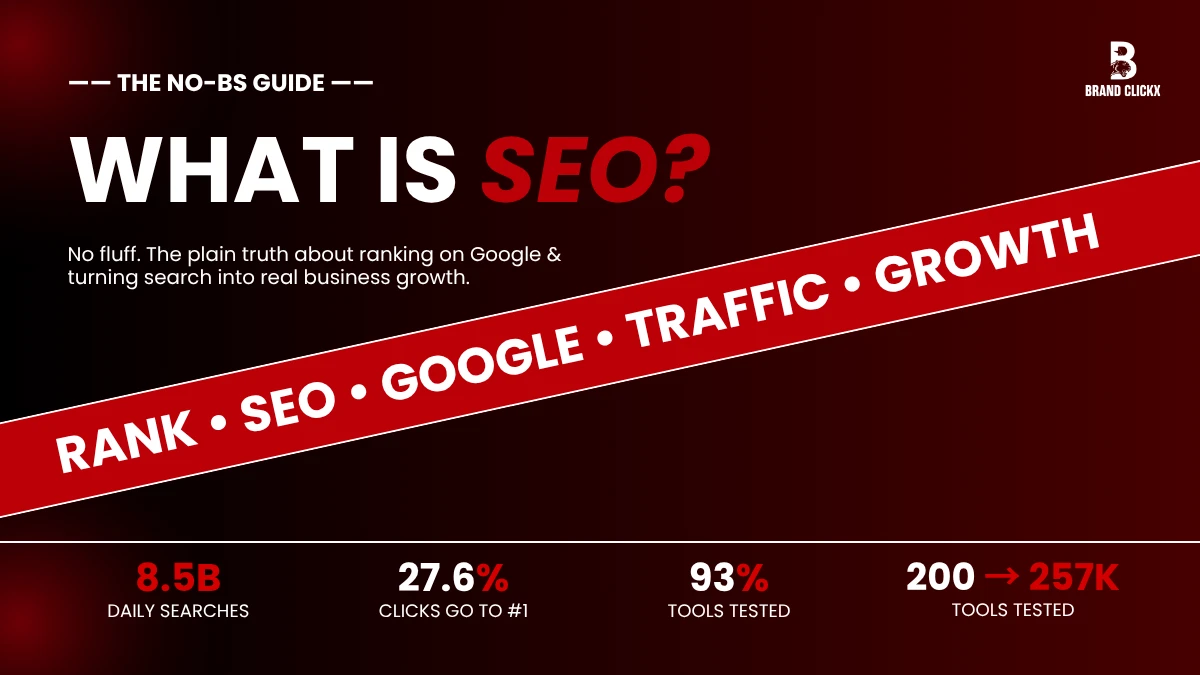
Look, SEO (Search Engine Optimization) gets overcomplicated by people trying to sell you courses. Here’s the plain truth: it’s the practice of getting your website to show up in Google’s free, organic results. Not the ads. The actual listings people click because they trust them.
When someone types “best digital marketing agency” into Google and your site shows up at the top that’s SEO working. No ad spend. No click fees. Just free, targeted traffic from people actively looking for what you offer.
I’ve been doing this for years at BrandClickX. We took one client from 200 monthly visitors to 257,000 in six months using the exact fundamentals I’m about to walk you through. Nothing fancy. Just consistent execution of what actually moves the needle.
This guide covers what SEO is, why it still matters in 2026, and how to do it right whether you’re starting from zero or trying to fix a site that’s stuck on page two.
Why Bother With SEO?
Here’s a number that should get your attention: 93% of online experiences start with a search engine. Google processes over 8.5 billion searches every single day. That’s not a typo. Billion.
And here’s the kicker: the first organic result gets about 27.6% of all clicks. If 10,000 people search for something related to your business each month, ranking #1 puts nearly 2,800 targeted visitors on your site. For free. Month after month. That’s 33,600 visitors a year from one single ranking.
Compare that to paid ads where you pay for every single click. Turn off the budget, the traffic dies instantly. SEO traffic compounds. The work you do today keeps paying dividends six months from now.
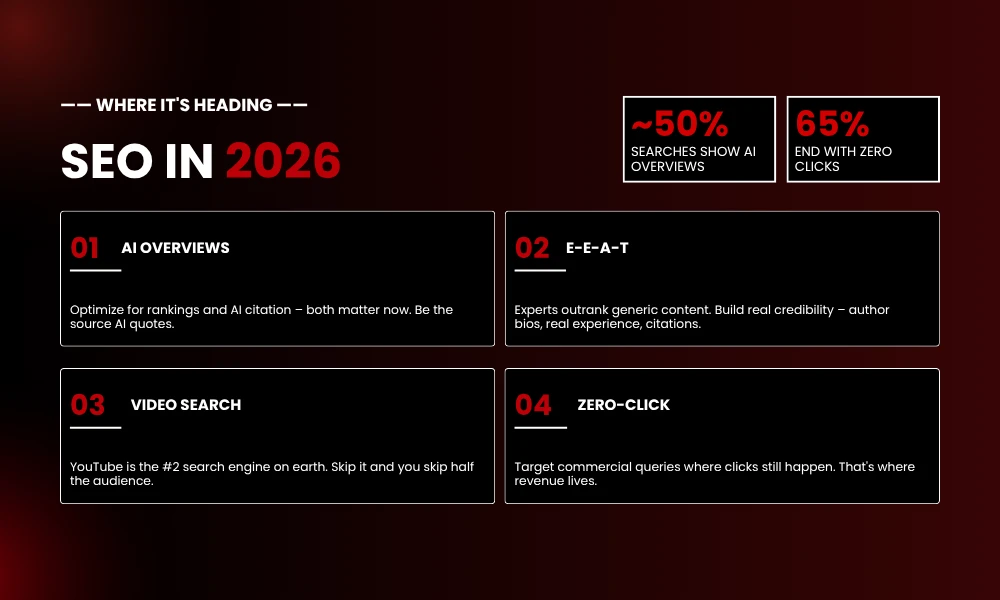
But 2026 changed the game. Google’s AI Overviews now show up on about half of all searches. AI chatbots like ChatGPT and Perplexity are becoming starting points for research. Ignore this shift and you’re leaving traffic on the table.
Here’s how SEO stacks up against other channels:
| Channel | Conversion Rate | Cost Per Click | Longevity |
| SEO (Organic) | 2.4% – 3.8% | $0 | Compounds over time |
| Google Ads (PPC) | 1.8% – 2.5% | $1 – $50+ | Stops when budget ends |
| Social (Organic) | 0.5% – 1.5% | $0 – $5 | Unpredictable |
| 3.0% – 5.0% | ~$0.05 | List-dependent |
SEO isn’t the fastest channel. But it’s the one that keeps giving long after you stop actively working on it.
How Google Actually Works
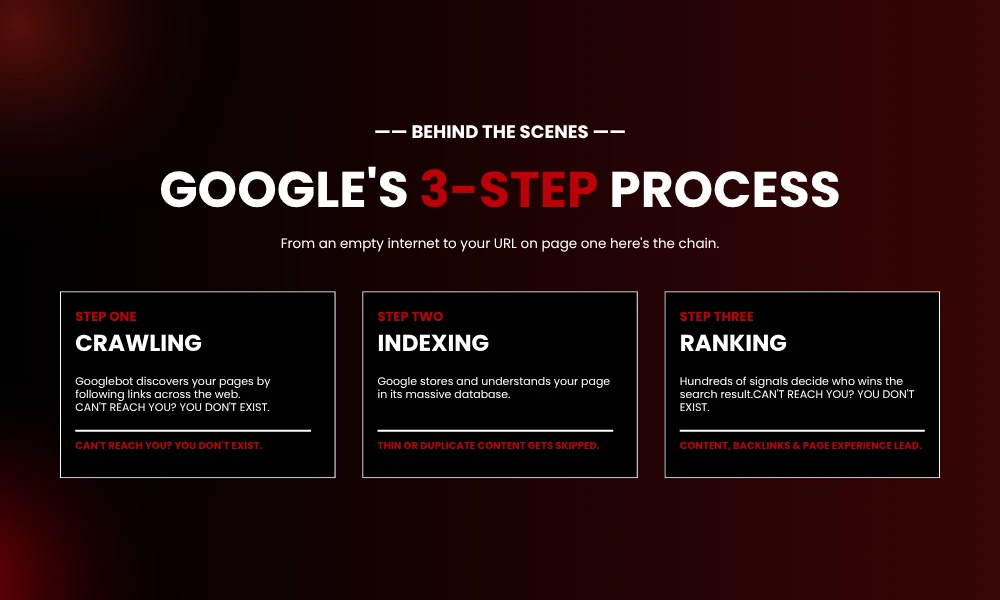
Before you optimize anything, you need to understand what happens when someone hits “search.” Google runs three processes behind the scenes: crawling, indexing, and ranking.
Crawling: Google Finds Your Pages
Google sends out crawlers (little bots called Googlebot) that follow links across the web, discovering new pages and updates. Think of them as digital librarians walking through an infinite library, noting what’s on each shelf.
If your pages can’t be crawled, they don’t exist on Google. Period. Broken links, server errors, bad robots.txt files, or messy JavaScript can all block crawlers. That’s why a clean sitemap submitted to Google Search Console isn’t optional it’s essential.
Indexing: Google Files Your Content
Once crawled, Google analyzes your page and stores it in the index, a massive database of everything Google knows about. Not every crawled page makes it into the index. Low-quality, duplicate, or thin content gets skipped.
In 2026, Google’s AI systems understand context and relationships far better than they used to. Keyword matching alone won’t cut it anymore. Topical depth and genuine usefulness are what get you indexed and ranked.
Ranking: The Algorithm Picks the Winner
When someone searches, Google’s algorithm evaluates hundreds of signals to decide which pages deserve the top spots. Here’s what’s actually moving the needle right now:
| Ranking Factor | What It Measures | Impact Level |
| Helpful Content | Quality, originality, depth | Very High |
| Backlinks | Authority and trust signals | Very High |
| Page Experience | Speed, mobile, Core Web Vitals | High |
| Search Intent Match | Does your content answer the query? | Very High |
| E-E-A-T | Expertise, experience, authority, trust | High |
The Three Pillars You Can’t Ignore
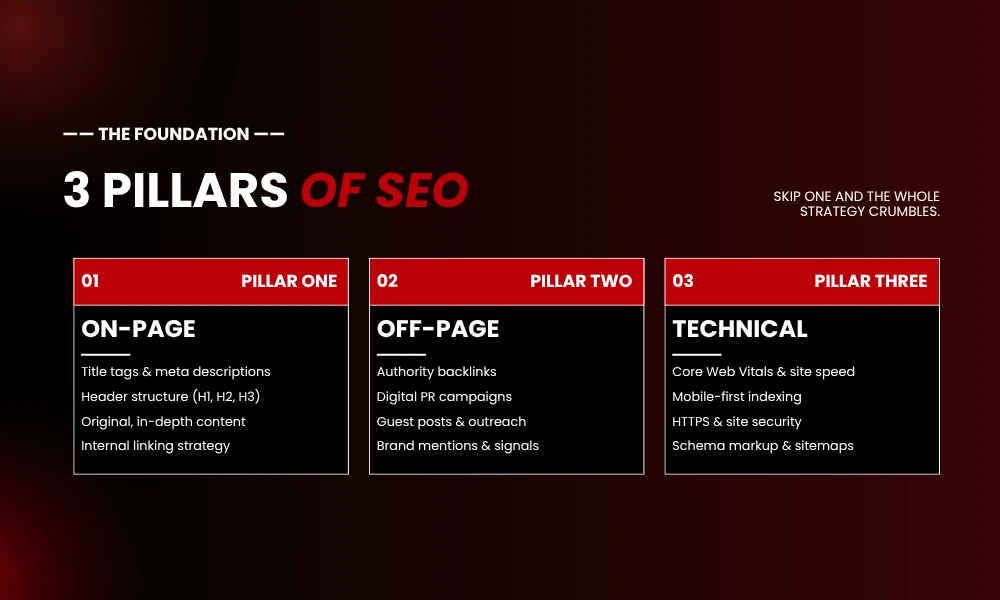
Every successful SEO strategy hits these three areas. Skip one and the whole thing crumbles.
On-Page SEO: What Visitors See
This is everything on your actual pages. The stuff you control directly.
Title tags are your biggest on-page lever. One well-written title tag can be the difference between position #5 and position #2. Keep it under 60 characters, front-load your keyword, and make it click-worthy.
Meta descriptions don’t directly affect rankings, but they absolutely affect whether someone clicks. Treat them like ad copy. If your meta description is boring, people scroll past you even if you’re ranking well.
Header tags (H1, H2, H3) structure your content for readers and Google. One H1 per page. Break up sections with H2s. Use H3s for subsections. Include keyword variations naturally.
Content quality is where most sites fall apart. Google’s helpful content system actively demotes pages that feel written for search engines instead of humans. Write content that genuinely answers every question someone might have about the topic. Go deep. Be original. That’s what ranks in 2026.
Internal links matter more than people think. They spread authority across your site, help Google find deep pages, and keep visitors engaged longer. Every important page should be reachable within three clicks from your homepage.
Off-Page SEO: Building Authority
This is about what happens outside your website. Mainly, it’s link building getting other reputable sites to link to yours.
Google treats backlinks as votes of confidence. When a trusted site links to you, it’s saying “this content is worth your time.” But not all links are equal. One link from a high-authority site beats a hundred links from spammy directories.
Here are the link-building tactics that actually work in 2026:
- Digital PR: Respond to journalist queries on HARO or Qwirky to land mentions in major publications.
- Guest posting: Write genuinely useful content for sites in your niche. Include a natural link back to your site.
- Skyscraper content: Create the most comprehensive resource on a topic, then reach out to sites linking to inferior versions.
- Broken link building: Find dead links on relevant sites, offer your content as a replacement.
- Unlinked brand mentions: Set up Google Alerts for your brand name. When someone’s mentioned you without a link, send a friendly email asking them to add it.
Our link building team at BrandClickX uses these exact methods. We built 150+ high-quality backlinks for a SaaS client in three months, which directly contributed to their traffic jump from 200 to 157K monthly visitors.
Technical SEO: The Foundation
You can have the best content in the world, but if Google can’t crawl your site properly, nobody will ever see it. Technical SEO is the unglamorous work that makes everything else possible.
Site speed is a confirmed ranking factor. Google’s Core Web Vitals measure three things: how fast your main content loads (LCP), how quickly your page responds to clicks (INP), and whether your layout shifts around while loading (CLS). If your scores are in the red, you’re leaving rankings on the table.
Mobile-first indexing means Google evaluates your mobile site first. If your mobile experience is terrible, your desktop rankings suffer too. Full stop.
HTTPS is non-negotiable now. Sites without SSL certificates are marked “Not Secure” and get a ranking disadvantage.
Schema markup helps Google understand your content and can unlock rich snippets, those enhanced search results with star ratings, prices, or FAQs that get way more clicks than plain listings.
If technical SEO feels overwhelming, our technical SEO audit identifies every issue and gives you a prioritized fix list.
SEO vs. SEM: Know the Difference
People mix these up constantly. Here’s the distinction:
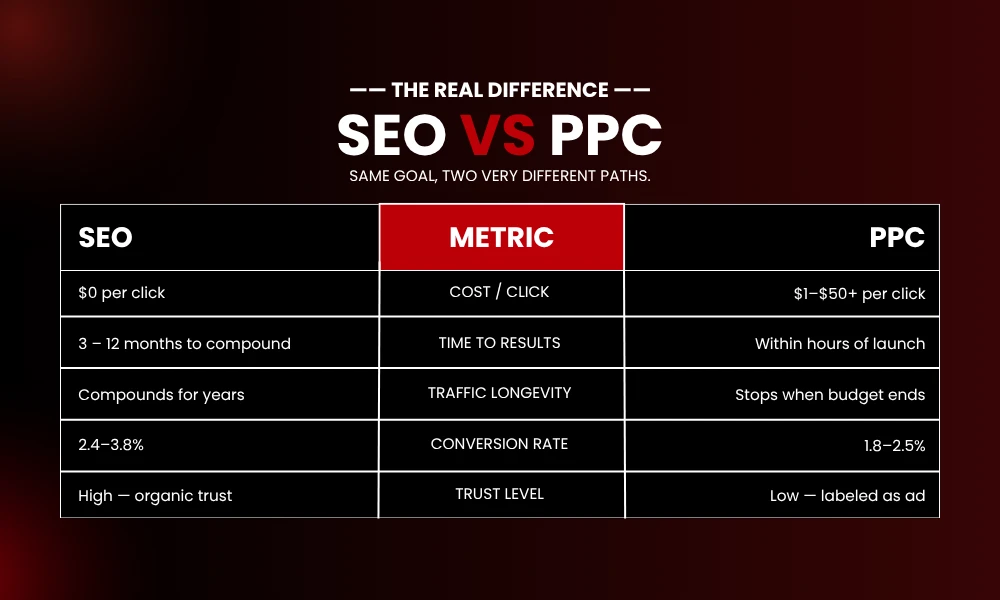
SEO = organic results. The free listings. Takes 3–12 months to see real results, but traffic compounds and costs nothing per click.
SEM (or PPC) = paid ads. You bid on keywords and pay every time someone clicks. Instant results, but the traffic dies the second you stop paying.
| Factor | SEO | SEM / PPC |
| Time to results | 3 – 12 months | Within hours |
| Cost per visitor | $0 (after setup) | $1 – $50+ per click |
| Traffic longevity | Years | Ends with budget |
| Trust level | High (organic = credible) | Lower (labeled as ads) |
| Best use case | Long-term growth | Quick wins, testing |
Smart businesses use both. Run PPC for immediate visibility while building your SEO foundation for sustainable, long-term traffic.
How to Build an SEO Strategy That Actually Works
Random blog posts and hoping for the best isn’t a strategy. Here’s the framework we use with every client at BrandClickX.
Step 1: Set Real Goals
“I want more traffic” isn’t a goal. “Increase organic traffic to our service pages by 40% in 6 months” is. Be specific. Attach numbers and deadlines. Otherwise you can’t measure success.
Step 2: Do Real Keyword Research
Keyword research isn’t about finding the highest-volume terms. It’s about finding the right terms, the ones your actual customers are searching for.
Every search query falls into one of four intent buckets:
| Intent | What They Want | Example | Content Type |
| Informational | To learn something | “what is SEO” | Guides, explainers |
| Navigational | To find a specific site | “BrandClickX SEO” | Brand/service pages |
| Commercial | To compare options | “best SEO agency 2026” | Comparison posts |
| Transactional | To buy or hire | “hire SEO agency Albany” | Product/contact pages |
Match your content to the intent. A guide about “what is SEO” shouldn’t hard-sell your services it should educate. Save the pitch for your commercial and transactional pages.
Tools we use: Ahrefs, SEMrush, and Google’s own Keyword Planner. Free alternatives like Ubersuggest work for smaller budgets.
Step 3: Audit What You Already Have
Before writing new content, fix what’s broken. Run a full audit covering:
- Technical issues (crawl errors, speed, mobile problems)
- On-page optimization (titles, headers, content gaps)
- Backlink profile (toxic links, missing opportunities)
- Current rankings (what’s working, what isn’t)
We use Screaming Frog, Ahrefs Site Audit, and Google Search Console for this. If you want a professional audit, our team can handle it.
Step 4: Optimize Existing Content First
Pages ranking on page two (positions 11–20) are low-hanging fruit. They’re already indexed, already getting some visibility, and often just need a few tweaks to hit page one.
Quick wins to prioritize:
- Update outdated stats and broken links
- Add depth to thin sections
- Improve title tags for better click-through rates
- Strengthen internal linking
- Add visuals to increase time on page
Step 5: Create Content That Deserves to Rank
In 2026, depth wins. One thorough 3,000-word guide that genuinely covers a topic outperforms five shallow 500-word posts every time. Google’s helpful content system rewards comprehensiveness.
Here’s what separates content that ranks from content that doesn’t:
- Originality. Add something new original research, unique data, a fresh angle.
- Skimmability. Short paragraphs, bullet points, clear headers. People scan before they read.
- Visuals. Custom images, charts, infographics. They increase engagement and shareability.
- Strong openers. Your first 100 words determine whether someone stays or bounces.
If you need content that actually ranks, our SEO content writing team creates 100% human-written, strategically optimized content designed to perform.
Step 6: Build Links the Right Way
Content alone won’t rank in competitive niches. You need authority, and backlinks remain the strongest authority signal Google uses.
Focus on quality, not quantity. A few links from relevant, trusted sites in your industry will outperform hundreds of directory links or PBN garbage. Google is getting better at detecting manipulative link building every year shortcuts will hurt you.
The link-building approach that’s worked for us:
- Create genuinely link-worthy content (research, tools, comprehensive guides)
- Promote it through digital PR and outreach
- Build relationships with editors and site owners in your niche
- Convert unlinked brand mentions into links
Step 7: Track, Measure, Adjust
SEO isn’t “set it and forget it.” Algorithms change. Competitors adapt. You need to stay on top of it.
Metrics we track monthly for every client:
- Organic traffic (total and by landing page)
- Keyword rankings for target terms
- Click-through rate from search results
- Conversion rate from organic traffic
- New referring domains (backlink growth)
- Core Web Vitals scores
Google Search Console and Google Analytics are free and give you most of what you need. Add Ahrefs or SEMrush for competitive intelligence.
Mistakes I See All the Time
After auditing hundreds of sites, these are the errors that show up again and again:
Chasing keywords without checking intent. Ranking #1 for the wrong keyword is worse than ranking #5 for the right one. Always look at what’s currently ranking before you optimize.
Ignoring technical basics. Beautiful content on a slow, broken site won’t rank. Period. Fix your technical foundation first.
Buying backlinks. It will blow up in your face. Google detects paid link schemes and hands out penalties that can wipe out your traffic overnight. Build links through merit.
Keyword stuffing. It’s 2026. Google’s AI reads like a human. If your content reads awkward because you’re forcing keywords in, it will hurt you. Write naturally.
Quitting too early. This is the biggest one. SEO takes 3–6 months minimum. Most people give up at month 2, right before the compounding effect kicks in. Commit to at least 6 months before you judge results.
Neglecting user experience. High bounce rates and short dwell times tell Google your content isn’t satisfying users. Prioritize readability, speed, and genuine value.
Where SEO Is Heading
The landscape is shifting fast. Here’s what’s actually changing in 2026:
AI Overviews now appear on nearly half of all searches. Google’s synthesizing answers at the top of the page, which reduces clicks to traditional organic results for informational queries. You need to optimize for both traditional rankings and AI citation.
Zero-click searches are at about 65% now. People find their answer directly in the SERP without visiting any website. Target commercial and transactional queries where clicks still happen.
E-E-A-T (Experience, Expertise, Authoritativeness, Trustworthiness) keeps getting more important. Content from recognized experts outranks generic fluff. Build author bios, publish on external platforms, and establish real credibility.
Video and visual search are growing fast. YouTube is the world’s second-biggest search engine. Google surfaces video directly in results now. If you’re not creating video content, you’re missing a massive opportunity.
FAQ
How long does SEO actually take?
Most sites start seeing real results in 3 to 6 months. Significant improvements usually take 6 to 12 months. New sites in competitive niches might need a year. Established sites optimizing existing content can see movement in weeks. The key is consistency, stop and start, and you’re back to square one.
Is SEO still worth it with AI search taking over?
More than ever. Organic search is still the highest-ROI channel for most businesses. AI search doesn’t eliminate the need for SEO, it changes how you approach it. The sites that optimize for both traditional rankings and AI citations will win.
Can I do SEO myself?
Absolutely, for smaller sites, at least. Basic SEO is learnable with free resources. But competitive niches, technical issues on large sites, and serious link building usually need professional help. Many businesses do a hybrid: content in-house, technical and links outsourced.
White hat vs. black hat — what’s the real difference?
White hat follows Google’s rules: quality content, earned links, solid technical foundation. Black hat uses manipulation: keyword stuffing, cloaking, paid links. Black hat might give short-term gains, but penalties can destroy your site. Not worth the risk.
How much should SEO cost?
DIY SEO costs $100–$500/month for tools. Professional services run $1,500–$5,000/month for small businesses, and $10,000+ for enterprises. The real question isn’t cost, it’s ROI. If your SEO generates more revenue than it costs, it’s worth every dollar. Check out our pricing for reference.
Do backlinks still matter?
Yes. They’re still one of the top three ranking factors. But quality over quantity, always. A few links from relevant, authoritative sites beat hundreds of garbage links. Google cares about relevance, context, and natural patterns.
What’s the single most important SEO factor?
If I had to pick one: content that genuinely satisfies search intent. Without that, technical perfection and a million backlinks won’t save you. Google’s helpful content system rewards pages written for humans. Everything else supports that.
The TL;DR
SEO is getting your website to show up in Google’s free search results. It boils down to three things:
- Create valuable content that answers what people are searching for
- Fix your technical foundation so Google can crawl and index your site properly
- Build authority through quality backlinks from trusted sites
That’s it. No secret sauce. No magic tricks. Just consistent execution of the fundamentals over time.
The businesses winning with SEO in 2026 prioritize user experience over algorithm hacks, create content that’s genuinely helpful, and treat link building as relationship-building, not a numbers game.
The search landscape will keep evolving AI, voice search, visual search. But the core principle never changes: be the best answer to your audience’s questions, and the rankings will follow.
Let’s Talk
I’ve walked you through the theory. Now comes the hard part, actually doing it.
At BrandClickX, we turn SEO strategy into measurable business growth. Whether you need a full site audit, content that ranks, or an end-to-end SEO campaign, we’ve done it for brands like SEGA, RE/MAX, and Movoto.
The numbers:
- 200 → 257,000 monthly organic visitors in 6 months
- 100% human-written content, no AI fluff
- Transparent reporting with measurable ROI