Introduction: The Shakeout Is Over. Now Comes the Hard Part.
The AI writing tool market looked very different eighteen months ago.
There were hundreds of products. Venture money was flowing into anything that put a GPT wrapper on a content brief template. Every tool claimed to be the “best AI writer.” And most of them were essentially the same product with different landing pages.
The shakeout arrived fast.
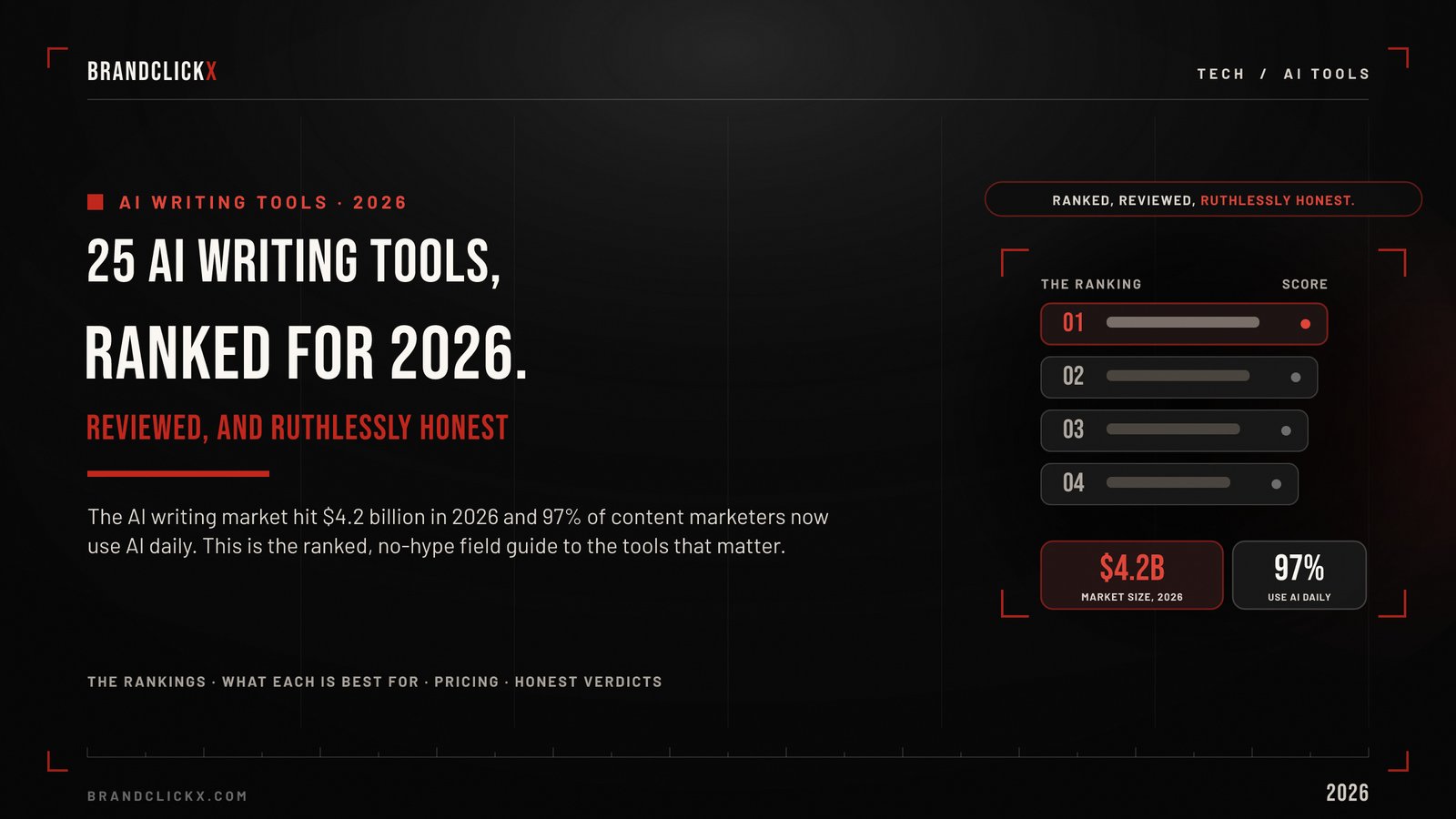
The global AI writing tool market reached $4.2 billion in 2026 and is projected to hit $12 billion by 2030. But the growth is not distributed evenly.
ChatGPT alone processes 2.5 billion daily requests. Grammarly has 40 million daily active users. Jasper rebuilt its entire product around agents after revenue dropped by half in 2024. Copy.ai repriced itself at $1,000 a month and left most of its original user base behind.
The tools that survived the shakeout did so for a reason.
They either went deeper, building brand governance, compliance layers, and enterprise workflow integration that general LLMs can’t replicate.
Or they went narrower, solving a specific writing problem (SEO optimization, fiction continuity, paraphrasing, editing) better than any horizontal tool could. Or they were the horizontal tools, ChatGPT and Claude, that everyone else was building on top of.
Here is the honest 2026 guide to the 25 AI writing tools worth your attention, organized by what each one actually does better than anything else, priced accurately, and free of the affiliate bias that corrupts most content in this category.
The Hard Truth Before the List
One statistic should anchor everything that follows.
This is not a failure of AI writing tools. It is the correct framing for how to use them. AI handles volume, structure, first drafts, and variation.
Humans handle judgment, voice, nuance, and brand. The organizations achieving 61% higher productivity from AI writing tools are not replacing writers, they are removing the blank-page problem and the repetitive drafting work so writers can focus on what they are actually paid to do.
Buy tools accordingly. The question is never “can this AI write for me?” The question is “does this AI make my human writers significantly faster and better?”
Tier 1: The Foundation Models — The Tools Everything Else Is Built On
1. ChatGPT (OpenAI)
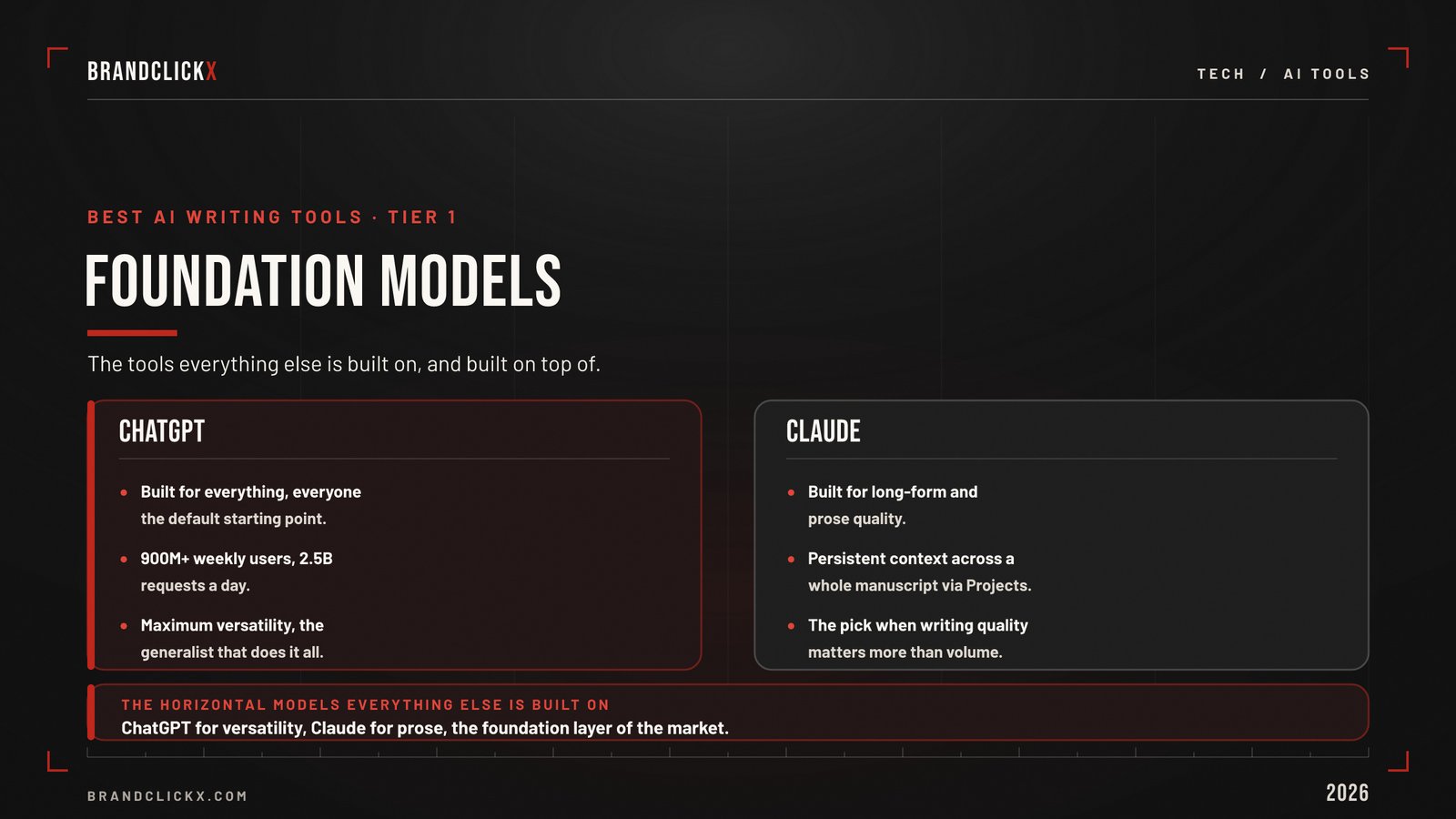
Built for: Everything. Everyone. The default starting point for AI writing in 2026.
The numbers: 900 million+ weekly active users by March 2026. 50 million+ paying subscribers. 78.16% of the global AI chatbot market. 2.5 billion daily requests processed.
No AI writing tool has ever reached these numbers. Nothing comes close.
ChatGPT’s dominance in 2026 is built on GPT-4o, a model that handles virtually any writing task competently: blog posts, emails, social media, product descriptions, ad copy, scripts, technical documentation, creative writing, translation. The free tier now includes GPT-4o access with limits, making it genuinely useful at zero cost.
What it does uniquely well: Versatility. The ability to switch from a technical whitepaper to a product description to a limerick in the same conversation, maintaining context throughout, is something no purpose-built tool can replicate.
The honest limitation: ChatGPT is the generalist. It does everything adequately. It is not the best tool for any specific task. For long-form prose quality, Claude surpasses it. For brand-consistent marketing copy at scale, Jasper surpasses it.
For editing and polish, Grammarly surpasses itand Grammarly’s generative AI also helps brainstorm, draft, and rewrite, not just refine.
Who uses it: Everyone. Literally everyone. Which is both its strength and the reason specialized tools still have a market.
Pricing: Free (GPT-4o with limits) / Plus $20/mo / Team $30/user/mo / Enterprise custom
2. Claude (Anthropic)
Built for: Long-form writing, complex reasoning, prose quality, content strategy
The numbers: Claude Opus 4.6 handles 10–15 page chapters with consistent voice and structure. 46% most-loved among senior knowledge workers in writing tasks, per Toolradar’s April 2026 survey. 91% customer satisfaction.
Claude is not the most popular AI writing tool. It is the best one, at least for the use cases where writing quality is the primary criterion.
Its long-context window, available via the Projects feature for persistent context across sessions, allows a writer to maintain consistent voice, argument structure, and reference material across a complete manuscript.
This is the capability that makes Claude the default tool for content strategists, editorial teams, and anyone writing anything longer than 2,000 words who cares about the output reading like a human wrote it.
What it does uniquely well: Prose quality. Nuance. The ability to internalize a specific voice and maintain it without drift across a long document. Claude’s writing doesn’t just fill word counts, it thinks about structure, argumentation, and reader experience simultaneously.
The honest limitation: No built-in SEO tools. Smaller ecosystem than ChatGPT. The Artifacts feature is powerful for document previews but still feels developer-oriented for many writers.
Who it’s for: Long-form writers, content strategists, editorial teams, anyone producing content where quality matters more than volume.
Pricing: Free (limited) / Pro $20/mo / Max $100/mo / Team $25/seat/mo
Tier 2: Enterprise Marketing Platforms, Brand Voice, Governance, and Campaign Scale
3. Jasper AI
Built for: Enterprise marketing teams, brand-consistent content at scale, campaign orchestration
The numbers: After dropping from $120M to ~$55M in revenue in 2024 as ChatGPT absorbed basic use cases, Jasper rebuilt around $88M ARR through its agent pivot. 100,000+ customers. $131M raised total.
The Jasper of 2026 is not the Jasper of 2022. The original product, a GPT wrapper with marketing templates, got destroyed when ChatGPT launched. The rebuilt product is something more defensible: a brand governance and content agent platform that enforces voice consistency across large, decentralized marketing teams.
Jasper Campaigns let you plan entire marketing initiatives, define goals, audience, and key messages, and Jasper generates aligned content across every format simultaneously. Jasper Agents handle optimization, personalization, and research autonomously. The Brand Voice feature trains on your existing content and enforces that voice on everything the platform produces.
What it does uniquely well: Brand governance at scale. If you manage multiple writers, agencies, or global teams all producing content under one brand, Jasper is the only tool that enforces consistency systematically rather than relying on humans to remember style guide rules.
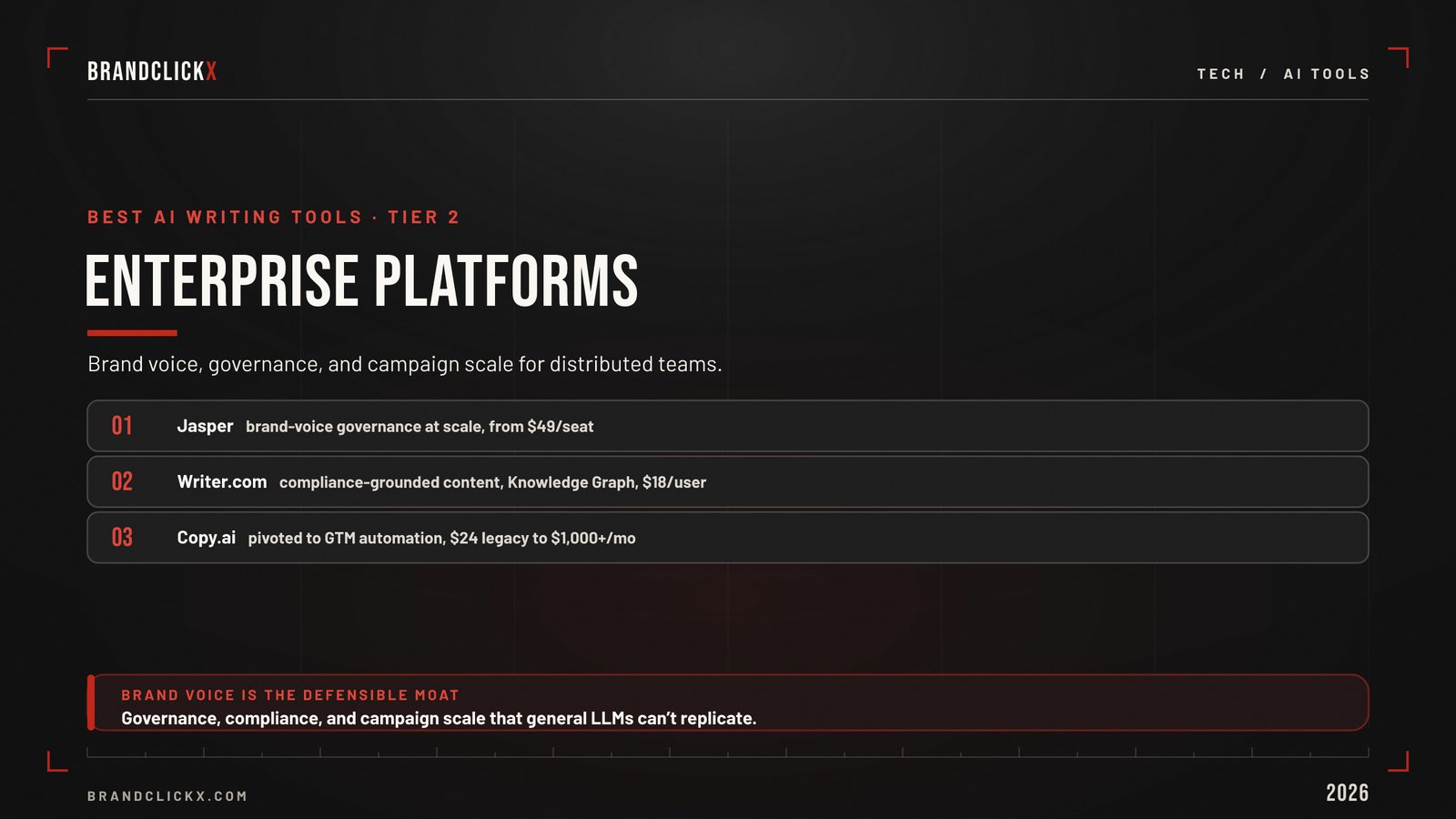
The honest limitation: The pricing starts at $49/seat/month, expensive for individual writers. And for general writing tasks, Claude or ChatGPT at $20/month produce comparable or better output without the brand governance layer.
Who it’s for: Enterprise marketing teams, content agencies, CMOs managing distributed creative operations.
Pricing: Creator $49/mo / Pro $69/mo / Business custom
4. Writer.com
Built for: Enterprise content operations in regulated industries, compliance-sensitive teams
Writer.com is the enterprise content platform most frequently chosen by financial services, healthcare, and technology companies that need AI writing capabilities and strict compliance guardrails simultaneously.
Its Knowledge Graph grounds AI outputs in verified company information, eliminating the hallucination risk that makes other AI writing tools unusable in regulated environments. The AI Agent Builder handles multi-step content workflows. The brand voice layer enforces terminology consistency automatically.
As Toolradar’s comparison notes, Writer was the first platform in the category to launch an AI Agent Builder for enterprise multi-step content processes, ahead of Jasper and every other marketing-specific platform.
What it does uniquely well: Compliance-grounded AI writing. Producing content that is simultaneously brand-consistent, factually grounded in verified company data, and safe for regulated industries is a problem only Writer.com has solved at enterprise scale.
Who it’s for: Large enterprises in regulated industries where content accuracy is a compliance requirement, not just a quality preference.
Pricing: Team $18/user/mo / Enterprise custom
5. Copy.ai
Built for: GTM teams, sales workflows, automated prospecting and content pipelines
Copy.ai is no longer an AI writing tool in any traditional sense.
It pivoted entirely to GTM automation, repriced at $1,000/month minimum for its Growth plan, and rebuilt its platform around automated prospecting, inbound lead processing, deal coaching, and multi-step sales content generation. Revenue grew 260% over eight months following the pivot.
The original Copy.ai, quick social posts, email subject lines, ad copy, is still accessible at the $24/month Chat plan. But that tier is a legacy product. The company has moved upstream.
What it does uniquely well: If you need automated prospecting, inbound lead processing, deal coaching, and content generation in one platform, it is genuinely powerful. Nothing in the category integrates GTM and content operations as thoroughly.
The honest reality: For anyone who just needed an AI copywriting tool, the pivot left them behind. ChatGPT or Claude at $20/month covers what Copy.ai’s original product offered.
Who it’s for: Revenue operations teams, enterprise GTM organizations, companies automating the full sales content pipeline.
Pricing: Chat $24/mo / Growth $1,000/mo / Expansion $2,000/mo / Scale $3,000/mo
Tier 3: The Editing and Optimization Layer
6. Grammarly
Built for: Built for the full writing process brainstorming, drafting, and generating text with AI prompts, plus rewriting, tone adjustment, and polishing across every app you write in
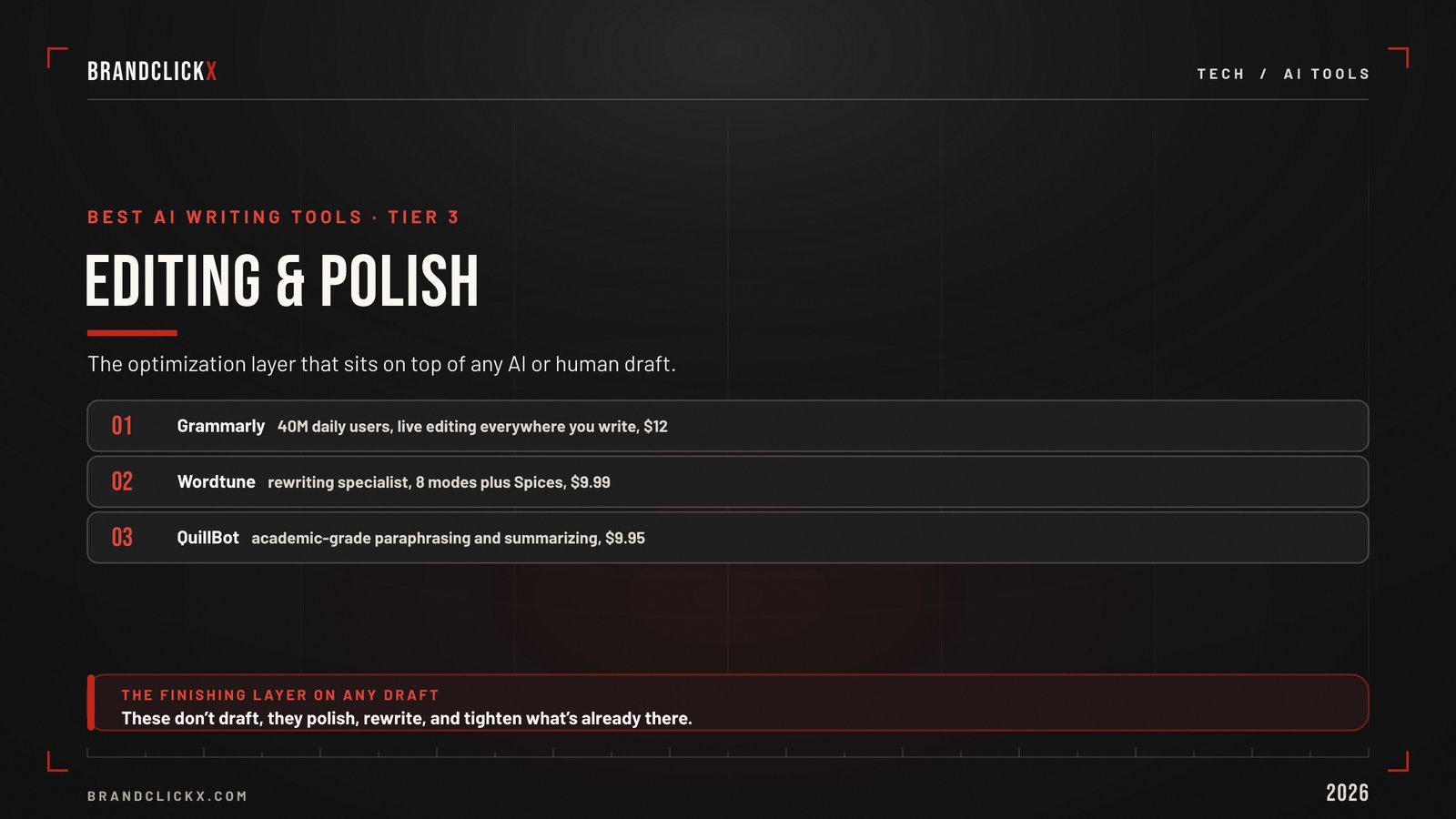
The numbers: 40 million daily active users. The most widely deployed writing tool in corporate environments globally.
Grammarly’s genius in the AI era is positioning. It never claimed to replace writers. It claimed to make every writer better, and it has delivered on that claim consistently across 15 years of product development.
The 2026 Grammarly is AI-powered throughout: tone detection and adjustment, rewrite suggestions, document-level clarity scoring, and the Business Report Writer launched in January 2026 for structured corporate documentation. It works across Gmail, Google Docs, Notion, Slack, LinkedIn, and every major writing environment simultaneously through its browser extension.
What it does uniquely well: Live, in-line editing across every platform you write in. You write in Gmail, Grammarly underlines and suggests. You write in Notion, Grammarly is there. You write in LinkedIn, Grammarly is there. No other tool matches this cross-platform editing presence.
The honest limitation: Grammarly supports the whole writing process: its generative AI writing tools help you brainstorm, outline, and draft, and it also refines grammar, clarity, and tone across every app you write in.
Most working writers use: Grammarly supports both drafting and editing, generating and brainstorming with AI prompts alongside its rewriting and proofreading tools.
Pricing: Free / Pro $12/mo (billed annually) / Enterprise custom
7. Wordtune
Built for: Rewriting, sentence-level improvement, tone adjustment
Wordtune is the rewriting specialist.
Where Grammarly, the leading AI writing assistance platform, supports the full writing process-from brainstorming and drafting to rewriting and error correction-Wordtune improves sentences
, suggesting alternative phrasings, adjusting reading level, shortening verbose passages, and shifting tone from formal to casual or vice versa.
Its Spices feature adds a layer of sophistication that generic rewriting tools lack: it can suggest analogies, counterarguments, examples, and statistics to strengthen a draft rather than just rephrase what’s already there.
Who it’s for: Writers who have a working draft and need to elevate the quality without wholesale rewriting. Particularly useful for non-native English speakers producing professional content.
Pricing: Free (limited) / Plus $9.99/mo / Unlimited $14.99/mo / Business custom
8. QuillBot
Built for: Paraphrasing, summarization, academic writing assistance
QuillBot is the most widely used paraphrasing tool in the AI writing category, and one of the most underrated by marketing professionals who dismiss it as a student tool.
Its eight paraphrasing modes (Standard, Fluency, Formal, Academic, Simple, Creative, Expand, Shorten) give writers granular control over how a passage is rewritten. The Summarizer handles documents up to 6,000 words. The Citation Generator supports APA, MLA, and Chicago formats natively.
For content teams repurposing existing long-form content into new formats, a blog post into a whitepaper summary, a webinar transcript into a newsletter, QuillBot compresses that workflow significantly.
Pricing: Free / Premium $9.95/mo (annual)
Tier 4: SEO and Search-Optimized Writing Tools
9. Writesonic
Built for: SEO-optimized content at volume, search visibility
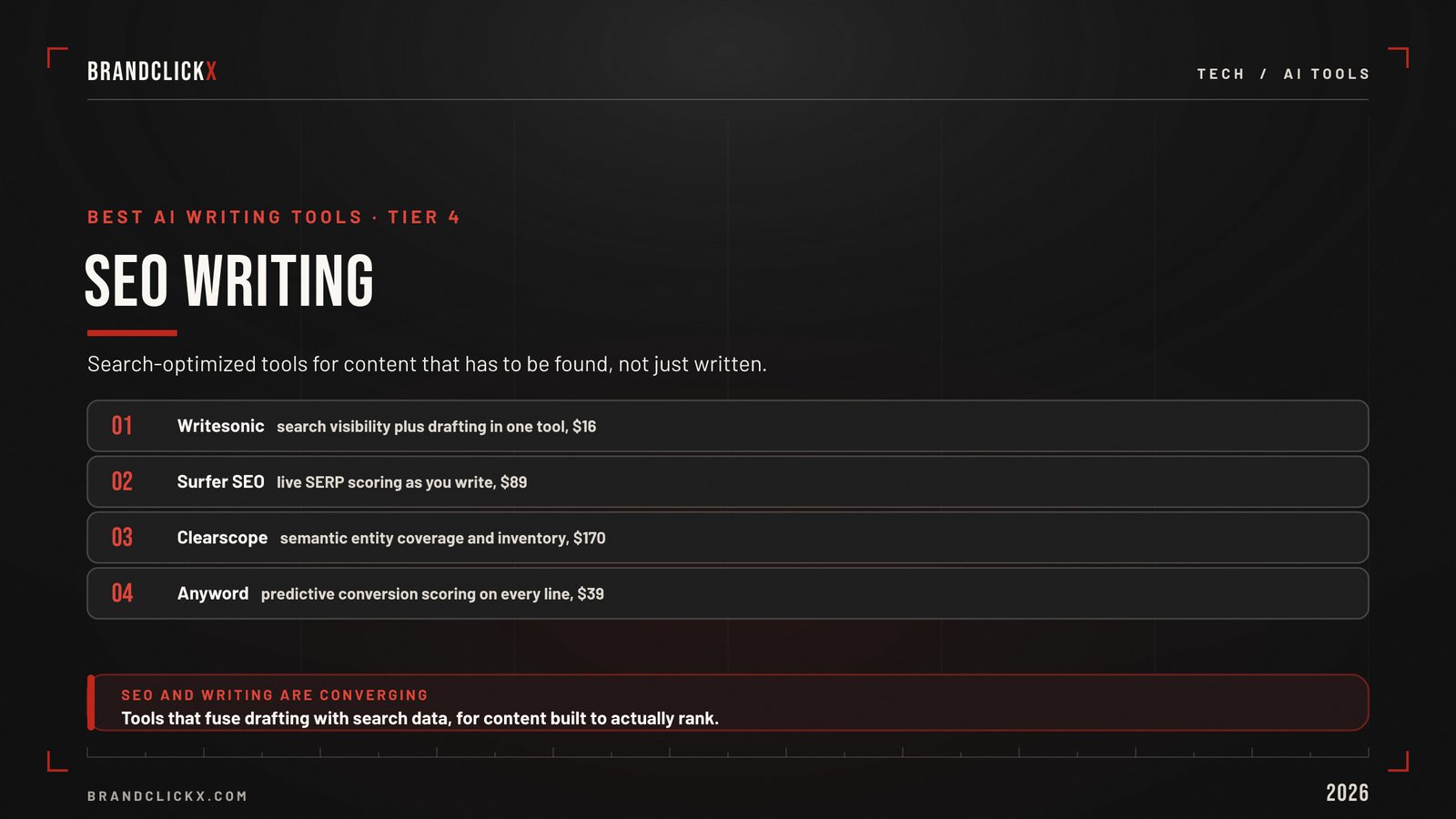
Writesonic in 2026 is not an AI writing tool. It rebranded as an “AI Search Visibility Platform”, and that pivot reflects a genuine insight: the most urgent writing problem for most content teams is not generating words, it is generating words that rank.
Writesonic integrates keyword research, SERP analysis, content briefs, and AI-generated drafts into a single workflow. Its Chatsonic feature adds real-time web access to ground content in current data. The Botsonic product handles chatbot creation from existing content.
What it does uniquely well: The combination of SEO data and AI drafting in one tool, without requiring a separate SEO platform. For teams producing high-volume SEO content on tight budgets, this integration eliminates a significant workflow friction point.
Pricing: Free / Individual $16/mo / Teams $40/mo / Enterprise custom
10. Surfer SEO (Writing Mode)
Built for: Content optimization against live SERP data
Surfer SEO is primarily known as an SEO analysis tool, but its Content Editor has become a core writing tool for SEO content teams. It scores content in real time against keyword density, header structure, entity coverage, and competitor benchmarks, giving writers a live optimization signal as they draft.
The AI Outline Generator and AI-powered paragraph suggestions have added genuine drafting capability alongside the optimization layer. The integration with Google Docs and WordPress means writers never leave their primary environment to access Surfer’s scoring.
The key distinction: Surfer optimizes existing writing. It does not replace the writing itself. Teams that try to use Surfer and an AI writer simultaneously frequently produce content that scores well and reads poorly. The tools belong to different moments in the same workflow.
Pricing: Essential $89/mo / Scale $129/mo / Scale AI $219/mo / Enterprise custom
11. Clearscope
Built for: Enterprise content teams prioritizing semantic SEO
Clearscope is the Surfer SEO alternative for larger content organizations that need a more robust reporting layer, cleaner interface, and better team collaboration features alongside content optimization.
Its Report feature maps the semantic entity coverage required to compete for a keyword, and the Content Inventory tool tracks optimization scores across a published content library over time. For content operations teams managing hundreds of published pages, that inventory visibility is the capability that justifies Clearscope’s premium pricing.
Pricing: Essentials $170/mo / Business $350/mo / Enterprise custom
12. Anyword
Built for: Predictive performance scoring for marketing copy
Anyword is the most analytically sophisticated copy tool on this list. Its core differentiator: it doesn’t just generate marketing copy, it predicts which version will perform better before you publish.
The Performance Score, generated for every piece of content Anyword produces, is trained on performance data from billions of ad impressions. Blog post introductions, email subject lines, ad headlines, landing page copy, each gets a predicted conversion score alongside the content itself.
For performance marketing teams where every copy variant has a measurable downstream impact, Anyword’s predictive layer is the difference between guessing and testing with data.
Pricing: Starter $39/mo / Data-Driven $79/mo / Business $349/mo / Enterprise custom
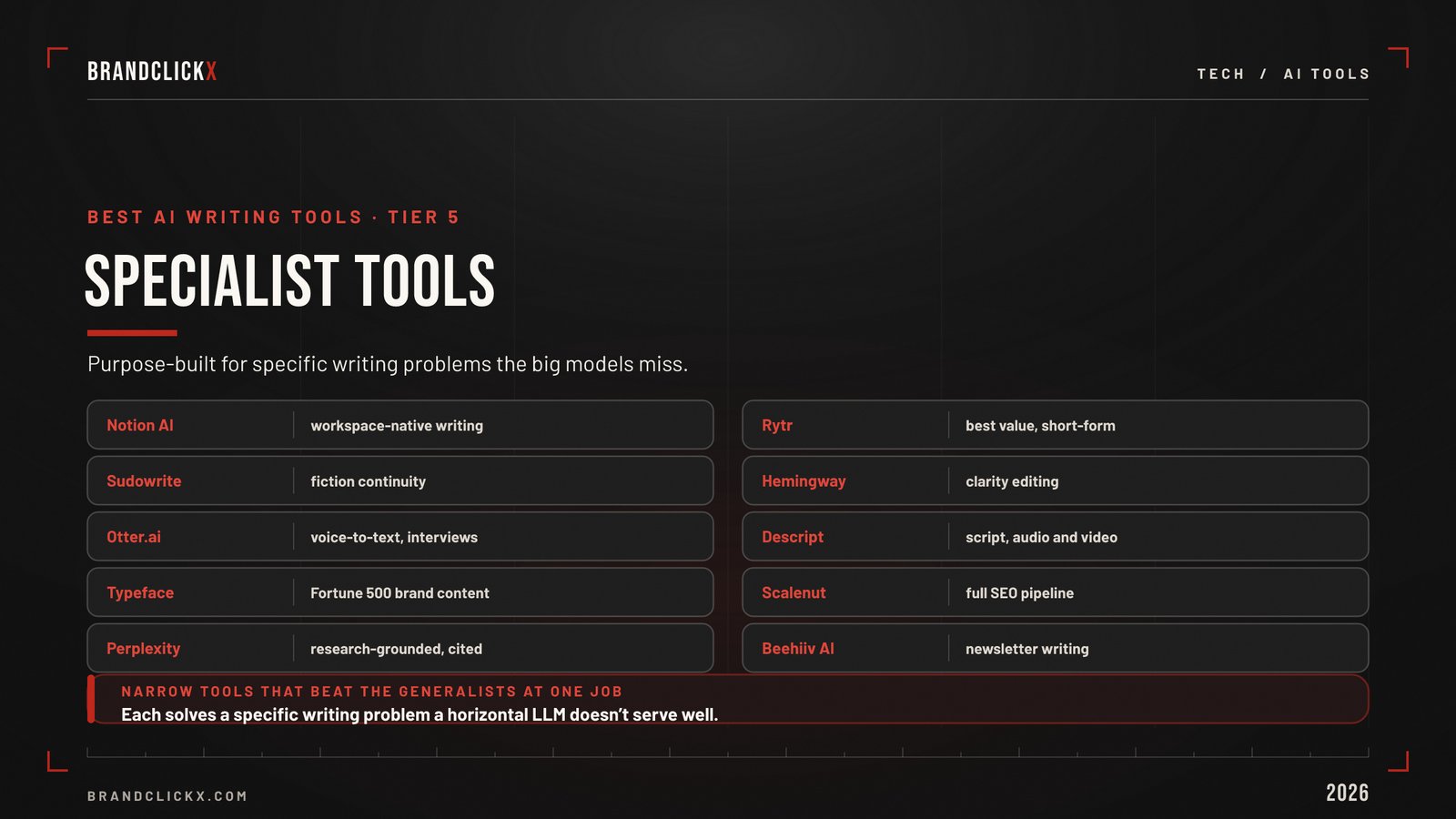
Tier 5: Specialist Tools — Purpose-Built for Specific Writing Problems
13. Notion AI
Built for: Teams already living in Notion who want AI woven into their existing workspace
Notion AI in 2026 is deeply embedded into Notion’s document and database layer, generating content, summarizing pages, translating documents, and filling database properties automatically.
Mobile AI agents arrived in January 2026, allowing Notion AI to build forms, search calendars, and create entire project structures from natural language commands on mobile devices. The custom agents beta adds another orchestration layer for teams building complex content workflows inside Notion.
The honest constraint: You need to be on the $19.50/user Business plan to meaningfully access AI features. That is steep if writing assistance is the only reason for the upgrade. If your team already runs on Notion, the AI integration is the most frictionless available. If it doesn’t, the switching cost is rarely justified by the writing features alone.
Pricing: Plus $12/mo includes basic AI / Business $19.50/user/mo for full AI access
14. Jasper (for individual creators vs. enterprise)
Already covered above, but worth noting that Jasper’s Creator plan at $49/month is genuinely competitive for individual marketing professionals who need brand voice consistency and template-based workflows rather than the full enterprise governance layer.
15. Rytr
Built for: Budget-conscious teams, quick drafts, high-volume short-form content
Rytr is the best value AI writing tool in the market. Full stop.
At $7.50/month (annual billing) for the Unlimited plan, Rytr provides access to 40+ use-case templates, 20+ writing tones, multi-language support, and a Chrome extension, covering the most common short-form writing needs without requiring a premium subscription.
It doesn’t compete with Claude on prose quality. It doesn’t compete with Jasper on brand governance. But for a solopreneur, a small agency, or a team that needs to produce product descriptions, email subject lines, and social captions at volume without a significant budget, nothing comes close to Rytr’s value proposition.
Pricing: Free (10,000 chars/mo) / Saver $9/mo / Unlimited $29/mo
16. Sudowrite
Built for: Fiction writers, novelists, creative writing
Sudowrite is the only tool on this list built specifically for long-form fiction, and it is the best in that category by a significant margin.
Its Story Engine maintains character consistency, plot threads, and narrative tone across a full manuscript. The Write feature generates prose in the established voice of the document, not generic AI prose. The Describe tool generates sensory-rich scene descriptions from a brief prompt. The Brainstorm feature generates plot options consistent with the established story.
No general-purpose AI writing tool handles fiction continuity across 80,000 words as reliably as Sudowrite. It is a narrow product, but within its niche, it is exceptional.
Pricing: Hobby $19/mo / Professional $29/mo / Max $59/mo
17. Hemingway Editor
Built for: Clarity editing, readability improvement, eliminating passive voice
Hemingway Editor is the oldest tool on this list and still the most immediately useful for a specific problem: identifying sentences that are too long, passive constructions, adverbs that weaken prose, and readability grade level.
It doesn’t generate content. It doesn’t rewrite. It highlights problems and lets the writer fix them. That intentional limitation is its strength, it trains writers to produce cleaner prose rather than outsourcing the problem to AI.
For content teams publishing at editorial publication standards, Hemingway is the final pass before submission that Grammarly’s AI suggestions sometimes miss by over-correcting toward formulaic sentence structures.
Pricing: Free (web) / Desktop app $19.99 one-time
18. Otter.ai
Built for: Meeting transcription, voice-to-text, turning spoken content into written drafts
Otter.ai transcribes meetings, interviews, and voice recordings in real time, with speaker identification, automatic summary generation, and action item extraction.
For content teams where subject matter expert interviews are the primary research source, Otter eliminates the transcription bottleneck that used to gate all subsequent writing work. Record the interview, get the transcript, use Claude or ChatGPT to turn it into a first draft.
Pricing: Basic free / Pro $16.99/mo / Business $30/user/mo
19. Descript
Built for: Script writing, podcast and video content, audio-to-text editing
Descript sits at the intersection of writing and audio/video production. Its Overdub feature allows editing audio by editing the transcript, delete a word from the text, it disappears from the audio. Add a sentence to the script, it synthesizes the voice speaking it.
For content teams producing podcasts, video scripts, or training materials, Descript compresses the production workflow significantly, making written and spoken content effectively the same artifact.
Pricing: Free / Hobbyist $24/mo / Creator $40/mo / Business $80/mo
20. GrammarlyGO (Business Tier)
Already covered in the Grammarly entry, but
Grammarly’s Enterprise style guide and brand tone features deserve separate mention.
The ability to create brand-specific style guides that Grammarly enforces across all team member writing, not just grammar, but tone, terminology, and brand voice, is a governance feature that competes directly with Jasper’s brand voice layer at a significantly lower price point.
Pricing: Pro $12/member/mo (billed annually); team features once in the Business plan are now part of Pro, with Enterprise available through Superhuman Go
21. Typeface
Built for: Enterprise brand-personalized content generation at scale
Typeface is the enterprise AI content platform built specifically for Fortune 500 marketing organizations that need to maintain brand consistency across multiple geographies, product lines, and channels simultaneously.
Its Enterprise Hub integrates with existing DAMs, CMSes, and approval workflows, meaning generated content flows into existing governance processes rather than creating parallel pipelines that bypass brand review.
Customers include major consumer goods companies running campaigns across dozens of markets simultaneously, a use case where manual brand consistency is essentially impossible and where Typeface’s automated brand enforcement creates measurable operational leverage.
Pricing: Enterprise custom
22. Wordtune (Read & Summarize)
Already covered in the rewriting tier, but Wordtune’s Read & Summarize feature deserves specific mention for research-heavy content teams. It can summarize a 40-page research report into a five-bullet executive summary in seconds, grounding the summary in the source document rather than hallucinating.
For marketing teams that need to translate technical research, analyst reports, or competitor documentation into accessible content, this is the most reliable summarization tool available.
23. Scalenut
Built for: End-to-end SEO content workflow, research, brief, draft, optimize
Scalenut is the most complete SEO content pipeline tool for mid-market content teams. It combines keyword research, competitor analysis, AI-generated content briefs, AI drafting, and real-time SEO scoring in a single platform.
Where Surfer SEO and Clearscope optimize content you’ve already drafted, Scalenut starts from a keyword and walks you through the entire workflow to a publishable first draft. For teams producing 20–50 SEO articles per month without a dedicated SEO analyst, Scalenut’s end-to-end automation is the highest-leverage tool available at its price point.
Pricing: Essential $39/mo / Growth $79/mo / Pro $149/mo
24. Perplexity AI (for research-backed writing)
Built for: Research-grounded writing, fact-checking, cited content generation
Perplexity is not primarily a writing tool. But for writers who need every claim sourced and verified before it appears in a draft, it is the most important tool in the research phase.
Every Perplexity response is grounded in current web sources with citations attached. For content requiring real-time data, recent statistics, or competitor information that predates any AI model’s training cutoff, Perplexity eliminates the hallucination risk that makes other LLMs unreliable for factual writing.
The Pages feature, which generates shareable, cited reports from research conversations, has become a lightweight publishing tool for teams that need to produce research-backed content rapidly.
Pricing: Free / Pro $20/mo / Enterprise custom
25. Beehiiv AI (for newsletter writing)
Built for: Newsletter creators, email content, subscriber-facing writing
Beehiiv is primarily a newsletter platform, but its AI writing features are purpose-built for the specific demands of email content: subject line optimization, preview text generation, in-email AI drafting, and performance prediction based on subscriber engagement history.
For the creator economy segment, writers building audience-first businesses around newsletters, Beehiiv’s AI layer is the most contextually appropriate writing tool because it has access to the subscriber data, open rate history, and engagement patterns that make its suggestions genuinely personalized rather than generic.
Pricing: Free (up to 2,500 subscribers) / Scale $42/mo / Max $84/mo
The 2026 AI Writing Tool Market at a Glance
| Tool | Best For | Pricing Start | Key Differentiator |
| ChatGPT | Everything, everyone | Free / $20 Pro | 900M+ weekly users, maximum versatility |
| Claude | Long-form, prose quality | Free / $20 Pro | Best writing quality, 200K context |
| Jasper | Enterprise brand governance | $49/seat | Brand voice enforcement at scale |
| Writer.com | Regulated enterprise content | $18/user | Compliance grounding, Knowledge Graph |
| Copy.ai | GTM automation, sales content | $24 / $1,000 | Full GTM pipeline, not just writing |
| Grammarly | Full writing process – drafting, editing, polish, cross-platform | Free / $12 Pro | 40M DAUs, works everywhere you write |
| Wordtune | Rewriting, tone adjustment | $9.99/mo | 8 rewriting modes, Spices feature |
| QuillBot | Paraphrasing, summarization | Free / $9.95 | Academic-grade paraphrasing |
| Writesonic | SEO content at volume | $16/mo | Search visibility + drafting combined |
| Surfer SEO | Content optimization | $89/mo | Live SERP scoring while you write |
| Clearscope | Enterprise SEO content ops | $170/mo | Semantic entity coverage + inventory |
| Anyword | Performance-scored copy | $39/mo | Predictive conversion scoring |
| Notion AI | Workspace-native writing | $19.50/user | AI inside your existing docs/databases |
| Rytr | Budget teams, short-form | Free / $7.50 | Best value in the entire category |
| Sudowrite | Fiction, creative writing | $19/mo | Best-in-class for narrative continuity |
| Hemingway | Clarity editing | Free / $19.99 | Trains writers, doesn’t replace them |
| Otter.ai | Voice-to-text, interviews | Free / $16.99 | Meeting transcription + summaries |
| Descript | Script, audio/video content | Free / $24 | Edit audio by editing text |
| Typeface | Fortune 500 brand content | Enterprise custom | Multi-market brand automation |
| Scalenut | Full SEO content pipeline | $39/mo | Research → brief → draft → optimize |
| Perplexity | Research-grounded writing | Free / $20 | Cited, real-time sourced content |
| Beehiiv AI | Newsletter, email content | Free / $42 | Subscriber data-grounded suggestions |
Key Takeaways
- The category has permanently split in two. Horizontal foundation models (ChatGPT, Claude, Gemini) dominate general writing. Vertical platforms (Jasper, Writer.com, Anyword) dominate specific enterprise use cases. The thin wrappers in between are gone.
- Grammarly serves as both a drafting aid – its generative AI brainstorms, outlines, and drafts – and an editing layer, so it can complement or reduce reliance on a separate drafting tool.
- Brand voice is the only truly defensible moat. The tools that survived the ChatGPT-era shakeout did so by building brand governance layers that general LLMs can’t replicate without significant prompt engineering. Jasper, Writer.com, and Typeface all charge premium prices for this capability because it is genuinely difficult to replicate.
- SEO and writing are converging. Writesonic’s rebrand as a “Search Visibility Platform” is the signal. As Google AI Overviews change what content needs to accomplish to drive traffic, the tools that combine writing and search optimization in one workflow will grow faster than pure writing tools.
- 97% of AI content still needs a human. Build your stack around acceleration, not replacement. The teams winning with AI writing tools are the ones that have clearly defined which parts of the workflow belong to AI and which parts belong to humans, and have not confused the two.
FAQ: Best AI Writing Tools 2026
What is the best AI writing tool in 2026?
It depends entirely on what you’re writing. Claude produces the best long-form prose quality. ChatGPT offers the best versatility and largest ecosystem. Jasper is strongest for enterprise brand voice. Grammarly is the leading AI writing assistance platform, supporting everything from brainstorming and drafting to rewriting and polish.. Most professional writers use two tools: one for drafting (Claude or ChatGPT) and one for editing (Grammarly).
How big is the AI writing tools market in 2026?
The global AI writing tool market reached $4.2 billion in 2026 and is projected to hit $12 billion by 2030, per Grand View Research. 97% of content marketers now use or plan to use AI writing tools in 2026, up from 90% in 2025.
Do AI writing tools replace human writers?
No. Across 12,000+ pieces of analyzed AI-generated content, 97% required human editing for optimal performance. Organizations achieving 61% higher productivity use hybrid workflows where AI handles first drafts and humans handle strategy, judgment, and final editing.
What happened to the AI writing tools that were popular in 2023–2024?
The market went through a major shakeout. Copy.ai pivoted to GTM automation at $1,000+/month. Jasper’s revenue dropped from $120M to ~$55M before recovering through an agent pivot. Dozens of thin GPT wrappers shut down as the base models absorbed their core features. The survivors went deeper into enterprise or narrower into specific use cases.
What is the most cost-effective AI writing stack in 2026?
For most professionals: Claude Pro at $20/month plus Grammarly Pro at $12/month, $32 total. For budget-conscious teams: Rytr Unlimited at $7.50/month. For SEO content: add Writesonic at $16/month. For enterprise brand governance: evaluate Jasper starting at $49/seat or Writer.com at $18/user.
Conclusion: Buy for the Problem, Not the Category
The most common AI writing tool mistake in 2026 is buying based on category, “we need an AI writing tool”, rather than problem, “we need to produce 40 brand-consistent blog posts per month without doubling our content team.”
The tools on this list solve different problems. Claude and ChatGPT solve the blank page problem. Jasper and Writer.com solve the brand consistency problem.
Grammarly supports the full writing process from brainstorming and drafting to editing and polish.
. Anyword solves the performance prediction problem. Sudowrite solves the fiction continuity problem. Perplexity solves the hallucination problem.
The $4.2 billion market will reach $12 billion by 2030, not because teams are buying more tools, but because the tools are solving more specific, higher-value problems than they were two years ago.
The teams building the most effective AI writing stacks in 2026 are the ones that have answered two questions before spending a dollar: what specific bottleneck in our writing workflow does this tool eliminate? And is there a tool that does that specific thing better than a general-purpose LLM?
If the answer to the second question is yes, buy it.
If the answer is no, Claude or ChatGPT at $20/month is probably already sitting in the gap.