AI Overview
The AI attribution crisis is the breakdown of marketing measurement caused by AI search and shopping. When people research and buy after asking ChatGPT, Perplexity, or Google’s AI Overviews, the referral data often disappears, so analytics tools like GA4 file high-intent visits under “Direct” and the real source vanishes. That blinds in-house teams. But it creates a clear agency opportunity: rebuilding measurement with marketing mix modeling, incrementality testing, and AI-visibility tracking is hard, recurring, board-level work. The crisis that threatens execution-only agencies makes measurement-led ones indispensable.
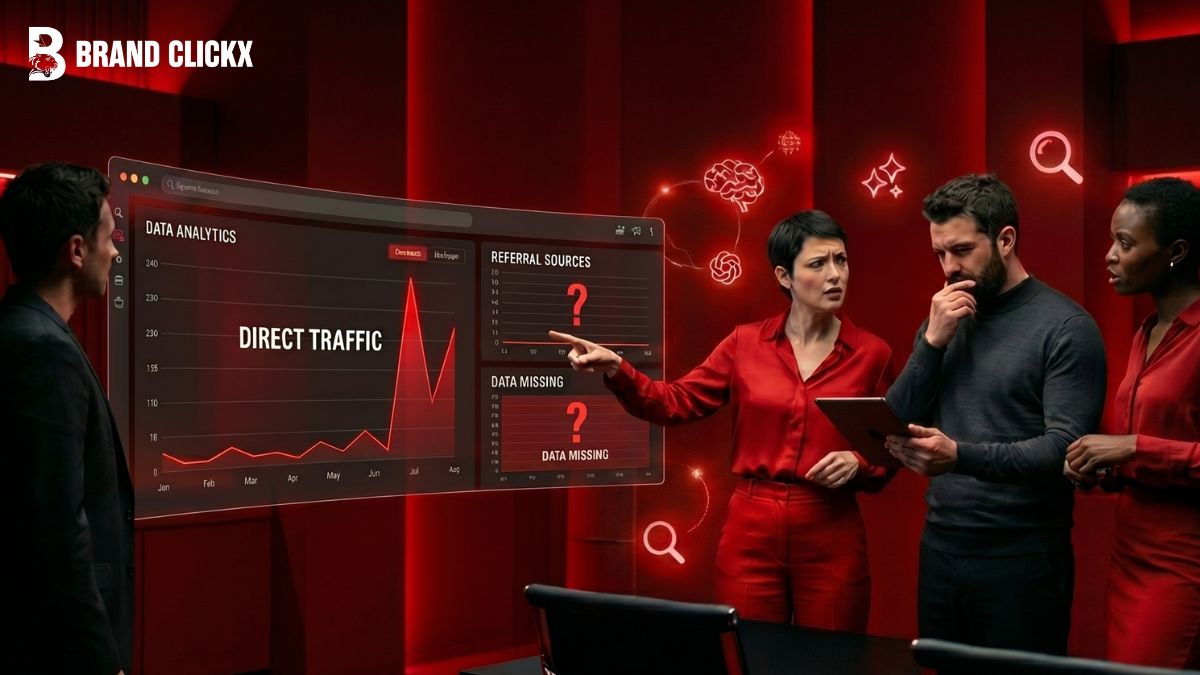
Open your analytics tomorrow and the numbers will look fine. That’s the problem.
Direct traffic is up. Organic looks soft. Conversions are holding, but you can’t quite say why. Most marketing teams will read that and conclude demand is cooling, or that their SEO slipped.
They’ll be wrong. And the agencies that understand why are about to get very busy.
Here’s the contrarian truth nobody in the doom-loop is saying out loud: the same AI wave that’s supposedly making agencies obsolete is quietly handing them the most valuable new service line in a decade. The catch is that it’s hidden inside a crisis everyone else is too panicked to read clearly.
Let’s read it clearly.
What actually broke

For twenty years, marketing measurement rested on one assumption: a customer searches, clicks, lands on your site, and the analytics capture the source. Tidy. Traceable.
That chain is snapping.
In 2026, a huge share of the buying journey happens before any click, inside AI surfaces you can’t see into. People ask ChatGPT to compare products. They let Perplexity shortlist vendors. They read an AI Overview and never visit the ten blue links underneath it.
The dealership-marketing platform Hrizn put the shift bluntly: the click is no longer the moment of truth. The decision now forms upstream, in conversations with machines, and your website shows up late, if at all.
This isn’t a fringe behavior. According to Salesforce research, 39% of consumers, and over half of Gen Z, already use AI for product discovery. That is the top of your funnel quietly migrating somewhere your dashboard can’t follow.
And the people arriving from AI aren’t tire-kickers. They’ve already been pre-qualified by the model. Ahrefs found that AI search visitors convert at roughly 23 times the rate of traditional organic visitors. Fewer of them, but far more valuable, and almost none of them tracked correctly.
Why your dashboard is lying

Here’s the mechanical reason the numbers deceive you, and it’s worth understanding precisely.
When someone clicks a link inside an AI app, especially on mobile, the app often strips out the referrer data. The click arrives at your site with no fingerprint of where it came from.
GA4 receives a session, looks for a source, finds nothing, and does what it’s built to do: it dumps the visit into “Direct.” As Parcel Perform explained in a useful technical breakdown, that misclassification turns high-intent AI traffic into invisible Direct traffic.
So your Direct bucket swells with phantom visits. Your AI-driven revenue gets miscredited. And if you’re a performance team optimizing to the dashboard, you start defunding the exact content and channels feeding those AI recommendations, because on paper they show zero return.
That’s the trap. You cut the thing that’s working because the tool can’t see it working.
| What your dashboard shows | What’s actually happening |
| Direct traffic spiking | AI referrals stripped of their source |
| Organic “declining” | Discovery moved into AI Overviews and chat |
| Some channels showing zero ROI | Those channels are feeding AI recommendations |
| Conversions flat or unexplained | High-intent AI visitors converting, miscredited |
There’s a partial technical fix, and it’s worth doing. You can build a custom channel group in GA4 with a regex that catches known AI referrers like Perplexity, ChatGPT, and Claude, pulling browser-based visits out of Direct.
But it only catches the desktop traffic that still passes a referrer. The mobile-app clicks, the biggest and fastest-growing slice, stay invisible. A regex patch is a flashlight in a much bigger dark room.
Everyone’s reading this as a threat. That’s the mistake.

The panic narrative writes itself. AI broke measurement. AI automates content and media buying. So agencies, the thinking goes, are getting squeezed from both sides and heading toward extinction.
Run the logic one step further, though, and it flips.
If measurement is broken for everyone, then measurement becomes the scarce, valuable skill. And rebuilding it is not a button you press. It’s statistics, data engineering, and AI-visibility expertise stacked together, the kind of work most in-house teams simply don’t have the bench to do.
The trade body IAB has already declared the measurement ecosystem fundamentally broken, citing privacy changes, fragmented platforms, and inconsistent cross-channel tracking. When the official industry verdict is “this is broken,” that’s not an obituary for agencies. That’s a brief.
Think about what a CMO is feeling right now. They have to walk into a boardroom and defend spend with numbers they no longer trust. That fear is the most billable emotion in marketing.
From execution vendor to measurement partner
This is the repositioning that matters, and it’s the heart of the agency opportunity.
For years, the agency value proposition has been execution: we run your ads, your SEO, your content. That work is exactly what AI is commoditizing. It’s getting faster, cheaper, and easier to bring in-house.
Measurement is the opposite. It’s getting harder, higher-stakes, and more specialized at the precise moment clients need it most. An agency that owns the measurement layer stops being a vendor you can swap out and becomes the partner that tells you where your money actually works.
| The execution agency (commoditizing) | The measurement-led agency (defensible) |
| Runs ads, posts content, builds links | Rebuilds attribution and proves incrementality |
| Competes on price and output volume | Competes on truth and decision quality |
| Easy to replace or automate | Embedded in the client’s budget decisions |
| Reports clicks and rankings | Reports causal impact and AI visibility |
| Talks to the marketing manager | Talks to the CFO and the board |
That last row is the whole game. Measurement work earns you a seat in the room where budgets are decided. Once you’re the source of truth, you’re not getting fired in the next cost review. You’re the one the cost review depends on.
This is also a cleaner growth path. Execution retainers shrink as AI gets cheaper. Measurement and intelligence retainers grow as the data gets messier. For agency growth in 2026, that’s the trade you want to be on the right side of.
The new measurement stack agencies can actually sell
So what does the service look like in practice? It’s a stack, not a single tool, and that complexity is the moat. Here’s what belongs in it.
Marketing mix modeling, modernized. MMM is the old discipline having its comeback, because it measures channels in aggregate without needing to track individuals. It’s privacy-proof by design. Adoption has surged as cookie-based tracking collapsed, and it answers the question CMOs care about: if I move budget here, what happens to revenue?
Incrementality testing. Geo-holdout experiments, where you deliberately turn off spend in some markets and compare, measure true causal lift instead of the credit a platform claims for itself. This is how you separate marketing that works from marketing that merely takes credit.
Self-reported attribution, parsed by AI. The humble “How did you hear about us?” field is back, and it’s now readable at scale. Modern teams use LLMs to categorize thousands of free-text answers and reassign credit to dark channels that no pixel ever caught, podcasts, Slack groups, a friend’s recommendation.
AI-visibility tracking. A new metric some call “share of model”, how often your brand shows up in AI recommendations versus competitors. If buyers are deciding inside ChatGPT and Perplexity, your presence there is a number worth measuring and improving.
Analytics re-architecture. The unglamorous foundation: GA4 channel groups, server-side tracking, first-party data capture, and a warehouse so the client owns their data instead of renting visibility from platforms that keep going dark. Tools like Adobe’s Attribution AI bring algorithmic multi-touch modeling into this layer for enterprises.
The norm now is not one model but several, run together and reconciled. Multi-touch attribution for day-to-day tactics, MMM for strategic budget, incrementality to validate both. Single-model attribution died with the cookie.
| Method | What it solves | Best for |
| Marketing mix modeling | Privacy-proof, channel-level ROI | Budget allocation, big spenders |
| Incrementality testing | True causal lift vs claimed credit | Validating paid channels |
| Self-reported attribution | Dark-channel and word-of-mouth credit | Pipeline and demand-gen teams |
| AI-visibility tracking | Brand presence inside AI answers | Anyone losing the upstream journey |
| Analytics re-architecture | Capturing what platforms hide | The foundation under all of it |
What it looks like with a real client
Picture a direct-to-consumer brand whose Direct traffic jumped 40% over two quarters while paid search “performance” looked flat. The in-house read: paid is tired, Direct is just brand strength, hold the course.
An agency running the measurement stack would tell a different story.
A regex audit reveals a chunk of that Direct surge is actually Perplexity and ChatGPT referrals. An incrementality test shows the “tired” paid search is doing real upstream work, seeding the brand mentions the AI engines later recommend. And a share-of-model check finds the brand is cited in AI shopping answers far less than its closest rival.
Suddenly the conversation changes. The brand wasn’t coasting on demand. It was underinvesting in the exact content feeding its highest-converting channel, and quietly losing the AI shelf to a competitor. That’s a finding worth a retainer, because it directly moves revenue.
That’s the pitch, made concrete. Not “we’ll get you more clicks.” Instead: “your numbers are lying to you, and we can prove what’s really driving growth.”
How to package and price it
The mistake agencies make is bolting “attribution” onto an existing media retainer as a free dashboard. That trains clients to see it as overhead.
Sell it as its own thing. A measurement and AI-visibility practice, priced on the value of the decision it informs, not the hours it takes.
A few moves that work:
- Lead with an audit. A paid attribution-and-AI-visibility audit surfaces the Direct-bucket distortion and the share-of-model gap fast. It’s a low-risk entry that almost always justifies the bigger engagement.
- Sell the reconciliation, not a tool. Clients don’t want another dashboard. They want one trusted number. Position the agency as the layer that reconciles MTA, MMM, and incrementality into a decision.
- Tie it to the boardroom. Frame deliverables as budget-defense and forecasting, the things a CFO signs off on. That moves you out of the marketing-services line item and into strategic spend.
- Make it recurring. Models need feeding and recalibrating. That’s not a flaw, it’s the retainer.
The honest caveats
This is a real opportunity, not a magic one, and overpromising is how agencies lose the trust that makes measurement valuable in the first place.
MMM needs enough historical data and spend to be reliable, so it suits established brands more than week-old startups. Incrementality testing needs scale and discipline; a tiny budget can’t run a clean geo-holdout. The regex fix is partial, and mobile-app traffic stays stubbornly dark. And “share of model” is an emerging metric, useful directionally, not yet a precise science.
The agencies that win here will be honest about that uncertainty. The ones that sell attribution as a solved problem will get caught the moment a client checks the math.
Used well, that honesty is itself the differentiator. In a market drowning in confident dashboards that turn out to be wrong, the partner who says “here’s what we can prove, and here’s what we can’t” is the one who keeps the account.
Frequently asked questions
What is the AI attribution crisis?
It’s the breakdown of marketing measurement as AI search and chat strip referral data, so tools like GA4 misfile high-intent AI traffic as Direct, hiding what really drives sales.
Why does AI traffic show up as Direct in GA4?
AI apps, especially on mobile, often sandbox clicks and strip the HTTP referrer. With no source attached, GA4’s default rules file the visit as Direct, masking the AI customer journey.
How can agencies profit from the attribution crisis?
By selling measurement as a service: marketing mix modeling, incrementality testing, AI-visibility tracking, and analytics re-architecture. It’s specialized, recurring work that fuels agency growth.
Is marketing mix modeling making a comeback?
Yes. As cookies and user-level tracking collapsed, MMM adoption surged because it measures channel ROI in aggregate without tracking individuals, making it privacy-proof and resilient.
Can you fix AI attribution in GA4?
Partly. A custom channel group with a regex catching Perplexity, ChatGPT, and Claude recovers browser-based AI referrals, but mobile-app traffic stays invisible, so it’s a baseline, not a full fix.
What is share of model in AI marketing?
Share of model measures how often a brand appears in AI-generated recommendations versus competitors. As buyers decide inside AI tools, it’s becoming a key marketing measurement metric.
Key takeaways
- The crisis is real and miscounted. AI traffic hides in GA4’s Direct bucket, so teams misread strong AI-driven demand as soft demand and defund what’s actually working.
- High value, low visibility. AI visitors convert at roughly 23x organic, yet most go untracked. The mismeasurement is most dangerous on your best traffic.
- Threat for execution, gift for measurement. AI commoditizes the work agencies used to sell. It also makes measurement scarce and valuable, repositioning agencies as indispensable.
- The stack is the moat. MMM, incrementality, self-reported attribution, AI-visibility tracking, and analytics re-architecture together are too complex for most in-house teams to run alone.
- Sell truth, not dashboards. Package measurement as board-level budget defense, price it on decision value, and stay honest about the limits. That honesty is the differentiator.
What happens next
The click spent two decades as the unit of marketing truth. It’s being quietly retired, and most of the industry hasn’t updated its instruments.
Expect a messy stretch. Through 2026, plenty of brands will misread their own data, cut the wrong budgets, and blame a slowdown that was really a measurement failure. Some will lose ground they never see themselves losing, because the dashboard kept saying everything was fine.
The agencies that thrive will be the ones that stopped selling clicks and started selling clarity. They’ll treat attribution not as a report but as a product, the reconciled, defensible answer to the only question a CFO really asks: what is actually working, and how do you know?
Marketing measurement is being rebuilt from the ground up right now. The firms that build it will own the most strategic seat in their clients’ businesses for the next decade. The ones still optimizing to a lying dashboard will wonder where the work went.
That shift, from execution to intelligence, is the story BrandClickX will keep covering, with reporting from people who have run the campaigns and rebuilt the measurement, not just watched the dashboards.