
The Big Picture
AI chip stocks have been in a sharp, multi-day sell-off this week, with Nvidia, AMD, Intel, and several memory makers all declining despite Micron posting record quarterly earnings. The sell-off is being driven primarily by rising inflation concerns and Federal Reserve interest-rate uncertainty, not by any single company-specific problem.
Micron’s blowout results on June 24 briefly eased the pressure, but broader Big Tech weakness and a hot inflation reading have kept the sector volatile through the past several trading sessions.
Why AI Chip Stocks Are Selling Off
The sell-off intensified across multiple sessions this week, with the Nasdaq Composite falling roughly 2.2% in one session and the Nasdaq 100 dropping more than 3.2% at its worst point. Several specific chip and memory names Sandisk, Micron, and Arm fell more than 10% in a single session, while Marvell, Analog Devices, Western Digital, Texas Instruments, and Qualcomm each dropped around 9%.
Two main factors are driving the decline:
- Rising inflation and Fed rate uncertainty. A fresh Personal Consumption Expenditures (PCE) reading, the Fed’s preferred inflation gauge, showed prices rising again in May, partly attributed to shock from the Iran war and its effect on energy prices.
This has kept the possibility of further interest-rate hikes in play, which tends to hit high-growth tech and chip stocks particularly hard. - Valuation anxiety heading into Micron’s earnings. JPMorgan and Wedbush analysts both noted that part of the selling reflected nervousness ahead of Micron’s June 24 earnings report, given how central memory-chip demand has become to the broader AI investment narrative.
Wedbush’s Dan Ives characterized the volatility as part of an ongoing pattern of “gut check moments” in the AI trade rather than a sign that AI demand itself is slowing.
Micron’s Earnings Briefly Calmed the Market
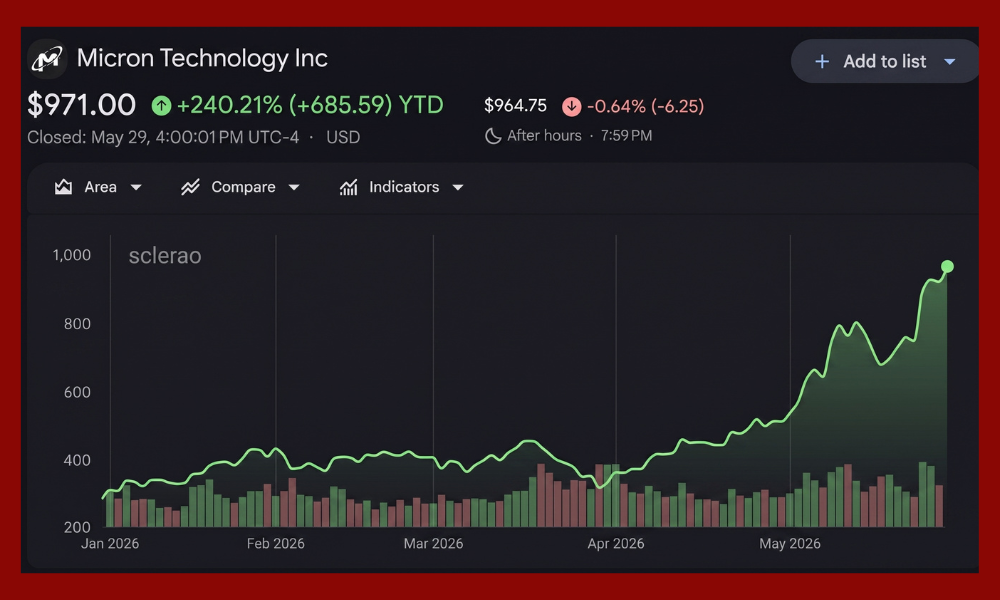
Micron reported record quarterly results after the bell on June 24, and the stock jumped more than 15% in response, its best single-day move in recent memory.
Fiscal Q2 revenue reached $23.86 billion with adjusted EPS of $12.20 and a non-GAAP gross margin of 74.4%. For the next quarter, management guided to $33.5 billion in revenue and an adjusted EPS of $19.15, with gross margin expected to reach roughly 81% at the midpoint.
The standout detail: Micron’s entire 2026 high-bandwidth memory (HBM) output is already sold out, with management saying it can only fulfill half to two-thirds of total customer demand.
HBM is the specialized memory that sits alongside AI processors from Nvidia and AMD, feeding them data fast enough to support large-model training, meaning Micron’s results function as a real-time read on how strong underlying AI infrastructure demand actually is.
Despite the beat, the relief was short-lived. The following session, a fresh inflation reading overshadowed Micron’s results, and broader Big Tech weakness, including concerns about declining free cash flow at major hyperscalers due to heavy AI spending, kept pressure on the sector.
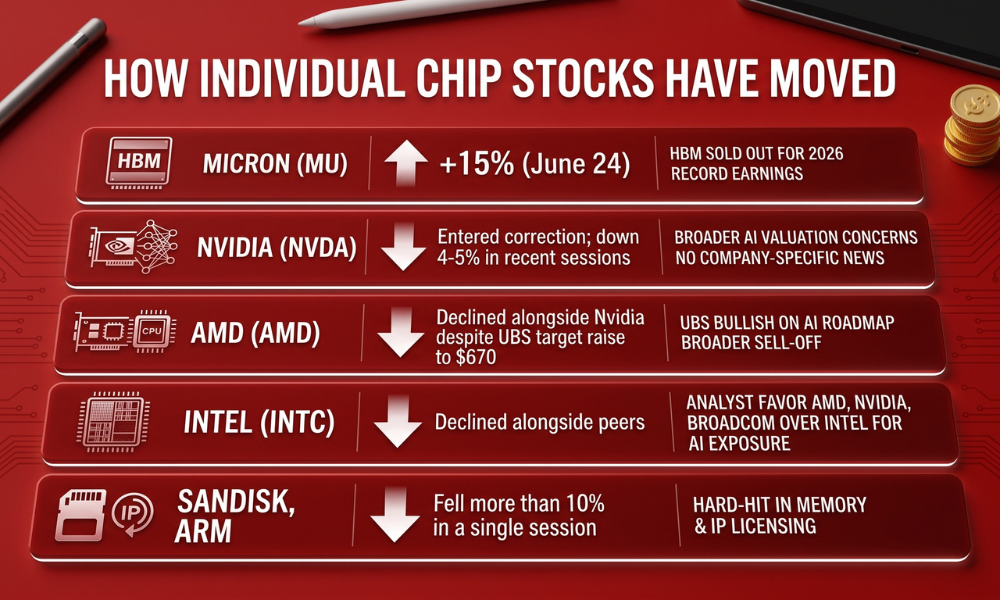
How Individual Chip Stocks Have Moved
| Company | Recent Move | Context |
| Micron (MU) | +15% (June 24) | Record earnings, HBM sold out for 2026 |
| Nvidia (NVDA) | Entered a stock correction; down roughly 4-5% in recent sessions | Broader AI valuation concerns, no company-specific news driving the drop |
| AMD (AMD) | Declined alongside Nvidia despite a recent UBS price target raise to $670 | UBS had been bullish on AMD’s AI accelerator roadmap shortly before the broader sell-off |
| Intel (INTC) | Declined alongside peers | Goldman Sachs has favored AMD, Nvidia, and Broadcom over Intel for AI exposure |
| Sandisk, Arm | Fell more than 10% in a single session | Among the hardest-hit names in the memory and IP licensing space |
Notably, several analysts had turned more bullish on individual names shortly before the sell-off, UBS raised its AMD price target to a street-high $670 just before shares declined alongside the rest of the sector, illustrating how broad, macro-driven the selling has been rather than reflecting a reassessment of any single company’s fundamentals.
The Other Ongoing Story: AI Chip Exports to China
Separate from this week’s stock volatility, the longer-running question of AI chip exports to China remains an active backdrop story:
- The U.S. Commerce Department’s Bureau of Industry and Security (BIS) revised its licensing policy to allow case-by-case review of export licenses for Nvidia’s H200, AMD’s MI325X, and similar chips to China, provided security requirements are met.
- Separately, BIS has faced reported staffing and processing bottlenecks, with license approval times reportedly stretching into months as the agency’s licensing and rulemaking staff turnover has run close to 20%.
- Nvidia CEO Jensen Huang has publicly described smuggled AI chips reaching China through unauthorized channels as a “dead end,” underscoring continued tension around enforcement even as official export channels have partially reopened.
- AMD’s MI308 chip has reportedly been gaining traction with Chinese cloud and AI buyers as a practical alternative, given its higher memory capacity and lack of the security objections that have slowed Nvidia’s H20.
This export-policy backdrop isn’t moving today’s stock prices directly, but it remains one of the key structural risks analysts cite when discussing AMD and Nvidia’s longer-term China revenue exposure.
What This Means Going Forward
A few things worth watching in the near term, based on current analyst commentary:
- Thursday’s PCE inflation data is widely viewed as the next major catalyst, a softer reading could ease rate-hike fears and support a rebound in chip stocks, while a hotter print could extend the sell-off.
- Micron’s HBM scarcity is being read as a bullish demand signal for the broader AI infrastructure trade, even though it didn’t fully insulate the stock from the next day’s macro-driven decline.
- Valuation, not demand, appears to be the central market debate right now. Multiple analysts have explicitly framed this week’s moves as repricing of how much growth is already baked into AI chip valuations, rather than evidence that underlying AI compute demand is weakening.

Frequently Asked Questions
Why are AI chip stocks falling today?
The decline is primarily driven by rising inflation concerns and uncertainty over Federal Reserve interest-rate policy, not company-specific problems. A hotter-than-expected PCE inflation reading has kept the possibility of further rate hikes in play, which tends to weigh heavily on high-growth tech and chip stocks.
Did Micron’s earnings help or hurt the chip sell-off?
Both. Micron’s record results and sold-out HBM output sent its stock up more than 15% and briefly eased broader market jitters, but the relief was short-lived once a fresh inflation reading and concerns about hyperscaler free cash flow took over the next session.
Is AMD doing better or worse than Nvidia right now?
Both stocks have declined together amid the broader sector sell-off. AMD had received a bullish UBS price target raise to $670 shortly before the decline, suggesting the drop reflects macro conditions across the sector rather than a reassessment specific to either company.
What’s happening with AI chip exports to China?
The U.S. Commerce Department has allowed case-by-case review of export licenses for chips like Nvidia’s H200 and AMD’s MI325X to China, though the licensing agency has faced reported staffing bottlenecks slowing approval times to months in some cases.
Is this sell-off a sign that AI demand is slowing?
Most analyst commentary frames it as valuation-driven repricing rather than a demand problem. Micron’s sold-out 2026 HBM capacity is specifically cited as evidence that underlying AI infrastructure demand remains strong despite the stock price volatility.