


AI Overview
In a June 5, 2026 filing, the Google SpaceX deal committed Google to paying SpaceX about $920 million a month, roughly $30 billion total, for around 110,000 Nvidia GPUs at Memphis data centers originally built for xAI. The term runs October 2026 to June 2029. Google called it short-term “bridge capacity” for surging demand for its Gemini Enterprise platform. It is Google’s second compute deal with a rival’s infrastructure in weeks, after Anthropic’s $1.25 billion-a-month agreement with SpaceX. The deal reveals three things: compute is scarce, electricity is the deeper bottleneck, and AI money is increasingly moving in circles.
Google is, by most counts, the single largest owner of AI compute on Earth. It designs its own chips. It runs some of the biggest data centers ever built.
And it just rented 110,000 Nvidia GPUs from a rocket company.
Sit with that for a second, because it is the whole story. When the company with the most compute on the planet has to lease more from Elon Musk’s SpaceX, a firm that also owns a direct Gemini rival, you are not looking at a routine cloud contract. You are looking at a confession.
Three confessions, actually. The deal quietly admits that compute is scarce, that power is an even bigger wall than chips, and that the AI boom has started financing itself in circles. Read it that way and a dull-sounding filing becomes the clearest snapshot we have of how the AI race actually works in 2026.
Here is what is really going on.
The deal in 60 seconds
| What | The detail |
| Who pays whom | Google pays SpaceX |
| How much | ~$920 million a month, about $30 billion total |
| For what | ~110,000 Nvidia GPUs, plus CPUs, memory, components |
| When | October 2026 to June 2029, ramping up at a reduced fee through September |
| Where | SpaceX data centers in Memphis, originally built for xAI |
| Disclosed | June 5, 2026, in a filing ahead of SpaceX’s IPO |
The numbers came straight from a regulatory filing, and CNBC laid out the structure: payments start lower during ramp-up, then hit the full $920 million in October.
Google did not call it a master plan. It called the arrangement short-term “bridge capacity” for demand on Gemini Enterprise, its AI agent platform, that ran hotter than the company expected.
That word, bridge, does a lot of work. You do not spend $30 billion bridging a gap unless the gap is real, urgent, and bigger than you can fill yourself.
Confession one: even the giants are short on compute
Start with the obvious question. Google builds its own AI chips, the TPUs. So why is it paying for 110,000 of Nvidia’s?
Part of it is plain availability. When demand spikes faster than you can stand up new capacity, you grab whatever powered, working compute exists, even if it runs on someone else’s silicon in someone else’s building.
And Google is not alone in this scramble. This is its second compute deal with a rival’s infrastructure in a matter of weeks. The first was Anthropic, which agreed to pay SpaceX roughly $1.25 billion a month to rent essentially all the compute at the Colossus 1 data center near Memphis. Google’s slice is about half that.
So inside one month, two of the best-funded AI players on the planet both turned to a rocket company for capacity. That tells you the shortage is not a startup problem. It reaches the very top.
The strategic question used to be “who has the smartest model.” It quietly became “who can physically get enough compute, online, this quarter.” Models are commoditizing. Capacity is the thing everyone is fighting over.
Confession two: the real wall is power, not chips
Here is the part most coverage skips, and it is the most important.
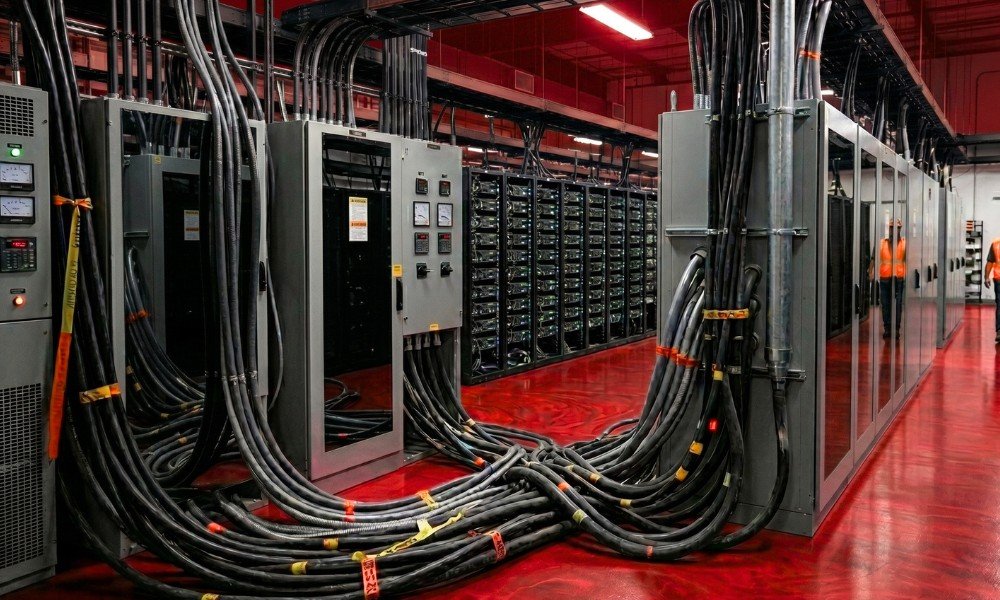
The bottleneck in 2026 is not really GPUs. Nvidia is shipping. The choke point is electricity, and everything that moves it.
A single AI request can pull up to a thousand times the power of an old-fashioned web search. Stack millions of those, and you get data centers that draw as much electricity as a mid-sized city. The grid was never built for that.
The numbers are brutal. High-voltage transformers that took two to three years to source before 2020 now carry lead times stretching toward five years. Thousands of gigawatts of would-be capacity sit frozen in US interconnection queues. Electrical gear is a small slice of a data center’s cost and close to the entire reason projects stall.
This is exactly why SpaceX had compute to rent in the first place.
When xAI threw up its Colossus supercluster in Memphis at record speed, the local utility could not deliver power fast enough. So the team bypassed the grid with onsite gas turbines, generating electricity behind the meter to keep the GPUs fed. It worked. It also drew real criticism over emissions in the surrounding community, the kind of tradeoff the AI build-out keeps making out of public view.
Scale that up and the stakes get vivid. The first gigawatt-scale AI data centers are arriving in 2026, and a single one of them draws about as much power as a full nuclear plant. xAI’s next Memphis campus, Colossus 2, is racing to that scale.
So when Google rents 110,000 GPUs in Memphis, it is not just buying chips. It is buying energized, powered, cooled capacity that someone else already fought the grid to build. In an era where megawatts are harder to get than silicon, that is the scarce asset changing hands.
That is the insight worth holding onto. The AI race is turning into an energy race. Whoever controls power, through grid deals, nuclear contracts, or a field of gas turbines, controls the pace of AI itself.
Confession three: the money is moving in circles
Now follow the cash, because this is where smart investors start to squint.
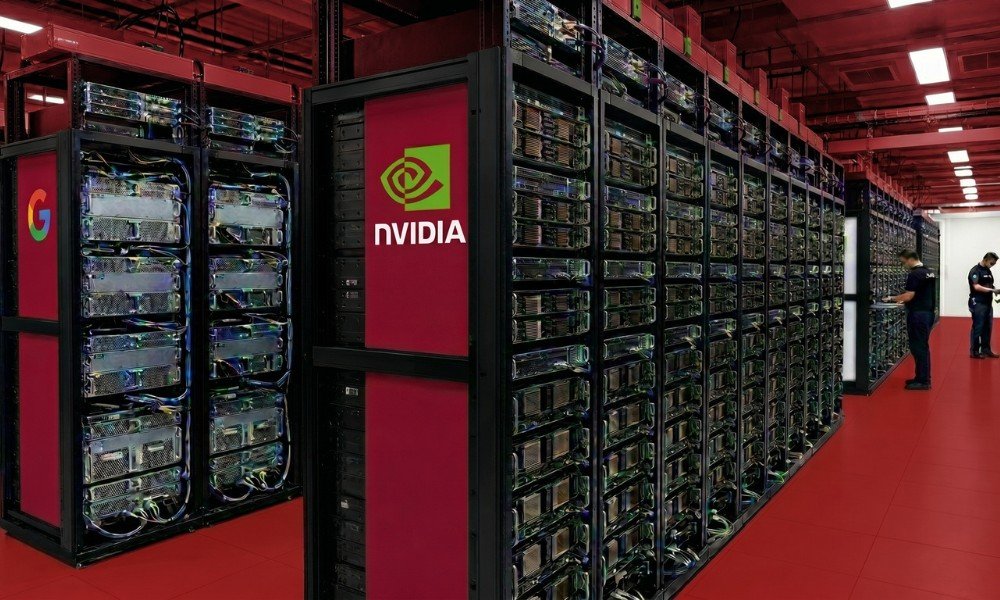
Alphabet, Google’s parent, owns roughly 6% of SpaceX, a stake reportedly worth north of $100 billion. SpaceX disclosed the Google deal in a filing ahead of an IPO expected to value it well past a trillion dollars.
See the loop? Google pays SpaceX, which lifts SpaceX’s revenue and valuation right before the IPO, which lifts the value of the 6% that Alphabet already owns. One analyst summed it up sharply: capex that funds itself on paper.
This is not a one-off quirk. It is the defining financial pattern of the current AI boom, and it has a name: circular financing.
The most-cited example is Nvidia’s pledge to invest up to $100 billion in OpenAI, money OpenAI then spends largely on Nvidia chips. Bernstein analyst Stacy Rasgon flagged the obvious “circular” concern when that deal landed. OpenAI’s enormous cloud commitment to Oracle runs on similar logic. Capital flows out, products and rent flow back, and everyone’s revenue and valuation rise together.
| The loop | Who funds whom | What flows back |
| Google ↔ SpaceX | Google rents compute from SpaceX | SpaceX value rises; Alphabet’s 6% stake gains |
| Nvidia ↔ OpenAI | Nvidia invests up to $100B in OpenAI | OpenAI buys Nvidia GPUs |
| OpenAI ↔ Oracle | OpenAI commits huge cloud spend | Oracle builds, books the revenue |
Defenders say this is just how hyperscale infrastructure gets funded when demand is this intense, and that the underlying usage is real. Skeptics see an echo of the dot-com era, when overbuilt fiber-optic networks looked like permanent growth right up until the bottom fell out.
Both can be partly right. That is what makes it nervous money.
The accidental winner is a rocket company
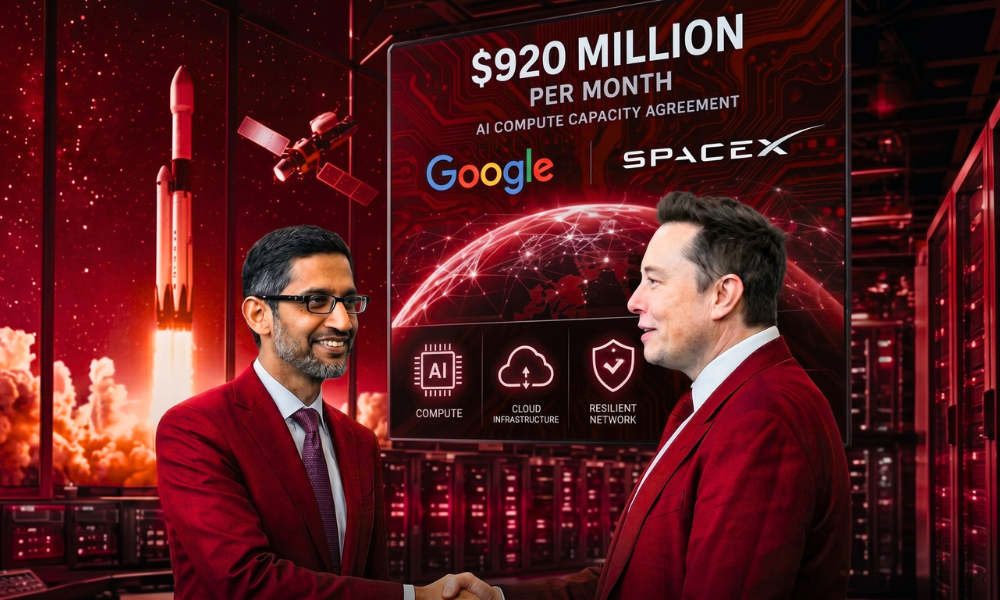
Step back and the strangest part of the AI race comes into focus. The clearest winner so far does not make a model or a chip. It launches rockets.
SpaceX folded xAI’s data centers into a compute-leasing business at the exact moment demand outran supply. Between the Google and Anthropic contracts, Reuters estimates the two deals could generate around $26 billion a year for SpaceX, with combined lifetime value north of $70 billion.
Here is the stat that reframes the whole company: SpaceX’s projected annual data-center revenue is on track to exceed what it earns from Starlink, launches, and everything else combined. Tom’s Hardware noted the same thing. A rocket company’s biggest business is now renting AI compute.
In a gold rush, the people who get rich are rarely the ones panning for gold. They are the ones selling shovels. SpaceX is selling shovels, scheduled, guaranteed compute, to the richest buyers in technology, and collecting rent from rivals who would never share a lunch table.
So is this a bubble, or the price of admission?
Honest answer: nobody knows yet, and anyone who tells you otherwise is selling something.
The bear case is straightforward. Valuations are sprinting ahead of profits. The financing runs in loops. The physical build-out resembles the fiber overinvestment that cratered after 2000. If demand ever softens, a single broken link, a delayed data center, a missed payment, could ripple through interconnected contracts fast.
The bull case is just as real. Usage of AI tools keeps climbing. The products keep getting more capable. Google’s whole reason for this deal, demand for Gemini Enterprise outrunning forecasts, is a genuine signal that enterprises are adopting AI faster than even Google modeled.
| The bear case | The bull case |
| Circular financing inflates everyone at once | Real, rising demand from real customers |
| Valuations outpace actual profit | Products keep improving and getting adopted |
| Echoes dot-com fiber overbuild | Compute shortage is genuine, not manufactured |
| One failure could cascade | Capacity, once built, gets used |
The truth is probably uneven. Some corners of AI are clearly frothy. Others are underbuilt for the demand already in front of them. The Google SpaceX deal is evidence for both arguments at once, which is exactly why it is worth paying attention to.
What this means if you’re not a trillion-dollar company
It is tempting to file all this under “giants being giants.” That would be a mistake, because the squeeze flows downhill.
When Google and Anthropic lock up massive blocks of GPUs and power on multi-year contracts, that capacity leaves the open market. The pool everyone smaller fishes from gets shallower and pricier.
For a founder or a mid-market brand, the lesson is practical. The AI tools your teams rely on sit on top of a supply chain that is genuinely constrained, and the constraint is increasingly electricity, not code. Pricing, reliability, and even feature availability now depend on whether your vendor secured compute and power early.
A few things worth doing now:
- Ask your AI vendors where their compute lives and how stable that supply is. “We use a major cloud” is no longer a complete answer.
- Treat AI capacity like a supply-chain risk. Diversify providers where you can, and read the fine print on rate limits.
- Expect prices to reflect scarcity, and budget for it rather than assuming costs only fall.
The companies that win the next phase will be the ones that treated compute and power like critical supply, secured ahead, never assumed, while everyone else discovered mid-launch that the smartest model is useless with nowhere to run it.
Frequently asked questions
What is the Google SpaceX deal?
Google agreed to pay SpaceX about $920 million a month for roughly 110,000 Nvidia GPUs at Memphis data centers built for xAI, running October 2026 to June 2029, worth around $30 billion.
Why is Google renting compute instead of using its own?
Google called it short-term “bridge capacity” for unexpectedly high Gemini Enterprise demand. Even its huge owned capacity, including its own TPU chips, could not absorb the surge fast enough.
What is the real bottleneck in AI right now?
Power, not chips. Transformer lead times stretch to five years and grid queues are jammed, so energized, powered data-center capacity is harder to secure than the GPUs themselves.
What is circular financing in AI?
It is when money loops between partners, like Google paying SpaceX while owning 6% of it, or Nvidia funding OpenAI to buy Nvidia chips. Each deal inflates the others’ revenue and valuation.
Is the Google SpaceX deal a sign of an AI bubble?
It fuels the debate. Bears point to circular financing and dot-com-style overbuilding. Bulls cite real, surging demand. The deal is genuinely evidence for both views.
Why does this matter for smaller companies?
Giant long-term compute and power contracts pull capacity off the open market, making GPUs scarcer and pricier for startups and mid-market firms, and turning compute into a real supply-chain risk.
Key takeaways
- Even Google is short on compute. When the largest compute owner rents 110,000 GPUs from a rival, the shortage is structural, not a startup problem.
- Power is the true bottleneck. Chips are flowing; transformers, grid hookups, and electricity are not. The AI race is becoming an energy race.
- The money runs in circles. Alphabet owns ~6% of SpaceX, so Google’s payments lift the value of Google’s own stake, part of a wider pattern that worries bubble watchers.
- A rocket company is the quiet winner. SpaceX’s data-center revenue is on track to top its rocket business, proof that selling compute beats building models right now.
- The squeeze hits everyone below. Locked-up capacity makes compute scarcer and costlier for smaller players, so treat AI compute as a supply-chain risk, not a given.
What happens next
This deal will read, in hindsight, as the moment the AI race openly changed shape.
The first chapter was about intelligence: whose model was smartest. The chapter we are in now is about industry: whose data centers are biggest, whose power is locked in, whose GPUs actually arrive on schedule. The winners of the next stage may be decided less by research breakthroughs than by concrete, electricity, and transformers.
Expect more deals like this, not fewer. Expect rivals to keep renting from each other, because in a shortage, availability beats pride. And expect power, not silicon, to be the word that shows up in the next round of headline contracts.
The companies that understand this early will treat compute and energy the way manufacturers treat critical supply, secured in advance and never assumed. The ones that do not will keep being surprised, the way Google just was, by how quickly demand outruns the ability to build.
That shift, from a race of ideas to a race of infrastructure, is the story BrandClickX will keep covering, with reporting from people who have built and run these systems, not just watched the headlines roll by.