
GOOGLE AI OVERVIEW
The Walmart Google deal, announced in June 2026, connects Walmart Connect’s first-party shopper data to Google Display & Video 360. Brands can target YouTube ads using real Walmart purchase behavior, then measure whether those ads drove sales at Walmart. The partnership gives Google retail outcomes to rival Amazon advertising, and gives Walmart reach far beyond its own sites.
The Walmart Google deal did not arrive with a Super Bowl spot or a keynote stage. It arrived as a blog post on a Thursday. And it may reshape where billions in ad dollars flow.
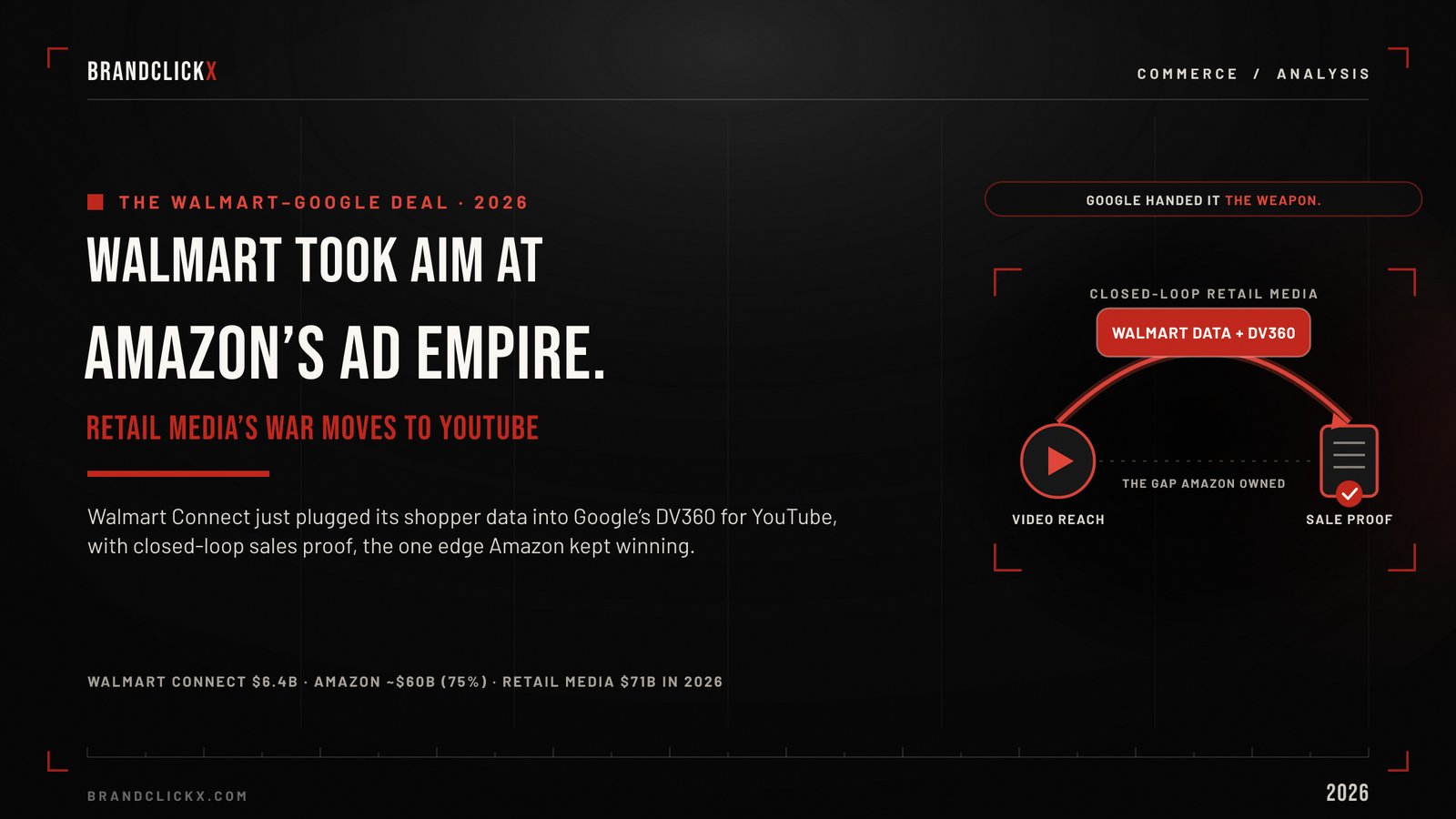
On June 11, 2026, Walmart Connect and Google quietly tied Walmart’s shopper data directly into Google’s programmatic engine. Brands can now target YouTube ads using real Walmart purchase behavior, then prove which of those ads led to a sale.
That last part is the whole game. For years, the biggest gap in digital advertising was the space between a video view and a checkout. Amazon built a $60 billion business by owning that link. Walmart and Google just built a bridge across it.
Why it matters: retail media is now a top-three advertising channel, sitting alongside search and social. The companies that connect audience reach to proven sales will set the price for everyone else. This deal is a play for exactly that position.
The Deal in Plain English
Strip away the press language and the mechanics are clean. Walmart Connect, the retailer’s advertising arm, brought its first-party audiences and measurement into Google Display & Video 360, known across the industry as DV360.
DV360 is where many large advertisers and agencies plan and buy media. Now, inside that same workflow, a brand can select a Walmart shopper segment, run it against YouTube, and see whether those views turned into purchases at Walmart.
The integration starts with YouTube. More inventory types are planned to follow.
Strategic Breakdown: three things happen in one motion here. Audience activation, premium video reach, and closed-loop sales measurement all sit in a single platform. Before this, advertisers had to stitch those pieces together across separate tools and hope the data lined up.
Walmart framed the value as combining high-intent shopper signals with the kind of reach only a platform like YouTube provides. Agencies welcomed it for a practical reason: the audiences now live inside the systems their teams already use daily.
The named players signal how serious this is. Walmart Connect leadership and Google’s retail team announced it together, and Publicis Media Exchange offered the agency endorsement. This is not a pilot tucked in a corner. It is a front-door product.
Why This Is Really About Amazon
Let us be direct about the target. The Walmart vs Amazon rivalry has a new front, and it runs straight through advertising.
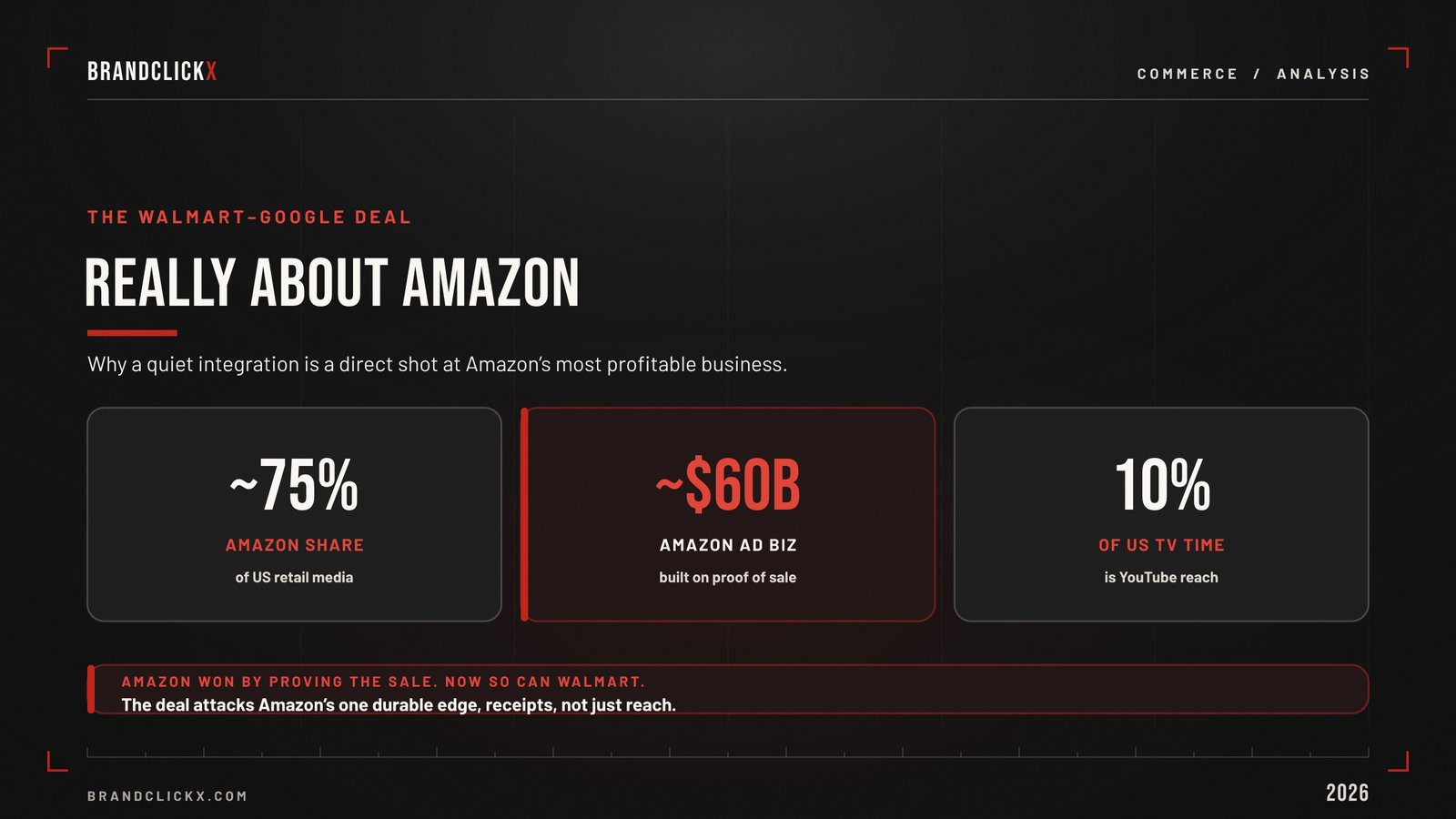
Amazon more or less invented retail media advertising. It turned its shopper data and checkout proof into one of the most profitable engines in technology. Amazon advertising commands roughly three-quarters of US retail media spend, with ad revenue that climbed from about $47 billion in 2023 toward the $56 billion range by 2025.
The reason brands kept feeding Amazon was simple. Amazon could prove the sale. Other platforms offered reach, but not receipts.
Industry Impact: the Walmart Google deal attacks that exact advantage. It pairs Walmart’s purchase data with YouTube, which already accounts for around 10% of all TV viewing time in the United States. Reach plus retail outcomes, in one buy.
For Google, the logic is defensive and offensive at once. Advertisers had been shifting budget into retail media networks because those networks offered something Google ads historically could not: direct proof of purchase. Now Google can argue it offers both massive reach and a clean line to the cash register.
So the deal does two jobs. It hands Walmart distribution far beyond its own properties. And it gives Google a credible answer to the one question Amazon kept winning.
The Money Behind Retail Media
To understand why both companies moved, follow the spend. Retail media advertising has gone from a niche line item to one of the fastest-growing categories in marketing.
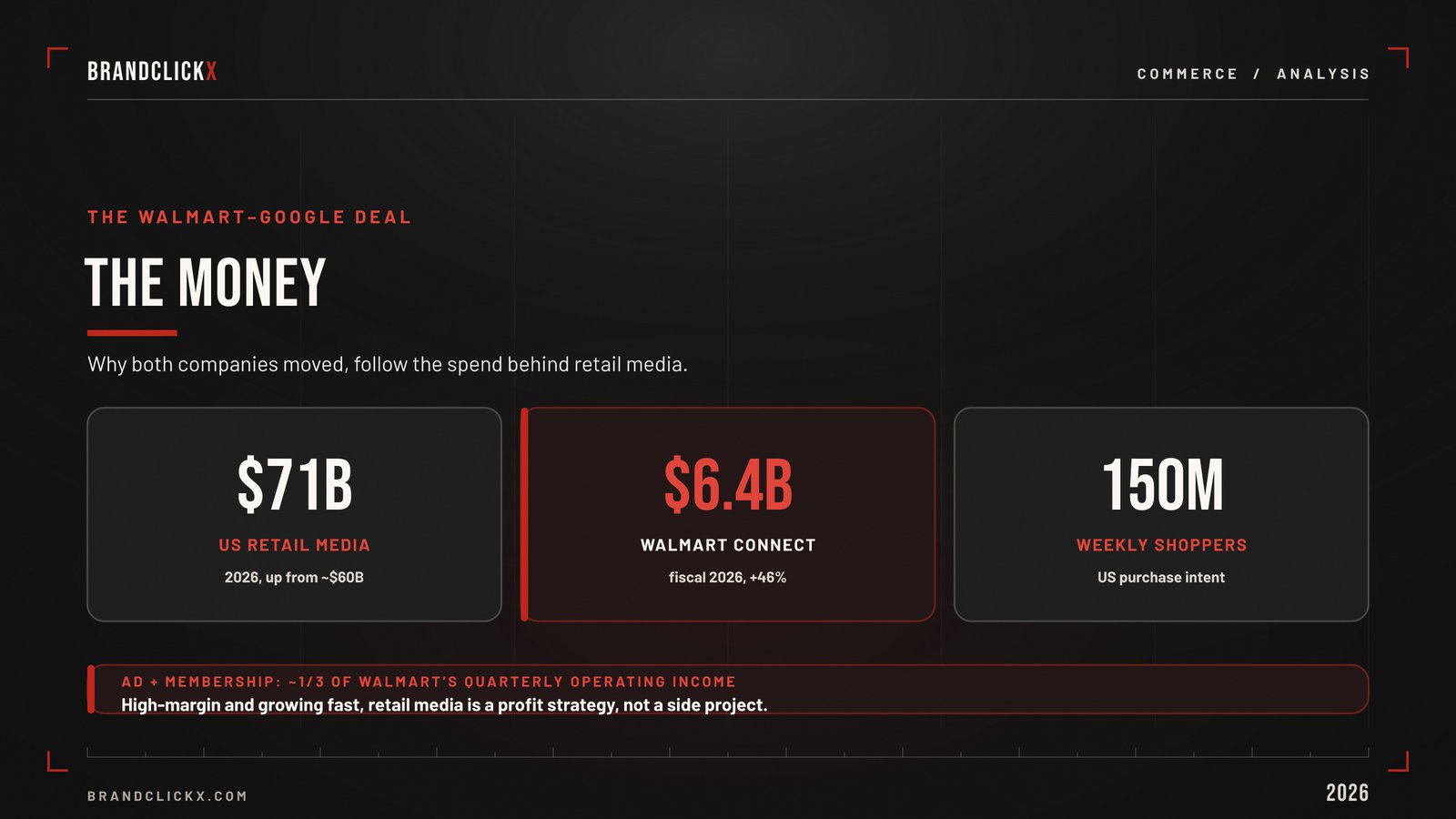
US retail media spending is projected to reach about $71 billion in 2026, up from roughly $60 billion the year before. That growth rate is leaving traditional digital channels behind, and forecasts suggest retail media will overtake social media networks within a few years.
Walmart’s own numbers tell the story of urgency and opportunity. Walmart Connect ad revenue stood near $2.94 billion in 2023 and was projected to more than double by 2026.
The actual results outran the projection. Walmart’s global advertising business reached $6.4 billion in fiscal 2026, a 46% jump, with its US Walmart Connect arm growing 41% in the holiday quarter alone.
Market Observation: ad revenue still represents a small slice of Walmart’s total business. But it is high margin, and advertising plus membership fees now drive roughly a third of the company’s quarterly operating income. That is why retail media advertising is not a side project. It is a profit strategy.
The deeper driver is data. As third-party cookies faded, brands grew desperate for reliable first-party signals. Retailers realized their shopper data was a goldmine. Walmart sees about 150 million weekly US shoppers, which is one of the largest pools of purchase intent on earth.
That scale is the asset. The Walmart Google deal is the distribution.
What Walmart Gets, What Google Gets
A partnership only lasts if both sides win. Here is the honest trade behind the headline.
| Dimension | What Walmart Gets | What Google Gets |
| Reach | Distribution far beyond Walmart.com, onto YouTube and DV360 | Retail outcome data it never owned before |
| Data | New monetization of first-party shopper signals at scale | A proof-of-purchase answer to Amazon advertising |
| Advertisers | Access to brands buying in DV360 workflows | A reason for budgets to stay inside Google ads |
| Measurement | Closed-loop sales proof tied to its own checkout | Performance credibility for YouTube advertising |
| Competition | A stronger position against Amazon in retail media | A new lever in the broader programmatic advertising fight |
Neither company is doing the other a favor. Both are answering the same threat from opposite sides. Amazon owns the closed loop. This deal lets Walmart and Google build one together.
Enterprise Perspective: for large brands, the practical win is fewer walled gardens to navigate. Shopper targeting that used to require separate retail media buys can now ride inside a programmatic platform many teams already operate.
The Connected TV Land Grab
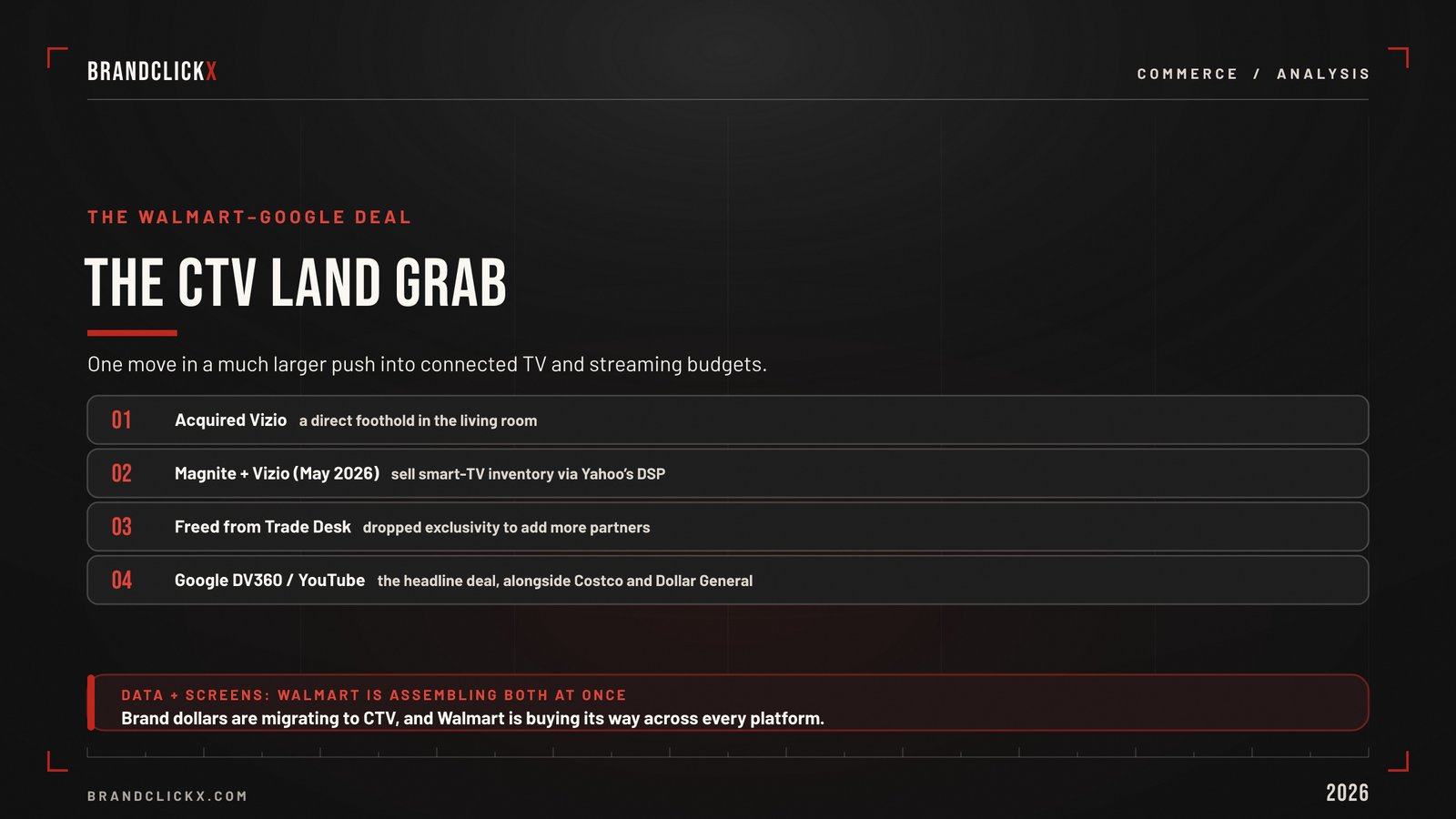
Zoom out and a pattern appears. The Walmart Google deal is one move in a much larger push into connected TV advertising and streaming budgets.
Walmart has been busy. The retailer dropped the exclusivity clause in its partnership with The Trade Desk last year, freeing it to work with more ad tech partners. In May 2026, it struck a deal with supply-side platform Magnite to sell inventory on Vizio smart TVs through Yahoo’s demand-side platform.
Walmart also acquired Vizio outright, which gave it a direct foothold in the living room. So the retailer now sits on shopper data and screen inventory at the same time.
The Bigger Shift: brand dollars are migrating to streaming and CTV, where audiences spend their attention. As connected TV programmatic buying becomes a bigger part of the media mix, advertisers are looking for ways to combine TV-style reach with more precise targeting and measurement. The companies winning that migration are the ones who can attach shopping outcomes to TV-style reach. Walmart is assembling those pieces across multiple platforms at once.
Google is not the only retailer suitor for YouTube either. Costco and Dollar General were added to a similar YouTube targeting suite at Google’s Brandcast event in May 2026. Walmart simply brings the most scale to the table.
This is how retail media advertising escapes the retailer’s own website. It rides into premium video, smart TVs, and programmatic exchanges, carrying purchase data with it.
What It Means for Advertisers and Brands
So what should a CMO or growth lead actually do with this? The opportunity is real, but it rewards teams that move with intent.
The headline benefit is measurement. Instead of tracking views and clicks, a brand can run YouTube advertising and see which exposures produced sales at Walmart. That makes video spend defensible in a performance budget review, which is where most brand dollars get cut.
Tactical Framework for acting on the Walmart Google deal:
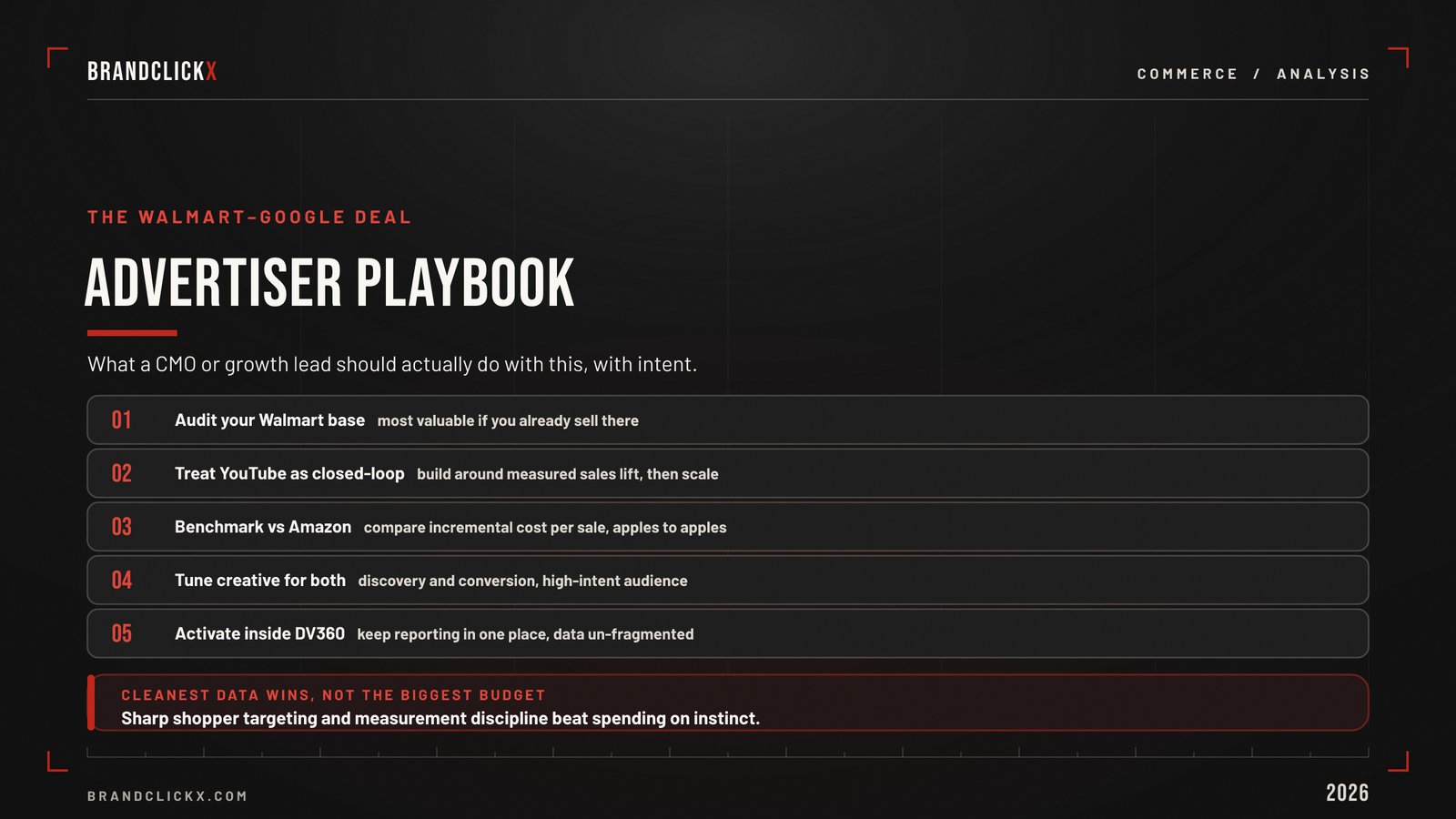
- Audit your Walmart shopper base first. The deal is most valuable for brands that already sell through Walmart and have meaningful purchase data to activate.
- Treat YouTube as a closed-loop channel, not a reach-only buy. Build campaigns around measured sales lift, then scale what proves out.
- Compare incremental cost per sale against your Amazon advertising spend. This is the first real apples-to-apples test many brands will get.
- Keep creative tuned for both discovery and conversion. The audience is high intent, so the message should move shoppers, not just impress them.
- Push your agency to run the activation inside DV360 directly, so reporting stays in one place and the data does not fragment.
Expert Insight: the brands that win retail media are rarely the ones with the biggest budgets. They are the ones with the cleanest data and the discipline to follow the measurement. A smaller advertiser with sharp shopper targeting can outperform a giant buying on instinct.
The Measurement Question Nobody Wants to Ask
Now the part the press releases skip. Closed-loop measurement is powerful, and it is also complicated.
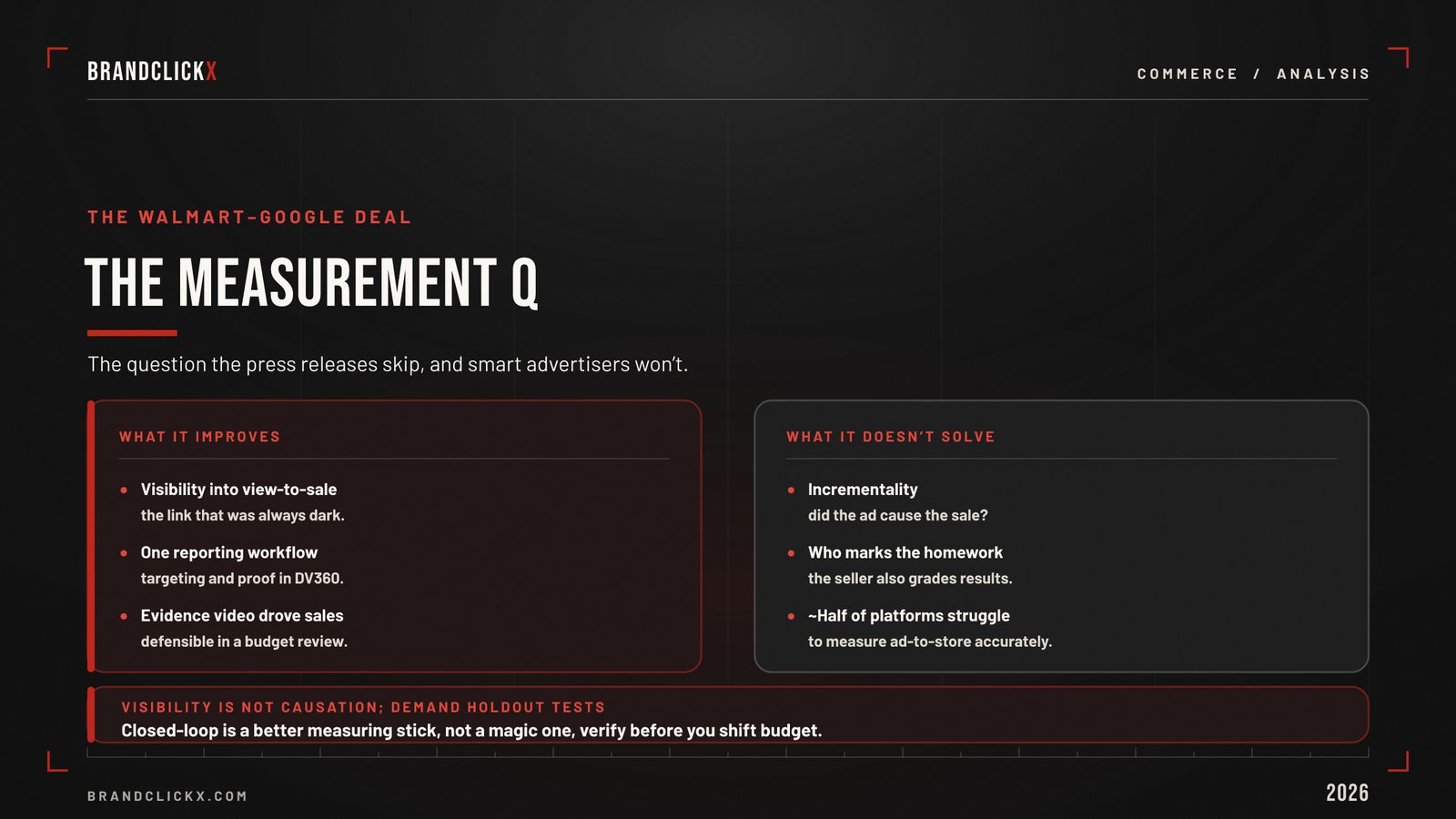
When the platform selling the ads is also the platform grading the results, brands have to ask who is marking the homework. Retail media networks have long faced questions about incrementality, the test of whether an ad caused a sale or simply reached someone who would have bought anyway.
The industry has not solved this cleanly. Roughly half of retail media platforms struggle to measure ad-to-store conversion accurately, and a meaningful share of marketers cite proving incrementality as their top concern.
Why It Matters: the Walmart Google deal improves visibility, but visibility is not the same as causation. Smart advertisers will still demand holdout tests and independent verification before they shift major budget. The deal is a better measuring stick, not a magic one.
This is the maturity test for retail media advertising. The networks that embrace clean, third-party-validated measurement will earn long-term trust. The ones that lean on flattering attribution will eventually lose it.
The Bigger Shift: Retailers Become Media Companies
Step back far enough and the real story comes into view. Retailers are becoming media companies, and the line between commerce and advertising is dissolving.
Google did not stop at audiences. It has been developing a Universal Commerce Protocol with Walmart and other retailers, aimed at standardizing how AI agents handle discovery, personalization, and checkout while keeping retailers as the merchant of record.
That points at the next phase. As shopping moves toward AI agents and automated discovery, the companies that control both the data and the distribution will control the transaction.
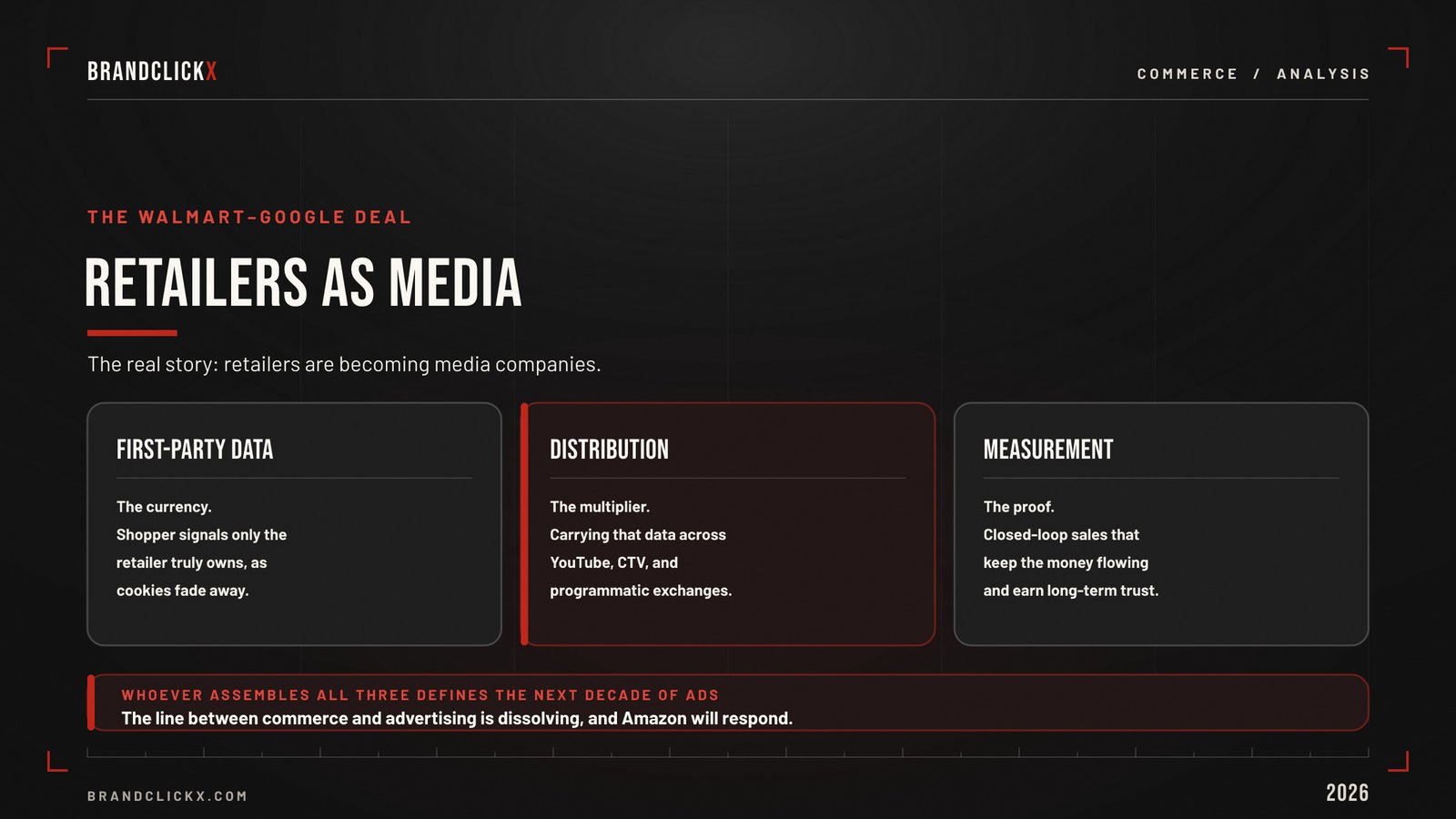
Future Outlook: the Walmart Google deal is a snapshot of a longer trend. First-party data is the currency. Distribution across platforms is the multiplier. And measurement is the proof that keeps the money flowing. Whoever assembles all three at scale defines the next decade of digital advertising.
Amazon will not stand still. It has been opening its own ad technology to outside retailers and expanding its video offerings. So the response is coming. This is a volley, not a knockout.
What Happens Next
The deal is live, but the impact will unfold over quarters, not weeks. Here is what to watch as the story develops.
- The expansion beyond YouTube. The integration starts with one inventory type, so the pace of new formats will signal how committed both sides are.
- The measurement standard. Watch whether independent verification becomes part of the package or stays inside the walled garden.
- Amazon’s countermove. Expect Amazon to deepen its own video and external retailer offerings to defend its share.
- Budget migration. The clearest signal will be brands publicly shifting spend toward retail media advertising on YouTube.
- The AI commerce layer. The Universal Commerce Protocol and agent-driven shopping will decide who owns the transaction long term.
Each of these will move the market more than the original announcement did.
COMPARISON TABLE: WALMART CONNECT VS AMAZON ADVERTISING
| Factor | Walmart Connect | Amazon Advertising |
| Approximate ad revenue | About $6.4 billion (fiscal 2026, global) | Near $56 to $60 billion |
| US retail media share | Second largest network | Roughly 75% of the market |
| Core data advantage | Omnichannel, heavy in-store and grocery trips | Deep online purchase and search behavior |
| Reach beyond own sites | Expanding via Google, Vizio, Magnite, Trade Desk | Largely Amazon-owned, expanding into outside retailers |
| Video and CTV | YouTube via Google, plus Vizio smart TVs | Prime Video and growing video ad inventory |
| Key 2026 move | The Walmart Google deal and DV360 integration | Opening ad technology to external retailers |
KEY TAKEAWAYS
- The Walmart Google deal connects Walmart Connect shopper data to Google DV360, starting with YouTube, with closed-loop sales measurement built in.
- The real target is Amazon advertising. The deal attacks Amazon’s biggest edge by pairing purchase proof with massive video reach.
- Retail media advertising is now a top-three channel, with US spend heading past $71 billion in 2026 and on track to overtake social media.
- Walmart Connect hit roughly $6.4 billion in fiscal 2026, but it still trails Amazon’s near $60 billion ad business and its dominant share.
- Connected TV advertising is the wider battleground, and Walmart is assembling data plus screen inventory across multiple platforms at once.
- Measurement is the open question. Closed-loop proof helps, but smart advertisers will still demand incrementality testing before shifting budget.
Frequently Asked Questions
What is the Walmart Google deal?
It is a June 2026 partnership that plugs Walmart Connect shopper data into Google Display & Video 360, letting brands target YouTube ads and measure resulting sales at Walmart.
How does the Walmart Connect Google partnership challenge Amazon?
It gives advertisers Amazon-style purchase data and closed-loop sales proof outside Amazon, paired with YouTube reach, pressuring Amazon advertising’s grip on retail media budgets.
What is a retail media network?
A retail media network lets a retailer sell ads using its first-party shopper data, on its own sites and across platforms like YouTube, with sales-based measurement attached.
How big is Walmart Connect compared to Amazon advertising?
Walmart Connect reached about $6.4 billion in fiscal 2026, the second-largest US retail media network, while Amazon advertising still leads near $60 billion with roughly 75% share.
What does the deal mean for advertisers?
Advertisers can run YouTube campaigns using real Walmart shopper targeting and see which views drove purchases, making video spend easier to justify against performance channels.
CONCLUSION
The Walmart Google deal looks small on the surface and large underneath. A single integration, announced in a blog post, just moved the retail media war onto Amazon’s home turf.
For a decade, the company that could prove the sale won the budget. Amazon owned that proof and built an empire on it. Now Walmart and Google have built their own version, and they have aimed it at the most profitable corner of Amazon’s business.
Future Outlook: expect a faster, messier, more competitive retail media market. More platforms will plug shopper data into premium video. More budgets will chase measured outcomes instead of raw impressions. And the measurement debate will get louder, because trust is the currency that decides who keeps the spend.
The brands that win will treat this as a discipline, not a trend. Clean data, honest measurement, and the willingness to follow the numbers wherever they lead.
At BrandClickX, we read moves like this the way operators do. Not as a press cycle, but as a signal of where attention, budgets, and proof are heading next. The retailers who become media companies are rewriting the rules of digital advertising in real time.
Amazon set the standard. Walmart and Google just challenged it. The next chapter belongs to whoever proves the most, to the most advertisers, with the least friction.