The anxiety in every marketing team right now is the same: is AI coming for my job?
The honest answer is more useful than the panic. AI is not erasing marketing roles. It is dissolving the busywork inside them and quietly raising the bar for everyone who remains.
The World Economic Forum’s Future of Jobs research estimates that a large share of today’s core skills could be outdated within a few years. That sounds alarming until you see what it really means. The skills that expire are the mechanical ones. The skills that compound are the human and strategic ones.
So the question is not whether to fear AI. It is which digital marketing skills are worth building when machines handle the routine and judgment becomes the job.
This is a data-backed map of that skill stack, what employers actually want, and what to learn first.
Key Takeaways
- AI is automating tasks, not replacing marketers. The bar for human contribution is rising, not falling.
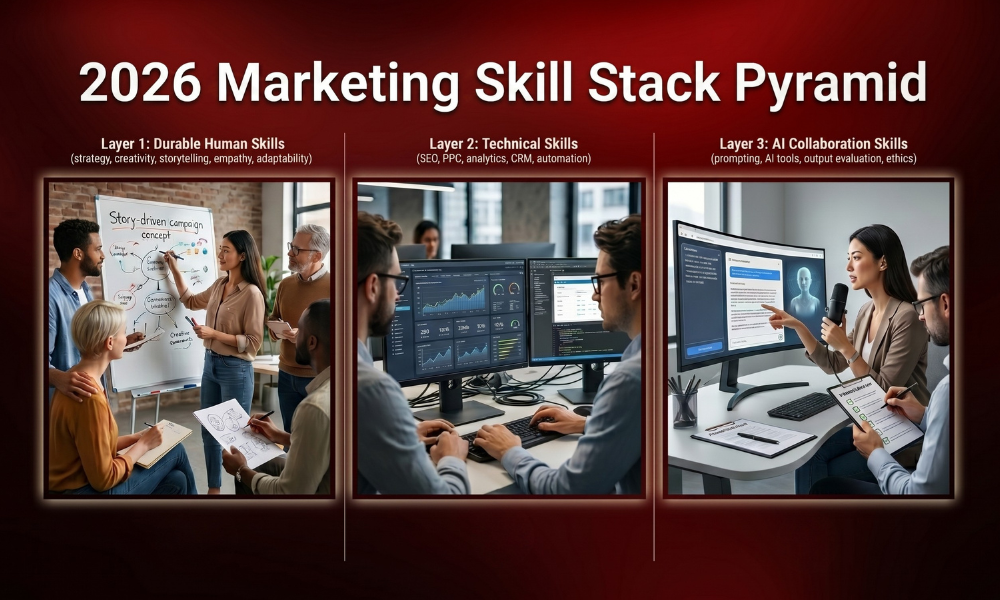
- The 2026 skill stack has three layers: durable human skills, technical skills, and AI-collaboration skills.
- Employers consistently prioritize data literacy, SEO, content strategy, and AI literacy.
- Adaptability is repeatedly ranked the single most valuable meta-skill across marketing roles.
- The safest career bet is the T-shaped marketer: broad fluency plus one deep specialty.
The Myth: AI Is Replacing Marketers
Let’s kill the myth first, because it leads to the wrong decisions.
AI is genuinely good at a specific list of marketing tasks. Drafting first-pass copy. Summarizing data. Generating variations. Optimizing ad delivery. Handling repetitive workflows.
What AI is not good at is the work around those tasks. Deciding what is worth doing. Knowing when the output is wrong. Understanding a customer’s unspoken fear. Building a brand people trust. Making a creative leap that no pattern in the training data would predict.
A McKinsey analysis found that companies using AI-informed marketing meaningfully improved campaign efficiency, by figures approaching 30 percent in some cases. Read that as leverage, not replacement. The marketer did not disappear. The marketer got faster and had to think at a higher level.
Why it matters: the real threat is not AI. It is a marketer who uses AI well taking the work of one who doesn’t. The dividing line in 2026 is fluency, not job title.
This is the human-AI fusion that now defines the field. The routine is automated. The judgment, creativity, and strategy are amplified. Your value moves up the stack.

The 2026 Skill Stack, in Three Layers
Think of modern digital marketing skills as three layers that build on each other. You need all three, but they age differently.
Layer 1: Durable Human Skills
These are the slowest to change and the hardest for AI to replicate. They compound over an entire career.
- Strategic thinking. Choosing what to do and what to ignore. AI executes. Strategy decides.
- Creativity. The original idea, the unexpected angle, the campaign that breaks the pattern.
- Storytelling. Turning features and data into something people feel and remember.
- Emotional intelligence. Understanding real human motivation, which is where marketing actually lives.
- Adaptability. The meta-skill. Platforms, tools, and algorithms will keep changing. The willingness to keep learning is what survives all of it.
Layer 2: Technical Skills
These are the craft of execution. They evolve, but the categories endure.
- Data literacy and analytics. Reading numbers, measuring results, and making decisions from evidence rather than opinion.
- SEO. Earning visibility in search, now reshaped by AI search and visual discovery.
- Paid advertising (PPC). Running profitable campaigns across search and social.
- Marketing automation and CRM. Building systems that nurture customers at scale.
- Conversion rate optimization. Turning traffic into outcomes through testing and refinement.
Layer 3: AI-Collaboration Skills
This layer is new, and it is rising fastest in value.
- AI-tool fluency. Knowing which tools to use for which jobs, and how to integrate them into real workflows.
- Prompting and direction. Getting useful output by giving AI clear, expert instruction.
- Judging output. The expertise to recognize when AI is wrong, biased, or generic, and fix it.
- Ethics and privacy literacy. Understanding consent, data use, and transparency, which customers increasingly demand.
| Skill | Layer | Why it matters | AI-proof |
| Strategic thinking | Human | Decides direction AI can’t | High |
| Creativity | Human | Originates ideas AI can’t | High |
| Adaptability | Human | Survives every tool shift | High |
| Data literacy | Technical | Drives evidence-based decisions | Medium-high |
| SEO | Technical | Owns sustainable organic growth | Medium |
| Automation and CRM | Technical | Scales relationships | Medium |
| AI-tool fluency | AI | Multiplies everything else | Rising |
| Output judgment | AI | Catches what AI gets wrong | High |
Strategic breakdown: chase only Layer 2 and your skills age with the tools. Build Layer 1 and Layer 3 around them, and you compound instead of expire.
What Employers Actually Want
The market is specific about its priorities, and the data is consistent.
Analysis of 2026 marketing roles points to a clear set of top skills. National University’s review of in-demand marketing skills names data literacy, content strategy, SEO, and AI literacy as the most important, with data analytics, SEO, PPC, CRM, and automation leading the technical list.
Robert Half’s 2026 hiring research describes leaders balancing brand-building and creativity with rising expectations around analytics, automation, and AI-enabled marketing, and raising the bar on digital fluency, AI literacy, adaptability, and cross-functional collaboration.
Two themes run through all of it. First, the blend of technical and human skills is what employers reward, not either alone. Second, qualified talent is genuinely scarce, which is good news for anyone willing to build the stack.
Market observation: the candidates who struggle are the specialists in a single, automatable task. The candidates who win combine a deep skill with broad fluency and the judgment to direct AI.
The T-Shaped Marketer
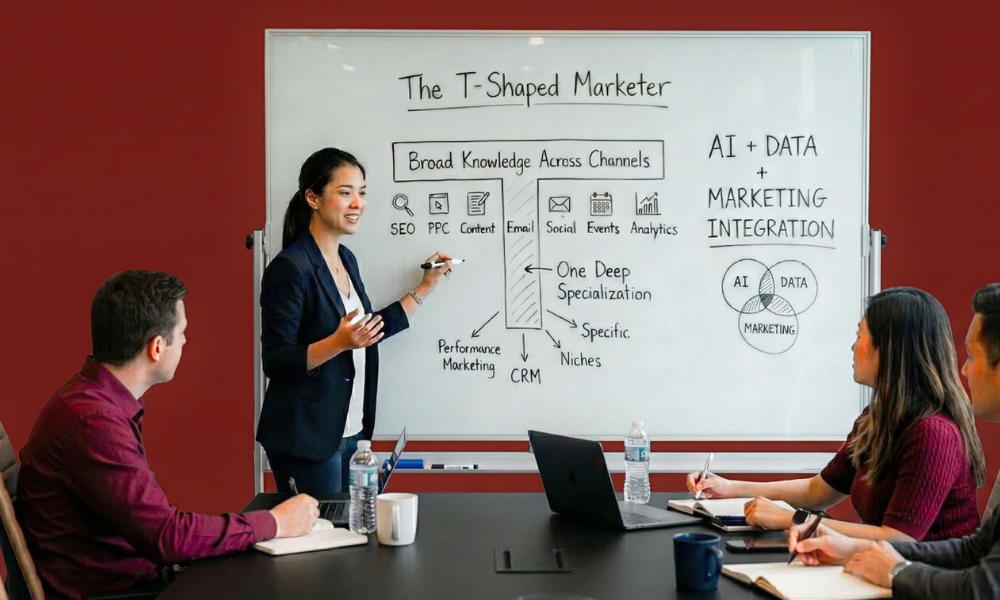
The most resilient career shape in 2026 is the letter T.
The horizontal bar is breadth: a working understanding of every major channel and discipline, so you can think across the whole system and collaborate with specialists.
The vertical bar is depth: one area where you are genuinely excellent, whether that is SEO, paid media, analytics, or content.
Breadth without depth makes you replaceable, because you are competent at everything and essential at nothing. Depth without breadth makes you fragile, because your one skill might be the one that gets automated or falls out of favor.
The T-shape solves both. You have a specialty that makes you valuable now, and the breadth to adapt when the landscape shifts.
Enterprise perspective: teams increasingly hire for the T. They want a specialist who can also see the whole board, because siloed specialists slow everything down in an integrated, fast-moving environment.
What to Learn First
Trying to learn everything at once is the fastest route to learning nothing. Here is a sequence that builds.
| Step | Focus | Why first |
| 1 | Fundamentals | Understand value, the mix, and the funnel before tactics |
| 2 | One channel, deep | Build a specialty employers can hire for |
| 3 | Data and analytics | Measure results and decide from evidence |
| 4 | AI fluency | Multiply your output and judgment |
| 5 | Breadth and adaptability | Round out the T and keep learning |
Start with the fundamentals of digital marketing so your skills have a framework to attach to. Pick a specialty and learn it by doing on a real project. Layer in analytics so you can prove what works. Then build AI fluency by using AI in your actual workflow, not in the abstract.
The single most important habit is the one you cannot outsource: continuous learning. The tools will keep changing. The marketers who treat learning as permanent are the ones who stay valuable through every shift.
Tactical framework: one specialty, plus data, plus AI fluency, plus relentless adaptability. That combination is close to recession-proof and automation-resistant.
The Bigger Shift
There is one more skill that is quietly becoming non-negotiable: trust.
As AI floods every channel with content and personalization gets more precise, customers are growing more skeptical. Edelman’s Trust Barometer has found that a large majority of consumers will buy from brands they trust even when cheaper options exist. Trust is no longer a soft value. It is a growth lever.
For marketers, that turns ethics, transparency, and consent-based practice into a genuine skill. Knowing how to use data and AI in ways that respect people, rather than just exploit them, is becoming part of the job description.
This connects to the broader marketing fundamentals and to how brands build durable marketing strategies in a low-trust, AI-saturated environment.
Future outlook: the marketer of the next decade is part strategist, part analyst, part storyteller, and part AI director, anchored by the human judgment and trustworthiness that no tool can fake.
Frequently Asked Questions
What digital marketing skills are most in demand in 2026?
Data literacy, SEO, content strategy, and AI literacy, alongside human skills like strategic thinking and creativity. On the technical side, employers prioritize data analytics, SEO, PPC, CRM, and automation, with adaptability ranked the top meta-skill.
Will AI replace digital marketers?
No. AI automates repetitive tasks but reshapes roles rather than eliminating them. Demand is rising for marketers who can direct AI, judge its output, and add the strategy and creativity AI lacks. The risk is being out-competed by marketers who use AI well.
What technical skills do digital marketers need?
Data analytics, SEO, paid advertising, marketing automation, CRM, and conversion rate optimization, plus growing AI-tool fluency, meaning the ability to prompt, evaluate, and integrate AI into real work.
Which digital marketing skills are future-proof?
The ones AI cannot easily replicate: strategic thinking, creativity, storytelling, emotional intelligence, and adaptability, paired with data interpretation and effective AI collaboration.
How do I start learning digital marketing skills?
Begin with fundamentals, learn one channel deeply on a real project, add analytics to measure results, then build AI fluency by using AI tools in your work. Pair courses with hands-on practice.
Is digital marketing a good career in 2026?
Yes. Demand for skilled marketers is strong and qualified talent is hard to find. Professionals who combine technical skill, analytical thinking, and human creativity are well positioned for stable, high-value careers.
Key Takeaways for Executives
- Treat AI as leverage, not a threat. It automates tasks and raises the bar. Fluency, not job title, is the new dividing line.
- Build all three layers. Human skills, technical skills, and AI-collaboration skills compound together. Technical skills alone age with the tools.
- Prioritize what employers reward. Data literacy, SEO, content strategy, and AI literacy lead the 2026 demand list.
- Aim for the T. One deep specialty plus broad fluency is the most resilient and most hireable shape.
- Make trust a skill. Ethical, transparent use of data and AI is becoming a growth lever, not a compliance footnote.
The Bottom Line
The digital marketing skills that matter in 2026 are not the ones AI can do. They are the ones that direct AI, interpret its output, and add the strategy, creativity, and trust that no model can manufacture.
The marketers who thrive will pair a deep specialty with data fluency, AI collaboration, and an appetite for permanent learning. The ones who cling to a single automatable task will keep watching the bar rise without them.
Tracking exactly these shifts, where strategy, AI, commerce, and brand collide, is the work BrandClickX exists to do.